
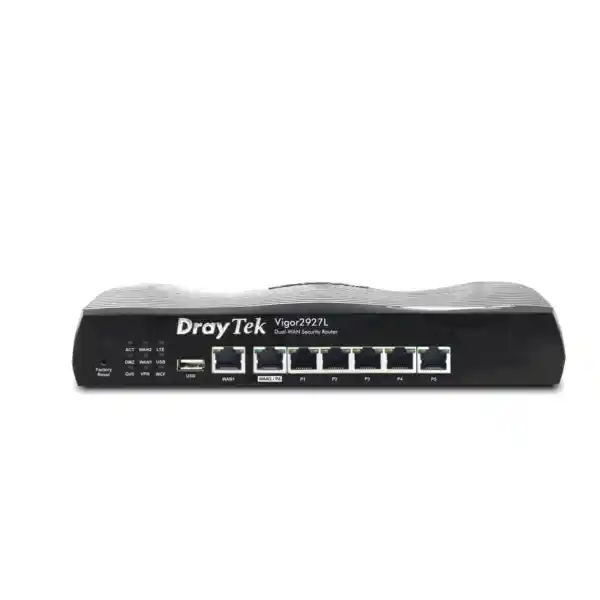
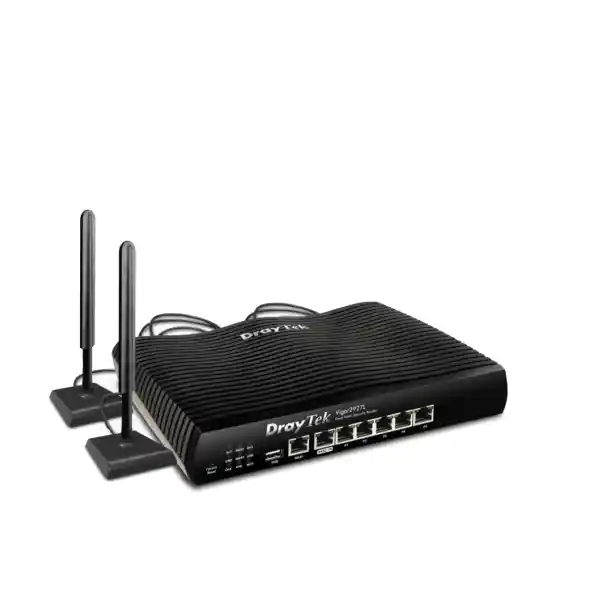
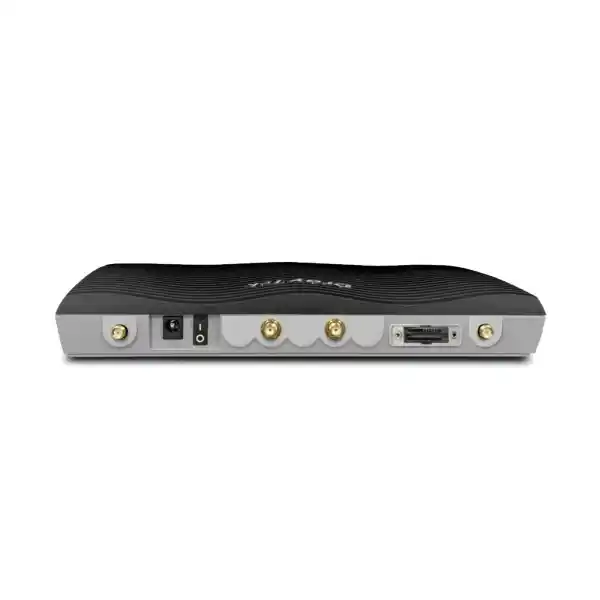
DrayTek Vigor2927L Dual-WAN LTE VPN Router
The DrayTek Vigor2927L is engineered for organizations that need Internet continuity rather than a single point of failure. It combines two Gigabit Ethernet WAN paths, an integrated 4G LTE Cat 6 modem with dual SIM slots, policy-driven routing, business firewall controls, VPN services, VLAN segmentation, application-aware quality of service and centralized device management. For UAE offices that depend on cloud applications, SIP calling, remote-access VPN, payment systems, surveillance, branch-to-head-office links or online customer services, the platform provides a practical way to design resilient connectivity without stacking multiple standalone appliances.
A resilient edge router for UAE branches, offices and service locations
Internet connectivity in a modern branch office is not simply a browsing service. The WAN edge may carry Microsoft 365 or Google Workspace sessions, ERP transactions, cloud POS traffic, hosted PBX calls, IP camera backhaul, DNS requests, remote administration, site-to-site VPN tunnels, guest traffic, supplier portals and customer-facing applications at the same time. A basic broadband router can become a bottleneck when those workloads compete for bandwidth or when the primary ISP experiences an outage. The Vigor2927L addresses that problem with a multi-WAN architecture designed to keep routing decisions, firewall enforcement and business traffic control within one management plane.
The model is particularly relevant where a wired broadband service is the preferred primary path but LTE must be available as a fast recovery route. Its embedded modem removes the operational dependency on an external USB cellular dongle for the main mobile service. Two standard-size SIM slots are provided, with one SIM operating online at a time, allowing an administrator to maintain two carrier options in the device and choose the active profile according to availability, policy or operational needs. The LTE subsystem supports Category 6 performance, with a theoretical radio link rate of up to 300 Mbps downstream and 50 Mbps upstream under suitable carrier, signal and network conditions. Those figures are maximum link capabilities, not guaranteed Internet throughput; actual UAE performance depends on the selected mobile operator, spectrum, tower loading, indoor coverage, antenna placement and the service plan.
FourTeck positions the Vigor2927L as a business connectivity appliance rather than a consumer 4G router. A deployment can combine Ethernet WAN links and LTE, use health checks to decide whether a path is usable, apply failover or load-balancing logic, steer specific applications with route policy, keep voice and critical business flows prioritized, and segment internal networks with VLANs. Organizations planning a broader secure-edge rollout can coordinate procurement and deployment services through FourTeck UAE, while firewall-focused design and branch security requirements can be aligned with the specialist resources available from Firewall Dubai.
Verified hardware and performance profile
Performance values are vendor maximums measured under controlled or optimal conditions. Real throughput can be lower when services, encryption, packet sizes, carrier conditions, inspection rules, traffic mixes or endpoint limitations change.
Understanding the WAN architecture before deployment
The Vigor2927L should be designed as a policy-controlled WAN edge. Its fixed Gigabit WAN interface can terminate a primary ISP connection delivered by an ONT, modem or upstream handoff. The switchable Gigabit WAN/LAN port can be configured as another Ethernet WAN when a second fixed carrier is available, or returned to LAN duty if the branch needs more local access connectivity. The built-in LTE connection introduces another independent transport option, which is valuable for sites that need diversity beyond two services entering the same building riser or provider network.
A robust design starts by identifying which links should be active simultaneously and which should remain standby. Active/active use can distribute flows across multiple WANs, but this is not the same as bonding a single TCP session across circuits. Individual sessions normally follow the path selected by the router according to load-balancing, route-policy and state-tracking logic. If the requirement is uninterrupted application continuity, the design must account for the fact that a path failure may change the public IP address. Stateless web sessions may recover quickly, whereas some banking portals, IPsec peers, hosted applications or voice sessions can require re-establishment. Business continuity therefore depends on both router behavior and application characteristics.
Failover detection also deserves engineering attention. A WAN interface being electrically up does not prove that the Internet is reachable. Correct connection-detection settings help the router determine whether upstream connectivity has failed beyond the immediate Ethernet handoff. Administrators should define sensible health-check targets, intervals and recovery behavior so the appliance does not flap between links during an intermittent provider incident. LTE should be tested in the final rack or installation position because concrete walls, coated glass, plant rooms and metal cabinets can reduce radio quality. Antenna position and cable routing can materially affect mobile performance.
For UAE sites with multiple branches, the WAN design can also reserve LTE for business-critical destinations instead of general Internet browsing. Route policies can keep ERP, cloud telephony, payment or remote-management traffic available during a primary outage while rate limits or firewall policies suppress low-priority guest downloads. That approach protects mobile data allowances and reduces congestion when the site is operating in degraded mode.
4G LTE Cat 6 and dual-SIM resilience
The embedded LTE modem is one of the defining differences between Vigor2927L and the standard non-LTE Vigor2927 family. Category 6 LTE supports carrier aggregation and a maximum radio link rate of 300 Mbps downstream and 50 Mbps upstream in the vendor specification. In practice, an enterprise should treat cellular bandwidth as variable. A speed test captured during commissioning is useful, but it is not a capacity guarantee for every hour of the day. Signal metrics, mobile-network congestion, operator shaping, APN type, radio band, carrier aggregation availability and the physical environment influence results.
The two SIM slots provide operational flexibility, particularly when the organization wants a second mobile operator available at the site. Only one SIM is active at a time, so the design should not assume simultaneous aggregate throughput from both cards. The value is resilience and choice: the network team can maintain alternative subscriptions and switch service according to policy or incident response. Before delivery, confirm SIM form factor, active data service, APN parameters, roaming restrictions, PIN configuration, public versus private addressing requirements and whether inbound connectivity is needed. Mobile services commonly use carrier-grade NAT, which affects unsolicited inbound access and some VPN designs.
Where the LTE connection is intended for outbound branch Internet failover, carrier-grade NAT may be acceptable. Where the branch must receive inbound VPN initiation, host a service or expose a remotely managed appliance, the mobile plan may need a public static IP, private APN or other operator-specific solution. Site-to-site VPN can often be designed so the branch initiates the tunnel outbound, reducing dependence on an inbound-reachable mobile address. This should be agreed before procurement because cellular addressing is a service-plan question, not a router setting alone.
The LTE link can also support temporary or transitional sites. A new office can become operational before the fixed circuit is installed, then retain LTE as secondary connectivity after the permanent service arrives. The same approach can help pop-up retail, project offices, warehouses, events and remote facilities where installing a wired circuit would take longer than deploying a cellular service. For related implementation work, structured cabling, remote support, on-site configuration and broader infrastructure planning can be coordinated through FourTeck IT Services UAE.
Hardware acceleration: what it changes and what it does not
DrayTek equips the Vigor2927 LTE platform with acceleration capabilities for NAT, routing, QoS and IPsec. Vendor documentation states that hardware acceleration can deliver firewall performance up to approximately 940 Mbps on a single WAN and up to 1.8 Gbps combined across both WANs under test conditions. The accelerator can handle up to 8,000 NAT and routing connections while maintaining features such as quality of service, bandwidth limits, WAN budget controls, traffic graphs and data-flow monitoring. This matters because business routers often lose significant throughput when traffic controls are enabled entirely in software.
Acceleration does not remove the need for sizing. A 1 Gbps Internet circuit can carry many different workloads, and the performance experienced by users depends on packet size, session count, encryption, logging, content filtering, policy complexity, application behavior and bidirectional traffic patterns. If a branch uses multiple site-to-site tunnels, remote-user VPN, heavy logging and granular firewall rules at the same time, capacity planning should be based on the intended production configuration rather than on an isolated NAT headline. The recommended 60,000 NAT session capacity also indicates that the platform is aimed at SMB or branch scale rather than very large campus or data-center perimeter roles.
For IPsec, DrayTek specifies hardware-accelerated throughput up to 800 Mbps, with acceleration available to the first 16 tunnels on a first-come, first-served basis in the implementation described by the vendor. The product supports up to 50 VPN tunnels overall, so not every possible tunnel should be assumed to receive identical accelerated performance simultaneously. This distinction is important when a central branch aggregates many encrypted links. Designers should map expected bandwidth per tunnel, concurrent use and encryption requirements, then validate the target configuration.
A practical acceptance test should include ordinary Internet browsing, large file transfers, cloud application sessions, SIP calls, VPN traffic and failover events while monitoring CPU load, latency, jitter and WAN utilization. The goal is not merely to prove peak throughput; it is to confirm predictable service under the traffic mix the branch actually produces.
VPN architecture for branch-to-branch and remote access
The Vigor2927L supports a broad VPN toolkit. Depending on firmware and deployment requirements, the platform includes IPsec, IKEv2, L2TP over IPsec, SSL VPN, OpenVPN, WireGuard, GRE and selected legacy protocols. It can support up to 50 VPN tunnels, with DrayTek listing IPsec performance of up to 800 Mbps when hardware acceleration is used, SSL VPN throughput up to 120 Mbps and WireGuard throughput up to 80 Mbps under its stated test conditions. Those values provide a starting point for sizing, not a promise for every encryption profile or traffic pattern.
For permanent site-to-site links, IPsec is normally the preferred enterprise choice because it provides standards-based interoperability and can use IKE negotiation, pre-shared keys or certificates depending on the peer design. IKEv2 is particularly useful for modern deployments because of its resilient negotiation model and strong cryptographic capabilities. The router supports SHA-1 and SHA-256 authentication options and AES among its encryption choices, but new deployments should favor current cryptographic settings and avoid legacy algorithms unless an older third-party endpoint forces compatibility. Security policy should be reviewed against the organization’s current standards rather than accepting historic defaults.
Remote-access design should consider user identity, multi-factor strategy, endpoint posture, split tunneling and the amount of traffic that must traverse the office. The router supports authentication sources including local users, RADIUS, LDAP, TACACS+ and mOTP capabilities in the vendor feature set. Authentication architecture should be selected based on the organization’s identity system and support model. For example, a small office may use a limited local user database, while a larger deployment may integrate remote access with centralized directory or RADIUS services.
When the LTE path is part of VPN failover, peer behavior must be tested. A public IP change can trigger tunnel renegotiation. Dynamic DNS or a design where the branch initiates toward a stable central gateway can make recovery easier. If a carrier uses CGNAT, inbound VPN initiation toward the branch may not be possible without a suitable mobile service. The failover test should therefore verify not only Internet reachability but also tunnel re-establishment, route installation, DNS resolution and access to each required application subnet.
For organizations with multiple African and Middle East sites, standardizing a repeatable branch template can reduce configuration drift. FourTeck also supports regional infrastructure projects through its Africa network solutions portal, which can be relevant when the same routing and security design must extend beyond the UAE.
Firewall policy, NAT and perimeter control
The Vigor2927L is a stateful business router with firewall and policy capabilities rather than a simple NAT gateway. The platform supports IP-based firewall policies, VPN pass-through, application-layer gateways, content filtering, denial-of-service defenses and spoofing defenses. NAT functions include port redirection, open ports, port triggering, DMZ host configuration and UPnP. In business environments, those mechanisms should be used deliberately. Convenience features such as UPnP may be inappropriate on trusted corporate VLANs unless a specific application requires them.
A secure configuration begins with a default-deny mindset for unsolicited inbound traffic. Any port-forwarding rule should have a documented owner, destination, business justification and review date. If remote administration is required, VPN access is generally preferable to exposing the management interface directly to the Internet. Management access should be restricted by source network, strong credentials and the most secure supported protocol. Log events should be forwarded to a syslog or monitoring system when the organization needs central visibility or audit retention.
Content filtering can be applied using application, URL keyword, DNS keyword and web-feature controls available on the platform. The exact effectiveness of filtering depends on traffic encryption, categorization services, firmware and configuration. Content controls should not be mistaken for endpoint protection or a full secure web gateway. A layered design can combine the router’s network enforcement with managed endpoint security, DNS protection and cloud security services.
The firewall also plays a central role in segmentation. Guest, staff, voice, surveillance and infrastructure networks should not automatically communicate simply because they share the same physical router. VLAN interfaces and firewall rules can restrict lateral movement. For example, a guest VLAN may be permitted to reach the Internet but denied access to business subnets; an IP-phone VLAN may reach SIP or PBX services but not user workstations; a CCTV VLAN may communicate only with approved recorders, viewing stations, NTP and management services. This turns segmentation into an enforceable policy rather than a naming convention.
Rule order, object naming and change control matter. A technically capable firewall can still be insecure if broad allow rules accumulate over time. During deployment, build policies from documented application requirements, then review hit counts and logs after cutover. Remove temporary rules once troubleshooting is complete and preserve a known-good configuration backup before major changes.
VLAN segmentation and LAN design
The Vigor2927L provides five fixed Gigabit LAN ports and supports both 802.1Q tag-based VLANs and port-based VLANs. DrayTek specifies support for up to 16 VLANs and eight LAN subnets on the platform. This gives an SMB or branch office enough logical separation for common trust zones without requiring a separate router for each department or service. The exact switch topology still matters: a single router port can carry an 802.1Q trunk to a managed access switch, or individual ports can be assigned as untagged access networks where appropriate.
A useful starting design might separate corporate users, voice, guest access, CCTV, servers or network services, building-management or IoT devices, and network administration. The precise number of VLANs should be driven by security and operational boundaries rather than by creating segmentation for its own sake. Every VLAN introduces DHCP, addressing, routing, firewall, DNS and troubleshooting considerations. A concise IP plan with clear subnet sizes and gateway addresses makes ongoing support easier.
The router includes DHCP server functions and can support multiple IP subnets, custom DHCP options and IP-to-MAC binding capabilities. DHCP options may be useful for IP phones, provisioning systems or other managed devices that need vendor-specific parameters. Static infrastructure such as managed switches, access points, servers and controllers should follow a consistent addressing approach. Reservations can provide stable addresses without abandoning central DHCP administration.
When VLANs extend to managed switches, trunk membership and native VLAN behavior must be coordinated end to end. A common deployment mistake is configuring the router correctly but leaving access-switch uplinks with mismatched tagging. Commissioning should therefore validate connectivity from an endpoint in every VLAN, not simply confirm that the router interface appears up. Test DHCP, DNS, Internet access, inter-VLAN restrictions, management access, voice registration and any local server dependencies.
The Vigor2927L can also participate in centralized switch and AP management within the supported DrayTek ecosystem. That can simplify smaller deployments by giving administrators a hierarchy view and configuration control from the router. Centralization is useful, but configuration backups and documented switch port maps remain essential for recovery and future maintenance.
QoS, bandwidth controls and application performance
Bandwidth problems are not always caused by insufficient circuit speed. A branch with a 500 Mbps or 1 Gbps service can still experience poor voice quality when a backup, cloud synchronization job or large download fills an uplink queue. The Vigor2927L includes IP-based bandwidth limits, session limits, quality of service, VoIP prioritization and application QoS capabilities. These controls allow the network team to decide which traffic should receive preferential treatment when the WAN becomes congested.
DrayTek’s implementation includes hardware QoS acceleration on the platform. The design goal is to preserve traffic control while maintaining strong forwarding performance. Voice traffic can be prioritized using SIP-related classification, and administrators can place business-critical applications into high-priority classes. Reserved bandwidth for high-priority classes can be made available to lower-priority classes when it is not being used, which improves efficiency compared with rigidly wasting capacity.
QoS works best when the configured WAN rate reflects realistic throughput. If the router believes an uplink can send 1 Gbps but the actual mobile or ISP path only delivers 120 Mbps, the upstream provider may become the real queue and the router loses control of packet scheduling. For fixed circuits, shape slightly below measured sustainable capacity when precise prioritization is necessary. For LTE, rates can vary dramatically, so conservative policies and traffic-class limits may be more useful than expecting perfectly deterministic scheduling.
Session limits are helpful in guest networks, shared accommodations, training centers or environments where a small number of devices may open thousands of concurrent flows. Per-IP bandwidth limits can prevent one endpoint from exhausting the branch’s Internet capacity. These features should be applied with visibility: overly aggressive limits can make legitimate cloud applications appear unreliable, particularly modern browsers and collaboration tools that open many parallel connections.
A commissioning test should deliberately saturate the WAN with a large transfer while placing a voice call or running an interactive application. If latency and packet loss remain controlled for the priority traffic, the policy is doing useful work. If not, adjust classification, queue rates and application matching instead of assuming the circuit itself is defective.
Important model distinction: Vigor2927L is not Vigor2927Lac and not Vigor2927L-5G
Accurate product selection matters because the Vigor2927 family contains several variants. The Vigor2927L described on this page is the LTE model without integrated Wi-Fi. DrayTek’s model table shows no 2.4 GHz or 5 GHz WLAN radio for Vigor2927L. Organizations needing integrated 802.11ac wireless should evaluate the appropriate Vigor2927Lac variant, while organizations requiring native 5G cellular connectivity must select the separate Vigor2927L-5G family. Those are different products and should not be treated as interchangeable specification labels.
The absence of integrated Wi-Fi is often an advantage in professionally designed offices. Dedicated access points can be positioned according to RF coverage rather than according to the location of the Internet router. Ceiling-mounted APs can provide better radio geometry, and a controller or management platform can coordinate multiple access points across a larger floor. The router can then focus on WAN, firewall, VPN, DHCP and policy services. This design also allows wireless standards to be upgraded independently of the edge router.
The 4G Vigor2927L should also not be specified when a project contract explicitly requires 5G SA/NSA service. LTE Cat 6 remains useful for backup connectivity and may be more than adequate for many branches, but it does not provide the radio capabilities of DrayTek’s 5G model. Procurement documents should therefore state the full required model and cellular generation rather than simply saying “Vigor2927 LTE router.”
When a quotation is requested, FourTeck can align the router with compatible external access points, managed switches, rack accessories, structured cabling and support services. That avoids the common problem of receiving a correct router but incomplete surrounding infrastructure.
Management, monitoring and operational visibility
A branch router becomes much easier to support when its state can be monitored and its configuration can be backed up. The Vigor2927L provides local management functions, firmware upgrade capability, configuration backup and restore, administrative access controls, notification features, SNMP, syslog and NetFlow-family export capabilities including NetFlow v5, v9 and IPFIX in the vendor feature set. These tools allow a network team to move beyond reactive troubleshooting and build basic operational telemetry.
SNMP can feed interface state, utilization and device health into a network-monitoring platform. Syslog can centralize firewall, VPN and system events so incidents do not disappear when a router reboots. Flow records can help identify top talkers, unexpected traffic patterns and bandwidth-intensive applications. Because telemetry itself may expose sensitive information, management protocols should be restricted to trusted administrative networks and secured appropriately. SNMPv3 should be preferred over older community-string versions where the monitoring platform supports it.
The router supports centralized AP and switch management for compatible DrayTek devices, with the vendor listing management capacity for up to 20 access points and 10 switches on this platform. This can be useful for branches that want one management view without deploying a separate controller appliance. Administrators can use the router to coordinate VLANs and inspect network hierarchy. Exact features depend on device compatibility and firmware, so the planned switch and AP models should be validated before a standardized rollout.
DrayTek also provides VigorACS management capabilities for supported environments, enabling centralized administration across multiple routers. For multi-site UAE companies, central management can reduce configuration drift and simplify firmware planning, but it should be paired with change control. Maintain a configuration baseline, record WAN credentials and circuit IDs securely, define who can make production changes, and retain an offline recovery copy after major changes.
Monitoring thresholds should focus on business symptoms, not only interface up/down events. Useful alerts include repeated WAN failover, rising LTE data consumption, VPN instability, abnormal session counts, high packet loss, unusual bandwidth spikes and device resource pressure. These indicators often reveal a developing service problem before users report a complete outage.
Deployment scenario 1: dual fixed WAN with LTE contingency
A high-availability branch can use WAN1 for its preferred business broadband service and configure the switchable WAN/LAN interface as WAN2 for a second fixed connection. LTE then becomes an additional contingency path. This architecture is attractive when the site carries revenue-sensitive services such as card payments, cloud POS, booking systems, customer support or remote desktop workloads. The fixed circuits handle normal traffic, while LTE remains available if both wired services are compromised or if a building access problem affects the physical carrier paths.
The main design question is true path diversity. Ordering two ISP products does not guarantee that they use separate last-mile infrastructure. Both may share a duct, building riser, carrier backhaul or upstream exchange. LTE can provide a different physical medium, making it a valuable tertiary path. During implementation, test failure by disconnecting the actual WAN handoff and by simulating upstream reachability loss. Verify that the router declares the path unavailable based on health checks and that priority applications recover as expected.
Traffic policies can also distinguish normal and degraded states. During normal operation, collaboration, browsing and backups may use either fixed WAN. During a dual-fixed-WAN outage, the LTE policy can allow ERP, payment, VPN, DNS and voice while limiting software updates, large cloud synchronization and guest browsing. This preserves mobile bandwidth and supports predictable business continuity.
Document the recovery sequence. Some circuits may return with unstable packet loss before they are fully healthy. Conservative failback timers can prevent the router from moving users back and forth between an intermittent fixed line and stable LTE. An operational runbook should explain how to check WAN status, confirm active routing, inspect cellular signal, verify tunnel state and escalate to the correct provider.
Deployment scenario 2: primary fixed broadband with LTE failover
The most common use case is simpler: one Ethernet WAN carries normal production traffic and LTE remains on standby. This is appropriate for clinics, professional offices, shops, restaurants, warehouses and small branches where a second fixed ISP is difficult to justify but an Internet outage would still interrupt operations. The embedded modem reduces the number of devices and power supplies compared with a separate consumer cellular router placed upstream.
A well-designed failover policy considers data cost. Mobile business plans may have quotas or fair-use thresholds. The router’s WAN budget and bandwidth-management capabilities can help control consumption, but the organization should still understand the carrier contract. If cloud backups or operating-system updates continue unrestricted during a fixed-line outage, a large data allowance can disappear quickly. Route and firewall policy should therefore encode business priorities before an incident occurs.
Cellular failover also needs realistic power protection. If the office loses utility power, the router, ONT, switches and access points may all shut down even though the mobile tower is still operating. A UPS sized for the router plus essential switching and wireless equipment can extend connectivity during short power events. Critical desktops or POS terminals may also need protected power. Network resilience is a chain; the strongest WAN strategy cannot help if the LAN equipment loses power.
Commissioning should include a user-facing test. Disconnect the primary WAN while a cloud application and a voice call are in use. Observe whether new sessions recover, whether DNS is available, whether the VPN re-establishes and how long the transition takes. Record the behavior so staff know what to expect during a real outage.
Deployment scenario 3: new office, project site or temporary location
New offices often have a timing mismatch: employees need Internet access on opening day, but a fixed circuit can take longer to install. The Vigor2927L can start with LTE as the initial WAN, allowing basic operations while the permanent service is pending. Once the fixed circuit is delivered, the network can transition it to primary status and retain LTE for resilience. This avoids replacing the router simply because the access technology changes after launch.
Temporary sites require disciplined expectations. LTE performance is highly location-dependent, so a pre-deployment survey should test the intended mobile operators at the actual site. An excellent phone speed test outdoors does not guarantee the same signal inside a warehouse, basement office or metal cabin. Antenna placement, window proximity and equipment position can improve results. The site should also confirm whether local coverage remains usable during peak business hours.
If the temporary location hosts voice, CCTV or remote access, upload capacity can be more important than download speed. LTE Cat 6 is specified for up to 50 Mbps uplink at the radio layer, but practical upload may be much lower. Continuous camera streams or large file uploads should therefore be modeled carefully. Where a remote NVR or cloud camera platform is used, set appropriate bitrates and retention policies rather than assuming the mobile link can carry every stream at full quality.
Once fixed broadband is live, retest the complete topology. Confirm the primary/backup order, health checks, route policies, VPN preference, NAT behavior and any public-address dependencies. Then save a final configuration backup and update the site documentation to show both access methods.
Deployment scenario 4: retail and hospitality networks
Retail and hospitality sites tend to mix trusted business devices with customer-facing connectivity. POS terminals, back-office PCs, payment gateways, digital signage, CCTV, IP phones, guest Wi-Fi and building systems may all share the same Internet edge. The Vigor2927L’s VLAN, firewall, bandwidth and multi-WAN features provide a foundation for separating those workloads while keeping the design manageable.
A retail design might place POS devices in a dedicated VLAN with access only to required payment services, DNS and management destinations. CCTV can use a separate surveillance VLAN. Employee devices can reside in a corporate network, while guest users receive Internet-only access. Voice can be isolated and prioritized through QoS. These boundaries reduce unnecessary lateral communication and make troubleshooting easier because each class of device has an explicit policy.
The platform also provides hotspot web portal functionality and authentication options, although the Vigor2927L itself does not include Wi-Fi radios. Guest wireless would normally be delivered by external access points connected through managed switching. This separation is appropriate for hotels, restaurants and showrooms where AP placement should be optimized for coverage and client density. The router can provide the routing, VLAN and policy layer while dedicated wireless infrastructure handles radio access.
For hospitality deployments, confirm capacity at peak occupancy rather than during an empty-site test. Guest traffic can create thousands of sessions and large bursts from streaming or software updates. Per-client bandwidth limits, session limits and QoS can protect operational services so a busy guest network does not degrade reservations, telephony or staff systems.
Deployment scenario 5: secure branch VPN to headquarters
A distributed company may use Vigor2927L at smaller branches to maintain an encrypted link to a central firewall or another DrayTek gateway. The site-to-site tunnel can carry ERP, file services, internal DNS, management and approved application traffic. Internet-bound traffic can either break out locally or route centrally, depending on policy, security architecture and bandwidth constraints. Local breakout generally conserves VPN bandwidth for SaaS applications, while centralized egress can simplify inspection and compliance in some organizations.
Route design must avoid overlap. Every branch should use a unique LAN prefix if it must communicate with other sites through VPN. Reusing the same private subnet in multiple branches creates routing ambiguity and complicates troubleshooting. A documented address plan should reserve blocks for branches, servers, voice, guests and infrastructure. Where legacy overlap already exists, renumbering is often preferable to building complicated NAT workarounds between sites.
The tunnel should be tested over both primary WAN and LTE. If the branch public address changes during failover, the central peer must permit renegotiation. Dynamic DNS, responder configuration or branch-initiated tunnels can help, but the exact method depends on the central gateway. Verify not only that the VPN status shows connected, but also that application traffic routes correctly and that DNS resolves internal names.
For a branch that may eventually need significantly higher encrypted throughput, more than 50 tunnels, advanced threat prevention or larger user scale, the router should be evaluated against a next-tier firewall rather than stretched beyond its intended role. Good sizing means selecting the Vigor2927L where its feature set and performance envelope fit, not simply because it can technically establish a tunnel.
Routing policy and multi-WAN application steering
Route policy is one of the most useful features in a multi-WAN branch. Instead of allowing every session to follow only default load-balancing logic, an administrator can direct traffic according to source, destination, service or application requirements. Business-critical services can be pinned to the circuit with the best latency, bulk traffic can use a lower-cost link, and selected destinations can prefer VPN or direct Internet access.
Policy routing is especially valuable when external services use source-IP allowlists. If a SaaS provider, bank, wholesaler portal or remote firewall only trusts the public address of WAN1, the relevant traffic should continue to prefer that interface while it is healthy. A fallback policy can define what happens during an outage. The application owner must decide whether temporary loss of the trusted source IP is acceptable or whether a second address must be pre-registered with the provider.
DNS traffic deserves explicit consideration. If a branch fails to LTE but continues using a DNS resolver reachable only through a private WAN path, users may perceive a total outage even though IP connectivity works. Keep DNS architecture aligned with WAN and VPN behavior. The router supports local DNS and conditional DNS forwarding features that can help separate internal and external name resolution where needed.
Avoid creating dozens of route policies without documentation. Complex rule sets can become difficult to troubleshoot, particularly when load balancing, NAT and VPN routes overlap. Use descriptive rule names, group related destinations, document intended precedence and test with representative traffic. After a change, capture which WAN is actually used rather than assuming the policy matched.
A clean design usually has a small number of explicit business policies layered on top of predictable default behavior. This creates resilience without turning every application into a special case.
Sizing the Vigor2927L correctly
Router sizing should begin with user count, device count, WAN speed, traffic profile and security requirements. DrayTek describes the Vigor2927 series as suitable for approximately 50 hosts and lists support for 60,000 NAT sessions. The host guideline is a planning reference rather than an absolute licensing cap. A 40-user creative studio transferring large media files may place more demand on the edge than a 70-device office where most clients use email and lightweight SaaS applications. IoT devices can also inflate connection counts without corresponding to human users.
Start by inventorying endpoints: desktops, laptops, phones, tablets, IP phones, cameras, printers, access points, switches, servers, controllers, payment devices and building systems. Then identify concurrent traffic. Video meetings, cloud backup, large downloads, surveillance upload and VPN encryption create different load patterns. Include growth over the expected service life so the branch does not outgrow the appliance immediately after installation.
Next, map security services. Simple stateful firewalling and NAT have different performance characteristics from encrypted VPN, granular application QoS and intensive logging. The Vigor2927L’s hardware acceleration helps preserve throughput, but maximum vendor figures still reflect controlled conditions. If the business expects sustained near-gigabit encrypted traffic, dozens of heavily used tunnels or advanced security inspection beyond the router’s native feature set, evaluate a larger security appliance.
Cellular sizing should be based on the fallback objective. If LTE only needs to keep email, ERP and voice running for a few hours, modest bandwidth may be sufficient. If the site expects every user to continue full cloud backup, streaming and large transfers during an outage, both the mobile plan and RF capacity must be much higher. Define the degraded-mode service level instead of assuming “backup Internet” means identical performance.
Finally, include physical and operational constraints: rack or shelf space, power, UPS runtime, SIM provisioning, antenna location, ISP handoff type, available switch ports and who will manage the device. A technically correct router is only part of a successful branch design.
LTE radio planning for UAE sites
The Vigor2927L’s LTE capability should be treated as an RF system, not merely a checkbox. The quality of a mobile WAN depends on signal strength, signal quality, band selection, carrier aggregation opportunities and local network utilization. Indoor equipment rooms often have poorer coverage than office areas because racks, concrete cores, foil-backed insulation, elevators and metal doors attenuate cellular signals. During a survey, test the router or comparable radio near the intended installation and consider antenna placement before the cabinet position is finalized.
The model provides external LTE antenna connections, enabling the supplied or compatible antenna arrangement to be positioned for usable reception. Keep antenna cables as short as practical and avoid unnecessary adapters because cable and connector losses reduce signal. Do not mount the antennas inside a fully enclosed metal cabinet if that blocks RF energy. Where specialist external antennas are considered, confirm compatibility, connector type, gain, local regulatory requirements and the operator’s active frequency bands.
Carrier diversity should be planned deliberately. Two SIM slots do not create diversity if both SIMs use the same mobile network and the outage affects that network. If business continuity justifies it, consider subscriptions from different operators and test both at the site. Keep account ownership, recharge or billing, SIM PINs and data-plan contacts documented so the backup service is not discovered to be suspended during an emergency.
Monthly data consumption can be estimated by simulating an outage day. Measure average corporate usage, then apply restrictions that reflect fallback priorities. Voice and transaction traffic use relatively modest bandwidth compared with video streaming or cloud backup. A router policy that blocks or rate-limits nonessential traffic during LTE operation can greatly extend the usefulness of a capped plan.
Because radio networks change over time, include periodic LTE validation in maintenance. A backup link that worked at installation may degrade because of building changes, carrier optimization or new interference. A scheduled failover test confirms the service still meets operational needs.
Security hardening checklist for production deployment
A new router should not go live with only WAN credentials and a default LAN. Start by updating to an approved stable firmware release after reviewing the vendor’s release notes and backup recommendations. Change administrative credentials, restrict management to trusted networks, disable unused remote-access methods and configure secure management protocols. If remote administration is required, use a VPN or tightly restricted source addresses rather than exposing the web interface to the public Internet.
Create separate administrative and user trust zones where practical. Network devices should be managed from a controlled subnet, not from guest or general-purpose client networks. Apply firewall rules between VLANs so only necessary management hosts can reach router, switch, AP, server and camera interfaces. Log denied and security-relevant events at a level that provides useful evidence without overwhelming storage.
For VPN, prefer current encryption and authentication methods. Phase out legacy protocols or algorithms unless an unavoidable compatibility requirement exists and the associated risk has been accepted. Use certificates or strong pre-shared keys as appropriate, and rotate credentials according to policy. Remote users should have individual identities rather than shared accounts. Where supported by the organization’s authentication architecture, add multi-factor controls.
Disable unnecessary NAT exposure and review every inbound rule. Use least privilege between internal VLANs. Separate guest Wi-Fi completely from corporate services. Restrict IoT and CCTV devices to the destinations they genuinely need. Protect DNS and NTP dependencies so isolated networks still function predictably. If UPnP is not required, disable it on business networks to prevent endpoints from automatically creating unsolicited mappings.
Back up the final configuration after acceptance and store it securely. The backup contains sensitive network information and should be protected accordingly. Keep a record of router model, serial information, firmware, WAN providers, circuit references, SIM providers, APN settings, public IP addresses, VPN peers and the date of the last tested restore point.
Security hardening is not a one-time event. Review firmware advisories, administrative accounts, firewall rules, VPN users and exposed services periodically. Remove obsolete policies after staff or application changes. The goal is to keep the deployed configuration aligned with the current business environment rather than preserving every historical exception.
Commissioning and acceptance testing
A production-ready installation should finish with documented acceptance tests. Begin with physical validation: confirm WAN and LAN cabling, port labels, SIM installation, antenna connections, power supply, UPS protection and ventilation. Record the active firmware version and save a baseline configuration. Verify that each WAN receives the expected addressing, gateway and DNS parameters and that any static public IP information matches the ISP handover document.
Test normal Internet performance on each fixed WAN individually. Measure throughput, latency and packet loss to multiple destinations rather than relying on a single speed-test server. Then test LTE using the intended SIM and antenna placement. Capture representative signal and performance at different times if the site depends heavily on cellular service. Confirm that the configured APN and addressing model support all required applications.
Next, validate LAN segmentation. Connect a test endpoint to each VLAN and confirm DHCP lease assignment, default gateway, DNS resolution and authorized destinations. Attempt prohibited connections to ensure firewall rules block them. Confirm management networks can reach approved devices while guest or IoT segments cannot. If managed switches carry tagged trunks, test access ports across the physical floor rather than only at the rack.
VPN acceptance should include tunnel establishment, route exchange or static routing, internal DNS and representative application access. Test both primary and failover paths. If a tunnel must recover after a WAN change, measure the reconnection behavior and verify that stale routes do not persist. For remote access, test authentication, address assignment, permitted subnets and split-tunnel behavior according to policy.
Finally, trigger real failover. Disconnect WAN1, observe path selection, open new SaaS and web sessions, place a voice call, access critical internal resources and confirm monitoring alerts. Restore WAN1 and observe failback. Repeat for WAN2 if present. A resilience design is not complete until failure has been intentionally tested.
Close the project with a short handover document containing topology, IP plan, VLAN table, WAN details, VPN peers, policy summary, backup location, support contacts and recovery steps. This reduces troubleshooting time when an incident occurs months later.
Specification reference for procurement teams
| Product | DrayTek Vigor2927L |
|---|---|
| Product class | Dual-Ethernet-WAN business firewall router with built-in 4G LTE |
| Ethernet WAN | 1 × fixed GbE RJ-45 WAN plus 1 × GbE RJ-45 WAN/LAN switchable interface |
| LAN | 5 × fixed Gigabit Ethernet LAN ports |
| Cellular | Built-in 4G LTE, Category 6 |
| LTE maximum radio link | Up to 300 Mbps receive / 50 Mbps transmit under suitable network conditions |
| SIM | 2 × standard-size SIM slots; one SIM online at a time |
| NAT session scale | Up to 60,000 sessions |
| Hardware-accelerated NAT/routing | Vendor states up to 940 Mbps single-WAN firewall performance and up to 1.8 Gbps combined dual-WAN under test conditions |
| VPN tunnels | Up to 50 |
| IPsec | Up to 800 Mbps with hardware acceleration under vendor test conditions; first 16 accelerated tunnels described by vendor implementation |
| SSL VPN | Vendor maximum up to 120 Mbps |
| WireGuard | Vendor maximum up to 80 Mbps |
| VLAN | 802.1Q tag-based and port-based VLAN; up to 16 VLANs |
| LAN subnets | Up to 8 |
| Wireless LAN | None on Vigor2927L; use external access points or choose a different Wi-Fi model |
| Management | SNMP, Syslog, NetFlow/IPFIX, configuration backup/restore, firmware management and supported DrayTek centralized management functions |
Always confirm current firmware, local hardware revision, included accessories, mobile bands and exact distributor supply specification before final purchase, because regional bundles and firmware capabilities can change.
Procurement considerations for UAE organizations
A useful quotation should contain more than a router model and quantity. State whether the branch requires primary WAN installation, LTE activation, dual-SIM setup, VPN migration, VLAN configuration, managed switch integration, external access points, rack mounting accessories, UPS capacity and post-installation support. Include the number of sites and whether configurations must follow a common template. This gives the supplier enough information to separate hardware cost from engineering effort.
Confirm whether the LTE service is already available. If not, decide who is responsible for SIM procurement and account activation. The mobile plan should match the intended role: emergency failover, regular load balancing or primary connectivity. Ask the operator about data allowance, APN, public or private addressing, inbound requirements, throttling policy and static IP availability where relevant.
For fixed WAN connections, provide the handoff type and any required VLAN tagging, PPPoE credentials or static IPv4 details. If the ISP supplies a managed router, clarify whether it can operate in bridge mode or whether the Vigor2927L will sit behind it. Double NAT may be acceptable for basic outbound Internet access but can complicate VPN, inbound services and troubleshooting. A clean demarcation should be agreed before cutover.
Warranty and support expectations should also be explicit. Define who owns firmware maintenance, configuration backups, after-hours outage response and ISP escalation. A branch with a 4G backup path still needs someone to investigate repeated primary failures and cellular data consumption. Managed support can be more valuable than simply purchasing redundant links if no one is responsible for monitoring them.
FourTeck can align the Vigor2927L with switching, wireless, firewall and IT infrastructure requirements across UAE sites. The quotation stage is the right time to disclose dependencies such as IP-PBX systems, CCTV, payment networks, cloud VPN peers or head-office firewalls so the final design includes the necessary routing and security policies.
Frequently asked technical questions
Does the Vigor2927L have Wi-Fi?
No. The Vigor2927L variant is the non-Wi-Fi LTE model. DrayTek’s model table lists no 2.4 GHz or 5 GHz WLAN radio for this SKU. Use dedicated access points or select a suitable wireless variant if integrated Wi-Fi is required.
Is the integrated modem 4G or 5G?
It is 4G LTE Category 6. Vigor2927L-5G is a separate product family. Do not substitute the 4G model where a tender or project specifically requires 5G SA/NSA connectivity.
Can both SIMs work at the same time?
The router contains two SIM slots, but one SIM is online at a time. The second slot is useful for alternate-carrier resilience or operational switching, not for aggregating two simultaneous mobile data sessions.
How many VPN tunnels are supported?
The platform supports up to 50 VPN tunnels. DrayTek states IPsec throughput up to 800 Mbps with hardware acceleration under its test conditions, with acceleration capacity described for the first 16 eligible IPsec tunnels.
Can LTE be used only during an outage?
Yes. LTE can be configured as a failover path rather than normal active traffic. Policies should also limit nonessential usage during an outage when the mobile plan has a data cap.
Can it replace a firewall?
It provides stateful firewalling, segmentation, content controls, DoS defenses and VPN, making it appropriate as the branch edge for many SMB environments. Projects requiring advanced enterprise threat prevention, higher scale or deeper inspection should compare a dedicated next-generation firewall.
Does it support VLANs?
Yes. It supports 802.1Q tag-based and port-based VLANs. DrayTek specifies up to 16 VLANs and eight LAN subnets on the platform, suitable for segmented branch designs.
What is the best way to size LTE backup?
Define which applications must survive the outage, then measure their bandwidth and data use. Prioritize ERP, DNS, VPN, voice and transaction traffic while limiting large updates, backups and guest use during cellular operation.
Lifecycle, firmware and support planning
Network equipment should be managed across its full service life. Firmware updates can add protocol support, security fixes, interoperability improvements and management changes, but production upgrades should be planned. Before updating, export the current configuration, review release notes, confirm the target version supports all required functions and schedule a maintenance window that allows rollback if necessary.
For multi-site deployments, avoid upgrading every branch simultaneously unless the change has already been validated. A pilot site can expose compatibility problems with VPN peers, ISP authentication, custom route policy or managed switches. Once the pilot remains stable, roll out in controlled batches. Record the firmware baseline so support engineers know what behavior to expect when comparing sites.
Configuration backups should be created after commissioning and after significant changes. Store backups in a protected location outside the router itself. A recovery plan should include not only the configuration file but also WAN credentials, SIM details, VPN secrets or certificates, address plans and device inventory. If the router must be replaced, missing service credentials can cause more downtime than the hardware swap.
Periodically verify that failover still works. ISPs change upstream networks, mobile operators optimize radio coverage, and business applications evolve. A quarterly or scheduled resilience test can identify stale assumptions. Confirm primary failure detection, LTE activation, VPN reconnection, DNS, critical SaaS access and mobile data usage. Restore normal operation and review logs to ensure the event is visible to monitoring.
Support contracts should define responsibility clearly. If the branch reports “the Internet is slow,” the support process should distinguish LAN congestion, Wi-Fi issues, WAN packet loss, LTE degradation, DNS failures and VPN problems. Good telemetry and a documented topology shorten diagnosis and reduce unnecessary equipment replacement.
Decision recap: where the Vigor2927L fits best
The DrayTek Vigor2927L fits businesses that want a compact branch router with resilient wired and cellular connectivity, solid VPN capability, VLAN segmentation and traffic management without moving immediately to a large enterprise firewall platform. Its strongest use cases are SMB offices, retail branches, clinics, hospitality locations, warehouses, project offices and remote sites where Internet downtime has a direct operational impact.
Choose it when LTE Cat 6 is sufficient for backup or primary mobile access, when up to 50 VPN tunnels meet the topology, and when the expected host and session scale aligns with the platform. Its non-Wi-Fi design is appropriate where wireless coverage is provided by dedicated access points. Dual Ethernet WAN capability makes the platform useful even after the branch grows from one fixed circuit to two.
Evaluate a different model when the project requires integrated 5G, built-in Wi-Fi, substantially higher VPN scale, advanced next-generation threat prevention or sustained throughput beyond the intended SMB/branch envelope. Product selection should follow the actual circuit speeds, security requirements and continuity objective rather than model naming alone.
For UAE deployments, the best result comes from pairing the router with correctly sized ISP links, a suitable LTE plan, proper VLAN and firewall policy, managed switching, external access points where required, UPS protection and documented failover testing.
Quotation input checklist
Consultation and deployment planning
For a production quotation, provide the number of routers, target UAE locations, Internet circuit speeds, preferred mobile operators, VPN peer information, user and device counts, VLAN requirements and whether FourTeck should include configuration, installation or migration. This allows the proposed Vigor2927L deployment to be sized around the actual traffic and continuity requirement rather than supplied as an isolated box.
FourTeck can combine the router with managed switching, dedicated wireless access points, structured cabling, UPS protection and support services. Where the branch already uses an existing firewall or head-office VPN concentrator, include the make and model so interoperability and routing responsibilities can be checked before implementation.
The intended outcome is a documented edge design with tested WAN failover, predictable application behavior, controlled network segmentation and a recoverable configuration. That turns the Vigor2927L from a connectivity appliance into a maintainable business network component.


Reviews
There are no reviews yet.