
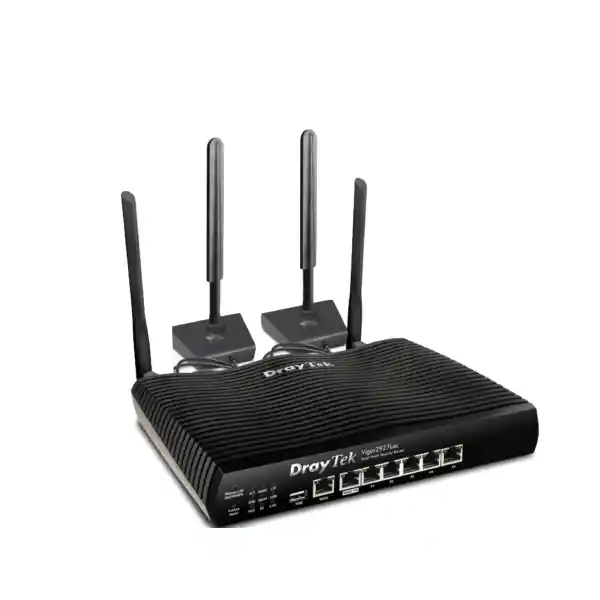
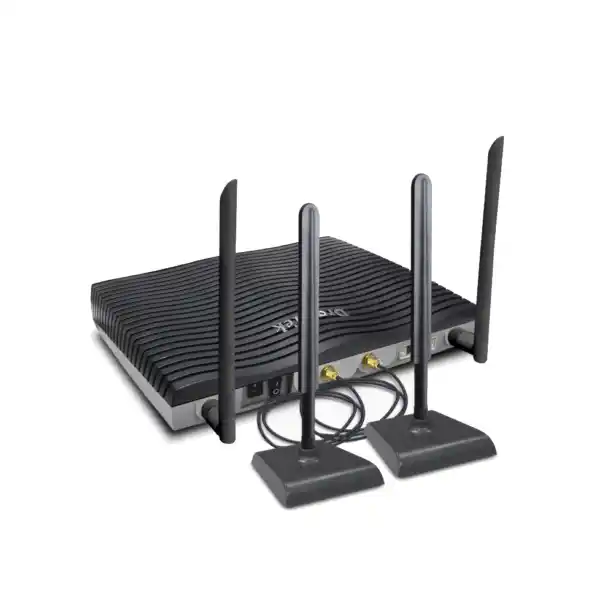
DrayTek Vigor2927Lac in UAE: Dual-WAN LTE Cat 6 VPN Router with 802.11ac Wave 2
The DrayTek Vigor2927Lac is designed for organizations that need more than a basic internet gateway. It combines dual Gigabit Ethernet WAN capability, an integrated LTE Cat 6 modem with two SIM slots, five fixed Gigabit LAN ports, a switchable WAN/LAN Gigabit port, 802.11ac Wave 2 wireless, policy-based routing, VPN, firewalling, quality of service, bandwidth control and business continuity tools in one appliance. For UAE offices, retail outlets, clinics, warehouses, project sites, hospitality environments and distributed branches, this architecture can reduce the number of separate devices required at the edge while giving network administrators practical choices for primary connectivity, backup connectivity and controlled failover.
Integrated 4G LTE supports up to 300 Mbps downlink and 50 Mbps uplink under suitable radio and carrier conditions.
A strong fit for branch connectivity and remote-user access requirements where multiple encrypted tunnels are needed.
Designed for active SMB networks with many simultaneous flows from users, cloud services, phones and applications.
Up to 400 Mbps on 2.4 GHz and 867 Mbps on 5 GHz at the wireless link layer.
Direct answer: what the DrayTek Vigor2927Lac is built to do
The Vigor2927Lac is a multi-WAN security router for small and midsize business networks that cannot treat internet access as a single-circuit utility. Its design lets an administrator use one Gigabit Ethernet port as a fixed WAN, configure the additional switchable Gigabit interface as a second Ethernet WAN when required, and maintain integrated 4G LTE as another available path. This gives the network team several continuity strategies: fixed broadband with LTE failover, two fixed broadband circuits with LTE as contingency, or LTE-led deployment where a wired service has not yet been delivered. Two standard-size SIM slots are provided, with one SIM active at a time, allowing a second SIM to support cellular continuity planning without an external LTE router.
For LAN access, five fixed Gigabit Ethernet ports support local switching and the switchable interface can become an additional LAN port when it is not needed for Ethernet WAN duty. The Lac model also includes dual-band 802.11ac Wave 2 Wi-Fi, with a 2×2 radio design and separate 2.4 GHz and 5 GHz operation. It is therefore capable of acting as the main wireless access point in a small environment, although larger offices should normally treat the integrated radio as one cell within a broader wireless design rather than assume one router can provide ideal RF coverage everywhere.
The operating value of the platform lies in combining transport diversity with routing and security controls. Features such as load balancing, WAN failover, route policy, VPN, firewall rules, traffic management, content controls, guest portal functions and wireless segmentation allow the router to make decisions about which users, applications or subnets should use which path. That is particularly useful in UAE branch environments where cloud applications, voice, video meetings, payment terminals, surveillance systems and guest Wi-Fi can all compete for the same uplink and where loss of the primary circuit can stop business processes immediately.
Why UAE organizations consider it
Connectivity at many UAE business sites is critical even when the site itself is small. A boutique, pharmacy, clinic, restaurant, workshop, site office or regional branch may have only a few dozen endpoints, yet those endpoints can depend on cloud ERP, VoIP, payment processing, video collaboration, remote support and centralized applications. In this scenario, a router that can fail over to LTE is not merely about browsing continuity; it can help preserve transaction processing and operational visibility.
The integrated cellular modem also simplifies temporary deployments. A new office can be staged on LTE while waiting for a fixed service, a construction or event site can go live without installing a separate mobile gateway, and a branch can retain a physically diverse backup path after the primary fiber or Ethernet service is commissioned. The exact performance still depends on local carrier coverage, band support, signal quality, tower load and the selected mobile plan.
What it is not
The Vigor2927Lac should not be treated as a universal replacement for higher-end next-generation firewalls, dedicated SD-WAN appliances or large-office Wi-Fi systems. It is an SMB edge router with strong multi-WAN and VPN functionality, not a data-center security appliance. Its 802.11ac radio is Wi-Fi 5 rather than Wi-Fi 6, and its Ethernet interfaces are Gigabit rather than multi-gigabit. These limits are important when the WAN service is faster than 1 Gbps, when the site contains hundreds of dense wireless users, or when deep security inspection requirements call for a different firewall class.
Correct positioning prevents two common purchasing errors: overspending on a platform whose advanced functions will never be used, or under-sizing the edge because the router was chosen only from the headline WAN speed. FourTeck can help map the model against real traffic, VPN, wireless and resilience requirements before procurement.
Interface map and physical connectivity
Port planning matters because the router is frequently placed at the center of a compact branch. The switchable WAN/LAN interface provides flexibility, but it should be assigned deliberately during design. If two fixed circuits are required, reserve that port for WAN duty and connect the internal network through one or more of the five fixed LAN ports, ideally into a managed switch if VLAN segmentation, PoE endpoints or additional port density is needed. If only one fixed WAN plus LTE is required, the switchable interface can add another Gigabit LAN handoff. In either case, documenting the interface role in the site network diagram reduces mistakes during remote support and failover testing.
LTE Cat 6, dual SIM and cellular design in the UAE
The integrated LTE subsystem is one of the defining differences between the Vigor2927Lac and the non-LTE Vigor2927 variants. DrayTek specifies LTE Category 6 capability with theoretical link rates up to 300 Mbps downlink and 50 Mbps uplink. Supported FDD bands include 1, 3, 7, 8, 20 and 28, while TDD bands include 38 and 40. Those radio capabilities provide useful flexibility, but a purchasing decision should still validate the exact network bands and service profile used at the intended UAE location. Carrier aggregation, signal-to-noise ratio, antenna orientation, tower loading, building construction and the mobile operator’s policy can all make actual throughput materially different from the headline modem rate.
Dual SIM does not mean two cellular links are bonded simultaneously. The design uses two physical SIM slots with one SIM online at a time. This is valuable for continuity because a second SIM can be staged as an alternative, but it should not be presented as active-active cellular aggregation. If the resilience objective is to survive both a fixed-circuit failure and an issue affecting one mobile subscription, administrators should test the intended SIM switching behavior, credentials, APN configuration and monitoring workflow before the branch is placed into production.
Antenna placement can determine whether LTE backup feels dependable or unpredictable. The router should not be hidden deep inside a metal rack, placed behind dense concrete, or installed where RF is heavily shielded simply because the Ethernet cabling terminates there. If the communications cabinet has poor cellular reception, plan the enclosure, antenna positioning and cable path with RF performance in mind. Administrators should record baseline signal values and run failover tests at busy times of day, not only during installation when the mobile network may be lightly loaded.
For cost control, cellular data budgets and route policies deserve as much attention as signal strength. Backup LTE should normally carry the traffic that keeps the business operational, while nonessential large updates, recreational streaming, bulk cloud synchronization and other high-volume activity may need restriction during failover. That policy approach protects both mobile data consumption and user experience. It also creates a clearer operational definition of “continuity”: critical systems continue functioning, even if the temporary backup path cannot reproduce every behavior of the primary broadband circuit.
Dual-WAN architecture: failover, load balancing and route policy
A multi-WAN router becomes valuable when link diversity is translated into predictable traffic behavior. The Vigor2927Lac provides load balancing and failover functions for its available internet connections, allowing administrators to define how traffic should use Ethernet WAN and LTE paths. In a straightforward configuration, the primary fixed line carries normal traffic and the cellular path remains on standby. In a more advanced design, two fixed Ethernet circuits can operate concurrently while LTE remains available for contingency. The right model depends on service costs, application sensitivity, public IP requirements and how the organization wants sessions to behave when a path changes.
Load balancing should not be interpreted as a guarantee that one individual download becomes the sum of all WAN speeds. Multi-WAN routers commonly distribute sessions or flows according to policy, so aggregate site throughput can improve while a single session remains attached to one path. Applications tied to source IP addresses, inbound NAT rules or stateful cloud security controls may need route persistence. Voice and video can also perform better when they are kept on the lower-latency path instead of being moved dynamically simply because another link has unused bandwidth.
Route policy provides the control layer for these decisions. A business can direct payment terminals, IP telephony, management traffic or a specific server subnet toward the preferred circuit while allowing ordinary web traffic to share capacity. During failover, policy can also determine which classes should be permitted to use LTE. This makes the Vigor2927Lac useful not only as a backup router but as a policy enforcement point at the edge. The design process should map business applications to source networks, destination types, ports, public-IP dependencies and tolerance for path changes before rules are created.
Connection detection deserves explicit testing. A WAN link can remain electrically “up” even when upstream internet reachability is broken. Effective failover therefore depends on how the router detects actual path health, not merely cable state. The implementation team should choose detection targets and thresholds that distinguish a real outage from a brief internet fluctuation. Overly aggressive settings can produce route flapping; overly relaxed settings can leave users waiting on a dead path. A documented test matrix—physical cable removal, upstream modem failure, DNS issue, loss of internet reachability and LTE recovery—provides much stronger assurance than a single unplug-and-replug test.
Hardware acceleration and realistic routing performance
DrayTek states that the Vigor2927 LTE platform can reach up to 940 Mbps firewall/NAT performance on a single WAN with hardware acceleration and up to 1.8 Gbps combined across dual WAN in its internal test conditions. The platform also has a hardware QoS acceleration function intended to preserve traffic-control capability while improving forwarding performance. These numbers are useful for sizing, but they are laboratory maximums rather than guaranteed application throughput. Actual results change with packet size, enabled features, session mix, QoS rules, VPN encryption, wireless overhead, WAN type and the behavior of the connected service.
It is more accurate to describe the router as having a hardware-assisted forwarding path than to invent an undocumented ASIC architecture. The practical implication is that selected forwarding operations can be processed more efficiently than a purely software path. Administrators should understand which features are compatible with acceleration in the firmware release being deployed and should verify throughput after enabling the policies that matter in production. If a site expects sustained near-gigabit internet utilization plus multiple encrypted tunnels and complex traffic handling, testing under a representative configuration is preferable to relying on a single headline number.
The 60,000-session figure is similarly a scale indicator, not a user count by itself. Modern endpoints create many concurrent connections: browsers open parallel sessions, collaboration tools maintain persistent connections, operating systems synchronize cloud services, IP phones register to call platforms, security agents contact update servers, and smart devices generate background traffic. A fifty-user office can therefore have a surprisingly large session table. The Vigor2927Lac is positioned by DrayTek for networks around 50 hosts, which gives a more useful planning reference than translating sessions directly into employee count.
When evaluating performance, separate four measurements: raw WAN routing, encrypted VPN throughput, wireless client throughput and application experience. A router may forward near line rate while a VPN session is limited by encryption processing, or the Ethernet path may be healthy while a distant Wi-Fi client performs poorly due to RF conditions. Treating all four as one number creates misleading expectations. A professional commissioning process measures each layer independently and then validates the end-to-end applications that users actually depend on.
IPsec VPN
The platform supports up to 50 VPN tunnels and DrayTek quotes IPsec VPN throughput up to 800 Mbps under its test methodology. This makes it suitable for branch-to-head-office connectivity, branch-to-cloud gateway connectivity and encrypted links between distributed locations where the routing and security requirements fit the product class. Real encrypted throughput depends on cipher selection, packet size, tunnel count, peer performance and other active features.
For site-to-site deployments, document local and remote subnets carefully and avoid overlapping address plans across branches. An apparently simple VPN project becomes difficult when every small office uses the same default private network. A coordinated addressing plan, route policy and DNS strategy makes central services easier to operate and reduces the need for awkward NAT inside encrypted tunnels.
SSL VPN and remote users
DrayTek lists 25 SSL VPN connections and throughput up to 120 Mbps for the series. Remote-access sizing should focus on what users do after connecting rather than only the number of accounts. Administrators running web administration, RDP sessions or business applications may require modest bandwidth, while large file transfers and cloud synchronization can consume much more.
A secure remote-access design should define authentication requirements, user groups, permitted networks, logging, endpoint expectations and split-tunnel policy. Remote users should receive only the access required for their role. Management interfaces should not be exposed broadly to the internet simply because a VPN feature is available; administrative access should be restricted and monitored.
802.11ac Wave 2 wireless: where AC1300 fits
The Lac suffix identifies the LTE model with 802.11ac wireless. The radio supports 2.4 GHz 802.11b/g/n operation with a maximum link rate of 400 Mbps and 5 GHz 802.11a/n/ac with a maximum link rate of 867 Mbps. Two dual-band external antennas are specified, with antenna gain figures of 2.5 dBi for 2.4 GHz and 3 dBi for 5 GHz. The 5 GHz radio supports 802.11ac Wave 2 capabilities including 2×2 MU-MIMO, and the maximum channel bandwidth is 80 MHz. These are link-layer values; application throughput will always be lower because Wi-Fi is a shared half-duplex medium with protocol overhead and environmental loss.
For a small office, the integrated radio can provide a compact all-in-one deployment. Separate SSIDs can be used for staff and guests, and wireless VLAN or isolation features can help prevent guest clients from reaching internal resources. In more demanding environments, however, the router should be paired with dedicated access points. A single AP placed where the internet circuit enters the building is rarely the optimal RF design for a long office, multi-room clinic, reinforced concrete site, warehouse or multi-floor workspace.
The main RF planning choice is whether to prioritize 5 GHz capacity or 2.4 GHz reach. Five-gigahertz channels generally provide more usable spectrum and better capacity for modern client devices, but they attenuate more quickly through walls. The 2.4 GHz band offers wider propagation but faces more interference and has fewer non-overlapping channels. In a business installation, channel selection, transmit power, SSID design and AP placement should be coordinated rather than left entirely to defaults. If the site later expands to multiple access points, consistent SSIDs and VLANs can support mobility while central routing and policy remain on the Vigor2927Lac.
Because the router is Wi-Fi 5 rather than Wi-Fi 6, organizations purchasing for a new high-density wireless project should compare whether integrated wireless is still the right requirement. If the edge routing and LTE functions fit perfectly but the WLAN needs newer technology, it can be sensible to use the router primarily as the wired security gateway and deploy separate Wi-Fi 6/6E access points. This modular approach lets the organization upgrade wireless independently without discarding a router whose WAN, LTE and VPN functions remain adequate.
Firewall segmentation and LAN design
Business routing should start from segmentation rather than a flat LAN. The Vigor2927 family supports multiple LAN subnets and VLAN-oriented designs, allowing an administrator to separate trusted staff endpoints, voice devices, guest wireless, cameras, building systems and management interfaces. Segmentation reduces the number of devices that can communicate directly and creates clear policy boundaries. It also makes troubleshooting easier because each class of device has an intentional network identity instead of sharing one undifferentiated broadcast domain.
A retail branch, for example, might place payment terminals on one subnet, staff computers on another, IP phones on a voice VLAN, CCTV devices on a restricted network and guests on an internet-only wireless VLAN. The router can then enforce rules governing which zones may initiate connections to others. The camera VLAN may need access to a recorder or cloud service but not to user laptops. Guest Wi-Fi generally needs DNS, DHCP and internet access while being denied access to internal RFC1918 networks. Management interfaces should be reachable only from an administrator network or VPN.
Segmentation should be designed together with the Ethernet switch. If several VLANs traverse one cable between the Vigor2927Lac and a managed switch, the trunk/tagging configuration must match on both sides. Access ports then place endpoints into the correct VLAN. PoE requirements for phones and access points belong in the switch selection, because the router’s LAN ports are not a substitute for a managed PoE access layer. The same principle applies to port count: five fixed Gigabit LAN interfaces are useful, but they do not remove the need for a proper switch when the site has many endpoints.
Firewall rules should follow least-privilege logic. Begin by documenting required flows between zones, then create explicit permissions rather than broadly allowing any-to-any access and trying to add blocks later. Keep rule names descriptive, record the owner and purpose, and schedule periodic review. Small branches often accumulate temporary rules that become permanent because no one remembers why they exist. Clean policy documentation is therefore an operational security control, not an administrative luxury.
Quality of Service, bandwidth limits and application continuity
Quality of Service becomes important whenever business-critical real-time traffic shares a constrained uplink with bursty data. The Vigor2927Lac includes QoS and bandwidth-management capabilities, and DrayTek highlights hardware QoS acceleration as part of the platform. A practical policy might protect VoIP and video-conference signaling/media from being crowded out by software downloads or cloud backups. The objective is not to make the WAN faster; it is to manage congestion so delay-sensitive applications remain usable when demand exceeds available capacity.
Bandwidth limits can also protect fairness. If one user or device starts a large transfer, per-client or class-based limits can prevent that session from consuming most of a smaller internet circuit. Session limits are another control where appropriate, particularly for environments containing unmanaged guest clients or devices that may create abnormal numbers of connections. Administrators should tune these settings with measurements rather than apply arbitrary restrictions that become another source of support calls.
Failover introduces a second QoS scenario: the backup path may be slower than the primary. A branch with a fast fixed line and LTE contingency should not assume that every background workload can continue unchanged after failover. Route and traffic policies can prioritize point-of-sale, voice, remote support and essential cloud services while suppressing large updates, media streaming or nonurgent synchronization. This prioritization improves continuity because the business-critical applications receive a predictable share of the reduced capacity.
Good QoS design starts with uplink measurement. Configure shaping values from realistic sustained throughput, not the ISP’s marketing rate, and leave enough headroom for the router to control the queue before congestion moves upstream where it can no longer influence packet order effectively. Re-test after the circuit or mobile plan changes. A policy tuned for a 50 Mbps uplink may be inappropriate after an upgrade to 200 Mbps or when LTE performance varies heavily by time of day.
Voice, unified communications and IP PBX environments
The Vigor2927Lac does not include the FXS analog voice ports found on some Vigor “V” variants, but it is well suited to route IP-based voice traffic. Its QoS controls, multi-WAN behavior and Gigabit LAN interfaces can support IP phones, hosted PBX clients and on-premises IP PBX systems when the network is configured appropriately. VoIP quality depends heavily on latency, jitter, packet loss and NAT behavior, so failover testing should include live call scenarios rather than only web browsing.
A voice VLAN is normally preferable to mixing phones with every workstation and IoT device. The router can provide inter-VLAN policy while a managed PoE switch powers the phones. DHCP options may be used where required by the handset provisioning model, and QoS classes can prioritize RTP/media and relevant signaling. If the organization uses a cloud PBX, confirm that its session timers and NAT traversal work as expected across both the primary WAN and LTE backup. A path change can alter the public source IP and may cause existing calls or registrations to re-establish.
FourTeck also supports broader communications infrastructure through IP PBX solutions for Dubai and UAE deployments. When the edge router, switches, voice platform and handsets are designed as one system, it becomes easier to define VLANs, QoS, numbering, security boundaries and failover behavior coherently instead of troubleshooting each layer independently after installation.
Guest Wi-Fi, hotspot portal and public-facing access
The Vigor2927Lac includes hotspot and captive-portal functionality intended for environments that need to present a controlled landing experience to guest users. This can be useful in reception areas, clinics, cafes, serviced offices, showrooms and small hospitality venues. The technical design should separate the guest SSID from internal resources, apply bandwidth policies where necessary and define how long guest sessions remain active. The portal is not a substitute for network segmentation; guest clients should still be isolated at the routing and firewall layers.
User experience also matters. A guest network that requires excessive steps, redirects unreliably or performs badly under load can create more front-desk support than value. Keep the authentication process aligned with the business need, verify captive portal behavior across common mobile operating systems, and ensure DNS and HTTPS redirection work correctly. Where regulatory, legal or organizational policy requires user consent, logging or terms of use, the configuration should be reviewed accordingly.
If guest demand grows, move radio capacity to dedicated access points while the Vigor2927Lac remains the gateway enforcing VLAN and WAN policy. This allows RF coverage to scale separately from internet routing. A small router can remain a very capable edge device even after the wireless network expands beyond the capacity or physical reach of its built-in antennas.
Deployment topology 1: primary fiber with LTE failover
This is the most common continuity topology for the Vigor2927Lac. The fixed Gigabit WAN connects to the ISP ONT, modem or Ethernet handoff, while the embedded LTE modem remains configured as a standby path. The LAN ports or managed access switch serve staff, voice, printers, CCTV and wireless clients. Under normal conditions, all preferred traffic uses the fixed service. If reachability monitoring determines the primary internet path has failed, selected traffic moves to LTE.
The implementation team should decide which applications are allowed during failover. Essential SaaS, payment processing, IP telephony, remote support and business messaging may be permitted, while operating-system updates and large backup jobs are restricted. This policy protects both capacity and mobile data allowance. The cellular path should be tested with the actual SIM and installation location because indoor RF conditions can differ significantly even within the same building.
Recovery behavior is as important as failover. When the primary link returns, administrators should understand whether new sessions move back immediately and how long-lived sessions behave. Sensitive applications may need to re-establish. Documenting the expected user symptoms helps the help desk distinguish normal reconnection from a configuration fault. Scheduled quarterly failover tests can verify that a backup path which worked on installation day still works months later after firmware, carrier and network changes.
Deployment topology 2: dual fixed WAN plus LTE contingency
Sites with higher availability requirements can use both Gigabit Ethernet WAN capability and integrated LTE. One fixed WAN may connect to a primary ISP, the switchable interface may be assigned as the second fixed WAN, and LTE becomes an additional contingency path. This configuration is particularly attractive when the two wired services have genuinely different last-mile routes or providers. Two contracts are not automatically resilient if both circuits share the same building entry, upstream duct or carrier core dependency.
With two active fixed links, load balancing can spread site demand while route policy keeps sensitive traffic on a preferred service. Inbound services require careful design because public IP addresses differ between providers. If the branch hosts anything that must be reachable from outside, consider how DNS, port forwarding, VPN peers or cloud relays behave after a WAN change. For many modern branches, keeping public-facing services in the cloud and treating the site as primarily outbound simplifies multi-WAN continuity.
LTE should be configured as a controlled emergency tier rather than simply another equal-cost link unless the business explicitly wants to use cellular data during normal operation. Monitoring and alerting should distinguish “WAN2 failed but WAN1 remains healthy” from “both fixed WANs unavailable and site is on LTE.” Those are different operational states and may require different escalation. If a branch silently runs on mobile backup for days, the organization can discover a large data bill or poor user experience only after the fact.
Deployment topology 3: rapid branch or project-site activation
A temporary or newly opened site may not have a wired circuit on day one. The Vigor2927Lac can be commissioned using LTE so users, cloud applications and secure VPN access become available while the permanent broadband service is pending. When the fixed line is later delivered, the router can be reconfigured to make Ethernet WAN the primary path and retain LTE for backup. This reduces the need to purchase a temporary cellular router that has no purpose after the site is fully commissioned.
This model works well for construction offices, pop-up retail, exhibitions, relocations and phased branch openings, but LTE capacity must be assessed honestly. A site with large CAD files, high-resolution video, many surveillance cameras or continuous cloud backup can overwhelm a mobile plan even if basic browsing is fast. The network team should estimate daily and monthly data consumption, then enforce policies that match the temporary connectivity phase.
Security should not be relaxed because the site is temporary. Use the same VLAN, VPN, administrator-access and logging standards that will apply after the fixed circuit arrives. If the temporary deployment is built as a shortcut, it often remains in service longer than expected and becomes difficult to normalize later. A reusable branch template makes LTE-first activation both fast and supportable.
Branch sizing methodology: how to decide whether Vigor2927Lac is the right class
Start with the number of active endpoints rather than employee count. One employee may use a laptop, phone, mobile device and cloud applications while the same site also contains printers, cameras, door controllers, televisions, access points and IoT systems. DrayTek positions the Vigor2927 platform around 50 hosts and 60,000 NAT sessions, which is a useful baseline for an SMB branch. If the site contains significantly more endpoints, very high concurrent connection counts or heavy east-west routing requirements, assess a larger platform instead of assuming headline WAN throughput is the only sizing factor.
Next, measure WAN demand in both directions. Cloud backup, surveillance uploads, video conferencing and large file synchronization can make upload capacity as important as download. LTE Cat 6 has a specified maximum uplink of 50 Mbps at the radio-link level, and real-world throughput may be lower. A failover design must therefore ask whether the critical applications remain functional on the likely backup uplink, not whether the mobile modem’s download headline appears fast enough.
Then examine VPN. Count site-to-site tunnels, remote users, and the throughput expected through encrypted paths. The platform supports up to 50 VPN tunnels, with DrayTek quoting IPsec throughput up to 800 Mbps and SSL VPN throughput up to 120 Mbps under test conditions. If a branch sends most of its traffic through a full-tunnel VPN, encrypted throughput becomes more relevant than plain NAT throughput.
Finally, evaluate wireless density and lifecycle. AC1300 Wi-Fi can be effective for a small office, but a new deployment expecting many modern clients, dense meeting rooms or multi-gigabit internet may be better served by dedicated Wi-Fi 6 or later access points. The router can still be suitable as the WAN/VPN gateway if its edge performance meets the requirement. Separating routing and wireless refresh cycles often gives better long-term value.
FourTeck’s broader UAE IT services practice can assist with site discovery, network segmentation, switch/AP design, migration and post-installation testing when the requirement extends beyond supply of the router itself.
Security engineering considerations
No edge router should be considered secure simply because it includes a firewall. Security comes from configuration, firmware maintenance, access control, segmentation and monitoring. Change default administrative credentials, restrict management to trusted networks or VPN, disable services that are not required, use encrypted administration protocols, and maintain configuration backups. If remote management is necessary, limit source networks where possible and avoid exposing broad administrative access directly to the public internet.
Firmware lifecycle is equally important. Before installation, confirm the release recommended for the model and review vendor notes for security fixes, behavior changes and feature compatibility. Keep a change record so the team knows which configuration was running before an upgrade. For critical branches, export a tested backup and schedule firmware changes inside a maintenance window that allows rollback or on-site assistance if needed.
DNS policy, web filtering and content controls can support acceptable-use and threat-reduction objectives, but they should not be mistaken for complete endpoint security. A layered design still requires maintained operating systems, endpoint protection, identity controls, secure SaaS configuration and user awareness. The Vigor2927Lac controls traffic at the branch edge; it does not replace security controls inside applications or endpoints.
Logs should be exported or collected when operationally important. Local logs are useful during immediate troubleshooting, but centralized retention helps investigate events after the router restarts or after a longer period has passed. At a minimum, the support process should be able to identify WAN changes, VPN status, administrative actions and notable firewall events. Time synchronization is necessary so logs from the router, switches, servers and cloud systems line up during an incident.
For organizations with stricter security, compliance or inspection requirements, evaluate whether an SMB router provides the required control depth. A platform can be excellent for resilient routing and VPN while a different security architecture is more appropriate for regulated workloads. The right decision depends on the control objectives, not brand preference.
Monitoring, maintenance and support readiness
A resilient router should tell the support team when resilience is being used. Monitor WAN availability, public IP changes, LTE state, VPN tunnel health and resource utilization. If the branch fails over silently, users may continue working while the organization remains unaware that its primary circuit has been down for hours. A clear alert lets support investigate the circuit before a second failure removes the backup path as well.
Configuration backups should be stored securely after initial commissioning and after every significant change. Include the firmware version, WAN credentials handling process, VLAN table, IP plan, VPN peer information, policy routing summary and administrator access method in the site documentation. Avoid placing secrets directly in general-purpose diagrams, but document where authorized support staff can retrieve them. Good records reduce recovery time when equipment must be replaced.
Periodic testing should include more than ping. Verify DNS resolution, SaaS login, VPN reachability, voice calls, business transactions and remote management over each intended WAN path. For LTE, also check current signal and data-plan status. Cellular networks evolve, and a SIM that once worked can be affected by plan expiration, APN changes, coverage changes or physical movement of the router.
FourTeck’s UAE technology and infrastructure portfolio can be used when a deployment needs coordinated router, switching, wireless, server, communications or support services rather than a standalone appliance purchase.
Technical specification reference
| Product | DrayTek Vigor2927Lac |
| Product class | Dual-Ethernet WAN firewall/VPN router with embedded LTE and 802.11ac Wave 2 WLAN |
| Ethernet WAN | 1 fixed Gigabit RJ-45 plus 1 Gigabit RJ-45 switchable as WAN/LAN |
| Fixed LAN | 5 × Gigabit Ethernet RJ-45 |
| LTE | Integrated LTE Category 6, up to 300 Mbps downlink / 50 Mbps uplink link rate |
| SIM | 2 × standard-size SIM slots, one online at a time |
| LTE bands | FDD 1/3/7/8/20/28; TDD 38/40; WCDMA bands 1/8 |
| Wireless | 2.4 GHz 802.11b/g/n up to 400 Mbps; 5 GHz 802.11a/n/ac up to 867 Mbps; 80 MHz maximum channel bandwidth; 2×2 wireless design |
| Wi-Fi antennas | 2 × dual-band external; 2.5 dBi at 2.4 GHz and 3 dBi at 5 GHz |
| LTE antennas | 2 × external dipole |
| USB | 1 × USB 2.0 |
| NAT sessions | 60,000 recommended session scale |
| NAT/firewall performance | Up to 940 Mbps single WAN with hardware acceleration; up to 1.8 Gbps combined across dual WAN in vendor internal testing |
| VPN | Up to 50 VPN tunnels; IPsec throughput quoted up to 800 Mbps; up to 25 SSL VPN connections with throughput quoted up to 120 Mbps |
| Key edge functions | Load balancing, failover, route policy, QoS, bandwidth management, firewall, content controls, hotspot portal, VPN and multi-subnet/VLAN networking |
Performance figures are maximum values from vendor testing under optimal conditions and may differ in production according to packet characteristics, enabled features, network conditions and applications. Always validate firmware-specific capability and regional radio compatibility before final deployment.
Retail and point-of-sale
Retail branches need continuity for POS terminals, card services, stock systems, cloud ERP, staff devices and CCTV. The Vigor2927Lac can keep a fixed circuit as primary and use LTE as a backup while routing guest Wi-Fi or bulk traffic under separate policy. Segmented VLANs help prevent guest devices from interacting with business systems, and QoS can prioritize transaction-related or voice traffic during congestion.
Clinic and professional office
A small clinic, consultancy or legal office often depends heavily on SaaS and remote access despite having relatively few employees. Dual WAN, VPN and LTE continuity can protect appointment, document, VoIP and remote-support workflows. The design should segment staff, guest and specialized equipment and should enforce secure administration because sensitive business data may be involved even when the local network is compact.
Warehouse and logistics
Warehouses can require resilient access for scanners, inventory terminals, label printers, voice handsets and cloud logistics systems. The router can provide edge connectivity while managed switches and dedicated APs extend coverage into larger spaces. LTE is especially useful as a backup when fixed-line failure would stop dispatch or receiving activity, but indoor RF should be surveyed around metal structures and racks.
Construction and temporary sites
Project offices frequently need internet before permanent infrastructure is available. The integrated LTE modem enables quick activation, while Ethernet WAN can take over when fiber or fixed broadband arrives. VPN can connect the temporary site to head office, and bandwidth controls can protect essential project applications from large downloads or recreational use on a metered mobile plan.
Migration from a basic single-WAN router
Replacing a simple router with the Vigor2927Lac is an opportunity to improve network structure rather than copy every old setting. Start by recording the existing WAN authentication method, public IP details, DHCP scope, static reservations, port forwards, VPNs, DNS settings, Wi-Fi SSIDs and any services tied to the old router. Identify business systems that depend on fixed private addresses or public source IPs. A migration worksheet prevents surprises when a hidden dependency appears after cutover.
Next, design the target VLAN and subnet structure. If the old network is flat, decide whether the migration can introduce separate staff, voice, guest, CCTV and management zones. It may be safer to stage segmentation in phases rather than change routing, switching and endpoint addressing simultaneously. The Vigor2927Lac can first replace the WAN edge while keeping the existing LAN, then the team can introduce VLANs after internet and VPN services are stable.
Before the maintenance window, preconfigure the router offline where possible. Update firmware, change administrator credentials, configure WAN and LTE parameters, build VPN profiles, define the LAN addressing and prepare backup files. During cutover, connect one service at a time and validate each layer: internet, DNS, business applications, inbound services, VPN, Wi-Fi, phones and LTE failover. A checklist is faster than troubleshooting by memory.
After successful migration, keep the previous router available until the validation period is complete if business policy permits. Capture the final configuration backup and update diagrams. Resilience should also be tested intentionally: disconnect the primary WAN, confirm LTE takes over, verify critical applications, then restore the link and confirm the network returns to its intended steady state.
Procurement guidance for UAE buyers
A product quote should identify the exact Vigor2927Lac model rather than simply “Vigor2927,” because the family includes variants with different wireless, LTE and voice capabilities. Confirm that the supplied unit matches the required regional hardware and radio support, includes the expected power adapter and antennas, and is sourced through an appropriate channel. For LTE deployment, verify that the intended SIM format and network plan are ready before the installation appointment; otherwise the cellular portion cannot be fully commissioned.
Consider the surrounding bill of materials. A branch may also need a UPS, managed PoE switch, rack or shelf, patch cords, dedicated access points, surge protection and structured cabling. If LTE signal is marginal at the rack location, physical placement may matter more than buying a higher-capacity Ethernet switch. If the office has more than a handful of wireless clients or difficult construction, budget for proper AP placement instead of assuming the router’s integrated Wi-Fi can cover the entire site.
Support planning should be part of procurement. Identify who owns WAN credentials, who can change firewall rules, how firmware updates are approved, where backups are stored and what happens when the site fails over to LTE. If the router supports an important branch, a spare-unit strategy or rapid replacement process may be justified. The cost of a router is often small compared with the operational cost of a branch being offline for a day.
For product availability, deployment coordination and network integration in Dubai and across the UAE, see FourTeck Firewall Dubai. Regional organizations that need consistent designs beyond the UAE can also review FourTeck Africa infrastructure coverage for multi-country technology requirements.
Commissioning checklist for a production deployment
1. Hardware and firmware
Confirm exact model, inspect antennas and power components, record serial details internally, install the approved firmware, reset to a known configuration state where appropriate, set secure administrator credentials and establish time synchronization.
2. WAN and LTE
Configure Ethernet WAN authentication or static addressing, insert the intended SIM, configure APN details if required, verify LTE registration and signal, and test internet access independently through each intended path before combining failover rules.
3. LAN and VLANs
Create the addressing plan, DHCP scopes and reservations. Configure VLAN interfaces and matching switch trunks/access ports. Verify inter-VLAN policy from a test endpoint in every zone rather than assuming tags and firewall rules are correct.
4. Wireless
Configure staff and guest SSIDs, security mode, VLAN mapping and client isolation as required. Validate 2.4 GHz and 5 GHz coverage from work areas. Do not place the router solely for cabling convenience if RF coverage is poor.
5. VPN and routing
Build site-to-site and remote-access profiles, validate encryption parameters, test name resolution across tunnels and confirm route policy sends each application through the intended WAN. Check that branch subnets do not overlap remote networks.
6. Resilience test
Simulate primary WAN failure, verify critical services across LTE or alternate WAN, observe alarms and public IP changes, then restore service and confirm normal routing resumes. Record the behavior for the help desk and business owner.
Troubleshooting framework
When internet access is poor, isolate the layer first. Test a wired client directly through the LAN before diagnosing Wi-Fi. Check whether the issue affects one WAN or all WANs. Compare router-reported link state with actual reachability to external targets. Review DNS separately from IP connectivity because users often report “internet down” when only name resolution is failing. If the site is on LTE, review signal conditions and carrier performance before changing firewall rules.
For VPN issues, confirm basic internet reachability and time settings, then verify peer addresses, proposals, authentication credentials and local/remote subnet definitions. Overlapping subnets are a common cause of confusing behavior. If the tunnel establishes but traffic does not pass, inspect routing and firewall policies rather than repeatedly rebuilding the tunnel. Capture whether the problem occurs on the fixed WAN, LTE or both, because NAT and public IP behavior may differ.
For wireless complaints, identify whether the client is on 2.4 GHz or 5 GHz, note signal strength, test near the router, and compare several devices. A single older client may have a driver or compatibility issue. If all clients perform poorly only in one area, coverage or interference is more likely than WAN routing. In larger offices, adding access points is usually more effective than increasing transmit power in an attempt to force one radio to cover every room.
For intermittent failover, review the detection method and thresholds. If the router declares an outage too quickly, brief packet loss can cause path changes; if it reacts too slowly, users remain on a failed service. Test using controlled failure scenarios and keep a timestamped log of events. Troubleshooting becomes much easier when the team can correlate WAN state, LTE state, VPN state and user reports on the same timeline.
Lifecycle and upgrade planning
The Vigor2927Lac uses Gigabit Ethernet and Wi-Fi 5, so lifecycle planning should consider the direction of the site’s services. If the branch is expected to remain below 1 Gbps of wired WAN capacity and has moderate wireless density, the platform can remain practical for a broad set of SMB workloads. If the organization is ordering multi-gigabit internet, deploying large Wi-Fi 6/6E client populations or requiring extensive next-generation security inspection, the edge architecture may need a newer or larger class of device.
A useful strategy is to separate functions by lifecycle. Keep the Vigor2927Lac as the resilient WAN/VPN gateway while using managed switches and independent access points that can be upgraded separately. This avoids replacing the router solely because wireless standards evolve. Conversely, if the router’s WAN performance or security feature set becomes the limiting factor, the existing APs and switches can stay in place when the edge device is upgraded.
Document spare configurations and replacement procedures before failure occurs. If a replacement unit is available, the support team should know which firmware to install, how to restore the configuration securely and how to reinsert or activate SIM connectivity. If no spare is maintained, record the procurement and escalation path. Business continuity depends on people and process as much as dual WAN.
Finally, review the network after major business changes. A branch that began with 15 users may later host 60 users, more cameras, cloud telephony and continuous video collaboration. A router chosen correctly at installation can become under-sized after years of growth. Annual capacity review prevents the organization from discovering that change only during an outage or peak business period.
Decision recap: when Vigor2927Lac is a strong fit
The DrayTek Vigor2927Lac is well aligned with an SMB branch that needs resilient internet connectivity, integrated LTE backup, dual-band Wi-Fi 5, business VPN, traffic management and VLAN-capable routing without moving to a much larger enterprise appliance. Its strongest scenarios are offices with roughly dozens rather than hundreds of endpoints, WAN services at or below Gigabit class, meaningful dependence on cloud applications, and a clear operational need for backup internet. The embedded Cat 6 modem reduces external equipment, while dual SIM capability adds flexibility for cellular continuity planning.
Choose this class when
You need one platform for fixed WAN, LTE backup, VPN, policy routing, QoS and moderate integrated Wi-Fi; the site is SMB-sized; Gigabit interfaces are sufficient; and continuity matters more than ultra-high throughput or very dense wireless access.
Evaluate a larger or newer platform when
The internet service exceeds 1 Gbps, the site has substantially more endpoints, high inspection/security requirements dominate the design, very large VPN loads are expected, or Wi-Fi 6/6E density is a primary requirement rather than an optional separate access layer.
Quotation input checklist
For an accurate UAE quotation and deployment recommendation, provide the items below. These inputs allow the router to be sized around the business requirement rather than treated as a generic box.
Dubai/Abu Dhabi/other emirate, number of staff, total active devices, working hours and critical business periods.
ISP, circuit type, subscribed speed, authentication method, static public IP requirement and handoff type.
Whether a second fixed circuit exists, preferred mobile operator, available SIM/data plan and expected backup traffic.
Number of site-to-site peers, remote users, applications across VPN and expected encrypted traffic volume.
Number of wired devices, VLAN requirements, PoE phones/APs/cameras, existing managed switches and subnet plan.
Floor area, wall construction, user density, guest Wi-Fi requirements and whether dedicated access points already exist.
Structured consultation panel
A successful Vigor2927Lac deployment is a small architecture project, not merely a hardware delivery. The configuration should reflect WAN diversity, LTE signal, routing policy, VLAN segmentation, VPN dependencies, voice requirements, guest access and the organization’s support model. FourTeck can scope the router together with switching, wireless and communications infrastructure so the installed network has a documented steady state and a documented failure state.
Plan
Confirm circuit mix, LTE requirements, host count, VPN topology, VLANs, wireless coverage and business-critical traffic.
Deploy
Stage firmware and configuration, install the router, integrate managed switching/APs, validate all WANs and document the final network.
Prove resilience
Test primary failure, LTE or secondary-WAN takeover, critical applications, VPN behavior, monitoring alarms and restoration to normal service.
Operate
Maintain backups, firmware, logs, capacity reviews, SIM status and a support procedure that identifies when the site is running on backup connectivity.
For UAE supply and deployment planning, prepare the quotation inputs above and use the contact action below. The final recommendation can then be matched to the actual branch traffic, continuity objective and supporting network equipment.


Reviews
There are no reviews yet.