
DrayTek Vigor3910 in UAE
A high-performance, rack-mountable multi-WAN VPN router for organizations that need fast Internet aggregation, resilient branch connectivity, network segmentation, dynamic routing, and centralized control without introducing unnecessary architectural complexity.
Designed for bandwidth-intensive headquarters, large offices, multi-site enterprises, managed service environments, campuses, hospitality networks, retail groups, education, logistics, and other UAE deployments where WAN diversity, secure VPN concentration, and predictable policy enforcement are operational priorities.
Why the Vigor3910 still fits serious enterprise edge designs
The DrayTek Vigor3910 is not simply a faster small-business router. Its value is the way several enterprise edge functions are consolidated into a single DrayOS platform: high-speed Ethernet and fiber interfaces, multiple simultaneous WAN uplinks, policy-driven load balancing, failover, BGP and OSPF routing, VLAN-based segmentation, inter-VLAN policy, VPN concentration, user authentication, bandwidth management, diagnostics, and management of compatible DrayTek access points and switches. For many UAE organizations, that combination can reduce the number of appliances required at the Internet edge while keeping day-to-day administration accessible to an internal IT team or managed service provider.
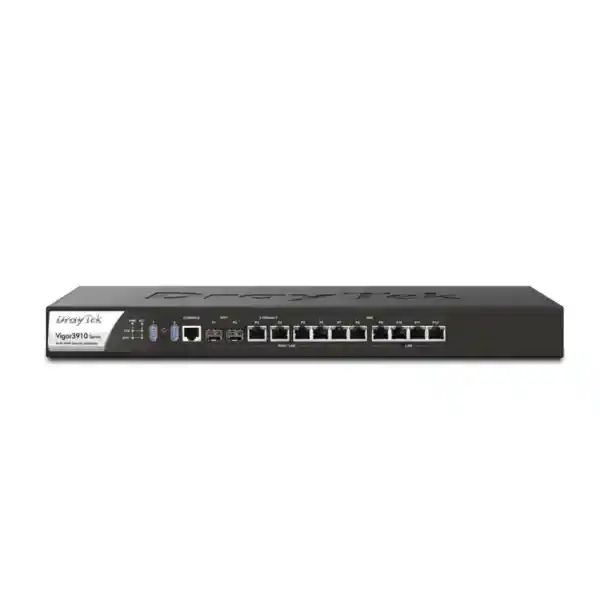
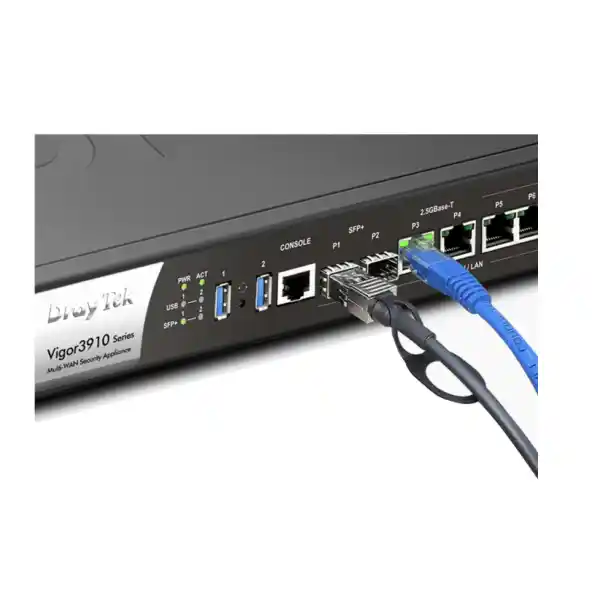
The hardware layout is particularly useful when an office is moving beyond 1Gbps Internet access. Two SFP+ interfaces can operate at up to 10Gbps and can be assigned as WAN or LAN interfaces. Two 2.5GbE copper ports provide another practical path for high-speed broadband handoffs, modern aggregation switching, or local server connectivity. Four additional configurable Gigabit Ethernet ports expand WAN or LAN options, while four fixed Gigabit Ethernet LAN ports remain available for internal connectivity. This gives architects room to separate carriers, transit links, server zones, management segments, downstream firewalls, or routed distribution networks without immediately adding an external media-conversion layer.
FourTeck positions the Vigor3910 as an enterprise routing and VPN platform rather than as a replacement for every security control in a modern architecture. It provides a stateful firewall, NAT, policy controls, content-related controls, DoS defenses, VPN isolation, authentication integrations, and segmentation features, but organizations with advanced threat prevention, sandboxing, full TLS inspection, compliance-mandated next-generation security stacks, or very large east-west inspection requirements may still use a dedicated security appliance alongside it. The right design depends on traffic profile, threat model, application mix, branch count, compliance obligations, and the services that must remain available during a carrier or device failure.
10G-ready interfaces
Dual SFP+ ports create a practical path for 10Gbps carrier, core-switch, data-center, or routed backbone connectivity, while 2.5GbE copper provides a useful middle tier for high-speed Ethernet handoffs.
Multi-WAN flexibility
Configurable interfaces support multiple Internet circuits with load balancing, failover, health checks, policy-based routing, and traffic steering for business continuity and application-aware path selection.
Up to 500 tunnels
The platform is designed to terminate large numbers of site-to-site and remote-access tunnels, making it suitable for headquarters that aggregate branch, warehouse, retail, project-site, and teleworker connectivity.
VLAN and subnet control
Tag-based and port-based VLAN features, multiple LAN subnets, DHCP controls, routing policy, local authentication, and traffic controls help separate users, servers, guests, voice, IoT, operations, and management zones.
Hardware architecture and port map
The physical design of the Vigor3910 is one of its strongest differentiators. Rather than forcing an administrator into a fixed one-WAN, one-LAN layout, the appliance exposes eight interfaces that can be assigned to WAN or LAN roles and keeps four additional Gigabit Ethernet interfaces as fixed LAN ports. This is useful in real enterprise installations because edge topology changes over time. A business may start with two broadband circuits, add a dedicated Internet leased line, introduce a separate MPLS or SD-WAN handoff, build a dedicated DMZ, or connect a 10G aggregation switch. A flexible port model reduces the chance that a router must be replaced merely because the media type or topology evolves.
| Interface group | Quantity | Speed / media | Typical design use |
|---|---|---|---|
| SFP+ configurable | 2 | 10G / 2.5G / 1G fiber capability depending on module and support | 10G WAN handoff, core uplink, routed backbone, high-speed server or security-zone link |
| RJ-45 configurable | 2 | 2.5G / 1G / 100M Ethernet | Multi-gig broadband, aggregation, high-speed copper transit |
| RJ-45 configurable | 4 | 1G / 100M / 10M Ethernet | Additional WANs, branch transport, DMZ, management, routed LANs |
| Fixed LAN RJ-45 | 4 | 1G / 100M / 10M Ethernet | Access switching, management, services, downstream LAN |
| USB | 2 | USB 3.0 | Supported peripherals and operational use cases |
| Console | 1 | RJ-45 serial console | Out-of-band style local administration and recovery workflows |
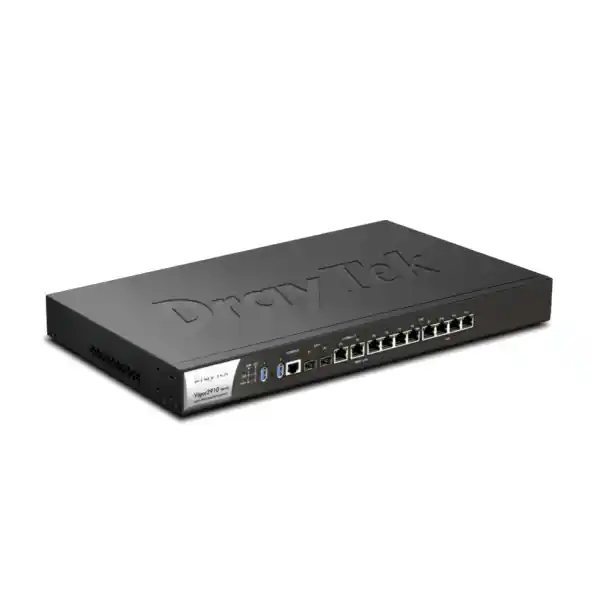
The chassis is approximately 443 × 285 × 45 mm, which corresponds to a 1U-class rack form factor. DrayTek lists AC input and a maximum power figure around 35 watts for the model, although actual consumption depends on operating conditions and connected interfaces. The published operating temperature range is 0 to 45°C. In UAE server rooms, that makes correct rack ventilation, clean power, UPS protection, and controlled ambient temperature important. The router should not be treated as a substitute for proper environmental design simply because its normal power draw is modest compared with large security appliances.
SFP and SFP+ optics should be selected against the exact carrier handoff, fiber type, connector type, wavelength, distance, and interoperability requirements. For copper handoffs, cable category, patch-panel quality, and negotiated speed should be validated. A 10G-capable port does not automatically mean the complete path is 10G-capable: switch uplinks, optics, transceivers, structured cabling, ISP CPE, firewall insertion points, and downstream servers all contribute to the usable throughput envelope.
Performance: understanding what the numbers mean
DrayTek currently positions the Vigor3910 around a 9Gbps NAT throughput class, while published regional and historical datasheets can show different measured figures for VPN throughput, SSL VPN throughput, session scale, or firmware-dependent feature limits. That is normal for long-lived enterprise platforms because test methodology, firmware acceleration, packet size, cryptographic profile, and enabled services influence results. A sound procurement decision should therefore use the current firmware release notes and the exact workload that the router will carry, rather than treating a laboratory maximum as a guaranteed application throughput figure.
For IPsec, the current global product information lists performance in the multi-gigabit range and supports up to 500 concurrent VPN tunnels. OpenVPN and SSL VPN concurrency is lower than the overall tunnel count, with published support for up to 200 concurrent OpenVPN plus SSL VPN connections in current product data. These are substantial numbers for branch aggregation, but tunnel count alone is not a sizing metric. A headquarters with 150 branches exchanging backups and surveillance traffic may stress the appliance more heavily than 400 low-utilization tunnels used only for occasional ERP transactions. Encryption algorithm, packet size, latency, routing policy, QoS, logging, and simultaneous Internet traffic all matter.
NAT session capacity also needs context. UAE regional material and some current regional pages publish a 150,000-session figure, while other DrayTek materials from different markets and firmware eras have listed higher session values. For a production design, FourTeck validates the exact supported value against the intended firmware and local product variant before final sizing. More importantly, an architect should estimate sessions per active user, server publishing requirements, guest traffic, cloud applications, voice and video concurrency, IoT behavior, and any high-connection-rate workloads such as content synchronization or large software-update waves.
Hardware acceleration is especially relevant because the Vigor3910 is designed to move large volumes of traffic while continuing to apply features such as QoS and bandwidth control. Yet every environment is different. If the router is expected to sit in front of a heavily virtualized data center, terminate hundreds of high-rate tunnels, perform complex routing, host guest portals, and process large quantities of logging simultaneously, a lab validation or staged pilot is prudent. FourTeck can structure a test plan around real application flows instead of synthetic expectations.
Multi-WAN engineering for UAE connectivity
Load balancing
The Vigor3910 can distribute outbound traffic across multiple WAN interfaces using load-balancing logic. This is useful when an organization buys connectivity from more than one carrier or combines a primary leased line with secondary broadband. Traffic distribution can reduce dependency on a single path and make better use of aggregate purchased bandwidth.
Load balancing should still respect application behavior. Banking portals, identity systems, SaaS platforms, voice services, or remote systems may react poorly if related sessions unexpectedly appear from different public IP addresses. Policy-based routing can pin selected applications, subnets, users, or services to a preferred WAN while less sensitive traffic remains eligible for balancing.
Failover and health detection
WAN resilience is not achieved by connecting two cables and assuming the router can detect every failure. A carrier circuit may remain electrically up while upstream routing, DNS reachability, or Internet transit has failed. Health-check design should therefore use appropriate detection targets and intervals, with care taken to avoid false failovers.
Recovery behavior matters as much as failure detection. Returning sessions to a restored primary path too aggressively can create flapping. A controlled failback policy, application testing, and documentation of expected public IP changes are important in environments that publish services or maintain whitelisted SaaS access.
Policy-based path control
Route policy provides more granular decisions than a simple default route. Traffic can be directed according to address, service, protocol, destination, or other supported policy objects. This helps separate corporate browsing, backups, guest Internet, voice, cloud replication, and management traffic.
In a multi-site UAE business, route policy can also keep branch-to-headquarters traffic on a preferred VPN or private circuit while allowing ordinary Internet traffic to break out locally. The exact design depends on whether security policy is centralized, whether cloud services require direct access, and how DNS and identity services are delivered.
Carrier diversity
Real resilience requires more than separate account numbers. Circuits may share a building entry point, upstream fiber route, exchange, power source, or provider infrastructure. The router can manage multiple logical paths, but physical diversity has to be engineered with the carriers and building facilities team.
For critical sites, FourTeck can help document demarcation points, CPE handoffs, media type, public addressing, routing requirements, SLA expectations, backup options, and the dependencies that sit outside the Vigor3910 itself.
VPN concentrator for branches, remote users, and hybrid infrastructure
One of the strongest use cases for the Vigor3910 is VPN concentration. The platform supports a broad set of tunneling technologies including IPsec, IKEv2, L2TP, L2TP over IPsec, SSL-based access, OpenVPN host-to-LAN use cases, GRE, and WireGuard support in current product information. The availability and exact behavior of individual protocols can depend on firmware, client platform, and regional release, so a deployment should standardize on a small, approved protocol set instead of enabling every method simply because it exists.
For permanent branch connectivity, IPsec is commonly the first design choice because it offers strong interoperability, mature cryptographic options, and predictable site-to-site operation. The Vigor3910 supports IKE authentication methods including pre-shared keys and certificate-based approaches. In larger environments, certificate management can provide cleaner lifecycle control than manually maintaining unique pre-shared secrets across hundreds of sites, although it introduces its own PKI requirements. Encryption and authentication parameters should be aligned with organizational policy, peer capability, and current security guidance.
Remote-access requirements are different. A teleworker VPN must combine cryptographic protection with identity assurance, endpoint usability, and operational support. DrayTek supports local authentication plus external services such as RADIUS, LDAP, TACACS+ in relevant functions, and token-based methods including TOTP or mOTP depending on feature context. Two-factor authentication is an important control where supported, but it should be deployed as part of an identity policy that also covers account provisioning, offboarding, password rules, access groups, logging, and recovery processes.
VPN isolation and VPN-from-LAN capabilities can also be useful in segmented designs. Rather than assuming a device is trustworthy simply because it is physically connected to an office LAN, access to sensitive systems can be mediated through an authenticated tunnel or a dedicated protected zone. This does not automatically create a complete zero-trust architecture, but it provides useful building blocks for reducing implicit trust and controlling lateral access.
For branch aggregation, the 500-tunnel scale allows the Vigor3910 to act as a hub for distributed organizations. A retail group can connect stores, a logistics company can connect depots, a construction company can connect project offices, or a services business can connect regional branches back to headquarters. The design must account for route summarization, overlapping IP space, failover, DNS, access policy, monitoring, and the possibility that a branch uses dynamic public addressing. VPN Matcher and NAT traversal features can help with peers behind NAT in supported scenarios.
VPN throughput should always be interpreted as a shared resource. If hundreds of tunnels are established, that does not mean every tunnel can simultaneously run at multi-gigabit speed. Capacity planning should model aggregate encrypted traffic during peak periods, including backups, software distribution, cloud synchronization, video, remote desktop, file services, and ERP traffic. For business-critical deployments, FourTeck recommends leaving headroom so that a failover or incident does not push the platform directly to its ceiling.
Security architecture: what the router controls at the edge
Stateful policy and NAT
IP-based firewall policy, NAT, port redirection, open-port rules, port triggering, DMZ host functions, application-layer gateways, and VPN pass-through provide the core controls expected at an enterprise Internet edge.
Segmentation and spoofing defense
VLANs, subnets, inter-VLAN routing policy, bind-IP-to-MAC functions, access rules, and spoofing defenses help contain traffic and reduce the assumption that every internal endpoint belongs in the same trust domain.
DoS and content controls
DoS protection and content-related controls can reduce exposure to common abuse patterns. Some web-category capabilities may depend on a subscription, so the desired filtering scope should be confirmed during quotation.
Administration protection
Management access can be constrained with access lists and secure protocols. Administrators should disable unnecessary services, use HTTPS or SSH where appropriate, restrict management source networks, and protect credentials with strong operational controls.
Security design should be layered. The Vigor3910 can enforce useful routing, segmentation, VPN, firewall, content, and access policies, but endpoint security, identity governance, secure DNS, email security, backups, vulnerability management, application security, and monitoring remain separate requirements. For organizations that require advanced threat detection or regulated security controls, FourTeck can integrate the router with a dedicated firewall architecture rather than stretching one device beyond its intended role.
BGP, OSPF, static routing, and enterprise path design
The presence of BGP and OSPF separates the Vigor3910 from routers designed only for straightforward Internet access. OSPF can distribute internal routes dynamically across a routed campus, data-center edge, or multi-router enterprise network. BGP can support more advanced routing relationships where policy, multiple upstreams, autonomous systems, or service-provider style designs are involved. The exact feature depth should be validated against the planned topology, because supporting a protocol does not mean every carrier-scale extension or use case is appropriate for a given appliance.
Static routes remain useful for small, predictable networks, but they become difficult to maintain when sites, subnets, and backup paths multiply. Dynamic routing can reduce manual configuration and accelerate convergence, provided route filters and metrics are carefully controlled. A route leak can be as disruptive as a physical outage, so advertisements should be explicit and monitored. In BGP designs, prefix filters, neighbor settings, default-route behavior, failover policy, and any public ASN or provider requirements must be planned with the carrier.
Policy-based routing adds another layer. Traditional routing selects a path primarily from the destination prefix; policy routing can make decisions based on additional traffic characteristics. This is valuable when Internet circuits have different costs, latency, security paths, or service restrictions. For example, guest traffic can leave through a broadband circuit while ERP traffic follows a leased line, and backup traffic can be rate-limited or sent over an alternate path outside business hours.
When several mechanisms overlap—BGP, OSPF, static routes, VPN routes, and route policy—the design should document precedence and failure behavior. FourTeck can create a routing matrix that defines source zone, destination zone, preferred path, backup path, NAT behavior, VPN requirement, and expected failover outcome. That documentation makes troubleshooting substantially faster during an outage.
VLANs, multiple LANs, DHCP, and segmentation strategy
Modern office networks should rarely be built as one flat broadcast domain. The Vigor3910 supports 802.1Q tag-based VLANs and port-based VLAN designs, multiple LAN subnets, DHCP services, custom DHCP options, IP-to-MAC binding, local DNS functions, and inter-VLAN routing controls. DrayTek documentation has published different maximum VLAN/subnet values across firmware generations and regional pages, so the exact limit required for a large design should be confirmed against the firmware selected for deployment. In practical enterprise use, the more important question is how segmentation maps to security and operations.
Segmentation is effective only when switch trunks, access ports, wireless SSIDs, DHCP scopes, DNS behavior, and firewall rules are aligned. A VLAN ID by itself does not create a security policy. The Vigor3910 can route between segments, but administrators should explicitly define which flows are required and block unnecessary lateral access. Management interfaces for switches, access points, hypervisors, storage systems, and cameras should ideally sit in a dedicated administrative zone accessible only from authorized support networks.
For larger buildings or campuses, the Vigor3910 can act as a routing and policy point while compatible managed switches carry tagged VLANs across the access layer. FourTeck can integrate this with structured switching and wireless design through the wider FourTeck UAE portfolio, so the router configuration is developed as part of the complete network rather than in isolation.
QoS, bandwidth control, and application experience
A fast WAN does not guarantee good application performance. Congestion can still occur at carrier handoffs, VPN interfaces, Internet uplinks, cloud edges, or during failover when traffic is compressed onto a smaller backup link. The Vigor3910 includes bandwidth management, session limits, QoS, DSCP and 802.1p related controls, and application-aware prioritization features that can help preserve performance for important traffic.
Voice is a classic example. A call consumes relatively little bandwidth, but delay, jitter, and packet loss immediately affect user experience. Reserving or prioritizing voice traffic can help when large downloads, backups, surveillance transfers, or guest traffic compete for the same uplink. Video conferencing has similar sensitivity and often uses significantly more bandwidth. Correct classification is essential: prioritizing the wrong traffic merely moves congestion from one application to another.
Bandwidth limits can also be applied to less critical classes. Guest Internet, test networks, large file synchronization, and unmanaged devices may be given ceilings so that business applications retain capacity. Session limits can reduce the impact of misbehaving endpoints or applications that open excessive connections. These controls are particularly useful in mixed-use properties, serviced offices, education networks, hospitality environments, and shared infrastructure.
FourTeck normally begins QoS design with a traffic inventory: voice, video, ERP, CRM, file services, backup, SaaS, remote desktop, guest Internet, surveillance, software updates, and general browsing. We then map each category to latency sensitivity, minimum bandwidth, peak bandwidth, and business criticality. This produces a policy that reflects actual operations rather than a generic template.
Centralized management of DrayTek switches and access points
The Vigor3910 can provide management functions for compatible DrayTek infrastructure on the LAN. Auto-discovery, provisioning, monitoring, hierarchy views, selected maintenance actions, and VLAN-related workflows can reduce the need to sign into every access point or switch individually. Published product information supports management of multiple DrayTek APs and switches, with exact quantities depending on platform and firmware.
This integrated management is useful for a single headquarters or a moderately sized campus, especially when the same team manages routing, switching, and wireless. It can make routine tasks such as device discovery, status checks, configuration consistency, and remote maintenance faster. For multi-site fleets, VigorACS provides a broader centralized management approach and can be used to monitor and administer compatible DrayTek devices across locations.
Centralized management should be treated as an operational system, not just a convenience feature. Administrators need role separation, secure credentials, configuration backup, firmware governance, change records, alerting, and controlled remote access. Before a firmware upgrade, organizations should review release notes, confirm compatibility, back up configuration, plan a maintenance window, and define rollback steps. This is especially important when the router terminates every branch VPN or carries business-critical Internet access.
Organizations that need broader lifecycle support can combine the router deployment with FourTeck IT Services UAE for network assessment, configuration standards, monitoring design, migration assistance, documentation, and ongoing support. The aim is to build an operating model around the appliance rather than leave it as an undocumented single point of knowledge.
High availability and resilient edge design
Network uptime depends on more than WAN failover. If a single router carries every circuit and that router fails, multiple providers do not preserve service. DrayTek supports high-availability capabilities on the Vigor3910 platform, allowing redundant appliance designs in supported configurations. A resilient architecture should consider device redundancy, power redundancy at the rack level, switch uplink redundancy, carrier diversity, and the dependencies of public addressing and VPN peers.
For many mid-sized businesses, two routers in a supported high-availability arrangement can significantly reduce the impact of hardware maintenance or a device fault. However, the surrounding topology must be designed correctly. If both routers connect to one access switch, one power strip, one optical termination unit, or one building fiber path, those components remain common failure points. High availability is a system property, not a checkbox on one appliance.
Configuration synchronization, firmware parity, heartbeat links, state behavior, WAN addressing, and upstream/downstream switching all need planning. Public services may also depend on NAT rules that must remain consistent during a failover. VPN peers should be tested to confirm how quickly tunnels re-establish when the active router changes. Monitoring must distinguish a failed device from a failed carrier so operations teams know which escalation path to follow.
FourTeck can design the Vigor3910 into a layered resilient architecture and, where security requirements call for a dedicated security stack, integrate it with solutions represented through the Firewall Dubai practice. This is particularly relevant for organizations that want DrayTek multi-WAN and routing flexibility while maintaining specialized threat-prevention controls at the perimeter.
Where the Vigor3910 fits in real UAE environments
Corporate headquarters
A headquarters can use the Vigor3910 as the primary Internet edge router, terminating two or more carrier circuits, routing multiple internal VLANs, and aggregating VPN tunnels from branches. High-speed SFP+ interfaces can connect to a core switch or a downstream security appliance without forcing the entire architecture through 1Gbps links.
The router can steer cloud, browsing, voice, and branch traffic across different paths while OSPF or static routing integrates with the campus core. This is often a strong fit for organizations upgrading from dual-Gigabit routers but not yet requiring a carrier-class chassis.
Multi-branch businesses
Retail, logistics, automotive, healthcare administration, education, and service businesses can terminate large numbers of site-to-site tunnels at a central Vigor3910. Branches can receive access only to the applications they need, while Internet breakout policy can vary by location.
The design should use a consistent IP addressing plan, unique branch subnets, route summarization where practical, standardized tunnel names, and documented authentication. This makes growth from ten sites to one hundred sites manageable.
Hospitality and serviced offices
Hotels, business centers, and shared facilities often need multiple isolated tenant or service networks, guest access, voice, back-office systems, surveillance, and management infrastructure. VLANs, PPPoE server functions, hotspot portal features, QoS, and multiple WAN paths can provide a flexible routing foundation.
Capacity planning is essential because guest devices can create large session counts and unpredictable bandwidth peaks. Separate policy for operations and guest networks helps protect essential services when occupancy or event traffic increases.
Education and training campuses
Schools, training centers, and campuses may segment administration, staff, students, labs, guest access, CCTV, and building systems while using several Internet circuits. The Vigor3910 can route and control these segments and provide bandwidth policies to prevent bulk downloads from starving critical applications.
Dynamic routing can also help when multiple buildings or routed distribution layers are involved. Wireless design should still be engineered separately for density, roaming, channel reuse, and client capacity.
Data-center edge and server environments
The 10G interfaces and dynamic routing support allow the Vigor3910 to participate in server-edge or colocation designs where Internet routing, VPN access, or network segmentation is needed. It can also sit upstream or downstream of a dedicated firewall depending on the control model.
For workloads with very high east-west traffic, intensive threat inspection, large public routing tables, or specialized data-center requirements, a larger platform may be more appropriate. The Vigor3910 should be selected because its feature and performance envelope matches the design, not because an available port is labeled 10G.
MSP and managed network edge
Managed service providers can standardize configuration templates, VPN patterns, monitoring, logging, and change control around the platform. DrayTek management tooling can reduce operational effort when compatible devices are deployed across the network stack.
A repeatable naming scheme, firmware standard, backup policy, admin-access model, and escalation process are key. The technical advantage of a capable router is amplified when operations are standardized across customers or branches.
A practical sizing method before you buy
Router sizing should start with requirements, not model names. The first metric is WAN capacity. List every existing and planned circuit, its committed and burst speed, media type, handoff, public addressing, VLAN tag requirements, and whether the ISP provides Ethernet, fiber, or managed CPE. If the primary link is 2Gbps and the backup is 500Mbps, failover policy should specify which traffic is allowed to consume the smaller circuit. If the organization plans a 10Gbps Internet service, determine whether the expected real traffic will approach the Vigor3910 throughput envelope after routing, NAT, VPN, and policy features are applied.
The second metric is user and device scale. Count employees, phones, cameras, printers, access-control panels, Wi-Fi clients, servers, virtual machines, IoT endpoints, guest devices, and branch routers. Estimate peak concurrency rather than relying only on total inventory. A campus may have 2,000 registered devices but only 700 active at a time; a hotel can show the opposite pattern during a conference. NAT sessions per device vary enormously, especially with modern browsers and cloud applications.
Third, map VPN demand. Record branch count, remote-user count, encryption type, average bandwidth, peak bandwidth, and critical applications. Identify whether tunnels are always on or dial on demand. Determine if backup and replication flows cross the tunnels. Confirm whether remote access uses DrayTek clients, native operating-system clients, or third-party software. If hundreds of connections are expected, identity and certificate lifecycle become as important as raw tunnel capacity.
Fourth, define segmentation. Count required VLANs and subnets today, then allow room for growth. Typical categories include corporate users, finance, servers, voice, wireless management, guest Wi-Fi, CCTV, access control, printers, IoT, building automation, development, backup, and network management. If multiple tenants or business units share the infrastructure, separate addressing and policy may increase the count quickly.
Fifth, document routing. Determine whether static routing is sufficient or whether OSPF or BGP is necessary. If public BGP is involved, confirm carrier requirements, address ownership, ASN, route filters, prefix lengths, and redundancy model. If OSPF is used internally, define areas, interface types, route redistribution, and the boundary between the Vigor3910 and the campus core.
Sixth, assess security expectations. If the requirement is stateful firewalling, segmentation, VPN, content controls, DoS defense, and secure administration, the Vigor3910 may provide a strong consolidated edge. If the requirement includes high-volume IPS, malware sandboxing, full TLS decryption, advanced application control, DLP, or a specific compliance-certified security stack, the router may be better used alongside a dedicated next-generation firewall.
Finally, include operational headroom. Design for firmware upgrades, temporary single-WAN operation, traffic spikes, business growth, and incident response. A device that runs at 90 to 100 percent of its capacity during normal operation has little room for failure conditions. FourTeck can review this sizing worksheet before quotation so the bill of materials reflects the expected production workload.
Deployment workflow: from existing edge to Vigor3910
A successful migration is a controlled change, not simply a hardware swap. FourTeck begins by capturing the existing topology: WAN addressing, ISP credentials, VLANs, DHCP scopes, static routes, VPN peers, NAT rules, firewall policies, DNS settings, authentication dependencies, port forwards, monitoring destinations, and any unusual application requirements. The current device configuration may contain years of accumulated rules, so each item should be classified as required, obsolete, or unknown before translation.
The target design is then built around a clean interface and VLAN map. Each physical port receives an intended role, each VLAN receives an ID and subnet, each WAN receives addressing and health-check parameters, and each routing relationship is documented. Policy rules are organized by business purpose rather than copied line-for-line from a legacy appliance. This avoids bringing obsolete exceptions and hidden dependencies into the new platform.
VPNs are staged carefully. Site-to-site peers are grouped by protocol and cryptographic profile. Where practical, a representative branch is migrated first and tested for application reachability, DNS, performance, and failover. Remote-access users receive documented connection profiles and authentication instructions. If two-factor authentication is introduced during the same project, the support team should be prepared for enrollment and recovery questions.
Cutover testing includes more than a successful ping. Teams should test Internet browsing, SaaS login, DNS resolution, inbound services, voice calls, video conferences, ERP access, branch applications, printing, remote access, monitoring, NTP, and any cloud IP allowlists. Both primary and backup WAN paths should be tested. If the organization uses public services, external monitoring can confirm whether DNS and NAT behave as expected from outside the premises.
After migration, the configuration should be backed up and labeled with the firmware version and deployment date. Monitoring, syslog, SNMP, or webhook-based visibility can be enabled according to the operational design. Alert thresholds should reflect actual baselines rather than generating constant noise. Administrators should know how to collect packet captures, review NAT sessions, inspect route tables, and identify which WAN is carrying a flow.
For businesses with multiple offices or an international footprint, FourTeck can align the UAE edge with broader network standards through FourTeck global services. Standardized addressing, VPN profiles, monitoring, and documentation make future branch rollouts faster and reduce the variation that often creates support problems.
UAE procurement and implementation considerations
A router purchase should include the components and services required to make the installation complete. For the Vigor3910, that may include rack hardware, compatible SFP or SFP+ modules, fiber patch leads, copper patch cords, UPS capacity, console access, spare optics, and any downstream switching changes needed to exploit multi-gigabit or 10G interfaces. If the ISP handoff is fiber, confirm whether the carrier expects its own optical network terminal or permits direct presentation to the customer router.
Licensing and subscriptions should also be separated from base hardware capabilities. Some filtering or category services can require subscription coverage, while core routing and VPN features may not follow the same commercial model. The quotation should identify mandatory items, optional subscriptions, support terms, and renewal-sensitive services so there are no surprises after deployment.
Environmental readiness is especially important in the Gulf. The router belongs in a conditioned communications room or rack with airflow, clean power, and suitable UPS protection. Dust, heat, overloaded rack PDUs, and poor cable management can create failures that have nothing to do with the device specification. If the site has generator-backed power, the UPS still plays an important role in smoothing transfer events and providing graceful continuity.
For organizations in Dubai, Abu Dhabi, Sharjah, Ajman, Ras Al Khaimah, Fujairah, or Umm Al Quwain, the design may also need coordination with building management, structured-cabling contractors, Internet providers, and internal application teams. A complete implementation plan identifies who owns each dependency. FourTeck can provide the Vigor3910 as part of a broader routed network and firewall project rather than treating procurement as a box-only transaction.
Stock, firmware, warranty, and exact regional hardware revision should be confirmed at quotation time. Product capabilities described here are based on DrayTek platform documentation, but vendors may update firmware behavior, limits, supported protocols, or regional availability. Production design should therefore lock the relevant assumptions to the quoted unit and approved firmware baseline.
Technical specification summary
| Platform | DrayTek Vigor3910 enterprise multi-WAN VPN router / concentrator |
|---|---|
| Processor | Quad-core architecture; regional material identifies a 1.2GHz quad-core processor |
| Configurable SFP+ | 2 × SFP+ ports supporting high-speed WAN/LAN roles, up to 10G class |
| Configurable multi-gig copper | 2 × 2.5GbE RJ-45 WAN/LAN ports |
| Configurable Gigabit copper | 4 × Gigabit Ethernet RJ-45 WAN/LAN ports |
| Fixed LAN | 4 × Gigabit Ethernet RJ-45 |
| USB / console | 2 × USB 3.0 and 1 × RJ-45 console |
| NAT performance | Up to 9Gbps class in current DrayTek product positioning; real throughput depends on configuration and traffic |
| VPN scale | Up to 500 concurrent VPN tunnels; up to 200 concurrent OpenVPN + SSL VPN connections in current global product information |
| Routing | IPv4/IPv6 static routing, policy routing, RIP v1/v2, OSPFv2, BGP and inter-VLAN routing support |
| VPN protocols | IPsec, IKEv2, L2TP, L2TP over IPsec, SSL VPN, GRE, IPsec-XAuth, OpenVPN host-to-LAN and WireGuard support in current product information |
| LAN and VLAN | 802.1Q tag-based and port-based VLAN, multiple LAN subnets, DHCP, IP binding, local DNS functions, hotspot portal features |
| Security | Stateful firewall policies, NAT, ALGs, DoS defense, spoofing defense, access controls, content controls, VPN isolation and related features |
| Management | Web administration, SSH/Telnet options, SNMP, syslog, configuration backup/restore, firmware management, VigorACS support, compatible AP/switch management |
| Dimensions | Approximately 443 × 285 × 45 mm |
| Operating environment | Published operating temperature 0 to 45°C; use in a conditioned rack or communications room |
Performance values are maximum or vendor-published test figures and can vary with firmware, encryption, packet size, WAN design, enabled services, traffic direction, and network conditions. Confirm the current regional specification during final design.
Frequently asked technical questions
Can the Vigor3910 use both 10G SFP+ ports as LAN links?
The high-speed SFP+ interfaces are designed as configurable WAN/LAN ports, which gives administrators flexibility to use them for carrier or internal connectivity according to the supported firmware configuration. A design could therefore dedicate one high-speed port to WAN and another to a core switch, or use both for internal or external roles where the topology requires it. Optic compatibility and supported link modes should be confirmed before purchase.
Does 9Gbps NAT mean every Internet connection will reach 9Gbps?
No. NAT throughput is a vendor performance measurement under defined conditions. Real application throughput is influenced by packet size, session behavior, enabled policy features, WAN overhead, ISP performance, routing, VPN encryption, client capability, server response, and the rest of the network path. The figure indicates the platform class; it is not an end-to-end service guarantee.
Can it replace a next-generation firewall?
It depends on the security requirement. The Vigor3910 includes firewall, NAT, segmentation, DoS defense, VPN, access, and content-related capabilities, but organizations requiring advanced IPS, sandboxing, deep threat intelligence, full TLS inspection, data-loss prevention, or mandated security certifications may deploy a specialist firewall as well. FourTeck can design the devices in complementary roles.
Is the Vigor3910 suitable for hundreds of branch VPNs?
The platform supports up to 500 concurrent VPN tunnels, so it is technically positioned for large branch aggregation. Suitability still depends on aggregate encrypted throughput, routing complexity, failover behavior, branch traffic patterns, authentication, and monitoring. The tunnel count should be evaluated together with real bandwidth and session demand.
Does it support BGP and OSPF?
Yes, DrayTek lists BGP and OSPFv2 alongside static routing, RIP, policy routing, and inter-VLAN routing. For public BGP or complex enterprise routing, the exact feature set and scale should be validated against the planned carrier and route policy before deployment.
Can the router prioritize voice and video?
Yes. QoS, bandwidth guarantees or limits, DSCP/TOS classification, 802.1p-related handling, and application-aware controls can be used to protect latency-sensitive traffic. Effective QoS requires correct classification and must be designed around the actual bottleneck, especially on a lower-speed backup WAN.
Can it manage DrayTek switches and access points?
The platform includes centralized management functions for compatible DrayTek access points and switches, including discovery, provisioning, monitoring, and maintenance workflows. VigorACS can extend management across distributed sites. Exact supported device counts and features should be checked against current firmware and the specific managed models.
What information is needed for a UAE quotation?
The most useful inputs are site location, number and speed of WAN circuits, ISP handoff type, number of users and devices, branch count, remote-user count, required VPN protocols, VLAN/subnet count, routing requirements, need for HA, existing firewall or router model, rack and power details, SFP requirements, and whether configuration, migration, support, or monitoring services are required.
Decision recap: when to shortlist the Vigor3910
Strong fit
Shortlist the Vigor3910 when you need multi-gigabit Internet routing, several independent WAN links, dual 10G SFP+ capability, a large VPN hub, advanced VLAN segmentation, policy routing, BGP/OSPF support, QoS, and DrayTek-centered management in a rack-mountable appliance.
Validate carefully
Validate exact firmware limits, regional performance values, NAT-session requirements, optical compatibility, encryption load, subscription-dependent filtering, HA behavior, and any advanced firewall requirements before final approval. Very high security-inspection workloads may call for a dedicated security appliance.
For many UAE enterprises, the Vigor3910 offers a useful balance between high-speed routing, VPN scale, port flexibility, and operational simplicity. Its best deployments are the ones where the design team uses that flexibility deliberately: separating traffic into well-defined zones, choosing clear failover behavior, controlling route policy, documenting VPNs, and leaving enough performance headroom for growth.
Quotation input checklist
Plan the Vigor3910 around your actual network, not a generic template
Share your WAN speeds, branch count, VPN requirements, VLAN plan, core-switch interfaces, security architecture, and availability target. FourTeck can translate those inputs into a practical bill of materials and deployment approach for the DrayTek Vigor3910 in Dubai and across the UAE.
The engagement can cover product supply, optics, routing design, migration, VPN build, failover testing, high availability, segmentation, management integration, documentation, and post-deployment support. This makes the final configuration easier to operate and reduces the risk of discovering topology constraints during the cutover window.

Reviews
There are no reviews yet.