

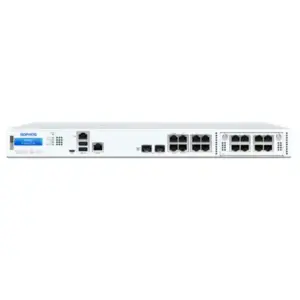
Fortinet FortiADC 5000G in Dubai, UAE
The FortiADC 5000G is built for demanding application delivery environments where very high throughput, encrypted traffic processing, resilient service design and operational visibility must be considered together. It combines high-capacity Layer 4 and Layer 7 traffic handling with hardware SSL acceleration, global load balancing, application protection and automation capabilities within the FortiADC platform.
Performance figures are vendor laboratory specifications and can vary with traffic profile, security services, configuration and network conditions.
Direct answer for buyers
Fortinet FortiADC 5000G is a high-end physical application delivery controller for distributing and protecting application traffic at large scale. It is mainly considered where organisations need high Layer 4/Layer 7 throughput, substantial encrypted traffic capacity, dense 40G/100G connectivity, global traffic management, application security and resilient service delivery. Large data centres, service providers, major enterprise platforms and high-volume digital services are the most natural environments to evaluate it. Before proceeding, buyers should confirm measured application throughput, TLS transaction rates, concurrent connections, interface and optics requirements, high-availability topology, required security subscriptions, rack power and cooling, support term, implementation scope and the exact Fortinet ordering bundle.
What the FortiADC 5000G does
An application delivery controller sits between users and application servers and makes decisions about how incoming connections should be handled. In practical terms, the FortiADC 5000G can distribute traffic across real servers, monitor server health, make Layer 7 routing decisions, offload TLS processing, provide global server load balancing across locations, and apply application security controls. This can reduce the amount of delivery logic handled by individual application servers while giving network and application teams a central point for traffic policy and visibility.
The model is not simply a faster Ethernet switch. Its value comes from combining application-aware load distribution, traffic optimization, encryption services, availability functions and security features. That distinction is important during procurement because raw port speed alone does not determine whether an ADC is correctly sized. Application behaviour, TLS handshakes, request rates, persistence methods, health checks, security inspection and redundancy all influence the design.
Who should consider it
The FortiADC 5000G is best evaluated by organisations with substantial application delivery requirements rather than small environments seeking a basic load balancer. Typical candidates include large enterprise data centres, telecom and service-provider infrastructure, high-volume e-commerce platforms, financial or public-sector application estates, hosting providers, major education or healthcare platforms, and organisations consolidating several high-throughput application services on an ADC layer.
It may also be relevant when an existing ADC platform is approaching traffic, TLS or connection limits, or where 100 Gigabit Ethernet interfaces are necessary in the application delivery path. It can be excessive for modest deployments. A smaller FortiADC model, virtual appliance or cloud deployment may be more economical when traffic levels are lower, application counts are limited, or physical 100G connectivity is not required. Correct sizing should be based on measured and forecast demand rather than selecting the largest appliance by default.
Business challenges this model can help address
Application traffic concentration
When many users, APIs and digital services converge on a shared delivery tier, traffic management must remain predictable. FortiADC can distribute connections using Layer 4 and Layer 7 policies while monitoring the health of application servers.
Encrypted traffic overhead
TLS processing can consume application-server resources and complicate inspection. The 5000G uses ASIC SSL acceleration and is specified for 180 Gbps TLS bulk encryption throughput, helping buyers design a dedicated encryption processing layer.
Multi-site application resilience
Global server load balancing can direct users between sites according to configured availability and traffic policies. This supports architectures that need geographic distribution, disaster-recovery planning or application presence across more than one data centre.
Application-layer protection
FortiADC includes web application protection capabilities, with additional security services depending on the selected bundle or subscription. Buyers should map the required WAF, bot, threat, sandbox, IPS or other functions to the correct entitlement.
Core capabilities in a buyer context
Traffic can be distributed with application-aware policies, health checking, persistence and content-based decision logic. Scripting support allows custom traffic handling where standard policy options do not fully match an application workflow.
GSLB is relevant when services span multiple data centres or cloud regions. It helps make site-level traffic decisions using configured criteria such as service availability, location or network conditions.
WAF capabilities, adaptive learning and application security services can be incorporated into the delivery layer. Specific advanced protections can depend on the selected security bundle and subscription.
FortiADC can provide browser-based access to internal applications without requiring a client-side agent for the gateway use case, with authentication and access-control options available within the platform.
FortiADC supports automation approaches including RESTful APIs, declarative APIs, Ansible, Terraform and cloud-init, allowing teams to incorporate application delivery changes into infrastructure workflows.
FortiView provides application and traffic visibility, while integrations with Fortinet and third-party management or analytics systems can support broader operational monitoring and incident workflows.
FortiADC 5000G fit matrix
Use this matrix to decide whether the model deserves a place on the shortlist.
| Requirement | Suitable when | Confirm before ordering |
|---|---|---|
| Very high ADC throughput | Traffic planning approaches the high end of the FortiADC hardware range. | Measured L4/L7 traffic, growth headroom and inspection profile. |
| Heavy TLS use | Large encrypted workloads need dedicated SSL processing. | TLS versions, cipher suites, handshake rates, certificate strategy and key management. |
| 100G network connectivity | The ADC tier must connect to a 100GbE switching fabric. | Optics, cabling, breakout requirements, switch compatibility and interface allocation. |
| Multi-site service delivery | Applications span data centres or regional locations. | DNS/GSLB design, health checks, failover objectives and routing dependencies. |
| Application security at ADC layer | WAF or advanced application protection is part of the design. | Bundle entitlement, policy scope, tuning effort and security operations ownership. |
Verified technical specifications
The following values are model-specific specifications published for FAD-5000G. Performance figures are measured under vendor test conditions and should be treated as sizing references rather than guaranteed production results. Actual performance can change with traffic characteristics, enabled services, software version, policy complexity and network conditions.
| Brand | Fortinet |
|---|---|
| Product / model | FortiADC 5000G / FAD-5000G |
| Product type | Hardware Application Delivery Controller |
| L4/L7 performance | 350 Gbps |
| L4 connections per second | 2.5 million |
| L4 HTTP requests per second | 18.5 million |
| L7 requests per second | 4.2 million |
| Maximum L4 concurrent connections | 400 million |
| SSL acceleration | ASIC |
| TLS bulk encryption throughput | 180 Gbps |
| TLS TPS, ECDHE-RSA-AES256-GCM-SHA384 | 90,000 |
| TLS TPS, ECDHE-ECDSA-AES256-GCM-SHA384 | 140,000 |
| Compression throughput | 175 Gbps |
| Virtual domains | Up to 150 |
| Memory | 512 GB |
| Network interfaces | 4 x 40G QSFP and 8 x 100G QSFP28 |
| Management interface | 1 x 10/100/1000 management interface |
| HA interfaces | 2 |
| Storage | 1.92 TB SSD |
| Management methods | HTTPS, SSH CLI, direct console CLI and SNMP |
| Power supply | Dual, hot-swap PSU support |
| Trusted Platform Module | Yes |
| Dimensions | 440 x 88 x 600 mm (W x H x D) |
| Weight | 15.68 kg |
| Form factor | 2U appliance |
| Input voltage | 100–240V AC, 50/60 Hz |
| Average / maximum power consumption | 796 W / 915 W |
| Operating temperature | 0–40°C |
| Airflow | Front to back |
| Availability | Contact FourTeck to confirm current UAE availability, exact bundle and vendor lead time. |
Licensing, bundle and compatibility dependencies
FortiADC capabilities extend beyond the physical appliance, so the hardware model alone is not a complete bill of materials. Fortinet currently presents Network Security, Application Security and AI Security bundle families for FortiADC hardware. The exact services included in a subscription differ by bundle, and advanced security functions can depend on active entitlement. FortiCare support is also part of common bundle structures. A quotation therefore needs to distinguish between the base FAD-5000G appliance and a hardware-plus-services bundle with a defined term.
Compatibility should be reviewed at several layers. Network teams need to confirm 40G and 100G optics, switch port types, cabling and link design. Application teams should document protocols, persistence, health checks, hostnames, certificates, content-routing requirements and expected HTTP/TLS behaviour. Security teams should decide whether the ADC will provide WAF, bot protection, threat analytics, sandbox integration, IPS, malware inspection or other controls, and then map those needs to the right license. Operations teams should confirm management integrations, logging destinations, high-availability method and change process. FourTeck can help translate these requirements into a quotation request, but final compatibility should be validated against the deployed software release and surrounding infrastructure.
A practical purchase and deployment journey
Measure the workload
Collect current and peak throughput, requests per second, concurrent connections, TLS transactions, application count and expected growth. Separate normal traffic from exceptional events and seasonal peaks.
Define the topology
Document the ADC position, VLANs, routing, NAT, server networks, firewall path, management network, HA links and any second data centre or cloud location involved in the service.
Select services and licenses
Decide which application security, threat, support and management functions are required. Confirm the subscription term and whether the requested capability is standard or bundle dependent.
Build the physical BOM
Confirm quantity, rack positions, power feeds, optics, cabling, spare components and any accessories. 100G connectivity requires particular attention to transceiver and switch compatibility.
Plan configuration and migration
Prepare virtual servers, pools, monitors, certificates, persistence, security policies and cutover sequencing. If replacing another ADC, map configuration logic rather than assuming a one-to-one feature translation.
Test before production
Validate health checks, failover, certificates, application functionality, logging and rollback. Performance testing should resemble the expected production traffic profile rather than relying only on synthetic port-speed tests.
High-throughput application delivery without losing application awareness
The 5000G is specified for 350 Gbps L4/L7 performance, but the more important design question is what type of traffic produces that load. A simple TCP service, an API platform with many short-lived connections and an HTTPS application with intensive policy processing can place very different demands on an ADC. Fortinet publishes additional figures such as 2.5 million L4 connections per second, 18.5 million L4 HTTP requests per second, 4.2 million L7 requests per second and up to 400 million concurrent L4 connections. Those metrics help architects compare the appliance against an actual traffic profile rather than relying on one headline number.
Layer 7 functionality is valuable because it lets the ADC make decisions using application information. Content routing, persistence, custom health checks, traffic rewrite and scripting can support applications that need more than basic destination selection. The operational benefit is control: teams can separate application pools, direct specific requests, protect maintenance windows and react to backend health without changing end-user URLs. The limit is that richer processing can affect capacity. Sizing should therefore include the intended policy set and security services, not just current bandwidth.
TLS acceleration as an architectural resource
Encrypted application delivery is often one of the main reasons to deploy a dedicated ADC tier. The FortiADC 5000G uses ASIC SSL acceleration and is specified for 180 Gbps TLS bulk encryption throughput. Fortinet also publishes transaction figures for two cipher examples: 90,000 TLS transactions per second using ECDHE-RSA-AES256-GCM-SHA384 and 140,000 using ECDHE-ECDSA-AES256-GCM-SHA384. These figures show why certificate type and cryptographic workload matter when sizing.
TLS offload can move encryption work away from backend application servers, while SSL inspection and visibility can support security workflows. However, an encryption design must account for certificate ownership, private-key handling, re-encryption to servers, compliance policy, modern TLS versions and operational renewal processes. Some organisations terminate TLS on the ADC; others require encryption on both client and server sides. High-security environments may integrate with external key-management or HSM workflows. FourTeck can help document the required topology and licensing, but the security owner should approve certificate handling and cryptographic policy before production.
Resilience, segmentation and operational scale
Large application estates often require more than a single appliance. FortiADC supports high-availability modes within the platform, and the 5000G hardware provides two HA interfaces and dual hot-swap power supplies. The appliance also supports up to 150 virtual domains, which can help separate administrative or service contexts where that design is appropriate. These capabilities are useful for shared infrastructure, but they should not be mistaken for a complete availability strategy.
A resilient design needs independent power feeds, redundant switching, failure-domain analysis, tested state behaviour, monitoring and defined failover objectives. If applications span multiple sites, GSLB introduces additional DNS, health-check and routing considerations. Teams should decide what happens when a server fails, when an ADC fails, when a whole site is unreachable and when connectivity between sites is degraded. The ADC can participate in these responses, but application architecture and upstream dependencies still matter. A clear runbook and regular failover testing are more valuable than assuming that redundant hardware automatically produces resilient services.
Suitable environments and use cases
Large enterprise application estates
Business-critical ERP, portals, customer platforms and shared application services can benefit from a central ADC layer where traffic policy, availability and encrypted delivery are managed consistently.
Service-provider and hosting platforms
High interface density, large connection capacity and virtual-domain support make the model relevant to shared service environments, provided tenancy, licensing and operational boundaries are designed carefully.
High-volume web and API services
Digital platforms with large request volumes can use advanced load balancing, TLS processing and application protection, but API behaviour and security policy should be included in performance testing.
Multi-data-centre applications
GSLB can form part of a design for regional traffic distribution, site failover or disaster recovery when DNS, monitoring and application data dependencies are also addressed.
ADC consolidation projects
Organisations retiring multiple legacy load balancers may evaluate a high-capacity platform to consolidate application delivery, but migration should preserve application-specific behaviours and not merely duplicate IP addresses.
Encrypted traffic service tiers
Where TLS traffic is a major infrastructure workload, the 5000G can be evaluated as a dedicated acceleration and visibility point alongside firewalls, application servers and security monitoring systems.
Integration and operational considerations
A successful FortiADC deployment depends on the systems around it. Start with the switching fabric. The 5000G provides 4 x 40G QSFP and 8 x 100G QSFP28 interfaces, so the network design should define which ports carry client-side traffic, server-side traffic, interconnects or aggregated links. Optics and cabling should be chosen for the exact switch platform, distance and data-centre standard. If breakout cables are planned, confirm support on both ends. Link redundancy should be designed independently from ADC high availability so one cable or switch failure does not become a hidden single point of failure.
Routing and addressing decisions are equally important. FortiADC supports IPv4 and IPv6, NAT functions and dynamic routing capabilities within the platform. Architects should document whether the deployment is one-arm, two-arm, routed, transparent or another supported topology, how return traffic reaches the ADC, and whether source addresses need to be preserved. Application owners may require the original client IP for logging or policy, which affects configuration.
Management integration should be planned before cutover. FortiADC provides FortiView analytics and can integrate with FortiAnalyzer, FortiSIEM, Splunk and other systems depending on the operational design. API and automation tools can be valuable where application teams deploy frequently, but automated changes need controls, testing and rollback. For larger estates, FortiADC Manager can support centralized management of multiple appliances. The best design is one in which networking, application and security teams agree who owns virtual services, certificates, security policies, monitoring and incident response.
Questions to resolve before requesting a quotation
Provide current peak bandwidth, request rates and forecast growth rather than only Internet circuit speed.
Include certificate type, handshake rate, bulk encryption traffic, client/server TLS termination and any inspection requirement.
Confirm 40G/100G ports, optics, fibre type, distances, switch models and redundancy.
Clarify WAF, IPS, anti-malware, sandbox, bot protection, DLP, threat analytics and other subscription-dependent services.
State appliance quantity, active/standby or active/active expectations, secondary sites and DNS dependencies.
Separate supply from installation, base configuration, migration, policy tuning, testing, documentation and knowledge transfer.
Procurement and evaluation checklist
How FourTeck can assist with sizing and procurement
FourTeck can help turn a technical requirement into a cleaner purchasing request. The process can begin with a review of the application estate, expected throughput, TLS traffic, interface needs and deployment topology. From there, the discussion can identify whether the FortiADC 5000G is appropriately sized, whether a smaller FortiADC appliance could meet the requirement, and which security or support bundle should be included in the quotation. This is particularly useful when the buyer has a high-level requirement such as “100G application load balancing” but has not yet translated it into connection rates, TLS workload, optics and licensing.
For projects that involve deployment services, FourTeck can also discuss installation and configuration scope. That may include rack and connectivity planning, base system configuration, HA setup, virtual servers, pools, monitors, certificates, persistence, routing, logging integration, migration planning or testing. The exact deliverables should be defined in the quotation because application migration effort can vary considerably by environment.
Explore the FourTeck technology product range, review available deployment and support services, or contact FourTeck with your model, quantity and project details.
UAE availability and support guidance
For Dubai and UAE projects, availability should be checked against the exact hardware or bundle SKU, quantity, subscription term and required delivery window. Enterprise ADC appliances can have different lead times from mainstream network devices, and a base FAD-5000G requirement is not identical to a one-, three- or five-year security bundle. Contact FourTeck to confirm current UAE availability rather than assuming online stock status from another region applies locally.
Delivery coordination can be discussed after the requirement is confirmed. If installation or configuration is required, include it in the request so hardware, optics, licenses and engineering scope can be planned together. Warranty and support terms should also be confirmed as part of the exact Fortinet bundle rather than inferred from generic product listings. Buyers evaluating a wider Fortinet architecture can also review FourTeck information on Fortinet solutions in Dubai and the Fortinet UAE resource site.
Dubai, Abu Dhabi, Sharjah and Ajman project coverage
FourTeck can coordinate requirement review and quotation discussions for organisations operating in Dubai, Abu Dhabi, Sharjah and Ajman. For a FortiADC 5000G project, the most useful information to share is the deployment site, required quantity, whether the design is standalone or high availability, expected application traffic, interface requirements, subscription bundle, support term and any installation or migration services. Site-specific factors such as rack space, power, data-centre access, cabling and maintenance windows can affect the implementation scope even when the hardware model is the same. Project dates should therefore be treated as planning inputs until the equipment, licensing and engineering requirements have been confirmed.
GCC Availability
FourTeck can assist organisations planning FortiADC 5000G procurement across GCC markets with requirement review, model and license selection, quotation coordination, delivery planning and configuration-scope discussions. For projects in the United Arab Emirates, Saudi Arabia, Kuwait, Qatar, Bahrain or Oman, the buyer should specify the destination country, deployment site, quantity, desired security bundle, subscription term, required optics and expected implementation timeline. Product availability, licensing, delivery schedules, service visits, project scope and vendor lead times can differ by country and by the exact Fortinet ordering code. A multi-country rollout may also require separate planning for local power, data-centre access, import processes and implementation resources. FourTeck can help organise the technical bill of materials and regional quotation request, but stock, customs handling, country certification and installation dates should be confirmed for the specific project rather than assumed from another GCC market. For Kuwait requirements, buyers may also review FourTeck Kuwait information.
Africa Availability
For organisations in Africa evaluating the FortiADC 5000G, FourTeck can help structure product, licensing and deployment requirements before a quotation is prepared. Large ADC projects often involve more than the appliance itself, so buyers should provide the destination country, quantity, exact bundle or security services, required 40G/100G optics, support term, planned data-centre environment and any installation or migration expectations. Availability and fulfilment can depend on destination, vendor lead time, regional license rules, shipping arrangements, power requirements, local project conditions and the amount of engineering work involved. This is especially relevant for regional service providers or enterprises deploying a common application-delivery architecture across several sites. FourTeck can support planning for East Africa and other African markets while keeping each project tied to its actual destination and technical scope. Buyers can review the FourTeck Africa technology site or FourTeck Kenya information for regional contact context. Current product availability and onsite coverage should always be confirmed for the requested country.
Related products, services and alternatives to consider
FortiADC 4000G
A lower-capacity G-series hardware model to evaluate when 150 Gbps L4/L7 performance and its interface profile are sufficient. It should be sized on workload, not treated as an automatic equivalent.
FortiADC 2000G
A 90 Gbps model that may fit smaller application delivery tiers. Its port mix and performance are different, so it is useful when 100G density and 5000G-scale capacity are unnecessary.
FortiADC virtual appliances
Virtual and cloud form factors can suit software-defined or cloud-centric environments. Compare platform limits, licensing and hypervisor or cloud requirements against the need for dedicated hardware acceleration.
FortiADC Manager
Centralized management may be relevant when operating multiple FortiADC appliances. Management architecture should be considered early for large or distributed estates.
Installation and migration services
A new ADC often affects routing, DNS, certificates and application policy. Planning, configuration, migration and testing can be scoped separately from hardware supply.
Fortinet application security integration
If the requirement extends beyond ADC functions, review how FortiADC fits with FortiGate, FortiAnalyzer, FortiSIEM and other Fortinet components rather than selecting each product in isolation.
Why businesses contact FourTeck for this type of requirement
A FortiADC 5000G purchase typically involves technical choices that are easy to overlook in a simple product listing. FourTeck can help clarify whether the requested model matches the intended traffic profile, what security bundle is required, which optics and accessories belong in the bill of materials, and whether installation or migration work should be quoted. This can reduce the risk of receiving a hardware-only quotation that omits subscription services, interfaces or professional services needed for the actual deployment.
The discussion can also be used to compare nearby FortiADC models when the 5000G appears over- or under-sized, align the support term with the organisation’s procurement cycle, and document compatibility questions before an order is placed. For larger projects, this requirement-clarification stage is valuable because application delivery intersects with networking, application, security and operations teams. FourTeck’s role is to coordinate the information needed for a clearer quotation and implementation plan, not to substitute assumptions for technical validation.
What buyers are trying to understand before shortlisting a 5000G-class ADC
High-capacity ADC research usually begins with a model number, but buyers quickly discover that the decision is not really about one throughput figure. The practical questions are whether the appliance can handle the specific connection pattern of the applications, whether it has the right physical connectivity, how encrypted traffic changes sizing, what security services require subscriptions, and how the system will behave during maintenance or failure. For the FortiADC 5000G, those questions are especially important because it sits at the high end of the FortiADC hardware range and can become a shared delivery layer for many applications.
Is 350 Gbps the number that matters most?
No. It is an important ceiling for model comparison, but real sizing should also look at connection rate, HTTP requests, Layer 7 requests, TLS transactions and concurrent connections. The 5000G is specified for 2.5 million L4 connections per second, 18.5 million L4 HTTP requests per second, 4.2 million L7 requests per second and up to 400 million concurrent L4 connections. A buyer running many short API calls can stress a different metric from a buyer moving large encrypted files. The expected policy and security processing also matter.
Why do TLS figures deserve separate attention?
Modern applications are predominantly encrypted, and TLS handshakes can become a sizing constraint before raw bandwidth does. The 5000G uses an SSL ASIC and is specified for 180 Gbps bulk TLS encryption, but transaction rates vary with cryptographic choices. Fortinet publishes different transaction values for RSA and ECDSA examples, which shows why the certificate profile matters. Buyers should gather certificate types, TLS versions, peak new-session rates and whether traffic will be re-encrypted to backend servers. That information makes a quotation discussion far more meaningful than simply stating “HTTPS traffic.”
Does the appliance include every FortiADC security feature?
The platform exposes a broad set of application and network security capabilities, but feature availability can depend on the selected subscription bundle. Fortinet currently groups hardware offers into Network Security, Application Security and AI Security bundle families. A procurement team should therefore ask for the exact SKU and term, not just “FortiADC 5000G.” If WAF signatures, adaptive learning, bot protection, threat analytics, sandbox, DLP, IPS or malware protection are part of the requirement, they should be listed explicitly so entitlement can be checked before purchase.
What does 8 x 100G connectivity change?
It gives architects substantial physical bandwidth, but it also raises practical questions about the data-centre fabric. QSFP28 optics, fibre type, link distance, switch compatibility, port-channel design and redundancy need to be decided. Not every port should automatically be populated, and link capacity should not be confused with application processing capacity. Teams should map client-side, server-side, HA and management traffic, then choose optics and cabling accordingly. If the surrounding switches are not 100G-ready, a 5000G purchase may trigger additional infrastructure work.
Another common research question is whether a high-end physical ADC is preferable to virtual or cloud alternatives. There is no universal answer. Physical hardware makes sense when predictable high throughput, dedicated interfaces and hardware SSL acceleration are important in an on-premises data centre. Virtual FortiADC options can fit private-cloud or software-defined environments where elastic placement matters more than dedicated appliance interfaces. Public-cloud deployments may favour marketplace or cloud-native deployment models. Organisations with hybrid applications sometimes use more than one form factor, with GSLB coordinating services across locations.
Buyers also compare FortiADC with existing load-balancing platforms when planning a migration. The safest approach is not to create a feature-name checklist and assume every object translates directly. Instead, inventory virtual IPs, server pools, health monitors, persistence methods, content rules, scripts, SSL certificates, redirects, security policies, DNS dependencies and operational integrations. Then rebuild the application intent on the target platform. This is particularly important for mature ADC estates where years of custom rules may be hidden inside configurations that application owners no longer fully document.
Quotation preparation should therefore include more than model and quantity. A strong request states the deployment country, number of appliances, HA requirement, traffic and TLS profile, required ports and optics, license bundle, support term, application count, migration scope and desired implementation services. FourTeck can use that information to coordinate a clearer UAE quotation and identify which details still need technical confirmation.
Decision questions that often surface late in an ADC project
How much performance headroom should be reserved?
Headroom should cover expected growth, traffic bursts, maintenance scenarios and the effect of enabled services. There is no single percentage that fits every application. A service with stable internal traffic may need less reserve than a public platform exposed to seasonal campaigns or unpredictable connection spikes. Build the sizing model from measured peaks, then add a justified growth and resilience margin rather than choosing capacity by instinct. If two appliances operate in HA, consider whether one unit must carry the required load during maintenance or failure.
Should TLS terminate on the ADC or remain end-to-end?
That is a security and application architecture decision. Terminating TLS on the ADC can enable content inspection, Layer 7 routing and server offload. Re-encrypting traffic to backend servers preserves encryption across the data-centre segment. Some regulated environments have strict key-handling or encryption requirements. Confirm certificate ownership, HSM needs, backend TLS policy and responsibility for renewals before configuration. The answer can affect both performance and operational complexity.
Can one appliance serve many teams or applications?
The platform supports multiple virtual domains and a large connection scale, so shared deployment is possible. The more important question is governance. Define administrative boundaries, address spaces, naming standards, certificate ownership, change approval, capacity allocation, logging and incident escalation. A technically capable shared ADC can still become difficult to operate if every application team uses different conventions and there is no agreed ownership model.
What information is needed to migrate from another vendor?
Provide an inventory of virtual services, pools, nodes, health checks, persistence, traffic scripts, redirects, SSL profiles, certificates, security policies, GSLB objects and monitoring integrations. Include traffic data for each major service and identify applications that cannot tolerate address or behaviour changes. Migration estimates depend more on configuration complexity and testing requirements than on the number of physical appliances being replaced.
When does a smaller FortiADC model make more sense?
If measured traffic, TLS load and port requirements are comfortably below the 5000G range, a 4000G, 2000G, 1000G or another FortiADC option may deliver a better cost-to-capacity fit. The correct comparison uses the same workload assumptions across models. Do not downsize solely on current bandwidth if connection or TLS rates are high, and do not select the 5000G only because it is the largest model. FourTeck can help structure the comparison around workload and bill of materials.
How should UAE price requests be prepared?
Ask for the exact FAD-5000G base appliance or bundle SKU, quantity, subscription term, support level, optics and professional services. State the UAE delivery location and desired timeline. Online prices from other countries can be useful as market references but may refer to different bundles, tax treatment, support terms or stock positions. A current FourTeck quotation should be treated as the project-specific commercial reference.
Frequently asked questions
What is the Fortinet FortiADC 5000G mainly used for?
It is a high-capacity hardware application delivery controller used to distribute, optimize and protect application traffic. It is suited to large environments that need advanced L4/L7 load balancing, high TLS processing capacity, dense 40G/100G connectivity, GSLB and application-delivery security functions.
What is the published L4/L7 performance of the FortiADC 5000G?
Fortinet specifies 350 Gbps L4/L7 performance for FAD-5000G. Actual production performance can vary with traffic type, enabled features, policy complexity, software version and network conditions, so sizing should include the expected workload rather than relying on one number.
Which network interfaces does the 5000G provide?
The published hardware specification lists 4 x 40G QSFP and 8 x 100G QSFP28 network interfaces, plus a dedicated 10/100/1000 management interface. Optics and cabling should be confirmed for the connected switch platform and data-centre design.
Does FortiADC 5000G support high availability?
FortiADC supports high-availability capabilities, and the 5000G hardware includes two HA interfaces and dual hot-swap power supplies. The complete HA design still needs redundant switching, power, configuration and failover testing appropriate to the application.
Are all FortiADC security services included with the base appliance?
No assumption should be made that every security service is active on a base appliance. Fortinet offers different FortiADC security bundles, and feature availability can depend on the selected subscription. Confirm the exact bundle and term for WAF, threat, bot, sandbox, IPS, malware and other required services.
What TLS capacity is published for FortiADC 5000G?
Fortinet specifies 180 Gbps TLS bulk encryption throughput and ASIC SSL acceleration for the model. Published TLS transaction rates vary by cryptographic profile, so buyers should include certificate types and expected new-session rates in sizing.
Can the FortiADC 5000G be used for multi-site applications?
Yes, FortiADC includes global server load balancing capabilities that can support traffic distribution across multiple sites. A production GSLB design must also account for DNS, health checks, application data dependencies, routing and failover objectives.
What should be included in a FortiADC 5000G quotation request?
Include the exact model or bundle SKU, quantity, HA requirement, traffic and TLS profile, required 40G/100G optics, subscription term, support requirement, delivery location and any installation, configuration or migration services.
Is the FortiADC 5000G currently available in Dubai?
Current UAE availability should be confirmed for the exact SKU, quantity and bundle term. Availability can change with vendor lead time and project requirements, so contact FourTeck for a current Dubai or UAE quotation rather than relying on overseas stock listings.
Prepare a FortiADC 5000G requirement that is ready to quote
Share the quantity, application traffic, TLS profile, required interfaces, HA topology, security bundle, support term and UAE deployment location. FourTeck can help review the requirement, identify missing bill-of-material items and coordinate a current quotation and configuration discussion.

Reviews
There are no reviews yet.