

Fortinet FortiAuthenticator 300G in Dubai, UAE
The FAC-300G gives organisations a dedicated on-premises platform for centralising user authentication, multi-factor authentication, single sign-on, certificate services and identity-aware access workflows. It is designed for buyers who want a hardware appliance with a base capacity of up to 1,500 local and remote users and a documented upgrade ceiling of 3,500 users.
Direct answer for buyers evaluating the FAC-300G
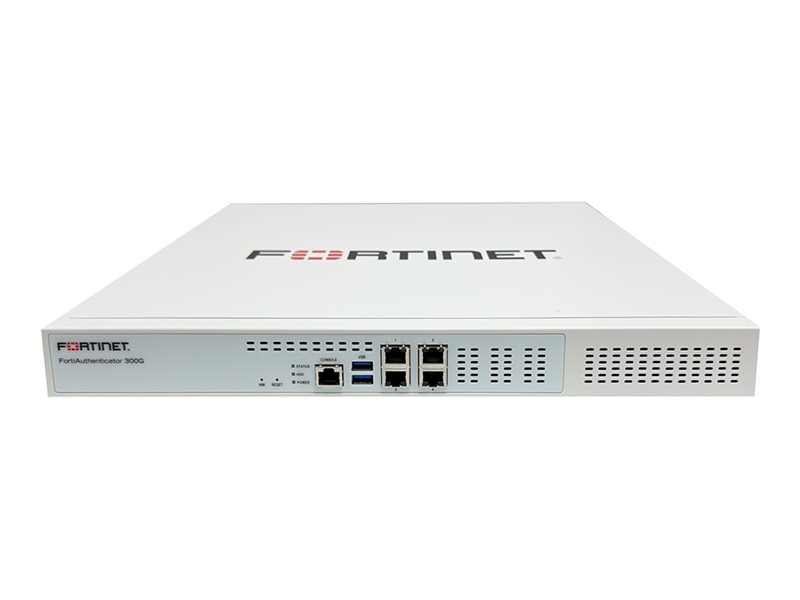
Fortinet FortiAuthenticator 300G is a rack-mounted identity and access management appliance used to centralise authentication and identity services across business networks. It can support RADIUS and TACACS+ authentication, LDAP and Active Directory integration, SAML identity-provider and service-provider roles, multi-factor authentication, Fortinet Single Sign-On, certificate management and FIDO-based passwordless authentication. Organisations considering it should verify the number of users, network access servers, FortiTokens, user certificates and groups they expect to manage, as well as the required support level and high-availability design. The hardware ships with one 450 W power-supply unit by default, while an additional compatible PSU is available for redundancy. Licensing, token purchases and project scope should be confirmed before an order is placed.
What the appliance does
The FortiAuthenticator 300G acts as a central identity decision point for networks that need to authenticate people, devices and administrative users against defined identity stores and access policies. Instead of allowing every firewall, VPN gateway, wireless system or application to maintain a completely separate authentication workflow, organisations can consolidate major identity functions in one dedicated platform.
That central role is useful when authentication needs to span Fortinet Security Fabric deployments and third-party systems. Depending on the intended design, the appliance can participate in RADIUS, TACACS+, LDAP, SAML, certificate-based and single-sign-on workflows. The value is not simply having another server in the rack; it is creating a structured authentication service that security, networking and infrastructure teams can govern more consistently.
Who should consider the 300G
The 300G is relevant to medium-sized organisations, branch-heavy businesses, regulated environments, education groups, healthcare operations, professional services firms, industrial sites and other organisations that want a physical on-premises authentication appliance rather than a purely virtual or cloud-hosted identity service. Its base capacity of 1,500 local and remote users gives buyers a clear starting point, while supported hardware user-upgrade licences can extend the documented limit to 3,500.
It is less appropriate when projected scale already exceeds that upper limit, when a much larger RADIUS-client population is required, or when the organisation prefers a cloud or virtual deployment model for operational reasons. In those cases, comparing the FAC-800G, larger hardware models or FortiAuthenticator virtual options is more sensible than attempting to force the 300G into the wrong role.
Business challenges the FAC-300G can help address
Fragmented authentication
When VPNs, network devices and applications use separate identity stores and policies, administration becomes harder to control. FortiAuthenticator can centralise multiple authentication services and connect them to existing directories.
Weak password-only access
Organisations seeking stronger verification can design multi-factor authentication around FortiToken, supported one-time-password methods, FIDO2 and other supported workflows. Token and messaging requirements are separate procurement considerations.
Manual identity mapping
Integration with directory and single-sign-on services can help network security controls make better use of user and group context, reducing dependence on static IP-based identification where the deployment is designed correctly.
Certificate administration
The appliance includes certificate-management capabilities that can support certificate-based access designs, SCEP workflows and enterprise PKI use cases. The certificate lifecycle and trust model should be planned before deployment.
Core identity capabilities in one operational platform
Is the FortiAuthenticator 300G the right fit?
| Requirement | Suitable when | Confirm before ordering |
|---|---|---|
| User population | The base design is within 1,500 users or can remain within the documented 3,500-user upgrade limit. | Current identities, projected growth and which accounts are counted in the deployment. |
| RADIUS environment | The design fits the documented base capacity of 500 RADIUS clients or the upper limit of 1,166. | Number of NAS devices, sites, wireless controllers, VPN gateways and other RADIUS clients. |
| MFA deployment | The organisation wants central MFA and can plan the appropriate token or messaging method. | FortiToken quantity, token type, SMS gateway or credits, and enrolment workflow. |
| Rack deployment | A 1RU on-premises appliance is operationally preferred. | Rack space, airflow, power, cabling and secondary PSU requirements. |
| Resilience | Active-passive HA or configuration-sync designs are required and fit the chosen architecture. | Second appliance, licensing alignment, topology and failure-handling expectations. |
Verified FortiAuthenticator 300G hardware and capacity information
| Brand | Fortinet |
| Product / SKU | FortiAuthenticator 300G / FAC-300G |
| Product type | Physical identity and access management appliance |
| Copper interfaces | 4 × 10/100/1000 RJ45 interfaces |
| SFP interfaces | 0 |
| Local storage | 2 × 1 TB SSD configured as RAID 1 |
| Trusted Platform Module | Yes |
| Local + remote users | 1,500 base / 3,500 documented upper limit |
| FortiTokens | Up to 3,000 supported; token purchases are separate |
| RADIUS clients | 500 base / 1,166 documented upper limit |
| User groups | 300 |
| CA certificates | 10 |
| User certificates | 7,500 |
| Dimensions | 44 × 438 × 420 mm (1.73 × 17.24 × 16.54 in) |
| Weight | 5.75 kg (12.7 lb) |
| Form factor | Rack mountable, 1RU |
| Power supply | 450 W redundant auto-ranging 100–240 V; ships with one PSU by default, optional additional PSU SKU SP-FAC300G-PS |
| Power consumption | 101.5 W average / 131.7 W maximum |
| Operating temperature | 0°C to 40°C |
| Airflow | Front to back |
| Management | CLI, direct console and HTTPS |
| High availability | Active-passive HA and configuration-sync HA |
| Current UAE availability | Contact FourTeck to confirm quantity, lead time, support term and regional ordering options. |
Licensing, token and redundancy dependencies
The appliance capacity and the authentication method are separate parts of the bill of materials. The base FAC-300G hardware licence supports up to 1,500 users. FortiAuthenticator hardware user-upgrade licences such as FAC-HW-100UG and FAC-HW-1000UG can be stacked to increase supported users, but the model’s documented upper limit remains 3,500. A buyer therefore needs to size the starting deployment and expected growth rather than assuming the hardware can scale indefinitely.
FortiToken hardware or software tokens are not automatically the same purchase as the FAC-300G appliance. The chosen MFA method may require FortiToken licences, hardware tokens, supported FIDO tokens, SMS credits or a third-party SMS gateway. If authentication continuity is critical, the architecture may also require a second FortiAuthenticator appliance and aligned licensing for high availability. The physical appliance ships with one power-supply unit by default; buyers wanting power-supply redundancy should include the compatible additional PSU in the quotation.
Compatibility should be checked against the FortiGate, FortiClient, directory, SAML application, VPN, wireless, switching and other systems that will participate in the identity workflow. Version compatibility and protocol requirements can affect the final design, so the proposed software versions and integration points should be documented before implementation.
A practical purchase and deployment journey
Map identities
Count employees, contractors, administrators, remote users and other identities that will rely on FortiAuthenticator services, then forecast realistic growth.
Define access flows
List RADIUS, TACACS+, LDAP, SAML, certificate, SSO and MFA use cases so the design reflects real authentication traffic instead of a generic appliance purchase.
Build the bill of materials
Confirm hardware, user upgrades, support term, token quantities, optional PSU and any additional appliances required for resilience.
Plan integration
Validate network reachability, time synchronisation, certificates, directory service accounts, DNS and application metadata before configuration begins.
Test and hand over
Use staged testing for user enrolment, fallback, failover, SSO, certificate or MFA scenarios and document the operational process before production handover.
Centralised authentication without replacing every directory
FortiAuthenticator does not require an organisation to discard Active Directory or another established identity store simply to obtain stronger network authentication. A common design is to integrate with existing directories and use FortiAuthenticator as an authentication and policy intermediary. This can allow network devices, remote-access systems and supported applications to consume central identity services while the authoritative user data remains where the business already manages it.
The architectural advantage is control. Network teams can define RADIUS or TACACS+ flows, security teams can introduce stronger verification, and application owners can use SAML or certificate-based approaches where appropriate. The actual outcome depends on directory structure, groups, protocol support, certificate trust and software versions. A discovery session should therefore document every identity source and relying system before the final design is approved.
MFA choices should follow risk and user experience
The FAC-300G supports several ways to strengthen authentication, but buyers should resist selecting a method solely because it is available. FortiToken-based MFA, email or SMS one-time passwords, and FIDO2 passwordless methods have different operational considerations. Remote employees, privileged administrators, third-party contractors and front-line workers may need different enrolment and recovery procedures even when they authenticate through the same platform.
Procurement also changes with the method. FortiToken licences or hardware tokens are separate from the base appliance, SMS may require FortiGuard credits or a third-party gateway, and compatible FIDO hardware is a separate purchase. The best design balances assurance, usability, recovery and lifecycle management. FourTeck can help map the required authentication methods to the appropriate bill of materials without assuming that every user needs the same factor.
Resilience is an architecture decision, not a checkbox
FortiAuthenticator supports active-passive high availability and configuration-sync approaches, but a resilient authentication service requires more than enabling an HA setting. Buyers should consider where the appliances are placed, how clients reach them, whether directories and DNS remain available during a site event, how certificates are protected, and how authentication clients behave when the primary node is unavailable.
Power redundancy is another layer. The 300G uses a 450 W redundant-capable power design and ships with one PSU by default, with the SP-FAC300G-PS available as an additional module. If dual feeds are a requirement, include that second PSU and verify rack power arrangements. If business continuity requires a second appliance, capacity and licensing alignment should be assessed at the same time so failover does not create an unexpected service limitation.
Business environments where the 300G may fit
Multi-site enterprises
Centralise authentication for branch firewalls, VPN users and network equipment while keeping directory services integrated with established corporate identity processes.
Privileged administration
Use TACACS+ or RADIUS in suitable network-administration scenarios, with MFA and role design considered as part of the broader privileged-access policy.
Education and campus access
Support network authentication, guest workflows, certificate use and federated access patterns where the documented capacity matches the institution’s identity population.
Regulated and sensitive networks
Create stronger identity checks for access to business systems while maintaining on-premises control of the authentication appliance and its configuration.
Integration and operational considerations
A FortiAuthenticator project is usually connected to several other services, so deployment quality depends on the readiness of the surrounding environment. Network routing and firewall policies must allow the required authentication traffic. DNS and NTP need to be reliable because identity and certificate workflows are sensitive to naming and time. Directory bind accounts, groups and organisational-unit structures should be documented. SAML integrations require accurate metadata, certificates and entity identifiers. RADIUS or TACACS+ clients require shared secrets, client definitions and policy planning. Certificate services require a trust and renewal model that operations teams understand.
Version compatibility should also be checked before configuration. FortiAuthenticator software versions evolve, and interoperability with FortiGate, FortiClient and other Fortinet products can depend on supported release combinations. Third-party application support for SAML, RADIUS, LDAP or certificate authentication varies as well. The safest approach is to record the current software versions and intended target versions during the quotation stage, then validate them against the relevant vendor documentation before implementation.
Operational ownership matters after go-live. Teams should decide who manages user enrolment, token assignment, certificate approval, administrator access, backup, software upgrades, monitoring, incident response and periodic access reviews. FortiAuthenticator can centralise key authentication services, but the governance around those services remains a business responsibility. FourTeck can include configuration or deployment assistance in the quotation when required.
Questions to resolve before requesting a quotation
Procurement checklist for FortiAuthenticator 300G
How FourTeck can assist with sizing and deployment planning
A useful FortiAuthenticator quotation starts with the authentication design rather than the hardware code alone. FourTeck can help organisations review user numbers, RADIUS client counts, directory sources, MFA methods, certificate requirements, SAML applications, high-availability expectations and deployment responsibilities. That information can then be used to identify whether FAC-300G is appropriately sized and which user upgrades, tokens, support contracts or accessories should be included.
Where implementation support is required, the scope can address initial appliance setup, network integration, directory connectivity, RADIUS or TACACS+ services, MFA enrolment planning, SAML configuration, certificate functions, testing and operational handover. Migration from an existing authentication system should be scoped separately because user databases, tokens, shared secrets, certificate trust and application dependencies can make each project different.
For wider security planning, buyers can also review FourTeck technology products, implementation and support services, and Fortinet firewall planning in Dubai.
UAE availability and support guidance
FortiAuthenticator 300G availability in the UAE can vary with quantity, support term, vendor lead time and the exact bill of materials. Contact FourTeck to confirm current UAE availability rather than assuming a particular stock position from an online listing. A request should ideally include the FAC-300G quantity, required user-upgrade licences, FortiToken requirements, power-supply redundancy, high-availability design and support term so the quotation reflects the intended production environment.
Delivery and project coordination can be discussed after the requirement is confirmed. If installation or configuration services are required, include them at quotation stage so site access, rack readiness, IP addressing, directory information, administrator availability and testing windows can be planned. For direct assistance, use the FourTeck UAE contact page.
Dubai, Abu Dhabi, Sharjah and Ajman coverage
Businesses in Dubai, Abu Dhabi, Sharjah and Ajman can ask FourTeck to coordinate FortiAuthenticator requirements covering product selection, licence sizing, delivery planning, installation scope and configuration support. The exact service arrangement depends on the project location, site-access requirements, number of appliances, integrations and requested schedule. For multi-site UAE projects, share the site list and intended architecture early so the bill of materials can distinguish central appliances, high-availability nodes, tokens, support contracts and any site-specific implementation tasks. Availability and visit timing should be confirmed in the formal quotation rather than assumed in advance.
GCC Availability
FourTeck can assist organisations planning FortiAuthenticator deployments across GCC markets with requirement review, user sizing, model selection, licensing guidance, quotation coordination and deployment planning. For a FAC-300G requirement, buyers should provide the destination country, appliance quantity, projected user population, authentication methods, token quantities, support term and whether configuration or installation assistance is required. Requirements in the United Arab Emirates, Saudi Arabia, Kuwait, Qatar, Bahrain or Oman may differ in procurement process, delivery routing, project access and service scope. Product availability, licence region, vendor lead time, delivery schedule and support arrangements can also vary by country and quantity. For regional projects, it is useful to standardise the intended authentication architecture while still documenting local directory, network and application dependencies at each site. FourTeck can coordinate the commercial requirement once those details are available; no local stock, fixed delivery date, customs outcome or installation date should be assumed until the destination and final bill of materials are confirmed.
Africa Availability
Organisations planning FortiAuthenticator for Africa can work with FourTeck on product evaluation, user and RADIUS-client sizing, token planning, support requirements, accessories and deployment scope. Availability can depend on the destination country, exact FAC-300G quantity, licence requirements, vendor lead time, shipping arrangements, power considerations and the level of local implementation support needed. Projects in East Africa, including Kenya and Uganda, or in other African regions should identify the destination, proposed deployment schedule, number of users, directory integrations and any requirement for high availability before quotation. This helps separate the hardware purchase from licences, FortiTokens, optional power supplies and services. FourTeck can also discuss regional procurement planning through its Africa technology coverage. Buyers should confirm current fulfilment and project conditions for the specific country rather than assuming inventory, immediate shipment, customs handling, onsite coverage or guaranteed delivery dates.
Related options and supporting services to evaluate
FortiAuthenticator 800G
Consider the larger hardware model when user population, RADIUS client count, storage or interface requirements exceed the 300G’s documented limits. Exact sizing should be verified before selecting the model.
FortiAuthenticator VM
A virtual deployment can be relevant when appliance ownership, data-centre architecture or flexible virtual infrastructure better matches the organisation’s operating model.
FortiToken options
MFA deployments may require software or hardware token purchases. Token type, quantity, assignment model and recovery procedures should be planned with the user population.
Configuration and migration
FourTeck can scope assistance for initial configuration, directory integration, RADIUS or SAML setup, migration, testing and administrator handover where required.
Why businesses contact FourTeck for FortiAuthenticator planning
Identity projects frequently fail at the purchasing stage when the request contains only an appliance name but omits the user count, authentication methods, licences, tokens, high-availability requirements and integration scope. FourTeck helps turn the product request into a more complete technical and commercial requirement. That can include clarifying whether the FAC-300G is the right capacity, identifying supported user-upgrade needs, separating token purchases from the hardware, checking whether an optional PSU should be included and defining the support term.
For implementation, the discussion can cover directory integration, RADIUS or TACACS+ clients, SAML applications, MFA enrolment, certificate functions, network prerequisites, testing and handover. Buyers can learn more about FourTeck or use the business technology contact channel to share a requirement.
What buyers are usually trying to understand before selecting the FAC-300G
A buyer comparing FortiAuthenticator 300G is usually deciding more than whether the appliance can sit in a rack. The important question is whether its identity capacity, authentication methods and operational model fit the organisation for the life of the project. The documented base limit of 1,500 local and remote users makes the starting point clear, but the stronger sizing conversation considers the upper limit of 3,500 users, expected business growth and the number of systems that will depend on the appliance. If the organisation is already close to the upper limit before deployment, moving to a larger model can be more practical than buying the smaller appliance and immediately planning multiple upgrades.
Buyers also compare FortiAuthenticator with services already available in their directory or cloud identity platform. The decision is rarely about duplicating every identity feature. FortiAuthenticator becomes most relevant when network authentication, Fortinet integration, RADIUS or TACACS+ services, certificate functions, Fortinet Single Sign-On or specific MFA workflows need a dedicated central platform. Existing Active Directory or LDAP infrastructure can remain important because FortiAuthenticator can integrate with external directories rather than forcing every identity to be recreated locally. For SAML applications, the appliance can participate as an identity provider or service provider where the application and design support that role.
Another common research question is whether the 300G is simply a newer version of the 300F. The G-series model is listed with 2 × 1 TB SSD storage in RAID 1, while buyers should still evaluate the product based on the current ordering guide and exact model specifications rather than assuming every feature from a previous-generation model carries over unchanged. Procurement teams should use FAC-300G as the exact manufacturer SKU when requesting a quote and should keep upgrade licences separate from the hardware line item.
Organisations planning high availability often search for whether one appliance is enough. Technically, the 300G supports active-passive HA and configuration-sync HA, but business continuity depends on the whole authentication path. If the secondary node is in another rack or site, network routes, directory reachability, DNS, NTP and client failover behaviour need to be tested. A second power-supply module protects against a PSU failure only when the rack also has suitable power design; it does not replace an HA appliance. Likewise, an HA pair does not protect an identity workflow if both nodes depend on the same unavailable directory or network path.
For Dubai and UAE buyers, pricing questions should be approached as a complete configuration rather than a single appliance figure. The final commercial amount can depend on product cost, support term, user upgrades, token quantity, optional PSU, second appliance for HA, services and vendor lead time. Public internet prices can provide only a rough market reference because they may use different support assumptions, currencies and availability conditions. A useful quotation request therefore states the appliance quantity, user count, token requirement, support duration, destination and services needed. This reduces the risk of comparing quotes that contain different components.
Deployment questions are equally practical. Before installation, teams should identify which systems will send RADIUS or TACACS+ requests, which directory contains the users, which applications need SAML, whether certificates will be issued, how users will enrol in MFA and who owns support after go-live. If those details are not yet known, FourTeck can help structure a discovery discussion before hardware is ordered. This is particularly useful when the organisation is moving from device-local authentication or a mixture of separate identity services and wants a more consistent model across network access, administrator access, VPN and supported applications.
Decision questions that help prevent the wrong purchase
Should we buy the 300G if we expect more than 3,000 users soon?
Possibly, but growth should be modelled carefully. The base licence covers up to 1,500 users and supported hardware upgrades can extend the 300G to a documented maximum of 3,500. If the projected population is already approaching that ceiling, compare a larger model before ordering so future expansion does not immediately force a platform change.
Do all employees automatically need a FortiToken?
No. Token requirements depend on which users and applications will use MFA and which authentication method is selected. Some groups may use FortiToken, others may use supported FIDO or other OTP methods. Token quantity should follow the access policy, not simply the employee headcount.
What matters more: user count or RADIUS client count?
Both can matter. A distributed network can have many firewalls, controllers, switches or other NAS devices even with a modest user population. The 300G lists 500 RADIUS clients at base capacity and an upper limit of 1,166, so a branch-heavy environment should count devices as carefully as identities.
Can we use our existing Active Directory?
FortiAuthenticator supports integration with Active Directory and LDAP. The design should confirm directory reachability, service accounts, group structure and the required authentication flow. Integration allows the project to build on an existing identity source rather than assuming all user records must be recreated.
When does the optional second PSU make sense?
The appliance ships with one PSU by default and supports an additional SP-FAC300G-PS module. A second PSU is useful when the rack has redundant power feeds and the business wants to reduce the impact of a single power-supply failure. It does not substitute for a second appliance when authentication-service continuity is required.
What information produces a more accurate UAE quote?
Provide FAC-300G quantity, user count, projected growth, RADIUS-client count, MFA method, FortiToken quantity, user-upgrade requirements, support term, HA design, optional PSU requirement, delivery destination and desired installation or configuration scope. This helps ensure competing quotations describe the same solution.
Frequently asked questions
How many users does the FortiAuthenticator 300G support?
The FAC-300G base hardware licence supports up to 1,500 local and remote users. Compatible FortiAuthenticator hardware user-upgrade licences can expand the appliance to the documented upper limit of 3,500 users.
What storage and network interfaces does the FAC-300G include?
The FortiAuthenticator 300G has four 10/100/1000 RJ45 interfaces and 2 × 1 TB SSD local storage configured as RAID 1. It does not list SFP interfaces on this model.
Does the FortiAuthenticator 300G support MFA and passwordless authentication?
Yes. FortiAuthenticator supports multi-factor authentication methods including FortiToken-based options and FIDO2 passwordless registration and authentication. Token, FIDO hardware or messaging components may require separate purchases.
Can the FAC-300G integrate with Active Directory, LDAP, RADIUS and SAML?
Yes. FortiAuthenticator supports Active Directory and LDAP integration, RADIUS and TACACS+ services, and SAML identity-provider and service-provider roles. Exact interoperability should be checked against the versions and applications in the proposed environment.
Is high availability supported on the FortiAuthenticator 300G?
Yes. Fortinet documents active-passive HA and configuration-sync HA for the FAC-300G. A resilient deployment may require a second appliance, appropriate licensing and a tested network and directory architecture.
Are FortiTokens or SMS services included with the appliance?
Do not assume they are included. FortiToken software or hardware tokens are separate purchases, and SMS authentication may require FortiGuard SMS credits or a supported third-party gateway depending on the chosen design.
Which user-upgrade licences apply to the FAC-300G?
Fortinet lists FAC-HW-100UG and FAC-HW-1000UG as stackable hardware user-upgrade options for the 300G family. The resulting licensed capacity must remain within the 3,500-user upper limit for the model.
What should UAE buyers confirm before ordering?
Confirm the exact FAC-300G quantity, user count, upgrade licences, FortiToken requirements, support term, optional second PSU, HA design, delivery destination, integration requirements and any installation or configuration services.
Can FourTeck help with FortiAuthenticator installation and configuration?
Yes. FourTeck can scope assistance for requirement review, sizing, initial configuration, directory integration, RADIUS or TACACS+ setup, MFA planning, SAML integration, testing and operational handover where these services are required.
Prepare a complete FortiAuthenticator 300G requirement
Share your user count, planned growth, RADIUS-client quantity, MFA method, support term, high-availability requirement and UAE delivery location. FourTeck can help determine whether FAC-300G fits the project and identify the licences, tokens, accessories and services that should be included in the quotation.

Reviews
There are no reviews yet.