

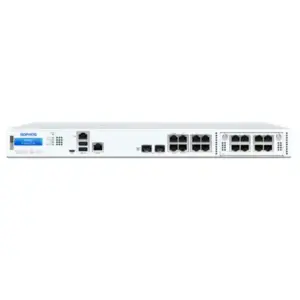
Fortinet FortiGate 4800F Firewall in Dubai, UAE
The FortiGate 4800F is built for networks where interface density, encrypted-traffic inspection, session scale and east-west segmentation are design constraints rather than secondary considerations. It combines multiple 400GE and 200GE interfaces with FortiOS, NP7 network processors and CP9 content processors in a 4RU platform intended for demanding enterprise, service-provider and hyperscale deployments.
A good fit when the project needs
- 400GE or 200GE firewall connectivity at the data-centre core
- High session scale for carrier, cloud or large enterprise traffic
- Hardware-accelerated NGFW, VPN and segmentation functions
- A 4RU appliance with redundant, hot-swappable AC power
- Optional hyperscale acceleration where the licensed feature set is required
Direct answer: what is the FortiGate 4800F?
The Fortinet FortiGate 4800F is a high-end physical next-generation firewall for very large data-centre, service-provider, mobile-network and hyperscale security designs. It is mainly used where a security platform must inspect and control very high traffic volumes while connecting directly to 400GE, 200GE, 100GE, 50GE and lower-speed network links. Buyers should consider it when capacity planning shows that smaller appliances will not meet interface, session, VPN or inspection requirements. Before proceeding, confirm the exact AC model, optics and cabling, FortiGuard and FortiCare subscriptions, high-availability design, power and cooling, rack requirements, and whether the separate hyperscale license is needed for the intended acceleration features.
What it does in a large network
The appliance sits at a high-capacity security enforcement point and applies firewall, application control, intrusion prevention, VPN, segmentation and other FortiOS functions to traffic moving between network zones, data-centre fabrics, internet edges, cloud interconnects or carrier network elements. Its purpose is not simply to route packets quickly; it is to preserve useful inspection and policy control as link speeds and session counts increase.
Fortinet’s published figures show the difference between raw firewall throughput and security-enabled performance. The 4800F is rated up to 3.1 Tbps for large-packet IPv4 or IPv6 firewall throughput, while the enterprise traffic mix figures are lower when IPS, NGFW and threat-protection functions are active. That distinction matters for sizing because real projects should be based on the security services that will actually be enabled.
Who should consider it
The FortiGate 4800F is most relevant to organisations operating large private or colocation data centres, cloud and hosting platforms, telecom and mobile infrastructure, internet-facing service environments, major government or enterprise cores, and networks where 100GE to 400GE links must pass through security policy without forcing a major architectural bottleneck.
It is usually excessive for a standard office perimeter, small campus or ordinary branch. A buyer should not select the 4800F solely because it is a higher-numbered model. The correct choice depends on measured traffic, encrypted traffic percentage, session growth, port speeds, east-west segmentation needs, VPN requirements, feature subscriptions and availability architecture. FourTeck can help compare these inputs before a bill of materials is prepared.
Business challenges the 4800F is designed to address
Security at very high link speeds
When core and interconnect links move to 100GE, 200GE or 400GE, placing an undersized firewall in the path can create an avoidable choke point. The 4800F provides high-speed interface density and hardware acceleration for designs that must inspect large traffic volumes.
Large session populations
Cloud platforms, service providers, mobile networks and high-volume internet services may maintain huge numbers of simultaneous sessions. The 4800F publishes 280 million concurrent TCP sessions in its base figures and higher licensed hyperscale figures for specific use cases.
Encrypted traffic inspection
Modern application traffic is heavily encrypted, so raw firewall throughput alone is not a useful sizing metric. Fortinet publishes an SSL inspection figure of up to 63 Gbps under its stated IPS and HTTPS test profile, giving designers a specific figure to evaluate against projected TLS traffic.
East-west segmentation
Large data centres increasingly need policy enforcement between workload zones rather than only at the north-south perimeter. FortiOS supports segmentation use cases, while high-speed ports allow the firewall to be positioned within high-capacity data-centre paths when the architecture is designed appropriately.
Core capabilities that matter during evaluation
Product-fit matrix
| Requirement | Suitable when | Confirm before ordering |
|---|---|---|
| 400GE firewall insertion | Core or interconnect architecture needs direct 400GE-class ports. | Optic type, distance, fibre, breakout plan and port allocation. |
| Security inspection at high throughput | Projected IPS, NGFW and encrypted traffic is within the tested capacity with headroom. | Actual services enabled, traffic mix, growth rate and SSL inspection percentage. |
| Large session scale | Service-provider, carrier or cloud workloads create very large concurrent connection tables. | Base versus hyperscale-licensed session targets and logging requirements. |
| High availability | The architecture requires active-active, active-passive or supported clustering approaches. | Appliance quantity, HA links, switch design, routing convergence and maintenance procedure. |
| Rack and facility readiness | The data centre can support a 4RU, approximately 41.2 kg appliance with front-to-back airflow. | Rack depth, rails, power circuits, cooling budget and service clearance. |
Verified FortiGate 4800F technical information
The following values are based on current manufacturer documentation for the exact FG-4800F AC appliance. Performance figures are published as “up to” values and vary with system configuration, traffic profile, feature set and software. They should be used as design inputs, not as guaranteed production results.
| Brand / model | Fortinet FortiGate 4800F, SKU FG-4800F |
| Product type | High-end next-generation firewall / hyperscale-capable security appliance |
| Form factor | Rack mount, 4RU |
| Security processors | Fortinet NP7 and CP9 hardware acceleration |
| 400GE / 200GE / 100GE / 40GE interfaces | 8 hardware-accelerated QSFP-DD / QSFP56 / QSFP28 / QSFP+ slots |
| 200GE / 100GE / 40GE interfaces | 12 hardware-accelerated QSFP56 / QSFP28 / QSFP+ slots |
| 50GE / 25GE / 10GE / GE data interfaces | 8 hardware-accelerated SFP56 / SFP28 / SFP+ / SFP slots |
| HA / auxiliary interfaces | 4 hardware-accelerated 50GE / 25GE / 10GE / GE SFP56 / SFP28 / SFP+ / SFP slots |
| Management | 2 × 10GE/GE RJ45 management ports, 1 × USB 3.0 port, 1 × console port |
| Included transceivers | 2 × SFP+ short-range 10GE transceivers per manufacturer data sheet |
| Onboard storage | No onboard SSD capacity listed for FG-4800F; the 4801F is the storage-equipped variant |
| IPS throughput | Up to 87 Gbps, enterprise traffic mix |
| NGFW throughput | Up to 77 Gbps with firewall, IPS and application control enabled under vendor test conditions |
| Threat protection throughput | Up to 75 Gbps with firewall, IPS, application control and malware protection enabled under vendor test conditions |
| IPv4 / IPv6 firewall throughput | Up to 3.1 / 3.1 / 0.93 Tbps depending on packet size |
| Firewall latency | 3.6 μs at 64-byte UDP in vendor test conditions |
| Concurrent TCP sessions | 280 million base figure; up to 1.8 billion with required Hyperscale Firewall License |
| New TCP sessions per second | 915,000 base figure; up to 25 million with required Hyperscale Firewall License |
| IPsec VPN throughput | Up to 800 Gbps in the vendor AES256-SHA256 test profile |
| SSL inspection throughput | Up to 63 Gbps using the vendor average HTTPS / IPS test profile |
| Virtual domains | 10 default / up to 500 maximum |
| High availability | Active-active, active-passive and clustering configurations supported |
| Dimensions | 175 × 435 × 663 mm |
| Weight | Approximately 41.2 kg |
| AC input | 200–240V AC, 50/60 Hz |
| Power consumption | Approximately 1602 W average / 1918.2 W maximum for FG-4800F AC |
| Power redundancy | Four AC power supplies; redundant and hot-swappable 2+2 arrangement |
| Airflow / operating temperature | Front-to-back airflow; 0°C to 50°C operating range |
| Availability | Contact FourTeck to confirm current UAE availability, lead time, licensing and exact bill of materials |
Licensing, configuration and compatibility dependencies
The appliance hardware is only one part of a deployable solution. FortiGuard security services, FortiCare support, central management, logging, hyperscale acceleration, optical modules and professional services may be separate line items. The manufacturer lists a perpetual Hyperscale Firewall License for the 4000F series to enable hardware acceleration for functions such as CGNAT-related session setup, firewall session logging and NAT. The higher published concurrent-session and new-session figures are marked as requiring this license. Buyers should therefore state clearly whether hyperscale CGNAT or carrier-scale session acceleration is part of the design rather than assuming every maximum figure is available with the base hardware.
FortiGuard service bundles also vary. Security functions such as IPS, malware protection, URL and DNS filtering, data-loss prevention, OT security, cloud logging and other services depend on the chosen subscription, software release and current Fortinet packaging. A quotation should identify the exact service bundle, contract term and support level instead of using a generic description such as “licensed firewall.” FortiCare and FortiGuard entitlements should be matched to the organisation’s operating model and renewal plan.
Optics are another major dependency. The 4800F exposes several physical slot types, but not every port will operate at every speed with every transceiver or breakout cable. Confirm the required speed, fibre type, wavelength, reach, connector, peer device and breakout arrangement for each link. Use current Fortinet compatibility and ordering information when finalising the bill of materials. FourTeck can help turn a logical port plan into a quotation-ready optics and cable schedule.
A practical purchase and deployment journey
Measure traffic and growth
Collect peak and sustained throughput, connection rates, concurrent sessions, encrypted-traffic share and expected growth. Include east-west flows, internet edges, VPN and inter-data-centre traffic.
Define security services
Decide which security functions must run concurrently. NGFW sizing should be based on enabled inspection features, not the highest raw firewall number.
Build the port and optics map
Map every physical interface to speed, optic, cable type, peer device, VLAN or routed role, and HA function. This prevents expensive transceiver omissions and incompatible breakouts.
Confirm licensing and support
Select FortiGuard, FortiCare, central-management and optional hyperscale entitlements with the required term. Align subscription expiry with procurement and renewal policy.
Plan implementation
Prepare rack, power, cooling, routing, HA, management access, change window, migration sequence and rollback steps before the appliance is placed into production.
400GE connectivity without treating optics as an afterthought
A key reason to shortlist the 4800F is its ability to connect into very high-speed fabrics. The chassis provides eight QSFP-DD-class slots that can support 400GE and lower-speed options, alongside twelve QSFP56/QSFP28-class slots and additional SFP56/SFP28-class interfaces. This gives architects flexibility to build north-south and east-west security paths without immediately inserting a separate aggregation layer solely to step interface speeds up or down.
The flexibility does not eliminate design work. A 400GE port is only useful when the optic, fibre plant, peer interface, lane mapping and breakout mode are compatible. For procurement, create a port-by-port schedule rather than ordering a chassis first and optics later. The same review should identify spare optics, maintenance access and whether any links will be used for HA or auxiliary functions.
Security performance must be sized from the inspection profile
The 4800F’s raw firewall rating is much higher than its published IPS, NGFW and threat-protection figures. That is normal for high-end security appliances because advanced inspection requires more processing than simple forwarding. The useful question is therefore not “What is the maximum firewall throughput?” but “What throughput remains with the services we intend to enable?” For this model, Fortinet publishes up to 87 Gbps IPS, 77 Gbps NGFW and 75 Gbps threat protection under defined enterprise traffic tests.
Encrypted traffic needs separate attention. The SSL inspection figure is up to 63 Gbps under Fortinet’s stated HTTPS test mix. Organisations with a high percentage of TLS traffic should test policy assumptions, certificate deployment, application compatibility and bypass requirements. Capacity should include growth and failover headroom so one unit in an HA pair can carry the required load during maintenance or failure.
Session scale and hyperscale acceleration are separate design decisions
Service-provider and cloud environments can exhaust a firewall because of session count or connection creation rate even when bandwidth remains within limits. The 4800F has a base concurrent TCP session figure of 280 million and a base new-session rate of 915,000 per second. The manufacturer also publishes much higher figures—up to 1.8 billion concurrent sessions and 25 million new sessions per second—when the required Hyperscale Firewall License is applied.
This is especially relevant for CGNAT, mobile-core security and other carrier-scale designs. The optional license is not simply a generic performance add-on; it enables hardware acceleration for specific hyperscale functions. Buyers should document NAT scale, logging volume, flow distribution, session lifetime and failover behaviour before deciding whether the licensed hyperscale mode is needed. FourTeck can include the license as a distinct bill-of-material item when the technical requirement supports it.
Ideal business environments and use cases
Large enterprise data-centre core
Suitable where major application zones, internet edges or high-speed interconnects need NGFW policy at 100GE–400GE-class links. The design should account for east-west and north-south traffic separately.
Cloud and hosting platforms
High tenant or workload density can generate large session tables and rapid connection creation. Virtual domains, segmentation and central management may be relevant, subject to the platform design.
Mobile and carrier networks
Fortinet identifies CGNAT, IPv6 migration, IPsec aggregation and mobile-network security as use cases. The hyperscale license and detailed carrier design should be confirmed for the required functions.
High-capacity segmentation
Large organisations can use the platform to enforce policy between security zones or data-centre domains where traffic volumes would overwhelm smaller appliances.
Integration and operational considerations
A successful 4800F deployment depends on more than replacing one firewall with another. Start with routing and Layer 2 design. Decide whether interfaces will operate as routed links, VLAN trunks, aggregated links or segmentation boundaries, and confirm how the surrounding switching fabric handles maintenance and failure. If VXLAN or other overlay functions are part of the architecture, verify the exact FortiOS design and supported acceleration behaviour for the target release.
High availability should be tested as an end-to-end system. The data sheet supports active-active, active-passive and clustering configurations, but the correct mode depends on traffic symmetry, state synchronisation, upstream and downstream routing, maintenance practices and failure objectives. For a high-capacity appliance, failover testing should include the peak load that one unit may need to carry when its peer is unavailable. HA link optics and dedicated ports should be included in the bill of materials rather than assumed.
Operations teams also need a management and logging plan. Local management is only one option within the Fortinet ecosystem; organisations may use FortiManager, FortiAnalyzer or cloud-delivered services depending on licensing and operating model. Log volume can be substantial on large firewalls, especially with threat inspection and hyperscale traffic. Retention, analytics, event forwarding and SIEM integration should therefore be sized in parallel with the appliance.
Finally, review the physical facility. At approximately 41.2 kg and 4RU, the unit requires suitable rack mounting, depth and handling procedures. AC input is 200–240V, with four AC power supplies and front-to-back airflow. Published average power consumption is around 1602 W for the FG-4800F AC model, so power circuits, rack PDU capacity and cooling must be confirmed before delivery. Installation scope should state whether FourTeck is only supplying equipment or also assisting with rack installation, configuration, migration, testing and handover.
Buyer questions to resolve before a quotation
Provide current and forecast throughput for internet, east-west, VPN and inter-site flows.
TLS inspection can be a primary sizing constraint, so estimate the percentage and application mix.
List each 400GE, 200GE, 100GE, 50GE, 25GE and 10GE connection, including fibre reach and peer device.
State CGNAT scale, connection rates and session targets so the optional license can be evaluated correctly.
A one-, three- or five-year requirement can materially change the bill of materials and lifecycle plan.
Confirm appliance quantity, failover mode, maintenance windows and single-unit load expectations.
Procurement checklist for the FG-4800F
How FourTeck can assist with sizing and quotation
For a platform at this scale, the most useful procurement conversation starts with architecture rather than price. FourTeck can review the proposed network role, link speeds, traffic estimates, security services, availability target and management requirements, then help translate them into a clearer equipment and licensing list. This reduces the risk of receiving a quotation that contains the correct chassis but misses the required optics, licenses or support term.
The review can also include the distinction between the FG-4800F and related variants. The base FG-4800F uses AC power and does not list onboard SSD storage, while the 4801F family adds storage and there are DC-powered versions for facilities that require them. Selecting a variant should follow the facility and operational requirement rather than model numbering alone. For broader firewall planning, buyers can review Fortinet firewall options for Dubai or browse the FourTeck firewall product range.
Where implementation support is needed, define it in the quotation. Possible activities may include pre-deployment design review, configuration preparation, rack and power coordination, HA setup, policy migration, routing integration, change-window support, validation and handover. Scope depends on the existing environment and should not be assumed to be included with hardware supply. See FourTeck firewall services for planning context, then share the project requirement for a specific discussion.
UAE availability and support guidance
Contact FourTeck to confirm current UAE availability for the Fortinet FortiGate 4800F. Availability may depend on the exact hardware variant, quantity, FortiGuard and FortiCare term, transceivers, optional hyperscale license and vendor lead time. Because this is a high-end platform, procurement should normally validate the full bill of materials at the same time as the chassis rather than treating optics and licensing as later additions.
Delivery and project coordination can be discussed after the exact requirement is confirmed. If installation, configuration, migration or testing is required, include that scope in the request so it can be planned separately from product supply. FourTeck can assist buyers in Dubai and the wider UAE with requirement clarification, quotation coordination and deployment planning without assuming that a specific unit is currently in local stock.
Dubai, Abu Dhabi, Sharjah and Ajman project coverage
Organisations planning FortiGate 4800F deployments in Dubai, Abu Dhabi, Sharjah and Ajman can discuss the project as one UAE requirement rather than separate city-level purchases. The key inputs remain the same: exact deployment site, appliance quantity, rack and power readiness, port speeds, optics, required subscription term, HA design and implementation scope. For multi-site environments, it is useful to identify which location is the primary data centre, whether a disaster-recovery site requires a matching platform, and whether the configuration will be standardised across sites. FourTeck can coordinate the quotation discussion around these technical and procurement inputs while current availability and delivery planning are confirmed for the actual order.
GCC Availability
For GCC projects, FourTeck can assist organisations that are evaluating the FortiGate 4800F for data-centre, carrier, cloud or large-enterprise security requirements. The planning process can include requirement review, exact model selection, FortiGuard and FortiCare term selection, hyperscale-license evaluation, optics and cabling, quotation coordination, deployment scope and renewal planning. Projects may involve the United Arab Emirates, Saudi Arabia, Kuwait, Qatar, Bahrain or Oman, but the correct purchasing path depends on the destination and the exact bill of materials rather than a generic regional assumption.
Product availability, licensing conditions, delivery schedules, service visits, vendor lead times and project scope can vary by country, model, quantity and requirement. Buyers should provide the destination country, required quantity, preferred FortiGate variant, subscription term, interface and optic list, deployment location and expected timeline. For regional coordination, FourTeck can help structure those inputs so the quotation reflects the actual project. Buyers with a Kuwait requirement may also review the FourTeck Kuwait technology resource. No local-stock or fixed delivery assumption should be made until the order details have been checked.
Africa Availability
For organisations in Africa planning a high-capacity firewall purchase, FourTeck can help evaluate whether the FortiGate 4800F matches the technical requirement and what additional items are needed for a complete deployment. The discussion can cover hardware variant, FortiGuard and FortiCare licensing, 400GE/200GE/100GE optics, rack and power requirements, optional hyperscale licensing, configuration scope, migration planning, support expectations and renewal ownership. This is particularly useful for data-centre and service-provider projects where a missing transceiver, wrong power assumption or incomplete license term can delay implementation.
Availability and fulfilment may depend on the destination, quantity, license region, shipping arrangements, power and regulatory requirements, vendor lead time and local project conditions. Buyers should share the destination country, exact requirement, quantity, preferred deployment schedule and any installation or support expectations. FourTeck resources for African technology projects and selected markets such as Kenya and Uganda can support initial planning, while the actual quotation should be confirmed against the specific destination and bill of materials. Local inventory, customs outcomes and onsite coverage should not be assumed without verification.
Related products, services and alternatives to consider
FortiGate 4801F variants
Consider when onboard storage is required. The 4801F shares the high-speed interface architecture but includes two 1.92 TB SSDs according to manufacturer documentation. Confirm AC, DC or NEBS variant separately.
FortiGate 4400F / 4200F class
Potential alternatives when 4800F-scale interface density or capacity is unnecessary. A comparison should use current model-specific data sheets and the same real traffic assumptions.
FortiManager and FortiAnalyzer
Central management and analytics may be relevant for large or multi-firewall deployments. Licensing, deployment model and log retention should be scoped independently.
Optics, cables and rack accessories
QSFP-DD, QSFP56/QSFP28, SFP56/SFP28 optics, cables and rack rails can be essential bill-of-material items. Compatibility and reach should be validated per link.
Deployment and migration services
Configuration, policy migration, routing integration, HA setup and cutover assistance can be discussed when the project requires more than hardware supply.
Why businesses contact FourTeck for a 4800F project
A high-end firewall purchase often fails at the edges of the bill of materials rather than at the chassis itself. Buyers contact FourTeck to clarify requirements, compare the exact FortiGate model, review license terms, map optics and accessories, coordinate a quotation, and decide whether implementation assistance should be included. That practical review is especially important with the 4800F because its design can involve multiple high-speed optical standards and an optional hyperscale license in addition to ordinary security subscriptions.
FourTeck can also help organise the procurement information that manufacturers and distributors typically require: destination, quantity, model, subscription term, support level, optic quantities, installation scope and target timeline. The objective is to make the request specific enough to price accurately without making unsupported assumptions about stock, delivery, warranty or deployment dates. Buyers can learn more about FourTeck’s technology approach before starting the quotation process.
What buyers commonly need to understand before shortlisting the FortiGate 4800F
When buyers research the 4800F, the most useful questions are usually not about a single headline number. They revolve around whether the platform is correctly sized for encrypted traffic, whether 400GE connectivity is genuinely required, how the hyperscale license changes session-scale capabilities, what subscriptions are needed for the planned security functions, and how the appliance differs from neighbouring models. Answering those questions early makes the procurement process much more predictable.
Is 3.1 Tbps the number to size the project against?
Usually not. The 3.1 Tbps figure applies to large-packet firewall forwarding under vendor test conditions. If the project will enable IPS, application control, malware protection or SSL inspection, use the lower security-enabled figures as starting points. Fortinet publishes 87 Gbps IPS, 77 Gbps NGFW and 75 Gbps threat protection for the 4800F enterprise traffic mix, plus 63 Gbps SSL inspection under the stated HTTPS profile. A sound design adds operational headroom and considers failover load.
Why would an enterprise need 400GE on a firewall?
400GE becomes relevant where the firewall sits directly in a large data-centre fabric, AI or cloud environment, internet exchange, high-capacity service edge or inter-data-centre link. It can reduce the need to aggregate many lower-speed interfaces before security inspection. The presence of 400GE ports does not mean every deployment should use them; the correct port speed follows the surrounding network and expected traffic growth.
What changes when the Hyperscale Firewall License is added?
The manufacturer describes the license as enabling hardware acceleration for hyperscale functions such as CGNAT session setup, firewall session logging and NAT using NP7. It is also the dependency marked against the higher published session scale: up to 1.8 billion concurrent TCP sessions and 25 million new TCP sessions per second. Buyers should not add it automatically; confirm that the intended architecture actually uses the accelerated hyperscale functions.
Does the base FG-4800F include local SSD storage?
The current manufacturer specification table does not list onboard SSD storage for the FG-4800F. The 4801F variants list two 1.92 TB SSDs. This distinction can matter for organisations that have specific local logging or storage requirements, so confirm whether the 4800F or 4801F family is the correct hardware before the quotation is finalised.
Licensing is another area where online product listings can cause confusion because hardware-only SKUs, one-year bundles, multi-year bundles and separate service subscriptions may appear next to one another at very different prices. A useful quotation request should therefore identify whether the buyer wants the base FG-4800F hardware or a bundle that includes FortiCare and a FortiGuard protection package. It should also state the desired contract term. Treating every online price as the price of the same configuration can lead to an invalid comparison.
The same applies to optics. The firewall’s front panel supports several high-speed form factors, but a port count by itself does not describe the deployment. A buyer may need 400GE long-reach optics on one link, 100GE short-range optics on another, and breakout cabling for 25GE or 50GE connections elsewhere. Each choice affects cost, compatibility and the physical fibre design. Preparing that link schedule before requesting a quote often produces a more accurate bill of materials than simply asking for “a 4800F with transceivers.”
Finally, buyers should compare the 4800F against the actual requirement rather than assuming the largest available appliance is the safest choice. If projected inspection throughput, sessions and port density fit a smaller FortiGate with suitable headroom, that model may be easier to operate and procure. Conversely, if the design requires 400GE density, large session scale or substantial security processing, using a smaller appliance can introduce capacity and expansion constraints. FourTeck can help structure a side-by-side requirement review before the final model is selected.
Decision questions buyers ask during technical and commercial planning
How much headroom should we leave above measured traffic?
There is no universal percentage because traffic growth, maintenance behaviour and failure scenarios differ. Build headroom around the security-enabled metric that constrains the design. For an HA pair, check whether one appliance must carry the planned peak load when the other is unavailable. Include forecast growth over the intended service life rather than sizing only for today’s average utilisation.
Can we buy the hardware now and decide subscriptions later?
Technically the hardware and services are separable, but procurement is usually cleaner when the security bundle, FortiCare term and required optional licenses are decided with the chassis. Security features and support entitlements depend on those choices, and renewal dates become easier to manage when they are planned from the start. Ask FourTeck to quote the exact term rather than a generic licensed configuration.
What information is needed for an accurate optics quote?
For each link, state the required speed, fibre type, distance, connector type, peer device and whether breakout is required. Also identify HA links and any spare optics policy. This lets the bill of materials distinguish QSFP-DD, QSFP56/QSFP28 and SFP56/SFP28 requirements instead of adding a generic optic that may not match the design.
Should the 4800F be chosen for a normal corporate internet edge?
Only when the measured requirement justifies it. The platform is aimed at very high-capacity environments and can be excessive for ordinary office or campus internet connections. Compare peak encrypted traffic, sessions, VPN, interface speeds, segmentation and growth against neighbouring FortiGate models before committing to a 4RU high-end appliance.
When should deployment services be included in the same quote?
Include them when the project needs design validation, rack and power coordination, policy migration, routing changes, HA setup, testing or cutover support. Define responsibilities clearly: who supplies optics, who changes the switching fabric, who owns certificate deployment, who approves firewall rules, and what rollback process will be used. Service scope depends on the environment and should be quoted separately when required.
How do we compare online prices that differ by hundreds of thousands?
First verify the SKU. A base FG-4800F hardware price is not comparable with a bundle that includes one, three or five years of FortiCare and FortiGuard services. Currency, tax, region, discount level and availability also differ. Use online pricing only as a rough research signal and request a current quotation for the exact UAE bill of materials.
Frequently asked questions
1. What type of organisation is the FortiGate 4800F intended for?
It is intended for very large enterprise data centres, service providers, carrier and mobile environments, cloud platforms and other networks that need high session scale and high-speed interfaces up to 400GE. It is generally not a first-choice platform for ordinary branches or small office perimeters.
2. What is the difference between FortiGate 4800F and 4801F?
The current manufacturer specification table lists no onboard SSD storage for the FG-4800F, while the 4801F variants include two 1.92 TB SSDs. Power variants also differ. Confirm the exact hardware SKU before ordering because storage and power requirements can affect the model choice.
3. Does the FortiGate 4800F require the Hyperscale Firewall License?
Not for every deployment. The separate license is required for the manufacturer’s hyperscale-accelerated session figures and for specific hardware-accelerated hyperscale functions such as CGNAT-related session setup, logging and NAT. Confirm the use case before adding it to the bill of materials.
4. What are the published IPS, NGFW and threat-protection figures?
Fortinet’s current 4800F data sheet lists up to 87 Gbps IPS, 77 Gbps NGFW and 75 Gbps threat protection for its defined enterprise traffic tests. Real performance varies with traffic, configuration, FortiOS release and enabled features, so production sizing should include headroom.
5. Does the appliance support 400GE connections?
Yes. The manufacturer specifies eight hardware-accelerated QSFP-DD-class slots supporting 400GE and lower-speed options. Optic type, reach, fibre and breakout compatibility must be checked for each planned link before purchase.
6. Are FortiGuard and FortiCare included with the base FG-4800F hardware?
Do not assume they are included with a hardware-only SKU. Fortinet offers different bundles and service terms, and the exact entitlement depends on the SKU quoted. Ask for the hardware, security-services bundle and support term to be shown separately or clearly identified in the quotation.
7. Can FourTeck help with installation and migration?
FourTeck can discuss installation, configuration, migration and testing assistance where required. The exact service scope depends on the existing firewall, routing, policy set, HA design, change window and customer responsibilities, so it should be defined in the quotation rather than assumed.
8. Is the FortiGate 4800F currently available in Dubai?
Current availability must be confirmed at the time of enquiry. It can vary with quantity, hardware variant, subscriptions, optics and vendor lead time. Contact FourTeck with the exact requirement so UAE availability and delivery coordination can be checked.
9. What should I send FourTeck to receive an accurate quote?
Send the required quantity, deployment country, preferred FG-4800F variant, security subscription term, support level, port and optic list, expected traffic and session scale, HA requirement, installation scope and target timeline. If some details are unknown, FourTeck can use the discussion to clarify them before the final bill of materials is prepared.
Build the 4800F quotation around your real network
Share the expected traffic, interface speeds, optic distances, security services, HA plan and subscription term. FourTeck can help turn those inputs into a clearer FG-4800F bill of materials and confirm current UAE availability before you proceed.

Reviews
There are no reviews yet.