
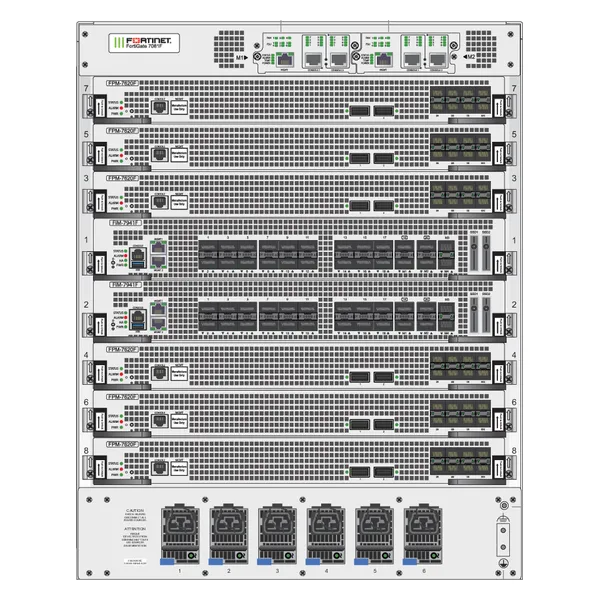
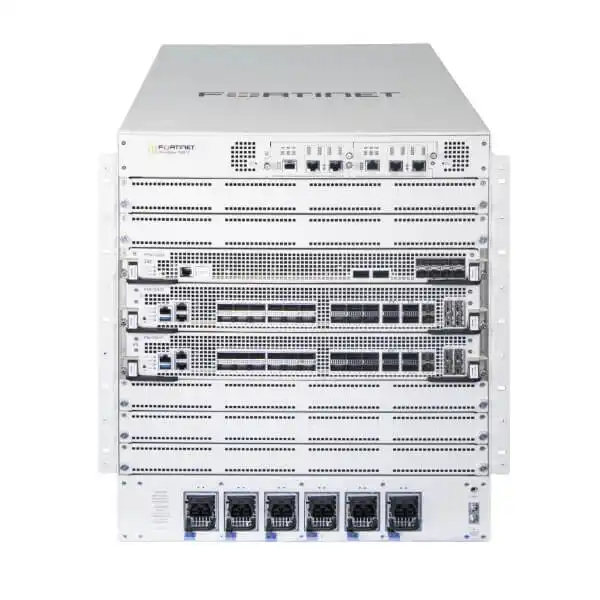
Fortinet FortiGate 7081F Firewall in Dubai, UAE
The FortiGate 7081F is a chassis-based next-generation firewall for organisations that need very high session scale, high-speed data center interfaces, encrypted-traffic inspection, IPsec capacity, and a platform that can be expanded with Fortinet interface and processor modules. It is not a small edge appliance or a simple one-box branch firewall; it is a 12U modular security platform whose final performance, ports, power profile, subscriptions, and project cost depend on the exact build.

Direct answer for buyers
The Fortinet FortiGate 7081F is a high-end modular next-generation firewall designed for large data centers, service-provider environments, internet gateways, high-volume segmentation, and other deployments that need exceptionally high connection scale. Fortinet currently lists the platform with 405 Gbps IPS throughput, 330 Gbps NGFW throughput, 312 Gbps threat-protection throughput, 324 Gbps SSL inspection throughput, 378 Gbps IPsec VPN throughput, and 600 million concurrent TCP sessions. Buyers should not select it from headline throughput alone. Confirm the number and type of FIM and FPM modules, required 400G/100G/40G/25G/10G interfaces, subscriptions, FortiCare coverage, HA licensing, rack and power design, optics, FortiOS compatibility, and the traffic profile that will be inspected before requesting a final quotation.
What the FortiGate 7081F does
The 7081F places next-generation firewall inspection, intrusion prevention, application control, VPN, encrypted-traffic inspection, segmentation, policy enforcement, and Fortinet Security Fabric participation into a large modular chassis. Its architecture is intended to handle traffic volumes and session counts that would be excessive for conventional branch or mid-range appliances. The chassis accepts Fortinet Interface Modules in the first slots and Fortinet Processor Modules in the remaining processing slots, allowing a project team to match interface density and security compute to a large environment rather than treating the firewall as a fixed-port box.
Fortinet documentation describes a 1 Tbps fabric backplane for data communication among chassis slots and a 50 Gbps base backplane for management and synchronization. The platform uses purpose-built NP7 network processors and CP9 content processors in its processing modules. This matters to buyers because packet forwarding, session setup, VPN processing, and content inspection are separate workload dimensions; a design that looks adequate from raw firewall throughput may still be undersized once TLS inspection, IPS, application control, logging, or heavy east-west traffic is introduced.
Who should consider it
The 7081F is most relevant where firewall capacity is a core infrastructure decision: large enterprises running private data centers, financial or government environments with dense segmentation, cloud and colocation operators, telecom and service-provider networks, hyperscale-like internet edges, and organisations consolidating multiple security gateways onto a smaller number of high-capacity platforms. It may also fit environments that need 100G or 400G connectivity and want room to add processing modules as protected traffic grows.
It is usually not the right choice for a branch, small campus, retail site, or ordinary internet edge where lower FortiGate models can meet the requirement with less rack space, power, operational complexity, and subscription cost. A buyer should therefore start with measured traffic and design assumptions, not the model name. FourTeck can help compare the 7081F with other FortiGate options through the FourTeck firewall product portfolio and a requirement-led sizing discussion.
Business challenges this chassis can address
Security at very high traffic volumes
Large data centers often carry far more east-west and north-south traffic than a traditional perimeter firewall. The 7081F is designed for environments where firewalling, IPS, threat protection, and encrypted-traffic inspection need to operate at hundreds of gigabits per second. The practical value is not merely a large benchmark number; it is the ability to design security controls without forcing every high-speed workload through a small appliance bottleneck.
Interface growth and architecture changes
Data center fabrics evolve. A site may begin with 100G uplinks and later introduce 400G interconnects, additional peering, new zones, or separate security domains. A chassis platform can be planned around modular interface and processing choices. The value depends on the correct FIM, FPM, optic, cabling, and slot plan, so the expansion path should be documented in the original design rather than treated as an afterthought.
Large session and connection scale
High-volume public services, cloud platforms, carrier networks, content-heavy applications, and environments with many short-lived flows can generate immense session tables and connection setup rates. Fortinet’s current product matrix lists up to 600 million concurrent sessions and 5.4 million new sessions per second for the FG-7081F. Session behavior should still be tested against the real application mix, NAT use, logging, inspection features, and peak conditions.
Consolidated security operations
A high-end FortiGate can combine multiple network-security functions under FortiOS and participate in centralized policy, logging, and Security Fabric workflows. Consolidation can reduce the number of independent enforcement systems, but it increases the importance of change control, HA design, management separation, log capacity, administrator roles, and tested rollback procedures. The platform should therefore be deployed as part of an operational architecture, not only as a hardware purchase.
Capability band: the numbers buyers usually need first
All performance values should be treated as up-to figures under vendor test conditions. Actual production results depend on packet size, policies, enabled security profiles, TLS versions and ciphers, logging, VPN mix, modules, FortiOS release, HA design, traffic distribution, and other configuration factors.
Is the 7081F a good fit for your requirement?
| Requirement | Suitable when | Confirm before ordering |
|---|---|---|
| Very high firewall and IPS capacity | Your measured and forecast traffic genuinely reaches a high-end chassis class. | Traffic mix, packet sizes, security profiles, encrypted percentage and growth headroom. |
| 100G/400G data center connectivity | The firewall must sit directly in a high-speed spine, core, interconnect or peering design. | FIM/FPM type, port mode, optics, breakouts, cabling and switch compatibility. |
| Large session tables | Applications generate very high concurrent and new-session rates. | NAT behavior, timeout profile, logging, session asymmetry and peak events. |
| High availability | The design requires redundant security gateways and failure-domain planning. | HA mode, duplicate licenses, matching support, link redundancy, state synchronization and maintenance procedure. |
| Future modular expansion | You expect interface or processing needs to grow over the project lifecycle. | Initial slot population, reserved capacity, power/cooling headroom and future module availability. |
Fortinet FortiGate 7081F technical information
Model-specific figures below are based on current Fortinet product information. Performance is configuration dependent.
| Brand | Fortinet |
| Product | FortiGate 7081F |
| Hardware SKU | FG-7081F |
| Product type | Modular next-generation firewall / data center firewall chassis |
| Form factor | 12U, standard 19-inch rack, 8-slot chassis |
| Chassis backplanes | 1 Tbps fabric backplane; 50 Gbps base backplane for management and synchronization |
| Firewall throughput | Up to 1.89 / 1.88 / 1.129 Tbps for 1518 / 512 / 64-byte UDP in the current Fortinet Product Matrix; see performance-document note below |
| IPS throughput | Up to 405 Gbps, enterprise mix |
| NGFW throughput | Up to 330 Gbps, enterprise mix |
| Threat protection throughput | Up to 312 Gbps |
| SSL inspection throughput | Up to 324 Gbps, IPS average HTTPS test profile |
| Application control throughput | Up to 900 Gbps |
| IPsec VPN throughput | Up to 378 Gbps |
| Firewall latency | 7.5 microseconds in vendor test conditions |
| Concurrent sessions | Up to 600 million TCP sessions |
| New sessions per second | Up to 5.4 million |
| Firewall policies | Up to 200,000 |
| Gateway-to-gateway IPsec tunnels | Up to 40,000 |
| Client-to-gateway IPsec tunnels | Up to 260,000 |
| SSL VPN throughput | Up to 13.7 Gbps; deployment support depends on FortiOS version and current feature guidance |
| Recommended maximum SSL VPN users | 30,000 in the cited test/profile context |
| Virtual domains | 10 default / up to 500 maximum, subject to licensing and platform guidance |
| Maximum FortiSwitches | 300 |
| Maximum FortiTokens | 20,000 |
| Interfaces | Varied by installed FIM/FPM modules; platform supports high-speed 10G, 25G, 40G, 100G and 400G connectivity in supported module/optic combinations |
| Processing modules | FPM-7620F modules supported in processing slots; current Fortinet hardware documentation describes NP7 and CP9 acceleration |
| Interface modules | FIM options include FIM-7921F and FIM-7941F in supported configurations; confirm exact BOM |
| Local storage | 4 × 4 TB SSD listed in current Fortinet Product Matrix |
| Power supplies | Six power-supply positions in the current platform information; exact AC/DC PSU variant and power design must be confirmed |
| DC variant | Available as a platform variant; confirm regional SKU and BOM |
| FortiOS support | FG-7081F is listed among supported models in current FortiOS 8.0 release information; validate the target release against your change policy |
| Availability | Contact FourTeck for current UAE model, module, subscription and lead-time confirmation |
Configuration, licensing and compatibility dependencies
The chassis is only the beginning
A 7081F project has to define the installed FIM and FPM modules, not just the chassis SKU. Fortinet hardware documentation places FIMs in slots 1 and 2 and FPMs in slots 3 through 8. The number of processing modules, the selected interface module, interface speeds, transceivers, breakout design, and physical connections all influence the usable architecture. A quotation should therefore show the entire initial build and any planned expansion components rather than a single appliance line item.
FortiGuard and FortiCare are design decisions
Current Fortinet ordering material shows Enterprise and Unified Threat Protection bundles for the FG-7081F, along with other service choices. The correct subscription depends on which protections the organisation intends to enforce and how it wants support handled. Do not assume that every FortiGuard capability is included with the bare hardware. The quote should state the bundle, term, support tier, renewal SKU where relevant, and any separate services or licenses needed for the intended use.
HA units need matching coverage
Fortinet’s current ordering guidance states that each appliance in a high-availability cluster requires its own license and FortiCare contract, and cluster members should have the same level of licensing. This is important in procurement because a two-chassis HA design is not simply double hardware: subscriptions, support, optics, interconnects, rack space, power feeds, and implementation effort also need to be duplicated or designed appropriately.
Power, cooling and rack readiness cannot be treated as installation-day details
The FortiGate 7081F occupies 12 rack units and supports multiple high-capacity, hot-swappable power supplies. The exact PSU variant, input feed, PDU capacity, redundancy model, circuit design, heat load, front-to-back clearance, rack depth, cable routing, earthing, and maintenance access should be reviewed before delivery. Data center teams should reserve sufficient space for service access and confirm that the chosen rack and power system can support both the initial chassis and any later module expansion. FourTeck can include infrastructure checks in the planning discussion, but site electrical approval remains part of the customer’s data center process.
A practical purchase and deployment journey
Measure the traffic
Collect real and peak north-south and east-west traffic, encrypted percentage, packet profile, session counts, VPN load, growth targets, segmentation boundaries, and required security controls. A chassis-class firewall should be justified by data rather than by a broad estimate.
Build the architecture
Define where the firewall sits, which links need 400G/100G/40G/25G/10G, how HA connects, whether traffic is symmetric, where management lives, how logs are collected, and which failure domains must remain independent.
Freeze the BOM
Select the chassis variant, FIM and FPM modules, transceivers, cables, FortiGuard bundle, FortiCare tier, HA quantity, management and analytics components, rack accessories, and any migration or professional services.
Prepare the site
Confirm rack units, depth, power, PDUs, grounding, airflow, cabling, fiber paths, management ports, change windows, rollback procedures, backup configurations, routing prerequisites, and access for engineering staff.
Deploy and validate
Stage software, apply baseline hardening, load policies, validate routing and HA, test failover, verify logging, enable security profiles in controlled steps, monitor resource use, document the final state, and hand over operating procedures.
Modular performance for high-density data center links
The strongest architectural reason to evaluate the FortiGate 7081F is its modularity. Fortinet describes the platform as an eight-slot chassis, with two slots intended for Interface Modules and up to six processing-module positions. This structure separates the physical chassis from the specific compute and I/O build. For a buyer, that means the answer to “How many ports does the 7081F have?” is not a single fixed number. The correct answer depends on the exact FIM and FPM configuration purchased, the port speeds selected, the supported optics, and whether any module interfaces are used as fabric-channel data interfaces or other designated roles.
The FPM-7620F processing module is especially important in understanding the architecture. Fortinet documentation describes it as a high-performance worker module that receives load-balanced sessions from the FIMs over the chassis fabric. It includes two NP7 network processors and eight CP9 content processors, with front-panel high-speed interfaces available in supported configurations. NP7 acceleration is used for network-processing functions, while CP9 accelerates content-oriented security work. The operational effect is that adding processing resources and distributing traffic through the chassis can increase the security capacity of the overall platform, subject to the architecture and supported configuration.
Buyers should therefore map physical links to logical security zones before ordering. For example, a large private cloud may require separate high-speed paths for internet edge, inter-data-center traffic, application zones, shared services, backup, management, and regulated workloads. A carrier may need peering, transit, customer, service-chain, and management domains. A government or financial data center may place different trust boundaries around internet-facing systems, payment or citizen services, internal application tiers, and disaster-recovery links. The module and port plan should follow that architecture rather than simply maximizing port count.
Optics are a second-order detail that often becomes a first-order procurement issue. 100G and 400G deployments may involve different QSFP families, breakout modes, fiber types, distances, switch capabilities, and vendor support matrices. If a project assumes a particular optic or cable without checking the FortiGate module and upstream switch support, the hardware can arrive before the link design is actually workable. FourTeck can help structure the bill-of-material discussion, while the final compatibility should be confirmed against the specific module and transceiver documentation for the chosen build.
Security inspection at scale is more than raw firewall throughput
A common mistake in high-end firewall selection is to size on the largest “firewall throughput” number and then discover that the real workload is dominated by threat inspection. Raw stateful forwarding is only one part of the data path. Production security policies may use intrusion prevention, application control, malware protection, URL or DNS filtering, SSL/TLS inspection, logging, VPN encryption, segmentation, and identity context. Each added function changes the performance profile, and encrypted traffic can be particularly significant because the firewall may have to decrypt, inspect, and re-encrypt sessions.
For the FG-7081F, Fortinet’s current product matrix lists 405 Gbps IPS throughput, 330 Gbps NGFW throughput, 312 Gbps threat-protection throughput, and 324 Gbps SSL inspection throughput. Those figures are more useful than raw firewall throughput when a project expects security services to remain enabled under load. They still do not guarantee a production result. The real capacity depends on application behavior, packet sizes, TLS cipher suites, certificate operations, policy structure, logging destinations, session duration, attack traffic, high-availability synchronization, and the distribution of flows across the chassis.
The correct approach is to build a “protected traffic budget.” Start with the peak traffic that must actually cross the firewall. Divide it into traffic classes such as encrypted web, API, east-west application, database, backup, replication, remote access, site-to-site VPN, and uninspected trusted transit if any. Then determine which controls apply to each class. The resulting inspection profile gives a more defensible basis for sizing. In environments where traffic bursts are extreme or where inspection policies are still evolving, reserve meaningful headroom rather than targeting a benchmark ceiling.
FortiGuard services also need to be considered as operational subscriptions, not decorative line items. If the security design depends on current IPS intelligence, malware protection, web or DNS filtering, application control, or other FortiGuard-delivered capabilities, the selected bundle and term need to match that intent. A bare chassis without the appropriate services is not equivalent to a fully subscribed next-generation firewall design. FourTeck can help clarify the intended security functions and align the request with current Fortinet bundle options before a commercial quotation is prepared.
Segmentation, VPN and operational control for large environments
At data center scale, a firewall is often used as much for segmentation and policy control as for internet perimeter protection. The 7081F supports a large number of firewall policies and virtual domains, which can help organisations separate administrative or security domains on the same physical platform. Fortinet’s current matrix lists 10 default VDOMs and up to 500 maximum, subject to the platform’s licensing and configuration rules. A VDOM design can be useful for business units, environments, customers, regulated zones, or operational separation, but it should be planned carefully because shared hardware still creates common dependencies around chassis maintenance, power, software, and capacity.
VPN is another major use case. Current Fortinet model information lists up to 378 Gbps IPsec VPN throughput, up to 40,000 gateway-to-gateway IPsec tunnels, and up to 260,000 client-to-gateway IPsec tunnels. These ceilings may be relevant to service providers, large distributed enterprises, cloud interconnects, and organizations aggregating encrypted site links. For a real design, the important questions include cipher choice, tunnel bandwidth distribution, route scale, dynamic routing, failover behavior, NAT traversal, remote peer diversity, monitoring, and whether all tunnels must remain active during an HA event.
Centralized operations matter at the same scale. FortiGate deployments can be managed and monitored as part of the wider Fortinet ecosystem, commonly using FortiManager for centralized policy and configuration workflows and FortiAnalyzer for logging, reporting, and analytics where those products are part of the architecture. The goal should be controlled change and good visibility. A high-capacity chassis with thousands of policies or many VDOMs requires strong naming standards, role-based administration, change approval, configuration backups, log-retention planning, firmware governance, and an agreed process for emergency changes.
The result is that the 7081F should be evaluated as a platform within a security operations model. The appliance can provide substantial capability, but business continuity depends on how it is integrated with routing, switching, identity, logging, monitoring, incident response, backup, and change-management processes. FourTeck’s network security service planning can be used to define the implementation and handover scope separately from the hardware supply.
Ideal business environments and use cases
Large enterprise data center edge
Suitable where multiple high-speed internet, cloud, partner, and application flows converge and the security platform must maintain advanced inspection under substantial load. Architecture should include HA, diverse links, logging, routing, and planned maintenance paths.
East-west segmentation
Relevant to private cloud, large virtualization, application hosting, and regulated environments that need policy boundaries between workloads or data-center zones. Traffic placement and asymmetric-flow handling should be reviewed before inserting any firewall into a high-speed fabric.
Service-provider security gateway
Can fit operators that need high connection scale, many tunnels, large policy sets, and high-speed interfaces. Multi-tenant or VDOM designs require careful resource, support, logging, and operational separation planning.
Data center consolidation
May suit organisations replacing several older high-end firewalls with a coordinated chassis platform. Consolidation should be preceded by policy cleanup, traffic analysis, migration sequencing, risk review, capacity modelling, and a rollback plan.
Integration and operational considerations
A chassis firewall at this scale interacts with almost every core infrastructure team. Network engineering must confirm routing adjacencies, ECMP behavior, VLANs, VRFs, link aggregation, MTU, optical interfaces, and failure handling. Security engineering must define zones, security profiles, identity context, TLS inspection policy, certificate handling, exceptions, threat-intelligence use, and incident procedures. Platform or cloud teams need to identify workload flows and dependencies. Data center operations must validate rack, power, cooling, cable paths, maintenance access, and remote hands procedures. Procurement must align hardware, subscriptions, optics, support and service terms into one commercial package.
Logging deserves dedicated planning. High-throughput security appliances can generate large volumes of traffic, event and threat logs. Retention objectives, compliance requirements, analytics workflows, SIEM integration, storage capacity, log transport resilience, and the effect of logging on operations should be agreed before cutover. If FortiAnalyzer or another analytics platform is being used, size it for the expected log rate and retention rather than for the firewall model alone.
Firmware governance also matters. Current Fortinet release information includes the FG-7081F among supported FortiOS 8.0 models, but production environments should not select a release simply because it is available. Review feature requirements, support policy, known issues, upgrade paths, interoperability, maintenance windows, and organizational validation practices. Chassis systems may also include module-specific operational considerations during upgrades, so the change method should follow the current Fortinet guidance for the exact configuration.
Compatibility notice
Do not assume that any 100G or 400G optic, cable, FIM, FPM, FortiOS release, management platform version, or third-party switch combination will work simply because the nominal speed matches. Confirm the current support matrix and exact part numbers for the final build.
Migration notice
A configuration-conversion service can reduce manual effort, but converted policies still need review. Legacy objects, NAT behavior, route design, VPN parameters, security profiles, unsupported features, logging and policy order should be validated before production cutover.
Buyer questions to resolve before requesting a quotation
Provide current peaks, expected three-to-five-year growth, encrypted percentage, east-west and north-south split, packet profile, and which security profiles apply.
List each 400G, 100G, 40G, 25G and 10G requirement, optic distance, fiber type, switch endpoint, breakout requirement, redundancy and reserved future capacity.
Define the initial FIM and FPM population and whether later module expansion is part of the project plan. Avoid purchasing a base chassis without documenting the intended growth path.
Map actual security services to the current bundle options and subscription term. Include support, renewal expectations and any separate service SKUs in commercial planning.
HA mode affects quantity, licensing, links, routing, state synchronization, maintenance procedures, rack allocation and failure testing.
Separate hardware supply from staging, migration, rack installation, configuration, policy conversion, testing, cutover, documentation, training and post-change support.
Procurement checklist for the FortiGate 7081F
✓ Confirm exact hardware SKU: FG-7081F or required regional/AC/DC variant.
✓ Confirm quantity and whether a second chassis is required for HA.
✓ Confirm initial FIM type and quantity.
✓ Confirm initial FPM-7620F quantity and future processing growth plan.
✓ List every required interface speed, optic, breakout cable and link distance.
✓ Confirm FortiGuard bundle, subscription term and security services.
✓ Confirm FortiCare support level and matching coverage for HA members.
✓ Validate rack space, rack depth, airflow, grounding and service clearance.
✓ Validate PSU type, PDU capacity, redundant power feeds and site electrical approval.
✓ Confirm FortiOS target release and management/logging compatibility.
✓ Define migration, policy-conversion, staging, testing and cutover scope.
✓ Confirm destination, delivery coordination, warranty/support terms and vendor lead time in the final quote.
How FourTeck can support evaluation and project planning
FourTeck can help a buyer turn a broad request for a FortiGate 7081F into a quote-ready requirement. The useful starting point is a short technical brief: current and forecast traffic, security services, number of data center links, preferred interface speeds, HA requirement, existing firewall platform, routing design, VPN scale, logging platform, target deployment location, and expected project timeline. From that information, FourTeck can coordinate model and bill-of-material discussions, identify licensing questions, and separate supply requirements from optional installation or configuration work.
For organisations already using Fortinet, the review can include the current FortiGate estate, FortiManager and FortiAnalyzer versions, support contracts, FortiGuard services, VDOM structure, object and policy scale, and upgrade path. For a migration from another firewall vendor, the emphasis shifts to rule conversion, NAT and routing behavior, VPN migration, interface mapping, logging, policy cleanup, application dependencies, and the cutover sequence. A detailed scope reduces the risk that a hardware quotation omits important subscriptions, optics, modules or professional services.
You can review broader firewall solutions from FourTeck or discuss Fortinet-specific requirements through the Fortinet firewall consultation page. Pricing and availability should be requested against the exact BOM because the 7081F is a configurable chassis platform and service subscriptions can represent a substantial part of the lifecycle cost.
UAE availability and support guidance
Contact FourTeck to confirm current UAE availability for the FortiGate 7081F chassis, required FIM and FPM modules, AC or DC variant, optics, FortiGuard subscriptions, FortiCare coverage, and any associated management or logging products. Availability may differ between the base chassis and the individual modules or subscription SKUs, so a project should not assume that every component has the same lead time. Delivery coordination can be discussed after the exact bill of materials, quantity and deployment location are confirmed.
If installation or configuration assistance is required, include that scope in the quotation request rather than treating it as an informal post-delivery task. High-end chassis deployments may require site-readiness checks, staging, firmware preparation, migration planning, HA setup, routing changes, security-policy validation, logging integration, testing and formal handover. FourTeck can coordinate these requirements based on the agreed project scope. No stock level, delivery date, warranty period or installation date should be assumed until it appears in the specific quotation or vendor confirmation.
Dubai, Abu Dhabi, Sharjah and Ajman project coverage
Businesses in Dubai, Abu Dhabi, Sharjah and Ajman can approach FourTeck for requirement review, quotation coordination, configuration planning and project discussions for the Fortinet FortiGate 7081F. The practical information to share is the exact deployment site, required quantity, target rack, interface and optic plan, subscription term, HA requirement, preferred implementation window and whether the project includes migration or installation services. For data-center deployments, site access rules, engineer approvals, change windows, remote-hands requirements, rack and power readiness, and cabling responsibilities should be clarified before scheduling work. Delivery and service coordination remain dependent on the final scope, component availability, vendor lead time and customer site conditions.
GCC Availability
For GCC projects, FourTeck can assist organisations that are assessing the FortiGate 7081F for high-capacity data center or service-provider security requirements. The process can include requirement review, model and module selection, FortiGuard and FortiCare licensing guidance, bill-of-material coordination, quotation preparation, installation-scope discussion, configuration planning and renewal considerations. Projects in markets such as the United Arab Emirates, Saudi Arabia, Kuwait, Qatar, Bahrain and Oman may have different commercial, logistics, power, regulatory, service and lead-time conditions. Availability should therefore be confirmed for the destination country and exact SKU set rather than inferred from another market.
Before requesting a regional quotation, provide the destination country, quantity, AC or DC requirement, FIM and FPM plan if known, interface and optics list, subscription term, HA design, target deployment location and expected timeline. If on-site services are required, include data-center access conditions, site-readiness responsibilities and the desired implementation scope. Product availability, licensing, delivery schedules, vendor lead times, service visits and project scope can vary by country, model, module quantity and customer requirement. For Kuwait-specific coordination, buyers may also use the FourTeck Kuwait resource.
Africa Availability
Organisations planning a FortiGate 7081F deployment in Africa can work with FourTeck to structure the requirement before procurement. This is particularly useful for a chassis platform because the project may involve separate hardware, processor modules, interface modules, optics, subscriptions, support, installation tasks and logistics. Buyers should identify the destination country, deployment environment, required quantity, traffic and security targets, interface speeds, preferred license term, power variant, support expectations and target schedule. FourTeck can then help coordinate a quote and clarify which parts of the requirement need further technical confirmation.
Regional fulfilment can vary significantly across East Africa, West Africa, Southern Africa and Central Africa. Shipping arrangements, vendor lead time, licensing region, power requirements, customs processes, local regulations, site access and service availability can affect the final plan. No local inventory, customs outcome, fixed delivery time or country-wide onsite coverage should be assumed without project-specific confirmation. Buyers in Kenya, Uganda and other African markets can review the broader FourTeck Africa technology resource and share their destination, bill of materials, preferred deployment schedule and support expectations for tailored guidance.
Related products and services to consider
FortiGate 7121F
The 7121F is the larger sibling in the same 7000F family and has higher listed IPS, NGFW and threat-protection throughput. It is relevant when the 7081F does not provide enough long-term capacity. A comparison should use protected traffic, session scale, interface needs, module plan and lifecycle cost rather than only the headline model number.
FortiManager
Centralized management can be important when the 7081F is part of a wider FortiGate estate or has many VDOMs and policy domains. Confirm the management platform version, capacity, licensing and operational model required for the final environment.
FortiAnalyzer
High-volume firewall platforms can generate substantial logs. FortiAnalyzer may be appropriate for Fortinet-native logging, reporting and analytics. Size the logging platform from estimated events and retention objectives rather than assuming the firewall model determines the answer.
Migration and configuration services
Policy conversion, route migration, VPN recreation, interface mapping, staging, HA setup, testing and cutover can be scoped as a separate professional service. This is especially useful when replacing another vendor or consolidating multiple legacy firewalls.
Why businesses contact FourTeck for a 7081F project
The value FourTeck can add is practical requirement clarification. A high-end firewall quotation can become inaccurate if it begins with only “one FortiGate 7081F” and leaves the modules, optics, subscriptions, support, HA, power, management and services undefined. FourTeck can help the buyer organise those decisions into an orderable bill of materials and identify questions that need validation before purchase. This is useful for IT teams that know the target architecture but need procurement coordination, and for procurement teams that have a model request but need technical stakeholders to confirm the implementation details.
FourTeck can also help distinguish hardware capability from licensed security services. That prevents the common mistake of comparing a bare chassis price with a fully subscribed bundle from another source. During planning, the discussion can cover security profiles, expected throughput, interfaces, HA, FortiGuard bundle, FortiCare support, management, logging, migration, installation and future expansion. Buyers can learn more about the company through the FourTeck firewall team overview before arranging a project discussion.
What buyers usually need to know before shortlisting this platform
One of the first questions around the FortiGate 7081F is whether it is genuinely a “1.89 Tbps firewall.” The current Fortinet Product Matrix lists 1.89 / 1.88 / 1.129 Tbps for 1518 / 512 / 64-byte UDP, but another current Fortinet NGFW ordering guide lists 1.19 Tbps for the 1518-byte headline while keeping 5.4 million new sessions per second, 312 Gbps threat protection and 324 Gbps SSL inspection. Buyers should not try to resolve this by choosing whichever number is larger. The useful conclusion is that the exact performance baseline must be checked against the current quotation, module build and vendor documentation used for the project. For a security design, the inspected-throughput figures are often more important anyway because they better reflect a policy set that includes security services.
A second frequent question is how the 7081F differs from the 7121F. Both are large modular FortiGate 7000F chassis, but the current matrix lists the 7121F with higher IPS, NGFW, threat-protection, IPsec and new-session figures. The 7081F is therefore not simply the “same thing cheaper”; it represents a different capacity point. A project team should compare the two using expected protected traffic at year three or year five, session growth, encryption levels, interface density, module population, power and rack constraints, and the commercial effect of subscriptions. If the 7081F is already near its projected ceiling on day one, the larger platform or a different architecture may be more appropriate. If the 7081F provides comfortable headroom with a sensible module plan, buying more chassis than the workload requires can add unnecessary cost and operational overhead.
Price is another major research topic, and published online prices vary widely because sellers may list a base chassis, a starter module configuration, a regional variant, a DC version, a service bundle, or a multi-year subscription. A number without an exact SKU is therefore easy to misread. Buyers should compare like with like: FG-7081F hardware, included starter modules if any, AC or DC configuration, transceivers, FortiGuard bundle, FortiCare level, subscription term, HA quantity, management products, services and taxes or logistics. For FourTeck, the right commercial next step is a requirement-based quotation rather than treating a marketplace or overseas list price as the expected UAE selling price.
Licensing questions also appear early. Current Fortinet ordering material shows Enterprise and Unified Threat Protection hardware bundles for the 7081F and separate renewal SKUs. The correct bundle depends on the intended controls, not on a generic preference for the package with the most features. If the organisation requires IPS, web and DNS filtering, malware protection, application control, inline data-loss capabilities or other FortiGuard services, the chosen bundle and any add-ons should map to those policies. In an HA cluster, each unit needs valid support and the necessary FortiGuard licensing, so the subscription budget must cover both members rather than only the primary unit.
A chassis with “400G support” is not a promise that every slot exposes every speed. Confirm the FIM/FPM module, port type, optic, breakout mode and upstream switch combination for each link.
Six high-capacity PSU positions and a 12U chassis make facility readiness part of the purchase. The data-center team should approve feeds, PDU capacity, cooling, grounding and service clearance before delivery.
Configuration conversion can save time, but policy intent, NAT, routes, VPNs, object hygiene and unsupported features still need engineering review. Migration is a project, not a file import.
Buyers also ask whether the 7081F is suitable for AI data centers, cloud environments or high-performance east-west security. The practical answer is that it can be a strong fit where the network requires very high interface speed and inspection capacity, but suitability depends on the exact topology and workload. AI clusters, storage fabrics and distributed compute can create large east-west flows, elephant flows, unusual packet patterns and latency sensitivity. Some of that traffic may need inspection and some may not. The firewall should be placed where it can enforce meaningful policy without disrupting the data-plane design. The network team should model traffic paths, redundancy, MTU and failure behavior before inserting any security device into a high-performance fabric.
Another common question is whether the 7081F can be managed like a conventional FortiGate. It runs FortiOS and participates in Fortinet’s broader management and analytics ecosystem, but operational scale changes the discipline required. Hundreds of thousands of policies, hundreds of millions of sessions, many VDOMs and very high log rates create governance requirements that may be modest on a branch firewall. Use centralized change processes, administrative separation, configuration backups, standardized objects, log-capacity planning, firmware validation and tested HA procedures. A platform capable of handling enormous traffic can also create enormous impact if a routing or policy change is wrong.
Finally, buyers often want a simple answer on availability. Chassis-class products are more sensitive to regional variant, module, optic, subscription and vendor lead-time availability than small fixed appliances. The base chassis may be available on a different timeline from a specific FIM, FPM or optic. For that reason, the procurement request should include the complete target configuration, quantity, destination and desired schedule. FourTeck can then confirm the current UAE options and identify any component that needs an alternative, staged delivery or design adjustment before the purchase order is finalized.
Questions that help prevent the wrong 7081F purchase
Do we need a 7081F because of traffic, sessions, ports or future growth?
Identify the actual constraint. If the requirement is primarily 400G connectivity, interface design may drive the choice. If it is hundreds of gigabits of inspected traffic, security throughput matters. If it is a public service with massive short-lived connections, session setup may dominate. If the reason is only “future proofing,” quantify the growth. Different constraints can lead to different FortiGate models or architectures.
How many processor modules should we buy initially?
That depends on the supported chassis configuration, traffic distribution, required performance and growth plan. A starter configuration can be expanded, but the project should not assume that a later module addition is operationally invisible. Power, cooling, slot population, licensing implications, maintenance, testing and traffic-balancing behavior should be reviewed with the current Fortinet guidance.
Should we size from firewall, IPS or threat-protection throughput?
Use the metric closest to the intended policy set. A perimeter that performs IPS, application control, malware inspection and logging should not be sized only from stateful firewall throughput. If a large portion of traffic is encrypted and will be decrypted, SSL inspection capacity becomes important as well. Build separate traffic classes and reserve operational headroom.
Can we buy one chassis now and add HA later?
Technically an architecture can evolve, but procurement should consider whether a period without device-level redundancy is acceptable. Adding HA later may require matching hardware, current subscriptions, rack and power capacity, new links, routing changes and a maintenance window. If continuous availability is a business requirement, design and license the HA pair from the start.
What information produces an accurate quote?
Provide the hardware model, quantity, AC/DC preference, FIM/FPM configuration if known, interface speeds and optic distances, HA requirement, FortiGuard services, FortiCare level, subscription term, management and logging needs, delivery country, implementation scope and target schedule. If some items are unknown, share the traffic and architecture so they can be clarified before commercial pricing.
How should we prepare for a migration from another firewall?
Export and clean the policy base, inventory NAT and VPNs, document routes and dynamic routing, capture interface mappings, identify application dependencies, review certificate and TLS-inspection design, define logging, plan cutover and rollback, and test representative services before production. Policy conversion can assist, but validation remains essential.
Frequently asked questions
What is the Fortinet FortiGate 7081F designed for?
It is designed for very large data centers, service-provider networks, high-capacity security gateways and other environments that need modular high-speed interfaces, very large session scale and hundreds of gigabits per second of security inspection. It is a 12U modular chassis rather than a fixed-port branch firewall.
What is the FortiGate 7081F threat-protection throughput?
Current Fortinet model information lists up to 312 Gbps of threat-protection throughput. Actual results vary with traffic, packet sizes, enabled security services, encryption, logging, FortiOS version and chassis configuration.
Does the 7081F have fixed ports?
No single fixed-port count describes the chassis. The usable interfaces depend on the installed Fortinet Interface Modules and Processor Modules and their supported port modes. The quote should specify the exact modules, transceivers and cables required for the target 10G, 25G, 40G, 100G or 400G links.
Which licenses are required for a FortiGate 7081F?
Licensing depends on the security services and support level required. Current Fortinet ordering material includes Enterprise and Unified Threat Protection bundle options for the FG-7081F, as well as other services. Confirm the exact FortiGuard bundle, FortiCare level, term and any add-ons in the quotation.
Do both firewalls in an HA pair need licenses?
Yes. Current Fortinet ordering guidance states that each appliance in an HA cluster needs its own license and FortiCare contract, and cluster members should use the same licensing level for the required services.
Can the FortiGate 7081F support 400G connectivity?
The platform supports 400G connectivity in supported module and transceiver combinations. Buyers should confirm the specific FIM/FPM, QSFP type, breakout design, fiber and upstream switch compatibility before ordering.
Is FortiOS 8.0 supported on the FG-7081F?
Fortinet’s current FortiOS 8.0 release information lists the FG-7081F among supported models. Production deployment should still follow the organisation’s software validation, compatibility and lifecycle policy rather than upgrading solely because a release supports the hardware.
How can I get the FortiGate 7081F price in Dubai?
Request a quotation based on the exact chassis configuration, modules, optics, support, FortiGuard subscription, term, HA quantity and service scope. Published international prices often refer to different variants or bundles and should not be treated as a confirmed UAE selling price.
Can FourTeck help with installation and migration?
FourTeck can discuss staging, installation, HA configuration, migration, policy conversion, routing, VPN, testing, documentation and handover as part of a defined project scope. The exact activities, location and schedule should be included in the quotation request.
Build the right FortiGate 7081F bill of materials before ordering
Share your traffic profile, interface speeds, FIM/FPM plan, HA requirement, FortiGuard bundle, support level, rack and power details, delivery location and implementation scope. FourTeck can coordinate a UAE quotation and help identify configuration points that need confirmation before purchase.

Reviews
There are no reviews yet.