
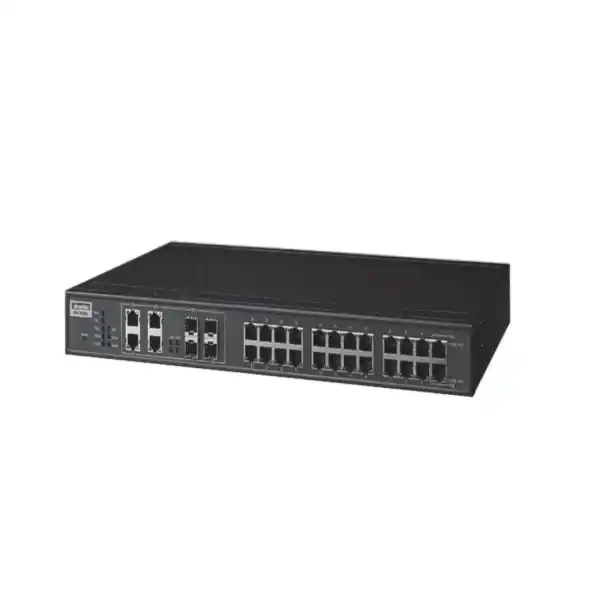
HPE Aruba Networking 2930F Switch
A mature Layer 3 access-switch family for wired edge connectivity, PoE-powered endpoints, resilient VSF stacks and branch or campus networks that need practical ArubaOS-Switch capabilities without unnecessary complexity.
Direct answer for buyers
The 2930F is a family of fixed-port HPE Aruba Networking access switches running ArubaOS-Switch, with Layer 2 functions, basic Layer 3 routing, security controls, QoS, stacking and multiple PoE/uplink choices.
It is mainly used at the network edge to connect users, IP phones, wireless access points, cameras, printers, IoT devices and branch-office infrastructure.
Organizations with an existing ArubaOS-Switch estate, ClearPass policies, Central-managed AOS-S deployments, or a requirement for a proven access design should shortlist it.
Confirm the exact JL-series SKU. Port count, PoE budget, uplink speed, acoustics and lifecycle position vary materially across the family.
FourTeck can map endpoint count, PoE load, fibre/copper uplinks, VSF design, optics, management requirements and migration plans to an appropriate quotation.
Where the 2930F fits in a business network
The HPE Aruba Networking 2930F Switch Series is positioned as an enterprise access-layer platform rather than a data-centre or high-capacity core switch. Its practical role is to aggregate wired endpoints close to users and devices, apply VLAN and access policies, provide Power over Ethernet where required, and forward traffic through built-in uplinks toward distribution, firewall or core infrastructure. That makes it relevant to offices, schools, hospitality sites, healthcare environments, warehouses, retail branches and multi-floor commercial buildings where predictable edge connectivity matters more than advanced data-centre fabrics.
For a Dubai buyer, the first design decision is not simply whether “2930F” is suitable. The family contains multiple configurations, and the best fit depends on what must physically connect to the switch. A 24-port non-PoE model may be appropriate for a rack serving desktop users and printers, while a 48-port PoE+ model may be more efficient for a floor carrying phones, access points and surveillance cameras. A small branch may prefer the compact 12-port PoE+ model, especially when quiet operation is important.
The platform supports common access-routing functions including static routes, RIP and Access OSPF. Access OSPF is intentionally scoped for access use rather than unrestricted enterprise core routing; HPE documents one OSPF area and up to eight OSPF interfaces. Buyers planning a heavily routed campus, extensive route redistribution, sophisticated EVPN fabrics or broad dynamic-routing scale should evaluate a more suitable current-generation architecture rather than assuming the 2930F can replace a dedicated distribution or core platform.
Strong fit when you need
- A proven Aruba access switch for users and edge devices
- PoE+ for phones, Wi-Fi access points or cameras
- Built-in SFP/SFP+ uplinks without a separate uplink module
- VSF front-plane stacking using standard Ethernet links
- 802.1X, MAC and web authentication options
- ClearPass-aligned role and policy workflows
- Cloud or local management choices
- AOS-S continuity in an existing 2930F/2930M environment
Evaluate another platform when your standard is AOS-CX, when you need a longer current-generation lifecycle runway, or when the design depends on features and scale outside the 2930F access-switch envelope.
2930F model selection: the part that changes the quotation
The model name alone is not enough for procurement. HPE lists several 2930F SKUs, including 24-port and 48-port non-PoE switches, 24-port and 48-port PoE+ variants, high-PoE-budget 48-port versions, and a compact 12-port fanless PoE+ model. Some older variants also have individual lifecycle notices. Use the table as a shortlist guide, then confirm current regional availability, warranty status, optics and support before purchase.
| Example SKU | Downlink profile | Uplink profile | PoE position | Typical buyer fit |
|---|---|---|---|---|
| JL253A | 24 × 1GbE | 4 × SFP+ | Non-PoE | User/device access where endpoint power is not required |
| JL254A | 48 × 1GbE | 4 × SFP+ | Non-PoE | Higher-density access racks without powered endpoints |
| JL255A | 24 × 1GbE | 4 × SFP+ | PoE+ | Mixed users, phones, APs and cameras on a 24-port edge |
| JL256A | 48 × 1GbE | 4 × SFP+ | PoE+ | Dense office floors or larger access blocks |
| JL558A | 48 × 1GbE | 4 × SFP+ | Up to 740 W PoE+ budget | High concentration of powered endpoints |
| JL693A | 12 × 1GbE PoE+ plus 2 × 1GbE | 2 × SFP+ | 139 W PoE+ | Small branch, meeting area or quiet deployment; fanless model |
Model availability changes by region and lifecycle. The exact JL part number, required power cord, transceivers and support service should therefore be part of every quotation request.
PoE planning: calculate the load, not just the port count
Endpoint requirement
A PoE+ port can deliver up to 30 W to a compliant powered device, but a switch cannot necessarily provide the maximum to every port simultaneously unless its total power budget supports that load. List each phone, access point, camera, intercom or other powered endpoint and note its expected or maximum draw. This prevents a common procurement mistake: buying enough Ethernet ports but insufficient PoE capacity.
Budget headroom
Leave practical power headroom for device replacement, access-point upgrades and peak demand. A network built exactly to today’s calculated wattage can become restrictive when a higher-power AP or camera is introduced. High-density PoE environments are where a 740 W 48-port variant becomes materially different from a standard PoE model.
Electrical and UPS impact
PoE load affects rack power, UPS sizing and heat. When a switch powers many endpoints, the UPS must protect both the switch itself and the attached powered devices if continued service during a utility interruption is required. This is especially relevant for voice, security cameras and wireless coverage that must remain available during short power events.
Uplinks and optics: confirm what connects upstream
The 2930F family includes built-in uplinks, with 10GbE SFP+ available on several models and 1GbE uplinks on others. This is useful because the uplink capability is part of the fixed switch design rather than a separate modular card, but it also means the selected SKU must match the intended upstream topology from the start. A 48-port access switch serving many active users can quickly make a 1GbE uplink the limiting factor, while a 10GbE SFP+ uplink gives more room for aggregated traffic, backups, wireless traffic and inter-VLAN services.
Fibre connectivity is not complete merely because the switch has an SFP or SFP+ cage. The quotation must identify the required media type, distance and interface at the far end. Single-mode and multimode fibre require different optics; direct-attach cable may be appropriate for short in-rack links; and existing patch panels or fibre connectors can influence the transceiver choice. Compatibility should be checked against the target 2930F SKU and software level rather than assuming any third-party optic will behave identically.
If VSF links will use front-panel Ethernet interfaces, reserve the necessary ports and bandwidth in the design. A stack simplifies operation because members behave as a single logical switch, but the links between members still consume physical interfaces. For a new deployment, decide whether the stack will use ring or chain topology, which ports are allocated to VSF, how uplinks are distributed across members, and how failure of a member or link should affect connected endpoints.
VSF stacking and resilience
HPE Aruba Networking Virtual Switching Framework allows up to eight 2930F members to operate as one logical stack. For buyers, the operational benefit is simpler management and the ability to scale access ports while retaining a single stack-level control structure. Standard Ethernet interfaces are used as the stacking links, which can be helpful when building or extending a stack without a proprietary rear stacking module.
Stacking does not remove the need for resilience planning. Uplink distribution, LACP design, stack topology, power sources and UPS feeds should be considered together. In a multi-switch rack, spreading upstream links across different stack members can reduce the impact of one member failure. Likewise, a ring VSF topology can provide a more resilient inter-member path than a simple chain when the physical layout supports it.
A brownfield expansion also needs software discipline. Adding a switch to an existing VSF stack should not be treated as a plug-and-forget task. Check software compatibility, back up the current configuration, confirm member numbering and priority, verify the intended VSF ports, and plan the maintenance window. If the estate is managed through HPE Aruba Networking Central, confirm the supported onboarding workflow for AOS-S stacks and whether the existing group design aligns with the current Central environment.
Security and policy controls
The 2930F supports enterprise access controls including IEEE 802.1X, web authentication, MAC-based authentication, RADIUS and TACACS+, ACLs, port security, DHCP protection, dynamic ARP protection, BPDU protection and secure administrative access. These features matter most when they are part of a defined policy rather than simply enabled one by one.
In an Aruba environment, ClearPass can support role-based access workflows and consistent policy between wired and wireless users. That can be valuable for offices where corporate laptops, phones, guest devices, printers, cameras and IoT equipment share physical switching infrastructure but require different VLANs and security treatment.
QoS and converged edge traffic
The family supports traffic prioritization, Class of Service and multiple queues, helping a network team preserve latency-sensitive traffic such as voice while still carrying normal data. LLDP and LLDP-MED can assist device discovery and endpoint configuration, particularly for IP phones.
QoS is not a substitute for adequate uplink capacity. If a floor switch consistently sends more traffic than its uplinks can carry, prioritization only controls which traffic waits or drops first. A sound design combines sensible VLANs, appropriate QoS policy and enough upstream bandwidth for the expected busy-hour load.
Management, automation and licensing considerations
The 2930F can be administered through traditional switch interfaces such as CLI and web GUI, and the platform supports SNMP for monitoring. HPE also positions the series for centralized management through HPE Aruba Networking Central and for policy integration with ClearPass. REST APIs and OpenFlow support provide additional automation options for organizations that have established operational workflows around ArubaOS-Switch.
The base 2930F feature set is notable because HPE describes its Access OSPF, RIP, IPv6, QoS and related switch capabilities as not requiring an additional software feature licence. That should not be interpreted to mean every surrounding service is free. Cloud management, support services, ClearPass and other software platforms can have their own subscriptions, licences or entitlements. A quotation should separate the physical switch from optional management and support items so the buyer can see the real operating-cost components.
For existing AOS-S networks, consistency may be a strong reason to continue with 2930F where the exact model remains appropriate and available. For a greenfield network, however, software architecture deserves equal weight with port count. Organizations standardizing on AOS-CX should compare a current AOS-CX access family before committing to a mixed operating model. The objective is not to choose the newest label automatically; it is to avoid unnecessary operational fragmentation over the expected service life of the network.
Performance numbers should be read by exact SKU
Switching capacity and forwarding throughput differ within the family. For example, HPE specifies up to 176 Gbps switching capacity and up to 112 Mpps on selected 48-port models with four 10GbE-capable SFP+ uplinks, while the compact 12-port JL693A is specified at 68 Gbps and up to 41.7 Mpps. These figures are useful for checking that the hardware is proportionate to the edge role, but they are rarely the only performance constraint in an office network.
Real application experience can be limited by uplink oversubscription, WAN capacity, firewall throughput, wireless design, server response, cabling quality or endpoint behaviour. For this reason, FourTeck recommends sizing the access layer from the actual topology: endpoint count and speed, expected east-west traffic, uplink count, LACP design, PoE demand, stack size and the capacity of the upstream firewall or distribution layer.
The 2930F hardware table also supports 32,768 MAC address entries and a routing table sized for an access role. Those values are comfortable for many branch and campus-edge environments, but a network with unusually high host scale, large Layer 3 segmentation or complex dynamic routing should be assessed against the documented limits rather than against the product family name.
Deployment scenarios in Dubai and the UAE
Office floor
A 24- or 48-port PoE+ model can combine user access, IP telephony and wireless AP connectivity. The design should reserve uplink and stack ports, allow spare user ports, and budget PoE for future AP upgrades rather than today’s device count alone.
Branch or retail site
The compact 12-port fanless JL693A can suit smaller locations where noise and space matter. Its 139 W PoE budget and two SFP+ uplinks make it useful for modest powered-device counts, although exact rack, environmental and redundancy needs still determine suitability.
CCTV and IoT edge
PoE+ models can power cameras and IoT endpoints, while VLANs, ACLs and role-based policy help isolate device classes. Camera count, codec bitrate, NVR location and retention design affect uplink requirements and should be considered alongside PoE wattage.
Existing Aruba campus
Where 2930F is already deployed, adding a compatible member or matching access block can reduce operational change. The benefit depends on exact lifecycle, software compatibility and availability; a like-for-like purchase is not always the best long-term choice.
Lifecycle and procurement caution
The 2930F name covers multiple part numbers, and lifecycle status can differ by SKU. This matters because a family page may remain visible even when an individual model has reached end of sale. HPE previously announced end of sale for the 8-port JL258A, with the 12-port JL693A and an HPE Aruba Networking 6200F model identified among replacement options. Buyers should therefore avoid treating an online listing for “2930F” as proof that every variant is current and orderable.
For a new project, ask for the exact part number and confirm whether the unit is new, authorized-channel stock, refurbished or secondary-market equipment. Warranty and support rights can differ materially between those sources. The quotation should also state whether transceivers, rack accessories, country-appropriate power cords, management subscriptions and support services are included or separate.
If the purpose is to extend an existing 2930F estate for a defined remaining service period, a matched SKU can be sensible. If the purpose is a new five-to-seven-year access refresh, compare the 2930F requirement against a current AOS-CX access platform such as the 6200F family. That comparison should focus on operations, feature requirements, port/PoE fit, support horizon and migration effort rather than brand-new versus old as a simplistic choice.
Installation and migration considerations
Record active ports, VLANs, trunks, spanning-tree state, PoE devices, authentication methods, static routes, uplink utilization and any monitoring dependencies. This exposes hidden requirements before equipment is ordered.
Choose downlink density, PoE budget and uplink type together. Include spare capacity and identify optics or direct-attach cables. For stacked designs, reserve ports for VSF and define member placement.
Standardize software, VLANs, AAA, QoS, SNMP, logging, NTP, management access and security policy. In a replacement project, translate the old configuration deliberately rather than copying obsolete settings blindly.
Test uplinks, LACP, gateway reachability, DHCP, DNS, authentication, voice VLANs, AP adoption, PoE draw and monitoring. Check both normal operation and expected failover paths before the maintenance window is closed.
Buyer questions that materially affect the answer
Choose PoE only when endpoints need power from the switch. For purely data devices, a non-PoE model can avoid unnecessary power-system cost. For mixed environments, calculate both total wattage and powered port count.
Density should follow the rack and growth plan. Two 24-port units may offer operational flexibility, while one 48-port unit uses less rack space. Stack design, failure domain and spare capacity influence the better choice.
For a busy 24- or 48-port edge, 10GbE is usually the more comfortable upstream target. Actual need depends on concurrent traffic, wireless load, server access, backups and how many uplinks are aggregated.
It can route and may serve small environments, but its feature set and documented routing scale are access-oriented. Larger or strategically critical cores should be designed around a platform intended for that role.
HPE states that core 2930F switching and access-routing features do not require a separate software feature licence. Central, ClearPass, support and other surrounding services can have separate entitlement or subscription requirements.
The 2930F VSF architecture supports mixed 2930F SKUs, but the design still must account for software compatibility, physical links, PoE needs and the operational implications of different port layouts.
Decision recap before requesting a quote
Confirm exact JL SKU, port density and lifecycle.
Add device wattage and allow practical headroom.
Choose 1GbE or 10GbE and specify optics/media.
Plan VSF member count, topology and reserved ports.
Define local, Central and ClearPass requirements.
Check whether 2930F or a current AOS-CX option best fits the project horizon.
What FourTeck needs for an accurate 2930F quotation
Choose the 2930F model for the network you actually have
Send FourTeck your port count, PoE devices, uplink media, stack requirement and existing Aruba environment. We can help determine whether a specific HPE Aruba Networking 2930F SKU is the right fit, what accessories belong in the bill of materials, and whether a current-generation alternative should also be quoted.

Reviews
There are no reviews yet.