
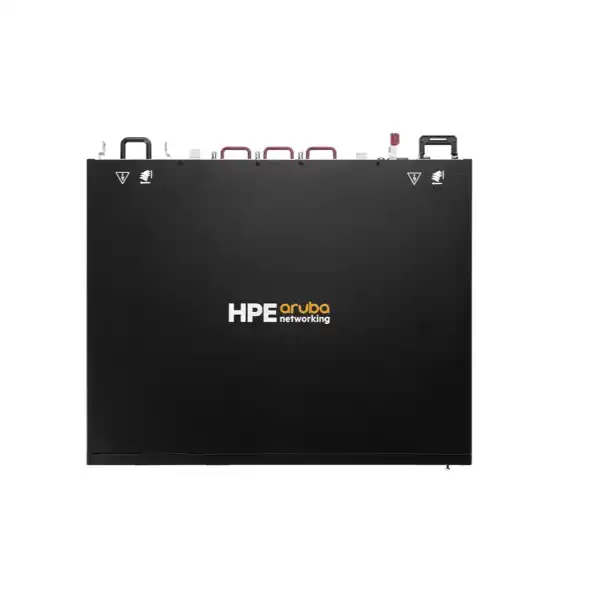
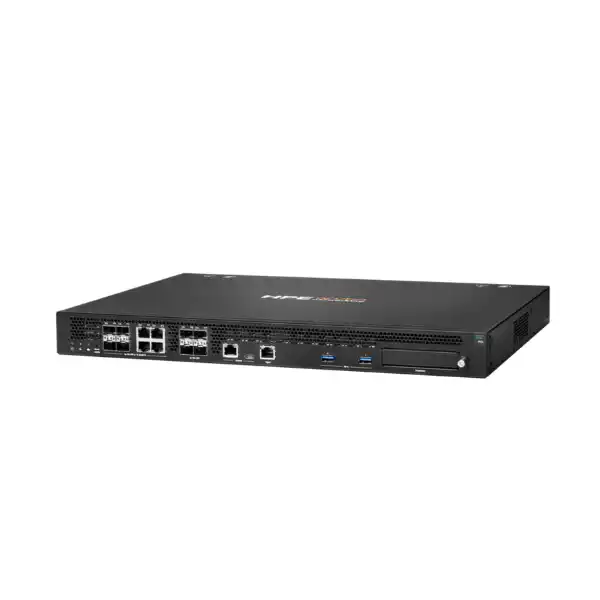
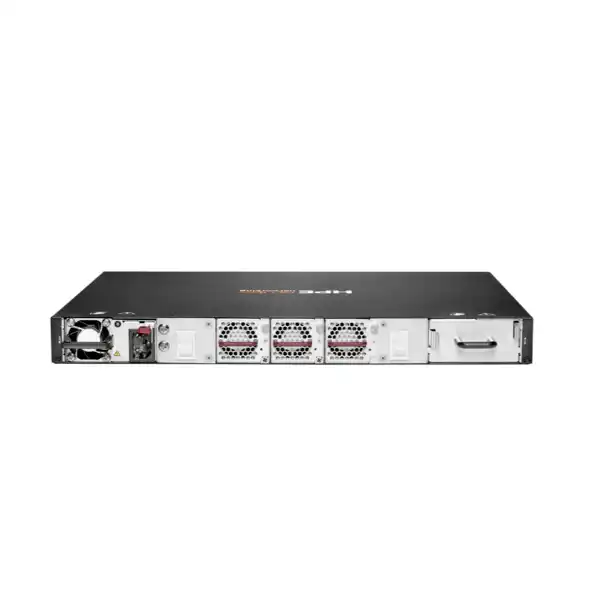
HPE Aruba Networking 9114 Gateway Dubai
A high-capacity 1RU edge gateway for organizations standardizing on HPE Aruba Networking Central and AOS 10. The 9114 combines 20 Gbps-class firewall and encrypted throughput, dense 10GbE uplinks, large wireless scale and resilient hardware options for demanding branch, campus-edge and VPN concentrator designs.
Direct answer: what is the HPE Aruba Networking 9114?
The 9114 is a cloud-optimized HPE Aruba Networking 9100 Series Hybrid Gateway designed for large branch and small campus edge deployments.
It can operate as a cloud-managed wireless gateway, an SD-Branch gateway for WAN and tunnel orchestration, or a VPN concentrator for remote networks and client VPN connectivity.
Enterprises with high AP counts, substantial encrypted traffic, 10GbE connectivity requirements, or resilience targets that exceed the needs of smaller branch gateways.
Confirm AOS 10 architecture, Aruba Central subscription, port and optic requirements, power redundancy, expected client/AP scale, and whether 20 Gbps-class forwarding is appropriate for the real traffic profile.
FourTeck can map the appliance, subscription tier, optics, power supplies, support and deployment services to the buyer’s Dubai or UAE network design.
Where the 9114 fits in an Aruba edge design
The 9114 is not simply a faster version of a small branch gateway. Its role is to provide a substantial aggregation and policy-enforcement point for environments where WLAN scale, encrypted tunnel scale and 10GbE connectivity matter at the same time. HPE positions the 9100 Series for large branches and small campuses, and the 9114 sits above the 9106 in throughput, interface density and AOS 10 scale.
For a Dubai office with a few dozen access points and modest WAN links, the 9114 may be unnecessary. For a regional headquarters, logistics hub, education campus, hospitality complex, healthcare site, enterprise branch or VPN concentration role with many remote sites, the additional scale can be meaningful. The correct decision depends on real traffic and architecture rather than on headline client numbers alone.
AOS 10 is a critical design condition
Current HPE QuickSpecs list the 9114 with a minimum supported software version of AOS 10.5 and show AOS 8 specifications as not supported for this model. That distinction matters in migrations. A buyer replacing an older mobility-controller architecture should not assume that controller-era operational models transfer unchanged to the 9114.
AOS 10 works with HPE Aruba Networking Central as the management and control layer. The gateway participates in a distributed, cloud-managed architecture rather than acting as a traditional standalone controller. Migration planning should therefore include Central tenancy, subscription licensing, configuration workflow, policy mapping and operational readiness.
HPE Aruba Networking 9114 technical specifications
| Specification | HPE Aruba Networking 9114 | Buyer relevance |
|---|---|---|
| Firewall throughput | 20 Gbps | Useful for high-volume east-west or north-south policy enforcement, subject to the deployed feature set and traffic profile. |
| Encrypted throughput | 20 Gbps for GRE and listed AES-CBC/AES-GCM modes | Important for VPNC and SD-Branch designs carrying large encrypted tunnel loads. |
| Maximum clients | 10,000 user MACs per gateway | A platform ceiling, not a substitute for traffic and application sizing. |
| Maximum APs | 4,000 per gateway; 8,000 per cluster | Relevant for very large WLAN aggregation; actual architecture may spread load across multiple gateways for resilience. |
| Cluster size | Up to 6 | Supports resilient multi-gateway designs and scaling beyond a single appliance. |
| Maximum clients per cluster | 80,000 | Current HPE QuickSpecs figure; resilience and traffic distribution must still be designed separately. |
| Datapath / firewall sessions | 2 million | Important for dense environments with many concurrent client and application flows. |
| Concurrent IPsec tunnels | 32,000 | A key capacity measure for VPN concentration and distributed branch connectivity. |
| Total tunnels | 40,000 | Helps size large overlay environments with many tunnel relationships. |
| Interfaces | 4 × SFP+ and 4 × combo SFP/1GbE copper | Provides a flexible mix of 10GbE fiber and 1GbE media, but optics must be selected separately where required. |
| Management and console | 1 × RJ45 out-of-band, USB-C and RJ45 console, 2 × USB 3.0 Type-A | Useful for operational access and deployment workflows. |
| Form factor | 1 RU; 43.7 × 442 × 351 mm | Requires rack space, front/rear access planning and suitable airflow. |
| Weight | 6.2 kg | Relevant for rack handling and installation preparation. |
| Power | 250 W PSU; up to 185 W maximum power consumption | Allow for power, cooling and UPS capacity; a redundant PSU slot is available. |
| Operating environment | 0°C to 40°C; 10% to 90% RH non-condensing | The data-room environment must remain within supported limits, especially in UAE facilities where cooling resilience matters. |
What the performance numbers mean in practice
20 Gbps firewall throughput
The 20 Gbps figure places the 9114 in a different class from smaller branch appliances, but it should not be treated as a guaranteed application throughput number under every possible feature combination. Real deployments involve packet sizes, tunnel overhead, policy complexity, uplink speeds and traffic distribution. Buyers should size against peak and sustained traffic, not only current ISP bandwidth.
Encrypted traffic at scale
HPE lists 20 Gbps encrypted throughput for GRE and multiple AES-CBC and AES-GCM modes. That makes the 9114 suitable for designs where branch, VPN or overlay traffic is heavily encrypted. A VPN concentrator project should additionally account for tunnel count, route scale, redundancy and upstream capacity.
Client and AP scale
The platform supports up to 10,000 client MACs and up to 4,000 APs per gateway under AOS 10. These are valuable architectural ceilings, yet the correct number of gateways may be higher than simple division suggests because enterprises often design for failover, maintenance events and realistic traffic headroom.
Session and tunnel capacity
Two million datapath/firewall sessions, 32,000 concurrent IPsec tunnels and 40,000 total tunnels make the 9114 relevant to dense enterprise edge deployments. For large distributed estates, tunnel design, routing behavior and failure-domain planning should be reviewed together instead of treating each limit independently.
Connectivity, optics and cabling decisions
The physical interface mix is one of the strongest reasons to select the 9114. It provides four 10GbE SFP+ interfaces plus four combo interfaces that can use SFP or 1GbE copper connectivity. This gives the appliance enough flexibility to sit between core or aggregation switching, WAN handoffs, security zones and data-centre-facing links without relying exclusively on 1GbE copper.
The appliance should not be ordered as though the front-panel cages automatically include the required optics. HPE QuickSpecs list supported 1G SFP, 10G SFP+ and direct-attach cable options separately. The correct transceiver depends on fiber type, distance, connector standard and the equipment at the far end. For example, short-reach multimode, long-reach single-mode and DAC choices solve different physical-link requirements. A quotation that omits this step can deliver a gateway that is technically correct but not connectable on installation day.
The 9114 also includes one RJ45 out-of-band management port, USB-C and RJ45 console interfaces and two USB 3.0 Type-A ports. The management network should be designed deliberately. Out-of-band access is especially valuable when the gateway is part of a critical branch or headend role because it provides a separate operational path when production connectivity is impaired.
Aruba Central subscription and licensing
Central is not optional in the normal AOS 10 design
HPE states that the 9100 Series is supported by the cloud-based version of HPE Aruba Networking Central and requires a Central subscription. AOS 10 is included in that subscription model. Buyers therefore need to budget for both the hardware appliance and the appropriate per-device subscription rather than comparing the 9114 purely on hardware price.
Choose the subscription around the use case
Current HPE ordering material lists 91xx subscription options for SD-Branch and WLAN roles, including Foundation, Advanced and security-inclusive variants, with multiple term lengths. The exact SKU set can change over time, so the quote should be built from the current ordering guide for the intended role rather than copied from an old bill of materials.
Licensing affects operations as well as procurement
Central supplies the cloud-based management and control framework used with AOS 10. License term and feature tier influence the operating model, support entitlement and available functionality. Procurement, networking and security teams should agree on the use case before a purchase order is raised so the subscription matches the architecture.
High availability, redundant power and maintenance planning
HPE describes the 9100 Series as supporting redundancy, clustering and live upgrades, with N+1 or NxN design options. The 9114 itself has a primary power-supply slot plus a redundant power-supply position. This is valuable, but redundancy only works as intended when the surrounding design is also redundant. Two PSUs connected to one UPS circuit do not provide the same protection as feeds from independent power paths.
The appliance can use AC or DC power-supply options depending on the ordered configuration. HPE’s installation guide specifies 250 W AC and 250 W DC power supplies. The AC unit supports 100–240 VAC at 50–60 Hz. The DC option is designed for negative DC supply ranges and has explicit grounding and safe-removal requirements. DC deployment should be handled by personnel familiar with the site’s DC power practice and local safety requirements.
For a business-critical Dubai installation, resilience planning should cover gateway clustering, separate upstream switch paths, independent power where practical, suitable spare strategy and operational procedures for upgrade windows. The value of the 9114 is highest when the appliance is part of a complete availability design rather than treated as a single oversized box.
Deployment use cases
Large enterprise branch
Use the 9114 when a large branch has substantial WLAN scale, multiple high-speed uplinks, significant local traffic and a requirement for unified policy and WAN operations through Aruba Central. It is particularly relevant when growth is expected beyond the practical comfort zone of smaller branch gateways.
Small campus gateway
A small campus can use the 9114 as a high-capacity wireless gateway with thousands of APs and clients supported at platform level. Campus architecture should still distribute gateways to achieve maintenance flexibility and failure-domain objectives rather than concentrating everything on one chassis.
SD-Branch
In an SD-Branch role, the gateway contributes tunnel and route orchestration, security and WAN management under the Aruba Central operating model. This is useful for enterprises that want wired, wireless and WAN policy coordination instead of managing each layer as an isolated platform.
VPN concentrator
The 9114’s encrypted throughput and tunnel scale make it a strong candidate for VPNC designs supporting remote networks, microbranches and client VPN connectivity. Headend capacity should be calculated using the number of sites, concurrent tunnels, routed prefixes, expected encrypted bandwidth and resilience requirements.
Sizing the 9114 correctly
A sound sizing exercise begins with workload rather than product limits. Count access points and clients, but also identify the amount of traffic that will actually traverse the gateway, the proportion that will be encrypted, expected peak concurrency, application sensitivity, number of remote sites, tunnel scale and planned growth. A gateway that is far below its client limit can still be stressed by a demanding traffic pattern; conversely, an environment with many low-traffic clients may not require the largest possible appliance.
For wireless gateway designs, assess AP count, user count, roaming domains and the amount of traffic being tunneled versus bridged. For SD-Branch, include WAN circuits, route design, segmentation and security features. For VPN concentration, model tunnel count, encrypted throughput, routing scale and failure scenarios. In each case, apply practical headroom so a failover event does not push the surviving gateway immediately to its design limit.
The published 9114 limits are therefore guardrails, not a design calculator. FourTeck can use the customer’s topology and growth assumptions to decide whether one 9114, a resilient pair, a larger clustered design or a different gateway family is the better fit.
9114 versus nearby Aruba gateway choices
When the 9106 may be enough
The 9106 is the more compact 9100 Series option. Current HPE specifications list 10 Gbps firewall throughput, up to 2,000 APs and 8,000 clients. It can be a better commercial fit when the branch is large but does not need the 9114’s 20 Gbps throughput, four 10GbE SFP+ interfaces or higher AP/tunnel scale.
The 9106 also has a different physical interface profile and built-in PoE budget, so the choice is not purely a throughput comparison.
When the 9114 is the stronger fit
Choose the 9114 when the design benefits from 20 Gbps firewall/encrypted throughput, four 10GbE SFP+ uplinks, 4,000-AP scale, 10,000 clients, 32,000 concurrent IPsec tunnels or hardware power redundancy. It is also the stronger choice when rack-mount deployment and dense fiber connectivity are expected.
Its additional capacity is most valuable when it solves a measurable requirement, not simply as a future-proofing label.
When a larger platform should be assessed
If the environment requires more client scale, different uplink speeds, a different gateway role or a larger failure domain, compare the 9114 with higher-capacity Aruba gateway platforms rather than forcing the 9114 into an unsuitable design.
This is especially relevant in campus and headend projects where route scale, 25GbE interfaces or very large client populations may drive the decision more than raw firewall throughput.
Installation and data-room considerations in Dubai
The 9114 is a 1RU appliance measuring approximately 43.7 mm high, 442 mm wide and 351 mm deep, with a listed device weight of 6.2 kg. It should be installed in a rack with suitable front and rear clearance, stable mounting and accessible cable management. The three fan trays and power-supply airflow must not be obstructed. Rack planning should account for the neighboring equipment, fiber bend radius, console access and the path of redundant power feeds.
HPE specifies a 0°C to 40°C operating-temperature range and 10% to 90% relative humidity, non-condensing. UAE facilities can experience high ambient temperatures outside conditioned spaces, so the network room needs dependable cooling, not simply nominal air conditioning. The current QuickSpecs list maximum heat dissipation of 631 BTU/hour and maximum appliance power consumption of 185 W, both of which should be included in rack-level power and thermal calculations.
Installation should also include ESD precautions for SFP handling and verification of the correct fiber or copper media. HPE’s installation guide notes that SFP modules are inserted until fully seated and that LC fiber connections must be handled carefully. These may sound like small operational details, but they are often the difference between a clean commissioning window and avoidable troubleshooting.
Migration planning from existing Aruba environments
The 9114 is an AOS 10 gateway, and current HPE specifications show AOS 8 as not supported on this model. That makes the migration architecture a first-order decision rather than a late implementation detail.
Confirm tenant readiness, subscription tier, license term, device onboarding and the operational roles of the network team. The gateway should not arrive before the management and licensing path is clear.
Document existing VLANs, roles, ACLs, SSIDs, routed interfaces and security policies. The goal is not merely to reproduce legacy configuration but to determine how policy should be expressed in the AOS 10 and Central design.
Check rack space, uplink media, optic compatibility, upstream switch ports, management access, console connectivity and power. Migration risk is often physical rather than software-related.
Plan how traffic moves to the new gateway, how the old path remains available during validation, what success criteria are measured and how service is restored if an unexpected dependency appears.
A resilient design should be tested under realistic failover conditions. Verify gateway, switch and power redundancy rather than assuming that the presence of multiple devices automatically creates high availability.
Procurement details that affect the quotation
The standard HPE Aruba Networking 9114 AC model is commonly identified by SKU R9M45A, while HPE also publishes DC and TAA variants. A buyer should state the exact required power and compliance variant because these are not interchangeable assumptions. The quotation also needs the number of gateways, redundancy plan and whether a second power supply is required for each unit.
Optics and direct-attach cables should be itemized according to each intended link. A four-port 10GbE requirement may use a very different bill of materials depending on whether the far end is in the same rack, across a multimode-fiber run or in another building over single-mode fiber. The combination of transceiver type and cable plant must match both ends of the connection.
Subscription licensing is another major quotation dependency. HPE lists multiple 91xx SD-Branch and WLAN subscription tiers and term lengths. FourTeck should quote the current subscription SKUs that match the intended operating role, because license offerings and orderable part numbers can change during the product lifecycle. Support term, installation, configuration assistance and migration services should also be specified explicitly rather than left as assumptions.
For UAE projects with formal procurement controls, include the required delivery location, legal entity, project schedule and any specific documentation requirements. If the project needs a TAA variant or DC power, state that at the first quotation stage so the correct model family is selected from the outset.
Common buyer questions
Does the Aruba 9114 support AOS 8?
Current HPE QuickSpecs show AOS 8 specifications as not supported for the 9114 and list AOS 10.5 as the minimum supported software version. Projects migrating from AOS 8 should therefore be planned as an architecture transition, not as a direct controller replacement.
Is Aruba Central required?
Yes, the current HPE material describes the 9100 Series as supported by cloud-based HPE Aruba Networking Central and requiring a Central subscription. The appropriate subscription should be included in the project bill of materials.
Are SFP and SFP+ transceivers included?
The gateway provides the SFP/SFP+ ports, while the required transceivers or DACs are selected separately according to distance, fiber type and far-end interface. The exact optic part numbers should be confirmed in the quotation.
Can it be deployed with redundant power?
Yes. HPE lists the 9114 with one power-supply slot plus a redundant power-supply position. If power redundancy is required, the second supply and independent power path should be included in the design and quote.
Is 20 Gbps the right size for every large branch?
No. The right model depends on traffic, AP and client scale, interface requirements, tunnel counts, resilience and growth. A smaller 9106 may be more economical for some sites, while larger or differently positioned gateways may be more suitable for very large campus or headend roles.
What information is needed for a Dubai quotation?
Provide quantity, intended role, AP and client counts, WAN and LAN speeds, uplink media, optic distances, redundancy requirements, AC or DC power preference, subscription term, support expectations, installation scope and the delivery location in the UAE.
Decision recap
Best suited to large branch, small campus, SD-Branch and VPNC roles that can use its 20 Gbps-class capacity.
Plan for AOS 10. Current HPE material does not support AOS 8 on the 9114.
HPE Aruba Networking Central subscription is a core project requirement and must match the intended role.
Four SFP+ and four combo ports provide flexibility, but optics and cabling need separate selection.
Use clustering and redundant power as part of an end-to-end availability design.
Reserve 1RU rack space, adequate cooling, cable access and appropriate power capacity.
What FourTeck needs for an accurate 9114 quotation
Plan the HPE Aruba Networking 9114 around your actual UAE network
FourTeck can help validate whether the 9114 is the right gateway, identify the required Aruba Central subscription, match SFP/SFP+ optics to the cabling environment, plan redundant power and prepare a quotation that reflects the real deployment rather than a bare appliance SKU.

Reviews
There are no reviews yet.