
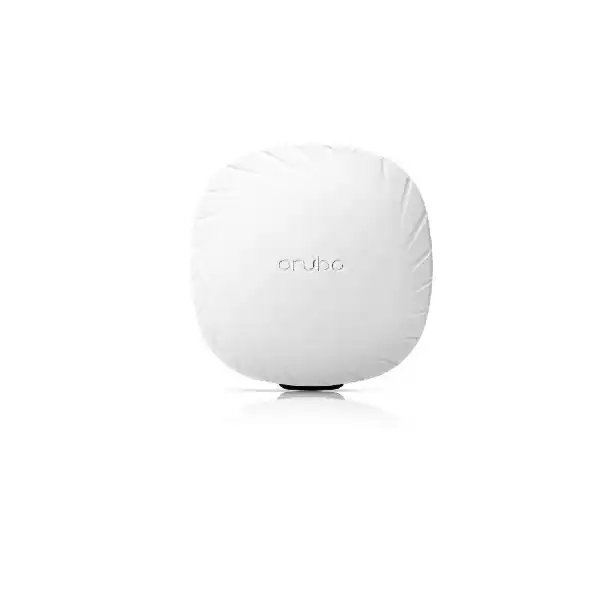

A direct answer for buyers evaluating the AP-503
HPE Aruba Networking AP-503 is a compact indoor campus access point for providing business Wi-Fi across everyday office, education, retail and branch spaces. It supports concurrent 2.4 GHz and 5 GHz Wi-Fi 6 operation with two spatial streams per radio and is positioned for low- to medium-density environments. Organisations should consider it when they need centrally manageable enterprise wireless without the capacity profile of a more advanced high-density model. Before proceeding, confirm the correct regulatory-domain part number for the UAE, the number and placement of access points, available 802.3af PoE, mounting needs, the intended HPE Aruba Networking operating and management architecture, and whether installation, configuration, subscriptions or support services are required.
What the AP-503 does
At its core, the AP-503 provides indoor wireless access for business users, managed devices and compatible IoT endpoints. Its two radios operate concurrently across the 2.4 GHz and 5 GHz bands, allowing newer Wi-Fi 6 clients and older supported Wi-Fi generations to connect according to the network design and configuration.
The product is not simply a consumer-style wireless router. It is intended to work as part of a managed HPE Aruba Networking wireless environment where radio settings, access policies, SSIDs, authentication and operational visibility can be handled through the selected architecture. The practical outcome is a repeatable wireless design that can be expanded across multiple rooms, floors or sites when the access-point count and management plan are correctly sized.
Who it is designed for
The AP-503 makes sense for organisations whose main requirement is reliable indoor coverage and efficient handling of everyday client populations rather than extremely high simultaneous user density. Examples include midsize office areas, training rooms, classrooms, retail floors, clinics, branch locations and operational spaces where staff devices, guest devices and selected connected equipment need controlled wireless access.
It is also relevant for buyers standardising on HPE Aruba Networking who want an access point that fits into a broader campus or branch architecture. A site with auditoriums, convention spaces, very dense open offices, unusually high throughput requirements or multigigabit uplink needs should be reviewed carefully because a different model may be more appropriate.
Business problems this access point can help address
Aging wireless infrastructure
For sites still operating older Wi-Fi generations, the AP-503 provides a path to Wi-Fi 6 features such as OFDMA and target wake time while retaining support for common earlier 802.11 standards. A proper migration plan should still account for client capability, channel design and existing controller or management software.
Uneven user experience
Wireless problems are often caused by placement, interference, sticky clients or channel contention rather than one headline speed figure. Aruba radio-management and client-steering capabilities can support a more consistent design when the surrounding architecture is correctly deployed and tuned.
Policy consistency
Businesses that need clearer separation between employees, guests and device groups can use HPE Aruba Networking policy capabilities as part of the wider solution. The exact enforcement method, required products and licensing should be confirmed rather than assumed to be included solely because an AP is purchased.
Simpler branch rollouts
A repeatable access-point model, PoE design and management approach can reduce variation when branches or similar rooms need the same wireless standard. Site survey findings, cabling, switch power budgets and local RF conditions still determine the final bill of materials.
Core capabilities that matter in a real deployment
The series combines up to 574 Mbps on 2.4 GHz and up to 1.2 Gbps on 5 GHz under supported Wi-Fi 6 conditions. This is an aggregate radio capability, not a promise that one client or every location will achieve that throughput.
Wi-Fi 6 scheduling can make airtime use more efficient with compatible clients, especially when many devices exchange smaller bursts of data. Results depend on the client mix, RF design and traffic behaviour.
Modern authentication and encrypted open-network options can support stronger wireless security designs. Authentication services, policy configuration and endpoint compatibility should be reviewed as part of deployment.
The built-in downtilt omnidirectional antennas are optimised for a horizontal ceiling-mounted orientation, which is important when planning placement and predicting how coverage will spread through a room.
AP-503 fit matrix
| Requirement | Suitable when | Confirm before ordering |
|---|---|---|
| Indoor office or branch Wi-Fi | Client density is low to medium and Wi-Fi 6 is required. | Coverage plan, client count, expected applications and roaming pattern. |
| Standard Gigabit wired edge | A 1GbE uplink meets the design requirement. | Switch port speed, VLAN configuration and upstream capacity. |
| PoE-powered deployment | 802.3af class 3 or higher PoE is available. | Total PoE budget, cable path and switch compatibility. |
| Cloud or centralised operations | The organisation already uses or plans a supported HPE Aruba Networking management model. | Software version, platform architecture and subscription requirement. |
| IoT expansion | Bluetooth 5 or Zigbee use is planned through the optional IoT expansion radio. | Required dongle, application support and integration scope. |
Verified technical information
The values below describe the AP-503 hardware platform and current HPE published specifications. Regional part numbers and permitted radio channels vary, so the exact UAE ordering code must be confirmed in the quotation.
| Brand | HPE Aruba Networking |
|---|---|
| Product | AP-503, 503 Series Campus Access Point |
| Product type | Indoor dual-radio campus wireless access point |
| Wireless standard | 802.11ax Wi-Fi 6; backward support for listed 802.11a/b/g/n/ac services |
| Radio design | Dual concurrent 2.4 GHz and 5 GHz, 2×2 MIMO |
| 2.4 GHz maximum data rate | Up to 574 Mbps with supported 2SS HE40 Wi-Fi 6 clients; 287 Mbps for HE20 |
| 5 GHz maximum data rate | Up to 1.2 Gbps with supported 2SS HE80 Wi-Fi 6 clients |
| Maximum associated clients | Up to 256 associated client devices per radio; practical design capacity should be sized to application and airtime needs |
| Ethernet | One E0 RJ-45 port, auto-sensing 10/100/1000BASE-T, 802.3az EEE |
| PoE | 802.3af PoE PD, class 3 or higher; power source sold separately |
| Maximum power consumption | 10.9 W worst case, excluding USB power draw; published idle maximum 4.7 W |
| Antennas | Integrated downtilt omnidirectional antennas for 2×2 MIMO; peak antenna gain 1.7 dBi at 2.4 GHz and 4.8 dBi at 5 GHz |
| USB | USB 2.0 Type-A host interface, up to 100 mA / 500 mW |
| Security hardware | Built-in Trusted Platform Module (TPM) |
| Dimensions with mount bracket | 145 x 145 x 51 mm |
| Weight with mount bracket | 270 g |
| Operating temperature | 0°C to +40°C |
| Mounting | Generic bracket for suspended ceiling rails ships with the AP; alternate brackets are available separately |
| Regulatory model | APIN0503 |
| UAE ordering reference | HPE UAE currently lists AP-503 (RW1) S2C07A and AP-503-RW R8M98A among regional options; confirm the exact required variant before ordering |
| Availability | Contact FourTeck for current UAE availability, lead time and quotation |
Configuration, licensing and compatibility dependencies
An access point can be technically compatible with Wi-Fi clients and still be the wrong procurement choice if the management architecture, software version, regional code or power design is not aligned. The AP-503 is available in multiple regulatory variants because legal radio channels and power limits differ by country. For a UAE deployment, the quotation should identify the exact HPE manufacturer part number rather than relying only on the generic AP-503 model name.
Management is another important dependency. HPE publishes support for controller-based and controller-less operating modes across relevant Aruba software generations, and HPE Aruba Networking Central subscriptions are available for centralised management. The correct software and subscription selection depends on how the organisation intends to operate the WLAN, what existing HPE Aruba Networking infrastructure is already deployed, and which current vendor software releases are supported at the time of implementation.
Optional IoT capabilities also need careful interpretation. Bluetooth 5 and 802.15.4/Zigbee support for the 503 Series requires an optional IoT expansion radio rather than being assumed as a fully integrated standard radio feature. Buyers planning asset tracking, sensor integration or location services should include that accessory and its application dependencies in the bill of materials.
From requirement to installed wireless service
Define the user experience
Document coverage areas, typical concurrent users, voice or video requirements, guest access, critical applications and any roaming requirement. This prevents a model choice based only on floor area.
Review RF and cabling
Confirm ceiling locations, cable paths, existing switch ports, PoE budgets, obstructions and sources of interference. A site survey is valuable when the environment is complex or performance expectations are high.
Confirm platform and subscriptions
Match the AP to the intended Aruba management architecture, supported software and security policy design. Include required subscriptions or services in the same commercial review.
Order the exact regional part
Specify quantity, regional SKU, mounts, optional IoT radio, support requirements and any PoE or switching components needed to complete the installation.
Install, validate and document
Mount and cable the APs, apply configuration, validate coverage and roaming, test representative applications and record the final configuration for support and future expansion.
Efficient Wi-Fi 6 for everyday client populations
The practical benefit of Wi-Fi 6 in this class of access point is not simply a higher top-line speed. OFDMA lets compatible clients share channel resources more efficiently, which can reduce wasted airtime when many endpoints are sending smaller transactions. Target wake time can also help compatible low-power devices schedule communications more efficiently.
That does not mean every older laptop or phone suddenly behaves like a Wi-Fi 6 client. Client capability, channel width, signal quality, interference, retransmissions and upstream network capacity all affect the final experience. A buyer should therefore judge the AP-503 by whether its radio design matches the expected client population and room density, not by treating 1.49 Gbps as a guaranteed user throughput figure.
Management that fits a wider Aruba environment
Wireless operations become easier when the access points, switching, authentication and policy approach are planned as one system. The AP-503 can participate in supported HPE Aruba Networking management architectures, including centralised cloud management through HPE Aruba Networking Central where the appropriate subscription and software support are in place.
For an organisation already using Aruba, this can make the AP-503 easier to incorporate into established naming, SSID, role and monitoring practices. For a new deployment, the management choice should be made before procurement because it affects licensing, configuration workflow and operational ownership. FourTeck can help the buyer map the access-point requirement to the intended management model rather than treating management as an afterthought.
Security controls need system-level planning
The AP-503 supports WPA3, Enhanced Open and hardware protection through a built-in TPM. Those are meaningful building blocks, but business wireless security also depends on identity sources, authentication methods, device posture, network segmentation, firewall policy and the way guest traffic is handled.
HPE Aruba Networking dynamic segmentation and policy capabilities can help organisations apply access rules consistently across wired and wireless environments, but the required controllers, gateways, ClearPass components, subscriptions or other dependencies vary by design. Procurement teams should therefore ask for the complete intended architecture, not assume that every policy feature is enabled by purchasing the AP alone.
Where the AP-503 fits well
Midsize offices
Open work areas, meeting rooms and general office zones where staff use laptops, phones and collaboration applications can suit the AP-503 when user density and RF design align with its two-stream radio profile.
Education spaces
Classrooms, training rooms and administrative areas can benefit from Wi-Fi 6 efficiency, although exam halls, auditoriums or very dense learning spaces may require a higher-capacity design.
Retail and service environments
Point-of-service devices, staff handhelds and guest access can share a managed WLAN, provided coverage, security segmentation and device compatibility are planned correctly.
Branches and distributed sites
Organisations with repeatable branch layouts can standardise AP placement, switch PoE and policy templates while still allowing for local channel plans, regulatory requirements and building differences.
Integration and operational considerations
Wireless access points sit at the intersection of cabling, switching, IP addressing, authentication, identity, security and end-user devices. For the AP-503, begin with the wired edge. Each AP needs a Gigabit Ethernet connection and an appropriate 802.3af PoE source. If many APs are planned on one switch, calculate the total PoE budget and confirm that the switch can deliver the required power on all intended ports while still leaving capacity for other powered devices.
Next, validate VLANs, DHCP, DNS, routing and any firewall path needed by the selected management architecture. If the organisation uses 802.1X, RADIUS, HPE Aruba Networking ClearPass or another identity platform, confirm certificate, authentication and role-mapping requirements before migration. Guest access may introduce captive portal, internet breakout, logging or privacy considerations that need separate design decisions.
Finally, plan lifecycle operations. Decide who will monitor AP health, review radio conditions, apply software updates, maintain subscriptions and document changes. A small wireless deployment can become difficult to support if nobody owns these tasks. For multi-site projects, a consistent naming convention, floor-plan documentation and standard configuration approach can save considerable effort when troubleshooting or expanding later.
If you are also reviewing switching, firewalls or other infrastructure, FourTeck can help coordinate the requirement across the wider business technology product range and discuss installation and configuration services that may be included in the project scope.
Questions to resolve before requesting a quotation
A headcount alone is not enough. Include staff laptops, phones, tablets, scanners, voice devices, guest devices and any connected equipment that can be simultaneously active.
Voice, video, cloud desktops and real-time operational applications need different performance assumptions from occasional browsing or background IoT traffic.
Existing controllers, Central subscriptions, software versions and identity services affect the final configuration and commercial scope.
Confirm cable category, termination quality, available switch ports and PoE budget before assuming the AP can be installed at the intended locations.
Procurement checklist for AP-503 projects
A clear bill of materials starts with confirmed site information. Include the following points in the request sent to FourTeck:
- Exact AP-503 regional variant or request FourTeck to confirm the UAE option
- Required access-point quantity and deployment sites
- Expected concurrent users and client-device mix
- Existing Aruba controller, Central or management environment
- Required subscription term where applicable
- PoE switch model, available ports and remaining power budget
- Ceiling type and any alternate mounting brackets
- Need for optional Bluetooth/Zigbee IoT expansion radio
- SSID, guest access, authentication and segmentation requirements
- Installation, cabling or configuration scope
- Testing, documentation and handover expectations
- Support and warranty guidance required for the project
- Delivery destination and preferred project schedule
How FourTeck can support the buying process
FourTeck can help turn a generic “we need Wi-Fi” request into a procurement-ready specification. That can include checking whether AP-503 capacity is appropriate, reviewing the requested quantity, identifying the current UAE regional variant, considering PoE switching and mounting, and clarifying whether HPE Aruba Networking Central subscriptions or other platform components should be included.
Where the project includes installation, FourTeck can also discuss access-point placement, cabling dependencies, configuration, testing and handover scope. These activities should be defined in the quotation rather than assumed to be part of hardware supply.
For a broader infrastructure discussion, visit FourTeck business technology solutions or send the project details through the FourTeck contact page.
Information that speeds up an accurate quote
Share the number of sites, approximate floor plan or area, expected users, existing switch models, current Aruba environment, required authentication method, deployment deadline and whether configuration or installation is required.
This gives the sales and technical team enough context to identify obvious dependencies early and reduces the chance of ordering an AP without a required subscription, mounting accessory or compatible PoE source.
UAE availability and support guidance
Contact FourTeck to confirm current UAE availability for the HPE Aruba Networking AP-503. Availability can depend on the required regulatory variant, quantity, vendor lead time and whether the quotation includes subscriptions, mounting accessories, PoE switching or professional services. The HPE UAE catalogue currently presents AP-503 regional options including RW and RW1 variants, which is why the manufacturer part number should be confirmed before a purchase order is issued.
Delivery and project coordination can be discussed after the exact requirement is confirmed. If the project needs installation, configuration or testing, include that scope in the quotation so scheduling can be planned against site access and technical dependencies. FourTeck can support business customers across the UAE with requirement review and procurement coordination without assuming that a particular item is in local stock at the time of enquiry.
Dubai, Abu Dhabi, Sharjah and Ajman project coordination
For organisations deploying wireless networks across Dubai, Abu Dhabi, Sharjah and Ajman, FourTeck can coordinate the requirement as one project rather than treating each access point as an isolated purchase. A multi-location request should identify the quantity required at each site, building access limitations, existing switching, target management architecture and whether the same SSID and security policies must be used across locations. This makes it easier to prepare a consistent bill of materials and identify where site-specific differences matter. Hardware supply, delivery planning, installation visits and configuration scope remain dependent on the confirmed quotation, site conditions and current product availability.
GCC Availability
FourTeck can assist organisations planning HPE Aruba Networking wireless deployments across the GCC by reviewing the requirement before the order is finalised. For an AP-503 project, that review can cover the exact regional model, access-point quantity, management architecture, subscription term, PoE switching, mounting, optional IoT accessories, installation needs and expected deployment schedule. This is especially useful for businesses that want a consistent wireless standard across the United Arab Emirates, Saudi Arabia, Kuwait, Qatar, Bahrain or Oman while still respecting country-specific regulatory domains.
Product availability, permitted radio configuration, licensing, delivery schedules, service visits and vendor lead times can differ by country, model and quantity. Buyers should share the destination country, exact requirement, number of access points, site type, preferred deployment timeline and any configuration or support expectations. FourTeck can then coordinate a quotation and advise which details need confirmation before procurement. For Kuwait-related enquiries, organisations may also review FourTeck Kuwait technology support.
Africa Availability
Organisations planning wireless infrastructure in African markets can ask FourTeck to review AP-503 requirements together with the surrounding network design. The commercial request should identify the destination, quantity, regional part number, power and regulatory requirements, management platform, subscription needs, mounting, installation expectations and any support or renewal considerations. For multi-site businesses, this information helps separate what can be standardised from what must change according to local conditions.
Availability and fulfilment may vary with destination country, vendor lead time, shipping arrangements, regulatory domain, quantity and project scope. Buyers in East Africa and other regions should avoid assuming that one SKU can be used everywhere. Share the exact deployment location and target schedule so the appropriate option can be reviewed. FourTeck provides regional information through resources such as FourTeck Africa, with dedicated market information also available for Kenya technology requirements.
Related options and services to consider
HPE Aruba Networking Central
Consider the appropriate Central subscription when cloud-based monitoring and management are part of the intended architecture. Subscription level and term should be confirmed for the actual project.
PoE access switching
If existing switches cannot provide the required 802.3af power or enough Gigabit ports, include compatible access switching and the full PoE budget in the design review.
Mounting accessories
The standard suspended-ceiling bracket may not fit every site. Wall, ceiling and alternate rail mounts can be evaluated according to the mounting surface and coverage plan.
Wireless installation and configuration
Projects that need site validation, configuration, testing or documentation can include professional service scope rather than purchasing hardware alone.
Buyer guidance: the questions people usually investigate before choosing an AP-503
A business buyer researching the AP-503 is usually trying to solve several decisions at once: whether the model has enough capacity, whether it works with the existing Aruba environment, which regional part number is correct, what extra subscriptions or accessories are needed, and how many units should be ordered. These questions are more important than simply finding the lowest visible device price because the wrong wireless model can create additional switching, licensing or redesign costs after purchase.
Is the AP-503 fast enough for a normal office?
For many low- to medium-density offices, the AP-503 has a sensible performance profile: two Wi-Fi 6 spatial streams per radio, up to 80 MHz on 5 GHz and a published maximum combined data rate of 1.49 Gbps. The more useful question is whether each coverage zone has an appropriate number of active devices and whether applications are mainly general productivity, cloud access, voice and video rather than unusually heavy local data transfer. High-density spaces should be sized differently because client count, airtime and interference become the limiting factors long before a theoretical radio rate is reached.
Does it need a controller or can it be managed another way?
The AP-503 belongs to HPE Aruba Networking’s campus access-point portfolio and has supported deployment options across controller-based, controller-less and Central-managed architectures depending on software generation and the organisation’s design. A buyer should not decide this from the AP hardware alone. Existing controllers, gateways, Central subscriptions, software versions, authentication systems and operational standards all influence the right approach. If an organisation is migrating from an older Aruba platform, software compatibility should be checked before hardware is ordered.
What is actually included with the access point?
HPE specifies that a generic mounting bracket for suspended ceiling rails ships with the AP-503, while alternate mounts can be ordered separately. The PoE power source is sold separately, so the usual expectation is that the AP will be powered by a compatible PoE switch or other approved source already in the network design. Optional IoT expansion functionality also requires separate hardware. This is why a quote should list the full bill of materials rather than only the access-point line item.
Why does the part number matter in Dubai and the UAE?
Wireless products use regulatory-domain variants because permitted channels and transmit-power rules differ across countries. HPE’s current UAE catalogue includes AP-503 RW and RW1 references, among other global variants. A purchasing team should therefore ask FourTeck to confirm the correct manufacturer part number for the intended UAE deployment. This avoids treating a US, Japan, Israel or other country-specific model as interchangeable merely because the physical enclosure looks the same.
Another common buyer question concerns coverage area. There is no responsible universal square-metre number for an enterprise AP because wall materials, ceiling height, neighbouring networks, channel width, transmit power and client capability can change coverage significantly. The right way to estimate quantity is to start from floor plans and capacity requirements, then validate with RF planning or a site survey when the environment warrants it. A single AP may show a strong signal over a large area but still be insufficient if many users compete for airtime or if voice roaming needs denser placement.
Pricing should also be interpreted carefully. A visible online hardware price may refer to a different regulatory variant, market, tax treatment or reseller bundle, and it may exclude subscriptions, mounts, switching, installation and support. For UAE procurement, ask for a quote based on the exact AP-503 part number and project scope. This produces a more useful commercial comparison than importing a public price from another market and assuming it represents the complete installed cost.
Decision questions buyers ask before they shortlist this model
Can I use AP-503 with an existing older Aruba WLAN?
Possibly, but compatibility depends on the controller or management architecture and its software release. HPE publishes minimum operating-system versions for the AP-503, and support can change as software evolves. Before adding AP-503 units to an established network, identify the controller, gateway or Central environment and its exact software version. FourTeck can use that information to help determine whether an upgrade, subscription or architecture change should be included in the plan.
Should I choose AP-503 for a very crowded venue?
Not without a detailed capacity review. HPE positions the 503 Series for low- to medium-density environments. A ballroom, event area, lecture hall or other heavily populated space may benefit from a model designed for greater capacity, different radio characteristics or higher-speed wired uplinks. The correct choice should be based on concurrent active clients, application demand, channel reuse and deployment geometry rather than the number of people a room can physically hold.
Do I need new PoE switches?
Not necessarily. AP-503 supports 802.3af class 3 PoE, so many existing enterprise PoE access switches can power it. The switch still needs a free Gigabit Ethernet port and enough remaining total power budget for all attached powered devices. For a large rollout, calculate the switch-level budget rather than checking one port at a time. Cable condition and length should also be reviewed where older structured cabling is being reused.
What should I send to get a useful quotation?
Provide the deployment country, site count, expected AP quantity, floor plans if available, estimated active users, critical applications, existing Aruba equipment, switch models, PoE capacity, desired management approach, subscription preference, mounting constraints and required services. This information lets the quote address the actual project rather than returning a bare hardware price that may omit important dependencies.
Does the 1.49 Gbps figure mean one user gets 1.49 Gbps?
No. It is the maximum combined data-rate figure for the radios under defined Wi-Fi 6 channel conditions. Real application throughput is lower and is shared among active clients. Protocol overhead, signal quality, channel width, interference, client radio capability and the 1GbE wired uplink all influence practical performance. Use the figure for model positioning, not as a guaranteed single-device speed.
Can it support IoT devices?
Yes for normal Wi-Fi IoT clients, subject to their standards and security requirements. For Bluetooth 5 or Zigbee integration, HPE specifies an optional IoT expansion radio for the 503 Series. Buyers planning sensors, asset tracking or location-related applications should describe the intended IoT platform so the optional hardware and software dependencies can be checked.
Why businesses contact FourTeck for Aruba wireless projects
The value of a procurement discussion is not in repeating a data sheet. It is in connecting the model to the site. FourTeck can help clarify whether AP-503 is appropriate for the intended density, identify the regional ordering code, review compatible PoE switching and mounts, check management and subscription questions, and include installation or configuration scope when required.
This is particularly useful when an organisation is expanding an existing Aruba environment, moving from older access points, standardising branches, or preparing a multi-site bill of materials. For company background and engagement options, see about FourTeck or contact the team with the project details.
Frequently asked questions
What type of access point is the HPE Aruba Networking AP-503?
It is an indoor dual-radio 2×2 MIMO Wi-Fi 6 campus access point with integrated antennas, designed primarily for low- to medium-density business environments.
What is the maximum combined wireless data rate?
HPE publishes a maximum combined data rate of 1.49 Gbps for the 503 Series, based on up to 574 Mbps on 2.4 GHz and up to 1.2 Gbps on 5 GHz under supported Wi-Fi 6 conditions. Real client throughput varies.
How is AP-503 powered?
It supports 802.3af PoE on the Gigabit Ethernet E0 port. HPE states that the power source is sold separately, so confirm the PoE switch or other power source in the bill of materials.
Does it include a mounting bracket?
A generic bracket for suspended ceiling rails ships with the AP-503. Alternate or spare mounting brackets are separate options and should be selected according to the installation surface.
Does AP-503 support WPA3?
Yes. HPE lists WPA3 and Enhanced Open support for the 503 Series. The final security design still depends on authentication, identity, policy and client compatibility.
Can AP-503 be managed with HPE Aruba Networking Central?
Yes, HPE lists Central as a management option. The required Central subscription, software compatibility and architecture should be confirmed for the deployment.
Does it have built-in Bluetooth 5 and Zigbee radios?
The 503 Series supports Bluetooth 5 and 802.15.4/Zigbee through an optional IoT expansion radio. Do not assume that accessory is included with the base access point.
Which AP-503 part number should I order for the UAE?
HPE’s UAE catalogue includes AP-503 RW and RW1 variants, including references such as R8M98A and S2C07A. Ask FourTeck to confirm the correct current regional part number for the intended deployment before ordering.
How many AP-503 units do I need?
Quantity depends on floor plan, wall materials, ceiling height, expected active users, application demand, channel plan and roaming requirements. Use RF planning or a site survey for environments where coverage and capacity need to be predictable.
How do I request current Dubai or UAE pricing?
Send FourTeck the required quantity, deployment location, exact or preferred regional model, management requirements, subscriptions, accessories and installation scope. FourTeck can then prepare a quotation based on the confirmed requirement and current availability.
Prepare the AP-503 requirement before you place the order
Share your site count, user density, existing Aruba environment, PoE switching, required quantity and installation scope. FourTeck can help confirm the UAE model, identify relevant subscriptions or accessories and prepare a business quotation without assuming unverified stock or delivery dates.

Reviews
There are no reviews yet.