
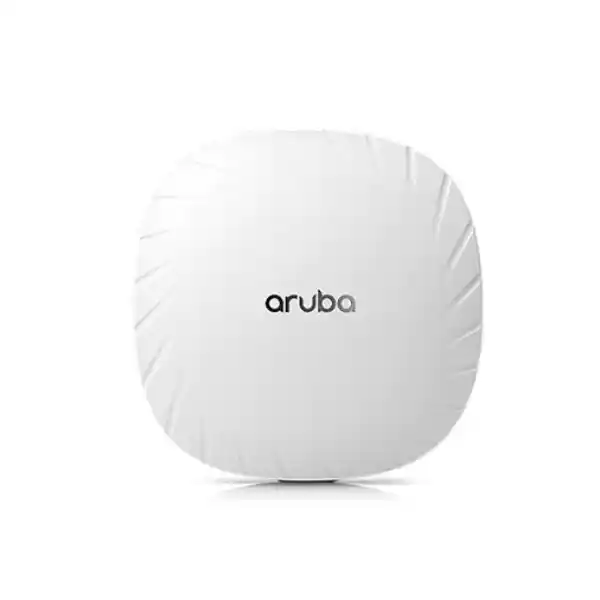
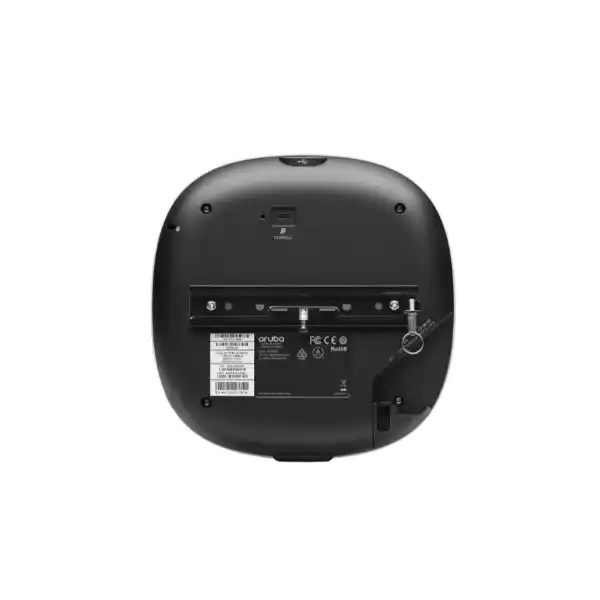
HPE Aruba Networking AP-515 in Dubai, UAE
For organisations planning a business wireless refresh, the AP-515 sits in the HPE Aruba Networking 510 Series as an indoor access point with internal antennas, dual-band Wi-Fi 6 radios, multi-gigabit Ethernet and integrated IoT radio capability. It is best evaluated as part of a complete WLAN design rather than as a stand-alone speed figure: switch uplinks, PoE budget, mounting position, channel plan, management mode and client mix all affect the result.

Product image shown for model identification. Confirm the regional ordering code and complete bill of materials before purchase.
802.11ax Wi-Fi 6
4×4:4 at 5 GHz, 2×2:2 at 2.4 GHz
1 x 2.5GbE plus 1 x 1GbE
RW model Q9H62A listed by HPE UAE
Direct answer for buyers
The HPE Aruba Networking AP-515 is a dual-radio indoor Wi-Fi 6 access point intended for campus-style business environments where device density, wireless efficiency and manageable growth matter. It combines internal ceiling-oriented antennas, a 4×4:4 5 GHz radio, a 2×2:2 2.4 GHz radio, 2.5GbE and 1GbE wired interfaces, and integrated Bluetooth 5 and Zigbee. Organisations should consider it when they need more wireless capacity than an entry-level 2×2 access point can provide, particularly in offices, meeting zones, classrooms and similar indoor spaces. Before proceeding, confirm the regional SKU, mount kit, PoE or DC power source, switch capability, software version, chosen Aruba management architecture and any licenses or subscriptions associated with that management design.
What the AP-515 does
The AP-515 provides indoor wireless access for Wi-Fi clients while connecting back to the wired LAN through its Ethernet interfaces. Its Wi-Fi 6 radio architecture is designed to improve spectrum use and client handling compared with earlier generations, particularly when many compatible devices share the same coverage area. The 5 GHz radio supports four spatial streams, while the 2.4 GHz radio supports two. HPE’s current 510 Series data sheet specifies a maximum combined peak data rate of 2.69 Gbps for the platform under the documented configuration.
The device can also participate in wider Aruba management and policy architectures. Exact management capabilities depend on the operating system, software release, controller or cloud design and licenses selected for the project.
Who should consider it
The AP-515 is a strong candidate for organisations with indoor areas where a simple single-radio or entry-level 2×2 access point may not provide the desired capacity. Typical examples include knowledge-worker offices, collaboration zones, training rooms, educational spaces, healthcare facilities, hospitality common areas and branch environments with a meaningful mix of laptops, phones, tablets and IoT devices.
It should not be selected only because its specification sheet shows higher radio capability. Small rooms with light use may be better served by a different model, while very high-density venues, outdoor locations or specialist antenna requirements may point to another access point family. A site survey and capacity plan remain the better basis for selection.
Business challenges the AP-515 can help address
Busy shared wireless spaces
Wi-Fi 6 features are intended to use airtime more efficiently when many compatible clients compete for service. This makes the AP-515 relevant where meeting rooms, classrooms or office zones experience bursts of simultaneous traffic.
Growing wired uplink demand
A 2.5GbE Smart Rate E0 port can reduce the risk of a 1GbE uplink becoming the immediate bottleneck when the wireless side is busy, provided the connected switch supports the required speed and PoE.
Mixed user and IoT requirements
Integrated Bluetooth 5 and Zigbee radios allow the AP to support selected location, sensor and IoT workflows without assuming that every use case works automatically. Application, software and platform dependencies still need confirmation.
Operational consistency
Within a compatible Aruba architecture, centralised policy and management can simplify how multiple sites and access points are administered. The exact management method should be chosen before the hardware bill of materials is finalised.
Core capabilities in practical terms
Dual-band Wi-Fi 6
The access point serves 2.4 GHz and 5 GHz clients using 802.11ax while remaining compatible with supported earlier Wi-Fi standards. The 5 GHz radio is the higher-capacity side of the design and is generally where modern enterprise clients should be encouraged when RF conditions allow.
Internal antennas
AP-515 uses integrated dual-band downtilt omnidirectional antennas. HPE states that these are optimised for horizontal ceiling mounting, which matters when deciding whether the AP-515 or the external-antenna AP-514 better suits the physical design.
Two Ethernet ports
E0 supports up to 2.5 Gbps and PoE input, while E1 provides 10/100/1000BASE-T connectivity. HPE also documents LACP support between the two ports for use cases where redundancy or additional wired capacity is part of the design.
Integrated IoT radio
Bluetooth 5 and Zigbee support can reduce the need for separate gateways in selected IoT or location deployments. Buyers should still validate application compatibility, software dependencies and the exact workflow before assuming the AP replaces a specialist IoT gateway.
Product-fit matrix
| Requirement | Suitable when | Confirm before ordering |
|---|---|---|
| Medium-density indoor Wi-Fi | Many business clients share office, education, healthcare or collaboration areas. | Expected concurrent devices, application mix, coverage goals and RF survey. |
| Multi-gigabit uplink | The access switch can deliver 2.5GbE and the design may exceed a 1GbE uplink. | Switch port speed, cable category and PoE power budget. |
| Internal-antenna ceiling deployment | A ceiling-mounted omnidirectional pattern suits the intended coverage cell. | Correct mounting kit and ceiling type; mount kits are ordered separately in HPE ordering guidance. |
| Aruba-managed campus WLAN | The organisation already uses or plans a compatible Aruba management architecture. | Software version, controller or cloud design, licenses and support entitlement. |
| IoT integration | Bluetooth or Zigbee radio capability is relevant to the project. | Application compatibility, management software and whether an external USB device is also required. |
Verified technical information
The values below are based on HPE Aruba Networking 510 Series current data sheet and QuickSpecs information for AP-515. Regional ordering identifiers differ, so this table separates the model-level specification from the UAE purchasing reference.
| Brand | HPE Aruba Networking |
|---|---|
| Product | AP-515 indoor campus access point |
| UAE-listed regional model | AP-515 (RW), ordering SKU Q9H62A. Confirm final region and SKU before order. |
| Wireless generation | Wi-Fi 6 (802.11ax) |
| Radios | 2×2:2 at 2.4 GHz and 4×4:4 at 5 GHz |
| Channel widths | 20/40 MHz at 2.4 GHz; 20/40/80/160 MHz at 5 GHz |
| Maximum combined peak data rate | 2.69 Gbps in HPE’s current 510 Series data sheet |
| Antennas | Four integrated dual-band downtilt omnidirectional antennas; optimised for horizontal ceiling orientation |
| Wired interfaces | E0: 2.5GbE Smart Rate RJ-45; E1: 10/100/1000BASE-T RJ-45 |
| Link aggregation | LACP supported between E0 and E1 |
| IoT interfaces | Bluetooth 5, Zigbee (802.15.4), USB 2.0 host |
| Power | 12 VDC or PoE on E0. HPE documents unrestricted operation with DC, 802.3at class 4 or 802.3bt class 5. 802.3af can operate with Intelligent Power Monitoring and may apply restrictions. |
| Maximum power consumption | 16.0 W DC; 20.8 W with 802.3at/bt PoE; 13.5 W with 802.3af and IPM enabled, excluding external USB load |
| Dimensions | 200 x 200 x 46 mm, excluding mount bracket |
| Weight | 810 g, unit excluding mount bracket |
| Operating environment | Indoor; 0°C to 50°C; 5% to 93% humidity, non-condensing |
| Security and certifications | Wi-Fi certifications include WPA/WPA2/WPA3 and Enhanced Open; UL2043 plenum rating and other regional certifications are documented by HPE. Confirm country-specific approvals for the final destination. |
| Management | On-premises, public cloud and VPC-as-a-Service options are listed for the 510 Series; exact software, licensing and deployment architecture must be confirmed. |
| Warranty guidance | HPE documents a hardware limited lifetime warranty for the series. Confirm entitlement, duration and regional terms for the specific SKU and quotation. |
Dependencies to resolve before purchase
The AP-515 hardware is only one part of the deployment. HPE ordering guidance says to add the appropriate mount kit, and power sources are sold separately in the current QuickSpecs. A buyer therefore needs to decide how the unit will be mounted and powered before the purchase order is issued. For full capability, the access switch and cabling should also support the intended 2.5GbE uplink and adequate PoE class where PoE is used.
Management is another design decision. The AP-515 has supported controller-based and controllerless Aruba deployment models, and current HPE literature also references cloud management. Licensing requirements vary by architecture and software generation. Do not assume that a particular cloud subscription, controller license or support contract is included with the base access point unless it is explicitly listed in the quotation.
Finally, region codes matter. HPE offers different AP-515 regional variants. The UAE product family page lists the RW model Q9H62A, but organisations operating across multiple countries should confirm the correct regulatory model for each destination rather than ordering a single code for all sites.
A practical deployment and purchase journey
Define coverage and capacity
List floors, rooms, expected concurrent users, business applications, roaming needs and device types. Coverage and capacity are different requirements; an AP can provide signal to a room without necessarily providing the capacity the room needs at peak time.
Validate the RF design
Use floor plans, construction details and preferably a wireless survey to select mounting positions, channel widths and AP count. Internal antennas are optimised for horizontal ceiling mounting, so placement should follow the intended antenna pattern.
Check switching and PoE
Confirm whether the switch offers 2.5GbE Smart Rate, sufficient PoE class and total PoE budget for all APs. Older 1GbE switches can still connect, but the design should recognise the resulting uplink constraint.
Choose management
Decide whether the WLAN will use Aruba Central, an on-premises controller architecture, a controllerless model or another supported design. This decision drives software, subscription and operational considerations.
Build the bill of materials
Include the correct regional AP SKU, mount kit, PoE injector or power adapter if needed, licenses or subscriptions, support service and any cabling or switching upgrades. Confirm what is included rather than assuming accessories ship with the base unit.
Stage, install and verify
After delivery, update the chosen software as required, apply configuration, mount the APs, verify channel and power behaviour, test roaming and applications, and document the final deployment for operations and support.
Wi-Fi 6 capacity where it matters
A buyer should interpret the AP-515’s Wi-Fi 6 specification as a capacity tool rather than a promise that every user will experience a particular speed. The 5 GHz radio has four spatial streams, while most laptops and phones use fewer streams. That is still useful: a higher-capacity AP can serve multiple client conversations more efficiently, especially when modern clients support Wi-Fi 6 scheduling features. In a conference area, for example, the goal is often not to give one device the entire radio but to keep many devices responsive at the same time.
Channel width is also a design choice. The AP supports wider channels at 5 GHz, including 160 MHz, but a wider channel is not automatically the best enterprise setting. Wider channels consume more spectrum, can reduce the number of non-overlapping channels available across a multi-AP floor and may increase co-channel contention if used too aggressively. In many offices, a balanced channel plan with more reusable channels provides better aggregate experience than simply choosing the maximum width everywhere.
Client capability, interference, building materials, transmit power, roaming thresholds and the wired LAN all influence the result. For this reason, FourTeck can help evaluate AP count and placement alongside switching and RF requirements rather than selecting the AP-515 solely from headline throughput.
Management, policy and operational control
The access point becomes easier to operate at scale when it is part of a consistent management model. HPE positions the 510 Series for on-premises and cloud-managed deployments, and current HPE product material describes HPE Aruba Networking Central as a management option for campus, branch and related networking. The right choice depends on what the organisation already operates, how many sites it has, whether IT wants cloud-based administration, and how change control and troubleshooting are handled internally.
Policy is equally important. Wireless access is not only about SSID names and passwords. Business networks often need employee, guest, contractor and IoT traffic to receive different access rules. Aruba architectures can support segmentation and policy enforcement, but the implementation depends on the broader network and software stack. A quotation should therefore identify whether the AP purchase is simply expanding an existing Aruba environment or whether a new management and policy architecture must be supplied.
Buyers should also consider operations after installation: who will receive alerts, who will manage firmware, how configuration backups or templates are maintained, how guest access is governed and what support process applies when a site loses service. These questions often determine whether the final design is manageable long after installation day.
Power, cabling and mounting are part of the design
PoE is convenient because the AP can receive both data and power over the same Ethernet run, but the PoE class matters. HPE states that AP-515 operates without restrictions when powered by DC, 802.3at class 4 or 802.3bt class 5. With 802.3af and Intelligent Power Monitoring enabled, the AP may apply feature restrictions based on the available power budget. This means a network refresh should include a switch power-budget calculation, not only a port-count calculation.
The E0 interface supports up to 2.5GbE, so cable plant quality should also be considered. Existing structured cabling may support the required rate, but its category, length, patching and condition should be validated where performance is important. If the access switch only provides 1GbE, the AP can still be used, but the wired side may constrain aggregate throughput under some workloads.
Mounting deserves specific attention because HPE’s ordering information instructs buyers to add a mount kit. The AP-515’s integrated antennas are designed for horizontal ceiling orientation, so simply placing the unit on furniture or mounting it in a different plane can change the RF pattern. The correct bracket also depends on the ceiling rail or surface type.
For Dubai projects, share reflected ceiling plans or site photographs when requesting a quote if the mount type is uncertain. That allows the hardware bill of materials to include the correct mounting option instead of treating it as an afterthought.
Ideal business environments and use cases
Corporate offices
Open-plan floors, meeting rooms and collaboration zones can generate many concurrent Wi-Fi sessions. AP-515 can suit those areas when RF planning supports the required cell size and the access switch can provide appropriate uplink and PoE capacity.
Education and training
Classrooms and training rooms often have highly synchronised usage, with many devices connecting and downloading content at the same time. Capacity planning should reflect peak class size rather than average daily occupancy.
Healthcare and clinical buildings
Healthcare networks may need stable roaming, strong segmentation and support for a mixed device estate. The AP-515 can fit indoor coverage plans, but medical-device compatibility, local policies and RF coexistence should be validated separately.
Hospitality common areas
Lobbies, meeting spaces and shared facilities can benefit from a medium-density enterprise AP. Guest authentication, bandwidth policy and roaming design should be planned along with the access point placement.
Branch and remote sites
Where an organisation wants a standard campus-class access point across branches, the AP-515 may offer more consistency than consumer-grade Wi-Fi. Zero-touch style provisioning depends on the selected management architecture and should be confirmed for the project.
IoT-enabled workplaces
Bluetooth and Zigbee capability can support selected sensors, beacons or location workflows, but application compatibility should be verified before treating the AP as a universal IoT gateway.
Integration and operational considerations
An AP-515 deployment touches several parts of the infrastructure. DHCP, DNS, VLANs, authentication, RADIUS, certificates, firewall policy, switching, routing and internet capacity may all influence the user experience. If the organisation is replacing another wireless brand, the migration plan should map current SSIDs, security settings, guest access, device onboarding and application dependencies before the old network is removed.
For an existing Aruba estate, verify software compatibility and minimum supported releases for the AP-515. HPE’s current QuickSpecs references HPE Aruba Networking Wireless Operating System and InstantOS 8.4.0.0 with restrictions, unrestricted operation from 8.6.0.0 or later, and Wireless Operating System 10.0.0.0. Production environments should use a vendor-supported release appropriate to the wider hardware estate, not simply the oldest version that can boot the AP.
Security configuration should be deliberate. WPA3 and Enhanced Open are supported, but the organisation may still have legacy devices that cannot use modern security settings. A phased SSID or authentication approach may be needed, especially for printers, scanners, embedded devices or specialist equipment. The target should be the strongest practical security posture without unexpectedly disconnecting critical devices.
Operational documentation should record AP names, switch ports, cable IDs, mount locations, management groups, software versions and support information. These details reduce troubleshooting time and simplify later expansion.
Questions to resolve before requesting a quotation
Share floor plans, usable area, wall construction, ceiling height, client density and coverage expectations. Quantity should come from capacity and RF design, not square metres alone.
Provide switch model, free ports, PoE class and remaining power budget. This determines whether the existing switching layer can support the intended deployment without restrictions.
State whether Aruba Central, a controller-based environment, controllerless operation or another existing Aruba management design is already in place.
This depends on the management and support design. Ask for licenses and terms to be listed as separate quotation lines so renewal planning is clear.
Ceiling rail profiles and solid surfaces use different mount options. Photographs or ceiling specifications can help identify the correct kit.
Clarify whether the quote is hardware-only or should include survey, installation, cable testing, configuration, migration, documentation and post-install verification.
Procurement checklist for AP-515 projects
How FourTeck can assist with AP-515 planning
FourTeck can help turn a product request into a complete procurement requirement. For a small expansion, that may simply mean confirming the correct regional AP, mount kit and compatibility with an existing Aruba network. For a larger wireless refresh, the discussion can include floor-plan review, AP sizing, switch and PoE checks, management approach, installation scope and quotation structure.
Customers who already know the exact requirement can request a product quotation through the FourTeck contact page. Buyers still comparing equipment can browse the business technology product range or discuss related implementation requirements through FourTeck services. The aim is to make the quotation explicit about what is included, what is optional and what must be confirmed before deployment.
When contacting FourTeck, provide the number of APs, site location, existing switch models, current wireless platform, preferred management method and whether you need installation or configuration. This reduces ambiguity and helps produce a bill of materials that is closer to the real project.
UAE availability and support guidance
HPE’s UAE product catalogue lists the AP-515 (RW) with ordering SKU Q9H62A, which provides a useful regional reference for Dubai projects. That listing does not establish FourTeck stock, delivery time or a fixed selling price. Contact FourTeck to confirm current UAE availability for the quantity you need, together with vendor lead time and any accessories, licenses or support items that must accompany the access points.
For deployments in Dubai, Abu Dhabi, Sharjah and Ajman, FourTeck can coordinate requirement review, quotation, delivery planning and project discussions once the final bill of materials is agreed. Installation and configuration should be identified in the quotation if required, because hardware supply alone does not include a site survey, mounting work, switch changes or WLAN migration unless these are specifically scoped.
Regional availability can change with model, quantity, regulatory variant and vendor lifecycle policy. If the AP-515 is being used to expand an existing network, share the current AP models and software environment so compatibility can be checked before ordering.
GCC Availability
Organisations operating across the GCC often need more than a single-country product quote. FourTeck can assist with requirement review, model and license selection, quotation coordination, configuration scope and deployment planning for projects that may involve the United Arab Emirates, Saudi Arabia, Kuwait, Qatar, Bahrain or Oman. The correct AP region code, software entitlement, support coverage and shipping plan should be confirmed for each destination rather than assuming one UAE bill of materials applies everywhere.
Availability, licensing, delivery schedules, service visits and vendor lead times can vary by country, model and quantity. Share the destination country, required AP quantity, preferred management platform, expected installation date and any need for mounting, configuration or support. FourTeck can then help structure the requirement for regional procurement. For Kuwait-related projects, buyers can also review FourTeck Kuwait resources. No local stock, customs outcome or fixed delivery commitment should be assumed until confirmed in the applicable quotation.
Africa Availability
For organisations extending an Aruba wireless standard into African operations, FourTeck can help review the model, accessories, management approach, licensing, installation expectations and support requirements before procurement. Projects in East Africa and other regions may have different regulatory, power, shipping and service conditions from a UAE deployment, so the destination should be part of the technical requirement from the start.
Availability and fulfilment may depend on destination country, product variant, quantity, license region, shipping arrangement, vendor lead time and local installation conditions. Buyers should provide the exact destination, AP count, target deployment schedule and whether configuration or onsite assistance is expected. FourTeck’s regional sites can support early planning, including Kenya technology enquiries, Uganda technology enquiries and broader Africa project coordination.
FourTeck does not assume local inventory, immediate shipment, customs outcomes or country-wide onsite coverage. Those details should be confirmed against the final destination and project scope.
Related products, services and suitable alternatives
HPE Aruba Networking AP-514
The AP-514 is the external-antenna counterpart in the 510 Series. It is worth considering where a specialist antenna pattern is required. External antennas and related mounting or antenna accessories must be selected correctly.
HPE Aruba Networking 500 Series
A lower-density Wi-Fi 6 family may be sufficient for lighter-use spaces. Compare radio capacity, Ethernet requirements, management architecture and total project cost rather than assuming every room needs AP-515 capacity.
Aruba Central management
Cloud management may be relevant for multi-site operations, but subscription terms and supported feature sets must be confirmed for the chosen architecture and software generation.
Wireless design and installation
Site survey, AP placement, cabling checks, installation, configuration and post-deployment validation can be scoped separately when the project requires more than hardware supply.
Why businesses contact FourTeck
A wireless purchase can fail for small reasons: the wrong regional code, an omitted mounting bracket, an undersized PoE budget, a management license that was not planned, or an AP count based only on floor area. FourTeck can help clarify those details before they become deployment issues. The focus is not to claim that one model is suitable for every site, but to align the product with the actual environment.
For new projects, this can include bill-of-material guidance, compatibility review and installation planning. For existing Aruba environments, it can include checking software generation, current AP mix and intended management model before expanding the network. For procurement teams, it means separating hardware, accessories, subscriptions, support and service scope so that costs and renewal obligations are easier to understand.
You can learn more about FourTeck or move directly to the contact page with the model, quantity and deployment details needed for a quotation.
What buyers are trying to determine before choosing AP-515
People researching the AP-515 usually move quickly from “what is it?” to practical questions about whether it is the right capacity, whether a license is required, what power source it needs, what comes in the box and how it compares with smaller Wi-Fi 6 access points. The useful answer is that the AP-515 should be chosen as a system component. Its 4×4 5 GHz radio and 2.5GbE uplink make it attractive for busier indoor areas, but those capabilities only deliver value when the switch, cabling, RF plan and management platform are aligned with them.
Is AP-515 still useful for mixed Wi-Fi clients?
Yes. Enterprise WLANs rarely contain only Wi-Fi 6 devices. The AP-515 supports earlier Wi-Fi generations as documented by HPE, so older clients can still connect when the SSID and security configuration permit them. The benefit of a Wi-Fi 6 deployment is not limited to the newest laptop: it also gives IT a modern radio platform while the device estate transitions over time.
Does 4×4 mean every client receives four streams?
No. Many phones and laptops are 2×2 clients. The 4×4 capability on the AP’s 5 GHz radio is still valuable because the AP has more radio resources to work with and can handle aggregate demand more effectively. Individual client throughput remains limited by that client’s own radio, channel conditions, distance and protocol overhead.
Why does the 2.5GbE port matter?
A multi-gigabit uplink gives the AP more wired headroom than a 1GbE port. It is most relevant in busy deployments where wireless aggregate traffic could exceed a conventional gigabit uplink. It does not mean every deployment must upgrade all switching immediately, but it is a design factor when new switches are being purchased.
Is a mount kit included?
HPE ordering information for AP-515 instructs buyers to add a mount kit, and current QuickSpecs list multiple mounting options. Treat the correct bracket as a separate bill-of-material item unless the specific bundle or quotation explicitly says otherwise. The ceiling rail profile or solid-surface requirement determines which kit is appropriate.
Another common question is whether the AP-515 needs a controller. The answer depends on software generation and deployment mode. The 510 Series has supported controller-based and controllerless Aruba architectures, while current HPE product material also promotes cloud management through Aruba Central. Rather than treating “controller required” as a yes-or-no product property, buyers should define the operational model they want: one local site managed simply, a larger campus controlled on premises, or multiple sites managed from a cloud platform. That decision then drives the appropriate software and subscription discussion.
Pricing research also shows why a business quotation is more useful than a marketplace number. Current search-visible UAE listings for Q9H62A vary substantially between sellers, and prices may represent promotions, old inventory, different warranty terms or different fulfilment conditions. FourTeck should therefore quote the exact regional SKU, quantity, accessories, license terms and service scope rather than use a public web price as a promise. For a buyer, the better comparison is total deployed cost: AP hardware, mount, switch or injector capacity, management subscription if applicable, support, installation and any required cabling work.
Comparisons with AP-505 or other smaller Wi-Fi 6 access points usually come down to density and infrastructure. The AP-515 has a 4×4 5 GHz radio and two Ethernet interfaces including 2.5GbE, while lower-capacity models may use simpler radio and wired designs. A smaller AP can be the more economical choice in a lightly used office or small room. AP-515 becomes easier to justify when the area has more active clients, heavier collaborative applications, a multi-gigabit switching layer or a desire to standardise on greater radio capacity.
Buyers should also consider lifecycle fit. A product can remain technically suitable even when newer Wi-Fi generations exist, especially when the organisation has an installed Aruba architecture and wants a compatible expansion. The right question is not simply “is there a newer standard?” but “does this model meet the site’s capacity, security, management, support and lifecycle requirements at an acceptable project cost?” FourTeck can help structure that comparison around the actual network rather than a specification race.
Decision questions buyers ask before they shortlist the AP-515
Will AP-515 improve coverage, or mainly capacity?
Coverage and capacity must be designed separately. The internal antennas provide a defined ceiling-oriented pattern, but installing a higher-capacity AP does not automatically extend reliable coverage through more walls. If dead zones are the problem, placement and AP count may matter more than radio stream count. If users already have good signal but performance drops when rooms become busy, capacity may be the stronger reason to consider AP-515.
Can existing 1GbE switching be retained?
Often yes, depending on the design, but the switch must still provide suitable PoE. A 1GbE uplink limits wired throughput to that rate, so an organisation investing in AP-515 for high aggregate capacity should decide whether multi-gigabit switching is part of the same phase or a future upgrade. The answer should come from expected traffic rather than from the maximum radio number alone.
What information is needed for an accurate quote?
At minimum, provide quantity, site country, preferred regional SKU if known, ceiling or mounting type, switch model, PoE capability and the existing Aruba management environment. For a new WLAN, add floor plans, expected user density and whether survey, installation, configuration or migration services are required. This allows accessories and service scope to be quoted explicitly.
Is Aruba Central mandatory?
No single management method should be assumed from the hardware name alone. Aruba Central is a current cloud management option, while AP-515 has also existed in controller-based and controllerless Aruba deployments. The correct choice depends on software compatibility, site count, operational preference and licensing. If Central is selected, confirm the applicable subscription separately.
Can the AP be powered by basic 802.3af PoE?
HPE allows operation with 802.3af when Intelligent Power Monitoring is enabled, but restrictions may be applied according to the available power budget. For an unrestricted design, HPE documents DC, 802.3at class 4 or 802.3bt class 5. This makes PoE+ a better planning baseline where switch capability permits it.
When should a different model be considered?
Consider another model when the space is lightly used and AP-515 capacity would be underutilised, when an external antenna is required, when the deployment is outdoor, or when a newer platform is needed for a lifecycle or feature requirement not met by 510 Series. The alternative should be chosen from the site requirement, not simply from a higher model number.
Frequently asked questions
What is the HPE Aruba Networking AP-515?
It is an indoor dual-radio Wi-Fi 6 access point in the 510 Series. It uses a 4×4:4 radio at 5 GHz, a 2×2:2 radio at 2.4 GHz, integrated internal antennas and multi-gigabit wired connectivity.
Which AP-515 SKU is listed for the UAE?
HPE’s UAE product family page lists the AP-515 (RW) with ordering SKU Q9H62A. Final regional eligibility and bill of materials should still be confirmed for the specific destination and project.
Does the AP-515 include internal antennas?
Yes. AP-515 uses four integrated dual-band downtilt omnidirectional antennas and HPE states that they are optimised for horizontal ceiling-mounted orientation.
Is the mounting bracket included?
The AP has a mounting interface, but HPE ordering guidance says to add the appropriate mount kit. Treat the mount kit as a separate requirement unless the quoted bundle explicitly includes it.
What PoE does AP-515 require?
For unrestricted operation, HPE documents 802.3at class 4, 802.3bt class 5 or DC power. 802.3af can be used with Intelligent Power Monitoring enabled, but restrictions may be applied depending on available power.
Does AP-515 support 2.5GbE?
Yes. Its E0 Smart Rate RJ-45 interface supports a maximum negotiated speed of 2.5 Gbps. E1 is a separate 1GbE interface.
Does AP-515 require a license?
Licensing depends on the chosen management architecture and software generation. Do not assume that a cloud subscription, controller entitlement or support contract is included with the base access point. Confirm these items in the quotation.
Can AP-515 support IoT devices?
It includes Bluetooth 5, Zigbee and a USB 2.0 host interface. Whether a specific IoT application is supported depends on the device, platform, software and integration design.
How can I get a Dubai price for AP-515?
Send FourTeck the required quantity, site location, regional SKU if known, mount type, management requirement and any installation or support scope. FourTeck can then confirm current UAE availability and prepare a quotation.
Plan the AP-515 as part of the complete WLAN
Share your quantity, floor plan, current switching, PoE capability, Aruba management environment and installation expectations. FourTeck can help confirm the regional AP-515 model, accessories, licensing or subscription dependencies and project scope before a UAE quotation is prepared.

Reviews
There are no reviews yet.