
Direct answer for buyers
HPE Aruba Networking AP-518 is a hardened, connectorized Wi-Fi 6 access point for locations where heat, cold, dust, moisture or installation conditions make a standard indoor AP a poor fit. It supports concurrent 5 GHz 4×4 MIMO and 2.4 GHz 2×2 MIMO, external antennas and enterprise management options. Organisations operating warehouses, logistics sites, industrial rooms, protected stadium enclosures and similar environments should consider it when they need controlled antenna placement and durable hardware. Before proceeding, confirm the correct UAE radio domain, antenna pattern, PoE capacity, mounting kit, management platform, software release compatibility and coverage design. Those items can materially change the final bill of materials and deployment outcome.
What the AP-518 does in a business wireless design
Extends Wi-Fi into difficult spaces
The role of the AP-518 is not simply to add another wireless cell. It is intended to place enterprise Wi-Fi 6 coverage in spaces where temperature swings, airborne contaminants, moisture or mounting constraints demand a more robust platform. HPE describes the model as indoor hardened and positions the 518 Series for harsh, weather-protected environments. That makes the environmental survey important: buyers should distinguish between a protected industrial or semi-exposed location and an installation that needs a fully outdoor-rated access point with a different ingress-protection profile.
Lets the RF design drive antenna choice
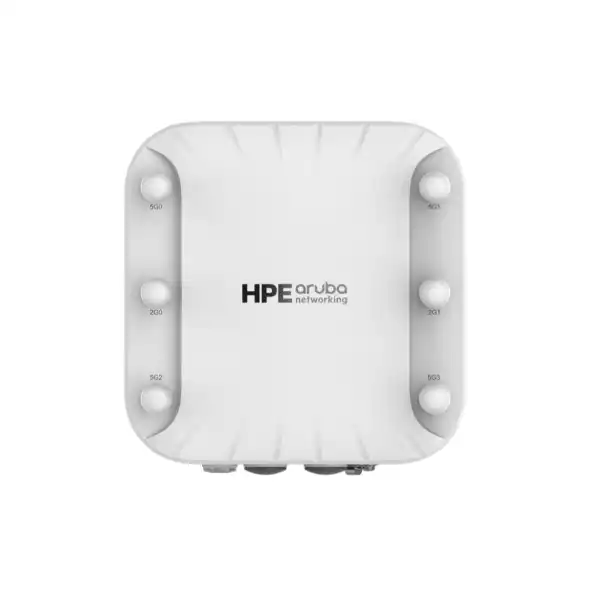
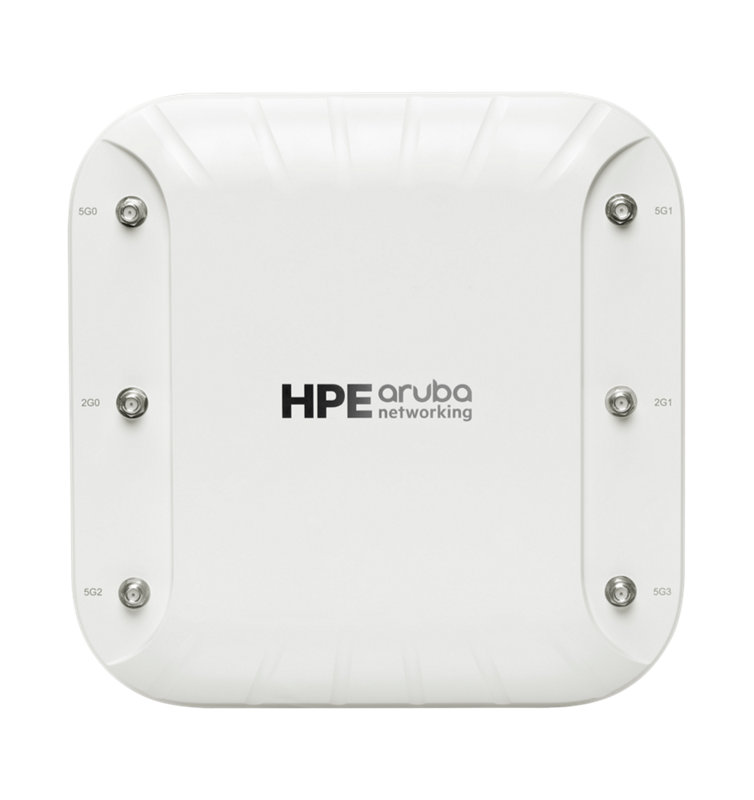
Unlike an access point with fixed internal antennas, the AP-518 provides four RP-SMA connectors for the 5 GHz radio and two for 2.4 GHz. This gives a designer more freedom to choose omnidirectional or directional antenna arrangements, subject to regional rules and HPE compatibility guidance. That flexibility is valuable in long warehouse aisles, equipment rooms, staging zones and specialised coverage areas, but it also means the access point should not be ordered in isolation. Antenna gain, cable losses, mounting orientation and local transmit-power limits must be considered together.
Who should consider this access point
The AP-518 is most relevant to organisations that have a defined reason for using hardened hardware and external antennas. It is not automatically the right choice for every warehouse or every outdoor-looking location. A conventional indoor AP may be simpler for climate-controlled offices, while a fully outdoor access point may be more suitable for sites directly exposed to heavy rain, open weather or requirements beyond the AP-518 environmental rating. The decision should begin with the installation environment and the RF design rather than with model familiarity alone.
Useful where aisles, racking, scanners and moving inventory call for deliberate antenna placement and resilient wireless hardware.
Applicable to controlled freezer zones, production spaces and protected equipment locations within the documented operating envelope.
Can fit deployments in stadium or venue infrastructure when the AP is installed in a location aligned with its environmental specification.
A natural consideration where existing HPE Aruba Networking architecture, operational processes and policy design should extend into tougher areas.
Business challenge map: what problem is being solved?
Coverage through racks and machinery
The response is not simply higher transmit power. Directional antenna options, AP placement and channel planning can shape coverage into the areas where handhelds, tablets, scanners and IoT clients actually operate.
Tougher environmental conditions
A hardened chassis broadens deployment choices, but the site must still be checked against the latest HPE temperature, humidity, ingress-protection and installation guidance.
Growing Wi-Fi 6 client density
OFDMA, MU-MIMO and other Wi-Fi 6 mechanisms can improve airtime efficiency where compatible clients share a radio, though the experienced result still depends on RF quality, client capabilities and traffic demand.
Policy consistency outside the office
The AP can participate in HPE Aruba Networking policy and management architectures so specialised spaces do not have to become isolated wireless islands with separate operational practices.
Core capabilities that matter during evaluation
5 GHz uses 4×4 MIMO while 2.4 GHz uses 2×2 MIMO, supporting modern and legacy WLAN clients within the supported standards.
Four 5 GHz and two 2.4 GHz RP-SMA connectors enable antenna choices based on the physical site rather than a fixed built-in pattern.
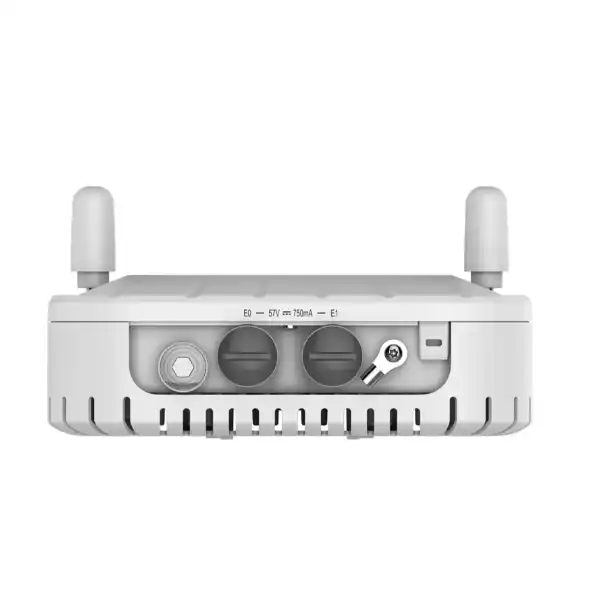
The primary SmartRate interface supports 100/1000/2500BASE-T and the secondary interface supports up to 1GbE, with link aggregation support documented.
Integrated Bluetooth 5 and 802.15.4 radio capability can support selected location and IoT workflows without requiring a separate overlay radio solely for those functions.
Product-fit matrix
| Requirement | Suitable when | Confirm before ordering |
|---|---|---|
| Hardened wireless | The AP is placed in a demanding but compatible environment. | Temperature, humidity, ingress rating, enclosure and direct weather exposure. |
| Custom RF coverage | The project benefits from external directional or omnidirectional antennas. | Antenna models, gain, cables, connector count, mounting and local EIRP limits. |
| Multigigabit uplink | The access switch can provide a suitable 2.5GbE and PoE connection. | Switch port speed, cabling category, PoE budget and redundancy design. |
| Centralised operations | The organisation already uses or plans an HPE Aruba Networking management architecture. | Central subscription, AOS architecture, controller/gateway requirements and software compatibility. |
| High client activity | The site has many active clients and can benefit from Wi-Fi 6 efficiency. | Actual concurrency, application mix, client radio capability and RF airtime conditions. |
Verified technical information
The following values are based on current HPE Aruba Networking QuickSpecs and support documentation for the 518 Series/AP-518. Where HPE publishes multiple regional variants, the final UAE ordering code must be confirmed before quotation. Radio performance is also constrained by local regulatory settings, antenna selection and client capability.
| Brand | HPE Aruba Networking |
|---|---|
| Product | AP-518 hardened access point |
| Wireless generation | Wi-Fi 6 (802.11ax), with support for earlier 802.11 standards as documented |
| Radios | Concurrent 5 GHz 4×4 MIMO and 2.4 GHz 2×2 MIMO |
| HPE stated aggregate on-air rate | Up to 3 Gbps for the HE80/HE40 positioning; individual PHY rates depend on channel width and client capability |
| Antenna connectors | 4 × RP-SMA for 5 GHz and 2 × RP-SMA for 2.4 GHz |
| Ethernet E0 | HPE SmartRate RJ-45, auto-sensing 100/1000/2500BASE-T |
| Ethernet E1 | 10/100/1000BASE-T RJ-45 |
| Link aggregation | LACP support between the two network ports is documented |
| IoT radios | Bluetooth 5 and 802.15.4 radio with Zigbee support |
| Power | PoE; HPE QuickSpecs document 802.3at-compliant PoE+ and note that power sources are sold separately |
| Worst-case AP power consumption | 25.6 W |
| Dimensions | Approximately 220 × 220 × 75 mm according to current QuickSpecs |
| Weight | Approximately 1.5 kg |
| Operating temperature | -40°C to +55°C in current QuickSpecs |
| Humidity | 5% to 95% non-condensing internal to chassis |
| Water and dust | IP55 in current QuickSpecs |
| Regulatory model | APIN0518 |
| Minimum software stated by QuickSpecs | HPE Aruba Networking OS / InstantOS 8.7.0.0; current deployment compatibility should be checked against the latest support matrix |
| UAE product variant | HPE UAE currently lists multiple regional variants, including EG R4G99A and RW R4H02A; confirm the correct SKU for the intended project |
Dependencies that can change the final bill of materials
A buyer should not interpret the AP-518 chassis as a complete deployment bundle. External antennas are a design choice and may need to be ordered separately. PoE sources are also separate, and the access switch or injector must provide the required power within the overall network power budget. Mounting hardware depends on the surface or structure. HPE Aruba Networking Central subscriptions, controller or gateway components, feature licensing and support coverage depend on the selected operating model rather than being assumed as part of the AP.
Regional radio rules also matter. The AP-518 exists in multiple country or regulatory variants. UAE buyers should therefore confirm the precise ordering code and current supported regulatory table. A product that is technically the same family can still be inappropriate if its radio domain is intended for another market. FourTeck can help make the quotation reflect the selected UAE variant, antenna arrangement and management architecture instead of producing a chassis-only price that later needs correction.
Purchase and deployment journey
Define the environment
Document temperature, moisture, dust, enclosure, mounting height, cabling route and whether the location is actually protected from direct weather.
Design RF coverage
Map client areas, attenuation, aisle geometry and interference, then choose antenna patterns and AP positions that support those objectives.
Build the BOM
Confirm AP variant, antennas, cables, mounts, PoE, switching, subscriptions, controller or gateway dependencies and required services.
Stage and validate
Load the appropriate software, apply WLAN and policy settings, test PoE and uplink operation, then validate coverage and roaming onsite.
Wi-Fi 6 efficiency for busy operational areas
The AP-518 supports Wi-Fi 6 mechanisms such as OFDMA and downlink MU-MIMO. Their practical value is improved use of radio airtime when many compatible clients are active. In a warehouse, for example, devices may send many short bursts rather than a few sustained high-throughput sessions. More efficient scheduling can help reduce contention, but it does not remove the need for sufficient AP density, sensible channel reuse or good signal quality. A poorly positioned high-specification AP can still deliver poor application performance.
Buyers should therefore avoid treating the published maximum wireless rate as a site throughput guarantee. End-user performance depends on channel width, interference, client radio capability, retransmissions, backhaul speed and the mix of applications. For operational networks, predictable coverage and roaming often matter more than the largest headline PHY rate. FourTeck can help translate the number of scanners, tablets, laptops, cameras or IoT devices into a practical RF and switching requirement.
External antennas: the feature that changes how this model is bought
The AP-518 is connectorized, which means antenna design is integral to the project. Four RP-SMA connectors serve the 5 GHz radio and two serve 2.4 GHz. That layout can support specialised coverage patterns, but antenna selection should follow the RF goal rather than a simple preference for higher gain. A high-gain directional antenna can be useful for focusing energy along an aisle or toward a defined work zone; it can be counterproductive when users move around the AP in all directions.
The engineer should also account for cable length, connector losses, mounting orientation and the regulatory transmit-power ceiling. A regulatory domain sets limits on allowed channels and effective radiated power, so the AP power setting and antenna gain cannot be chosen independently. For this reason, buyers requesting a quotation should provide a drawing or at least a description of the space, mounting height, desired coverage shape and major obstructions. Where a survey is available, it can reduce uncertainty and help avoid ordering antennas that later need to be changed.
This connectorized architecture is one of the clearest reasons to choose the AP-518 over an AP with integrated antennas. It is also the reason procurement teams should insist on an explicit antenna line item and compatibility confirmation in the bill of materials.
Management, policy and IoT integration
The AP-518 can participate in controller-based or controller-less HPE Aruba Networking deployments in supported software families, and current HPE documentation also lists AP-518 support in HPE Aruba Networking Central/AOS 10 environments. The correct design depends on what the wider network already uses. A customer with an established controller architecture may have different licensing and gateway requirements from a greenfield Central-managed deployment. Before a migration or expansion, current software support matrices should be checked rather than assuming that every historical release supports every desired feature.
HPE also documents Bluetooth 5 and 802.15.4 capability with Zigbee support. These radios can contribute to location, asset and sensor use cases, but the business application still requires compatible software, devices and design. Their presence should be viewed as platform capability, not an automatic location-service package. If IoT is part of the project, include the sensor type, protocol, management requirement and expected data flow in the design review.
Security and segmentation features depend on the surrounding HPE Aruba Networking architecture and feature set. WPA3, Enhanced Open, TPM-backed credential storage and policy-enforcement mechanisms are documented capabilities, but the way they are implemented should be aligned with authentication, NAC, gateway and user-role design across the rest of the network.
Ideal business environments and practical use cases
In a distribution centre, the AP-518 may be positioned to provide coverage along tall rack aisles where directional antennas can reduce wasted RF energy outside the working lane. In a cold-storage facility, a hardened access point may be required because temperature and humidity conditions fall outside ordinary office expectations. In a manufacturing area, the value can be the ability to combine a durable chassis with carefully selected antenna placement around machinery and production zones. In a venue, protected equipment spaces may need robust wireless service for operations, staff devices or IoT systems even when the public access network uses different AP models.
The model can also fit mixed networks where a standard indoor AP is used in offices while the AP-518 extends the same wireless policies into harsher operational spaces. That can simplify SSID, authentication and operational consistency. However, model choice should remain environment-specific. A fully exposed outdoor pole, rooftop or coastal location may require a different HPE Aruba Networking outdoor platform with environmental ratings better suited to direct precipitation and exposure.
The strongest use case is therefore not merely “outdoor Wi-Fi.” It is a project that needs enterprise Wi-Fi 6, a hardened form factor and external antenna control in a location that falls within the AP-518’s documented operating and ingress conditions.
Integration and operational considerations
Start with the wired edge. The primary E0 port supports 2.5GbE, so an HPE Aruba Networking or third-party access switch should have a compatible multigigabit port if the design intends to use that speed. The cable plant must also be suitable. A second 1GbE port can be used in supported designs, including link aggregation, but redundancy behaviour and switch configuration should be planned rather than assumed. PoE budget is equally important: HPE lists a worst-case AP consumption of 25.6 W and documents PoE power requirements, while injectors and power sources are separate items.
Operationally, decide who will monitor the AP, how configuration changes are approved, what software release policy is used and how replacement units will be staged. In industrial networks, access points are often mounted high or in difficult-to-reach areas. A five-minute configuration error can become a costly access event if a lift, safety permit or production window is required to reach the device. Pre-staging, labelling and change documentation reduce that risk.
Finally, include environmental maintenance. Dust, condensation, antenna damage, loose connectors and cable strain can affect radio performance even when the access point remains online. Periodic inspection can be more useful than waiting for a complete outage, especially where wireless supports scanners or workflows that have direct operational impact.
Buyer questions to resolve before requesting a quote
This determines whether the AP-518 environmental profile is appropriate or a more outdoor-focused model should be considered.
Coverage shape, mounting height, aisle layout and client movement determine whether omnidirectional or directional antennas are suitable.
The answer affects subscriptions, gateways, controllers, software versions and configuration methodology.
Check port power budget, 2.5GbE support, cable capability and any redundancy requirement before the AP arrives.
Concurrent usage, applications and client radio characteristics matter more than a simple count of registered devices.
HPE publishes multiple AP-518 regional variants. Confirm the correct radio domain before purchase rather than substituting another market SKU.
Procurement checklist
How FourTeck can assist with sizing and quotation
FourTeck can help turn a model request into a complete purchasing requirement. The process can begin with the number of locations, device quantities, client types, floor plan, ceiling or mounting height, environmental conditions and existing HPE Aruba Networking environment. From there, the discussion can identify whether AP-518 is suitable, which regional variant should be quoted, what external antennas and mounts are required, how PoE will be supplied and whether management subscriptions or infrastructure changes should be included.
Where the requirement is part of a larger wireless refresh, FourTeck can also discuss switching, configuration, migration and installation planning. Buyers can review related networking products, available technology services and the broader FourTeck Dubai technology portfolio. The quotation should clearly state which accessories, licenses and services are included rather than leaving those items implicit.
For a model-specific request, send the intended quantity, UAE delivery location, deployment environment and whether antennas, installation or configuration are required through the FourTeck contact page.
UAE availability and support guidance
Contact FourTeck to confirm current UAE availability for HPE Aruba Networking AP-518. Availability can depend on the exact regulatory variant, quantity, antenna and accessory requirements, vendor lead time and whether the request includes a specific support or management subscription. Delivery and project coordination can be discussed after the full requirement is confirmed. If installation or configuration is needed, include that scope in the quotation so access equipment, working-hour restrictions, mounting conditions and validation tasks can be planned. Buyers should also confirm whether the project requires a specific HPE support entitlement or warranty handling process; FourTeck can assist with the information needed for the procurement discussion without assuming that every unit or regional SKU is supplied under identical commercial terms.
Dubai, Abu Dhabi, Sharjah and Ajman project coverage
Organisations planning AP-518 deployments across Dubai, Abu Dhabi, Sharjah and Ajman can coordinate requirements through FourTeck using a common bill-of-material approach. For multi-site projects, provide the number of APs per location, environmental differences between sites, available switch and PoE infrastructure, antenna needs, mounting constraints and the desired management architecture. A standardised model can simplify operations, but antenna patterns and mounting accessories may still differ from one site to another. Installation and delivery scheduling should therefore be planned against the confirmed project scope rather than assumed from product availability alone.
GCC Availability
FourTeck can assist organisations planning HPE Aruba Networking AP-518 requirements across GCC markets with model review, antenna and accessory selection, quotation coordination, management and subscription discussions, configuration scope and deployment planning. A project spanning the United Arab Emirates, Saudi Arabia, Kuwait, Qatar, Bahrain or Oman should not assume that the same radio-domain SKU, license arrangement or delivery plan applies unchanged in every country. Wireless regulatory requirements, vendor lead times, shipping arrangements, service scope and local installation conditions can differ by destination.
For regional procurement, share the destination country for each site, required AP quantity, intended environment, antenna design, management architecture, expected deployment window and whether installation or post-install validation is required. FourTeck can then help structure the requirement and coordinate the commercial discussion. Product availability, licensing, delivery schedules, service visits and project scope remain dependent on country, model, quantity and current vendor conditions. For Kuwait-related technology requirements, buyers may also review FourTeck Kuwait information.
Africa Availability
For projects in Africa, FourTeck can help buyers evaluate whether the AP-518 fits the intended environment and can coordinate discussions around regional SKU selection, antennas, mounts, PoE, software management, accessories, support needs and deployment services. Requirements in East Africa, West Africa, Southern Africa or Central Africa can vary substantially because radio regulations, shipping routes, power infrastructure, local installation conditions and project access arrangements are not uniform. A hardened AP specification should therefore be matched to the destination and site rather than copied from a UAE bill of materials without review.
Share the destination country, exact quantity, preferred deployment schedule, installation environment and any support expectations so the requirement can be evaluated appropriately. Availability and fulfilment may depend on the destination, product model, quantity, license region, shipping arrangements, vendor lead time and local conditions. FourTeck does not assume immediate local inventory or guaranteed delivery. Buyers planning regional deployments can review FourTeck Africa resources or the Kenya technology portal for additional regional context.
Related options and services to consider
Alternative rugged or outdoor APs
If the location is directly exposed to weather or requires a different environmental rating, compare the AP-518 with current HPE Aruba Networking outdoor models rather than forcing the same hardware into every site.
External antenna packages
Antenna type is part of the design. Include compatible 5 GHz and 2.4 GHz antennas, required jumpers, mounting parts and regulatory considerations in the quotation.
PoE and switching
Confirm PoE budget and multigigabit uplink support on the access switch. An injector may be appropriate in some cases, but its placement and environmental suitability must be assessed.
Wireless design and validation
Survey, predictive design, configuration and post-install validation can reduce the risk of incorrect antenna choice, weak roaming or unplanned coverage gaps.
What buyers are trying to understand before they shortlist AP-518
A common buying question is whether AP-518 is an outdoor access point or a hardened indoor access point. HPE documentation uses both ruggedised and outdoor-platform language in different places, but the current QuickSpecs describe the AP type as indoor hardened and publish an IP55 water-and-dust rating. For procurement, the safest interpretation is to match the actual installation to the latest environmental specification rather than relying on a broad “outdoor” label. A weather-protected industrial space, freezer, warehouse or enclosure can be very different from a pole with direct rain, salt exposure and continuous sun. If the site is fully exposed, compare an access point specifically designed and rated for that exposure.
Does AP-518 include antennas?
The model is connectorized and uses external antennas. The quotation should therefore identify the antenna items needed for 5 GHz and 2.4 GHz. This is one of the most important differences between a connectorized enterprise AP and a model with integrated antennas.
Can it use a 2.5GbE switch port?
Yes. HPE documents a SmartRate E0 interface supporting up to 2.5Gbps, alongside a second 1GbE port. Whether 2.5GbE materially improves the application experience depends on traffic, radio utilisation and the rest of the network path.
Another recurring question is whether the AP needs a controller. The answer depends on the operating model. HPE documents AP-518 support in controller-based and controller-less Instant environments, and current Central documentation includes the model in AOS 10 support tables. That does not mean every management option is license-free or that an existing controller can automatically run the latest AP software. A buyer should state the current Aruba software family, controller or gateway model, Central subscription position and target architecture. That information lets the supplier confirm what is actually required rather than quoting only the access point hardware.
Power is another area where an apparently simple purchase becomes a deployment issue. The AP is PoE powered, HPE lists a worst-case consumption of 25.6 W, and power sources are sold separately. If an existing switch is being reused, check per-port PoE capability and the total switch power budget. A switch can have suitable PoE ports and still lack enough aggregate budget for a large group of APs. For remote industrial areas, the cable length, grounding approach, surge considerations and physical protection of the Ethernet run should also be reviewed.
Buyers also search for AP-518 range, but range is not a useful single number for a connectorized access point. Coverage changes with antenna gain and pattern, mounting height, channel, transmit-power restrictions, wall or rack attenuation, client capability and interference. A directional antenna can extend useful coverage along a narrow area while reducing coverage elsewhere. A realistic design therefore starts with the space and client behaviour, not a marketing distance. If range is the business concern, provide a floor plan, aisle length, rack height, material type and the device classes that must connect.
The model’s lifecycle is also a practical consideration. HPE’s 2026 WLAN platform support matrix continues to list AP-518 and shows the platform within its ruggedised/outdoor group. Even so, procurement teams should confirm current sale status, software support, replacement strategy and availability for the required regional SKU at the time of order. A model being supported does not guarantee that every country variant is equally available or that all accessories have the same lead time.
For quotation preparation, the most useful information is concise but specific: quantity, UAE delivery location, environmental conditions, mounting height, preferred antenna coverage pattern, existing switch model, available PoE budget, current Aruba management architecture, required support term and whether installation or validation is included. Supplying those details can prevent a low initial chassis-only price from becoming an incomplete project later. FourTeck can use them to review the bill of materials, identify dependencies and coordinate a more relevant quotation.
Decision questions buyers ask in real projects
If my warehouse already has Wi-Fi, why would I choose AP-518 instead of a normal office AP?
Choose it when the environment or antenna design genuinely requires a hardened, connectorized platform. The business case may be temperature tolerance, dust or moisture exposure within the supported rating, or the need to aim RF along aisles with external antennas. If the warehouse is fully climate controlled and simple omnidirectional coverage is sufficient, another indoor AP may be easier and less accessory-dependent.
How do I know which AP-518 regional version to buy in the UAE?
Do not choose by model suffix from another country’s price list. HPE publishes multiple AP-518 regulatory SKUs and the UAE storefront lists more than one selectable regional variant. The correct choice should be confirmed against current HPE regulatory guidance, the target deployment and the supplier’s regional ordering process.
Is an Aruba Central subscription always required?
Not for every historical operating model. AP-518 can operate in supported controller-based or controller-less Instant architectures, while Central-managed AOS 10 is another supported direction. The subscription and gateway requirements depend on the chosen management architecture and desired features, so the quotation should be based on the current environment rather than assuming one universal license.
What should be checked when replacing an older rugged Aruba AP?
Confirm mounting compatibility, antenna connectors and antenna design, PoE availability, cable condition, software architecture, switch port speed, SSID and security design, and whether the new AP can join the existing controller or management platform at the required software release. Physical replacement is only one part of the migration.
Will the published 3 Gbps rate be available to one user?
No single-user expectation should be based on that aggregate figure. HPE’s headline rate describes aggregate radio capability under defined Wi-Fi 6 conditions. Actual client throughput is affected by spatial streams, channel width, signal quality, protocol overhead, interference, uplink capacity and the client device itself.
What information makes a quotation accurate?
Provide quantity, site type, coverage objective, floor plan or dimensions, mounting height, existing switch and PoE details, current Aruba management platform, required antenna style, delivery location and any installation or post-install survey requirement. These inputs help separate mandatory components from optional services.
Why businesses contact FourTeck for this type of requirement
The value of a procurement discussion is often in identifying what is missing from the initial request. A buyer may begin with “AP-518, quantity 20,” while the real requirement includes six external antenna connections per AP, mounting kits, suitable PoE, software architecture, switch uplinks, regional radio-domain confirmation and onsite access constraints. FourTeck can help clarify those dependencies and structure a bill of materials that can be reviewed by both technical and procurement teams.
FourTeck can also discuss related installation, configuration, migration and support coordination without assuming that every service is automatically included. Buyers who want to understand the company and its technology scope can visit about FourTeck. For broader enterprise technology requirements beyond this wireless product, the main FourTeck UAE website provides additional context.
Frequently asked questions
Is HPE Aruba Networking AP-518 a Wi-Fi 6 access point?
Yes. HPE documents AP-518 as a dual-radio Wi-Fi 6 access point with 5 GHz 4×4 MIMO and 2.4 GHz 2×2 MIMO.
Does AP-518 have built-in antennas?
The AP-518 is connectorized for external antennas. It provides four RP-SMA connectors for 5 GHz and two for 2.4 GHz, so antenna selection should be included in the design and quotation.
What Ethernet ports are available?
HPE documents one SmartRate RJ-45 interface supporting up to 2.5GbE and a second RJ-45 interface supporting up to 1GbE. Link aggregation is also documented between the two ports.
How is the AP-518 powered?
The AP is powered by PoE. Current QuickSpecs list 802.3at-compliant PoE+ and a worst-case AP power consumption of 25.6 W. Power sources are sold separately, so the switch or injector must be included in planning.
Can AP-518 be managed without a hardware controller?
HPE documents controller-less Instant operation as well as controller-based operation, and the model also appears in current Central/AOS 10 support information. The exact management design and subscriptions depend on the chosen architecture.
Is AP-518 suitable for direct outdoor exposure?
The current HPE QuickSpecs describe AP-518 as indoor hardened and list IP55. Buyers should compare the actual exposure with current environmental specifications. A fully exposed outdoor site may call for a different outdoor model.
Which AP-518 SKU should be used in the UAE?
HPE publishes several regional AP-518 SKUs and the UAE storefront lists multiple variants. Contact FourTeck to confirm the correct UAE regulatory version for the project before ordering.
Can FourTeck help with antennas and installation?
FourTeck can discuss antenna selection, mounting, PoE, configuration, installation planning and post-install validation. The exact service scope should be included in the quotation.
What details should I send for a quotation?
Send the required quantity, UAE destination, environment, mounting height, coverage objective, existing switch and Aruba management platform, antenna preference if known, and whether installation or configuration is required.
Plan the AP-518 requirement before placing the order
Share the quantity, installation environment, desired coverage shape, existing switching and HPE Aruba Networking architecture. FourTeck can help confirm the UAE-suitable variant, antenna and PoE requirements, management dependencies and service scope, then coordinate a quotation based on the complete requirement rather than the access point chassis alone.

Reviews
There are no reviews yet.