
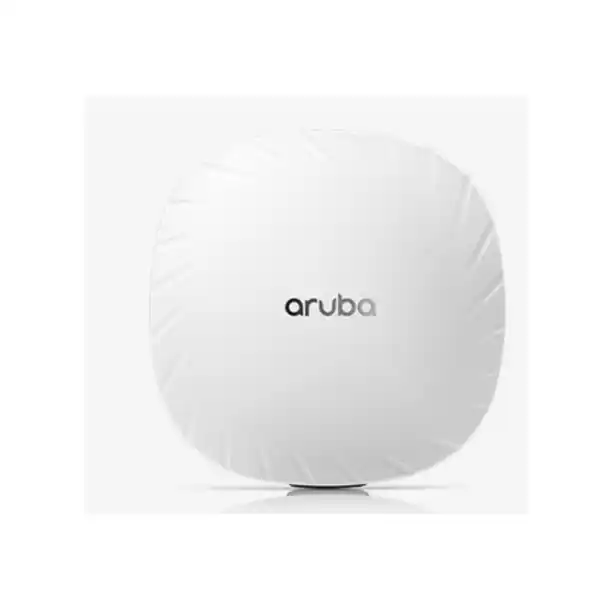
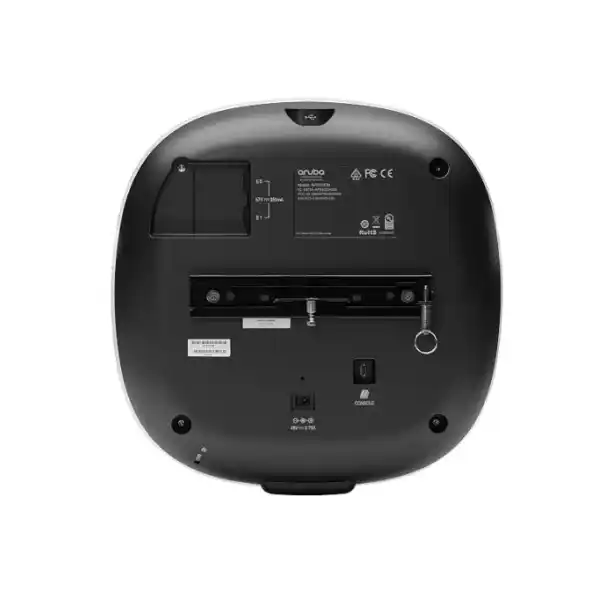
HPE Aruba Networking AP-535 in Dubai, UAE
The AP-535 is designed for business wireless environments where many users and devices share the same indoor coverage area and where the wired network must keep pace with higher Wi-Fi 6 traffic. Its dual 4×4 radios, integrated internal antennas, multi-gigabit Ethernet interfaces and integrated IoT radios make it a strong candidate for offices, meeting facilities, education spaces, healthcare environments and other deployments that need structured enterprise WLAN planning rather than a consumer-style access point.
FourTeck can help buyers confirm the regional ordering code, PoE design, mounting requirements, management approach, licensing or subscription dependencies, switch uplink capacity and quotation details before procurement.
The AP-535 has regional variants and requires the correct power and mounting choices. Confirm the complete bill of materials instead of ordering the access point in isolation.
Wi-Fi 6 / IEEE 802.11ax
Dual 4×4, 2.4 GHz and 5 GHz
Two 5GbE-capable interfaces
Integrated internal antennas
Regional part number must be confirmed
Direct answer for buyers considering the AP-535
HPE Aruba Networking AP-535 is an indoor enterprise access point from the 530 Series built around Wi-Fi 6 and dual 4×4 radio operation. It is mainly used to provide managed wireless connectivity in business environments where client density, application traffic and mobility requirements justify a higher-capacity access point. Organisations evaluating it should look beyond the radio specification and confirm the complete design: the right regional SKU, intended ceiling or wall mounting method, PoE budget, switch port speed, software and management architecture, licensing or subscription requirements, RF coverage plan and the number and type of client devices. FourTeck can assist with this requirement review before a UAE quotation is prepared.
What the AP-535 is built to do
The AP-535 provides concurrent 2.4 GHz and 5 GHz wireless service using 4×4 MIMO radios. HPE positions the 530 Series for higher-density indoor use, including larger offices, training and meeting facilities and healthcare environments. Wi-Fi 6 features such as OFDMA, multi-user MIMO and target wake time are intended to improve the way airtime is shared among compatible clients, especially where many devices need short, repeated exchanges rather than one device monopolising the channel.
The access point also has two multi-gigabit Ethernet interfaces and integrated Bluetooth 5 plus IEEE 802.15.4/Zigbee capability. Those interfaces do not automatically guarantee application performance; the rest of the design still matters, including switch capacity, cabling, power delivery, RF placement, controller or cloud management choice and policy architecture.
Who should consider this model
The AP-535 makes the most sense when the buyer needs an enterprise WLAN rather than a standalone small-office hotspot. Typical candidates include corporate offices with many concurrent laptops and mobile devices, meeting-heavy environments, campuses, training rooms, healthcare sites, large collaboration spaces and projects that need central wireless operations and policy control.
It may be less appropriate when the deployment requires external directional antennas, outdoor environmental protection, a newer wireless generation, or a very low device count that does not justify this capability level. The closely related AP-534 uses external antenna connectors, so antenna strategy is one of the first model-selection questions to resolve. FourTeck can help compare the deployment requirement before a final bill of materials is approved.
Business problems this access point can help address
Crowded indoor airtime
Where many users share the same radio space, Wi-Fi 6 scheduling mechanisms can improve efficiency compared with older WLAN designs, provided the clients and RF plan support those capabilities. Density still requires sensible channel planning, transmit-power decisions and enough access points in the right locations.
Wired uplink bottlenecks
Two 5GbE-capable interfaces provide more uplink flexibility than a single 1GbE edge connection. Whether a project benefits from multi-gigabit operation depends on switch capability, cable quality, aggregated client demand, power delivery and the selected network design.
Mixed mobile and IoT estates
Integrated Bluetooth and Zigbee-capable radio functions can reduce the need for separate overlay hardware in suitable projects. The actual use case depends on management software, application support, security policy and the intended IoT workflow.
Operational consistency
Enterprises often need common policy, monitoring and lifecycle operations across many access points. AP-535 can operate within HPE Aruba Networking management architectures, but the exact software, subscription and controller requirements should be confirmed for the intended deployment model.
Product-fit matrix
| Requirement | Suitable when | Confirm before ordering |
|---|---|---|
| High-density indoor Wi-Fi | The site has many concurrent users, devices or collaboration sessions. | RF survey, client mix, channel plan and required AP count. |
| Integrated antennas | Ceiling-oriented internal antennas suit the planned placement. | Mounting location, ceiling type and whether an external-antenna model is preferable. |
| Multi-gigabit edge | The access switch and cabling can support higher Ethernet speeds. | Switch port capability, PoE class, cable category and design redundancy. |
| Central management | The organisation wants common WLAN configuration, monitoring and policy operations. | Management platform, software release, licenses or subscriptions and existing Aruba architecture. |
| IoT enablement | Bluetooth or Zigbee functions have a defined business application. | Application compatibility, security controls, integration and any required software services. |
Dependencies that should be resolved before purchase
An AP-535 quotation is not complete simply because the model name is known. The ordering code is regional, power sources are separate, mounting kits are separate, and the best management method depends on the customer’s installed HPE Aruba Networking architecture. A project may also need multi-gigabit PoE switching, suitable copper cabling, a controller or gateway design, cloud-management subscriptions, support entitlement, installation services, configuration work or RF validation. These are design decisions rather than automatic contents of the access-point box.
Buyers upgrading from an older Aruba WLAN should also check software release compatibility and the preferred migration path. Current HPE technical material lists support across ArubaOS 8 and ArubaOS 10 environments, but the exact release and feature set should be matched to the installed network. Features such as dynamic segmentation, AirMatch, ClientMatch, Air Slice, central analytics and policy enforcement may depend on the wider software architecture and licenses rather than the AP hardware alone.
A practical AP-535 purchase journey
Define the wireless need
Share floor plans, user counts, device mix, critical applications, existing access points and expected growth. This determines whether AP-535 is a good fit and how many units are likely to be needed.
Confirm the infrastructure
Check access-switch port speeds, PoE capability, cable runs, available power budget, VLAN and routing design, internet capacity and whether redundant uplinks or switch stacks are part of the project.
Select the regional BOM
Confirm the destination-specific AP SKU, mounting kits, power accessories, management or subscription items and any services required for deployment or migration.
Quote and schedule
Once the requirement is clear, FourTeck can coordinate a project-specific quotation and discuss delivery, installation, configuration and support scope without assuming stock or fixed lead time.
Capacity depends on airtime, not just headline speed
The AP-535 is often shortlisted because it combines dual 4×4 Wi-Fi 6 radios with a vendor-stated combined aggregate data rate of up to 2.97 Gbps. That number is a physical-layer capability, not a promise that every user will receive that throughput. Real performance depends on channel width, interference, client capabilities, distance, application behaviour, spectrum availability and the number of devices competing for airtime.
For dense environments, the real value of Wi-Fi 6 comes from scheduling efficiency and handling many active devices predictably. OFDMA and multi-user MIMO can help compatible clients share airtime more efficiently, but the RF design still determines whether users experience stable service. FourTeck can help turn a capacity target into an AP count and infrastructure requirement rather than selecting quantity from floor area alone.
Multi-gigabit interfaces protect the wired edge from becoming an afterthought
Wireless design and switching design should be evaluated together. The AP-535 provides two Ethernet interfaces capable of speeds up to 5 Gbps. This gives architects flexibility where aggregate wireless demand could exceed the practical limits of a conventional 1GbE edge, and it may also support designs that use a second Ethernet connection for resilience or specific network architectures.
The benefit exists only when the upstream switch, cabling and power plan support it. A multi-gigabit port with insufficient PoE, older cabling or congested uplinks can become a constraint. For new builds or major refresh projects, evaluate the AP and access switch as one system. For existing sites, verify whether the current switch can supply the required 802.3at or 802.3bt power and the desired Ethernet speed before committing to AP quantities.
Integrated IoT radios can simplify a converged edge
The AP-535 includes Bluetooth 5 and IEEE 802.15.4/Zigbee capability in addition to Wi-Fi. In a suitable HPE Aruba Networking architecture, that can support location, beaconing or IoT gateway use cases without placing a completely separate radio overlay everywhere the WLAN is deployed.
The hardware capability should not be mistaken for a complete IoT solution by itself. The value depends on the business application, device protocols, management tools, security policy, integration method and support model. If IoT is part of the requirement, provide FourTeck with the device types, protocol expectations, management platform and workflow objective so the WLAN design can be checked for fit before procurement.
Where the AP-535 commonly fits
HPE positions the 530 Series for high-density enterprise environments, and the AP-535’s internal antennas make it particularly suited to structured indoor coverage where ceiling-mounted access points can be placed according to an RF plan. The exact number of devices per AP should not be chosen from a theoretical maximum client count; application load and airtime use are more important for real service quality.
Useful for floors with many laptops, collaboration devices, voice applications and mobile users, especially where roaming and central policy are important.
Suitable where rooms can suddenly fill with active clients and video, cloud applications or presentation traffic raises concurrent demand.
Can form part of a managed indoor WLAN where staff mobility and device density require careful RF and security design. Application and regulatory requirements must be reviewed separately.
Can support classrooms, libraries and shared spaces when the AP quantity, channels, authentication and switching architecture are designed for peak student device load.
Integration and operational considerations
Wireless projects fail when access points are selected independently from the network around them. For AP-535, start by validating switching. Determine whether existing access ports support the desired 1, 2.5 or 5 Gbps link speed and the required PoE class. Check total switch PoE budget, not only the wattage of one port, because a floor with many APs can exceed the chassis or power-supply budget even when each individual port is technically compatible. Verify cable category and quality for multi-gigabit operation, especially on older buildings or long runs.
Next, align the AP with the management architecture. An existing ArubaOS 8 environment may have a different controller, licensing and migration path from an ArubaOS 10 or HPE Aruba Networking Central design. Do not assume that an older controller, license or support contract covers a newly purchased AP. Confirm supported software releases and the intended operational model before creating the purchase order.
Finally, validate physical placement. AP-535 internal antennas are optimised for horizontal ceiling-mounted orientation. High ceilings, shelving, partitions, metallic structures, glass, atriums and unusually shaped rooms can change the RF design. Where external antennas are needed to shape coverage, AP-534 may be the more appropriate member of the same series. A site survey or predictive RF design should guide that choice.
Questions to resolve before requesting a quotation
Peak active-device count and application load are more useful than total registered devices for estimating density.
Provide switch model, PoE budget, port speeds and cabling details so edge compatibility can be checked.
Clarify whether the site is controller-based, Instant, cloud-managed or migrating between platforms.
The AP-535 has internal antennas; external antenna requirements may point to the AP-534 or another model.
List Bluetooth, Zigbee and application requirements so integration dependencies can be reviewed.
Installation, configuration, migration, testing, documentation and support can be quoted separately when required.
AP-535 procurement checklist
✓ Confirm AP-535 as the intended model rather than AP-534 or another 530 Series option.
✓ Confirm the correct regional ordering code for the deployment country.
✓ State required quantity and deployment locations.
✓ Provide floor plans or RF design information where available.
✓ Check access-switch model, available PoE class and total power budget.
✓ Confirm whether 1, 2.5 or 5 Gbps wired connectivity is intended.
✓ Select the correct mount kit for the ceiling or installation surface.
✓ Confirm management platform and supported software release.
✓ Identify any HPE Aruba Networking Central, controller, gateway or subscription requirements.
✓ Check whether IoT, location or USB-connected functions will be used.
✓ Decide whether installation, configuration, migration and testing services are required.
✓ Confirm support and manufacturer warranty terms for the selected regional SKU.
How FourTeck can assist with sizing and quotation
FourTeck can help convert the product request into a deployable bill of materials. That can include reviewing the AP model, regional variant, quantity, mounting method, switching and PoE requirements, management architecture, license or subscription dependencies, network configuration scope and support expectations. For larger wireless refreshes, sharing floor plans and the current network design early can reduce the chance of ordering the wrong quantity or overlooking a required accessory.
If the AP-535 is part of a broader infrastructure change, FourTeck can also discuss related business technology products and deployment and support services. The quotation can be structured around hardware only or expanded to include installation, configuration, migration and project coordination when those services are required.
For a new requirement, send the number of APs being considered, location, existing switch model, preferred management platform and expected deployment timeline through the FourTeck contact page.
Useful information to send
• Destination country and site address
• Required AP quantity
• Existing HPE Aruba Networking platform
• Switch and PoE details
• Mounting and installation needs
• Target schedule and support expectations
UAE availability and project support guidance
Contact FourTeck to confirm current UAE availability for the HPE Aruba Networking AP-535. Availability may depend on the regional SKU, requested quantity, vendor lead time, lifecycle position and any associated licenses, accessories or support items. The access point itself should be quoted together with the items needed for a usable deployment, particularly mount kits and a verified PoE source where those are not already present on site.
Delivery and project coordination can be discussed after the requirement is confirmed. If installation or configuration is needed, include it in the quotation request rather than assuming it is part of the hardware price. Wireless work may also require site access planning, cabling readiness, switch configuration, VLAN preparation, controller or cloud setup, testing and handover documentation. FourTeck can help clarify which activities belong in the project scope.
For more information about the company and service approach, buyers can review FourTeck business technology support or start with the Dubai technology solutions site.
Dubai, Abu Dhabi, Sharjah and Ajman coverage
FourTeck can coordinate HPE Aruba Networking AP-535 requirements for business projects across Dubai, Abu Dhabi, Sharjah and Ajman from one consolidated requirement. Buyers operating multiple UAE sites should provide each location, required quantity, existing network platform and whether the same wireless design is intended at every branch. A standardised bill of materials may be appropriate where infrastructure is consistent, while different floor layouts, switch models, mounting conditions or user density can require site-specific changes. Current product availability, regional ordering, delivery arrangements and installation scope should be confirmed as part of the quotation rather than assumed from one location to another.
GCC Availability
FourTeck can assist organisations planning AP-535 deployments across GCC markets by reviewing the requirement before the purchase order is finalised. That review can cover the correct regional access-point code, quantity, mounting kits, PoE switching, management platform, software or subscription needs, configuration scope and project schedule. For businesses with offices in the United Arab Emirates, Saudi Arabia, Kuwait, Qatar, Bahrain or Oman, it is useful to decide whether the WLAN design will be standardised or adapted to each site because building layout, regulatory domain, infrastructure and support requirements can differ.
Product availability, licensing, delivery schedules, service visits and vendor lead times can vary by country, model, quantity and project scope. Buyers should share the destination country, exact model requirement, quantity, preferred management architecture, deployment location and expected timeline so FourTeck can coordinate an appropriate quotation. For Kuwait-related requirements, the FourTeck Kuwait site may also be relevant for regional enquiry routing.
Africa Availability
FourTeck can help organisations evaluating HPE Aruba Networking AP-535 for African projects by reviewing product, license, accessory, power, mounting and management requirements before procurement. Wireless deployments across different countries can vary significantly in building conditions, local infrastructure, shipping arrangements, regulatory expectations and available technical resources, so a reusable design should still be validated for each destination. East Africa projects, including requirements in Kenya and Uganda, can be coordinated with attention to the exact site scope rather than assuming a single regional bill of materials will fit every office.
Availability and fulfilment can depend on destination, model variant, quantity, regulatory domain, power requirements, vendor lead time, installation scope and local project conditions. Buyers should provide the destination country, exact product need, quantity, preferred deployment schedule and any installation or support expectations. FourTeck’s Africa technology site can be used for broader regional enquiries, while local planning can be aligned to the specific project before a quotation is confirmed.
Related products and services to consider
HPE Aruba Networking AP-534
The closely related external-antenna model may be more suitable when the RF design requires specialised antennas. It should not be treated as identical to AP-535 because antenna selection changes the deployment design.
Multi-gigabit PoE switching
Access switches should be selected according to required link speed, PoE class, total power budget, uplink capacity and resilience. Compatibility must be checked against the full network design.
HPE Aruba Networking Central
Cloud management can be part of the operating model for Aruba wired and wireless infrastructure. Subscription and feature requirements should be confirmed for the intended architecture and term.
Wireless installation and configuration
Projects may include mounting, switch preparation, WLAN configuration, authentication, policy setup, testing, documentation and migration assistance depending on the agreed scope.
Why businesses contact FourTeck for AP-535 requirements
The difficult part of a wireless purchase is often not identifying a model name; it is making sure the access point, power source, mounting hardware, management platform, licenses, switching infrastructure and project services all fit together. FourTeck can help clarify those dependencies before a quotation is issued. This is especially useful when an organisation is refreshing an older Aruba environment, rolling out a standard branch design, replacing a mixed-vendor WLAN or planning multiple sites with different building conditions.
The assistance can be focused on product supply, or expanded to include bill-of-material review, compatibility discussion, installation planning, configuration scope, migration coordination and support requirements. No single service package should be assumed for every order; the quotation should reflect what the customer actually needs. Buyers can also use the wider FourTeck UAE website for related infrastructure enquiries.
What buyers usually need to know before shortlisting the AP-535
A buyer comparing enterprise access points is usually trying to answer a practical question: will this model solve the wireless problem in the building without creating a new problem in switching, power, management or support? For AP-535, the strongest starting point is to separate radio capability from deployment suitability. The model is a dual-radio 4×4 Wi-Fi 6 access point with integrated antennas. That makes it a natural candidate for indoor spaces where ceiling placement is possible and where many client devices need managed wireless service. It does not automatically make it the right choice for a warehouse aisle with directional coverage, an outdoor yard, a small room with only a few low-demand devices, or a project already standardised on a different wireless generation.
How many clients can it really support?
Datasheets can list high client limits, but design capacity should be based on active usage. Twenty devices uploading video or using real-time collaboration can create more airtime demand than hundreds of mostly idle phones. For a realistic design, estimate concurrent active clients, application mix and peak periods. Meeting rooms, classrooms and event areas often have short windows of very high activity that should influence AP placement and channel planning.
Does Wi-Fi 6 mean every client becomes faster?
No. Wi-Fi 6 improves efficiency and introduces mechanisms such as OFDMA and target wake time, but the client device must support the relevant features and the RF environment still matters. Older 802.11ac, 802.11n and legacy clients can connect, yet they may not benefit from every Wi-Fi 6 capability. A mixed client population should therefore be part of the capacity plan.
Another common comparison is whether the AP’s two 5GbE interfaces are necessary. In some environments a 1GbE uplink may be adequate for the real traffic profile; in others, a large number of active Wi-Fi 6 clients can justify multi-gigabit switching. The correct decision depends on expected aggregate throughput, local application usage, upstream switch capacity and cabling. It is usually better to design the wired edge with enough headroom than to buy high-capacity wireless hardware and attach it to a constrained switch, but that does not mean every port must operate at 5 Gbps on day one.
Buyers also search for the difference between AP-535 and AP-534. The key hardware distinction is antenna approach: AP-535 uses integrated internal antennas, while AP-534 provides connectors for external antennas. Internal antennas simplify standard ceiling deployments; external antennas allow specialised coverage patterns where the RF design requires them. The decision should be driven by building geometry and coverage objectives rather than model number alone.
Buyer insight: power can change available functionality
AP-535 supports intelligent power monitoring and multiple supported power arrangements. If the power source cannot provide the desired budget, feature availability or operation can be affected. This is why PoE class, total switch power budget and optional USB load belong in the procurement discussion. HPE states that 802.3af class 3 or lower is not supported, so an older PoE switch should not be assumed compatible just because it can provide some power.
Licensing and management questions are equally important. AP-535 hardware can participate in different Aruba software architectures, but a new access point does not mean every cloud subscription, controller feature or security service is automatically included. An existing Aruba customer should identify the controller or Central environment, current software release, license model and support contract. A new Aruba deployment should decide who will manage the network, whether cloud operations are preferred, and whether gateways, policy services or additional subscriptions belong in the design.
For quotation planning, provide enough information to avoid repeated revisions. Include the exact destination country, required quantity, floor or site type, current switch model, PoE capability, management preference, mounting conditions, expected user density and whether installation or configuration services are needed. If the APs are replacing older units, add the existing model and software environment. If the project covers several branches, identify which locations share the same design and which differ.
Price searches for AP-535 can vary widely because regional SKUs, seller terms, taxes, support, shipping and lifecycle conditions differ. A public web price should therefore be treated as a market reference rather than a project quotation. FourTeck can prepare a requirement-based quote after confirming the regional part number and bill of materials. That approach is more reliable than selecting the cheapest visible listing and discovering later that the power, mount, software entitlement or regulatory variant does not match the UAE deployment.
Decision questions buyers ask during AP-535 planning
Should I choose AP-535 for a normal office if I do not expect extreme density?
Possibly, especially if the organisation wants a consistent Aruba enterprise WLAN and expects growth, but capacity should still match the use case. A smaller or newer model could be more appropriate for lightly used areas. Compare required radio capability, management platform, lifecycle objectives and project budget instead of assuming the highest-capacity option is always the best fit.
Can I connect AP-535 to an existing 1GbE PoE+ switch?
A supported 802.3at PoE arrangement may power the AP, and the Ethernet interfaces can negotiate lower wired speeds, but the full design must be checked. Confirm port PoE class, total switch power budget, software support, cabling and whether the 1GbE edge will meet expected traffic. Do not rely on the connector type alone.
Do I need Aruba Central to use the access point?
Not in every architecture. HPE lists on-premises and cloud management options for the platform. The correct choice depends on whether the organisation uses ArubaOS 8, ArubaOS 10, Central or another supported deployment mode. Licenses and subscriptions should be matched to that architecture before ordering.
What if the building needs antennas pointed into specific zones?
AP-535 uses integrated downtilt omnidirectional antennas and is optimised for standard horizontal ceiling mounting. If the design requires directional, high-gain or specialised external antennas, compare AP-534 or another suitable platform and verify the antenna system as part of the RF plan.
What information helps FourTeck produce an accurate quotation fastest?
Send quantity, destination, existing switch model, PoE details, management architecture, software version where known, required mounts, installation expectations and target schedule. For larger sites, include floor plans and expected user density. This lets the quote reflect the full bill of materials instead of only the AP hardware.
Is a public online price enough to budget the project?
It can be useful as a rough market reference, but not as a complete project budget. Regional variant, support, accessories, mount kits, licensing, shipping, tax and services can change the final amount. A deployment quotation should be based on the destination-specific SKU and confirmed scope.
Frequently asked questions
Is HPE Aruba Networking AP-535 a Wi-Fi 6 access point?
Yes. AP-535 is an IEEE 802.11ax Wi-Fi 6 indoor access point with concurrent 2.4 GHz and 5 GHz radios. It also supports legacy Wi-Fi standards for mixed client environments.
Does AP-535 use internal or external antennas?
AP-535 uses four integrated dual-band downtilt omnidirectional antennas. If a project requires external antenna connectors, the AP-534 is the related 530 Series model to evaluate instead.
What Ethernet interfaces are available?
The AP-535 provides two Ethernet interfaces capable of speeds up to 5 Gbps. The actual negotiated speed depends on switch capability, cabling and the network design.
Can AP-535 run from ordinary 802.3af PoE?
HPE states that operation with 802.3af class 3 or lower PoE is not supported. Confirm a suitable 802.3at or 802.3bt design and the total switch power budget before purchase.
Are the power supply and mounting kit included?
Do not assume they are included. HPE documentation notes that power sources and mount kits are sold separately. The quotation should list the exact accessories required for the site.
Does the access point support Bluetooth and Zigbee?
Yes. AP-535 includes Bluetooth 5 and IEEE 802.15.4/Zigbee capability. Practical IoT use depends on the application, management architecture, security design and any required software services.
Which AP-535 part number should be ordered for Dubai?
The AP-535 has regional variants. HPE lists RW, US and other ordering codes, including JZ336A for the RW variant. The correct destination-specific part number should be confirmed for the UAE quotation rather than assumed.
Can FourTeck assist with installation and configuration?
Installation, configuration, migration, testing and project coordination can be discussed as separate scope items when required. The exact service content depends on the site and existing network.
Is AP-535 currently available in the UAE?
Current availability should be confirmed with FourTeck. It can vary by regional SKU, quantity, vendor lead time and lifecycle conditions. A quotation should also confirm any licenses, accessories and services required.
What should I send to request a quote?
Provide quantity, destination, switch and PoE details, management platform, mounting needs, user-density information and whether installation, configuration or migration support is required. Floor plans are helpful for larger deployments.
Build the AP-535 quotation around your actual network
Share the required quantity, destination, switch model, PoE capability, management architecture, mounting conditions and deployment schedule. FourTeck can help confirm the suitable regional AP-535 configuration and coordinate the hardware, accessories and service scope required for a business-ready quotation.

Reviews
There are no reviews yet.