
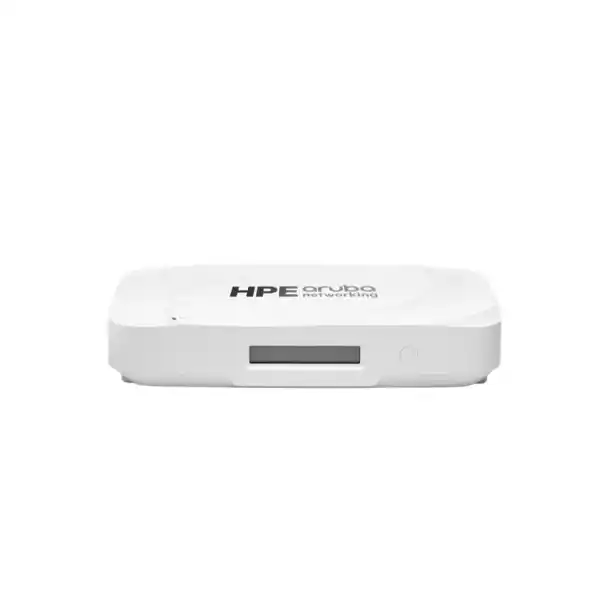
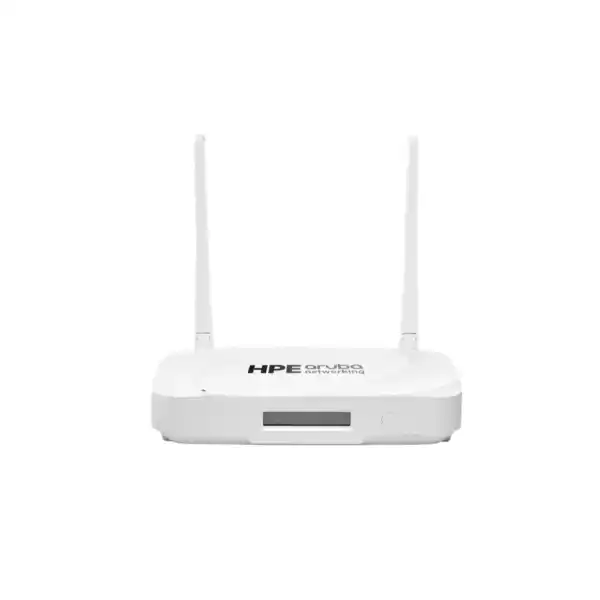

Dual-radio, tri-band Wi-Fi 6E remote AP
Up to 3.6 Gbps in 5 GHz + 6 GHz mode
Power users, small branches, temporary sites
Regional variant, Central entitlement and design
Direct answer for buyers evaluating the AP-605R
HPE Aruba Networking AP-605R is a desktop remote access point in the 600R Series for extending centrally managed enterprise connectivity to locations such as executive home offices, small branches and temporary workspaces. It supports Wi-Fi 6E across the 2.4 GHz, 5 GHz and 6 GHz bands using two radios that can operate on two bands at the same time, and it adds multiple Ethernet ports for local wired devices. Buyers should consider it when they want remote sites to participate in a managed Aruba networking architecture rather than operate as isolated consumer Wi-Fi. Before proceeding, confirm the correct regional SKU, 6 GHz regulatory requirements, HPE Aruba Networking Central licensing or subscription needs, WAN connectivity, power localization, wired-device requirements and whether the optional CAT 12 LTE module is part of the planned design.
What the AP-605R does
The AP-605R brings enterprise wireless, local wired access and centrally orchestrated connectivity into a compact remote-site form factor. It is not simply a Wi-Fi access point intended to provide a standalone SSID. In an HPE Aruba Networking architecture, it can be used to extend corporate policy and WAN connectivity to distributed locations while giving users local wireless access and Ethernet ports for endpoint devices.
HPE documents microbranch functions through HPE Aruba Networking Central, including SD-WAN route and tunnel orchestration, policy-based routing, multiple active tunnels, WAN-health visibility and cloud-security orchestration. These functions make the AP particularly relevant where IT teams want repeatable remote-site deployment without building a full branch stack at every small location. The exact feature set still depends on software version, subscription, design and upstream services.
Who should consider it
The strongest fit is an organisation already using, standardising on, or evaluating HPE Aruba Networking for distributed users. Examples include businesses supporting senior staff from managed home offices, retail or service organisations with compact satellite sites, project teams operating from temporary premises, and enterprises that need centrally visible connectivity at locations where a conventional campus access point alone may not address the WAN or local wired-device requirement.
A buyer seeking only inexpensive standalone Wi-Fi for a single unmanaged room may not need the broader capabilities of this platform. The business case becomes clearer when consistent policy, remote provisioning, troubleshooting, multiple wired interfaces, Wi-Fi 6E capacity or optional cellular backup are valuable. FourTeck can help compare this requirement with other access-point, branch-gateway or managed-network approaches.
Business challenges this remote access point can address
Inconsistent remote connectivity
Consumer routers often create a separate operational environment that IT cannot manage in the same way as the corporate network. The AP-605R is intended for managed remote deployments, allowing the organisation to bring remote users into a common operational framework. The result can be more consistent policy and visibility, provided the Central design and relevant services are correctly configured.
High-bandwidth work at small sites
Video collaboration, cloud applications and large file transfers can place heavy demands on wireless service in home offices and branch rooms. Wi-Fi 6E adds access to the 6 GHz band where regulations and client support permit it. The AP-605R can deliver up to 3.6 Gbps of combined peak radio data rate when its two 2×2 radios are configured for simultaneous 5 GHz and 6 GHz operation. Real application throughput depends on clients, RF conditions, channel plan, WAN speed and protocol overhead.
Too many separate devices
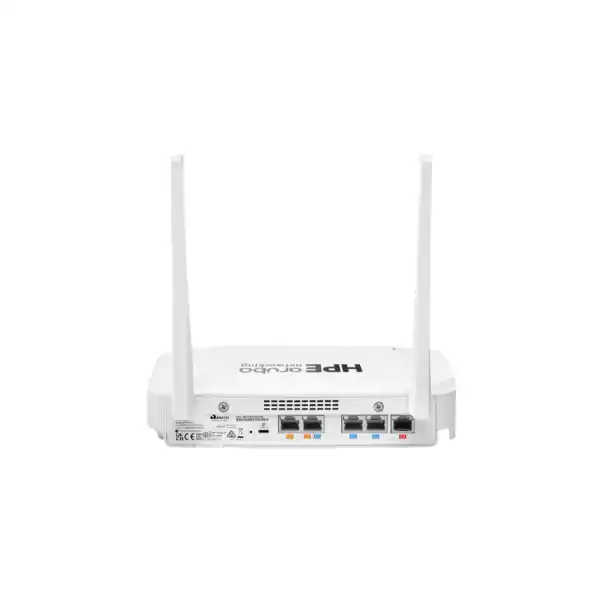
Small remote locations frequently need Wi-Fi plus several wired endpoints. The AP-605R includes five Ethernet interfaces across its uplink and downlink roles, reducing the need to treat every remote location as a miniature full-size wiring closet. One port supports 2.5 GbE, while an E4 downlink can provide 802.3af PoE output to a compatible connected device. Power budget and topology should be checked before relying on this function.
Limited resilience options
Where the fixed WAN is a business risk, HPE offers an optional AP-605CM12 CAT 12 LTE cellular module for primary or backup connectivity. This is an option rather than a standard assumption for every AP-605R purchase. Buyers should confirm regional cellular compatibility, carrier requirements, data service, antennas, subscription and whether an AP-605R12 bundle is more suitable than adding the module separately.
Core capabilities at a glance
AP-605R fit matrix
| Requirement | Suitable when | Confirm before ordering |
|---|---|---|
| Managed executive home office | Corporate IT wants centrally administered Wi-Fi and wired access at a remote residence. | WAN handoff, Central entitlement, corporate policy, privacy boundaries and client mix. |
| Small branch | A compact site needs Wi-Fi plus a few wired devices without a larger branch stack. | Port count, switching needs, PoE load, redundancy, coverage and WAN design. |
| 6 GHz client use | Compatible Wi-Fi 6E devices and regional rules allow 6 GHz operation. | UAE regulatory domain, client capabilities and RF plan. |
| Cellular resilience | The remote site needs LTE as primary or backup WAN. | AP-605CM12 or AP-605R12 option, carrier service, SIM, region and data plan. |
| Multiple wired endpoints | The site can use the AP’s local Ethernet interfaces within their speed and power limits. | Exact E0-E4 roles, VLAN design, PoE requirement and whether a dedicated switch is still needed. |
Configuration and dependency notice
The term “dual-radio tri-band” is easy to misread. AP-605R supports the 2.4 GHz, 5 GHz and 6 GHz frequency bands, but it has two Wi-Fi radios, so a deployment should not assume three simultaneous client-serving radios. HPE describes flexible coverage across any two bands, with the headline 3.6 Gbps combined peak data rate applying when the radios operate concurrently on 5 GHz and 6 GHz. If an environment depends on simultaneous service across all three bands, ask FourTeck to review whether a different access-point architecture is more appropriate.
6 GHz availability and channel use are regulatory matters. The correct regional model and software configuration must match the country where the AP is deployed, and client devices must also support Wi-Fi 6E to benefit from 6 GHz. HPE Aruba Networking Central functions, security services, orchestration features and support can require licenses or subscriptions that are not safe to assume from the hardware name alone.
Optional LTE should also be treated as a separate design choice. Confirm the AP-605CM12 module or an applicable pre-integrated bundle, carrier service, SIM arrangement, supported bands, antennas and data plan. The final quotation should make clear what is included, what is optional and which services FourTeck is expected to provide.
A practical purchase and deployment journey
Define the remote-site role
List the users, corporate applications, local wired devices, expected video or collaboration load, WAN type and any resilience requirement. A home executive site with a laptop, desk phone and printer has a different design from a small branch with several employees and IoT devices.
Validate the radio plan
Decide which two bands should operate concurrently and whether 6 GHz clients are present. Consider room size, construction, interference, client capabilities and expected device count rather than selecting a band only from headline throughput figures.
Confirm WAN and wired ports
Map the Internet handoff to E0 or the appropriate design, decide whether E1 is a secondary uplink or downlink, and list devices for E2-E4. If E4 will power a device, validate the 802.3af requirement and overall power budget.
Review Central and policy
Clarify HPE Aruba Networking Central licensing or subscription requirements, device groups, SSIDs, roles, segmentation, tunnels, routing and cloud-security integration. The operational design should be understood before units are dispatched to remote users.
Choose regional hardware
Confirm the UAE regulatory variant, localized power cord, quantity, optional LTE component and any console or deployment accessories. Do not substitute a US, Japan, Israel or another regional code simply because it appears in an online listing.
Stage, ship and verify
Use zero-touch provisioning where appropriate, verify assignment in the management platform, document who owns the local ISP and cabling, then test corporate access, local wired ports, expected policy behaviour and support escalation after the device is online.
Wi-Fi 6E capacity without treating headline speed as a guarantee
The AP-605R uses two 2×2 MIMO radios and can serve two of its three supported frequency bands concurrently. The most notable configuration is 5 GHz plus 6 GHz, where HPE specifies a maximum combined radio data rate of up to 3.6 Gbps. That number is useful for understanding the class of the product, but it should not be used as an expected Internet speed or single-client file-transfer result. Wireless data rates are negotiated at the radio layer; real throughput is lower because of protocol overhead, contention, client capability, signal quality and network conditions.
The 6 GHz band is particularly interesting for modern remote-work environments because compatible Wi-Fi 6E clients can operate in spectrum that is separate from legacy 2.4 GHz and much of the established 5 GHz congestion. This can help an organisation create a cleaner path for newer laptops and collaboration devices where regulations permit 6 GHz operation. However, older devices that lack Wi-Fi 6E cannot use the 6 GHz band. A mixed-client environment therefore needs a band plan that supports the actual endpoint population.
For buyers, the useful question is not “does it have 6 GHz?” but “which users and applications will benefit from the chosen two-band combination?” A remote executive office with a Wi-Fi 6E laptop and heavy video-conferencing use may gain more from 5 GHz plus 6 GHz than a legacy endpoint environment dominated by 2.4 GHz devices. FourTeck can review client generations, room layout, ISP speed and application patterns so the radio configuration aligns with the real requirement.
Wired connectivity that matters in a remote office
A remote access point often has to serve equipment that should not, or cannot, use Wi-Fi. AP-605R provides a five-port Ethernet layout identified as E0 through E4. E0 is a 10/100/1000Base-T uplink. E1 supports 100/1000/2500Base-T and can be configured by the management system as a secondary uplink or as a downlink. E2 through E4 are gigabit-class downlink ports. This gives the designer flexibility for a local desktop computer, IP phone, printer, conference device or another small-site endpoint without automatically adding a separate switch.
E4 can act as 802.3af Power Sourcing Equipment for a compatible device. That is useful, but it does not mean every PoE endpoint will be suitable. Check the powered device’s standard, maximum draw, cable run and the AP’s available power budget. HPE’s technical material identifies an additional worst-case power draw when the AP is sourcing PoE, which is another reason to review the power design instead of treating E4 as an unrestricted switch port.
The 2.5 GbE capability on E1 can also be misunderstood. A multigigabit interface removes a one-gigabit port ceiling for that link, but end-to-end performance still depends on the WAN, upstream equipment, cabling, remote-site topology and client traffic. For a simple Internet connection below one gigabit, the value may be future flexibility rather than immediate throughput. For a more demanding local design, it can be important when the port is used in a role that benefits from higher capacity.
Central management, microbranch functions and policy control
The AP-605R makes the most sense when remote connectivity is part of a managed architecture. HPE positions the 600R Series for deployment through HPE Aruba Networking Central, which can extend WAN and enterprise policy functions to home offices, small offices and temporary sites. HPE documents microbranch capabilities that include SD-WAN route and tunnel orchestration, policy-based routing, multiple active tunnels, WAN-health visibility and cloud-security orchestration. These capabilities can reduce the operational gap between a main office and smaller remote sites.
Zero-touch provisioning supports deployments where a device is sent to a location that does not have dedicated network engineering staff. The practical benefit is that a centrally prepared configuration can reduce the amount of local setup, but the deployment still needs correct cloud assignment, network reachability, subscription entitlement and a plan for the user’s physical connections. Good remote deployment documentation should explain which WAN port to use, where local devices connect, what status indicators mean and who the user contacts if the AP cannot reach the management service.
Security features documented for the 600R Series include WPA3, Enhanced Open for supported guest-use cases, Dynamic Segmentation capabilities, policy enforcement and a TPM for protected storage of credentials, keys and boot code. These are platform capabilities rather than a reason to skip architecture work. The organisation still needs identity, role, segmentation, tunnel, firewall, cloud-security and logging policies appropriate to its environment. FourTeck can help define the configuration scope to be included in a quotation instead of leaving those decisions until after hardware delivery.
Where AP-605R can be a strong operational fit
Executive home offices
Senior staff may need consistent access to corporate applications, high-quality video meetings and wired devices without becoming their own network administrator. A centrally managed remote AP can support a controlled corporate connectivity layer while the organisation documents the boundary between business and personal home networks.
Small satellite branches
A site with a limited number of workers may need more than Wi-Fi but less than a full branch rack. AP-605R can combine wireless service with several Ethernet connections, while Central-based microbranch capabilities can provide a consistent operating model. Coverage and port count should still be validated for the exact floor plan.
Temporary project locations
Construction offices, event workrooms and project sites can change quickly. A desktop device with zero-touch provisioning can simplify repeatable setup when the WAN is available. Optional LTE may be relevant where fixed connectivity is delayed or used as a fallback, subject to carrier and regional requirements.
Retail or service micro-sites
A very small outlet may need centrally governed wireless plus wired connections for business equipment. The AP can be evaluated as part of that design, but buyers should check whether device count, PoE demand, segmentation and resilience exceed what a remote AP alone should handle.
Integration and operational considerations
Start with the management architecture. If the organisation already operates HPE Aruba Networking Central, determine the device group, configuration hierarchy, licensing, monitoring responsibility and change-control process for remote APs. If Central is new to the organisation, include onboarding and administrative design in the project rather than assuming that hardware purchase alone creates a managed remote-access solution.
Then review upstream connectivity. The AP’s local ports do not change the capacity of the ISP circuit. A site with a 200 Mbps broadband service may still benefit from Wi-Fi 6E efficiency and modern client support, but its Internet traffic will remain limited by that WAN service. Conversely, a high-speed fibre circuit requires suitable cabling, modem or router handoff and port planning if the design expects to use more than one gigabit on the local link.
For corporate access, decide how traffic is routed or tunneled, how users and devices are authenticated, which traffic should exit locally, and which security services are applied. HPE’s microbranch functions can support sophisticated policy, but the right approach depends on the organisation’s security model. Voice, video and cloud SaaS traffic may have different path requirements from access to internal applications.
Finally, plan support. Remote users often cannot provide detailed network troubleshooting. A usable support model should capture WAN status, AP status, relevant logs, site contact details, power and cabling checks, and an escalation path. If cellular backup is used, support procedures should also include carrier status and SIM or data-plan ownership.
Questions to resolve before requesting a quotation
This drives regulatory-domain, localization and delivery decisions. An online part number from another country is not a safe substitute for a UAE-ready quotation.
Include laptops, mobiles, voice endpoints, printers and IoT devices. Client mix affects radio-band planning and whether a single AP is an appropriate fit.
Consider legacy 2.4 GHz needs, 5 GHz clients, Wi-Fi 6E capability and local 6 GHz rules. The AP is dual-radio rather than three-radio.
Share ISP speed, Ethernet handoff, modem or router details, public addressing requirements and whether failover is expected.
List each device and power requirement. E4 can source 802.3af PoE, but the design must remain within the platform power limits.
Clarify monitoring, segmentation, SD-WAN, tunnels, policy routing and cloud-security expectations so the correct subscriptions and configuration services can be scoped.
Procurement checklist for AP-605R projects
✓ Confirm exact AP-605R regional SKU and localization suffix.
✓ State required quantity and deployment destination.
✓ Identify the expected 2.4, 5 and 6 GHz client mix.
✓ Confirm whether 6 GHz operation is required and permitted.
✓ Document ISP speed and physical WAN handoff.
✓ Map E0-E4 port roles and attached wired devices.
✓ Check any 802.3af PoE-out requirement on E4.
✓ Confirm HPE Aruba Networking Central entitlement or subscription.
✓ Decide whether optional CAT 12 LTE is required.
✓ Confirm localized AC power cord and power arrangement.
✓ Define staging, zero-touch provisioning and shipping workflow.
✓ Include installation, configuration, testing or support scope where needed.
How FourTeck can support the buying process
FourTeck can help turn an AP model request into a bill of materials that reflects the deployment. That can include reviewing the exact AP variant, quantity, Central requirements, power localization, LTE option, wired endpoint needs and any related network services. This is particularly useful when a buyer has found several online AP-605R part numbers and needs to determine which one belongs in a UAE project rather than assuming all variants are interchangeable.
Where deployment assistance is required, the scope can be discussed around staging, configuration, SSID and policy design, cloud onboarding, remote-site cutover, testing, documentation and post-deployment support coordination. These activities should be described in the quotation so hardware and services are not mixed into an unclear package. Buyers can explore FourTeck’s technology services or review the broader product portfolio when comparing related infrastructure.
For a quotation, share the deployment country, quantity, target date, management platform status, expected WAN connection and any LTE, installation or support requirement. FourTeck can then coordinate the product and service discussion around the actual project rather than a generic product listing.
UAE availability and support guidance
Contact FourTeck to confirm current UAE availability for the HPE Aruba Networking AP-605R. Availability can depend on the requested regional variant, localization suffix, quantity, distributor or vendor lead time, subscription requirements and whether the project includes optional accessories such as the CAT 12 LTE module. A web listing from another market should not be treated as evidence that the same SKU is immediately available or appropriate in the UAE.
For accurate coordination, provide the required quantity, installation location, target deployment period, desired management arrangement and whether services are needed. FourTeck can discuss delivery planning after the exact requirement is confirmed. If installation or configuration is part of the project, include that scope in the quotation so responsibilities for staging, Central onboarding, policy, cabling, testing and handover are clear.
Buyers who need a broader infrastructure review can also visit FourTeck Universal Technology or use the FourTeck contact page to share an AP-605R requirement for quotation and configuration discussion.
Dubai, Abu Dhabi, Sharjah and Ajman project coordination
FourTeck can discuss AP-605R requirements for organisations operating in Dubai, Abu Dhabi, Sharjah and Ajman through one UAE project conversation. The useful starting point is the deployment pattern rather than the city name: number of remote sites, user count per site, WAN service, wireless-client mix, wired endpoints, management platform and the level of staging or installation assistance required. For multi-site projects, provide a site list and target rollout sequence so quantity planning and configuration standards can be reviewed together. Hardware availability, regional SKU selection, delivery coordination and service scheduling remain subject to confirmation for the exact requirement.
GCC Availability
Organisations planning HPE Aruba Networking AP-605R deployments across GCC markets can ask FourTeck to review the requirement as a regional procurement and deployment project rather than treating every country as an identical order. The United Arab Emirates, Saudi Arabia, Kuwait, Qatar, Bahrain and Oman can differ in regulatory requirements, available product variants, licensing conditions, delivery arrangements and service logistics. Share the destination country for each site, exact model requirement, quantity, expected Central or subscription needs, wired-device plan and target rollout period. FourTeck can assist with model-selection discussion, quotation coordination, configuration scope, installation planning and renewal guidance where applicable. Product availability, vendor lead times, service visits and delivery schedules can vary by country and project size, so they should be confirmed after the bill of materials is established. For Kuwait-related enquiries, buyers may also review FourTeck Kuwait information.
Africa Availability
For African deployments, FourTeck can help organisations evaluate the AP-605R requirement alongside regional hardware, subscription, power, shipping and implementation considerations. The practical questions include destination country, number of locations, quantity per site, client mix, WAN service, whether 6 GHz operation is part of the plan, and whether Central management or optional LTE connectivity is required. Availability and fulfilment may differ across East Africa, West Africa, Southern Africa and Central Africa because product variants, power localization, regulatory conditions, shipping arrangements, vendor lead times and local project circumstances are not uniform. Buyers should provide the exact destination, quantity, preferred deployment schedule and any installation or support expectations before treating a quoted configuration as final. FourTeck can coordinate planning and product guidance for suitable markets without implying immediate local inventory or guaranteed onsite coverage. Regional information is also available through FourTeck Africa.
Related options and services to consider
AP-605R12 LTE bundle
Where cellular connectivity is required from the beginning, ask whether an AP-605R12 configuration with integrated CAT 12 LTE is more appropriate than procuring the standard AP and cellular option separately. Regional availability and cellular compatibility must be confirmed.
AP-605CM12 CAT 12 module
This optional module can provide primary or backup LTE functionality for supported 600R deployments. Check carrier, SIM, data plan, supported region and whether the module is included or separately ordered.
HPE Aruba Networking Central
Central is central to the remote-management and microbranch use case. Confirm the required subscription or entitlement, term, feature needs and how the AP will be assigned within the organisation’s management hierarchy.
Configuration and deployment assistance
A service scope can cover design review, staging, cloud onboarding, policy configuration, remote-site deployment guidance, testing and documentation. Use the FourTeck services page to explore related support.
Why businesses contact FourTeck for this type of requirement
Remote-access-point procurement can look simple until regional variants, subscriptions, optional modules and network-policy requirements are considered together. FourTeck can help clarify the requirement before a buyer commits to a part number. That may include checking whether AP-605R is suitable for the site size, reviewing which wired ports will be used, identifying the need for 6 GHz, discussing Central subscription requirements and confirming whether cellular resilience changes the bill of materials.
For technical teams, the value is in turning requirements into configuration inputs that can be validated before rollout. For procurement teams, the value is in receiving a quotation that distinguishes hardware, licenses, optional components and services. For project owners, the value is in aligning delivery and deployment planning with the actual site sequence. None of these steps requires inflated claims about stock or guaranteed outcomes; they require clear information and a documented scope.
Organisations can also review FourTeck company information before starting a product or service discussion.
What buyers are really trying to understand about AP-605R
Many AP-605R searches begin with the phrase “Wi-Fi 6E remote access point,” but the purchase decision usually turns on a more practical question: can this device replace the collection of consumer Wi-Fi, small switch and remote-access workarounds at a distributed site? In the right architecture, it can consolidate several functions. It offers enterprise wireless, local Ethernet connectivity and cloud-managed remote-site features in one desktop device. That does not mean it replaces every branch router, switch or security appliance. The correct role depends on the site’s WAN, endpoint count, segmentation needs, resilience target and the services enabled through HPE Aruba Networking Central.
Is AP-605R a three-radio access point?
No. It is described as dual-radio and tri-band. It supports 2.4 GHz, 5 GHz and 6 GHz, but two radios operate at a time. That distinction matters for mixed client environments. A buyer who needs simultaneous coverage on all three bands should compare the requirement with other AP architectures rather than assuming “tri-band” automatically means three concurrent radios.
Does 3.6 Gbps mean a user gets 3.6 Gbps?
No. HPE’s figure is a combined maximum radio data rate for concurrent 5 GHz and 6 GHz operation. Individual device speed will be lower and is influenced by spatial streams, channel width, signal quality, distance, interference, client hardware, protocol overhead and the upstream network. A realistic design starts with application needs and WAN capacity, then checks whether the AP has sufficient headroom.
Another common buying question is whether the 2.5 GbE port is an uplink. E1 supports 100/1000/2500Base-T and can be configured as a secondary uplink or as a downlink through management software. E0 is the gigabit uplink port, while E2 through E4 are gigabit downlinks and E4 can provide 802.3af PoE. This flexibility is useful because a remote site may need a second WAN-style connection, a faster local device or several wired endpoints. The port plan should be drawn before deployment so the configuration and cables at the user’s site match the intended logical roles.
Buyers also frequently look for an “AP-605R with LTE.” The standard AP-605R and LTE-capable configurations should not be treated as identical. HPE documents an optional AP-605CM12 CAT 12 LTE module and AP-605R12 options. A cellular design introduces additional questions: which carrier will be used, who supplies the SIM, what bands are supported in the destination country, what data plan applies, and is cellular intended as primary or backup connectivity? A quotation should spell this out rather than adding “LTE” as a vague line item.
Licensing is another area where online product pages can be incomplete. The hardware can be listed by itself, but the operational model buyers associate with remote branch management relies on HPE Aruba Networking Central and related platform capabilities. The required entitlement or subscription can depend on the organisation’s environment and the functions it wants to use. Before asking for a final price, describe whether the AP will join an existing Central tenant, whether the organisation already owns applicable subscriptions, and which functions are expected. This helps prevent a situation where the hardware arrives but the desired cloud-managed workflow is not yet licensed or designed.
For UAE purchasing, the regional variant is equally important. HPE publishes different part numbers for markets such as the US, Japan, Israel and Rest of World. R8N09A is the AP-605R (RW) ordering reference in HPE’s documentation, and localization suffixes apply to items such as power cords. That does not justify blindly ordering the RW number for every UAE requirement. The correct bill of materials should be confirmed against current regional policy, availability and the exact installation location. The same caution applies to 6 GHz because permitted spectrum use is jurisdiction dependent.
The best quotation request therefore contains more than the phrase “one AP-605R.” Include quantity, destination, current Aruba environment, Central status, ISP handoff, user count, Wi-Fi 6E client count, wired-device list, PoE requirement, LTE need and desired service scope. With those details, FourTeck can discuss a configuration that reflects the actual remote-site design instead of comparing online prices that may refer to different countries, bundles or subscription assumptions.
Decision questions that prevent a wrong remote-AP purchase
Will this site really benefit from 6 GHz?
6 GHz is most useful when compatible Wi-Fi 6E clients are present and local regulation permits operation. If a location uses mainly older 2.4 GHz or 5 GHz endpoints, the purchase may still make sense for management and wired connectivity, but the 6 GHz feature will not transform those legacy clients. Count the client generations before deciding which two bands should run concurrently.
Can the AP replace a small switch?
Sometimes, but not automatically. Five Ethernet interfaces give the AP useful local connectivity, and E4 can power one 802.3af device. A branch with more ports, higher PoE demand, switch-specific features or structured cabling may still require a dedicated switch. List every wired endpoint, its speed and power requirement, then compare that with the AP’s available ports.
What changes when LTE is added?
The project becomes a cellular-service design as well as a Wi-Fi project. The hardware module or bundle, carrier, SIM, subscription, radio support and failover policy all matter. Decide whether LTE is backup for a failed fixed WAN or the normal primary path. The answer affects data plans, monitoring, traffic policy and expectations during outages.
What should be prepared in Central before shipping?
Ideally, IT knows where the AP belongs, what configuration group or site it should join, which SSIDs and policies apply, how WAN traffic will be routed or tunneled, and how support will identify the unit. Zero-touch provisioning is most valuable when those decisions are completed before the device reaches the remote user.
How do we compare AP-605R pricing fairly?
Compare the same regional hardware, localization, included power components, optional LTE status, subscription term, support coverage, tax treatment and services. A lower web price can refer to a different regulatory variant or hardware-only package. Ask vendors to state the exact part number and what is included so procurement compares like with like.
When should we select another type of AP?
If the main requirement is a large campus coverage area, a ceiling-mounted design, simultaneous service across more radios, higher client density, more spatial streams or outdoor operation, a different access-point family may fit better. AP-605R is intentionally shaped around remote, desktop and microbranch use. FourTeck can compare the use case before the model is fixed.
Frequently asked questions
Is the HPE Aruba Networking AP-605R a Wi-Fi 6E access point?
Yes. HPE identifies the AP-605R as a dual-radio, tri-band 2×2 Wi-Fi 6E remote access point. It supports operation across the 2.4 GHz, 5 GHz and 6 GHz bands, with two radios operating concurrently. Use of 6 GHz remains subject to regional regulations and compatible client devices.
What is the maximum wireless data rate?
HPE specifies up to 3.6 Gbps combined peak radio data rate when the two radios operate concurrently in 5 GHz and 6 GHz mode. This is a theoretical aggregate radio figure, not a guaranteed single-user or Internet throughput result.
How many Ethernet ports does AP-605R have?
The AP-605R has five Ethernet interfaces, E0 through E4. E0 is a gigabit uplink, E1 supports up to 2.5 GbE and can be configured for secondary uplink or downlink use, and E2-E4 are gigabit downlinks. E4 supports 802.3af PoE output for a compatible connected device.
Does the standard AP-605R include LTE?
Do not assume LTE is included with the standard hardware. HPE offers an optional AP-605CM12 CAT 12 LTE module and AP-605R12 configurations for cellular use. Confirm the required module or bundle, region, carrier, SIM and data service when requesting a quote.
Is HPE Aruba Networking Central required?
HPE positions Central as the cloud-native platform for deploying and managing the 600R remote-access use case, including microbranch functions. The exact entitlement or subscription requirement depends on the intended architecture and services. Confirm licensing before ordering.
Which AP-605R part number should be used in the UAE?
HPE lists R8N09A for the Rest of World AP-605R variant, but the final UAE order should be checked for current regulatory applicability, localization suffix, power cord and availability. FourTeck can confirm the bill of materials for the deployment rather than relying on a foreign-market listing.
Can AP-605R be deployed without onsite IT staff?
HPE supports zero-touch provisioning for remote deployments, which can reduce local setup work. Successful deployment still depends on advance assignment, Internet reachability, correct cabling, cloud entitlement and a clear user installation procedure. Complex sites may still need onsite assistance.
What should I provide to get an accurate FourTeck quotation?
Provide quantity, UAE or other destination, current Aruba environment, Central status, required wireless bands, user and client count, WAN speed, wired-device list, PoE needs, LTE requirement, target deployment timing and any staging, configuration, installation or support services required.
What warranty applies to AP-605R?
HPE states that the 600R Series includes a limited lifetime warranty. The exact regional warranty terms, exclusions and support entitlement should be confirmed for the quoted SKU and purchase channel before procurement.
Confirm the AP-605R configuration before you buy
Send FourTeck the site count, quantity, intended wireless bands, WAN handoff, Central requirements, wired-device needs and whether LTE is required. The quotation can then be built around the correct regional hardware, subscriptions, optional components and any configuration or deployment assistance. Current UAE availability and lead time will be confirmed against the exact requirement.

Reviews
There are no reviews yet.