
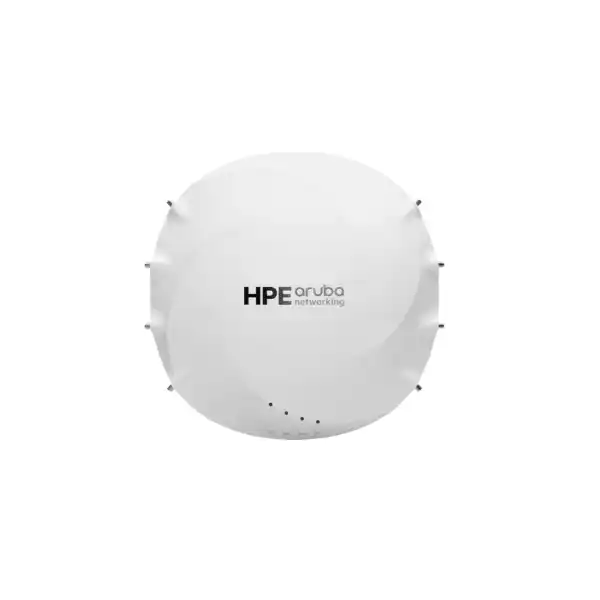
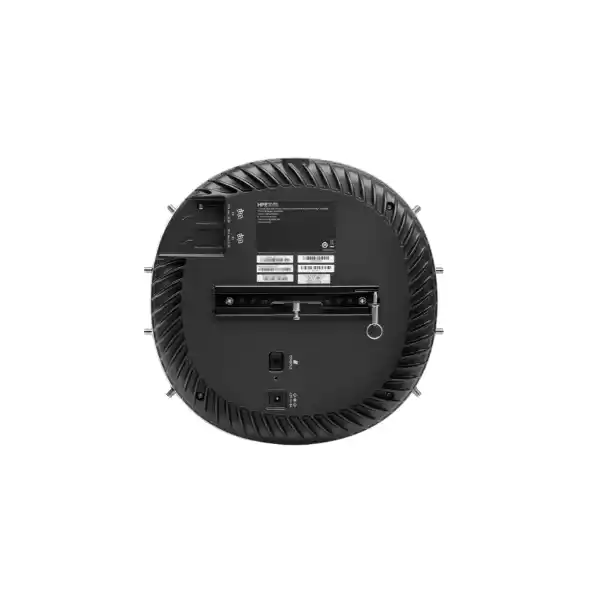

HPE Aruba Networking 650 Series
Central and current Aruba software branches
Exact SKU, regulatory domain and antenna plan
Confirm availability and project scope
Direct answer for buyers considering the AP-654A
HPE Aruba Networking identifies the AP-654A as a 650 Series access point. Current HPE Aruba Networking support documentation lists AP-654A in Central with minimum AOS-10 support at 10.7.2.0 and shows the A-suffixed 650 Series models on the AOS-8 8.13.0.x branch. The model is relevant to enterprises that need a high-end campus access point and want external-antenna flexibility, but the exact radio operation available at a site can depend on country rules and software. Before proceeding, confirm the orderable SKU, UAE regulatory support, antenna type and quantity, mounting location, switch uplink and PoE design, Central or controller architecture, subscription requirements, required quantity and implementation scope.
What the AP-654A is intended to do
A campus access point is the radio edge of the enterprise LAN. It converts the wired network into managed Wi-Fi coverage, applies wireless policy, participates in roaming, and provides the RF capacity users and connected devices rely on. Within the 650 Series, HPE positions the platform around Wi-Fi 6E-era tri-band capacity, advanced radio coordination, multi-gigabit wired connectivity, enterprise policy and centralised management. For a buyer, however, the important question is not whether the family has strong specifications; it is whether the AP-654A variant fits the planned RF design and the organisation’s software lifecycle.
The connectorized model is especially relevant where an architect or wireless engineer needs to choose external antennas for a particular geometry. That can be useful in high ceilings, directional coverage, halls, atriums or other situations where an integrated-antenna model may not provide the preferred radiation pattern. External antenna flexibility also increases design responsibility: antenna gain, cable loss, mounting, orientation and regulatory limits must be accounted for.
Who should shortlist it
The AP-654A may be appropriate for enterprise offices, universities, training facilities, hospitality properties, healthcare environments, retail sites and other indoor campus deployments where a premium access layer is justified by client density, application demand, coverage geometry or operational standards. It is most sensible when the organisation is already using, or intends to use, HPE Aruba Networking management and policy tools and can validate the software release required for the A-suffixed model.
It should not be selected simply because it sits high in the family. Smaller branches, straightforward ceiling-grid offices or projects with modest client counts may be better served by a lower-tier AP, while an integrated-antenna model may reduce design complexity in conventional spaces. Conversely, unusual RF geometry may make the external-antenna form factor valuable. FourTeck can review building type, user count, expected device mix, switch infrastructure and management preference before a bill of materials is prepared.
Business challenges the design can help address
Dense device populations
Modern workplaces may have laptops, phones, tablets, scanners, collaboration systems and IoT devices competing for airtime. A 650 Series design can provide a stronger capacity foundation, but actual experience still depends on channel reuse, client capabilities, RF conditions and the number of APs deployed.
Difficult room geometry
Connectorized antennas can support more deliberate coverage patterns than a one-size-fits-all integrated design. This can be useful where mounting height, aisle direction, room shape, ceiling material or containment requirements call for a specific antenna pattern.
Operational consistency
Managed access points can become part of a common policy, monitoring and lifecycle process. Buyers should verify whether HPE Aruba Networking Central, an AOS-8 architecture or another supported deployment model is planned and whether the required software branch supports the exact AP-654A revision.
Wired uplink bottlenecks
The 650 Series platform is designed around multi-gigabit wired connectivity so the wireless edge is not unnecessarily constrained by a legacy 1 GbE access port. The actual switch port speed, cabling category, PoE budget and redundancy design must be checked for the chosen orderable unit.
Capability band: what matters in a 650 Series decision
The 650 Series is built for 2.4 GHz, 5 GHz and 6 GHz operation where local regulations and configuration permit.
Connectorized deployment allows the RF design to use an antenna pattern suited to the physical space.
The family uses multi-gigabit Ethernet to support high wireless capacity and resilient infrastructure design.
HPE Aruba Networking Central and supported Aruba software releases provide the operational framework for configuration and monitoring.
AP-654A fit matrix
Verified and decision-critical product information
The table below separates facts confirmed in current HPE Aruba Networking documentation from items that should be checked against the exact AP-654A orderable SKU. This is important because HPE documentation distinguishes AP-654 from AP-654A in software-support tables, and radio rules can vary by regulatory domain.
| Brand | HPE Aruba Networking |
| Product | AP-654A access point |
| Product family | 650 Series |
| Access point class | Enterprise campus wireless access point; connectorized/external-antenna positioning should be confirmed against the exact SKU. |
| HPE Aruba Networking Central support | Current Central support tables list AP-654A with minimum AOS-10 GA software release 10.7.2.0. |
| AOS-8 support | Current published support tables list AP-654A on the 8.13.0.x branch. |
| AirWave support | AirWave 8.3.0.5 introduced support for AP-654A; later support matrices continue to list it. |
| 650 Series radio platform | The 650 Series is positioned by HPE as a Wi-Fi 6E tri-band platform using 2.4 GHz, 5 GHz and 6 GHz where regulatory rules permit. Exact AP-654A radio enablement is region dependent. |
| 650 Series throughput reference | HPE publishes up to 7.8 Gbps maximum tri-band aggregate data rate for the 650 Series. Real throughput is lower and depends on clients, channels, RF conditions and configuration. |
| Wired connectivity reference | HPE describes dual configurable 5 GbE ports on the 650 Series for high-capacity and resilient data/power designs. Confirm exact AP-654A port and PoE behavior for the selected SKU. |
| IoT and location features | The 650 Series documentation references BLE, Zigbee, GPS and 802.11mc FTM capabilities. Availability and feature use can depend on software, configuration and deployment architecture. |
| Security references | The 650 Series documentation includes WPA3, Enhanced Open, policy enforcement capabilities and TPM-backed credential/key protection. |
| Exact orderable SKU / part number | Not confirmed from the model name alone. Contact FourTeck for the UAE-appropriate orderable code. |
| License or subscription | Deployment dependent. Confirm Central subscription, support entitlement or architecture-specific licensing before ordering. |
| Antenna, mounting and power accessories | Configuration dependent; confirm antenna set, mount, power method and any optional accessories as part of the bill of materials. |
| UAE availability | Contact FourTeck to confirm current availability, quantity and vendor lead time. |
Compatibility and configuration dependencies
AP-654A procurement should begin with the software and regulatory plan, not with a quantity line on a purchase order. HPE Aruba Networking documentation treats the AP-654A as a distinct supported model from the earlier AP-654. Current Central information lists 10.7.2.0 as the minimum AOS-10 GA release for AP-654A, while current AOS-8 support material places the A-suffixed 650 Series models on 8.13.0.x. If an existing wireless estate is running an older code branch, the project may therefore require an upgrade, migration sequence or mixed-version review before the new APs are introduced.
Radio availability is another dependency. Wi-Fi 6E operation uses the 6 GHz band, but the channels that can be enabled depend on country regulation and the regulatory data distributed by the vendor. A buyer in the UAE should not assume that a US, EU or other regional orderable SKU is interchangeable with the correct local variant. The external antenna design must also comply with the regulatory domain. Gain, cable length, connector type and intended transmit power affect the allowed installation.
On the wired side, check switch port capability, cabling, PoE capacity and redundancy objectives. On the management side, confirm whether HPE Aruba Networking Central, an AOS-8 controller/Instant design or another supported architecture is intended, and ensure that the appropriate subscription or entitlement is included. FourTeck can help assemble these dependencies into one quotation request so hardware, licensing, antennas, mounting, switching and implementation are reviewed together.
A practical purchase and deployment journey
Define the wireless outcome
Document users, devices, applications, floor plans, mounting constraints, security requirements and growth expectations. A premium AP cannot compensate for an undefined RF design.
Confirm the AP-654A variant
Validate the UAE orderable SKU, software minimum, regulatory domain and whether the connectorized model is correct for the planned antenna pattern.
Build the supporting BOM
Add compatible antennas, mounts, licenses or subscriptions, switch-side requirements, power considerations and any support services required for the site.
Plan configuration and rollout
Decide how APs will be staged, adopted into management, assigned profiles, tested, documented and handed over. Include change windows where upgrades are required.
Validate after installation
Check coverage, channel use, client association, roaming, wired uplinks, policy enforcement and application performance rather than treating physical installation as project completion.
External antennas make RF design part of the product decision
The strongest reason to select a connectorized enterprise AP is control over the antenna system. In a conventional office with standard ceiling heights, an integrated-antenna model can be simpler because the antenna pattern, radio design and enclosure are already engineered as one unit. A connectorized AP such as the AP-654 family becomes more interesting when the installation geometry needs a different pattern: a warehouse-like aisle, an auditorium, a long corridor, a high atrium, a multi-level opening or a mounting location where radio placement and user area are not directly aligned.
That flexibility should not be confused with a guarantee of better coverage. The antenna changes how RF energy is distributed; it does not create additional spectrum. A directional antenna can concentrate energy toward a target area, while an omnidirectional pattern can distribute it more broadly. The right choice depends on where users are, what material separates them from the AP, how neighbouring cells should overlap, and what channels are available. Engineers also need to account for cable loss and antenna gain when calculating the effective radiated power permitted by local regulations.
For 6 GHz planning, the antenna and regulatory discussion becomes particularly important because rules are newer and more country-specific than long-established 2.4 GHz and 5 GHz deployments. A design prepared for another country should not simply be replicated in Dubai. The correct HPE Aruba regulatory information, local orderable SKU and supported antenna combinations should be checked before installation. This avoids discovering late in the project that an intended channel set, power level or accessory is not appropriate for the destination.
FourTeck can use the site brief to help identify the information an RF designer needs: floor plans, ceiling heights, wall types, client density, critical rooms, expected roaming paths, mounting restrictions and existing AP locations. For larger or difficult environments, a professional predictive design and post-install validation are more useful than estimating access-point quantity from square metres alone.
Multi-gigabit uplinks, resilience and the switching layer
HPE positions the 650 Series around dual configurable 5 GbE connectivity. At family level, that is useful because a high-capacity wireless platform can generate more traffic than a traditional single 1 GbE edge port was designed to carry, and dual connections can support resilience objectives. Yet buyers should translate the headline capability into a switching design. A 5 GbE port requires compatible access switching and suitable structured cabling. Power delivery must also be checked because radio and feature availability can be affected by PoE conditions on enterprise APs.
A site that connects an AP to an older 1 GbE switch may still function depending on the exact model and configuration, but the uplink could become a practical constraint in a busy environment. Conversely, buying new multi-gigabit switches purely because an AP supports higher speed is not automatically justified. The expected traffic profile, number of clients per AP, local application use, WAN capacity and redundancy policy all matter. If most traffic leaves the site through a much smaller WAN circuit, wired edge capacity should be assessed in the context of the whole network.
Redundant uplinks can be valuable for critical areas, but they also consume switch ports, PoE budget and cabling. The benefit must be weighed against project cost and operational complexity. A hospital, trading floor or high-availability operations centre may value resilience differently from a training room or standard office floor. The exact AP-654A behavior under dual-port and power-failover conditions should be checked in the applicable product and deployment documentation for the selected software release.
When FourTeck prepares a quotation, sharing the current switch model, free port count, cabling category, PoE budget and intended redundancy target allows the wireless BOM to be reviewed alongside the LAN. That is more reliable than treating access points as isolated devices.
Management, security, IoT and location capabilities in context
The operational value of an enterprise AP is determined as much by its management system as by its radios. HPE Aruba Networking Central provides a common platform for managing supported access points, and current support documentation explicitly lists AP-654A. That matters for organisations standardising branch and campus operations because configuration templates, monitoring, software lifecycle and troubleshooting can be handled through the chosen management architecture rather than separately at each AP.
The 650 Series documentation also references security capabilities including WPA3, Enhanced Open, policy enforcement, protected key storage using a trusted platform module and dynamic segmentation approaches in the wider Aruba architecture. These features can simplify how an organisation applies user and device policy, but the result depends on the surrounding design. Authentication servers, identity services, gateways, role definitions, VLANs, certificates and endpoint behavior can all affect the delivered security model. A product page cannot determine those dependencies for a live network.
For IoT and location use cases, HPE describes BLE, Zigbee, GPS and 802.11mc FTM support within the 650 Series. These capabilities can be useful for asset workflows, sensor connectivity, location references or applications that use proximity information. They should still be treated as parts of a solution rather than as automatic outcomes of purchasing an AP. The required application, tags or sensors, management services, location design and software entitlements must be understood.
The AP-654A is therefore best evaluated as a managed network component. Ask how it will be adopted, what software version is required, who owns configuration, how identities are authenticated, which policies apply, what data is monitored and how the organisation will maintain firmware over time. FourTeck can help turn those questions into a practical scope for quotation and implementation.
Ideal business environments and use cases
Enterprise offices and headquarters
Dense collaboration areas, boardrooms, open-plan floors and executive spaces can benefit from carefully planned high-capacity wireless. The AP-654A is especially relevant where the building geometry or mounting location makes an external antenna preferable. Confirm whether a simpler integrated-antenna 650 Series model would meet the same operational need with lower design complexity.
Education and training facilities
Lecture rooms and training spaces can see large numbers of active devices within a small area. The design should focus on capacity, channel reuse and device behavior rather than broad coverage. External antennas may help in auditoriums or unusual rooms, but they need professional placement and power calculations.
Hospitality and public venues
Hotels, conference spaces and guest environments require predictable roaming and policy while serving a changing device population. The AP-654A may fit selected high-demand areas. Guest authentication, segmentation, management architecture and physical aesthetics should be reviewed alongside RF performance.
Healthcare and operational sites
Clinical and operational spaces can have mobility, voice, telemetry and security requirements that make validation important. Wireless design should account for application certification, roaming behavior, interference, medical or operational devices, change control and resilience. Do not assume an AP upgrade alone improves every workflow.
Retail and customer-facing environments
Stores can combine staff devices, scanners, point-of-sale systems, guest access and IoT. A 650 Series AP can provide a strong platform for demanding zones, while RF design must consider shelving, store layout, neighbouring tenants and the relative importance of 2.4 GHz, 5 GHz and 6 GHz clients.
Special indoor coverage zones
Atriums, halls, high ceilings, long corridors and architecturally constrained areas are the situations where connectorized antennas can add real design value. These spaces should be modelled or surveyed, because antenna selection and mounting geometry are more important than relying on a nominal AP range.
Integration and operational considerations
Wireless projects often fail at the boundaries between technologies. The AP can be correctly specified while the switch, VLAN, DHCP, DNS, authentication, firewall or certificate configuration remains unprepared. For an AP-654A rollout, the network team should confirm the native or management VLAN, required SSIDs, role and policy structure, RADIUS or identity integration, IP address capacity, upstream routing, internet egress, guest services, quality-of-service requirements and monitoring responsibilities.
Software version deserves its own change plan. If existing APs are on a branch that predates AP-654A support, an upgrade may affect controllers, gateways, older AP compatibility or maintenance windows. Mixing hardware generations can be entirely normal, but the supported version matrix should be checked before procurement so the new AP does not force an unexpected operational change. Current HPE documentation distinguishes AP-654A from AP-654 in minimum release tables, which is precisely why exact model verification matters.
Installation teams also need a clear handoff from the RF design. A ceiling drawing should show each AP location, antenna type and orientation, cable path, switch port, VLAN or profile assignment and labeling convention. After deployment, validation should compare the installed state against the design, not simply confirm that devices power on.
For organisations using HPE Aruba Networking Central, ownership of subscriptions, groups, sites, labels, configuration templates and firmware policies should be decided before onboarding. FourTeck can coordinate product selection and implementation scope, while final enterprise policy should align with the customer’s governance and security standards.
Buyer questions to resolve before requesting a quotation
If the answer is a specific antenna pattern, mounting geometry or RF requirement, the connectorized choice is easier to justify. If not, compare the operational simplicity of an internal-antenna alternative.
State whether the deployment uses HPE Aruba Networking Central, AOS-8 infrastructure or another supported mode and provide the current version so compatibility can be checked.
The business case should identify capable clients, target applications and local regulatory support. A Wi-Fi 6E platform still serves 2.4 GHz and 5 GHz clients, but 6 GHz value depends on device adoption and allowed channels.
Provide switch model, port speed, PoE budget and cabling details. High-capacity wireless is more useful when the wired access layer is sized accordingly.
Do not derive AP count from floor area alone. Share floor plans, client density, walls, ceiling height and high-demand zones so coverage and capacity can be evaluated.
Separate supply, RF design, installation, cable work, configuration, migration, testing, documentation and ongoing support so responsibilities are clear.
Procurement checklist for the AP-654A
- Confirm the exact HPE Aruba Networking AP-654A orderable SKU for the destination country.
- Confirm required quantity and whether spares should be included.
- Confirm regulatory domain and the radio bands/channels allowed for the UAE deployment.
- Define the external antenna model, quantity, connector, gain and mounting approach.
- Check the HPE Aruba software branch and minimum release needed for AP-654A.
- Define HPE Aruba Networking Central or other management subscription requirements.
- Review switch port speed, PoE capacity, cabling and redundancy goals.
- Confirm mounts, brackets, cables and any installation accessories.
- Document SSIDs, authentication, segmentation and identity-system dependencies.
- Decide whether predictive RF design or on-site survey services are required.
- Define staging, configuration, migration and firmware change responsibilities.
- Include post-install validation and documentation if required.
- Confirm support entitlement and warranty terms for the exact SKU and region.
- Request current UAE availability and vendor lead time before committing a project date.
How FourTeck can assist with selection, sizing and quotation
FourTeck can help convert a model request into a procurement-ready wireless requirement. For the AP-654A, that normally begins with confirming whether the connectorized 650 Series model is appropriate for the physical environment and whether the customer’s current HPE Aruba software platform can support it. The quotation can then be built around the correct regional SKU, quantity, antenna system, management requirements and supporting accessories rather than supplying an isolated AP line item.
Where the customer already operates HPE Aruba Networking, useful information includes existing AP models, management platform, controller or gateway details, current software version, Central tenant structure, switch models and license position. For new deployments, floor plans, expected users, important applications, cabling status and security requirements help define a more complete scope. FourTeck can also discuss whether installation, configuration, migration or support coordination should be included in the quotation.
For broader network planning, buyers can review FourTeck technology products, discuss project services through the services team, or send the requirement through the FourTeck contact page. The objective is to make the AP, software, antennas, switch-side dependencies and deployment services fit the same project brief.
UAE availability and support guidance
Contact FourTeck to confirm current UAE availability for the HPE Aruba Networking AP-654A. Availability can vary according to the exact orderable SKU, regulatory region, quantity, antenna and accessory requirements, licensing position and vendor lead time. Because the A-suffixed model has distinct software-support entries, FourTeck should verify that the quoted hardware is the intended revision and that the proposed management release aligns with the customer’s environment.
Delivery and project coordination can be discussed after the exact requirement is confirmed. If installation or configuration is needed, include it in the request so mounting, cabling, antenna work, staging, Central onboarding, software changes, validation and documentation can be scoped separately. A project date should not be based on a generic product listing; confirm current lead time and service scheduling against the final bill of materials.
Dubai, Abu Dhabi, Sharjah and Ajman project coordination
FourTeck can discuss AP-654A requirements for business deployments across Dubai, Abu Dhabi, Sharjah and Ajman as one UAE project scope. For multi-site organisations, the useful approach is to standardise the information collected at each location: floor plan, expected users, switch and cabling condition, preferred management architecture, local mounting constraints and required service window. This helps determine whether the same AP and antenna design is appropriate everywhere or whether certain branches need a simpler model. Delivery, installation and support coordination remain dependent on confirmed product availability, project scope and scheduling. Share the exact site list and desired rollout sequence when requesting a quotation so hardware and services can be planned consistently.
GCC Availability
Organisations planning HPE Aruba Networking deployments across the GCC can use the same requirement-first approach rather than assuming that one AP orderable code is valid in every country. FourTeck can assist businesses in the United Arab Emirates and coordinate enquiries involving Saudi Arabia, Kuwait, Qatar, Bahrain and Oman by reviewing the requested AP model, regulatory destination, quantity, antenna design, management software, subscription needs, switch dependencies and implementation scope. This is especially important for Wi-Fi 6E equipment because 6 GHz rules and permitted operation can differ by market and can change over time.
Product availability, licensing, delivery schedules, service visits, project scope and vendor lead times can vary by country, model, quantity and requirement. A regional quotation request should therefore identify the destination country for each site, the exact AP or acceptable alternatives, required quantity, expected subscription term, existing HPE Aruba architecture, deployment location and target timeline. FourTeck can then help coordinate model selection, quotation preparation, delivery planning and configuration scope. For Kuwait-related coordination, buyers may also review FourTeck Kuwait resources. Stock, customs outcomes and fixed installation dates should be confirmed separately for the final project.
Africa Availability
For organisations evaluating the AP-654A or related HPE Aruba Networking wireless equipment for African projects, FourTeck can help structure the requirement around destination, product revision, regulatory domain, quantity, antenna design, management platform, licenses or subscriptions, switch readiness and deployment services. Regional projects often need more than a hardware comparison because power standards, shipping arrangements, local radio rules, installation conditions and support expectations can differ from one site to another. This is particularly relevant when a project includes several countries or when the wireless design was originally prepared for another regulatory region.
Availability and fulfilment may depend on the destination, product model, quantity, license region, power or regulatory requirements, shipping arrangements, vendor lead time, installation scope and local project conditions. Buyers should share the destination country, exact requirement, quantity, preferred deployment schedule and any installation or support expectations. FourTeck can then provide appropriate procurement and planning guidance. For selected East African requirements, the FourTeck Kenya, FourTeck Uganda and FourTeck Africa resources may be useful. Local inventory, customs outcomes, country-wide onsite coverage and delivery dates must be confirmed for the specific project.
Related products, services and alternatives to discuss
650 Series integrated-antenna option
If a standard ceiling deployment does not need external antennas, compare the relevant integrated-antenna 650 Series model. It may simplify RF design, mounting and procurement while keeping the project within the same product family.
Lower-tier HPE Aruba access points
Branches, standard offices or lower-density zones may not require the 650 Series. A nearby model can reduce cost and power demand if the radio, capacity and software requirements are met. Compare on use case, not model hierarchy alone.
HPE Aruba Networking Central
Central is a key management option for supported APs. Confirm subscription requirements, tenant structure, software policy and onboarding responsibilities as part of the deployment, rather than adding management after hardware is ordered.
RF design and deployment services
Predictive design, site survey, installation, configuration and post-install validation can be more important to the final user experience than selecting the highest specification AP. Scope services according to building complexity and business criticality.
Why businesses contact FourTeck for this type of purchase
The practical value of a technology supplier is often in clarifying what belongs on the purchase order. For an AP-654A requirement, FourTeck can help separate the model name from the complete deployment package: correct regional SKU, antenna set, mounting, management subscription, software compatibility, switch-side requirements and implementation services. This reduces the risk of receiving hardware that is technically capable but incomplete for the intended project.
FourTeck can also help compare whether a nearby access point or integrated-antenna variant is more suitable, particularly when the customer has not yet completed an RF design. For existing Aruba environments, sharing the current software and management architecture allows compatibility questions to be addressed before quotation. For new environments, the discussion can cover bill-of-material structure, deployment stages and the information an installer or wireless engineer needs.
The focus is requirement clarification, model selection, bill-of-material guidance, compatibility review, quotation coordination, installation planning, configuration scope, migration planning and support coordination. Buyers can learn more about the company through the FourTeck information page or move directly to request product consultation.
What buyers are trying to understand before choosing the AP-654A
Is AP-654A the same as AP-654?
They should not be treated as identical procurement references. Current HPE Aruba Networking support tables list AP-654 and AP-654A separately and give them different minimum software support points. That is a clear signal that buyers should use the exact suffix when checking firmware compatibility and orderable codes. Family-level capabilities are useful context, but a project should not assume that every earlier AP-654 specification, accessory or regulatory behavior transfers unchanged to AP-654A. Ask for the exact regional part number and confirm the matching data sheet or ordering guidance.
Does Wi-Fi 6E automatically mean faster user speed?
No. Wi-Fi 6E extends Wi-Fi 6 operation into 6 GHz where permitted, giving designers access to additional spectrum and wider channel options. A user only benefits from 6 GHz when the client supports it, the band is enabled under local regulation, the channel plan is appropriate and the application path is not constrained elsewhere. Older clients continue to use 2.4 GHz or 5 GHz. The biggest business advantage can be capacity and cleaner spectrum, not a guaranteed speed figure for every device.
Another common buying question is whether an external-antenna access point gives more range. Range is the wrong primary metric for enterprise Wi-Fi. The antenna pattern can shape where energy is concentrated, which is useful when the physical space has specific coverage geometry, but Wi-Fi is a two-way link. A client device has its own transmit power and antenna limitations. Extending AP transmit reach without considering the client’s return path can create an unbalanced cell. Enterprise design therefore focuses on usable signal, interference, channel reuse, data rate, roaming and capacity across the intended user area.
Buyers also search for the AP’s maximum data rate, and the 650 Series headline of up to 7.8 Gbps is easy to find. That number is a family-level maximum aggregate PHY reference across radios, not a promise that one laptop will transfer data at 7.8 Gbps. Actual application throughput is affected by protocol overhead, channel width, modulation, client stream count, airtime contention, signal quality, interference, wired uplink, server performance and WAN capacity. A better quotation question is: what client density and applications must each AP support in this building?
Software compatibility is especially important with AP-654A. Current HPE Aruba Networking Central material lists the model with minimum AOS-10 GA release 10.7.2.0, and current AOS-8 support documentation lists AP-654A on 8.13.0.x. Organisations that run an older branch should include software lifecycle work in the project plan. Before buying hardware, check whether the required release is approved by the organisation, whether older APs remain supported on that release, whether gateways or controllers need upgrades, and whether a maintenance window is available.
Licensing is another area where online product comparisons can be misleading. An access point can be physically purchased while the management model, subscription term and support entitlement remain separate decisions. If the organisation uses HPE Aruba Networking Central, confirm the subscription type and term needed for the chosen operating model. If it uses another supported architecture, check the corresponding licensing and support requirements. The quotation should make clear which subscriptions are included, which are optional and what happens at renewal.
Antenna purchasing also needs care. The connectorized AP is only one part of the RF system. The selected antenna must be appropriate for the band, connector and regulatory design. Mounting hardware, cable assemblies, lightning considerations where applicable, orientation and physical aesthetics may affect the installation. Even when an antenna is electrically compatible, it may not be the right radiation pattern for the room. The project should therefore identify the desired coverage shape before accessories are ordered.
For buyers preparing a Dubai quotation, the most useful information is not a generic request for a price. Provide quantity, destination, current Aruba environment, management preference, switch model, intended antenna approach, floor plans or approximate coverage zones, important applications and desired service scope. This allows FourTeck to distinguish between product-only supply and a project that also needs RF design, installation, configuration, migration or validation.
Finally, compare AP-654A against alternatives on operational fit. A less complex integrated-antenna model can be the better choice for standard offices. A lower-tier AP may be adequate in lightly used branches. A newer Wi-Fi generation may be relevant in greenfield projects if client lifecycle and budget support it. The right choice is the one that meets capacity, coverage, management, software and lifecycle requirements with the least unnecessary complexity. FourTeck can help build that comparison before the final bill of materials is approved.
Decision questions that prevent a wrong wireless purchase
Do we need AP-654A specifically, or simply a high-capacity Aruba AP?
Start with the reason for the external-antenna form factor. If the building needs a tailored radiation pattern, the AP-654A can be a logical candidate. If the main requirement is simply high-capacity Wi-Fi in a conventional office, an integrated-antenna 650 Series model may be easier to deploy. The model suffix should follow the RF requirement, not the other way around.
Will our current Aruba software accept the AP-654A?
Check before ordering. Current Central documentation lists minimum AOS-10 support at 10.7.2.0 for AP-654A, and current AOS-8 support tables place the model on 8.13.0.x. If your production environment is older, the AP purchase may be coupled to a software upgrade or migration. Share the exact current version when requesting a quote.
How should we estimate the number of APs?
Use coverage and capacity design rather than a square-metre rule. A small lecture hall can require more AP capacity than a larger low-occupancy office, while high ceilings or dense walls can change antenna placement. Floor plans, expected concurrent devices, applications, wall materials and roaming paths produce a more defensible estimate.
What must the access switch support?
Review multi-gigabit port capability, PoE budget, cabling and redundancy. The 650 Series is designed around higher-capacity wired uplinks, so an old switch can limit the value of the wireless upgrade. The correct answer depends on expected traffic and whether dual-port resilience is actually required in the project.
Should 6 GHz be a mandatory requirement?
Make it mandatory only when the client roadmap, applications and local regulatory support justify it. 6 GHz can provide additional clean spectrum, but many devices will continue to use 5 GHz. The project should confirm the UAE regulatory domain and the percentage of 6 GHz-capable clients expected during the AP lifecycle.
What information produces an accurate quotation?
Send the exact model request, quantity, deployment country, current Aruba platform and version, intended Central subscription, antenna requirement, switch model, floor plans where possible, mounting constraints, installation scope and target schedule. FourTeck can then identify which items are confirmed, which are optional and which need further design.
Frequently asked questions about HPE Aruba Networking AP-654A
What product family is AP-654A part of?
HPE Aruba Networking lists AP-654A in the 650 Series. Current platform-support tables distinguish the AP-654A from the earlier AP-654, so buyers should use the full model suffix when checking software and procurement information.
What is the minimum AOS-10 release for AP-654A?
Current HPE Aruba Networking Central support documentation lists AP-654A with minimum AOS-10 GA software release 10.7.2.0. Always check the latest support matrix before deployment because software support can evolve.
Can AP-654A be used with AOS-8?
Current HPE Aruba Networking AOS-8 support tables list AP-654A on the 8.13.0.x branch. If an existing environment runs an older version, review controller, gateway and AP compatibility before planning an upgrade.
Does the AP-654A require external antennas?
The AP-654 family is the connectorized/external-antenna option in the 650 Series. For AP-654A procurement, confirm the exact orderable SKU and the compatible antenna set. Antenna choice should be based on RF geometry and regulatory limits, not only connector fit.
Does it support 6 GHz Wi-Fi 6E?
The 650 Series is a tri-band Wi-Fi 6E platform designed for 2.4 GHz, 5 GHz and 6 GHz operation. Exact band enablement depends on the regulatory domain, software and country rules, so confirm UAE support for the selected SKU before ordering.
What switch infrastructure should be checked?
Review port speed, PoE capacity, structured cabling and any redundancy requirement. HPE describes dual configurable 5 GbE connectivity at 650 Series level, but the final design should verify the exact AP-654A SKU and its power/uplink behavior.
Is HPE Aruba Networking Central required?
Central is a supported management platform for AP-654A, but the required deployment architecture and licensing depend on the customer’s design. Confirm whether Central, AOS-8 or another supported model is intended and include the necessary entitlement in the quotation.
How many AP-654A units are required for a floor?
There is no reliable fixed square-metre ratio. Quantity depends on walls, ceiling height, antenna pattern, client density, channel plan, application requirements and desired redundancy. A predictive RF design or survey is preferable for business-critical deployments.
What information should be sent to FourTeck for a quote?
Provide quantity, UAE deployment location, current Aruba platform and software version, antenna requirement, management preference, switch model, floor plans or coverage notes, installation scope and preferred timeline. This helps FourTeck prepare a more complete bill of materials.
Is the AP-654A currently available in Dubai?
Current UAE availability should be confirmed for the exact regional SKU and required quantity. Vendor lead time, antenna/accessory selection and licensing can affect the complete order, so request an updated quotation rather than relying on a generic online stock statement.
Build the AP-654A requirement before you place the order
Send FourTeck the required quantity, deployment location, current HPE Aruba software version, antenna requirement, switch details and expected service scope. FourTeck can help confirm the UAE-appropriate model, identify software and licensing dependencies, compare suitable alternatives and prepare a quotation that covers the complete wireless requirement.

Reviews
There are no reviews yet.