
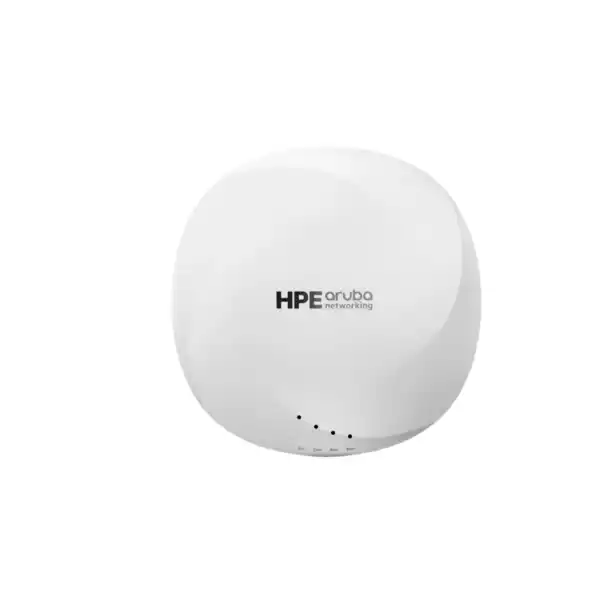
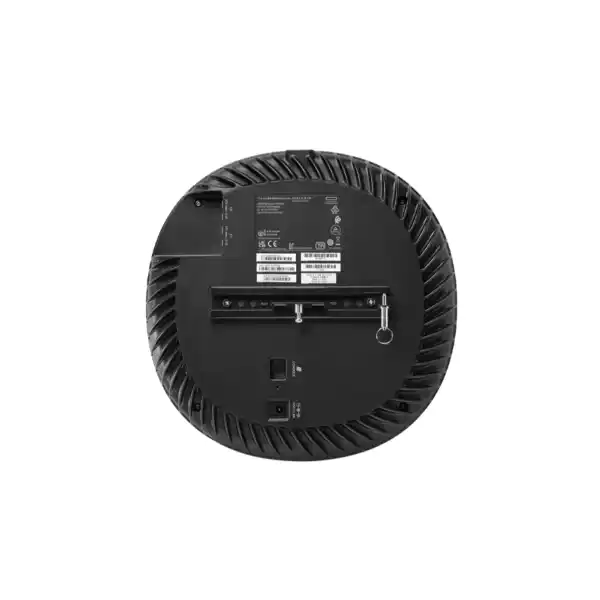

Direct answer for buyers evaluating AP-655
HPE Aruba Networking AP-655 is a high-capacity indoor Wi-Fi 6E access point in the 650 Series, designed to provide concurrent 2.4 GHz, 5 GHz and 6 GHz coverage with three 4×4 MIMO radios. It is mainly used in enterprise campus environments that need greater wireless capacity, multigigabit wired connectivity and support for modern client and IoT use cases. Organisations should consider it when they have dense device populations, demanding applications or a deliberate 6 GHz adoption plan. Before proceeding, confirm the correct regulatory-domain SKU, PoE and switch capacity, mounting hardware, management architecture, software version, client support for 6 GHz, and any HPE Aruba Networking Central subscriptions or related services required for the project.
What the AP-655 does
At its core, the AP-655 provides indoor enterprise WLAN access with concurrent operation across three Wi-Fi bands. The 6 GHz radio gives compatible Wi-Fi 6E clients access to additional spectrum, while the 5 GHz and 2.4 GHz radios continue to serve the broader installed base. This makes the product especially relevant to staged wireless modernisation: an organisation can introduce newer 6 GHz devices without abandoning devices that still depend on the established bands.
The access point also provides two multigigabit Ethernet interfaces, support for redundant data and power designs, built-in Bluetooth Low Energy and Zigbee capability, GNSS-based location functionality, and options for cloud or on-premises operation depending on the chosen HPE Aruba Networking architecture. These elements make it part of a wider campus network design rather than a simple radio endpoint.
Who should consider it
The AP-655 suits organisations that can use its radio and uplink capacity. Typical candidates include large corporate offices, universities, healthcare campuses, conference facilities, technology-intensive workspaces and other indoor environments with high client density or substantial application traffic. It can also be relevant where resiliency at the access layer is important and the design calls for two Ethernet paths or dual-power arrangements.
It may be excessive for small rooms, low-density branches or sites whose switching infrastructure cannot provide the required power and multigigabit uplink capability. A lower-tier AP can be more sensible when client counts, application demand or Wi-Fi 6E adoption are modest. FourTeck can help compare the AP-655 with nearby HPE Aruba Networking models before the bill of materials is finalised.
Business challenges the AP-655 is designed to address
Crowded wireless environments
More users and more devices can make conventional WLANs difficult to plan, especially when everything competes for 5 GHz airtime. Wi-Fi 6E introduces 6 GHz spectrum for compatible clients, helping designers create additional capacity without forcing every device into the same radio space.
Multigigabit application demand
The AP-655 can generate more wireless traffic than a traditional 1 GbE uplink is designed to carry. Its two Smart Rate Ethernet ports can negotiate up to 5 Gbps, giving network architects room to match wireless growth with appropriate access switching.
Access-layer resilience
Dual Ethernet interfaces support design options for redundancy and capacity. HPE documents hitless failover for Ethernet and power in supported configurations, which is useful where wireless service continuity is part of the campus design objective.
Mixed user and IoT estates
Beyond Wi-Fi, the platform includes BLE 5.0 and Zigbee support plus a USB host interface. That can reduce the need for separate overlay radios in selected IoT projects, although the actual application, sensor platform and integration design must be checked.
Core capabilities in practical terms
Is the AP-655 the right fit?
| Requirement | Suitable when | Confirm before ordering |
|---|---|---|
| High-density Wi-Fi | The site has many active users, high-throughput applications or capacity pressure. | RF survey assumptions, expected concurrent clients and application mix. |
| Wi-Fi 6E adoption | A meaningful portion of the device estate can use 6 GHz now or during the planned lifecycle. | UAE regulatory support, client capability and SSID/security design. |
| Multigigabit wired edge | Switch ports can provide 2.5/5 GbE and the cabling path supports the desired rate. | Switch model, port speed, PoE class, cable category and uplink oversubscription. |
| High availability | The design benefits from dual Ethernet and/or dual-power arrangements. | LACP, failover design, switch topology and power source configuration. |
| Simple indoor antenna deployment | Ceiling-mounted integrated antennas suit the RF design. | Mount type, ceiling construction, orientation and whether an external-antenna model is required instead. |
Verified AP-655 technical information
The table below summarises model-level information confirmed from current HPE Aruba Networking 650 Series documentation. Regional operating channels, ordering part numbers, software choices and some feature behaviour remain dependent on country and configuration, so these figures should be treated as design inputs rather than a complete quotation specification.
| Brand | HPE Aruba Networking |
|---|---|
| Model | AP-655 |
| Product family | HPE Aruba Networking 650 Series Campus Access Points |
| Product type | Indoor enterprise Wi-Fi 6E access point with internal antennas |
| Wireless standard | 802.11ax / Wi-Fi 6E |
| Radio architecture | Three concurrent 4×4 MIMO radios for 2.4 GHz, 5 GHz and 6 GHz |
| Maximum aggregate data rate | Up to 7.8 Gbps: 574 Mbps at 2.4 GHz, 2.4 Gbps at 5 GHz and 4.8 Gbps at 6 GHz under documented peak conditions |
| 6 GHz channel width | HE20/40/80/160 supported; available channels depend on regulatory domain |
| Antennas | Integrated downtilt omnidirectional antennas, designed primarily for horizontal ceiling mounting |
| Ethernet | 2 x RJ-45 Smart Rate ports, auto-sensing 100/1000/2500/5000BASE-T; LACP supported |
| Power | Direct 12 V DC or PoE on E0 and/or E1. Full unrestricted operation is documented with DC, 802.3bt Class 5 or dual combined 802.3at Class 4 power. Single 802.3at operation can impose restrictions depending on IPM configuration. |
| Maximum power consumption | Up to 36.0 W DC or 40.3 W PoE without a USB device; higher with a powered USB device attached |
| IoT interfaces | Bluetooth Low Energy 5.0, Zigbee / 802.15.4 and USB 2.0 host |
| Location | 802.11mc FTM support and integrated GNSS receiver |
| Security capabilities | WPA3, Enhanced Open, TPM, role and segmentation capabilities depending on the deployed Aruba architecture |
| Dimensions | 260 mm x 260 mm x 60 mm, excluding mount bracket |
| Weight | Approximately 1.8 kg without mount bracket |
| Operating temperature | 0°C to 50°C |
| Regulatory model | APIN0655 |
| Manufacturer ordering SKU | Region dependent. HPE lists different AP-655 ordering part numbers for regulatory domains; confirm the correct UAE part number before purchase. |
| Mounting | Mount bracket is fitted to the AP, while the appropriate mount kit is ordered separately. |
Configuration, licensing and compatibility dependencies
AP-655 capability depends on more than the access point hardware. The first dependency is regulatory domain. HPE publishes multiple regional AP-655 part numbers, and 6 GHz channel availability is governed by local regulations. A buyer should therefore avoid selecting a US, RW or other regional SKU by assumption. The correct model must match the destination and the approved operating domain for the intended UAE deployment.
Power is the second major dependency. The AP supports PoE and DC, but the available power budget affects whether every feature can operate without limitation. HPE documents unrestricted operation with direct DC, 802.3bt Class 5 PoE or dual combined 802.3at Class 4 PoE. A single 802.3at source can be used with Intelligent Power Monitoring, but feature restrictions may be applied according to the configured policy and actual power consumption. For procurement, this means the switch model, PoE class, available budget per port and total switch power budget should be reviewed before the access point quantity is ordered.
Management is another design choice. HPE Aruba Networking access points can be deployed with cloud-based and on-premises approaches, and HPE Aruba Networking Central subscriptions are available in different service tiers and terms. Whether a subscription is required, which tier is appropriate and how long it should run depend on the architecture and the commercial package selected. The hardware purchase alone should not be assumed to include every management service.
Finally, verify switch software, AP operating software and any gateway or policy-management components used in the design. The AP-655 has documented minimum operating software versions, but real projects should follow the currently supported release train and compatibility matrix for the chosen management architecture. FourTeck can include this review during quotation preparation.
A practical purchase and deployment journey
Define the wireless requirement
Document the number and type of users, expected concurrent clients, primary applications, coverage areas, roaming needs, IoT requirements and the proportion of Wi-Fi 6E-capable endpoints. This establishes whether AP-655 capacity is justified and how many units should be considered.
Validate the wired and power layer
Check cabling category, access-switch port speed, PoE class and the total switch power budget. A design that buys a high-capacity AP but connects it to an unsuitable uplink or restricted power source can leave performance on the table.
Select regulatory SKU and accessories
Confirm the model code for the destination, ceiling or wall mount requirements, optional power accessories and any cosmetic or cabling accessories needed for the installation. HPE ordering guidance treats the mount kit as a separate selection.
Choose management and licensing
Decide whether the APs will be managed through HPE Aruba Networking Central or another supported architecture. Identify required subscriptions, term lengths, gateway requirements, policy services and support coverage.
Plan RF, configuration and handover
Use an RF design or survey where appropriate, determine AP placement and channel strategy, build the WLAN configuration, test roaming and application behaviour, then document the deployed settings and operational responsibilities.
Capacity that comes from three purposeful radio bands
The AP-655 is most compelling when a design can use all three of its radio bands intelligently. Its 2.4 GHz radio remains important for compatibility and some IoT devices, but it is rarely where a high-capacity enterprise design wants to concentrate traffic. The 5 GHz radio continues to be the main workhorse for a wide range of enterprise laptops, phones and tablets. The 6 GHz radio creates another pool of spectrum for Wi-Fi 6E clients, which can help separate newer devices from legacy contention and give designers access to wider channels where permitted.
HPE documents an aggregate peak of 7.8 Gbps across the three radios: up to 574 Mbps at 2.4 GHz, 2.4 Gbps at 5 GHz and 4.8 Gbps at 6 GHz under the specified channel-width and modulation conditions. Those are radio data rates, not a guarantee that a user will receive that throughput. Real application performance depends on client capabilities, channel reuse, signal quality, interference, protocol overhead, switch uplinks, upstream network capacity and the number of active devices sharing airtime.
The practical planning value is therefore capacity distribution. A site with a growing Wi-Fi 6E endpoint population may move suitable devices to 6 GHz while keeping 5 GHz available for the wider fleet. This can improve design flexibility, especially in dense office floors and learning spaces where many active devices would otherwise share fewer channels. HPE’s ultra tri-band filtering is intended to allow 5 GHz and 6 GHz operation in close spectral proximity without the self-interference problems that can constrain channel choices on less specialised radio designs.
A buyer should still ask how many 6 GHz clients will actually exist over the expected service life. If nearly all endpoints remain Wi-Fi 5 or Wi-Fi 6 without 6 GHz support, much of the AP-655’s value may initially sit unused. If a hardware refresh, laptop lifecycle or mobile-device strategy is already bringing Wi-Fi 6E into the estate, the economics can look different. FourTeck can use expected client generations and site density to help decide whether AP-655 is appropriate or whether another model would be more balanced.
Multigigabit uplinks and power planning are part of the same decision
Wireless performance discussions often focus on radio rates while overlooking the wired edge. AP-655 includes two RJ-45 Ethernet interfaces that auto-negotiate 100 Mbps, 1 Gbps, 2.5 Gbps or 5 Gbps. HPE also documents LACP support between the two network ports, giving designers options for redundancy and additional capacity. For a new campus build, this is an opportunity to align Wi-Fi 6E with multigigabit switching rather than treating the AP as an isolated upgrade.
The cabling path matters. Multigigabit Ethernet can reuse some existing copper infrastructure, but actual attainable rates depend on cable category, length, termination quality and the switch capabilities at the other end. A pre-order review should identify which AP locations need 5 GbE, which can operate at 2.5 GbE, and whether the switch uplinks and core can absorb the aggregated traffic. Otherwise, a project can create a new bottleneck upstream from the radio layer.
Power must be reviewed at the same time. The AP supports direct DC power and PoE. HPE specifies unrestricted operation with DC, 802.3bt Class 5 PoE or two combined 802.3at Class 4 PoE sources. When only a single 802.3at source is available, Intelligent Power Monitoring can dynamically reduce features or transmit power according to the budget and policy. That flexibility can be useful during migration, but it should not replace deliberate power design when the requirement is full capability.
For procurement teams, this means the AP quotation should be cross-checked against switch port count, Smart Rate support, PoE class and total wattage. For existing networks, FourTeck can help identify whether the current switches can support the intended AP-655 design or whether a parallel switching upgrade should be budgeted.
Management, security and operational control
AP-655 can participate in HPE Aruba Networking architectures designed for centralised management. HPE Aruba Networking Central is one of the primary options, bringing wired and wireless operations into a common cloud-management environment. HPE also supports on-premises and other deployment approaches depending on software and platform choices. The right model depends on how the organisation wants to operate, license and govern its network.
From a security perspective, the 650 Series includes support for WPA3 and Enhanced Open as well as a built-in Trusted Platform Module for protected credential and key storage. HPE Aruba Networking also positions Dynamic Segmentation and policy enforcement as methods for applying role-based access and separating different classes of traffic. These capabilities depend on the wider architecture, policy components and licensing choices; they should not be interpreted as proof that buying an AP alone automatically delivers a complete zero-trust or segmentation solution.
Operational automation can also influence the decision. HPE features such as ClientMatch and AirMatch are intended to improve client steering and radio-frequency management, helping the WLAN adapt to changing device distribution and interference conditions. These features are valuable in environments where manual RF tuning across many APs would be difficult to maintain consistently. Zero-touch provisioning can also reduce the burden of bringing remote or distributed APs into service, provided the network and management platform have been prepared correctly.
Before deciding on management, buyers should answer ownership questions: Who will monitor the WLAN? Who controls firmware policy? Is the IT team comfortable with cloud management? Are subscriptions budgeted for the intended term? Is integration with existing ClearPass, gateway or switching infrastructure required? FourTeck can use those answers to shape the quotation around the operational model, not just the hardware model number.
Ideal business environments and use cases
High-density office floors
Open-plan offices with video meetings, cloud applications and large numbers of managed laptops can benefit from the extra radio capacity, particularly when a growing share of endpoints supports Wi-Fi 6E.
Universities and learning spaces
Lecture halls, collaboration areas and digitally intensive classrooms can create heavy concurrent demand. AP selection should be based on an RF design, seating density and application assumptions rather than room size alone.
Healthcare and clinical campuses
Hospitals and clinics may need resilient WLAN coverage for staff, mobile workflows and connected devices. Device certification, roaming behaviour and application requirements should be checked carefully before deployment.
Conference and public-use facilities
Meeting spaces and event facilities can experience short periods of very high user density. The AP-655 can be part of a capacity-oriented design, but channel planning, client distribution and wired backhaul remain critical.
Technology and engineering workplaces
Sites with modern laptop fleets, real-time collaboration, large data transfers or advanced visualisation may be better positioned to use the 6 GHz radio and wider channel options than environments dominated by older clients.
IoT-aware campus designs
BLE and Zigbee support can be useful where asset, sensor or location initiatives are being considered. Confirm the target application and integration platform before assuming that the AP alone replaces all IoT infrastructure.
Integration and operational considerations
A Wi-Fi 6E refresh touches multiple layers of the network. Start with identity and policy. If the organisation already uses HPE Aruba Networking ClearPass, gateways or role-based segmentation, determine whether the new APs will inherit an existing design or introduce a new policy model. Changes to authentication methods, certificate handling or guest access should be tested before a large rollout.
Next review endpoint compatibility. A 6 GHz SSID strategy must account for client operating systems, wireless adapters, driver levels and security requirements. Many organisations choose to migrate progressively, leaving compatible services on 5 GHz while allowing modern endpoints to use 6 GHz. The right approach depends on device lifecycle and support policy.
Location services and IoT functions also need architecture. The presence of BLE, Zigbee and GNSS on the AP creates options, but business value appears only when applications, analytics and processes consume the data. Buyers should identify whether those functions are part of the initial scope or a future roadmap item.
Finally, define operational ownership. Firmware cadence, configuration backup, alerting, capacity reviews, access-point replacement procedures and subscription renewals should be assigned to internal IT or a support provider. FourTeck’s networking and technology services can be discussed as part of the implementation scope where assistance is required.
Questions to resolve before requesting a quotation
Use coverage and capacity planning rather than a simple floor-area ratio. Dense rooms can need more APs even when physical coverage looks adequate.
HPE lists several AP-655 part numbers. Confirm the ordering code for the UAE and the required 6 GHz operating rules.
Check Smart Rate port speed, PoE class and total switch budget, not only whether the port is labelled PoE.
Mounting kits are selected separately. Ceiling rail type, solid surface or wall-box installations require different hardware choices.
Determine whether HPE Aruba Networking Central, on-premises management or another supported architecture matches the operational model.
Clarify whether the quote should include physical mounting, cabling checks, WLAN configuration, migration, testing, documentation or training.
AP-655 procurement checklist
Use this checklist to reduce bill-of-material changes after the purchase process has started.
- Confirm exact AP-655 regional ordering SKU
- Confirm required quantity and deployment sites
- Document expected client density and traffic profile
- Check Wi-Fi 6E client adoption and 6 GHz policy
- Verify switch Smart Rate port capability
- Verify PoE class and total power budget
- Select the correct mount kit for each ceiling or surface
- Confirm whether DC adapters or PoE injectors are needed
- Choose HPE Aruba Networking Central or other management architecture
- Confirm subscription tier and term where applicable
- Validate current software compatibility
- Define installation, configuration and migration scope
- Agree testing, documentation and handover expectations
- Confirm warranty and support terms on the final quotation
How FourTeck can assist with sizing and quotation
FourTeck can help turn the AP-655 model choice into a complete purchasing requirement. That begins with clarifying the deployment: number of floors or sites, expected users, device types, current wireless platform, available switching, PoE capability, preferred management model and any requirements for guest access, IoT, segmentation or location services.
From that information, the discussion can move to the bill of materials. The quote may need only APs and mount kits, or it may also require power accessories, switching, management subscriptions, installation work, configuration, migration or support coordination. Keeping those elements visible early helps procurement teams compare proposals on equivalent scope.
FourTeck can also help review alternatives when the AP-655 appears oversized or when an external-antenna design is required. The objective is to select a workable architecture rather than force one model into every area. Visit the FourTeck technology product range or send the project requirement for quotation planning.
UAE availability and support guidance
Contact FourTeck to confirm current UAE availability for the HPE Aruba Networking AP-655. Availability may depend on the regulatory-domain model, requested quantity, distributor or vendor lead time, and whether the order also includes mount kits, power accessories or subscriptions. Because HPE lists multiple regional AP-655 part numbers, the exact ordering SKU should be confirmed for the destination before a purchase order is issued.
Delivery and project coordination can be discussed after the requirement is clear. If installation or configuration is needed, include those services in the quotation request so the scope can address AP placement, mounting, switch readiness, WLAN setup, software compatibility, testing and handover. FourTeck does not assume that a hardware quote automatically includes installation, licensing or ongoing management.
Coverage across Dubai, Abu Dhabi, Sharjah and Ajman
For organisations planning HPE Aruba Networking deployments in Dubai, Abu Dhabi, Sharjah and Ajman, FourTeck can coordinate requirement review and quotation planning from a single project brief. Multi-site buyers should provide the destination for each site, quantity per location, target installation schedule, switching environment, management preference and any onsite-service expectations. This is especially useful when different buildings have different ceiling types, PoE readiness or client-density profiles. Regional product availability and service scope should be confirmed against the final bill of materials rather than assumed to be identical for every site.
GCC Availability
FourTeck can assist organisations planning AP-655 or broader HPE Aruba Networking requirements across GCC markets, including the United Arab Emirates, Saudi Arabia, Kuwait, Qatar, Bahrain and Oman. Regional projects should begin with the destination country because wireless regulatory domains, 6 GHz rules, product ordering codes, licensing terms and service logistics can vary. Buyers should share the exact access-point requirement, quantity, management preference, required subscription term, deployment location and expected project timeline. FourTeck can help coordinate model review, quotation, configuration scope, installation planning and related switching or power requirements. Product availability, vendor lead time, delivery schedules, onsite service options and licensing conditions are not assumed to be the same in every GCC country. For country-specific planning, including FourTeck Kuwait coverage, confirm the local requirement before finalising the bill of materials.
Africa Availability
Organisations evaluating HPE Aruba Networking access points for African deployments can contact FourTeck for requirement and procurement coordination. Projects in East Africa, West Africa, Southern Africa or other regions may involve different regulatory domains, shipping arrangements, power standards, installation conditions and vendor lead times, so the destination country must be part of the initial request. Buyers should provide the AP model or desired wireless outcome, quantity, site type, management platform, subscription needs, switch and PoE environment, preferred deployment schedule and any support expectations. FourTeck can help review the required hardware, licenses, accessories and implementation scope without assuming local inventory or a fixed delivery date. For regional enquiries, the FourTeck Africa technology site can be used as a starting point for project discussion.
Related products, platforms and services to consider
HPE Aruba Networking AP-654
The 650 Series external-antenna model may suit spaces where directional or specialised antenna design is required. Antennas and related mount hardware must be selected separately, so use it only where the RF design calls for connectorised antennas.
HPE Aruba Networking AP-635
A lower-tier Wi-Fi 6E campus AP may be worth evaluating for areas that do not need the AP-655’s 4×4 radio architecture or dual 5 GbE capability. Model selection should be based on actual client density and throughput requirements.
HPE Aruba Networking Central
Cloud management can provide centralised visibility, configuration and operational workflows for supported HPE Aruba Networking devices. Confirm the appropriate AP subscription tier and term for the project.
Multigigabit PoE switching
AP-655 projects often benefit from a review of Smart Rate port speeds and PoE budgets. The switch selection should match the AP quantity, desired uplink rate, redundancy model and total power demand.
Wireless design and installation
RF planning, mounting, configuration and validation can be included as a separate service scope when the buyer needs more than hardware supply. See FourTeck technology solutions for broader infrastructure assistance.
Why businesses contact FourTeck for AP-655 projects
The value of a specialist supplier is often in avoiding specification gaps. With a product such as AP-655, those gaps can include the wrong regulatory model, missing mount kits, insufficient PoE, a 1 GbE switching bottleneck, an unplanned management subscription or a mismatch between the AP and the client estate.
FourTeck can help clarify requirements, compare nearby access-point choices, build the bill of materials, review switch and power dependencies, coordinate quotation and discuss installation or configuration scope. Where the buyer already has an HPE Aruba Networking environment, the conversation can include software and management compatibility. Where the network is new, the wider switching, gateway, identity and support design can be considered before procurement.
This approach does not replace a site survey or formal network design where those are needed. It helps ensure that the commercial request contains enough technical context for a more accurate proposal and a smoother handoff into deployment.
What enterprise buyers commonly need to know about AP-655
The most useful way to evaluate AP-655 is to separate headline capability from deployable value. Buyers often begin with questions about speed, Wi-Fi 6E, coverage and price, but a successful project depends on the relationship between the access point, client devices, switching, power, mounting and management. The AP-655 can support a maximum aggregate radio rate of 7.8 Gbps, yet no single client should be expected to receive that figure. The number describes the combined peak capability of the three radios under specific channel-width and modulation conditions. Real user throughput is lower and shared among active clients.
Does Wi-Fi 6E mean every device becomes faster?
No. Only Wi-Fi 6E-capable devices can use the 6 GHz band. Older clients continue on 2.4 GHz or 5 GHz. The benefit is often better distribution of demand and access to additional spectrum for compatible devices, not an automatic speed increase for every endpoint.
Is a 5 GbE switch port mandatory?
The AP can negotiate lower Ethernet rates, but the selected uplink should match the design objective. A buyer choosing AP-655 for high capacity should examine whether 1 GbE would create a practical bottleneck. Multigigabit switching is therefore a design consideration, not simply an accessory choice.
Coverage is another area where buyers look for a single number, but enterprise RF planning does not work reliably that way. Wall materials, ceiling height, neighbouring networks, transmit-power limits, client sensitivity, application needs and channel reuse all affect the required AP count. AP-655 uses integrated downtilt omnidirectional antennas intended primarily for horizontal ceiling mounting. That makes it suitable for many conventional indoor campus areas, but it does not remove the need to plan placement. Warehouses, atriums, long corridors or unusual ceiling structures may require a different antenna approach or a connectorised model such as AP-654.
Power questions also deserve attention because the AP can operate under more than one PoE scenario. The broad message is simple: if full capability is required, design for a power source that HPE documents as unrestricted. If the existing switch only provides single-port 802.3at, Intelligent Power Monitoring can help the AP operate within the available budget, but restrictions may be applied. That can be acceptable during a phased migration, but it should be a conscious choice rather than a surprise discovered after installation.
A complete AP-655 quotation may require the correct regional access-point part number, mount kits, power accessories, switches, management subscriptions and services. If the existing environment already provides some of these elements, they may not need to be repeated. If it does not, excluding them can make a quote look artificially simple while leaving deployment dependencies unresolved.
Licensing is commonly misunderstood. HPE Aruba Networking Central offers subscription-based management, and HPE documentation lists multiple AP Foundation and Advanced subscription terms. Whether Central is part of the design depends on the chosen architecture. Buyers should therefore avoid assuming that a particular cloud-management entitlement is bundled indefinitely with the AP hardware. Instead, state whether cloud management is required, the desired term and the operational features needed, then ask for the appropriate subscription line items.
Price comparisons also need context. AP-655 is sold under different regional part numbers, and public web prices can represent US or other market SKUs, different reseller conditions or different availability positions. Those figures are useful for understanding market scale but should not be treated as a confirmed UAE selling price. A UAE quotation should be based on the correct regulatory model, quantity, required accessories, subscriptions and current vendor channel conditions.
Finally, buyers comparing AP-655 with newer Wi-Fi 7 products should focus on lifecycle and client strategy rather than generation labels alone. AP-655 remains a Wi-Fi 6E platform with substantial 4×4 capacity and dual 5 GbE interfaces. A Wi-Fi 7 model may make sense for new long-life deployments or specific application roadmaps, while AP-655 may be appropriate where the organisation has standardised on Wi-Fi 6E or needs alignment with an existing 650 Series estate. FourTeck can help frame that comparison around real endpoints, software support, budget and deployment timing.
Decision questions buyers ask before selecting this access point
How do I know whether AP-655 is too powerful for my site?
Look at concurrent clients, application demand, radio-capacity pressure and the proportion of modern endpoints. If the main requirement is simple coverage for a modest number of users, a smaller AP may provide better value. If the site has dense users, sustained traffic and a multigigabit edge, AP-655 becomes easier to justify. A coverage survey alone may not reveal the answer because capacity, not signal reach, is often the deciding factor.
What should I check on the existing switches?
Verify port speed, PoE standard, available power per port, total chassis or switch PoE budget, uplink capacity and software support. If the AP is expected to use dual Ethernet, confirm topology and LACP design as well. It is possible for a switch to power an AP but still restrict its feature set or limit traffic through a slower access port.
Will 6 GHz work with our current SSIDs?
That depends on security mode, client capabilities and the selected WLAN architecture. 6 GHz has specific requirements that differ from legacy open or older security configurations. Review authentication settings, endpoint support and operating-system readiness before extending an existing WLAN design into the new band.
Do I need a separate antenna purchase?
Not for AP-655 itself because it has integrated antennas. However, the mount kit is a separate ordering item. If the RF design needs external directional or specialised antennas, AP-654 rather than AP-655 may be the model to evaluate, and antenna selection would then become part of the bill of materials.
What information gives FourTeck enough detail for an accurate quote?
Provide the destination country, quantity, site type, existing switch models, preferred management platform, required subscription term, mounting environment, target schedule and whether services are needed. Include expected user density and client mix if sizing is also required. That helps distinguish a hardware-only request from a complete deployment requirement.
Should we buy AP-655 now if Wi-Fi 7 exists?
The decision depends on lifecycle, standards strategy, client roadmap, current Aruba architecture and budget. A newer standard does not automatically make an existing Wi-Fi 6E design inappropriate. Compare the applications and endpoint generations that will exist during the planned service period, then evaluate model fit and support policy rather than choosing solely by generation number.
Frequently asked questions about HPE Aruba Networking AP-655
Is the HPE Aruba Networking AP-655 a Wi-Fi 6E access point?
Yes. AP-655 is an indoor Wi-Fi 6E access point based on 802.11ax. It uses concurrent 2.4 GHz, 5 GHz and 6 GHz radios. Use of the 6 GHz band remains subject to the regulatory rules that apply to the deployment country and the capabilities of client devices.
What is the maximum aggregate data rate of AP-655?
HPE documents a maximum aggregate radio data rate of 7.8 Gbps across the three bands. This is a peak theoretical radio figure, not guaranteed application throughput. Actual performance depends on clients, channel widths, signal conditions, interference, network design and shared airtime.
Does AP-655 have built-in antennas?
Yes. AP-655 uses integrated downtilt omnidirectional antennas for its 4×4 MIMO radios and is primarily optimised for horizontal ceiling mounting. If a project needs external antennas, the connectorised AP-654 is a different model to evaluate.
Are mounting kits included with the AP-655?
HPE ordering guidance states that a mounting bracket is pre-installed on the AP, while the compatible mount kit is selected separately. The correct kit depends on the ceiling rail, solid surface or wall-box arrangement used at the site.
What PoE does AP-655 need for unrestricted operation?
HPE documents unrestricted operation with direct DC, 802.3bt Class 5 PoE or dual combined 802.3at Class 4 PoE. A single 802.3at source can be used with Intelligent Power Monitoring, but restrictions may be applied depending on power budget and configuration.
Can AP-655 be managed with HPE Aruba Networking Central?
Yes, AP-655 is supported by HPE Aruba Networking Central. The appropriate subscription tier and term depend on the management and feature requirements. Buyers should confirm whether Central subscriptions are part of the quotation rather than assuming they are included with the hardware.
Does AP-655 support Bluetooth and Zigbee?
Yes. The platform includes Bluetooth Low Energy 5.0 and Zigbee / 802.15.4 capability, along with a USB 2.0 host interface. Whether these functions are useful depends on the IoT application and the management or integration platform used in the project.
Which AP-655 part number should be ordered for the UAE?
The correct manufacturer ordering SKU is region dependent. HPE publishes several AP-655 regional part numbers, and the final selection should match the UAE regulatory domain and current vendor ordering guidance. FourTeck can help confirm the exact SKU during quotation.
Can FourTeck provide installation and configuration with the AP-655?
Installation, configuration, migration, testing and support can be discussed as separate project scope items where required. Share the site count, AP quantity, switching environment, management architecture and handover expectations so FourTeck can determine what should be included in the quotation.
Build the AP-655 requirement before you buy
Send FourTeck the AP quantity, destination, existing switch models, preferred management platform, site type and whether you need installation or configuration. The team can help confirm the appropriate regional SKU, mount and power requirements, subscription choices and quotation scope for a UAE deployment. Current availability and delivery timing should be confirmed against the final requirement.
More FourTeck resources
Explore the FourTeck Firewall Dubai technology site for related infrastructure topics or learn more about FourTeck’s business technology focus. For AP-655 pricing, licensing, accessories and project coordination, use the contact page so the requirement can be reviewed against current UAE availability.

Reviews
There are no reviews yet.