
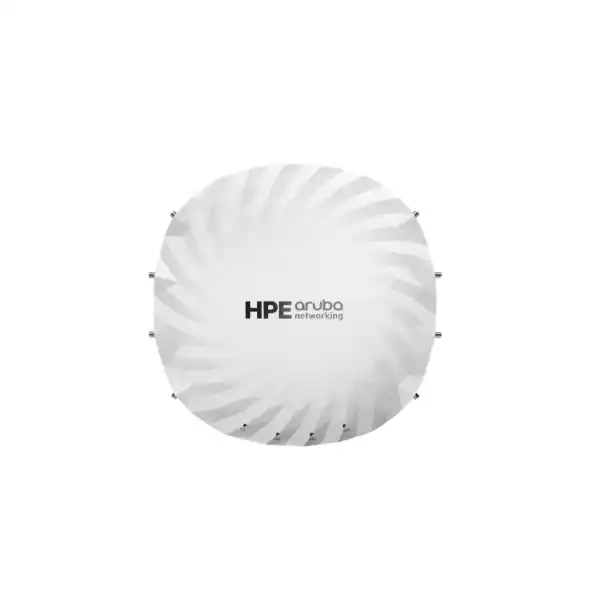
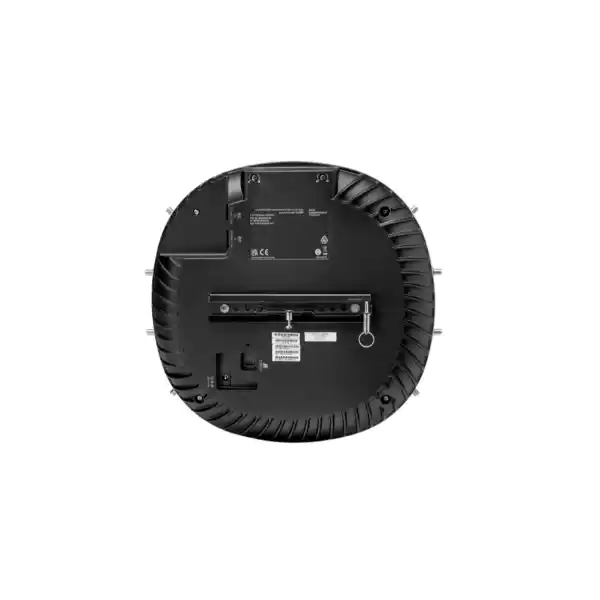
HPE Aruba Networking AP-754 Wi-Fi 7 Access Point in Dubai
The HPE Aruba Networking AP-754 is the external-antenna model in the flagship 750 Series campus access point family. It combines tri-radio Wi-Fi 7, dual 10GbE connectivity, integrated IoT radios and location-aware capabilities for demanding indoor enterprise deployments where antenna selection and RF design are part of the project.
What is the HPE Aruba Networking AP-754?
The AP-754 is an indoor HPE Aruba Networking 750 Series campus access point built for high-performance Wi-Fi 7 networks and differentiated by its external-antenna interfaces. It is mainly used where enterprise wireless capacity, 6 GHz operation, high-speed Ethernet uplinks, IoT connectivity and deliberate antenna pattern design are important. IT teams planning dense offices, healthcare spaces, education campuses, retail environments or industrial IoT deployments should consider it when the RF design calls for external antennas. The most important pre-order check is the complete regional bill of materials: exact AP variant, permitted radio operation, antennas, mounts, cabling, PoE design and management licensing. FourTeck can help translate those requirements into a quotation and deployment-ready shortlist.
Where the AP-754 Fits
HPE positions the 750 Series as its flagship Wi-Fi 7 campus access point family. The AP-754 uses external antennas, while the closely related AP-755 uses integrated downtilt omnidirectional antennas. That distinction matters more than appearance: external antennas allow the RF design to use a selected antenna type and orientation for the intended coverage pattern, but they also make antenna compatibility and installation planning part of the bill of materials.
Consider AP-754 when
The wireless design specifically benefits from external antennas, and the project can validate antenna type, gain, placement, cable loss, mounting and regional radio requirements before deployment.
Evaluate another option when
A standard ceiling-mounted integrated-antenna design is preferred, or the required environment, mounting method, power design or regulatory profile is better served by another model or access point family.
Verified AP-754 Technical Specifications
| Specification | HPE Aruba Networking AP-754 |
|---|---|
| Product family | HPE Aruba Networking 750 Series Campus Access Points |
| Deployment | Indoor |
| Wi-Fi generation | Wi-Fi 7 (802.11be) |
| Wi-Fi radios | Triple 4×4 |
| Radio configurations | 2.4 GHz + 5 GHz + 6 GHz; 5 GHz + 5 GHz + 6 GHz; or 5 GHz + 6 GHz + 6 GHz, subject to configuration and regulatory support |
| Maximum channel bandwidth | 20/40 MHz at 2.4 GHz; up to 160 MHz at 5 GHz; up to 320 MHz at 6 GHz |
| Aggregate radio rate | Up to 18.7 Gbps in tri-band 2.4/5/6 GHz operation; HPE specifies up to 28.8 Gbps maximum aggregate data rate with alternative supported radio modes |
| External antenna interfaces | Two sets of four female RP-SMA connectors |
| Wired network | 2 × 10GbE RJ-45 interfaces, supporting lower negotiated rates as specified by HPE |
| Link resilience | Dual-port redundancy, link aggregation support and combined PoE capability are supported by the 750 Series design |
| IoT | Dual BLE 5.4 and IEEE 802.15.4/Zigbee capability; two USB 2.0 host interfaces |
| Location services | Integrated GNSS receiver, 802.11 FTM support, BLE channel sounding and barometric sensor |
| Security-related hardware | Trusted Platform Module (TPM); MACsec support on the supported Ethernet interface |
| Operating system support | HPE Aruba Networking Wireless Operating System 10.7.0.0 or later |
| Management | On-premises, public cloud, Virtual Private Cloud (VPC) and as-a-service options, depending on architecture and entitlement |
| Regulatory / warranty note | Country-specific approvals must be confirmed. HPE lists a limited lifetime warranty for the 750 Series; exact warranty terms should be checked for the ordered regional SKU. |
Capabilities That Matter in a Real Deployment
Wi-Fi 7 and 6 GHz capacity
The AP-754 supports Wi-Fi 7 with 6 GHz operation and channel widths up to 320 MHz in that band. This can increase available wireless capacity for compatible clients, but usable channels and power levels remain region dependent, so UAE regulatory support and client capability must be confirmed.
External-antenna flexibility
Eight RP-SMA connectors are arranged as two sets of four. This gives network designers flexibility to choose suitable antenna patterns, but it also means the AP should not be ordered as a standalone line item without validating compatible antennas, RF cabling and installation details.
Dual 10GbE uplinks
Two high-speed Ethernet ports reduce the risk that the wired edge becomes the limiting factor for a high-capacity wireless design. The 750 Series also supports redundant connectivity and power options, so switching capability, multigigabit port availability and PoE design should be reviewed together.
Integrated IoT and location functions
BLE, Zigbee-related 802.15.4 support, USB expansion, GNSS and a barometric sensor can reduce the need for separate overlay devices in selected location and IoT use cases. The practical value depends on the applications, management platform and endpoint ecosystem in the customer environment.
Licensing, Management and Optional Components
The AP-754 should be treated as one component of the wireless architecture rather than as a complete standalone project. HPE Aruba Networking Central can provide centralized infrastructure management, automation and operational insights, while HPE also documents other management deployment models. The exact subscription or entitlement requirement depends on how the access point will be managed and which services are required.
Confirm before ordering: the management architecture, required HPE Aruba Networking Central subscription where applicable, compatible external antennas, mounting kit, PoE source, switch port capability, optional USB/LTE accessories and the correct region-specific AP ordering variant. A USB LTE modem is an optional component and is not part of the standard AP capability unless separately selected.
AP-754 Fit Matrix
| Requirement | Suitable when | Confirm before ordering |
|---|---|---|
| External antenna RF design | Coverage needs a selected antenna pattern or placement strategy | Antenna compatibility, gain, cables, connectors and mounting |
| High-density Wi-Fi 7 | Client density and application traffic justify a flagship tri-radio design | Client mix, channel plan, 6 GHz regulations and RF survey data |
| 10GbE edge connectivity | Access switching can provide suitable multigigabit ports and PoE | Switch port speed, PoE class/budget, cabling and redundancy design |
| IoT integration | BLE/Zigbee and location services align with the required use case | Endpoint protocols, management workflow and application compatibility |
Deployment and Installation Considerations
- Validate the regional variant. AP-754 ordering SKUs vary by regulatory domain. The exact UAE-compatible model should be confirmed before purchase.
- Complete the RF design. Because AP-754 uses external antennas, antenna type and placement should be driven by a survey, coverage objective and local radio rules rather than selected only from connector compatibility.
- Check switch and PoE readiness. Review 10GbE/multigigabit uplink capability, cable category, PoE budget and whether dual-link resilience is required.
- Confirm mounts and physical installation. HPE documentation notes that the AP mounting bracket attaches to mounting kits sold separately, so the ceiling, wall or specialist mounting method must be included in the BOM.
- Define management before staging. Decide whether the project will use HPE Aruba Networking Central or another supported management model and confirm the corresponding subscriptions and configuration workflow.
What to Confirm for an Accurate AP-754 Quotation
- Required AP quantity and project locations
- Exact regulatory / regional variant
- Expected client count and device types
- Wi-Fi 7 and 6 GHz client requirements
- External antenna type and RF coverage objective
- Antenna cables and mounting accessories
- Access-switch model and available port speeds
- PoE capacity and redundancy requirement
- Management platform and subscription term
- IoT, BLE, Zigbee or location-service requirements
- Installation, survey and configuration scope
- Support and warranty confirmation for the ordered SKU
When AP-755 or Another Access Point May Be More Suitable
The AP-755 is the closest 750 Series alternative when the project needs the same general Wi-Fi 7 family but prefers integrated downtilt omnidirectional antennas for a conventional ceiling-mounted design. AP-754 is more appropriate when the RF plan specifically calls for externally selected antennas. For sites that do not require flagship capacity, dual 10GbE, external-antenna flexibility or the 750 Series IoT/location feature set, another HPE Aruba Networking access point family may provide a better technical and commercial fit.
FourTeck can help compare the AP-754 against adjacent models based on coverage, density, switch infrastructure, antenna strategy and management requirements rather than choosing only by headline throughput.
FourTeck Assistance for UAE Wireless Projects
FourTeck can assist with requirement clarification, AP model selection, compatible antenna and accessory review, management-subscription guidance, bill-of-material preparation, quotation coordination and installation/configuration scope. For broader infrastructure planning, review enterprise technology products and installation and configuration services.
Availability can depend on the exact regional SKU, quantity, antenna and accessory requirements, subscription choices and vendor lead time. Contact FourTeck to confirm the current UAE configuration and quotation.
Frequently Asked Buyer Questions
Does the AP-754 include internal Wi-Fi antennas?
No. The AP-754 is the external-antenna 750 Series model and provides two sets of four female RP-SMA connectors. Compatible antennas and any required RF cabling should be selected separately for the intended design.
Does AP-754 support 6 GHz Wi-Fi?
Yes, the platform supports 6 GHz operation as part of its Wi-Fi 7 radio design. The actual channels and operating conditions available in a deployment remain subject to country-specific regulation and configuration.
Does the access point have 10GbE uplinks?
Yes. HPE specifies two 10GbE RJ-45 wired network ports. The switching environment should be checked for compatible multigigabit speeds, PoE and cabling.
Is an HPE Aruba Networking Central subscription required?
Subscription requirements depend on the selected management architecture and services. If the AP-754 will be managed through HPE Aruba Networking Central, the appropriate entitlement and term should be confirmed as part of the quotation.
What is the main difference between AP-754 and AP-755?
The principal documented hardware distinction is antenna design: AP-754 uses external antenna connectors, while AP-755 uses integrated downtilt omnidirectional antennas. The preferred model should follow the RF design and mounting approach.
Can FourTeck help specify the complete AP-754 BOM?
Yes. FourTeck can review the AP quantity, regional variant, antennas, mounting, switch and PoE requirements, management subscriptions and deployment scope before preparing a quotation.
Plan the AP-754 as a Complete Wireless Requirement
Share your client density, site type, antenna requirement, switch infrastructure and management preference so the exact UAE AP-754 bill of materials can be checked before quotation.

Reviews
There are no reviews yet.