
HPE Aruba Networking CX 10000 Switch Series Dubai
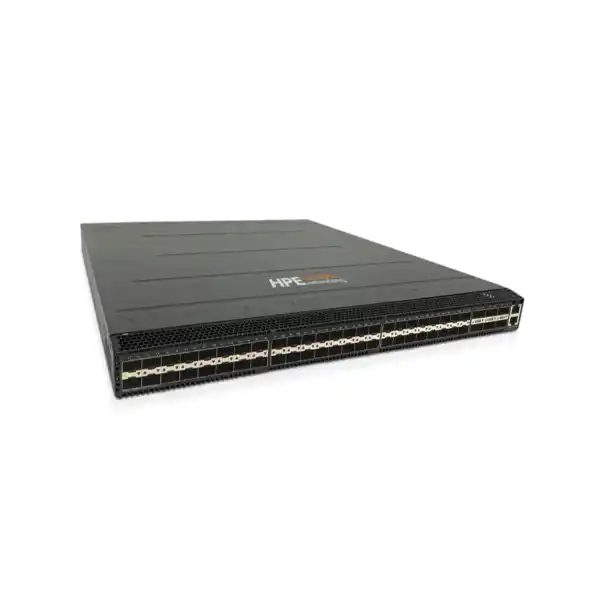
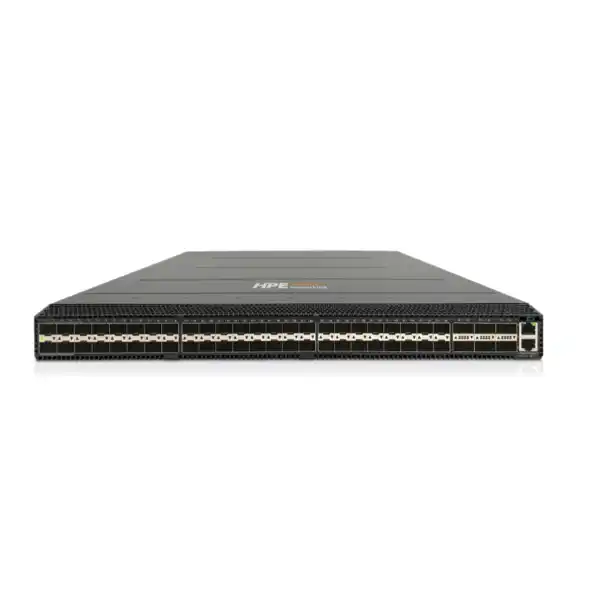
A distributed-services data-center switch designed to place selected security and network services close to workloads instead of sending every east-west flow through a centralized appliance. The CX 10000-48Y6C combines 48 × 1/10/25GbE SFP-family ports, six 40/100GbE QSFP-family ports, AOS-CX switching and programmable DPU services in a 1U platform.
Direct answer: what is the HPE Aruba Networking CX 10000?
Why the CX 10000 is different from an ordinary top-of-rack switch
The CX 10000 is not simply a 25GbE leaf switch with a larger feature list. Its defining design choice is the integration of programmable data-processing units so selected stateful services can be applied inside the switching platform, close to the servers generating the traffic. In conventional data-center designs, east-west flows that need inspection or segmentation may be redirected to centralized firewalls or service nodes. That traffic steering adds path complexity, consumes uplink capacity and can create concentrated policy-enforcement points.
By distributing service enforcement across CX 10000 switches, an organization can design policy around workload location while retaining standard leaf-spine connectivity. This is particularly relevant when segmentation requirements extend beyond VLAN boundaries, when many application tiers communicate laterally, or when a security team wants more visibility and stateful controls near workloads. It does not automatically replace every perimeter or application firewall. The architectural value comes from handling appropriate east-west services in the fabric while other security controls remain where they are best suited.
Where it fits in a data-center design
HPE positions the CX 10000 for access, leaf top-of-rack and end-of-row roles, with potential use in aggregation depending on the architecture. In a typical leaf-spine fabric, its 1/10/25GbE interfaces connect servers, hypervisors, appliances or storage endpoints, while 40/100GbE interfaces provide high-speed fabric or inter-switch connectivity. HPE validated designs also allow CX 10000 distributed-services switches to coexist with non-distributed-services CX leaf models in the same broader design.
That mixed approach matters commercially. A buyer does not need to deploy CX 10000 everywhere simply because one workload requires distributed security. Racks or server groups that need inline stateful services can use CX 10000, while racks with straightforward L2/L3 connectivity may use another suitable CX platform. The final choice should be based on traffic flows, segmentation boundaries, bandwidth, resilience and policy requirements rather than on a one-model-for-all-racks assumption.
CX 10000-48Y6C key hardware specifications
The table below focuses on the CX 10000-48Y6C bundles rather than the higher-speed CX 10040 family member. Exact transceiver compatibility and software requirements should still be checked against the selected release and bill of materials.
| Item | CX 10000-48Y6C detail | Buyer relevance |
|---|---|---|
| Downlink / host ports | 48 × SFP/SFP+/SFP28 supporting 1/10/25GbE with applicable configuration and compatible media | Match server NIC speed, fibre type, DAC/AOC reach and interface-group requirements. |
| High-speed ports | 6 × QSFP+/QSFP28 supporting 40/100GbE | Reserve enough ports for spine uplinks, VSX inter-switch links or other fabric needs. |
| Switching capacity | 3.2 Tbps bidirectional | Assess oversubscription and east-west traffic profile at rack level, not just individual server port rates. |
| Forwarding performance | Up to 2,000 Mpps | Useful for packet-intensive workloads where throughput alone does not describe demand. |
| Form factor | 1U, approximately 4.44 cm high × 43.82 cm wide × 51.1 cm deep | Verify rack depth, cable management and service clearance in the selected cabinet. |
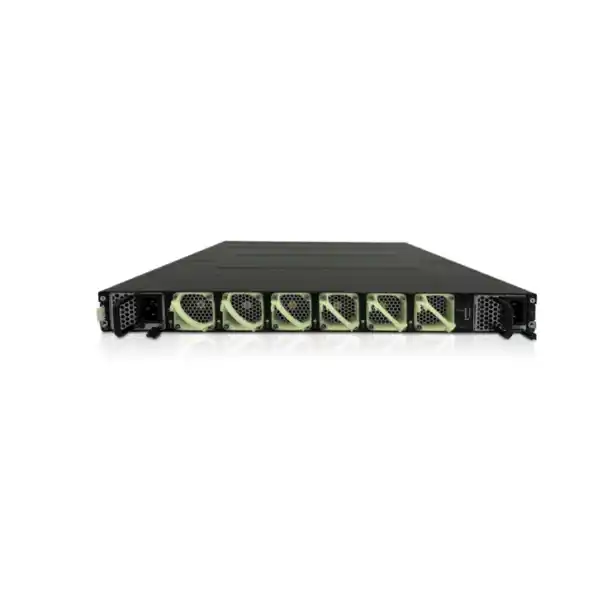
| Power supplies | Two field-replaceable, hot-swappable 800 W AC PSUs in bundle configurations | Plan diverse rack power where operational resilience requires it. |
| Fans | Six field-replaceable, hot-swappable fans | Fan direction must match the selected airflow bundle and data-hall cold/hot aisle design. |
| Power consumption | HPE lists up to 753 W maximum, about 550 W typical and about 400 W idle under its stated test conditions | Use engineering power and thermal calculations for the actual optics, traffic and rack environment. |
| Management | CLI, REST API, SNMP, HPE Aruba Networking Fabric Composer, HPE Aruba Networking Central support, console options and AMD Pensando PSM | Decide which platform owns switch configuration, fabric orchestration and distributed-services policy before deployment. |
Distributed services: capability and practical buyer impact
Stateful segmentation
The CX 10000 can enforce stateful policy closer to workloads rather than relying only on traditional network boundaries. This can support application-tier isolation and reduce dependence on hairpinning traffic through centralized devices. The useful design question is not whether segmentation is possible, but which flows need stateful enforcement, how policy objects will be defined, and how operations teams will maintain those rules over time.
East-west firewalling
East-west controls are valuable where server-to-server traffic is significant and security requirements call for inspection inside the data center. Distributed enforcement can avoid forcing every internal flow toward a remote firewall cluster. It should be positioned as part of a wider security architecture: internet edge, application-layer inspection, secure access and specialized threat controls may still require other platforms.
NAT and encryption services
The platform supports distributed services that include NAT and encryption capabilities. Their value depends on the use case, traffic path and software configuration. A design workshop should determine whether these services belong at the rack edge, between zones, across data-center boundaries or elsewhere, and then verify the exact supported feature set for the planned software release.
Telemetry and operations
Rich flow visibility can support security analytics, application dependency analysis and network-performance workflows. HPE describes integrations with operational and security tooling through APIs and flow data. Buyers should map required integrations early, because telemetry is most useful when the receiving analytics platform, retention strategy and operational ownership are defined before production cutover.
Airflow choice: R8P13A versus R8P14A
The two common CX 10000-48Y6C bundle identities solve the same switching and distributed-services role but use opposite airflow directions. R8P13A is the front-to-back, port-to-power configuration. R8P14A is the back-to-front, power-to-port configuration. Each bundle includes the corresponding six fans and two matching 800 W AC power supplies. This is a physical deployment choice, not a cosmetic preference.
Choose when rack orientation and hot/cold aisle design require air to move from the port side toward the power-supply side. Confirm which side faces the cold aisle and ensure adjacent equipment follows a compatible thermal pattern.
Choose when the facility requires airflow from the PSU side toward the port side. The power supplies and fans must remain matched to the intended direction; mixing airflow components can undermine thermal design and serviceability.
For Dubai and UAE facilities, this detail deserves early attention because rack densities, containment design and cooling strategy can materially affect thermal performance. The selected SKU should be confirmed against the actual cabinet orientation, not inferred from a generic bill of materials.
Optics, cables and interface-speed planning
The headline port count does not describe the complete purchasing requirement. The CX 10000-48Y6C uses SFP-family interfaces on 48 host-facing ports and QSFP-family interfaces on six high-speed ports. Buyers must select compatible transceivers, direct-attach cables or active optical cables according to server NIC type, fibre plant, reach, breakout requirements and supported software combinations. Those media items should be treated as part of the design, not as last-minute accessories.
HPE also documents an interface-group requirement when using certain 1GbE or 10GbE transceivers or DACs in the SFP28 port bank: groups of ports must be configured appropriately rather than assuming every port independently changes speed without consequence. This becomes important in mixed-speed racks where legacy 10GbE hosts coexist with newer 25GbE servers. A port-by-port schedule is therefore useful during quotation.
For the six 40/100GbE ports, reserve capacity for the chosen topology before allocating interfaces to auxiliary devices. A redundant two-spine design can require multiple high-speed links for spine connectivity plus a high-speed VSX inter-switch link when a dual top-of-rack design is used. A technically available port is not necessarily an uncommitted port once resilience is accounted for.
Rack kit is a separate selection
HPE ordering guidance calls for a rack kit to be selected with the CX 10000 bundle. Two-post and four-post options are available. The correct choice depends on the cabinet, mounting rails, depth, cable-management approach and service procedures.
A 1U chassis still requires enough rear clearance for power connections, airflow and service access. In dense server racks, transceiver bend radius and high-speed cable routing can be more operationally significant than chassis height.
Quotation implication: include rack type, usable depth and preferred mounting method with the request instead of ordering the switch first and choosing rails later.
Software, policy management and entitlement planning
The CX 10000 uses HPE Aruba Networking AOS-CX for the switching platform and can be managed through familiar network interfaces such as the CLI, REST API and SNMP. HPE Aruba Networking Fabric Composer adds fabric-oriented automation and unified network/security workflows, while AMD Pensando Policy and Services Manager provides the policy-and-services control layer for the programmable DPUs. A distributed-services deployment should define which system is authoritative for which task before implementation begins.
HPE design guidance identifies a CX 10000 Base Services License entitlement for PSM-related distributed-services operation. Subscription or management requirements can change with software generation and architecture, so a procurement team should not treat the bare hardware bundle as a complete security-services solution. The bill of materials should explicitly identify required software entitlements, term lengths where applicable, support coverage and any infrastructure needed to host management components.
This also affects responsibility boundaries. Network teams may operate AOS-CX and fabric connectivity, while security teams own policy definitions and segmentation intent. Designing role-based access, change control, backup and monitoring processes is as important as installing the switch. A powerful distributed platform without clear policy ownership can become harder to operate than the centralized design it was intended to simplify.
Sizing the CX 10000 for real workloads
1. Server port demand
Count physical and logical server connections by speed. Include bonded links, dual-homed hosts and growth ports. Forty-eight physical interfaces can be consumed quickly in a resilient rack where each server uses two links.
2. Uplink strategy
Calculate uplink count and aggregate bandwidth after accounting for the fabric topology and VSX requirements. Oversubscription should reflect application behaviour, not just a generic ratio.
3. East-west service demand
Identify which flows need stateful services and how much traffic those flows generate. Distributed firewall requirements should be sized from actual application paths and policy scope.
4. Resilience
Decide whether the design uses dual top-of-rack switches, VSX, redundant spines and diverse power feeds. Redundancy can change port usage and quantity more than raw server count suggests.
5. Growth profile
Forecast server density, NIC speed and east-west demand. If the near-term roadmap moves toward 100/200/400GbE hosts, the newer CX 10040 or another higher-speed CX platform may deserve comparison.
6. Operational model
Confirm who will run fabric automation, DPU policy, incident response and software lifecycle. Platform fit includes people and processes, not only hardware throughput.
When CX 10000 is a strong fit — and when to compare alternatives
Strong fit
CX 10000 is compelling when a rack or workload domain needs 10/25GbE server connectivity and there is a concrete requirement for distributed stateful services, east-west segmentation or service visibility close to workloads. It also suits environments standardizing on AOS-CX and leaf-spine designs where policy automation can be integrated into the data-center operating model.
The value is strongest when eliminating traffic hairpinning and reducing centralized service bottlenecks solves a measurable architecture problem.
Compare another option
If the rack only needs conventional L2/L3 switching, a non-DPU CX leaf may be simpler and more economical. If hosts are moving to 100GbE or higher speeds, CX 10040 or another high-speed platform may align better. If the security design requires functions better delivered by dedicated next-generation firewalls or application-specific controls, the CX 10000 should complement rather than replace those systems.
A balanced design can mix distributed-services and conventional leaf switches according to workload need.
Deployment journey for a UAE data-center project
Map server counts, NIC speeds, application tiers, east-west flows, trust boundaries, existing firewall dependencies and growth. The objective is to identify where distributed services create operational or security value rather than deploying them by default.
Decide single or dual ToR, spine connectivity, VSX design, uplink count and airflow direction. Record whether R8P13A or R8P14A matches the rack so power supplies, fans and cable orientation are correct.
Add compatible optics or DAC/AOC cables, rack kit, required software entitlements, management components and support. Validate power feeds and transceiver reach against the actual facility and cabling plant.
Establish software versions, base switching, fabric automation, PSM policy objects, authentication and operational roles in a controlled environment. Integration with monitoring, logging and security workflows should be validated before production traffic depends on it.
Move workloads or racks according to a rollback-aware sequence. Verify routing, redundancy, MTU, overlays, policy enforcement, telemetry and application reachability after each stage instead of introducing the entire fabric and security policy in one change window.
Migration considerations
Replacing an existing top-of-rack network with CX 10000 affects more than cable moves. VLANs, VRFs, routing adjacencies, BGP EVPN roles, link aggregation, MTU, server bonding and monitoring must be mapped. If security policy is also being moved from centralized enforcement toward distributed services, the migration changes two layers at once: network connectivity and policy location.
A lower-risk plan can introduce the CX 10000 first as a networking platform, validate operational stability, then activate distributed services for selected applications in phases. The exact sequence depends on existing architecture, but separating connectivity validation from policy migration can make troubleshooting more deterministic.
Support and lifecycle planning
Enterprise data-center switching should be purchased with a lifecycle view. Support coverage, spare strategy, software maintenance windows, configuration backup, replacement procedures and escalation ownership all influence service continuity. Hot-swappable power and fan components help hardware serviceability, but they do not remove the need for redundant network design.
Buyers should also align the selected AOS-CX release with the feature set and transceiver matrix required for the deployment. A design that depends on a specific interface mode, orchestration feature or integration should be checked against the intended software train before change approval.
Dubai and UAE procurement guidance
For a UAE quotation, specify more than the product family name. “CX 10000” can refer to the broader distributed-services switch family, while the practical purchase requires an exact hardware bundle, airflow direction and supporting components. A precise request should state the expected quantity, rack location, host port speeds, number of 100GbE uplinks, preferred optical media, rack-mount type and distributed-services objectives.
Availability can vary by exact SKU, optics and support selection. It is also sensible to separate immediate requirements from future expansion so the quotation can distinguish required items from optional capacity. If a project involves a new data-center row, co-location deployment or migration from another vendor, installation and configuration services can be scoped separately from hardware supply.
FourTeck can use the technical inputs to structure a UAE-focused bill of materials and identify details that need confirmation with current HPE ordering information. This avoids a common procurement error: pricing the switch chassis correctly while omitting the transceivers, rack kit or software component needed to deliver the intended architecture.
Frequently asked buyer questions
Is the CX 10000 a firewall?
It is a data-center switch with embedded programmable DPU resources that can deliver distributed stateful services including east-west firewalling and segmentation. It should not be assumed to replace every dedicated firewall role. The correct design depends on traffic direction, inspection depth, policy requirements and the security controls already in place.
Does the CX 10000 include 25GbE optics?
The bundle provides switch ports, but compatible optics or cables must be selected for the intended connectivity. The correct media depends on distance, fibre type, server NICs and HPE compatibility guidance. Treat transceivers and cables as explicit line items in the bill of materials.
Can it connect 10GbE servers?
The 48 SFP-family interfaces support 1/10/25GbE modes with compatible media and configuration. HPE notes interface-group considerations for certain lower-speed operation, so a mixed-speed rack should be reviewed port by port rather than assumed to be completely unconstrained.
Which airflow version should I order?
R8P13A uses front-to-back, port-to-power airflow; R8P14A uses back-to-front, power-to-port airflow. The answer depends on cold-aisle/hot-aisle orientation and which side of the switch faces the cold air source. Confirm the actual rack before ordering.
Does the rack kit come automatically?
HPE ordering guidance indicates a rack kit must be selected. Two-post and four-post options are available. The correct option should be chosen from the cabinet type and installation method rather than assumed from the 1U chassis.
When should CX 10040 be compared?
If the project requires substantially higher port speeds or is moving toward 100/400GbE fabric connectivity at higher density, compare the CX 10040. HPE lists CX 10040 models with 32 × 100G and six × 400G connectivity and 8 Tbps switching capacity, making it a materially different capacity tier.
Decision recap before you shortlist the CX 10000
What FourTeck needs for an accurate CX 10000 quotation
Providing these details allows the quotation to reflect a usable solution rather than a switch-only price. Where information is not yet known, FourTeck can help convert workload and rack requirements into the technical selections that need confirmation.
Plan the right HPE Aruba Networking CX 10000 configuration for your UAE data center
A successful CX 10000 project starts with the exact rack architecture, not just the product name. Share your server speeds, uplink design, airflow direction, security-service requirements and migration scope so the hardware, optics, software and support can be quoted as one coherent solution.

Reviews
There are no reviews yet.