
HPE Aruba Networking CX 10040 Switch Dubai
A 2U, 8 Tbps switching platform for high-density 100GbE and 400GbE data-center fabrics, with programmable DPU-based stateful services designed to bring security and visibility closer to application traffic.
Direct answer for UAE infrastructure buyers
The HPE Aruba Networking CX 10040 is a high-performance data-center switch in the CX 10000 family, built for dense 100GbE and 400GbE connectivity with integrated programmable DPUs.
Leaf, top-of-rack, end-of-row, and selected aggregation roles where east-west bandwidth, segmentation, telemetry, and high-speed server or fabric connectivity matter.
Enterprises, cloud operators, service providers, AI infrastructure teams, large virtualized estates, storage-heavy environments, and organizations redesigning data-center fabrics around 100G/400G.
Do not buy on port count alone. Confirm the exact airflow direction, optics/breakouts, cable distances, rack depth, power feed, software features, and resilience design first.
FourTeck can help map the required port speeds and media, bundle choice, software and support requirements, deployment topology, migration scope, and bill of materials for a UAE quotation.
Where the CX 10040 fits
The CX 10040 is not simply a conventional high-speed Ethernet switch with more ports. Its design combines an AOS-CX switching platform with programmable AMD Pensando DPUs, allowing selected stateful network and security services to be distributed in the switching fabric rather than forcing all east-west traffic through a separate centralized appliance path. That distinction matters in modern data centers where application-to-application traffic can remain inside the facility and may never traverse a traditional perimeter device.
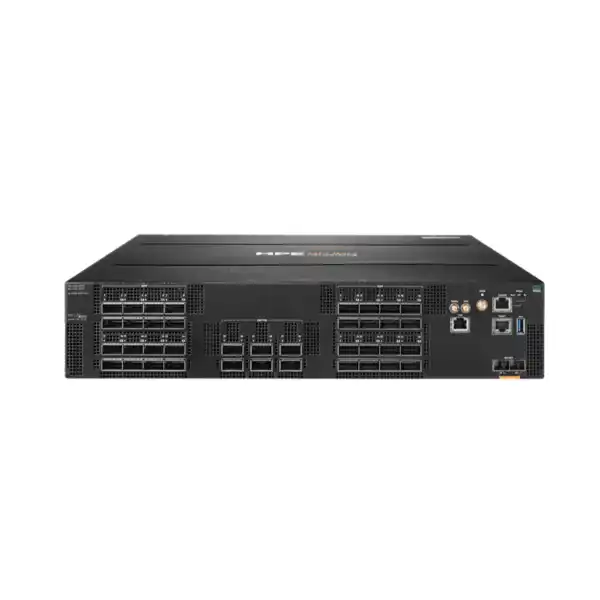
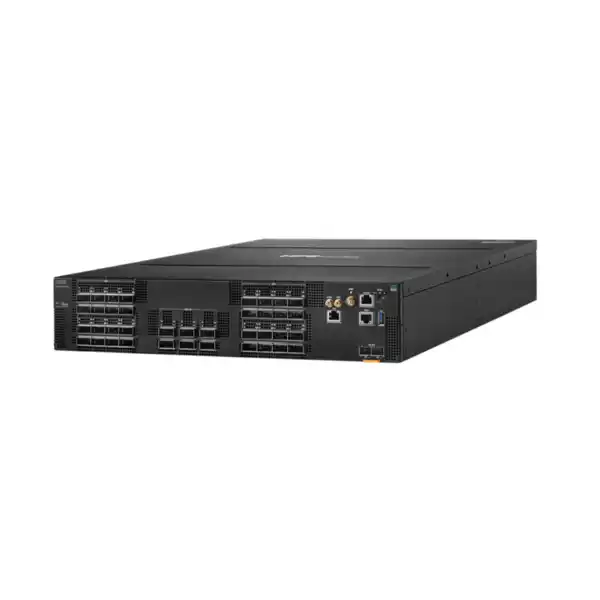
For buyers moving from 10/25/40/100GbE architectures toward dense 100GbE server or fabric links and 400GbE uplinks, the CX 10040 provides a substantial bandwidth step. HPE specifies 8 Tbps of bidirectional switching capacity and a high-density interface arrangement with 32 QSFP28 100GbE ports and six QSFP-DD 400GbE ports. HPE also identifies two 10GbE SFP+ interfaces in the platform connectivity description. Breakout support broadens the usable speed mix, but the exact breakout mode, optics, DAC/AOC choice, and port mapping should be validated against the intended AOS-CX release and the transceiver support matrix before procurement.
A strong fit when…
- The fabric requires many 100GbE connections and multiple 400GbE uplinks in a compact rack footprint.
- East-west application traffic is high enough that centralized security service insertion creates cost, latency, or scaling concerns.
- The network team wants AOS-CX operational tooling, APIs, telemetry, and data-center fabric capabilities in the same platform.
- Storage networking requires features such as lossless Ethernet mechanisms, RoCE, iSCSI, or NVMe-oF design consideration.
- The environment is planning high-bandwidth AI, cloud, virtualization, bare-metal, container, or service-provider infrastructure.
- The design needs a clear path to distribute segmentation and stateful service enforcement closer to workloads.
HPE Aruba Networking CX 10040 technical overview
The CX 10040 is designed around high-speed data-center connectivity rather than access-layer copper switching. Its value is therefore best evaluated by looking at fabric bandwidth, port media, DPU service capacity, rack and thermal requirements, resilience, and software dependencies as a connected system. HPE states that switching and routing operate at wire speed within the high-speed distributed architecture and lists 1.6 Tbps of stateful services performance through four AMD Pensando DPUs. HPE also describes a 4.8 Tbps encryption engine for MACsec capability that can be flexibly assigned to ports. These figures are important for architectural comparison, but they should not be interpreted as a guarantee that every security function, encryption mode, packet profile, or software feature will deliver the same practical throughput under every configuration. Final design should be based on the intended services, packet sizes, software version, policy scale, and traffic direction.
| Specification area | CX 10040 information | Buyer relevance |
|---|---|---|
| Switching capacity | 8 Tbps bidirectional | Suitable for high-bandwidth leaf/spine roles; oversubscription still depends on topology and active port speeds. |
| 100GbE ports | 32 × QSFP28 100GbE | Useful for dense server, storage, leaf, or spine connectivity where 100G is the operating baseline. |
| 400GbE ports | 6 × QSFP-DD 400GbE | Supports high-capacity fabric uplinks and breakout strategies; media selection is a separate design decision. |
| Stateful services | 1.6 Tbps through four AMD Pensando DPUs | Relevant when distributing segmentation, firewalling, telemetry, and related services within the fabric. |
| Packet buffer | 82 MB | Traffic patterns, congestion behavior, storage design, and lossless configuration remain important beyond the raw buffer figure. |
| System storage / memory | 128 GB M.2 SSD, 16 MB SPI flash, 2 × 32 GB SODIMM | Supports the platform control and service architecture; not a substitute for checking feature scale limits. |
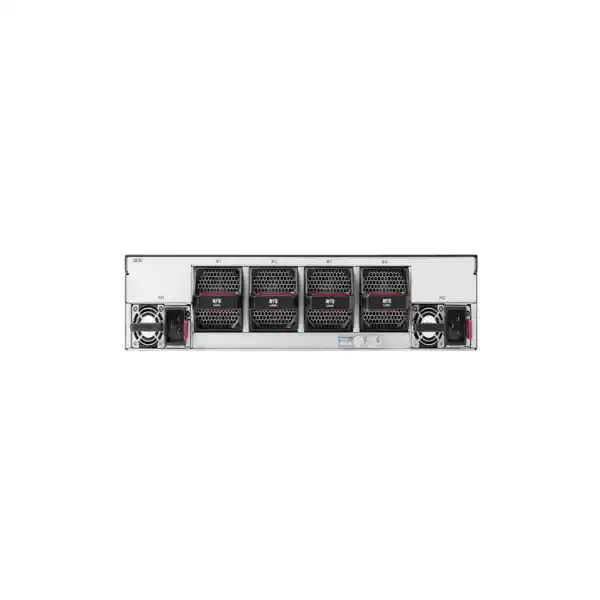
| Fans / PSUs | Up to four dual-rotor hot-swappable fans and two hot-swappable power supplies | Airflow direction and correct power redundancy must match the rack and facility design. |
| Full configuration weight | Approximately 23 kg | Rack load, handling, rail/mounting choice, and installation access should be planned before site delivery. |
Port design: the number on the front panel is only the starting point
A high-speed switch purchase can fail commercially even when the switch itself is technically correct, because the usable solution depends on the transceivers and cabling attached to every important port. The CX 10040’s 32 QSFP28 100G and six QSFP-DD 400G interfaces can support different speed strategies, including breakout scenarios, but the correct design depends on what each endpoint actually accepts. A 400G fabric link might use optical modules for longer reach, DAC for short in-rack links, or AOC where a lighter cable and longer reach than passive copper are required. A 100G port may terminate to a server NIC, storage system, another switch, or a breakout assembly feeding lower-speed endpoints. Those are different bills of materials.
For a Dubai quotation, FourTeck normally needs the target speed, media type, approximate cable length, connector type at both ends, and whether the link is switch-to-switch, switch-to-server, or switch-to-storage. Existing optics should not be assumed compatible just because the form factor matches. HPE supports an Unsupported Transceiver Mode that can allow non-listed transceivers or cables to be enabled, including high-speed media, but HPE explicitly states that the transceiver or cable itself is not covered by HPE warranty or support when used this way. For production fabrics, especially those supporting critical workloads, using validated media reduces troubleshooting ambiguity and support risk.
The CX 10040 also makes sense as part of a speed migration rather than an all-at-once replacement. A buyer may retain selected 25G, 40G, 50G, 100G, or other supported interfaces through appropriate breakout and media choices while moving core fabric paths to 400G. The important requirement is to engineer the port map before ordering. Breakout consumption can change the apparent number of independent logical links, and not every physical port arrangement should be assumed to support every desired breakout combination. A port-by-port worksheet is therefore more reliable than ordering optics from a generic count.
Distributed services and security architecture
Stateful segmentation
The embedded DPU architecture can apply stateful services within the switching fabric, helping organizations segment application tiers and workload groups without depending solely on an external appliance hairpin for every east-west flow. This can be particularly relevant to virtualized, bare-metal, and containerized environments where traffic patterns are dynamic.
Flow visibility
Deep flow and session-level telemetry can improve visibility into workload communication. The practical value is not merely more data; it is the ability to identify which systems communicate, validate segmentation assumptions, investigate anomalies, and build policy from observed application behavior.
Service distribution
Distributed enforcement can reduce the need to concentrate all service traffic through a small number of centralized points. This does not automatically eliminate dedicated firewalls or security platforms. Perimeter inspection, internet security, specialized threat prevention, compliance architecture, and north-south policy may still require separate controls.
MACsec capability
HPE describes a 4.8 Tbps encryption engine for MACsec that can be allocated to ports. Buyers considering link encryption should confirm supported port combinations, software release requirements, peer compatibility, key-management design, and the operational impact of enabling encryption on intended links.
Licensing is a design input, not an afterthought
The base switch includes AOS-CX switching functionality, but HPE separates advanced cloud management and distributed service capabilities into licensing and feature-pack choices. HPE documentation states that an HPE Aruba Networking Central Advanced license extends foundational Central capabilities with distributed accelerated stateful firewall functions, telemetry services, and related infrastructure. HPE also describes a CX Premium Feature Pack tier for additional functions such as IPSec VPN encryption, NAT, and other services, with some functionality subject to software availability.
This means two companies can buy the same CX 10040 hardware and end up with materially different operational capabilities. One may use the platform primarily as a high-performance L2/L3 leaf switch managed through conventional AOS-CX workflows, while another may depend on Central, Fabric Composer, distributed policy, logging, automation, or premium service functions. The correct quotation should therefore state the expected management platform, feature pack, subscription term, support level, and whether the buyer already owns relevant entitlements. Procurement teams should also distinguish perpetual native AOS-CX functions from subscription-dependent cloud or advanced service capabilities so renewal planning is visible from day one.
Data-center fabric and storage considerations
The CX 10040 is suited to high-bandwidth leaf-spine designs, but the switch model alone does not determine whether a fabric is properly sized. A resilient two-spine or multi-spine topology, for example, must be assessed by uplink count, required east-west bandwidth, failure-domain behavior, expected oversubscription, and the number of leaf switches that will connect over time. If six 400G interfaces are allocated to fabric uplinks, that represents a different capacity plan from a design that uses some of those interfaces for breakout connections or specialized storage paths. Growth should be included in the initial port map so expansion does not immediately force a topology redesign.
HPE lists support for Data Center Bridging features such as Priority Flow Control and Enhanced Transmission Service, as well as storage solution support including iSCSI, RoCE and NVMe over Fabrics. These capabilities make the platform relevant for converged Ethernet environments, but lossless networking is configuration-sensitive. PFC should not be enabled indiscriminately. Queue allocation, traffic classes, ECN behavior, buffer pools, NIC settings, server operating systems, storage vendor recommendations, and congestion management all affect results. For RoCE-based AI or storage traffic, the end-to-end design is more important than a checkbox showing that the switch supports a protocol.
Jumbo frames are supported with a maximum frame size around 9K bytes according to HPE documentation. Again, the whole path must agree. A switch configured for jumbo frames does not help if a server NIC, hypervisor virtual switch, storage interface, firewall path, or intermediate switch is using a smaller MTU. Migration plans should include an MTU validation test rather than assuming existing settings are consistent.
Leaf / Top-of-Rack
A natural role when servers or storage arrays need dense 100G attachment and the rack design can use 400G uplinks. Check server NIC speeds, cable reach, port breakout requirements, and whether redundant dual-homed host connectivity is required.
Spine / Fabric
The 400G interface density can be valuable in a higher-capacity fabric tier. Calculate total leaf uplink demand, ECMP path count, routing scale, resilience, and expansion headroom rather than treating total switching capacity as the only sizing metric.
AI & accelerated infrastructure
High-speed Ethernet, lossless features, telemetry, and PTP hardware support can make the platform relevant to precision-driven and AI infrastructure. Validate GPU/NIC vendor guidance, RoCE tuning, timing requirements, software support, and cabling topology for the actual cluster.
Physical deployment: airflow, rack space and power need early confirmation
HPE offers CX 10040 bundles in both front-to-back and back-to-front airflow orientations. This is not a cosmetic choice. The fan direction and power-supply airflow must align with the data-center hot-aisle/cold-aisle arrangement and with neighboring equipment. Selecting the wrong airflow direction can undermine thermal management even when the room cooling system itself is adequate. The two main non-TAA bundle identifiers commonly associated with the CX 10040 are S4R54A for front-to-back airflow and S4R55A for back-to-front airflow; TAA bundle variants also exist. The exact regional part number and availability should be confirmed at quotation time.
The installation documentation describes a chassis approximately 442.5 mm wide, 609.6 mm deep and 88.4 mm high, with a full configuration weight of about 23 kg. In practical terms, the buyer should reserve a 2U rack position with appropriate depth, rear clearance, cable-management space, and safe handling access. HPE documentation indicates that a 2-post rack mount kit is included with the switch, while an optional 4-post rack mount kit is ordered separately. A four-post installation may be preferable in many data-center racks because of the device weight and depth, but the chosen method must follow HPE installation guidance and the rack manufacturer’s loading rules.
Power also deserves careful review. HPE lists the CX 10040 for 100-127 VAC or 200-240 VAC operation, with an important restriction: low-line 100-127 VAC operation is limited in redundancy behavior, while 200-240 VAC supports full redundant and non-redundant operation. HPE estimates typical consumption around 1200 W for the CX 10040. Actual power and heat load will vary with modules, traffic, features, optics, and configuration, so facility planning should include PSU rating, available circuits, PDU sockets, feed redundancy, and cooling capacity. In a production Dubai data center, dual power feeds should be mapped explicitly to separate PDUs or appropriate redundant sources if the resilience target requires it.
AOS-CX operations, automation and management
AOS-CX is one of the reasons organizations may shortlist the CX 10040 alongside more traditional data-center switching platforms. HPE describes AOS-CX as a database-driven operating system with built-in telemetry and a time-series database that supports historical troubleshooting and analytics. Operational interfaces include CLI, REST API and SNMP, while HPE Aruba Networking Fabric Composer provides fabric orchestration and visualization for supported designs. HPE Switch Multi-Edit can also be part of the operational toolset.
For a greenfield data-center project, Fabric Composer can be especially relevant when the team wants guided deployment of leaf-spine designs and integrated workflows rather than configuring every switch independently. HPE documentation describes support for standards-based VXLAN EVPN and traditional VSX-oriented deployments within Fabric Composer workflows, together with ecosystem integrations. The value of these tools depends on the organization’s intended operating model. A team that already uses infrastructure-as-code may prioritize REST APIs, configuration automation and telemetry exports; another may prefer GUI-driven orchestration and centralized policy. The purchase should reflect the chosen model rather than assuming every available management layer is required.
High availability at the hardware level includes field-replaceable, hot-swappable fan and power components. At the network level, resilience comes from topology, routing, link aggregation, multi-chassis design choices, redundant peer devices, diverse paths, and tested failure behavior. Buying two switches does not automatically create resilience unless server attachment, uplinks, control-plane design, and power feeds eliminate the intended single points of failure. FourTeck can help turn an availability objective into a practical topology and BOM instead of treating redundancy as a hardware quantity only.
When the CX 10040 may be more switch than you need
A balanced shortlist should also identify cases where another platform deserves comparison. If the data center mainly needs 1/10/25GbE server access with only a small number of 100G uplinks, a lower-density or lower-bandwidth CX platform may provide a more economical fit. The original CX 10000 family, for example, targets a different interface mix and a lower switching-capacity tier. If the requirement is a very large 400G spine with little need for integrated distributed stateful services, another high-capacity switching family may deserve comparison based on port density, routing scale, buffering, power, and cost.
The CX 10040 is also not a direct substitute for every firewall role. Its integrated DPU services are valuable for distributed enforcement, segmentation and east-west controls, but organizations may still require dedicated next-generation firewalls for internet edge security, advanced threat services, remote access, WAN termination, or controls tied to a specific security vendor architecture. A good design uses each platform where it is strongest rather than forcing one device category to cover every security function.
Finally, buyers should avoid assuming that every roadmap capability is available in the software release they intend to deploy. HPE documentation notes that certain features can be hardware-capable with software support arriving in future releases. Software version, feature maturity, interoperability requirements, and support policy should therefore be checked against the planned deployment date. This is particularly important for timing-sensitive infrastructure projects where a feature mentioned in product literature is a mandatory acceptance criterion.
Common buyer questions
Does the CX 10040 include 400G ports?
Yes. HPE specifies six QSFP-DD 400GbE interfaces alongside 32 QSFP28 100GbE interfaces. The usable media and breakout arrangement must still be selected separately for the actual topology.
Is it intended only for leaf switching?
No. HPE positions the architecture for access, leaf/top-of-rack, end-of-row and potentially aggregation use, while the 100G/400G interface mix can also support fabric roles. Suitability depends on scale and topology.
Can it replace a dedicated firewall?
Not automatically. Its DPU-based stateful services are powerful for distributed segmentation and east-west controls, but perimeter, advanced threat, remote-access and vendor-specific security requirements may still need dedicated security platforms.
Do I need licenses beyond the switch?
Possibly. Native AOS-CX features are included, while advanced Central and distributed service capabilities can require additional licenses or feature packs. The required entitlement should be tied to the intended feature set and term.
What is the biggest procurement risk?
Ordering only the chassis. A production deployment usually also depends on the correct airflow bundle, optics, breakout cables, rack mounting, power feeds, software entitlements, support, and potentially professional installation or migration work.
Is it suitable for RoCE or NVMe-oF?
HPE lists RoCE and NVMe-oF support together with data-center bridging features. End-to-end lossless design, NIC configuration, queueing, ECN/PFC settings, storage guidance and validation remain essential.
Decision recap
Choose the CX 10040 when dense 100G/400G fabric connectivity and distributed services align with the workload architecture.
8 Tbps is substantial, but the real design still depends on active port speeds, oversubscription, breakout strategy and future growth.
Separate native AOS-CX capabilities from Central, advanced distributed services and premium feature-pack requirements.
Validate optics, DAC/AOC, server NICs, storage systems, peer switches, breakout modes, MTU and software versions.
Confirm airflow direction, 2U rack space, mounting method, approximately 23 kg device weight, power circuits and thermal capacity.
Redundant hardware is only one layer; topology, dual-homing, diverse uplinks, routing, power sources and failure testing complete the design.
What FourTeck needs for an accurate CX 10040 quotation
Providing the following information makes the quotation more precise and reduces the chance of missing optics, licensing, or installation items:
Plan the HPE Aruba Networking CX 10040 around your actual fabric
Share your target port speeds, topology, airflow, rack and power details, security-service requirements and software preferences. FourTeck can help turn those inputs into a practical CX 10040 bill of materials for Dubai and UAE deployment, including the switch bundle, optics, cabling, licensing, support and implementation scope.

Reviews
There are no reviews yet.