
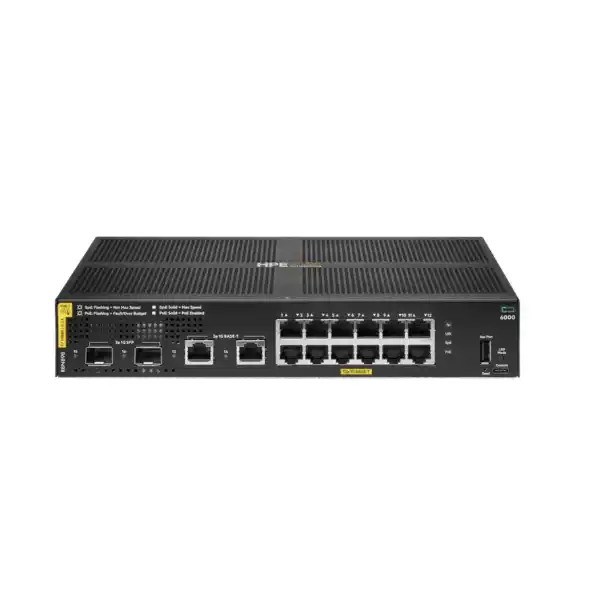
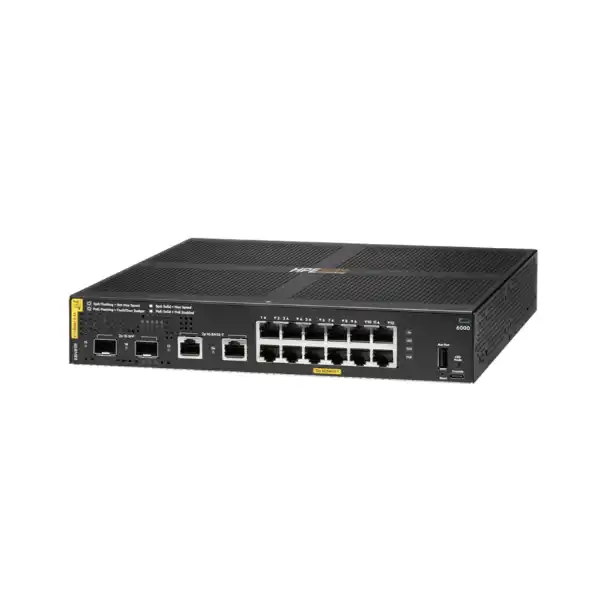
HPE Aruba Networking CX 6000 12-Port PoE Switch
A compact HPE Aruba Networking CX access switch for businesses that need managed Gigabit connectivity, quiet operation and up to 139 W of PoE/PoE+ power for edge devices without moving to a larger 24-port platform.
Direct Answer: What This CX 6000 Model Is For
The HPE Aruba Networking CX 6000 12-port PoE model is an entry-level, fully managed Layer 2 access switch for small enterprise and branch networks that need Gigabit Ethernet and PoE for connected edge devices. It is particularly relevant where a full 24-port switch would be unnecessary, yet centralized management, VLANs, access control, QoS and predictable business networking are still required. Its key sizing limit is the combination of twelve powered access ports and a 139 W shared PoE budget. Buyers should confirm endpoint count, per-device power demand and uplink requirements before ordering. FourTeck can help validate the exact regional part number, PoE budget, SFP requirements, management approach and configuration scope for a UAE deployment.
Where the 12-Port CX 6000 Fits
This model sits in the HPE Aruba Networking CX 6000 family as a compact PoE access option. HPE positions the series for branch offices, midsize businesses and small enterprises that require reliable wired access using the same AOS-CX operating approach found across the broader CX switching portfolio. The 12-port version is useful when the deployment needs more capability than a basic unmanaged switch but does not justify the port density, rack space or PoE capacity of larger models.
Typical endpoints can include wireless access points, IP phones, surveillance cameras, printers, point-of-sale equipment and other Ethernet or IoT devices. The practical question is not simply whether twelve ports are enough; the total PoE draw must also remain within the switch’s 139 W Class 4 budget, while uplink design must account for the available 1G interfaces.
Verified Technical Specifications
| Manufacturer | HPE Aruba Networking |
| Product family | CX 6000 Switch Series |
| Current HPE product number | R8N89B; regional or revision-specific ordering details should be confirmed before purchase |
| Access ports | 12 × 10/100/1000BASE-T Class 4 PoE ports |
| Additional network interfaces | 2 × 1G SFP ports and 2 × 1GbE ports |
| PoE standards | IEEE 802.3af and IEEE 802.3at |
| PoE budget | 139 W Class 4 PoE/PoE+ |
| Switching capacity | 32 Gbps |
| Throughput | 23.8 Mpps |
| 1 GbE latency | 2.3 μs |
| Processor | Dual-core Arm Cortex-A9 at 1016 MHz |
| Memory / flash | 4 GB DDR3 / 16 GB eMMC |
| Management | HPE Aruba Networking Central, Web GUI, CLI and HPE Aruba Networking Switch Multi-Edit Software |
| Console / host ports | 1 × USB-C console and 1 × USB Type-A host port |
| Input voltage | 100–127 VAC / 200–240 VAC |
| Maximum power consumption | 19.7 W without PoE; 165 W with PoE |
| Dimensions | 4.39 cm (H) × 25.4 cm (W) × 25.5 cm (D) |
| Configuration weight | 2.17 kg |
| Cooling | Fanless |
| Operating temperature | 0°C to 40°C up to 1.5 km altitude, with altitude derating above that level |
| Warranty guidance | HPE states limited lifetime warranty; current terms and regional coverage should be confirmed for the quoted unit |
Capabilities That Matter in a Small Access Network
PoE for Edge Devices
The twelve copper access ports support IEEE 802.3af and 802.3at Class 4 PoE. This allows compatible phones, cameras, access points and other devices to receive power and data over the Ethernet connection. The 139 W budget is shared, so endpoint power draw should be calculated rather than assuming every port can operate at its individual maximum simultaneously.
Managed Layer 2 Access
The CX 6000 platform provides managed Layer 2 functions together with static routing, access control lists, QoS, traffic prioritization, sFlow and IPv6 support. These controls are useful where a business needs segmentation, traffic policy and operational visibility rather than simple plug-and-play connectivity.
Flexible Administration
Administrators can work with the local Web GUI or industry-standard CLI, while HPE Aruba Networking Central and Switch Multi-Edit provide options for broader operational management. The right approach depends on the number of sites, existing Aruba infrastructure and whether centralized cloud-based management is part of the project.
Quiet Compact Deployment
Fanless operation is useful in offices, meeting areas, reception spaces and other locations where equipment noise matters. Its smaller footprint can also suit distributed branches or edge cabinets, provided the installation still meets power, ventilation, cabling and environmental requirements.
Product-Fit Matrix
| Requirement | Suitable When | Confirm Before Ordering |
|---|---|---|
| Port density | Up to twelve primary copper access connections meet the site requirement | Allow for growth, printers, phones, APs, cameras and spare ports |
| PoE power | The planned powered-device total remains inside the 139 W shared budget | Per-device wattage and any future AP/camera additions |
| Uplink design | 1G uplinks are appropriate for the branch or access-layer traffic profile | Fiber type, SFP choice, distance and upstream switch compatibility |
| Management | Local AOS-CX management or an Aruba Central-based design fits operations | Central entitlement, tenant design and firmware policy when cloud management is required |
| Physical placement | A compact fanless switch is preferred in a quiet or space-conscious location | Power source, enclosure, ventilation, temperature and cable routing |
When This Model May Fit
- Small branches with fewer than twelve primary wired edge devices.
- Offices that need PoE for phones, cameras or wireless access points.
- Deployments where fanless operation is desirable.
- Sites standardized on AOS-CX management and configuration practices.
- Access networks where 1G uplinks match expected traffic demand.
When Another Option Should Be Evaluated
- More than twelve access ports are required now or in the near term.
- The planned PoE load can exceed 139 W.
- Higher-speed uplinks are a design requirement.
- The site needs greater expansion capacity or a different redundancy model.
- A smaller 8-port switch can meet the requirement more efficiently.
Licensing and HPE Aruba Networking Central
Core switch software: HPE states that the CX 6000 series does not require a separate switch software license or subscription for standard switch ownership and local operation. That is useful for buyers who want a fully managed access switch without making basic switching functionality dependent on a recurring switch-software subscription.
Centralized management: HPE Aruba Networking Central is supported for CX 6000 management, but Central is a separate management service with its own entitlement and subscription considerations. If Central is part of the intended design, confirm the current subscription level, tenant requirements, device assignment and support term in the quotation.
Compatibility and Integration Checks
The physical switch can be straightforward to deploy, but accurate integration depends on the rest of the network. Before finalizing a bill of materials, verify the upstream switch or firewall interfaces, VLAN design, IP addressing, authentication method, required SFP transceivers, endpoint PoE classes and any monitoring or management integration.
- Fiber type and SFP reach
- Upstream 1GbE interface availability
- VLAN and trunk requirements
- PoE power per endpoint
- 802.1X or MAC-authentication policy
- DHCP and IP addressing design
- Existing Aruba Central environment
- Firmware and change-control requirements
Where It Fits in the CX 6000 Family
The 12-port 139 W model is a middle ground between the compact 8-port PoE option and larger 24-port or 48-port CX 6000 switches. It is therefore useful for sites where the device count is modest but the PoE requirement is meaningful.
| Option | Typical Reason to Consider | Key Decision |
|---|---|---|
| CX 6000 8-port Class 4 PoE, 67 W | Very small edge site with lower port and PoE demand | Will eight access ports and 67 W remain sufficient? |
| CX 6000 12-port Class 4 PoE, 139 W | Compact branch needing more powered endpoints without moving to 24 ports | Will twelve ports and a 139 W shared budget cover present and planned devices? |
| CX 6000 24-port Class 4 PoE, 370 W | Higher endpoint count or significantly larger PoE requirement | Is extra port density and PoE headroom worth the larger platform? |
Deployment and Installation Considerations
For a new branch deployment, start with an endpoint schedule rather than the switch alone. List every powered device, its expected wattage, the VLAN or security role it needs, and whether the connection must traverse copper or fiber upstream. This quickly determines whether the 12-port model has enough access capacity and PoE headroom.
The switch’s fanless design can simplify placement in quieter office areas, but electrical supply, ambient temperature, ventilation, enclosure design and cable management still matter. Where configuration is included in the project, the scope should identify VLANs, trunks, management IP addressing, authentication, spanning-tree policy, QoS, monitoring, backups and handover requirements.
Buyer Questions Before Ordering
Is 139 W enough for my devices?
Add the expected maximum PoE draw of every powered endpoint, then retain headroom for device replacement or growth. If the total approaches or exceeds 139 W, evaluate a higher-PoE model.
Do I need SFP modules?
Only when the selected uplink design uses the SFP interfaces. The transceiver type must match fiber medium, distance, wavelength and the upstream device.
Is Aruba Central mandatory?
No for core local switch operation. The switch can be administered through local interfaces; Central is an optional centralized management path that should be scoped separately.
Which product number should I quote?
HPE’s current exact-model data sheet lists R8N89B. Because ordering codes can change by revision, program or region, confirm the code on the final UAE quotation.
Procurement Checklist for a UAE Quote
- Required switch quantity
- Exact 12-port PoE configuration
- Current HPE regional product number
- Number of powered endpoints
- Maximum PoE wattage per endpoint
- Fiber or copper uplink design
- SFP type and required distance
- Local or Central management
- VLAN and authentication requirements
- Installation and configuration scope
- Rack, shelf or enclosure conditions
- Power and UPS availability
- Delivery destination in the UAE
- Support and warranty expectations
- Planned future port growth
How FourTeck Can Help
FourTeck can help turn a switch request into a complete requirement by reviewing endpoint count, PoE demand, uplink media, SFP needs, management approach and configuration scope. For projects involving multiple network components, the review can also identify dependencies between the access switch, firewall, wireless infrastructure, VLAN design and site cabling.
Useful next steps include reviewing FourTeck network and security products, discussing installation and configuration services, or contacting FourTeck for model and BOM guidance. Company and project information is also available through FourTeck UAE.
UAE Availability
Contact FourTeck to confirm current UAE availability for the HPE Aruba Networking CX 6000 12-port PoE configuration. Availability can depend on the exact product number, quantity, vendor lead time and required accessories. Delivery coordination, SFP selection, installation and configuration scope can be included in the quotation when required.
Frequently Asked Questions
Confirm the Right CX 6000 Configuration
Share the number of connected devices, required PoE wattage, uplink type, management preference and installation location. FourTeck can use those details to confirm the model, accessories and configuration scope for your UAE requirement.

Reviews
There are no reviews yet.