
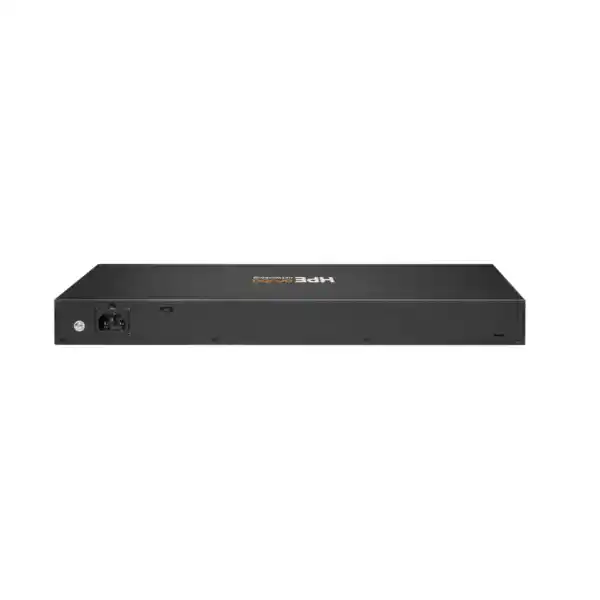
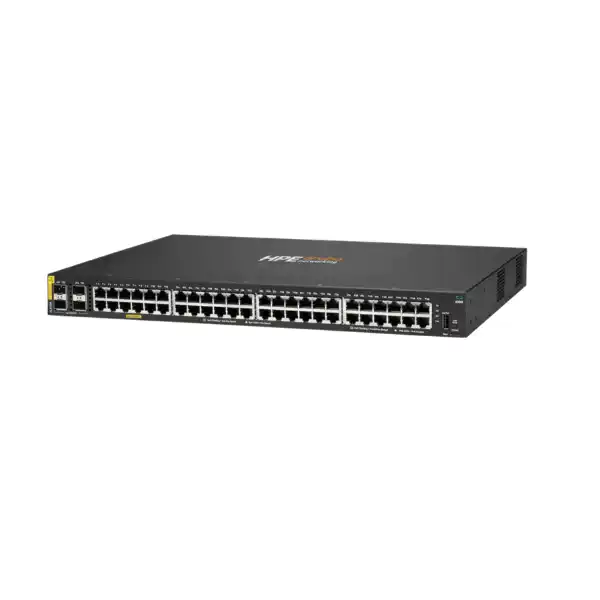
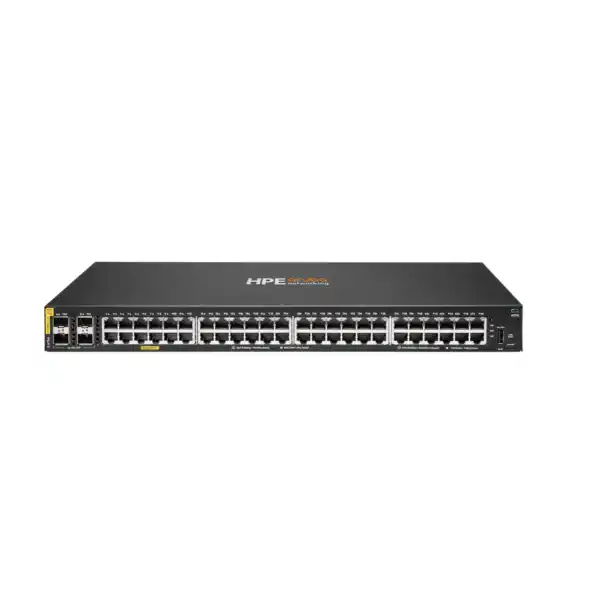
HPE Aruba Networking CX 6100 Series | Model JL675A
HPE Aruba Networking CX 6100 48G Class4 PoE 4SFP+ 370W Switch
The JL675A is a fixed 1U managed access switch built for organizations that need forty-eight Gigabit Ethernet edge ports, Class 4 Power over Ethernet and four integrated 1/10GbE SFP+ uplinks in a practical branch or small-enterprise design. It runs the HPE Aruba Networking CX Operating System and combines local administration options with optional centralized management, allowing buyers to choose a management model that matches the size and operating practices of the network.
Direct Answer: What Is the JL675A and Who Is It For?
The HPE Aruba Networking CX 6100 48G Class4 PoE 4SFP+ 370W Switch, part number JL675A, is a fully managed access-layer switch for connecting user devices, IP phones, wireless access points, cameras and other Ethernet endpoints. It is mainly suited to branch offices, SMB networks and enterprise edge locations that require 48 Gigabit copper ports, shared Class 4 PoE power and up to 10GbE fiber or DAC uplinks. The most important point to confirm before ordering is whether the 370W PoE budget, port count and uplink design match the real endpoint load. FourTeck can help determine the correct model, PoE budget, transceivers, rack and power requirements, management method, configuration scope and support options for a UAE deployment.
What the HPE Aruba CX 6100 JL675A Does in an Access Network
The JL675A sits at the network access layer, where end-user devices and operational endpoints connect to the wired infrastructure. Its forty-eight 10/100/1000BASE-T ports provide the density normally expected in a full-width office or branch wiring closet, while the built-in SFP+ uplinks give the design four dedicated interfaces that can operate with supported 1GbE or 10GbE transceivers. This layout is useful when a business needs a clear separation between copper edge connectivity and higher-speed connections toward another switch, an aggregation layer, a router, a firewall or another part of the campus network.
The model is more than a basic unmanaged port expander. It uses HPE Aruba Networking CX Operating System, commonly referred to as AOS-CX, and supports enterprise access functions such as VLANs, access control lists, quality of service, static routing, IPv4 and IPv6 operation, link aggregation, spanning-tree technologies, traffic monitoring and authentication controls. The practical value is that network teams can segment users and devices, prioritize time-sensitive traffic, control who or what is permitted to connect, and integrate the switch into standard operational processes rather than treating it as an isolated appliance.
Power over Ethernet is central to this particular SKU. The 48 copper access interfaces are Class 4 PoE capable and the switch provides a total PoE budget of up to 370W. This means the access cabling can carry data and electrical power to compatible endpoints such as IP telephones, security cameras and wireless access points without a separate local power adapter at every device. The important design distinction is that 370W is the total shared power budget, not a promise that all 48 ports can simultaneously deliver the maximum 30W associated with IEEE 802.3at Class 4. A project should therefore calculate the expected power demand of all planned endpoints and reserve sensible headroom for additions or replacement devices.
For businesses in Dubai and across the UAE, the JL675A can be considered when the network needs a conventional Gigabit access edge with PoE, 10GbE uplink capability and managed operational controls, without moving immediately to a higher-end campus access platform. It is particularly relevant where the device count is significant but the design does not require multi-gigabit copper access, very high PoE budgets, modular power supplies or the broader feature set of a higher switch family. Those boundaries matter, because choosing the right access switch is a capacity and architecture decision rather than simply a question of buying the model with the largest number of ports.
Who Should Consider the 48-Port 370W PoE Configuration?
The JL675A is a strong candidate for organizations that have a fairly dense group of Gigabit Ethernet endpoints in a single wiring area and need to power a meaningful number of those devices through the network cable. Examples include offices with a mixture of desktops and IP phones, retail or hospitality locations using IP endpoints and wireless access points, education facilities with access points and cameras, and branch sites where local switching must support multiple business functions without requiring a large modular chassis.
A 48-port model can also reduce the number of separate access switches required in a cabinet when the endpoint count is already above the practical range of a 24-port unit. Fewer physical switches can simplify rack planning and uplink consumption, but port utilization should still be estimated carefully. A site with only a small number of active outlets may be better served by the 24-port CX 6100 model, while a location expecting significant growth may prefer to preserve spare capacity rather than operating close to the full forty-eight-port limit from day one.
The 370W PoE variant is especially appropriate when the connected powered devices have moderate aggregate power demand. It can support a large number of low-power endpoints or a smaller number of higher-power Class 4 devices, depending on actual consumption and configuration. Buyers should create a simple endpoint schedule listing each device type, quantity and maximum expected power requirement. That schedule is more reliable than assuming every PoE port will use the same amount of power.
Organizations should evaluate another model when they expect the aggregate PoE requirement to exceed the 370W budget, need substantial future PoE headroom, require access speeds above 1GbE on copper, need different redundancy characteristics, or need a more advanced campus feature set. HPE also lists a CX 6100 48-port Class 4 PoE model with a 740W budget, part number R9Y04A. Comparing that model with JL675A is sensible when power, rather than port density, is the limiting factor.
Verified JL675A Technical Specifications
| Specification | HPE Aruba Networking CX 6100 JL675A |
|---|---|
| Product type | Fully managed fixed access switch |
| Part number | JL675A |
| Copper access ports | 48 × 10/100/1000BASE-T Class 4 PoE ports |
| Uplink ports | 4 × 1/10GbE SFP/SFP+ ports |
| PoE standards | IEEE 802.3af and IEEE 802.3at |
| PoE budget | Up to 370W Class 4 PoE power |
| Console / host | 1 × USB-C console port; 1 × USB Type-A host port |
| Power supply and fans | Fixed power supply and fixed fans |
| Switching capacity | 176 Gbps |
| Forwarding throughput | 98.6 Mpps |
| Packet buffer | 12.38 MB |
| Memory / flash | 4 GB DDR3 / 16 GB eMMC |
| CPU | Dual-core Arm Cortex-A9 at 1.016 GHz |
| MAC table | 8,192 entries |
| Switched virtual interfaces | 16 dual-stack SVIs |
| Form factor | 1U fixed switch |
| Dimensions | 4.39 × 44.2 × 30.48 cm (H × W × D) |
| Weight | Approximately 5.02 kg |
| AC input | 100–127 VAC / 200–240 VAC, 50/60 Hz |
| Power consumption at 230 VAC | Idle 30.6W; max without PoE 45W; max with PoE 480W |
| Operating temperature | 0°C to 45°C, with altitude derating above 1.5 km as specified by HPE |
| Mounting | EIA-standard 19-inch rack or equipment cabinet; rack-mounting kit included; horizontal surface mounting supported |
Specifications are based on current HPE Aruba Networking documentation for JL675A. Software feature availability can depend on the installed AOS-CX release, management platform and configuration. Confirm current regional ordering options before purchase.
PoE Planning: Why the 370W Budget Matters More Than the Port Count
The most consequential sizing question for JL675A is normally the PoE budget. Forty-eight PoE-capable ports give a great deal of physical connection flexibility, but the switch has a shared power pool of up to 370W. A buyer should therefore separate two questions: how many Ethernet ports are required, and how much electrical power must those ports deliver. Those figures are related, but they are not interchangeable.
IEEE 802.3at Class 4 can support powered devices that require substantially more power than basic 802.3af endpoints. A deployment might contain access points, cameras and telephones with very different maximum draws. If every planned endpoint is treated as though it consumes the maximum possible amount, the design may be overly conservative. If only typical draw is considered, the design may be under-sized when devices enter a higher-power state. A practical bill of materials should record the vendor-rated maximum PoE requirement for each endpoint, then compare the combined demand with the switch budget and any desired engineering reserve.
The JL675A supports PoE allocation methods using device usage or class information, with LLDP and LLDP-MED support. In operational terms, this helps the switch and endpoints exchange information relevant to power assignment and device behavior. The feature is useful, but it does not eliminate the need for pre-purchase sizing. If the calculated load is near 370W before growth is considered, the 740W CX 6100 48-port PoE model should be evaluated rather than assuming the 370W unit will remain comfortable under future changes.
The power calculation should also consider what the access layer is expected to become over the next few years. A branch that currently has twenty IP phones and six modest wireless access points may fit easily, but a later camera rollout or higher-power AP refresh could materially change the budget. Conversely, an office with many non-PoE desktop ports and a smaller set of powered endpoints may make excellent use of the forty-eight-port density without needing a higher-power switch.
FourTeck can review an endpoint list as part of switch selection. Useful inputs include device model, quantity, PoE standard, maximum wattage, expected future additions and whether any critical endpoints need power priority. This creates a more defensible recommendation than selecting a PoE model from port count alone and reduces the chance of a later upgrade caused by an underestimated power requirement.
48 Gigabit Access Ports
The 10/100/1000BASE-T interfaces suit conventional office and branch endpoints that use standard copper Ethernet. They are a good match where 1GbE remains the required edge speed. If endpoints require 2.5GbE, 5GbE or faster copper access, a different switch family should be considered.
Four 1/10GbE SFP+ Uplinks
Dedicated SFP+ uplinks allow the access switch to connect toward aggregation, another switch or supported network equipment without consuming a copper user port. The optical or DAC choice must be matched to speed, media, distance and the device at the far end.
AOS-CX Management
The switch can be managed through a Web GUI or command-line interface and supports programmatic REST APIs. HPE Aruba Networking Central and Switch Multi-Edit add centralized operational options but should be treated as separate management decisions with their own licensing requirements.
Uplink Design, Optics and Bandwidth Considerations
The four integrated 1/10GbE SFP+ interfaces are an important reason to consider the JL675A for a modern access layer. They provide a path for higher-speed connectivity from the switch to the upstream network and can be used with supported SFP or SFP+ transceivers according to the target speed and media. HPE lists 1G SX, 1G LX, 1G copper, 10G SR, 10G LR and other transceiver options for the CX 6100 family, as well as supported SFP+ direct-attach cables. The final optic must be selected for the exact cabling plant, distance and opposite interface.
A buyer should not assume that a 10GbE uplink automatically removes every potential bottleneck. Forty-eight edge ports can create substantially more aggregate offered traffic than one uplink can carry. Whether that matters depends on the application mix, traffic patterns and oversubscription target. Ordinary office endpoints rarely transmit at line rate simultaneously, while backup windows, imaging operations, large file transfers, CCTV traffic or local server access can create very different load profiles. The design should therefore consider peak traffic behavior rather than only nominal port speeds.
Link aggregation can be used where the wider topology and configuration support it. The CX 6100 family supports IEEE 802.3ad Link Aggregation Control Protocol, with up to eight LAGs and up to eight links per LAG documented by HPE. In a real deployment, the number of uplinks assigned to aggregation must be balanced against the four physical SFP+ interfaces available on this exact model. Redundancy, uplink bandwidth and any VSF use may compete for those ports, so the intended architecture should be agreed before optics are ordered.
Fiber selection is another procurement detail that can create avoidable delays. Short-reach multimode fiber, longer-reach single-mode fiber and DAC connections solve different physical problems. A quotation request is more accurate when it states the existing cable type, estimated link length, required speed and upstream device model. FourTeck can use these details to help identify appropriate supported optics or cables rather than adding generic transceivers that may not match the installation.
Performance and Platform Capacity
HPE specifies 176 Gbps switching capacity and 98.6 million packets per second forwarding capacity for JL675A. Those figures reflect the hardware capability of the platform and support its role as a non-blocking fixed access switch. They are useful for comparing models, but application experience also depends on uplink design, packet sizes, traffic patterns, congestion, QoS policy and the capacity of the rest of the network.
The switch includes 4 GB of DDR3 memory, 16 GB eMMC storage and a 12.38 MB packet buffer. The MAC address table supports 8,192 entries. HPE also specifies sixteen dual-stack switched virtual interfaces, 1,024 IPv4 ARP host entries, 512 IPv6 neighbor-discovery entries, and 512 IPv4 and 512 IPv6 unicast routes for this model. These limits reinforce the intended position of the CX 6100 as an access platform rather than a substitute for a large distribution or core routing system.
That distinction is important during design. The JL675A supports useful Layer 3 functions, including static IPv4 and IPv6 routing and small-network routing capabilities documented for the family, but it should still be selected primarily around its access-layer role. An organization planning extensive dynamic routing, large route tables, advanced segmentation architecture or high-density multi-gigabit access should compare higher platforms rather than choosing the CX 6100 solely because it provides some routing functions.
For most branch and SMB deployments, the value of these specifications is predictability. The switch can aggregate many normal user and IoT connections, prioritize important applications, and forward traffic at access-layer scale. Network teams should size the complete path from the endpoint through the uplinks and upstream devices, because no single switch specification describes end-to-end application performance.
Management Choices: Local Administration, Central and Automation
The JL675A uses HPE Aruba Networking CX Operating System, a database-driven platform based on a modular Linux architecture. For administrators, one practical benefit is consistency with other switches in the CX portfolio. The switch exposes configuration and state information through familiar management methods and a REST API, making it suitable for organizations that want either conventional hands-on administration or a more automated operating model.
Local management can be performed through the switch Web GUI and industry-standard style command-line interface. This is important for smaller networks that do not need a separate centralized management service simply to make the switch operational. HPE states that switch software is embedded and does not require a subscription merely to enable the product. That does not mean every optional management service is free: HPE Aruba Networking Central uses subscription licensing, and HPE Aruba Networking Switch Multi-Edit Software is separately licensed.
HPE Aruba Networking Central can provide unified operations across wired, wireless and other network domains, with capabilities such as onboarding, configuration, monitoring, troubleshooting and reporting. This can be attractive for organizations managing multiple branches or a larger Aruba estate because operational information is brought into a central platform. Before procurement, confirm whether Central is already in use, whether the switch must be added to an existing subscription, which license tier and term are appropriate, and whether cloud-based or on-premises Central aligns with company policy.
Switch Multi-Edit is a different tool aimed at orchestrating and validating configuration changes across multiple CX switches. HPE documentation states that a separate software license is required. Its relevance depends on operational scale. A site with one or two switches may not need it, while a network team that manages standardized switch configurations across many devices may value centralized editing, validation and audit capabilities.
The CX 6100 also supports zero-touch provisioning and REST APIs. These are useful where a repeatable deployment workflow is more important than manual device-by-device configuration. They do not remove the need for a validated configuration template, IP addressing plan, VLAN design, authentication policy and change-control process. Automation accelerates a good design, but it can also propagate a poor configuration quickly if those inputs are not reviewed.
Access Security and Segmentation Capabilities
An access switch operates where users and devices first enter the wired network, so security functions at this layer are operationally important. HPE documents an integrated trusted platform module for the CX 6100 family to support platform integrity during the boot process. The switch also provides access control lists for IPv4 and IPv6 traffic, allowing policy to permit or deny traffic based on relevant Layer 2 or Layer 3 information. ACL design should follow the actual network segmentation plan rather than being added after the switch is installed.
For identity and device access, the platform supports IEEE 802.1X authentication with RADIUS, MAC-based authentication and web authentication methods. HPE also documents concurrent authentication schemes per switch port, making the platform useful in environments where a single physical access port may need to accommodate different endpoint behaviors. This can support a more controlled edge than simply placing every connected device into a fixed VLAN.
Management access can be integrated with RADIUS or TACACS+ and protected through encrypted management methods such as SSH, secure browser access and SNMPv3. The switch also provides features such as port security, MAC address lockout, DHCP snooping protection, dynamic ARP protection, root guard and BPDU protection. These controls address different attack or misconfiguration scenarios; they should be enabled deliberately according to the network policy, because a security feature applied without understanding legitimate traffic can also interrupt business operations.
Colorless ports and local user roles can reduce the need to bind a physical port permanently to a single role. Instead, policy can be associated with the authenticated user or device under the supported configuration. This is particularly useful in offices where desks, phones or devices move and the operations team wants the network behavior to follow identity rather than a manually maintained port map.
Security design still depends on external systems and procedures. For example, 802.1X typically requires an appropriate RADIUS or network access control service, certificate or credential planning, endpoint supplicant configuration and a fallback method for devices that cannot perform full authentication. FourTeck can help define the switching configuration scope, but the complete access-control design should account for the existing identity, DHCP, DNS, firewall and endpoint environment.
Traffic Prioritization, Voice and Multicast Considerations
The CX 6100 supports quality-of-service functions that can prioritize traffic at the access layer. HPE documents strict-priority queuing, IEEE 802.1p traffic prioritization, class-of-service controls and rate limiting. These features are useful when the same access switch carries interactive voice, business applications, endpoint traffic and possibly video. The design goal is not to make every packet high priority, but to create a clear classification and queue strategy that protects delay-sensitive services when congestion occurs.
LLDP-MED is particularly relevant for voice deployments because it can exchange information used by endpoints such as IP phones, including network policy information. HPE also documents automatic voice VLAN configuration using RADIUS attributes and LLDP-MED as well as support for legacy phone scenarios through CDPv2. The exact voice design should be matched to the handset platform, call-control architecture and authentication model already in use.
For environments carrying multicast, the platform supports IGMP and MLD capabilities, including snooping. This can help constrain multicast traffic to interfaces where it is required rather than flooding it unnecessarily throughout a Layer 2 domain. CCTV, IPTV, collaboration and certain discovery-heavy systems can benefit from a deliberate multicast design. Buyers should confirm application behavior before assuming a generic switch configuration will produce the desired result.
Resiliency, Link Aggregation and VSF Stacking
The JL675A supports common Layer 2 resiliency mechanisms including spanning-tree variants, link aggregation and Unidirectional Link Detection. These mechanisms help prevent loops, detect certain link failures and create redundant network paths when designed correctly. They are not substitutes for a complete availability plan: the switch itself has a fixed power supply and fixed fans, so organizations that require component-level hardware redundancy inside each access switch should evaluate a platform designed for that requirement.
HPE Aruba Networking Virtual Switching Framework, or VSF, can combine compatible CX 6100 switches into a stack that is managed as a single logical chassis. Current HPE documentation describes support for up to six members in chain or ring topology and allows mixing 24-port and 48-port CX 6100 models; the 12-port models stack only with other 12-port units. For a stack composed entirely of 48-port switches, six members can provide up to 288 downlink ports.
VSF uses front-plane network interfaces, so stacking should be considered during uplink and transceiver planning rather than after every SFP+ port has already been assigned. The design should decide how many interfaces are needed for stacking, how many remain for upstream connectivity, what physical topology is required and what happens if a member or link fails. When multiple cabinets or longer distances are involved, supported fiber transceivers can extend the physical reach, but the final topology must match HPE support rules and the installed software release.
A stack can simplify operations by presenting multiple switches as one managed system, but it also creates configuration and change dependencies across the members. Organizations should document member roles, stack links, uplink paths, software versions and recovery procedures. FourTeck can include stack design and configuration requirements in the quotation scope when the project calls for more than a standalone switch.
Installation, Rack, Power and Environmental Planning
JL675A is a 1U switch intended for standard 19-inch rack or equipment-cabinet installation, and HPE documents a rack-mounting kit as included. The chassis is approximately 4.39 cm high, 44.2 cm wide and 30.48 cm deep, with a configuration weight around 5.02 kg. These dimensions are modest, but an installation check should still confirm rack depth, front and rear clearance, cable bend radius, patch-panel placement and access for maintenance.
The switch uses fixed fans with side-to-side airflow. Cabinet design should therefore avoid blocking the side vents and should maintain an appropriate thermal path through the rack or enclosure. HPE specifies an operating temperature range of 0°C to 45°C with altitude-related derating above 1.5 km. In Dubai and other hot-climate locations, the room or cabinet cooling design is particularly important because the published switch temperature range assumes the device is installed in a controlled environment rather than exposed directly to outdoor ambient conditions.
Electrical planning should use the switch input and full-load characteristics rather than only the 370W PoE figure. HPE specifies 100–127 VAC or 200–240 VAC at 50/60 Hz, with maximum power consumption at 230 VAC of 480W when PoE is fully loaded. The final rack power design should consider the switch, other network equipment, UPS loading, power distribution, growth and any local electrical requirements. A PoE switch can materially increase cabinet power and heat compared with a non-PoE access switch.
The localized power cord supplied with an order can vary by ordering configuration and region, so the exact power-cord requirement should be confirmed rather than assumed from a global product listing. The same principle applies to optics and console cables. A useful deployment bill of materials includes the switch, selected transceivers or DACs, patching, rack accessories if needed, appropriate power connectivity, licenses for optional management services and any implementation support.
Before installation, the technical team should also prepare the logical configuration: management IP addressing, VLAN IDs, trunk/access port definitions, spanning-tree policy, uplink aggregation if used, PoE priorities, authentication behavior, NTP, syslog, SNMP or telemetry choices, administrator authentication and configuration backup procedures. Physical installation without this information simply moves the project to the next unresolved stage.
Product-Fit Matrix for JL675A
| Requirement | JL675A May Fit When | Confirm Before Ordering |
|---|---|---|
| Access density | Up to 48 standard Gigabit copper access ports are appropriate. | Current active ports, growth and spare-port policy. |
| PoE load | The combined powered-device demand fits within 370W with sensible headroom. | Maximum wattage of every AP, phone, camera and IoT endpoint. |
| Uplinks | Four 1/10GbE SFP+ interfaces are sufficient for the topology. | Fiber type, distance, optic compatibility, redundancy and stacking use. |
| Management | Local GUI/CLI or optional Aruba Central meets operational requirements. | Central licensing, administration model and existing toolset. |
| Availability design | A fixed-power-supply access switch is acceptable. | Whether redundant field-replaceable power is mandatory. |
| Access speed | 1GbE copper access matches endpoint requirements. | Whether Wi-Fi APs or specialist devices need multigigabit copper. |
Where JL675A Fits in the CX 6100 Family
The CX 6100 family provides several fixed access-switch choices, and the JL675A occupies a specific middle position: it combines the full 48-port copper density with PoE, but uses a 370W power budget rather than the higher 740W budget available on R9Y04A. That makes it useful when the organization wants many physical access ports yet does not expect enough high-power endpoints to justify the larger PoE allocation.
The JL676A is the 48-port non-PoE option in the family and is relevant when most connected devices have their own power supply or when PoE is intentionally delivered elsewhere. The JL677A provides 24 Gigabit PoE ports with a 370W budget, which can be a better fit for a smaller access area that still needs substantial PoE per available port. JL678A is the 24-port non-PoE model. JL679A is a compact 12-port PoE model with a 139W budget and a different uplink arrangement, intended for smaller spaces.
The higher-power R9Y04A 48-port model deserves particular attention when cameras, wireless APs or other Class 4 devices make the power budget tight. Moving from 370W to 740W does not change the fundamental need to size endpoint power, but it materially changes the amount of PoE headroom available. A site that would regularly operate JL675A near its maximum power allocation may gain more resilience for additions by selecting the 740W option at the start.
Port density is not the only reason to compare families. If the design requires multi-gigabit access ports, higher availability hardware, advanced routing scale, different stacking architecture or features not available on CX 6100, a higher HPE Aruba Networking CX family may be more appropriate. FourTeck can compare the actual requirement with adjacent models rather than treating the supplied product name as an automatic recommendation.
Licensing and Subscription: What Is Included and What Is Optional?
The JL675A does not require a separate subscription simply to enable its embedded switch software. This makes local deployment through AOS-CX, Web GUI and CLI different from a cloud-managed product that cannot operate without an active service entitlement. Buyers should nevertheless separate the base switch software from optional operational platforms.
HPE Aruba Networking Central is an optional centralized management platform and is licensed separately. If Central is required, confirm the correct switch subscription class, term, deployment model and existing tenant or account structure before the purchase order is issued. Licensing catalogs can change over time, so a current quote should use the presently applicable Central SKU rather than relying on an older saved bill of materials.
HPE Aruba Networking Switch Multi-Edit Software is also separately licensed. It may be useful for teams that need multi-switch configuration editing, validation and deployment workflows. It should not be added automatically to every JL675A quote. The right approach is to decide how the organization wants to operate the switch, then include only the management subscriptions or software licenses necessary for that operating model.
Support services are another separate commercial decision. HPE documents a limited lifetime warranty for the CX 6100 family and lists optional support service offerings. The exact warranty entitlement, support response level, duration and regional applicability should be confirmed against the current HPE terms for the purchased unit rather than inferred from a generic product description.
Compatibility and Integration Checks Before Purchase
Compatibility should be treated as a short design exercise rather than a checkbox. At the physical layer, confirm that the four SFP+ uplinks will connect to the expected upstream ports at the required speed and distance. The transceiver on each side of a fiber link must match media type, wavelength and reach. For DAC connections, verify the supported cable and the interfaces at both ends. HPE provides an Unsupported Transceiver Mode for certain scenarios, but HPE also states that unsupported transceivers or cables do not receive warranty or support coverage as supported optics; production designs should therefore prefer supported components where supportability matters.
At the access layer, confirm endpoint speed and PoE requirements. The copper interfaces are Gigabit Ethernet, so devices that depend on 2.5GbE or 5GbE for their intended performance need another switch platform. PoE endpoints must fall within the supported standards and the aggregate 370W budget. If the existing environment includes older pre-standard PoE devices, HPE documents support for detecting and powering pre-standard PoE equipment, but the exact device should still be validated if it is operationally important.
At the logical layer, check VLAN requirements, routing boundaries, authentication services, voice VLAN behavior, multicast applications and management integrations. The CX 6100 supports standard enterprise functions, but a switch cannot compensate for an undefined network architecture. The configuration should identify which VLANs are carried on each uplink, where default gateways live, how endpoints obtain DHCP, how administrators authenticate, how logs are collected and how configurations are backed up.
If the switch will join an existing CX 6100 VSF stack, confirm the member compatibility, software version, stack topology and available interfaces. HPE allows 24-port and 48-port models to be mixed in a CX 6100 stack, while 12-port models stack only with other 12-port models. Existing configurations and software versions should be reviewed before adding a member to a production stack.
Management integration also deserves attention. An organization already using HPE Aruba Networking Central may want the new switch enrolled into the same management framework. A business using SNMP monitoring can use SNMP capabilities on the switch, while API-driven teams may use REST interfaces. The selection process should identify which of these integrations is actually required so the installation and licensing scope are clear.
Practical Deployment Scenarios
Branch Office with Phones, PCs and Wireless Access Points
A branch with forty or more wired outlets may need a single high-density access switch. Some ports can connect desktop devices while others power IP phones and APs. JL675A is attractive when the combined powered-device load is comfortably inside 370W and the upstream network can be reached through one or more 10GbE SFP+ links. VLAN and QoS policies can separate voice, user and infrastructure traffic while preserving a manageable access design.
Camera and IoT Aggregation
Security cameras and IoT devices are common PoE workloads, but their power and bandwidth patterns vary widely. A camera deployment should calculate wattage for every model, identify peak video traffic, and confirm whether uplink capacity is sufficient for the recorder or surveillance network. If a large share of the forty-eight ports will carry higher-power cameras, the 740W CX 6100 variant may be a better choice even when the port requirement is unchanged.
Education or Training Facility
Classrooms and training spaces can combine staff devices, access points, IP phones, AV endpoints and general network outlets. The 48-port density can simplify wiring-closet consolidation, while VLANs and access controls allow different device types to be separated logically. Growth and scheduled technology refreshes should be considered because newer access points may have different power or speed requirements from the devices being replaced.
Retail, Hospitality or Distributed Business Site
Distributed sites often value a predictable operating model and the ability to monitor switches centrally. JL675A can serve local Gigabit endpoints while HPE Aruba Networking Central, when properly licensed, can provide centralized operational visibility. The decision should include WAN dependencies, out-of-band recovery expectations, configuration standards and who will be responsible for remote troubleshooting.
When Another Switch Should Be Evaluated
Choose a higher-power alternative when the primary limitation is PoE. If the endpoint schedule approaches or exceeds 370W, the CX 6100 48G Class4 PoE 4SFP+ 740W model R9Y04A should be compared. Selecting a larger PoE budget can be preferable to managing a permanently constrained power allocation, especially where more access points, cameras or high-power devices are expected later.
Choose a smaller CX 6100 model when forty-eight access ports would leave substantial unused capacity with no credible growth requirement. A 24-port switch can reduce physical and commercial overhead for smaller wiring areas, and the 24-port PoE model JL677A still provides a 370W PoE budget. This can give more available power per populated port in a compact deployment.
Choose a non-PoE model when powered endpoints are not part of the design. JL676A provides 48 Gigabit access ports and four 1/10GbE SFP+ uplinks without the PoE function, avoiding the cost and power characteristics of a feature that may not be used. A mixed estate can also combine PoE and non-PoE models according to the device population in each cabinet.
Choose a higher switch family when the required access technology exceeds the CX 6100 design envelope. Examples include multi-gigabit copper for newer wireless APs, higher hardware resiliency expectations, more advanced Layer 3 scale, different uplink capacity or enterprise features not supported by CX 6100. The correct comparison depends on the actual requirement, not simply on the next model number.
Buyer Questions to Resolve Before Ordering
Is 370W enough for the planned PoE devices?
Add the maximum expected power demand of all powered endpoints and include growth headroom. If the result is near the switch limit, evaluate the 740W model rather than assuming average consumption will remain low.
Are four SFP+ uplinks sufficient for the topology?
Confirm how many ports are needed for upstream links, redundant paths, link aggregation and VSF stacking. The same physical uplink inventory cannot be allocated twice, so a topology sketch is useful before optics are purchased.
Do endpoints require faster-than-Gigabit copper?
JL675A provides 1GbE access ports. If new APs, workstations or specialist devices require 2.5GbE, 5GbE or higher copper speed, choose a switch family designed for those rates.
Will the switch be locally managed or centrally managed?
Local GUI and CLI are available without a Central subscription. HPE Aruba Networking Central is optional and separately licensed. Decide the operating model early so the quotation includes the correct subscriptions and implementation tasks.
Is stacking required now or later?
CX 6100 supports VSF stacking, but stack links consume front-plane interfaces and require compatible topology and software planning. Reserving ports and optics at the design stage is easier than rebuilding the uplink plan later.
What support level is required?
The current HPE datasheet states a limited lifetime warranty and lists optional support services. Organizations with specific replacement or response objectives should include the appropriate support entitlement rather than relying on warranty alone.
Procurement Checklist for a Complete JL675A Requirement
- Confirm exact model JL675A and required quantity.
- Record the number of active and spare copper access ports.
- List every powered endpoint and maximum PoE requirement.
- Confirm whether 370W provides adequate growth headroom.
- Define 1GbE or 10GbE uplink speed for each SFP+ interface.
- Specify fiber type, distance and compatible transceivers or DACs.
- State whether VSF stacking is required.
- Confirm rack space, airflow and cabinet depth.
- Confirm local power, UPS capacity and power-cord requirement.
- Choose local management or HPE Aruba Networking Central.
- Include required Central or Multi-Edit licenses where applicable.
- Define VLAN, QoS, authentication and management configuration scope.
- Confirm support entitlement and project handover requirements.
- Confirm current UAE availability and delivery coordination.
FourTeck Assistance for Selection, Quotation and Deployment
FourTeck can help turn a product request into a complete access-switch requirement. For JL675A, the most useful starting information is the number and type of connected devices, the expected PoE load, the existing uplink media, the upstream switch or firewall interfaces, rack and power conditions, management preference and whether configuration or installation support is required. With those inputs, the quotation can address the actual project rather than only the switch chassis.
For model selection, FourTeck can compare the 370W unit with the higher-power 48-port version, 24-port alternatives and other switching platforms when requirements fall outside the CX 6100 envelope. For bill-of-material guidance, the scope can include supported optics, DACs, relevant accessories, optional Central subscriptions and support services. Compatibility should be confirmed for the intended interfaces and software environment before ordering.
For deployment, assistance can cover agreed tasks such as base configuration, VLAN setup, uplink configuration, PoE policy, management integration, authentication settings, firmware review, VSF planning, testing and handover documentation. The exact service scope should be defined in the quotation because existing network conditions, change windows, remote access, cabling readiness and third-party systems can affect the implementation effort.
You can also review related business network products, discuss network installation and configuration services, or contact FourTeck for product sizing before finalizing the bill of materials.
UAE Availability and Quotation Guidance
Contact FourTeck to confirm current UAE availability for the HPE Aruba Networking CX 6100 JL675A. Availability can depend on exact SKU, quantity, localized power-cord option, vendor lead time and any licenses, optics or support services required with the order. Delivery and project coordination can be discussed after the technical requirement is confirmed. No stock level or delivery date should be assumed until it is validated for the requested quantity. If installation or configuration is needed in Dubai or another UAE location, include that scope in the quotation request so hardware, accessories and engineering work can be planned together.
Detailed Buyer Guidance for Common Design Decisions
Selecting Spare Port Capacity
A forty-eight-port switch does not need to be filled on day one to be a sensible purchase. Spare ports can make future moves and additions easier, but the right reserve depends on how quickly the site changes. A stable branch with twenty active ports and no planned expansion may be better served by a smaller switch, while an office moving toward forty active outlets could justify a 48-port model even if several interfaces remain unused initially. Spare port planning should be done separately from PoE planning because an unused physical port adds no PoE load, while a newly installed powered endpoint can consume both a port and part of the 370W budget.
Defining the Uplink Oversubscription Target
Access networks are normally oversubscribed because not every endpoint generates full-rate traffic at the same moment. The acceptable ratio varies by workload. Office productivity traffic may be comfortable with substantial oversubscription, while backup, media, storage or camera workloads can require more upstream capacity. The four SFP+ interfaces provide flexibility to build multiple uplinks or aggregated connections, but the upstream switch must have matching ports and compatible configuration. Measuring existing traffic can be more useful than assuming a universal ratio.
Planning for Network Management
The choice between standalone administration and centralized management affects ongoing operations more than initial installation. A single-site business may be comfortable with Web GUI and CLI management plus configuration backups and external monitoring. A multi-site organization may prefer Central to standardize onboarding, visibility and troubleshooting. The switch supports both approaches, so the buyer can align the toolset with the operations team rather than replacing hardware simply to change management style. Subscription cost, term and operational ownership should be included in the decision.
Using Static Routing Without Turning the Access Layer into a Core
Static IPv4 and IPv6 routing can be useful when a small branch needs straightforward inter-subnet paths or a simple routed handoff. It should not encourage an architecture where a modest access switch is expected to perform every distribution and core function. Route scale, redundancy, policy, dynamic routing needs and future topology should determine where Layer 3 boundaries belong. If those requirements are significant, compare a higher switch family or dedicated routing layer.
Building an Authentication Rollout
802.1X and related authentication features are most successful when introduced through a staged plan. Start by identifying endpoint categories, the RADIUS or NAC platform, certificate or credential methods, guest or remediation behavior, and exceptions for devices that cannot authenticate normally. Then test policies on a limited group of ports before broader enforcement. The switch can provide the access controls, but the business outcome depends on the complete identity and endpoint workflow.
Operational Considerations After Installation
A switch purchase should include a plan for day-two operations. Configuration backups, firmware management, logging, monitoring and change control are simple practices that make future troubleshooting easier. HPE provides dual software images and support for multiple configuration files, allowing administrators to maintain safer upgrade and rollback procedures. The organization should define who owns firmware review and how new AOS-CX releases are tested before being deployed to production switches.
Monitoring can use technologies such as SNMP and sFlow, depending on the existing toolset. sFlow is useful for traffic visibility and capacity planning because it provides sampled traffic information without relying on manual port-by-port observation. SNMP can expose operational metrics and events to a network monitoring system. These tools are valuable only when alerts have owners and thresholds are meaningful; collecting telemetry without an operational response process creates data rather than resilience.
PoE utilization should also be monitored. If a site gradually adds powered devices, the power budget can become constrained before the physical port count is exhausted. Periodic review helps identify whether the switch is nearing its planned reserve and whether a future device refresh could change the power profile. This is particularly relevant when replacing older APs or cameras with newer models whose maximum draw differs.
Documentation should capture the installed switch serial number, rack position, management address, software release, uplink destinations, optic types, VLAN assignments, stack membership if applicable, support entitlement and configuration backup location. This information is inexpensive to maintain and significantly improves troubleshooting, warranty handling and future upgrade planning.
Frequently Asked Questions
What is the exact part number for the 48G 370W PoE model?
The HPE Aruba Networking CX 6100 48G Class4 PoE 4SFP+ 370W Switch uses part number JL675A. This should be stated explicitly on the quotation and purchase order because the CX 6100 family also contains a 48-port non-PoE model and a separate 48-port PoE model with a 740W budget.
Can all 48 ports provide PoE?
The forty-eight 10/100/1000BASE-T access interfaces on JL675A are Class 4 PoE capable. However, the switch has a total PoE budget of up to 370W, so the aggregate power demand of all connected endpoints must remain within that budget. The correct design is based on device power requirements, not simply the number of PoE-capable ports.
Does JL675A require a subscription to operate?
No separate subscription is required merely to enable the embedded switch software. Local Web GUI and CLI management are available as part of the switch platform. Optional HPE Aruba Networking Central management and HPE Aruba Networking Switch Multi-Edit Software use separate licensing, so those services should be added only when required.
What uplinks does the switch provide?
JL675A includes four built-in 1/10GbE SFP/SFP+ uplink interfaces. The project must select supported transceivers or direct-attach cables that match the required speed, fiber type, distance and opposite device. Uplink planning should also account for any ports reserved for VSF stacking or link aggregation.
Can the CX 6100 JL675A be stacked?
Yes. HPE documents VSF stacking for the CX 6100 family with up to six members in chain or ring topology. The 24-port and 48-port models can be mixed, while 12-port models stack only with other 12-port units. Stacking uses front-plane interfaces, so the topology and optics should be planned before deployment.
Is this switch suitable for new Wi-Fi access points?
It can power and connect compatible APs whose Ethernet and PoE requirements fit the switch. The access ports are 1GbE, so an AP that depends on 2.5GbE or 5GbE copper for its intended throughput may justify a multi-gigabit switch instead. Check both the AP Ethernet speed and maximum PoE requirement before purchase.
What information is needed for an accurate UAE quotation?
Provide the required quantity, endpoint count, PoE device list and wattage, uplink speed and media, fiber distances, stacking requirement, management preference, optional licenses, support requirement, rack and power details, and whether configuration or installation is part of the project. FourTeck can then confirm current UAE availability and prepare a more complete bill of materials.
What warranty applies to JL675A?
HPE’s current CX 6100 datasheet states a limited lifetime warranty for the series and also lists optional support services. Exact warranty coverage, replacement terms and regional support conditions should be confirmed against the current HPE warranty statement and the specific purchased unit. Organizations with defined response-time requirements should consider an appropriate support service rather than relying on warranty alone.
Confirm the Right CX 6100 Configuration Before You Order
For a reliable quotation, send FourTeck your port count, powered-device list, uplink media and distances, management preference, stacking requirement and required implementation scope. The team can help determine whether JL675A is the right 48-port PoE choice or whether a different CX 6100 model or higher platform better matches the project.

Reviews
There are no reviews yet.