
Enterprise wired access • Class 4 PoE • 10GbE uplinks
HPE Aruba Networking CX 6200F 24G Class-4 PoE 4SFP+ 370W Switch
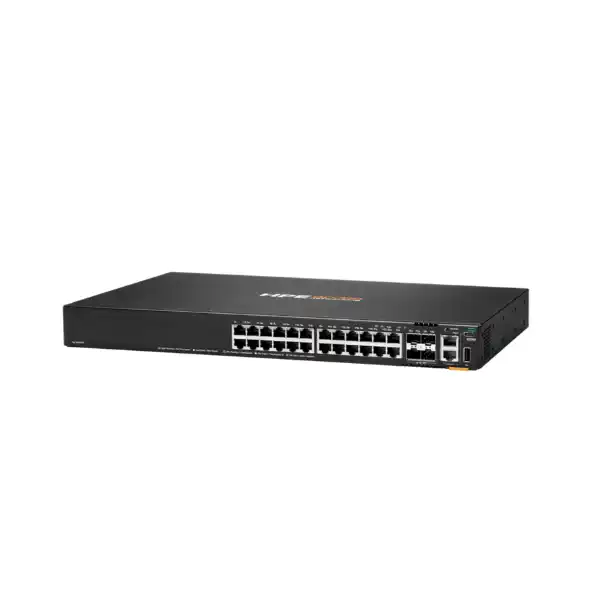
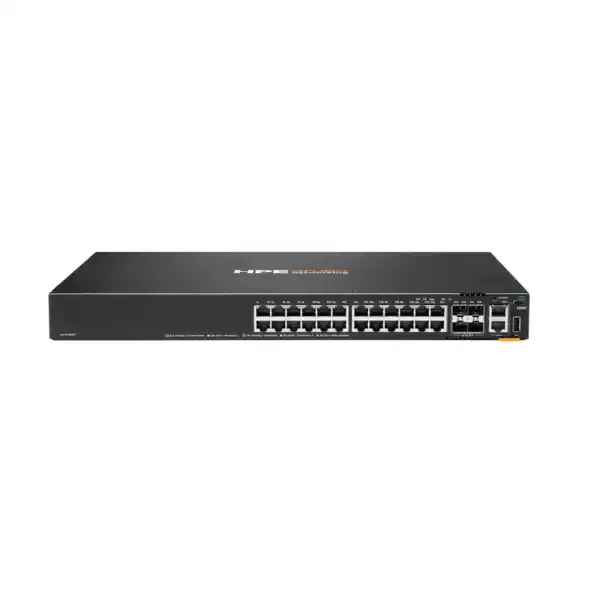
The HPE Aruba Networking CX 6200F 24G Class-4 PoE 4SFP+ 370W Switch, product number JL725B, is a fixed-power access-layer switch for organisations that need twenty-four 1GbE PoE/PoE+ edge connections, four flexible 100M/1G/10G SFP+ uplinks, AOS-CX management and the option to build an eight-member Virtual Switching Framework stack. It is particularly relevant when a branch, office floor, retail site, education environment or distributed campus needs a manageable access switch with a meaningful PoE budget without moving to a higher-port-count chassis.
Direct answer: what is the CX 6200F 24G PoE switch?
The JL725B is a fixed-configuration HPE Aruba Networking CX 6200F access switch with 24 Gigabit Ethernet Class 4 PoE ports, four SFP+ uplink ports and a 370W PoE power budget. It is mainly used to connect and power edge devices while providing managed switching, Layer 3 access features, monitoring and stackable operations through the AOS-CX platform. It suits organisations that need a 24-port PoE access layer rather than a 48-port or higher-power design. The most important item to confirm before purchase is whether the combined endpoint power demand, uplink design and required resiliency fit the fixed-power architecture. FourTeck can help validate the exact JL725B requirement, optics, stacking, PoE allocation, licensing or management needs and deployment scope.
Where the JL725B fits in a business network
The HPE Aruba Networking CX 6200F 24G Class-4 PoE 4SFP+ 370W Switch is positioned as an enterprise access-layer platform. In practical terms, that means it normally sits close to users and connected devices rather than acting as the core of a large data centre network. Its 24 copper access ports can serve office endpoints, voice devices, surveillance cameras, access-control equipment, printers, building systems, wired workstations and supported wireless access points. The four SFP+ ports give the design team higher-speed uplink choices so that the access switch is not limited to 1GbE connectivity back to distribution or aggregation.
For a UAE office or branch deployment, a twenty-four-port switch can be attractive when device density is moderate and the project needs a clean, rack-mounted access layer with enough PoE capacity for a mixed estate. The design is especially useful where a smaller access closet would be overbuilt by a 48-port switch, yet an unmanaged or entry-level switch would not provide the operational controls expected in an enterprise network. A buyer should still account for spare ports, growth, dual-homing plans and the number of powered devices expected during the intended service life.
The product should not be selected simply because the current endpoint count is below twenty-four. A correct decision looks at physical port count, PoE consumption, uplink bandwidth, fault tolerance, management model and expansion. If a site has eighteen endpoints today but is expected to add more cameras, Wi-Fi access points or telephony handsets, a 24-port design may become constrained earlier than expected. Conversely, a branch with ten to fifteen endpoints and modest growth may find the JL725B more proportionate than a 48-port PoE switch. FourTeck can use an endpoint and power schedule to help determine which position is more defensible.
Verified technical specifications for JL725B
| Specification | JL725B detail |
|---|---|
| Manufacturer | HPE Aruba Networking |
| Product family | HPE Aruba Networking CX 6200 Switch Series |
| Product number | JL725B |
| Access ports | 24 × 10/100/1000BASE-T Class 4 PoE ports |
| PoE standards | IEEE 802.3af and IEEE 802.3at |
| Maximum per-port PoE class | Class 4, supporting up to 30W per port, subject to total PoE budget |
| Available PoE power | Up to 370W |
| Uplink ports | 4 × 100M/1G/10G SFP+ |
| Console and management interfaces | USB-C console, RJ-45 console, OOBM and USB Type-A host |
| Switching capacity | 128 Gbps |
| Throughput | Up to 95.2 Mpps |
| Processor | Quad-core ARM Cortex-A72 at 1.8 GHz |
| Memory | 8 GB DDR4 |
| Flash | 16 GB eMMC |
| Packet buffer | 6 MB |
| VSF stack size | Up to 8 members |
| Stacking bandwidth | 40 Gbps |
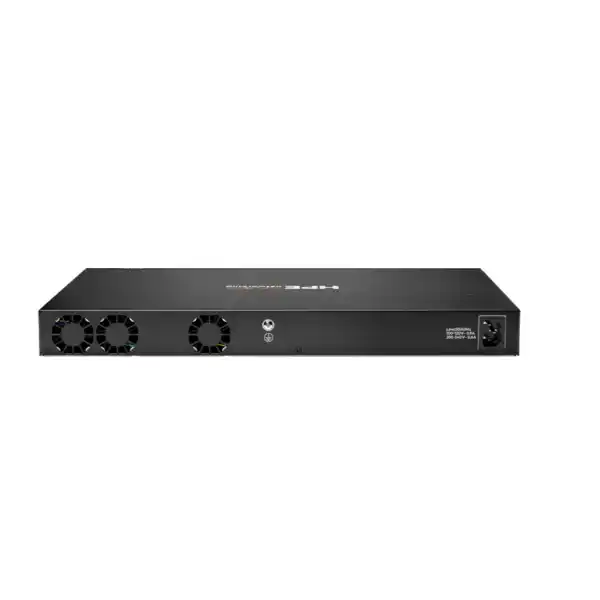
| Power supply | Fixed power supply |
| Fans | Fixed fans |
| Input voltage | 100–120 V / 200–240 V AC, 50/60 Hz |
| Maximum electrical power | 500W according to installation specifications |
| Typical switch power consumption reference | 65W at 230 VAC for switch operation reference; PoE endpoint load is additional within platform limits |
| Dimensions | Approx. 4.37 cm H × 44.25 cm W × 30.43 cm D |
| Configuration weight | Approx. 4.39 kg |
| Operating temperature | 0°C to 45°C up to 5,000 ft, with altitude derating above 5,000 ft |
| Management options | HPE Aruba Networking Central, Web GUI, CLI and HPE Aruba Networking Switch Multi-Edit Software |
| Warranty guidance | HPE lists limited lifetime warranty; exact entitlement and regional terms should be confirmed for the supplied unit |
PoE planning: why the 370W budget matters
The number “24” tells you how many copper access ports are available, but it does not tell you how many high-power devices can be powered simultaneously. The more important design number for a PoE deployment is the switch-wide power budget. JL725B provides up to 370W of Class 4 PoE power, while an individual supported port can deliver up to 30W. A project should therefore calculate the expected draw of every powered endpoint rather than multiply the port count by the maximum per-port figure and assume the switch can supply that total.
For example, a branch may have a mix of desk phones, cameras and wireless access points. Many devices draw less than their maximum negotiated allowance during normal operation, but sizing solely on observed consumption can create risk. Good planning uses the manufacturer power requirement for each endpoint, includes the relevant PoE standard, and retains sensible margin for device start-up, environmental conditions, future replacements and expansion. If most ports will serve equipment near the upper end of Class 4, the 370W budget may become the limiting factor before the physical port count is exhausted.
Buyers should also distinguish PoE from data bandwidth. A powered device may fit comfortably within the wattage budget but still influence uplink design because of the traffic it generates. Multiple high-resolution cameras, busy access points and voice or collaboration endpoints can create very different traffic patterns. The JL725B provides four SFP+ uplinks that can operate at supported speeds up to 10GbE, giving useful design flexibility, but the actual uplink architecture, link aggregation, transceiver choice and distribution switch compatibility must be decided as part of the wider network design.
FourTeck can review a PoE schedule before quotation. Useful inputs include device type, model, quantity, expected maximum draw, cable run, access VLAN, redundancy expectation and future device count. This avoids purchasing a switch that has enough ports but insufficient usable power headroom, or paying for a much larger platform when the 370W design already meets the requirement.
Uplink design and SFP+ selection
JL725B provides four 100M/1G/10G SFP+ ports. This is important because an access switch is rarely useful in isolation; it needs a path toward distribution, core services, firewalls, servers or another part of the LAN. The uplink ports let the design use suitable optical or copper transceiver options subject to platform support. Before ordering optics, the buyer should confirm media type, required distance, fibre type, connector type, remote equipment capability and whether the design needs one uplink, aggregated links or separate paths for resilience.
A 10GbE uplink can be valuable when many access ports are active at the same time or when the switch supports bandwidth-intensive endpoints. However, “10GbE capable” does not mean every uplink should automatically be configured at 10GbE. A small branch may have a 1GbE WAN edge and relatively light LAN traffic, while a campus access layer may justify multiple 10GbE links into distribution. The correct uplink speed is a capacity and topology decision rather than a product-label decision.
Transceiver compatibility deserves particular attention. SFP and SFP+ modules vary by wavelength, reach, fibre type and vendor qualification. A module that physically fits is not necessarily the correct supported choice. The remote side must also support the selected link type and speed. Where structured cabling already exists, FourTeck can help map the existing fibre plant to a suitable uplink plan and identify the model information required before a bill of materials is finalised.
The four uplink positions also provide architectural options. They may be used for switch uplinks, VSF stack links or other supported connectivity depending on design. Because these ports are a finite resource, a stack architecture should be planned before optics are ordered. A design that consumes multiple SFP+ ports for stacking leaves fewer available for other connections. This is one reason an apparently simple 24-port access-switch purchase benefits from a short topology review.
AOS-CX management and operational control
The CX 6200 family uses HPE Aruba Networking’s AOS-CX operating platform, with management options that include HPE Aruba Networking Central, a Web GUI, command-line interface and Switch Multi-Edit. This flexibility matters because different organisations have different operating models. A small IT team may value centralised workflows and visual monitoring, while a network engineering team may rely more heavily on structured CLI processes, APIs and configuration standards. The switch can therefore participate in a broader operational framework rather than functioning as an isolated edge device.
HPE also positions the CX 6200 series around programmable operations, REST APIs, Network Analytics Engine capabilities and telemetry. For a buyer, the practical value is not that the switch has an “automation” label; it is that operational tasks can be standardised and faults can be investigated with better context. Configuration consistency is particularly relevant when several branches use the same access design. A repeatable template can reduce variation between sites and simplify later troubleshooting, provided the organisation has an agreed operating process.
Management platform selection should be decided before deployment, not after the switches are installed. The project should confirm who will own administration, whether cloud or local management is preferred, what monitoring integrations are required, how credentials are controlled, how configuration changes are approved and how software updates are governed. If HPE Aruba Networking Central is part of the intended design, applicable subscription or entitlement requirements should be confirmed for the exact deployment and term. The presence of Central support on the switch should not be interpreted as an assumption that every desired cloud-management function is automatically included without the appropriate commercial entitlement.
For sites with strict operational separation, the out-of-band management interface and console options can also influence deployment planning. The switch includes USB-C and RJ-45 console connectivity, an OOBM interface and USB Type-A host capability. An implementation plan can define whether out-of-band management is actually connected, which management VLAN is used, what access controls protect administrative services and how emergency console access will be handled.
VSF stacking: scale without treating every switch separately
Virtual Switching Framework, or VSF, allows supported CX 6200 switches to operate as a logical stack. JL725B supports an eight-member stack size, and HPE documents front-plane stacking using supported links. In a multi-switch access closet, this can simplify operation because the stack is managed as a unified system rather than as a collection of unrelated standalone switches. It can also support a cleaner growth path when a site needs more access ports over time.
Stacking is not simply a checkbox. The physical topology, stack link allocation, optics or cables, software compatibility and member roles must be considered. HPE documents support for chain or ring topology across the CX 6200 family. A ring can provide a stronger topology than a simple chain because the stack has an alternative path if one stack link fails, but the final design depends on the available ports, cable routes and desired resilience. When switches are in different racks or areas, maximum supported distance and optical design also become relevant.
JL725B has a documented stacking bandwidth of 40 Gbps. Buyers should evaluate whether the stack architecture is appropriate for the traffic model rather than assuming stacking removes all bandwidth constraints. East-west traffic between devices on different members, upstream placement and uplink distribution can influence the result. In many office access scenarios the design is entirely suitable, but a very traffic-intensive or highly resilient environment may justify a different architecture or a higher-tier switching family.
Another planning point is model mixing. HPE documents flexibility across supported 24- and 48-port CX 6200 fixed and modular models in the relevant VSF context, subject to current software and hardware support. This can be useful if one floor requires a 24-port switch and another requires a 48-port model. It should still be verified against the exact part numbers and software release intended for deployment. FourTeck can review the stack composition and identify whether the planned member mix, uplink usage and software baseline need adjustment.
Product-fit matrix
| Requirement | JL725B may be suitable when | Confirm before ordering |
|---|---|---|
| Access port count | Twenty-four 1GbE copper ports provide enough current capacity plus practical growth margin. | Endpoint count, spare-port policy, future expansion and whether a 48-port model would reduce future replacement. |
| PoE requirement | Endpoints use IEEE 802.3af/at and total planned draw fits within the 370W budget. | Maximum device draw, startup behavior, growth and any endpoints needing more than Class 4. |
| Uplink capacity | Up to four SFP+ positions provide the required 1G/10G uplink and stack design. | Optics, link distance, fibre type, remote switch support and uplink redundancy. |
| Management | AOS-CX, Aruba Central support, Web GUI or CLI fit the organisation’s operations model. | Central subscription needs, admin ownership, monitoring and change-control requirements. |
| Stacking | An up-to-eight-member VSF stack provides an appropriate scale and management approach. | Stack topology, software version, port allocation, cable/transceiver plan and resilience target. |
| Resiliency | A fixed power supply and fixed fans are acceptable for the site availability requirement. | Whether the project requires hot-swappable or redundant power/fan architecture available in other models. |
The fixed-power design is an important selection boundary
The “F” in CX 6200F identifies the fixed-configuration part of the CX 6200 family. JL725B has a fixed power supply and fixed fans. This is straightforward for many access-layer installations, but it creates a clear distinction from modular models designed for enhanced component serviceability and power resilience. A buyer should not assume that every CX 6200 model provides the same power-supply architecture simply because the operating system and family name are shared.
Fixed power can be appropriate when the network design already provides resilience at a higher level, when individual access-switch replacement is operationally acceptable, or when the project values a simpler fixed configuration. However, a site that explicitly requires field-replaceable power supplies, power-supply redundancy or hot-swappable fan architecture should compare the CX 6200M family or another HPE Aruba Networking platform that meets those requirements. The right answer depends on the cost of an access-switch outage and how the overall LAN is designed.
Power resilience also extends beyond the switch itself. The rack may require an appropriate UPS, protected electrical circuits and sufficient load headroom for the switch plus its powered endpoints. The 370W PoE budget means the electrical design should consider potential downstream load, not only the switch electronics. For UAE deployments, local rack power, UPS autonomy, environmental cooling and circuit planning are practical implementation items that can be included in the project review.
Layer 2, Layer 3 and access policy considerations
The CX 6200 series is designed as an enterprise-class access platform and supports capabilities such as access control lists, quality of service, static routing and access OSPF according to HPE’s current family documentation. These functions give network architects more control than a basic Layer 2 edge switch. They can be relevant for segmented office networks, branch routing decisions, traffic prioritisation and controlled access between device categories.
Capability does not automatically determine architecture. Some organisations centralise nearly all Layer 3 routing at distribution or firewall layers, using access switches primarily for VLAN presentation, endpoint authentication and local policy enforcement. Others route selected VLANs at the access layer to reduce broadcast domains or align with a distributed campus design. JL725B can participate in either approach within its supported feature set, but the decision should be based on operational standards and failure-domain design rather than on feature availability alone.
Quality of service is particularly relevant when voice, video and business applications share access links. The switch can classify and prioritise traffic as part of a wider QoS policy, but effective QoS requires consistent treatment across the path. Marking traffic on the access switch is not sufficient if upstream devices ignore or rewrite those markings. A deployment plan should define trust boundaries, queue behavior and application requirements, especially where real-time communications coexist with bulk traffic.
Access control lists and policy features also need a clear operational model. The objective is to apply the minimum necessary control while keeping rules maintainable. Complex edge policy that is poorly documented can become difficult to troubleshoot. HPE Aruba Networking’s Dynamic Segmentation strategy is designed to support role-based policy consistency across wired and wireless access in suitable architectures. If the customer intends to use those capabilities, the required surrounding platforms, identity services, licenses and configuration should be validated rather than assumed from the switch model alone.
Network Analytics Engine and troubleshooting value
HPE positions the CX 6200 series with Network Analytics Engine functionality, telemetry and automation hooks. The practical purpose is to improve visibility into operational state and reduce the amount of manual checking required when a network problem appears. Instead of treating the access switch as a simple forwarding box, the platform can expose data and events that help administrators identify changes, anomalies or trends.
For a network manager, this matters during incidents that are difficult to reproduce. Intermittent link errors, utilisation spikes, policy changes or interface-state transitions may happen before an engineer connects to the device. A telemetry-aware platform can preserve more context and support a more structured investigation. It can also help capacity planning by showing longer-term patterns rather than a single snapshot. The value depends on how the monitoring and analytics capabilities are actually configured and integrated into operational workflows.
Automation should also be approached carefully. APIs and programmatic controls can reduce repetitive effort, but they can amplify configuration mistakes if change processes are weak. A sensible deployment defines configuration templates, validation, approval and rollback procedures. FourTeck can assist with the initial configuration scope and with identifying which aspects should be standardised across a fleet, while the customer retains governance over credentials, approvals and ongoing operations.
Who should consider the CX 6200F 24G Class-4 PoE model?
Branch offices: A branch with a few dozen users, IP phones, cameras and wireless access points may need managed PoE access without the footprint of a 48-port switch. JL725B can serve as the branch access layer while providing 10GbE-capable SFP+ uplinks where the upstream network supports them. The branch design should still account for WAN architecture, local services and redundancy.
Campus access closets: A campus floor or building zone that needs around twenty-four copper edge ports can use the switch as part of a standardised CX access design. VSF stacking can simplify scaling where multiple access switches are installed together. The power and port plan should be reviewed per closet because wireless and IoT growth can quickly change both PoE load and port density.
SMB networks requiring enterprise controls: Smaller organisations sometimes need features associated with larger networks: VLAN segmentation, controlled management, structured QoS, central monitoring and predictable configuration. JL725B can be suitable when those operational requirements are present but the organisation does not need a much larger switch.
Retail, hospitality and distributed sites: Sites that combine point-of-service equipment, cameras, phones, back-office systems and Wi-Fi can benefit from a managed PoE access layer. These deployments need careful separation of user, guest, payment, security and operational traffic. The exact security architecture depends on firewalls, identity systems and application requirements beyond the switch itself.
Education and training facilities: Classrooms, labs and administrative areas may use a mix of wired endpoints and wireless coverage. A 24-port PoE switch can be a practical building block for smaller wiring zones. Device growth and higher-power wireless access points should be checked before standardising the model across all buildings.
When another switch should be evaluated
Choose a higher-port-count option when 24 ports leave too little growth margin. A 48-port CX 6200F model may be more efficient when the site is already close to twenty-four connected endpoints, particularly if additional patch-panel ports are likely to be activated. Using two 24-port switches may improve fault separation in some designs, but it also increases equipment count, stack planning and power use. The correct decision depends on resilience and growth rather than port price alone.
Choose a higher-PoE design when the power schedule exceeds 370W. If many devices require near-Class-4 power simultaneously, or if the project expects higher-power endpoint classes, JL725B may not provide the required headroom. HPE Aruba Networking offers other CX 6200 variants with larger PoE capacity and modular models that support higher PoE classes. The endpoint list should determine the model.
Choose a modular platform when component redundancy is a requirement. The CX 6200F fixed supply and fixed fans are not intended to provide the same serviceability model as CX 6200M. Projects with strict availability requirements should evaluate power-supply and fan architecture before standardisation.
Choose a higher-tier switching family when access-layer demands exceed the CX 6200 role. A design requiring substantially greater scale, advanced campus fabric functions, different high-speed interfaces or data-centre behavior may belong on another HPE Aruba Networking switching family. A product should be selected for its architectural fit, not simply because it is familiar or already used at another site.
Licensing, subscriptions and management dependencies
The physical switch provides its base switching platform, but some management experiences and broader network services can depend on subscriptions, software entitlements or other infrastructure. HPE Aruba Networking Central support is a good example: the switch is compatible with Central, but a buyer planning Central-based management should confirm the appropriate subscription and term for the exact deployment. Procurement teams should keep hardware, support and management entitlements distinct in the bill of materials so renewal responsibility is clear.
Similarly, advanced policy designs can involve components outside the switch. Role-based access, identity integration, network access control, Dynamic Segmentation and security automation may rely on other HPE Aruba Networking products, subscriptions or third-party systems depending on the architecture. The presence of a capability in family documentation does not mean a standalone JL725B automatically delivers an end-to-end policy solution. FourTeck can help separate what is inherent in the switch from what requires additional systems or licensing.
Software version should also be treated as a dependency. Current HPE documentation identifies minimum AOS-CX software requirements for certain hardware revisions and part numbers. A new deployment should establish a supported software baseline, validate compatibility with any existing stack members and apply the organisation’s change procedure. Mixing old and new hardware without checking software compatibility can create avoidable installation delays.
Support entitlement is another commercial decision. HPE lists limited lifetime warranty coverage for the product family, but warranty should not be confused with a complete operational support service. Organisations that need specific support response, software assistance, replacement processes or lifecycle coverage should confirm the relevant support offering, regional entitlement and contract terms. FourTeck can include support requirements in the quotation discussion rather than leaving them until after hardware purchase.
Compatibility checks before a purchase order is raised
A network switch rarely fails procurement because the model name is wrong; more often, the surrounding details were not confirmed. For JL725B, the first compatibility check is endpoint Ethernet and PoE requirement. The access ports are 10/100/1000BASE-T Class 4 PoE ports supporting 802.3af and 802.3at. If an endpoint requires a higher PoE class, a multigigabit access link, or a capability outside those port characteristics, a different switch may be needed.
The second check is uplink media. Fibre type, connector type, distance, remote port capability and transceiver support should all be confirmed. Existing fibre documentation is often incomplete, so a site survey or optical-path review may be useful for older buildings. The fact that a fibre pair is available does not by itself confirm whether the intended transceiver and link speed will work.
The third check is rack environment. The switch is a rack-width device around 44.25 cm wide and 30.43 cm deep. Rack depth, cable-management space, PDU placement, airflow and access to front and rear should be verified. Its documented operating range is 0°C to 45°C up to 5,000 ft with derating at higher altitude. A communications room that routinely operates near or above the rated environment should be corrected rather than assuming the switch will compensate for poor cooling.
The fourth check is topology and software. Existing CX stack members, intended VSF topology, software versions and configuration standards should be documented. The fifth is operational tooling: monitoring platform, logging, time synchronisation, AAA, configuration backup and administrative access. When these items are planned before delivery, installation becomes a controlled implementation rather than an improvised device replacement.
Deployment and installation considerations in UAE environments
Physical installation starts with more than mounting the switch. The rack should have an appropriate location, power source, UPS capacity, grounding approach and cable-management plan. Copper patch leads should be labelled and mapped to switch ports, while uplink fibre should be tested or validated where needed. A device schedule that connects each endpoint to its target VLAN and PoE requirement can significantly reduce installation errors.
UAE equipment rooms can face challenging thermal conditions if air conditioning is not designed for continuous IT load. The CX 6200F operating specification reaches 45°C under the stated conditions, but a good design does not treat the maximum rating as a normal room target. Consistent cooling, dust control, airflow and maintenance access improve the operating environment for all rack equipment. For remote branches, temperature and UPS monitoring may be worth integrating into the site operations plan.
Configuration should be prepared before cutover where possible. Typical tasks include hostname and management addressing, VLAN creation, uplink configuration, loop-protection features, spanning-tree policy, link aggregation, access-port profiles, PoE settings, QoS, authentication, logging, NTP, SNMP or telemetry, administrative access controls and configuration backup. The exact scope depends on the network standard; not every site needs every feature.
A replacement project also needs a rollback plan. If JL725B is replacing an older access switch, the team should capture the existing port map and identify any legacy configuration that should not be carried forward. It is often better to rebuild a clean configuration from the approved standard than to copy years of accumulated exceptions. During cutover, endpoint testing should cover data connectivity, DHCP, DNS reachability, voice registration, PoE operation, wireless access points, cameras and any business-specific systems connected through the switch.
FourTeck can coordinate the implementation scope according to customer needs. That may include hardware supply, pre-configuration, onsite installation planning, migration support, testing and handover documentation. The quotation should state which activities are included so that hardware delivery and engineering services are not confused.
How to size the switch for wireless access points
Wireless access points are a common reason to buy a PoE access switch, but two separate checks are required: Ethernet port capability and PoE capability. JL725B access ports are 1GbE. If the selected access point is designed to benefit from multigigabit Ethernet speeds above 1GbE, the switch may become the wired bottleneck even when it can provide sufficient PoE power. This is particularly important when planning newer high-throughput wireless generations.
HPE’s broader CX 6200 portfolio includes models with different PoE classes and port capabilities, so the exact wireless design should drive the switch choice. A buyer should provide the access-point model, quantity, expected cabling, PoE class, desired uplink speed and whether secondary Ethernet ports are used. If the access points are standard 1GbE and fit within Class 4 power, JL725B may align well. If they need higher power or multigigabit access, another model should be evaluated.
Wireless capacity also affects upstream planning. Even if each access point connects at 1GbE, several busy access points can create aggregate traffic that justifies 10GbE uplinks. Guest traffic, corporate traffic, voice over Wi-Fi, IoT and local applications may follow different paths. FourTeck can review the wireless and switching design together so that the LAN access layer does not unintentionally constrain the wireless investment.
Using JL725B for IP surveillance and physical-security networks
IP cameras are another common PoE workload. A camera deployment can appear simple because each device uses one Ethernet port, but the aggregate design depends on PoE consumption, codec, resolution, frame rate, recording pattern and network path to the video management or recording system. JL725B can power compatible Class 4 endpoints and provide managed segmentation, but storage and recorder design remain separate responsibilities.
For surveillance networks, PoE budget should be calculated using the actual camera models. Pan-tilt-zoom units, heaters, IR illumination and accessories can increase power requirements relative to basic fixed cameras. If the total endpoint requirement approaches the 370W ceiling, the design should include headroom rather than expecting the switch to operate permanently at the edge of its available power allocation.
Traffic aggregation also matters. Twenty cameras each generating a moderate stream can create a meaningful sustained load, particularly when multiple streams are viewed or recorded simultaneously. The SFP+ uplinks can provide higher-speed connectivity toward recording infrastructure, but link design and redundancy should be calculated. Security networks may also need VLAN separation, access-control policy and restricted management paths. FourTeck can incorporate these requirements into the port and uplink plan when the switch is part of a wider physical-security project.
Voice, collaboration and office endpoint considerations
In a traditional office, the access switch may serve desk phones, user workstations, meeting-room systems, printers, access points and building devices. IP phones often use relatively modest PoE power, which can make a 370W budget comfortable for a voice-heavy environment. However, modern meeting-room systems and touch controllers can have different power profiles, so the endpoint schedule should still be checked.
Voice traffic benefits from consistent VLAN and QoS policy. The access switch can participate in that design, but the entire path to call-control and voice gateways must preserve the intended service treatment. When a phone provides a pass-through connection to a workstation, port authentication, voice VLAN assignment and endpoint policy should be designed carefully so that one physical switch port can handle both device roles without weakening segmentation.
Meeting-room technology can also create bursts of bandwidth and multicast or discovery traffic. Separating collaboration devices logically from ordinary user endpoints can make troubleshooting and policy control easier. A clean switch template for office access ports, voice ports, access points, cameras and building systems can reduce one-off configuration. FourTeck can help translate an existing LAN standard into a repeatable CX 6200F configuration approach.
Procurement checklist for the HPE Aruba CX 6200F JL725B
- Confirm the exact product number. Use JL725B for the current HPE Aruba Networking CX 6200F 24G Class-4 PoE 4SFP+ 370W Switch requirement, and verify any regional suffix or supply option included in the quotation.
- Confirm quantity and deployment locations. Identify how many switches are required per rack, branch or floor and whether spares are part of the procurement plan.
- List all copper endpoints. Count active devices, expected additions and the spare-port margin to determine whether 24 ports remain appropriate.
- Build a PoE schedule. Record endpoint models and maximum power requirements to validate the 370W switch budget.
- Check for higher-power endpoints. Confirm that no device requires a PoE class beyond the switch’s supported Class 4 capability.
- Confirm uplink speed and media. Define whether each connection uses 1GbE or 10GbE, the fibre or copper medium, and the required reach.
- Select supported transceivers. Match SFP/SFP+ modules to both JL725B and the remote device, including wavelength and fibre type.
- Decide whether VSF stacking is required. If stacking is planned, document member count, topology, stack-link ports and software baseline.
- Validate rack and power conditions. Check rack depth, PDU capacity, UPS loading, cooling and cable management.
- Define management method. Confirm use of HPE Aruba Networking Central, Web GUI, CLI or other operational tooling and identify any required subscription.
- Confirm configuration scope. Agree which VLANs, routing, QoS, authentication, monitoring, logging and security settings are part of implementation.
- Confirm support requirements. Separate base warranty information from any additional HPE support service or FourTeck support scope required by the organisation.
- Plan migration and testing. If replacing an existing switch, provide the old configuration, port map and cutover window so the new design can be validated.
- Confirm UAE availability and lead time. Availability varies by exact part number, quantity and vendor supply, so it should be checked before the purchase schedule is committed.
What FourTeck needs to prepare an accurate quotation
An accurate switch quotation is easier when the requirement includes more than the product name. At minimum, provide the quantity of JL725B units, deployment city or site, expected endpoint count and whether PoE devices are involved. For powered devices, a model list is ideal because FourTeck can compare likely power requirements with the 370W available budget and identify whether the planned switch remains appropriate.
For uplinks, provide the remote switch or firewall model, required speed, cable or fibre distance and any existing transceivers. If fibre type is unknown, note that clearly so the quotation does not assume an optic that may not match the installed plant. If stacking is required, provide the expected number of members and whether the switches are in one rack, separate racks or different areas of a building.
For management, specify whether the customer already uses HPE Aruba Networking Central, whether new subscriptions are required, and whether configuration must align with an existing CX template. For services, indicate whether the request is supply only, pre-configuration, onsite installation, migration, testing, documentation or ongoing support. These details let the quotation separate hardware, optics, subscriptions, accessories and engineering work rather than bundling assumptions into an unclear total.
Comparing JL725B with nearby CX 6200 choices
Versus a non-PoE 24-port CX 6200F: If every powered endpoint already has a local power supply or a separate PoE solution, the non-PoE model can avoid paying for unused PoE capacity. JL725B is preferable when centralised network power is required for phones, cameras, access points or other compatible endpoints. The decision should follow the endpoint power plan rather than a general preference for PoE.
Versus a 48-port CX 6200F PoE model: The 48-port option becomes attractive when port density is the main constraint. It may reduce the number of switches needed in a rack, but a denser switch also concentrates more endpoints into one failure domain. Some 48-port CX 6200F variants provide different PoE budgets, so the exact model must be chosen according to both port and power demand.
Versus the CX 6200M family: Modular CX 6200M switches are relevant when the project needs enhanced power and fan serviceability, different PoE capabilities or greater resilience. They also belong to the same broader access-switch family and management architecture, which can make them a natural comparison for organisations standardising on AOS-CX. JL725B remains the simpler fixed-power choice where those modular requirements are unnecessary.
Versus a higher-tier CX family: Organisations requiring additional scale, different high-speed interface options, advanced campus architecture or substantially different resilience may need to evaluate another CX series. The goal is not to choose the highest model available, but to select the least-complex platform that fully meets the design and lifecycle requirements with adequate margin.
Migration from an existing access switch
A migration should begin with discovery. Export the existing configuration, document active interfaces and identify which ports are truly in use. Old switches often contain shutdown ports, abandoned VLANs, temporary ACLs and descriptions that no longer match the connected devices. Reproducing all of that configuration on the new CX 6200F can preserve technical debt. A better approach is to map actual business requirements to a clean target configuration and carry forward only what is still required.
Next, compare feature behavior. Even when two switches support similar concepts such as VLANs, trunks, link aggregation or spanning tree, command syntax and default behavior can differ. AOS-CX should be configured according to its own supported design rather than by translating every legacy command mechanically. Authentication, LLDP, voice VLAN, DHCP relay, routing and QoS are areas where careful review is useful.
PoE migration deserves attention because endpoints may reboot during cutover and draw their start-up power at the same time. The target switch should have sufficient headroom for that event. It is also useful to decide which endpoints should be brought online first if the site depends on telephony, access control or security cameras. A staged validation can reduce the impact of troubleshooting.
Finally, the cutover plan should include success criteria and rollback. Confirm uplink reachability, management access, DHCP, gateway connectivity, DNS, voice registration, wireless operation, camera recording and any site-specific application. Store the final configuration and port map after completion. FourTeck can include migration assistance in the service scope when the customer provides access to the existing network information and an approved change window.
Operational practices after installation
A switch should enter normal operations with a documented owner, configuration backup, software-maintenance process and monitoring plan. The deployment team should record serial numbers, rack location, management address, uplink path and support entitlement. These details make later incidents much easier to handle, especially across multiple branches.
Configuration backups should be tested, not merely scheduled. The organisation should know how a failed unit would be replaced and how the saved configuration would be restored. In a VSF stack, the replacement procedure should also account for member identity and stack software compatibility. Keeping a current network diagram and stack topology can save significant time during an outage.
Software updates should follow HPE Aruba Networking release guidance and the customer’s change policy. New code can address security, stability or feature issues, but production networks should not be upgraded without compatibility review. When the switch is centrally managed, the management platform can simplify visibility and orchestration, yet maintenance windows and rollback planning remain important.
PoE utilisation should be monitored as the endpoint estate changes. A switch purchased with comfortable headroom can become constrained after new cameras, phones or access points are added. Reviewing port utilisation, error counters, link speed, PoE draw and uplink traffic periodically can identify pressure before users experience a problem.
Security and administrative hygiene
Access-switch security begins with administrative control. Management interfaces should be placed on an appropriate management network, credentials should follow the organisation’s identity policy, unused administrative services should be disabled where practical and logging should be sent to an appropriate monitoring destination. Console and out-of-band access should be physically and logically protected.
At the edge, VLAN segmentation, access-control lists, authentication and policy can reduce unwanted lateral movement between device categories. The exact design differs by environment. A camera network, guest wireless infrastructure and finance workstations may require separate policy even when they connect to the same physical switch. The switch provides building blocks, but an effective security architecture also involves identity systems, firewalls, endpoint controls and monitoring.
Change control is equally important. Network outages are frequently caused by incorrect configurations rather than hardware failure. A standard template, peer review for material changes and a documented rollback process can provide more practical reliability than adding unnecessary complexity. Where automation is used, credentials and API access should be governed as carefully as interactive administrator accounts.
Environmental and power planning
HPE documents JL725B for operation from 0°C to 45°C up to 5,000 feet, with a one-degree Celsius derating for each 1,000 feet from 5,000 to 10,000 feet. Relative humidity is specified for non-condensing operation within the family environmental limits. These values matter for communications rooms, warehouses and remote sites where HVAC may not be as tightly controlled as in a data centre.
The power specification should also be understood in context. HPE’s current product sheet gives a 65W reference consumption at 230 VAC for the switch itself, while the installation specifications allow a significantly higher overall electrical envelope because the switch can supply up to 370W of PoE to endpoints. When sizing a UPS, use a realistic maximum design load rather than only the no-PoE operating figure. If multiple PoE switches share the same UPS, endpoint power can become the dominant load.
Power recovery behavior is another operational consideration. After an outage, many powered endpoints may start simultaneously. The network should have enough UPS and power capacity for the restart event, and critical systems should be prioritised appropriately. In sites where phones, access control or cameras are operationally important, the UPS autonomy target should reflect the business requirement rather than a generic runtime.
Physical dimensions are approximately 4.37 cm high, 44.25 cm wide and 30.43 cm deep, with a configuration weight around 4.39 kg. These figures fit standard rack planning, but actual installation should include space for power cables, patching, fibre bend radius and airflow. A shallow wall cabinet may require particular attention to door clearance and cable management.
Frequently asked buyer questions
Does JL725B provide PoE on all 24 copper ports?
Yes. The model provides 24 10/100/1000BASE-T Class 4 PoE ports. Each supported port can provide up to 30W under the relevant PoE standards, but all ports share the switch’s maximum available PoE budget of up to 370W. The total endpoint load must therefore be calculated.
Can the CX 6200F 24G PoE switch use 10GbE uplinks?
Yes. JL725B has four SFP+ uplink ports supporting 100M/1G/10G operation according to HPE specifications. The correct transceiver, media type, distance and remote device compatibility must be confirmed. Some of those uplink resources may also be used in a VSF stacking design, so topology should be planned first.
Can multiple CX 6200 switches be stacked?
Yes. The CX 6200 family supports VSF stacking, with JL725B supporting up to eight members and 40 Gbps stacking bandwidth. Stack composition, links, topology and software compatibility should be validated before deployment.
Does JL725B have redundant power supplies?
No. JL725B is a CX 6200F fixed-power model with a fixed power supply and fixed fans. If the project requires modular or redundant power architecture, compare appropriate CX 6200M or other switching options.
Is HPE Aruba Networking Central supported?
Yes. HPE lists Aruba Central among the management options for the CX 6200 series. The required subscription or entitlement for the intended management functions and term should be confirmed separately.
Is this switch suitable for Wi-Fi access points?
It can be suitable when the access points use 1GbE Ethernet and fit the Class 4 PoE/PoE+ power profile. If the chosen access points require multigigabit Ethernet or higher PoE classes, another switch model should be evaluated.
What information is needed for a FourTeck quote?
Provide quantity, site location, endpoint count, PoE device models, uplink speed and distance, optic requirements, stacking plans, management preferences and whether configuration or installation is required. This helps FourTeck prepare a bill of materials without assuming accessories or services that may not be needed.
Is the HPE Aruba CX 6200F JL725B currently available in the UAE?
Availability should be confirmed for the required quantity at the time of quotation. Vendor supply, regional options and lead time can change, so FourTeck does not treat catalogue presence as a guarantee of immediate stock or delivery.
FourTeck assistance for selection, configuration and deployment
FourTeck can help turn the product request into a usable network bill of materials. The process can begin with model confirmation: verifying that JL725B is the correct 24-port Class 4 PoE version and not a nearby non-PoE, 48-port, higher-power or modular variant. From there, the requirement can be expanded to include optics, power, rack items, subscriptions and support where applicable.
For new sites, FourTeck can review the planned endpoint schedule, uplinks and segmentation requirements. For existing sites, the team can use the current switch configuration and port map to identify what needs to be reproduced, improved or retired. This is useful when moving from older switching platforms to AOS-CX because it allows the target design to be structured around current requirements rather than copied blindly.
Configuration support can be scoped to include basic management setup, VLANs, trunks, link aggregation, VSF stacking, routing, QoS, monitoring, authentication integration and other agreed items. Installation support can include rack placement, cabling coordination, cutover and validation when included in the quotation. The precise service content should be documented before the project begins.
Customers can review broader network and security products, discuss installation and configuration services, or contact FourTeck for product sizing and quotation. Where the network refresh also involves firewall changes, routing design, Wi-Fi or cabling, those dependencies can be included in the same requirement review.
UAE availability and ordering guidance
Contact FourTeck to confirm current UAE availability of the exact JL725B product number, required quantity and any regional supply option. Availability can depend on manufacturer supply, channel inventory, shipment timing and the precise configuration being quoted. A product listing should not be interpreted as a guarantee of immediate stock.
Delivery planning should follow technical confirmation. If optics, support, subscriptions or installation services are required, they should be included in the bill of materials before the purchase order is finalised. This helps avoid a common situation in which the switch arrives but the uplink transceivers, management entitlement or implementation resources are still missing.
For multi-site UAE projects, FourTeck can coordinate requirement review and quotation around branch quantities, standard configurations and site-specific differences. A standard hardware model can still require different optics, PoE headroom or installation scope at each location, so exceptions should be identified before deployment rather than during cutover.
Practical design example: a 24-port branch access closet
Consider a branch office with twelve user desks, six IP phones, three cameras, two access points and one access-control controller. The raw device count may suggest that a 24-port switch is sufficient, but the network designer should first determine which devices share a physical port and which require dedicated cabling. The two access points and cameras should also be checked for PoE class and actual Ethernet requirements. If the access points need multigigabit wired links, JL725B may not be the best fit even though the PoE budget is sufficient.
Next, calculate PoE. Suppose the phones and cameras use relatively modest power while the access points draw more. Add the maximum planned load for all powered devices and retain margin below the 370W total. This branch may fit comfortably, but the same switch could be unsuitable for a different branch with twenty high-power cameras. The product model alone cannot answer the sizing question.
Then define uplinks. A single 10GbE fibre link might be sufficient for normal operation, while a second link could be used for aggregation or an alternate path depending on the upstream switch and topology. If VSF stacking is later added, the uplink-port allocation should be revisited. Finally, create VLANs for users, voice, cameras, access points and building systems according to the organisation’s architecture, and ensure upstream firewall or routing policy aligns with those segments.
This example shows why buying a switch is really a small design exercise. The hardware choice is strongest when port count, PoE, uplinks, management and future change have been considered together. FourTeck can perform that review using the customer’s actual endpoint list rather than relying on a generic assumption.
Practical design example: stacked access switches on an office floor
In a larger office, one JL725B may not provide enough ports. Two or more CX 6200 switches can be combined in a VSF design so that the switching layer is managed as a logical system. This can make configuration and operations easier than treating every switch independently. A ring topology can also provide a more resilient stack-link path than a simple chain, depending on the exact design.
The engineer should decide which SFP+ ports are dedicated to stack links and which are reserved for upstream connectivity. Port allocation matters because the same physical uplink resources must support the chosen topology. If two stack links and two upstream links are required per member, the design needs to be mapped carefully. Where stacks span longer distances, compatible optics and fibre paths must be checked.
Power is still calculated per physical switch. A stack does not create one pooled 370W budget across all members. Each JL725B has its own available PoE power, so powered endpoints should be distributed with local headroom. If one stack member has most of the high-draw devices, that member can reach its PoE limit even while other members have spare capacity. Port assignment should therefore consider both traffic and power.
Operationally, the stack should have a defined software baseline, configuration backup process and replacement procedure. The team should know how a failed member is replaced and how the topology behaves if a stack link is lost. These details are especially important in branches without onsite network engineers.
Lifecycle and support planning
Network switching is usually a multi-year investment, so procurement should consider more than initial installation. The customer should track the exact part number, serial number, software release and support entitlement for each device. This is particularly useful as vendors introduce hardware revisions or updated part numbers within the same product family. HPE currently lists JL725B as the CX 6200F 24G Class-4 PoE 4SFP+ 370W model in current documentation.
Software lifecycle should be monitored through official HPE Aruba Networking release documentation. New releases can change recommended versions, feature support and hardware compatibility. An organisation with many CX switches may benefit from a controlled upgrade cadence so that branches do not drift into unrelated software versions. Standardisation simplifies support and replacement.
Hardware replacement planning should account for the fixed-power nature of JL725B. If a unit fails, the operational process normally focuses on replacing the switch rather than swapping a power supply in the field. Organisations with critical sites may therefore keep a spare or use network redundancy to reduce the business impact. The appropriate strategy depends on site criticality, support contract and acceptable recovery time.
Warranty and support should remain separate concepts. HPE’s product documentation references a limited lifetime warranty, but exact regional terms, software entitlement and service levels must be verified. If the organisation needs defined support response or coordinated engineering assistance, that requirement should be quoted explicitly rather than assumed to be covered by base warranty.
Decision summary for IT and procurement teams
The HPE Aruba Networking CX 6200F 24G Class-4 PoE 4SFP+ 370W Switch is a strong candidate when a site needs approximately twenty-four Gigabit Ethernet access ports, standards-based PoE/PoE+ up to Class 4, a total PoE budget of up to 370W and flexible SFP+ uplinks up to 10GbE. Its AOS-CX platform, VSF stacking and multiple management options make it suitable for organisations that want an enterprise-style access layer rather than a simple standalone switch.
The main reasons not to choose JL725B are equally clear. It is not a multigigabit access switch, it does not provide higher-than-Class-4 PoE on its copper ports, and it uses fixed power and fixed fans. If the project needs 48 access ports, a larger PoE budget, higher-power endpoints, multigigabit downlinks or modular power resilience, another CX model should be considered. These are design boundaries rather than product weaknesses; each becomes important only when the project requirement crosses it.
Before purchase, confirm the exact JL725B product number, endpoint and PoE schedule, uplink media, transceivers, stack topology, rack environment, management method, subscription requirements, software baseline and implementation scope. A short validation step can prevent expensive changes after delivery. FourTeck can assist UAE buyers with that review and prepare a quotation that separates hardware, optics, subscriptions, support and engineering services clearly.
Confirm JL725B for your network before ordering
Share your device count, PoE endpoint models, uplink distance, stack requirement and installation scope. FourTeck can help confirm whether the CX 6200F 24G Class-4 PoE 370W model is the right fit and prepare a UAE quotation with the required options.

Reviews
There are no reviews yet.