
Enterprise access switching · Dubai and UAE projects
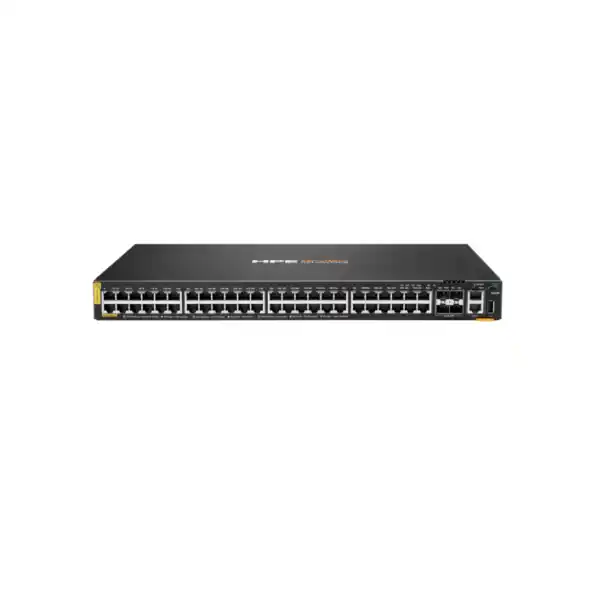
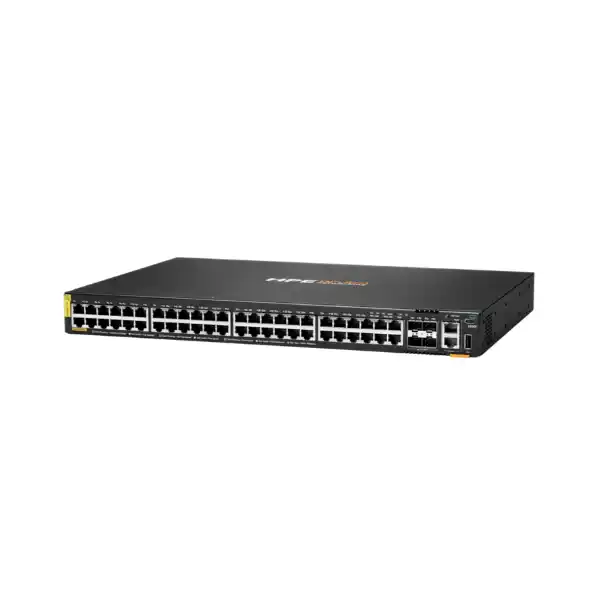
HPE Aruba Networking CX 6200F 48G Class 4 PoE 4SFP+ 370W Switch
A 48-port fixed access switch for organizations that need Gigabit edge connectivity, PoE/PoE+ for powered devices, 10GbE-capable uplinks and AOS-CX management without moving immediately to a modular access platform. The main purchasing decision is not simply the port count: the PoE power budget, uplink design, management method, exact HPE orderable revision and resiliency requirements should be confirmed together.
Direct answer for buyers evaluating this switch
The HPE Aruba Networking CX 6200F 48G Class 4 PoE 4SFP+ 370W switch is a fixed Layer 2/Layer 3 access switch in the CX 6200 family. It is mainly used to connect office users, wireless access points, IP phones, surveillance devices and other Ethernet endpoints while supplying up to 370W of shared PoE power. It suits branches, campus access closets and SMB networks that need 48 Gigabit copper ports and 10GbE-capable uplinks. Before ordering, confirm whether the 370W PoE budget is sufficient for the intended powered-device mix and verify the exact current regional or revision part number. FourTeck can help review port demand, endpoint power, uplinks, optics, VSF stacking, Aruba Central licensing, rack requirements and the appropriate UAE quotation configuration.
What the CX 6200F 48G 370W configuration is designed to do
This CX 6200F configuration is an access-layer platform rather than a data-center or high-density multigigabit aggregation switch. Its 48 copper interfaces operate at 10/100/1000BASE-T and can deliver IEEE 802.3af or 802.3at power to compatible endpoints. That makes the platform well aligned with conventional enterprise edge requirements: desktop computers, printers, phones, building devices, standard Gigabit-capable access points, cameras and other Ethernet-connected equipment. The 370W PoE budget is shared across the powered ports, so the switch should be sized by expected device draw rather than by assuming that every port can simultaneously consume the maximum 30W available to a Class 4 endpoint.
Four 1/10G SFP+ interfaces provide the high-speed links normally used for distribution or core connectivity, server or appliance connectivity where supported, and Virtual Switching Framework links. A buyer therefore has to think about uplinks and stacking as a combined design problem. If two or more SFP+ interfaces are allocated to a VSF topology, fewer interfaces remain for independent northbound links. Conversely, a standalone switch may use the SFP+ interfaces entirely for uplinks. The right design depends on the number of closets, required uplink redundancy, fiber path diversity, transceiver type, distance and the way the upstream switching layer is built.
The CX 6200 family runs HPE Aruba Networking AOS-CX, which provides a consistent operating model across a broad portion of the CX switching portfolio. HPE positions the family for enterprise branch offices, campuses and SMB networks, with features such as access control lists, quality of service, static and access OSPF routing, telemetry, APIs, centralized management options and VSF stacking. Those capabilities matter because the switch is not merely a powered port expander; it can participate in policy, segmentation, monitoring and routed access designs when the software version, configuration and wider network architecture support the required function.
Exact identity, product number and ordering revision
HPE documentation uses more than one product number and revision across the CX 6200F 48G Class 4 PoE 370W family. The JL727A reference appears in HPE technical documentation for the 48G Class 4 PoE 4SFP+ 370W configuration, while later CX-branded revisions and regional variants also exist. HPE previously announced the original Aruba-branded JL727A for end of sale and identified CX-branded replacements including JL727B and other part-number variants. For a new UAE purchase, the exact orderable code should therefore be confirmed at quotation time rather than assuming that an older reference number is the correct current SKU for every region.
This distinction matters because product names can look almost identical while the part number identifies the manufacturing revision, compliance variant, power-cord treatment, uplink labeling or regional configuration. HPE’s current QuickSpecs lists several 6200F 48G Class 4 PoE 370W entries, including 4SFP and 4SFP+ descriptions, TAA variants and no-location or power-cord suffixes. A procurement team should not substitute one code for another without checking uplink capability and regional requirements. If 10GbE SFP+ uplinks are a mandatory design requirement, the quotation should explicitly state that requirement and the selected part number should be checked against the current HPE ordering documentation.
For that reason, this page describes the technical configuration represented by HPE’s JL727A 48G Class 4 PoE 4SFP+ 370W data sheet while treating the final orderable part number as a quotation dependency. FourTeck can use the planned deployment, required uplink speed, quantity, destination and support requirements to help identify which currently supplied revision should be placed on the bill of materials.
Verified technical specification reference
The table below uses HPE’s published JL727A technical data as the reference point for the 48G Class 4 PoE 4SFP+ 370W configuration. Where HPE documentation shows revision-specific variation, that dependency is stated instead of presenting all revisions as physically identical.
| Specification | JL727A reference configuration | Buyer relevance |
|---|---|---|
| Product type | Fixed, stackable managed access switch | Intended for enterprise edge and access-layer deployment. |
| Copper access ports | 48 x 10/100/1000BASE-T Class 4 PoE | Suitable where endpoint access is Gigabit Ethernet rather than multigigabit. |
| PoE standards | IEEE 802.3af and 802.3at, up to 30W per supported port | Confirm endpoint class and total power budget. |
| PoE budget | Up to 370W Class 4 PoE power | This is a shared system budget, not 30W simultaneously on all 48 ports. |
| High-speed interfaces | 4 x 1/10G SFP+ ports | Used for uplinks and/or VSF; optics and cabling must be selected separately where required. |
| Switching capacity | 176 Gbps | Appropriate to the model’s access-port and uplink architecture. |
| Published throughput | Up to 130.9 Mpps in HPE’s current exact-model data sheet | Use current HPE documentation if comparing revisions because older tables may differ. |
| Latency | 1Gbps: 2.28 µs; 10Gbps: 1.46 µs | Published LIFO 64-byte packet reference values. |
| Processor | Quad-core Arm Cortex-A72 at 1.8GHz | Supports the AOS-CX control and management plane. |
| Memory / flash | 8GB DDR4 / 16GB eMMC | Exact hardware reference for JL727A. |
| VSF stack size | Up to 8 members | Plan SFP+ port use, optics, topology and uplinks as one design. |
| Maximum stacking distance | Up to 10km with supported long-range transceivers in HPE QuickSpecs | Actual design depends on approved optics, fiber type and topology. |
| Console / management ports | USB-C console, USB Type-A host, OOBM; JL727A documentation also references Bluetooth adapter use with the CX Mobile app | Check revision-specific console interfaces if operational standards require a particular port. |
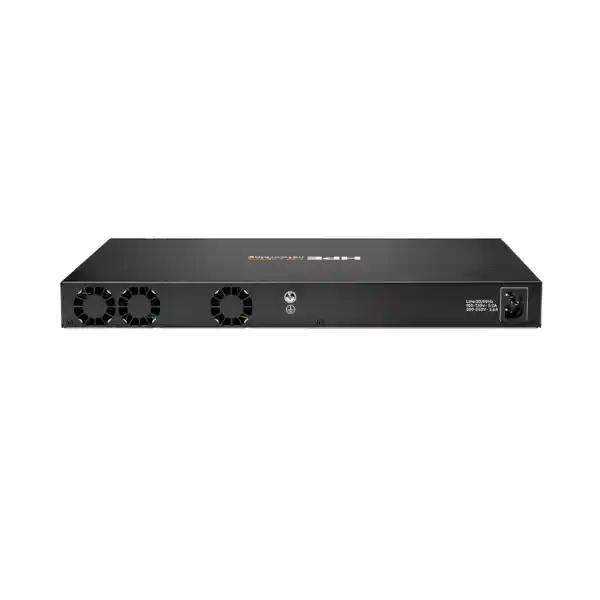
| Power supply | Fixed 500W power supply; up to 370W available to PoE | Fixed-power design means PSU redundancy requirements should be evaluated before purchase. |
| Input voltage | 100–120V / 200–240V AC, 50/60Hz | Confirm rack PDU, plug/cable option and UPS capacity for the deployment site. |
| Published system consumption | 76W at 230VAC at 100% traffic in HPE reference data, excluding the need to budget attached PoE loads appropriately | UPS and heat calculations should include expected endpoint power, not only switch electronics. |
| Operating temperature | 0°C to 45°C up to 5,000ft; derate 1°C per 1,000ft from 5,000ft to 10,000ft | Relevant for telecom rooms, enclosed cabinets and higher-altitude deployments. |
| Cooling | Fixed fans | Buyers needing field-replaceable or redundant fan architecture should compare modular CX 6200M options. |
| JL727A physical reference | Approx. 4.39 x 44.2 x 32.7cm; 5.05kg | Revision dimensions can vary slightly; confirm the quoted part when rack depth is constrained. |
| Management | HPE Aruba Networking Central, web GUI, CLI and Switch Multi-Edit Software | Central management has licensing/subscription implications that should be included in the project scope. |
How to size the 370W PoE budget correctly
PoE sizing is the most important difference between simply counting available ports and building a reliable access-layer bill of materials. The switch provides 48 PoE-capable copper ports, but its shared PoE budget is 370W. If every port were loaded equally, that would average roughly 7.7W per port. That average is not a per-port restriction: a compatible port can support a Class 4 endpoint up to 30W, but the combined allocation across all powered devices must remain within the system budget and the switch’s configured PoE policies.
A network with twenty devices expected to draw around 15W each represents approximately 300W of endpoint load before allowing operational margin, leaving substantially less room for adding higher-draw cameras, phones with expansion modules or additional access points. By contrast, a mixed office floor with desk phones at lower power, a smaller set of cameras and a limited number of access points may fit comfortably inside 370W. The right method is to prepare an endpoint schedule containing device type, quantity, IEEE PoE class, expected or maximum draw, and growth allowance. That schedule should be reconciled with the switch quantity and port map before quotation.
PoE planning should also recognize that endpoint requirements evolve. A switch purchased for standard phones and cameras may later be expected to power newer wireless access points or devices with greater draw. If the forecast indicates that many of the 48 ports will regularly need mid-to-high PoE+ power, the CX 6200F 48G 740W PoE model or another platform should be evaluated. Choosing the 370W model merely because current day-one consumption fits closely beneath the limit can create an avoidable replacement or redistribution problem when a floor is expanded.
Good fit signal
You need up to 48 Gigabit access ports, but the realistic aggregate PoE demand is comfortably below 370W with sensible growth margin.
Review a higher-power option
A large portion of the ports will power access points, cameras or other devices that commonly draw well above low-power phone levels.
Quotation input
Provide an endpoint quantity and wattage schedule so the switch model can be selected from actual power demand rather than port count alone.
Uplinks, fiber and VSF stacking need to be planned together
The four SFP+ interfaces are a major strength of this model because they can operate at 1GbE or 10GbE in the JL727A reference configuration. In a typical access design, one or more ports connect toward a distribution or core switch. The same high-speed front-panel interfaces can also be used for VSF stacking. That flexibility is useful, but it means a design must reserve enough interfaces for both purposes. A topology that consumes two SFP+ links for stack resiliency and two for upstream redundancy uses all four high-speed ports; a different stack architecture may leave a different number available.
HPE documents VSF support for up to eight CX 6200 members and references long-distance stacking with supported long-range transceivers, with a maximum stacking distance of up to 10km in the JL727A QuickSpecs. This can be helpful where a logical stack must extend beyond a single rack, but it should not be interpreted as permission to use any optic or fiber combination. Supported transceivers, wavelength, fiber type, distance, software version and the compatibility of the opposite endpoint must be checked against current HPE transceiver guidance.
For ordinary building access, a more important question is often whether the uplink should be 1GbE or 10GbE. A 48-port switch can aggregate a substantial amount of traffic even if individual users rarely sustain Gigabit rates. Wireless access points, local servers, imaging systems, cameras and simultaneous business applications can increase uplink demand. Organizations should therefore consider oversubscription, expected traffic peaks, upstream port capacity and redundancy instead of matching uplink speed only to historic utilization averages.
FourTeck can include supported optics or DAC components in a proposed bill of materials after the fiber type, distance, connector standard, upstream switch model and desired redundancy are known. Optics should never be treated as automatically included with the switch unless the quotation explicitly lists them.
AOS-CX management, Aruba Central and subscription considerations
The CX 6200 family uses AOS-CX, HPE Aruba Networking’s modern switching operating system. For local administration, HPE identifies web GUI and industry-standard CLI options, while Switch Multi-Edit Software can support coordinated configuration workflows. The platform also exposes REST APIs and supports programmable automation approaches that can reduce repetitive tasks in larger environments. This matters to teams standardizing on a common operational model: the switch can be integrated into structured configuration, monitoring and change-control practices rather than managed only as an isolated appliance.
HPE Aruba Networking Central provides centralized cloud-based management across supported wired, wireless and WAN infrastructure. Central licensing is a separate commercial consideration: HPE describes Central as licensed on a per-device basis for the switches, access points and gateways an organization chooses to manage through the platform. A buyer therefore should distinguish between the hardware requirement and the cloud-management subscription. The switch hardware can be evaluated as an access platform, while the Central subscription term, tier and quantity should be added to the project when cloud management is part of the operational design.
The practical decision is not whether cloud management is universally preferable. A smaller site with established local administration procedures may use CLI or web management, while a multi-site organization may value centralized inventory, monitoring, policy and workflow consistency. Existing Aruba Central tenants should verify device entitlement and subscription alignment. New deployments should decide whether Central is required at launch, whether the subscription term should align with a support or lifecycle period, and who will own onboarding and day-to-day administration.
Does the switch require an Aruba Central subscription?
A Central subscription is required when the switch is to be managed through HPE Aruba Networking Central. The switch also supports local management methods, so a Central subscription should not be assumed to be bundled with every hardware purchase. Confirm the intended management architecture and subscription term before the quotation is finalized.
Automation, analytics and operational visibility
HPE positions the CX 6200 series with a built-in Network Analytics Engine and a time-series database that stores configuration and operational state information. In practical terms, this gives network teams a framework for monitoring conditions and using software agents to identify events that affect network health. The value is greatest when operations teams have defined what they want to observe, how alerts should be interpreted, and what change or incident workflow should follow. Analytics capability alone does not replace monitoring design or operational ownership.
REST APIs and Python-based agents can support automation for repeatable tasks. This is relevant to organizations maintaining multiple access switches, where manual configuration drift becomes a risk. Automation can help standardize VLANs, roles, interface settings, monitoring and validation, but scripts and templates should be controlled like other production changes. They should be tested against the deployed AOS-CX version and documented so that future administrators understand what is automated and what remains manually managed.
For a buyer, the important point is to connect these capabilities to an operating model. If the deployment is a single branch, simplified local management may be enough. If the project covers many closets or sites, Central, Multi-Edit or API-based workflows may materially reduce repetitive administration. FourTeck can help define the initial configuration scope and identify which management method needs to be included in the implementation discussion, while the customer’s internal policy should determine change approval, account integration, monitoring retention and ongoing operational responsibility.
Segmentation, access control and routed access considerations
The CX 6200 family supports enterprise access functions including ACLs, quality of service, static routing and access OSPF routing. HPE also describes dynamic segmentation capabilities that can apply consistent policies across wired and wireless access when the surrounding Aruba architecture and configuration are in place. These functions can help separate users, voice, cameras, building systems and other device classes, but they do not automatically create a secure design. VLAN structure, role definitions, authentication method, upstream routing, firewall policy and identity integration must all be considered.
For voice environments, QoS configuration may be needed to classify and prioritize latency-sensitive traffic consistently across access and upstream layers. For camera networks, access controls and bandwidth planning can reduce unnecessary exposure and congestion. For corporate endpoints, 802.1X or other access-control methods may be part of the design, depending on customer policy and identity infrastructure. The switch can provide mechanisms used by these designs, but the implementation result depends on the complete architecture rather than on a single product feature.
Buyers should therefore describe the required segmentation outcome when requesting configuration support. Useful inputs include VLAN count, IP subnets, DHCP arrangement, authentication server, voice platform, wireless architecture, firewall location, routing boundary and any existing naming or policy standard. That information allows the configuration scope to be estimated accurately and avoids treating advanced policy as a one-click hardware capability.
Who should consider this 48-port 370W model?
Office access closets
A floor with many wired users, phones and moderate numbers of powered wireless or security devices can benefit from 48 Gigabit edge ports without paying for a much larger PoE budget than the endpoint mix requires.
Enterprise branches
Branches that need local switching, 10GbE-capable uplinks, segmentation and a consistent AOS-CX operating model can use the switch as part of a standardized branch design.
Campus edge expansion
Existing CX environments may use the 6200F as an access-layer expansion where fixed power and cooling are acceptable and the uplink/PoE profile matches the campus standard.
SMB network modernization
Organizations moving from unmanaged or older access switches can gain structured VLANs, routing options, monitoring and centralized-management choices while retaining familiar Gigabit edge connectivity.
The model is less compelling when the environment requires multigigabit copper access, Class 6 or higher PoE levels, a PoE budget substantially above 370W, modular field-replaceable power components or significantly faster uplink density. Those requirements point toward another CX 6200 configuration or a different switching family rather than forcing the 48G 370W fixed model into a role it was not designed to fill.
Product-fit matrix for a practical shortlist
| Requirement | Suitable when | Confirm before ordering |
|---|---|---|
| 48 wired edge ports | Most attached devices need 1GbE or less. | Any endpoints requiring 2.5/5GbE should be identified separately. |
| PoE for mixed endpoints | Aggregate planned load is comfortably within 370W. | Device class, maximum draw and growth margin. |
| 10GbE uplinks | Four SFP+ interfaces meet uplink and stack-port demand. | Exact quoted revision, supported optics, fiber and upstream compatibility. |
| VSF stacking | Up to eight members and front-panel stacking fit the topology. | Port allocation, stack links, software version and topology. |
| Cloud management | Aruba Central aligns with the customer’s operational model. | Per-device subscription, term and onboarding scope. |
| Local management | CLI/web administration meets the site’s operational needs. | Administrator access, AAA, logging and backup standards. |
| Power resilience | A fixed internal PSU is acceptable within the site design. | UPS architecture and whether redundant hot-swappable PSUs are required. |
| Regional procurement | A current UAE-compatible revision can be quoted. | Exact part number, power-cord option, quantity, lead time and support coverage. |
When another CX 6200 option may be more suitable
Choose a 740W 48-port PoE model when power demand is the constraint
If the network will power many higher-draw endpoints, the 48-port 740W PoE member of the CX 6200F family deserves comparison. It retains a similar access-port count while providing a much larger aggregate PoE budget. That can reduce the need to split powered devices across additional switches solely because of wattage. The comparison should still account for exact revision, uplinks, rack power and expected endpoint growth rather than assuming the higher-budget model is automatically preferable.
Choose a 24-port model when density is not needed
A small branch with fewer than roughly two dozen access connections may not benefit from a 48-port chassis. A 24-port CX 6200F can be a cleaner fit when rack density, initial cost or fault-domain sizing favors smaller switches. However, spare-port allowance, future users, phones, access points and cameras should be counted before reducing port density, because a 24-port model that is nearly full on day one may create an early expansion requirement.
Choose a non-PoE model when powered endpoints are not required
Where connected endpoints are self-powered and PoE is not expected, a non-PoE CX 6200F configuration may be more economical and can simplify power planning. This should be decided from the actual endpoint roadmap. Removing PoE to save cost can be false economy if wireless, voice or surveillance devices are likely to be added later.
Compare CX 6200M when component redundancy matters
The fixed CX 6200F design uses fixed power and fan components on this reference model. HPE’s modular CX 6200M models are positioned with hot-swappable, redundant power supplies and fans on relevant configurations. If the access layer must support serviceable component redundancy, the modular platform may better match the resiliency requirement. This is an architectural decision rather than a simple feature upgrade: power supplies, fan modules, support approach, rack design and total bill of materials all change.
Installation and rack planning for UAE sites
A switch purchase becomes an infrastructure deployment as soon as it enters a rack. Before installation, confirm rack unit availability, usable cabinet depth, front and rear clearance, cable-management space, PDU outlet type, available UPS capacity and cooling. HPE’s JL727A reference dimensions are approximately 4.39cm high, 44.2cm wide and 32.7cm deep, with a weight around 5.05kg. Later revisions can differ slightly, so an unusually shallow cabinet should be checked against the dimensions of the exact quoted part.
The published operating range reaches 45°C at lower elevations, but a telecom room should not be designed to operate continuously at a product’s maximum temperature. UAE deployments can face high ambient heat outside conditioned technical spaces. The cabinet, room HVAC, airflow path and adjacent equipment heat output should be reviewed together. Enclosed wall cabinets, warehouses and poorly ventilated service rooms deserve particular attention because a switch with dozens of powered endpoints can contribute meaningful thermal load even when the networking electronics themselves appear modest.
Power planning should include two different loads: the switch’s own electronics and the power delivered to connected PoE devices. HPE publishes 76W at 230VAC at 100% traffic for the JL727A reference, while the PoE system can supply up to 370W to endpoints. A UPS selection based only on the base switch consumption would therefore be undersized for a heavily loaded PoE deployment. Battery-runtime objectives should also be discussed: keeping the switch alive for an outage is useful only if the required access points, phones or cameras remain powered through the same PoE infrastructure.
FourTeck can include installation and configuration scope in the quotation when required. The site should provide rack location, power availability, existing patching, fiber route, upstream switch details, endpoint schedule and any change-window restrictions. These inputs help separate hardware supply from the labor and coordination needed for a predictable cutover.
Migration from an older access switch
Replacing an existing switch is not just a physical swap. The current configuration should be reviewed for VLANs, tagged and untagged ports, trunks, spanning-tree behavior, link aggregation, routing interfaces, DHCP relay, voice settings, QoS, ACLs, authentication, SNMP or telemetry, syslog, NTP, administrator access and any special port behavior. A configuration from another switch family should not be pasted directly into AOS-CX without translation and validation because syntax and operational behavior can differ.
The endpoint inventory is equally important. Port descriptions on an old switch may be incomplete or inaccurate. During migration planning, each active interface should be mapped to an endpoint type, VLAN, PoE requirement and criticality. Unused ports should be identified separately rather than automatically carried forward as configured access. This creates a cleaner target configuration and provides a chance to correct undocumented exceptions that accumulated over time.
A cutover plan should define how the uplink moves, whether both old and new switches can coexist temporarily, how IP addressing and management access are established, and what validation will be performed before the change is accepted. For voice or camera networks, testing should include endpoint registration and application reachability, not only link status. For wireless access points, confirm that PoE is sufficient and that the APs reconnect to the intended management architecture.
Where the CX 6200F forms part of a VSF stack, migration sequencing becomes more important. Stack formation, member numbering, software alignment and uplink configuration should be completed before large numbers of endpoint patch cords are moved. FourTeck can help scope preconfiguration and migration support based on the existing switch models, current configuration export and the desired target design.
Compatibility checks that prevent ordering mistakes
The most common compatibility risk on an access switch project is not the copper Ethernet port itself; it is the surrounding combination of optics, powered endpoints, management platform, software version and upstream design. Every quotation should therefore be checked against a short compatibility record rather than treating the switch as a standalone box.
- Optics and DACs: confirm the exact supported HPE transceiver or cable for the quoted switch revision, required speed, fiber medium and distance.
- Upstream switch: verify port type, supported speed, optic compatibility, LACP requirements and any vendor-specific constraints on the distribution/core side.
- Powered devices: validate IEEE PoE class, expected wattage, cable quality and the total aggregate budget rather than relying only on device count.
- AOS-CX software: check the target release against the deployed model, required features and the organization’s software standard.
- Aruba Central: confirm that the switch will be onboarded, that the correct per-device subscription is available, and that tenant ownership and onboarding credentials are understood.
- Rack and power: verify cabinet depth, PDU outlet, power-cord variant, UPS headroom and environmental conditions.
- Existing design: confirm VLANs, routing, authentication, spanning tree, link aggregation and segmentation requirements before configuration work begins.
Compatibility should be documented at the part-number level. A family-level statement such as “CX 6200F supports SFP+” is not enough when a current ordering table includes multiple 4SFP and 4SFP+ variants. The exact selected switch and exact selected optic should be checked together.
Performance numbers in the right context
HPE’s current exact-model data sheet for JL727A lists 176Gbps switching capacity and up to 130.9Mpps throughput, with published latency of 2.28 microseconds at 1Gbps and 1.46 microseconds at 10Gbps under the stated test reference. These numbers are useful for confirming the hardware class, but they should not be converted into application guarantees. Real user experience also depends on uplink congestion, routing design, oversubscription, endpoint performance, wireless conditions, WAN behavior, security policy and traffic patterns.
For access-layer sizing, the more practical performance questions are often architectural. How many users share each uplink? Are camera streams concentrated on one switch? Are access points generating high east-west or northbound traffic? Does local routing remain on the switch or travel to a central core? Will the SFP+ ports be consumed by VSF links? Does the upstream platform have enough 10GbE capacity for every access switch? These decisions can matter more than comparing two nearby packet-per-second figures in isolation.
HPE documentation has changed over time and some older QuickSpecs tables show different throughput figures for particular revisions. For a formal tender or technical compliance document, FourTeck recommends using the current manufacturer data sheet for the exact orderable revision being quoted rather than copying values from an older family summary. This approach keeps the technical submission aligned with the hardware actually being supplied.
Resiliency: what the fixed design does and does not provide
The CX 6200F 48G 370W reference uses a fixed power supply and fixed fans. That keeps the platform straightforward, but it means the switch itself does not provide the same field-replaceable redundant power architecture found on relevant modular CX 6200M models. Buyers should decide whether this is acceptable based on the service requirement for the access closet. In many office environments, a fixed access switch on a protected UPS is a reasonable design. In sites where a single switch failure would interrupt critical operational systems, a higher-resilience architecture may be justified.
Resilience can also be created at the network level. VSF can simplify multi-switch operation, while dual uplinks and redundant upstream switches can reduce dependence on a single path when configured correctly. However, stacking does not make each member’s internal power supply redundant. If a member loses power, devices physically attached to that member lose connectivity and PoE even when the logical stack continues through other members. This distinction matters for critical phones, cameras, access points or control systems.
A practical design can spread critical devices across more than one access switch, use redundant upstream connectivity and place switching infrastructure on appropriately sized UPS systems. Where those measures are insufficient, compare modular or higher-availability switching options. FourTeck can help separate “switch management simplicity” from “component and service resiliency” so the selected product matches the actual business continuity requirement.
Procurement and quotation checklist
A complete quote should describe the deployment rather than listing only one switch line item. The following information helps avoid missing optics, licenses, power choices or implementation work.
Confirm 48G Class 4 PoE, 370W budget and required SFP+ capability.
State switch count and whether units will operate independently or in VSF groups.
List phones, APs, cameras and other PoE devices with expected wattage.
Specify 1GbE or 10GbE, number of links, redundancy and upstream switch.
Provide medium, connector, approximate distance and existing optic information.
Confirm whether Aruba Central is required and the desired subscription term.
Identify cabinet type, PDU/UPS arrangement and site power standard.
State any required AOS-CX release policy or interoperability constraint.
Provide existing VLANs, IP networks, routing boundary and gateway design.
Identify 802.1X, RADIUS, local roles, ACLs or segmentation requirements.
Clarify hardware-only supply, rack installation, patching, configuration and testing.
Confirm required support coverage and current manufacturer lifecycle for the quoted revision.
Lifecycle and revision awareness for a new purchase
HPE Aruba Networking previously announced end-of-sale milestones for the original Aruba 6200F part numbers, including JL727A, while identifying later HPE Aruba Networking CX 6200F replacements such as JL727B and other revision or compliance variants. This history is important because a buyer may encounter the same family name on old inventories, current documentation, reseller listings and replacement tables. A product page or historical specification alone is not sufficient evidence that a particular old SKU is the best code for a new order.
At the same time, HPE continues to publish technical material using JL727A as a precise reference for the 48G Class 4 PoE 4SFP+ 370W configuration. That makes JL727A useful for understanding the hardware profile, but it does not remove the need to confirm the current orderable revision for Dubai or another UAE destination. New quotations should use the part number currently available through the relevant HPE supply channel and should verify whether that revision retains the exact uplink capability the project requires.
Support and warranty should likewise be confirmed against the actual quoted part. HPE’s exact-model data sheet describes limited lifetime warranty coverage for the reference product, but warranty terms and support-life dates are governed by HPE’s current warranty and lifecycle policies. FourTeck can incorporate support requirements into the quotation discussion, but the final commercial document should state the specific hardware code and any selected support service rather than relying on a generic family-level assumption.
Use-case planning: office, wireless, voice and surveillance
Office user access
For standard office endpoints, 1GbE copper remains suitable for many desktops, docking stations, printers and phones. The 48-port density can consolidate a full floor or department into one access switch where port counts align. Plan spare capacity rather than filling all ports on day one, because desk moves, meeting-room devices and temporary project equipment can consume ports quickly. If many users require multi-gigabit wired access, a different switch family should be evaluated instead of expecting 10/100/1000 ports to meet that requirement.
Wireless access points
The switch can power compatible PoE/PoE+ access points, but modern AP selection must be checked carefully. Some higher-performance or newer APs may require greater than Class 4 power or multigigabit Ethernet to reach their full intended capability. The fact that a device can physically connect to a Gigabit PoE+ port does not prove that the access design is optimal. Confirm the AP model, PoE class, Ethernet interface requirement and expected traffic before using this switch as the wireless access layer.
IP telephony
Voice deployments often fit well because many IP phones draw modest power relative to the 30W per-port maximum. Still, phones with sidecars, video capability or pass-through devices can consume more power. VLAN assignment, LLDP behavior, QoS policy, DHCP options and call-platform reachability should be included in migration and testing plans.
IP surveillance and building devices
Cameras can create a different load profile: continuous video traffic affects uplink bandwidth, while PTZ, heater or infrared functions can affect PoE demand. Building systems may also have special VLAN and access-control requirements. Separate camera or IoT segments, bandwidth calculations and security policy should be considered at the design stage rather than after endpoints are connected.
What FourTeck can help determine before the order
FourTeck’s useful role in a switching purchase is to turn a product name into a deployable requirement. That begins by confirming whether the 48G 370W configuration is the right family member and which current HPE orderable part should be quoted for the UAE project. From there, the discussion can cover the PoE budget, optics, stacking, Central subscriptions, rack power and configuration or installation scope.
For a straightforward hardware-only request, the customer may already have a validated bill of materials. In that case, quotation accuracy depends primarily on exact part numbers, quantity, regional options and any required support. For a new network or migration, more design input is useful: endpoint counts, existing switch models, fiber paths, upstream topology, VLANs, routing, access control, management method and expected growth. Those details allow the hardware line items and services to be separated clearly.
If configuration support is required, the scope can be defined around base setup, management access, VLANs, uplinks, trunks, LAGs, routing, PoE, QoS, authentication integration, monitoring, Central onboarding, VSF and testing. Migration support may also require review of the existing configuration and an agreed change window. The exact scope should be documented in the quotation rather than assumed to be included with hardware supply.
You can also review broader business networking products, explore installation and configuration services, or contact FourTeck with a switch bill of materials for requirement review.
UAE availability and delivery planning
Contact FourTeck to confirm current UAE availability for the exact CX 6200F 48G 370W revision required by the project. Availability can depend on the precise order code, uplink variant, quantity, power-cord treatment, compliance requirement, support option and vendor lead time. Because the original JL727A reference has lifecycle history and replacement part numbers exist, a new order should be verified against the current HPE catalog rather than relying on old reseller inventory descriptions.
Delivery and project coordination can be discussed after the requirement is confirmed. If the switch is part of a larger rollout, provide the site count, required delivery sequence, installation scope, optics, Central licensing and configuration expectations together. This helps keep hardware, licensing and services aligned. FourTeck does not need to assume immediate stock or a fixed delivery date to prepare a useful quotation; the exact lead time can be confirmed for the chosen part and quantity.
Buyer questions to resolve before purchase
Is 370W enough for all planned PoE devices?
Add the expected draw of every AP, phone, camera and IoT endpoint, include growth margin, and compare that total with the shared 370W budget. Do not multiply port count by 30W and assume the switch can supply that simultaneously.
How many SFP+ ports remain after stacking?
That depends on the VSF topology. Reserve stack links first, then confirm how many ports remain for northbound uplinks and whether that satisfies redundancy and bandwidth requirements.
Are optics included?
Do not assume so. The required SFP/SFP+ transceivers or DACs should be listed separately on the bill of materials and checked for exact switch, fiber and upstream compatibility.
Is Aruba Central mandatory?
No single management method should be assumed. HPE documents Central, web GUI, CLI and Multi-Edit options. Central management requires the relevant per-device subscription, so include it only when the project uses that cloud-management model.
Do I need the old JL727A part number?
Not necessarily. JL727A is a useful exact technical reference, but HPE identified newer CX-branded replacements. A new UAE quotation should confirm the current orderable revision that preserves the required port and uplink profile.
What if redundant power is required?
This fixed model uses a fixed PSU. If hot-swappable redundant power and fan serviceability are design requirements, compare relevant CX 6200M modular configurations or another suitable access platform.
Frequently asked questions
What is the HPE Aruba CX 6200F 48G 370W PoE switch mainly used for?
It is mainly an enterprise access-layer switch for connecting wired endpoints and Class 4 PoE devices in branches, campus closets and SMB networks. It combines 48 Gigabit copper PoE ports with four high-speed SFP+ interfaces in the JL727A reference configuration.
Can all 48 ports supply 30W at the same time?
No. Each compatible Class 4 port can support up to 30W, but the switch has a shared 370W PoE budget. The total endpoint power allocation must remain within that budget, so device-level sizing is required.
Does the CX 6200F support 10GbE uplinks?
The JL727A reference configuration provides four 1/10G SFP+ ports. Because HPE now lists multiple part-number revisions, confirm that the exact quoted part retains the uplink capability required by your design.
How many switches can be stacked?
HPE documents VSF stacking for up to eight CX 6200 members. The stack uses front-panel high-speed interfaces, so stack topology and remaining uplink capacity should be planned together.
Does Aruba Central require a separate subscription?
Yes, when Central cloud management is used, HPE licenses the platform on a per-device basis. The hardware also supports local management options, so the Central subscription should be included according to the chosen operational model.
Is the 370W model suitable for Wi-Fi access points?
It can power compatible IEEE 802.3af/at APs, but the exact AP model must be checked for PoE class and Ethernet speed. Higher-power or multigigabit APs may justify another access switch configuration.
What information is needed for an accurate UAE quote?
Provide quantity, endpoint and PoE requirements, uplink speed, fiber distance, stacking plan, Aruba Central need, support expectation, installation scope and delivery location. FourTeck can then confirm the current part number and associated bill of materials.
Can FourTeck assist with configuration and migration?
Configuration, installation and migration assistance can be scoped when required. The existing switch configuration, target VLAN/routing design, management method, authentication requirements and change window should be reviewed to define the work accurately.
Decision recap: is the 48G 370W model the right fit?
What FourTeck needs to prepare the right switch BOM
A concise requirement sheet is enough to begin. Share the details below and the hardware, optics, licensing and service scope can be reviewed as one package.
PoE endpoint list
Uplink speed and count
Fiber type and distance
VSF requirement
Aruba Central requirement
Existing switch/core model
Installation/configuration scope
Dubai/UAE project location
Confirm the exact CX 6200F revision, PoE budget and uplink plan
FourTeck can help determine whether the 48G 370W configuration fits your endpoint mix, which current HPE orderable part should be quoted for the UAE, and what optics, Aruba Central subscriptions or implementation services should be included. Share the switch quantity, PoE device list and upstream connection details so the quotation reflects the intended deployment rather than only a family name.

Reviews
There are no reviews yet.