
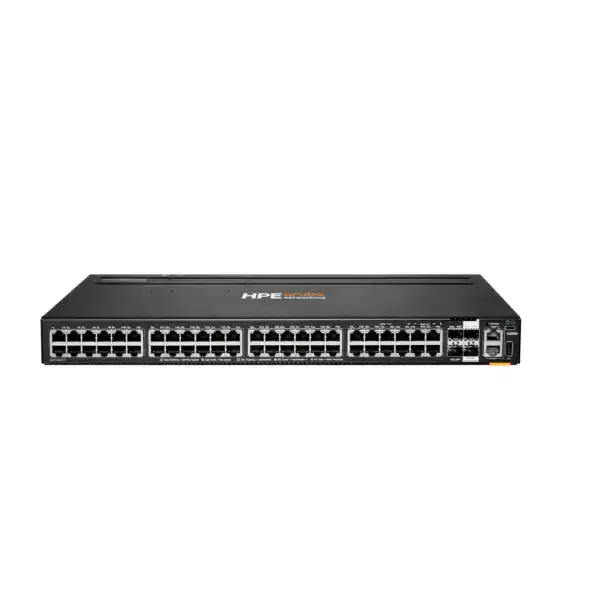
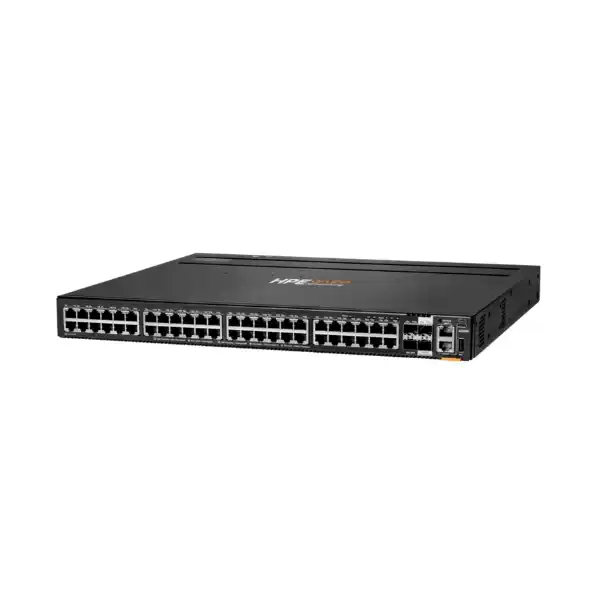
HPE Aruba Networking CX 6200M 48G 4SFP+ Switch (R8Q69A)
A modular, stackable 1U access switch for organizations that need forty-eight Gigabit Ethernet copper ports, four 1/10GbE SFP+ uplinks, AOS-CX operations and field-replaceable power and fan components—without paying for PoE capability that the deployment does not require.
This page covers the non-PoE CX 6200M 48G 4SFP+ model. The Class 4 PoE version, TAA version and 36G/12 Smart Rate Class 6 PoE model are different products and should not be treated as equivalent.
Direct answer: what is the CX 6200M 48G R8Q69A?
The HPE Aruba Networking CX 6200M 48G 4SFP+ Switch R8Q69A is a managed, stackable access-layer switch with 48 Gigabit Ethernet copper ports and four 1/10GbE SFP+ uplinks. It is mainly suited to wired user, server, printer, endpoint and infrastructure connectivity where powered Ethernet is not required from the switch. Organizations considering it should first confirm that 1GbE downlinks and non-PoE operation match the endpoint design, then size uplink optics, power-supply redundancy and stacking. FourTeck can help determine the exact bill of materials, including the separately ordered JL085A power supply, compatible transceivers, optional second fan tray, rack requirements, management approach and configuration services for a Dubai or wider UAE deployment.
Where R8Q69A fits in an enterprise access network
The CX 6200M 48G is designed primarily for the access layer—the part of a campus or branch network where user devices and local infrastructure connect before traffic is aggregated toward distribution, core, security or WAN systems. Its forty-eight 10/100/1000BASE-T interfaces make it a practical match for floors, communications rooms and branch racks where most connected devices need standard Gigabit Ethernet rather than multigigabit copper. Typical non-PoE endpoints can include desktop PCs, printers, fixed workstations, appliances with their own power, selected servers, industrial controllers or other Ethernet devices that do not need power delivered across the network cable.
The distinction between “48G” and “48G PoE” matters. R8Q69A supplies Ethernet data connectivity but does not supply PoE power to endpoints. That can make it an efficient fit when powered devices are absent, separately powered or connected through another switch. It can be the wrong choice when a large portion of the port count will serve IP phones, surveillance cameras, wireless access points, access-control devices or IoT endpoints that rely on PoE. In those environments, the related CX 6200M PoE models should be evaluated instead of planning around external injectors for dozens of ports.
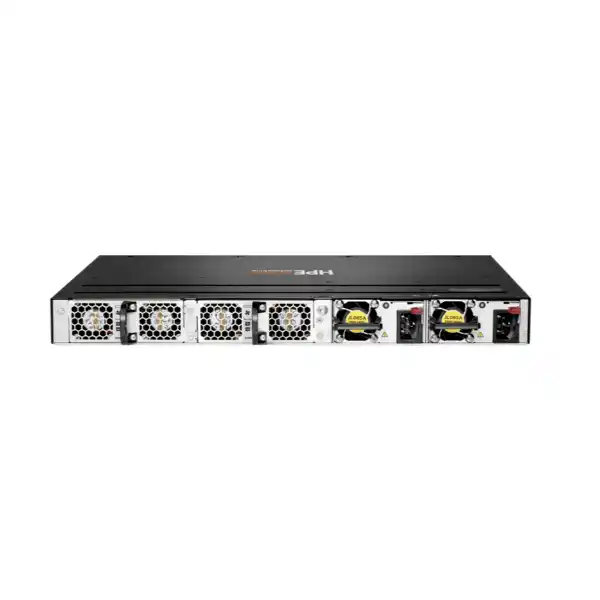
The modular “M” design is another reason to consider this specific model rather than a fixed-power CX 6200F alternative. The R8Q69A chassis provides two field-replaceable, hot-swappable power-supply slots and two fan-tray positions. One fan tray is included, while a second can be added. A compatible JL085A 250W power supply is mandatory and ordered separately; a second compatible supply can be planned when power-supply redundancy is required. This architecture is valuable for network teams that prefer serviceable components and a clearer path to component redundancy in access closets.
The four built-in SFP+ uplinks also shape the model’s role. They can operate at 1GbE or 10GbE, allowing the access switch to connect upstream with fiber or supported cabling depending on distance, media and transceiver choice. Two of the SFP+ ports are identified by HPE as LRM capable and two as LRM/MACsec 256 capable, so requirements for particular optical modes or MACsec should be mapped to the correct physical uplink ports rather than assumed across all four.
Who should consider the HPE Aruba Networking CX 6200M 48G?
High-density wired office floors
A floor with many wired workstations and printers can use the 48-port density efficiently when endpoint power is supplied separately. The four 10GbE-capable uplinks provide room to design resilient or aggregated upstream connectivity without consuming copper access ports.
Branches standardizing on AOS-CX
Organizations already using HPE Aruba Networking CX can extend a consistent AOS-CX operational model into branch access closets. Management design should still be confirmed, particularly whether the switch will be run locally, through HPE Aruba Networking Central, or as part of a broader managed environment.
Access stacks requiring serviceable power
The modular chassis is useful when field-replaceable power supplies and fans are preferred. Buyers can plan a second PSU and fan tray based on resilience requirements rather than being limited to a completely fixed internal power arrangement.
Growing campus access environments
VSF allows supported 24- and 48-port CX 6200F/M models to operate as a logical stack of up to eight members. That can simplify management and expansion where a single switch is not enough, provided uplink capacity and failure-domain design are sized correctly.
Verified specifications for R8Q69A
These values apply to the exact HPE Aruba Networking CX 6200M 48G 4SFP+ Switch R8Q69A. They should not be mixed with the PoE, Smart Rate or TAA variants in the same family. Transceiver support can also depend on the selected optic and AOS-CX software version, so optical parts should be validated against the current HPE transceiver guidance before ordering.
| Specification | R8Q69A detail |
|---|---|
| Product type | Managed, stackable enterprise access switch |
| Access ports | 48 × 10/100/1000BASE-T |
| Uplinks | 4 × 1G/10G SFP+; 2 × LRM and 2 × LRM/MACsec 256 |
| PoE | Not provided on R8Q69A |
| Console / management ports | 1 × RJ-45 console, 1 × USB-C console, 1 × out-of-band management, 1 × USB Type-A host |
| Power-supply slots | 2 field-replaceable, hot-swappable slots; minimum 1 PSU required |
| Supported PSU | JL085A 250W 100–240VAC; ordered separately |
| Fan design | 2 fan-tray slots; 1 fan tray included; optional second tray; trays are field replaceable and hot-swappable |
| Form factor / mounting | 1U; EIA-standard 19-inch rack or equipment cabinet; 2-post rack kit included |
| Dimensions | 4.4 cm H × 44.2 cm W × 38.5 cm D |
| Configuration weight | 5.73 kg |
| CPU | Quad-core Arm Cortex-A72 at 1.8 GHz |
| Memory / flash | 8 GB DDR4 / 16 GB eMMC |
| Packet buffer | 6 MB |
| Switching capacity | 176 Gbps |
| Throughput | Up to 202 Mpps |
| Average latency, 64-byte LIFO | 1Gbps: 3.6 μs; 10Gbps: 2.9 μs |
| VSF stack size | Up to 8 members with supported 24/48-port CX 6200F and CX 6200M models; 12-port 6200F models are excluded |
| Stacking bandwidth | 40 Gbps |
| Maximum stacking distance | Up to 10 km with suitable long-range transceivers |
| MAC address table | 32,768 entries |
| Switched virtual interfaces | 256 dual-stack SVIs |
| IPv4 / IPv6 host table | 8,000 ARP / 8,000 ND |
| IPv4 / IPv6 unicast routes | 2,000 / 2,000 |
| Operating temperature | 0°C to 45°C up to 5,000 ft; altitude derating applies above 5,000 ft; short excursion support to 55°C is specified by HPE |
| Operating humidity | 15% to 95% at 40°C, non-condensing |
| Airflow | Front and side to back |
| Power consumption at 230VAC | With JL085A: 56W idle; 75W at 100% traffic rate |
Ports and uplinks: what the 48G 4SFP+ layout means
The front-panel port mix is one of the strongest reasons to select or reject R8Q69A. Forty-eight copper ports negotiate 10/100/1000 Mbps, making the switch well suited to conventional Ethernet access where attached equipment is predominantly 1GbE or below. When an office refresh still has a large installed base of Gigabit desktops and business devices, this density can be more economical than specifying multigigabit access ports that may not be used. The trade-off is clear: R8Q69A is not the model to choose when a meaningful number of clients require 2.5GbE, 5GbE or 10GbE over copper.
The four SFP+ uplink ports can operate at 1GbE or 10GbE. In a typical design, one or more uplinks connect the access layer to a distribution switch, collapsed core, server aggregation point or another VSF member. A 10GbE uplink offers substantially more headroom than a single 1GbE uplink when many users share the same access switch, but the correct uplink design depends on actual traffic. A switch populated with office endpoints generating modest northbound traffic may be comfortable with fewer uplinks; a switch feeding storage-heavy workflows, virtual desktop traffic or high-volume local services may justify dual 10GbE uplinks or link aggregation.
Optics cannot be selected from port speed alone. Fiber type, link distance, connector type, existing patch panels, transceiver support and AOS-CX software should be checked together. HPE documents specific LRM support on the four uplink ports and MACsec 256 capability on two of them. If encrypted Layer 2 links using MACsec form part of the design, the physical port mapping matters. Do not assume all four SFP+ positions offer the same MACsec capability. Likewise, if a long-range VSF design is being considered, the optics and distance need to be engineered as a stack link, not treated as an ordinary uplink purchase.
R8Q69A also provides dedicated management and service interfaces: RJ-45 console, USB-C console, out-of-band management and USB Type-A host. These interfaces support different operational tasks. The console ports are valuable for initial provisioning and recovery, while OOBM can separate switch management traffic from the production data plane when an organization has a dedicated management network. The USB host interface can support operational workflows defined by the platform. FourTeck can review which interfaces are actually required in the deployment and include console or optical accessories only where they serve a clear implementation purpose.
Performance, forwarding capacity and what to size around
HPE rates R8Q69A at 176 Gbps switching capacity and up to 202 million packets per second of throughput. Those figures show that the platform is designed to switch traffic across its access and uplink interfaces at enterprise access-layer scale, but they should not be treated as a substitute for network sizing. Buyers still need to understand how many endpoints will be active, where applications are hosted, whether east-west traffic remains within the switch or stack, and how much northbound traffic is expected across the SFP+ links.
The key planning question is often uplink oversubscription rather than raw chassis capacity. Forty-eight 1GbE access ports could theoretically present much more aggregate edge bandwidth than a single 10GbE uplink. That is normal in many access networks because users rarely transmit at line rate simultaneously. What matters is whether the expected traffic profile is appropriate for the chosen number of uplinks. Teams running media workloads, backup traffic, engineering datasets or heavy VDI should model peaks and not rely on office-user assumptions.
R8Q69A includes 8 GB DDR4 memory, 16 GB eMMC flash and a 6 MB packet buffer. HPE also specifies a 32,768-entry MAC table, 256 dual-stack switched virtual interfaces, 8,000 IPv4 ARP entries, 8,000 IPv6 neighbor entries and 2,000 IPv4 plus 2,000 IPv6 unicast routes. These numbers make the switch capable of more than basic Layer 2 forwarding, but a campus architecture should still place routing and policy roles deliberately. The fact that a feature or table scale exists does not mean every deployment should push the access layer to its maximum limits.
For latency, HPE lists average LIFO latency for 64-byte packets at 3.6 microseconds on 1Gbps links and 2.9 microseconds on 10Gbps links. In buyer terms, the switch is intended for responsive enterprise LAN access rather than specialized ultra-low-latency trading or data-center fabrics. The more important operational variables will usually be correct topology, congestion control, uplink sizing, redundant paths, quality-of-service policy and consistent configuration.
Modular power and fan design: a major CX 6200M differentiator
The R8Q69A does not ship as a complete powered unit unless the required power supply is included in the ordered bill of materials. HPE specifies that one JL085A 250W power supply is the minimum and that the power supply is ordered separately. This is a critical procurement detail: ordering only the switch chassis SKU without the required PSU can leave the installation incomplete. The JL085A accepts 100–240VAC and is keyed for the non-PoE CX 6200M models.
Two hot-swappable power-supply slots are available. A single PSU meets the minimum operating requirement, while a second compatible unit can be considered where power-supply redundancy is part of the resilience target. Redundancy only becomes meaningful when the wider power design supports it. If both supplies are fed from the same failed PDU, circuit or upstream UPS, having two PSUs may not protect the switch from that common failure. For critical closets, buyers should discuss whether separate PDUs, UPS-backed feeds or other power arrangements are needed.
Cooling is also modular. The switch has two fan-tray slots and includes one fan tray. HPE specifies one tray as the minimum, with a second tray optional. With only one tray installed, there is no fan redundancy; adding a second tray allows the chassis to tolerate a fan failure within the supported design. Network teams that value component serviceability should therefore distinguish between “field replaceable” and “redundant.” A field-replaceable component can be serviced, but redundancy depends on the quantity actually installed.
At 230VAC with the JL085A power supply, HPE specifies approximately 56W idle consumption and 75W at a 100% traffic rate, with maximum heat dissipation listed at 205 BTU/hr. The switch’s primary airflow is front-and-side to back. These details matter in a densely populated rack: enough rear clearance, cabinet ventilation and sensible cable routing are necessary even when individual switch power draw is modest. In Dubai and the UAE, communications rooms should be planned around the manufacturer’s environmental range rather than assuming that building ambient conditions will always remain within specification.
VSF stacking: growth without treating every switch as a separate island
HPE Aruba Networking Virtual Switching Framework, or VSF, allows compatible CX 6200 switches to operate as a logical stack. R8Q69A supports stacks of up to eight members when used with supported 24-port and 48-port CX 6200F and CX 6200M models. HPE specifically excludes the 12-port 6200F models from this stacking combination. The ability to mix selected 24- and 48-port models can help an organization build access capacity in increments that better match each wiring closet.
Stacking can simplify administration because the collection of switches is managed as one logical system rather than as unrelated devices. It can also support resilient connection patterns and make expansion more structured. However, a stack should not be specified only because the feature exists. Designers should decide how many ports are needed now, how many are expected later, what stack topology is appropriate, how uplinks will be distributed, and what happens if a stack member or link fails.
HPE lists 40 Gbps stacking bandwidth and a maximum stack distance of up to 10 km when suitable long-range transceivers are used. That long-distance capability can be useful in campus scenarios, but distance introduces optical-design considerations. Fiber type, optical budget, transceiver support, patching, route diversity and operational ownership should all be verified. A long-distance VSF topology should be treated as an engineered network design rather than a simple cable extension.
For a single small branch, one R8Q69A might be easier to operate than a stack if forty-eight ports and four uplinks are sufficient. For a larger floor or campus closet, two or more members can provide higher aggregate access density and a consistent management domain. A deployment approaching the eight-member limit should also evaluate whether the network architecture would benefit from a higher-tier access or aggregation platform with different uplink speeds, availability features or scale. FourTeck can help compare “more CX 6200 members” against moving to another CX family where the requirements justify it.
AOS-CX management, automation and operational visibility
R8Q69A runs HPE Aruba Networking AOS-CX, the operating system used across a broad portion of the CX switching portfolio. AOS-CX is database driven and designed around programmable network operations. For a buyer, the benefit is not simply that the switch has a modern interface; the more important point is that configuration, state data, telemetry and automation can be handled in a consistent framework when the organization standardizes on CX.
HPE supports traditional command-line administration, a web interface in applicable workflows, REST APIs and Python-based programmability. That combination allows organizations to operate the switch manually, integrate it into scripts or connect it with broader network-automation processes. Automation should be introduced with governance rather than simply enabled because APIs exist. Configuration templates, change control, role-based access, backup practices and validation procedures determine whether automation reduces risk or merely performs mistakes faster.
The Network Analytics Engine is part of the CX operational approach. It can monitor time-series state and help network teams investigate events, trends and anomalies. In practical terms, this can shorten troubleshooting when operators know what data to collect and have defined appropriate monitoring logic. It does not remove the need for a network monitoring strategy, baseline performance data or escalation procedures. NAE is best viewed as a platform capability that can improve visibility when it is integrated into operational practices.
HPE Aruba Networking Central can provide unified network operations across supported wired, wireless and other HPE Aruba Networking infrastructure. Central should be treated as a separate management decision rather than assumed to be automatically included with the hardware. Subscription or licensing requirements can vary according to the selected Central service and term. If cloud or centralized management is required, the quotation should identify the correct management subscription and term explicitly.
HPE also documents Multi-Edit for coordinated configuration and validation across CX switches, with a separate software license required for that capability. This is an important example of why hardware selection and software entitlement should be discussed together. A buyer who expects large-scale centralized configuration workflows should not assume that every management feature is bundled indefinitely with the chassis. FourTeck can help separate the switch hardware, management platform, license term and implementation scope so the quotation reflects the intended operating model.
Segmentation, security controls and MACsec considerations
The CX 6200 family supports enterprise access controls including access control lists, quality-of-service mechanisms, IPv4 and IPv6 features, authentication-related workflows and HPE Aruba Networking Dynamic Segmentation architectures. R8Q69A can therefore take part in a policy-driven campus design rather than functioning only as a basic unmanaged Layer 2 switch. The exact security behavior, however, depends on configuration and on the broader systems used for identity, policy and enforcement.
Dynamic Segmentation is particularly relevant to organizations trying to apply consistent role-based policy to wired and wireless devices. In a complete design, device identity and network policy can be used to determine how a user or endpoint is treated rather than relying only on fixed port-by-port VLAN configuration. Depending on the chosen architecture, related HPE Aruba Networking components and services may be required. Buyers should not interpret “supports Dynamic Segmentation” as meaning that a complete identity-based policy system is automatically delivered by the standalone switch.
Two of the four SFP+ uplink ports are documented with MACsec 256 capability. MACsec can protect Ethernet traffic on supported links by providing Layer 2 encryption and integrity. The value is most obvious when uplinks traverse areas where link confidentiality is important, but the feature must be supported and configured on both ends of the connection. Because only specified uplink ports provide this capability, interface mapping should be confirmed during design. Optics, peer-switch capability and software support also need to align.
Basic operational security remains equally important. Separate administrative accounts, secure management protocols, restricted management reachability, appropriate logging, configuration backups, controlled firmware processes and network access policies should all be part of the deployment. A secure-capable switch does not become a secure network merely by being installed. FourTeck can scope configuration support around the organization’s existing standards, whether the requirement is a straightforward access switch or part of a wider segmented campus architecture.
Layer 2, Layer 3 and traffic-control capabilities in buyer terms
The CX 6200 series supports the Layer 2 functions expected in enterprise access networks, including VLANs, spanning-tree options, link aggregation and multicast controls. For R8Q69A, these functions allow the forty-eight access ports to be divided into logical networks, redundant paths to be managed safely, and multiple physical uplinks to be grouped where a suitable peer configuration exists. Link Aggregation Control Protocol support can be used to create resilient or higher-capacity logical links, but the design should account for hashing behavior: a single flow does not necessarily use the entire combined bandwidth of a multi-link bundle.
Quality of Service is useful when the switch carries traffic with different sensitivity to delay or congestion. HPE documents strict priority and Deficit Weighted Round Robin queueing, IEEE 802.1p traffic prioritization, classification controls and rate-limiting functions. In a real deployment, QoS works best when marking and trust boundaries are defined consistently from access through the upstream network. Applying an access-switch QoS template without considering WAN, wireless or application policy can produce little benefit.
The platform also supports Layer 3 services including static routing and access OSPF, as well as IPv6 routing capabilities such as static routing and OSPFv3. This gives designers flexibility to place some routing at the access layer when the architecture calls for it. It does not automatically make R8Q69A the right substitute for a distribution or core switch. Route scale, uplink bandwidth, redundancy architecture, feature requirements and organizational standards should determine where routing boundaries sit.
For buyer decision-making, the useful question is not “does the switch support routing?” but “what role should this access switch perform in our design?” A simple branch may use routed uplinks and local VLAN gateways. A larger campus may keep gateway functions in a distribution layer or use an HPE Aruba Networking fabric design. The switch’s feature set gives options, but topology should be selected intentionally so troubleshooting, resilience and future growth remain manageable.
Compatibility and integration checks before ordering
Most avoidable switch-purchase problems are caused by a mismatch between the chassis and the surrounding environment rather than by the switch specification itself. R8Q69A should therefore be ordered as part of a small bill of materials and design check. At minimum, confirm power supplies, optics, fiber, stack design, rack space, patching, software-management expectations and endpoint requirements.
Power
At least one JL085A 250W PSU is required and ordered separately. If two PSUs are planned, confirm whether the rack provides independent power feeds and whether appropriate regional power cords or PDU connections are included.
Optics and cabling
Select SFP/SFP+ transceivers according to speed, fiber type, connector, distance and support matrix. For MACsec or LRM requirements, verify the exact uplink port and compatible peer device.
Endpoint power
R8Q69A is non-PoE. If phones, access points, cameras or sensors require PoE, evaluate a CX 6200M PoE model or a deliberate alternative power design instead of discovering the gap after installation.
Stack membership
VSF supports selected 24/48-port CX 6200F and 6200M members. Check software compatibility and the final stack topology before adding the switch to an existing deployment.
Management and licenses
Decide whether local AOS-CX operation is enough or whether HPE Aruba Networking Central, Multi-Edit or another management workflow is required. Relevant subscriptions and licenses should be quoted separately where applicable.
Rack environment
Allow 1U plus suitable front-and-rear clearance, account for front/side-to-back airflow, verify cabinet depth and maintain the manufacturer operating environment.
Product-fit matrix for the CX 6200M 48G R8Q69A
| Requirement | R8Q69A may fit when | Confirm before ordering |
|---|---|---|
| 48-port wired access | Most endpoints need 1GbE or lower over copper. | Whether 48 ports leave enough growth capacity without excessive unused density. |
| No endpoint PoE | Connected devices have separate power or PoE is provided elsewhere. | Phones, APs, cameras and IoT power needs for every planned port. |
| 10GbE uplinks | Four 1/10GbE SFP+ ports provide adequate upstream capacity. | Fiber media, optic type, distance, aggregation and redundancy. |
| Modular resilience | Field-replaceable PSU and fan components are preferred. | Second PSU, second fan tray and independent feed requirements. |
| VSF expansion | The access layer may grow across compatible CX 6200 members. | Stack member compatibility, software, optics and topology. |
| AOS-CX operations | The organization wants CX CLI, APIs, analytics and supported centralized management options. | Central or Multi-Edit licensing, operational workflows and configuration responsibility. |
Where this model sits within the CX 6200 family
R8Q69A is the 48-port, non-PoE modular model in the CX 6200M group. Its closest lower-density modular counterpart is the 24G 4SFP+ R8Q67A, which provides twenty-four rather than forty-eight Gigabit copper access ports. Organizations with only fifteen or twenty wired devices in a closet may find the 24-port model easier to justify, particularly if future growth is modest. By contrast, a site already near twenty-four ports can avoid an early second-switch purchase by moving directly to the 48-port model.
The closest power-enabled 48-port alternative is the CX 6200M 48G Class 4 PoE 4SFP+ model R8Q70A. That version is intended when access ports must provide IEEE 802.3af/at PoE up to the supported per-port and overall power budgets. Its compatible power supplies and thermal/power planning differ from R8Q69A. A buyer should therefore choose between R8Q69A and R8Q70A based on endpoint-power requirements, not merely on whether the PoE model is considered more feature rich.
The CX 6200M 36G 12SR5 Class 6 PoE 4SFP+ model R8Q71A moves into a different access requirement by adding Smart Rate multigigabit ports and higher-power PoE capability. That model can be more appropriate for newer wireless access points or devices that need more than 1GbE over copper and higher PoE classes. It is not a direct substitute when the requirement is simply forty-eight inexpensive non-PoE Gigabit ports.
The fixed CX 6200F range should also be considered when modular power and fan serviceability are unnecessary. Fixed models can simplify the bill of materials because their power supplies are built in. The 6200M design, however, gives more choice around replaceable PSU and fan components. The correct family member depends on port count, PoE, copper speed, serviceability, uplinks, rack design and lifecycle strategy—not on model number alone.
When another switch should be evaluated
R8Q69A is a strong access-layer option only when its specific port and power profile aligns with the requirement. If many endpoints need PoE, a PoE-capable CX 6200M model is usually cleaner than relying on external power injectors. If the access layer must serve Wi-Fi 6E or Wi-Fi 7 access points requiring multigigabit Ethernet, a model with Smart Rate ports should be compared. If the design requires uplinks faster than 10GbE, a different CX family with higher-speed uplink interfaces may be more suitable.
A smaller 24-port model deserves consideration when the rack has limited devices and little expected growth. Purchasing a 48-port switch for twelve endpoints can be reasonable when standardization or future expansion justifies it, but it is not automatically efficient. Conversely, if a closet needs more than forty-eight ports from day one, buyers should decide whether to stack multiple CX 6200 units or move to a different architecture. The answer depends on uplink requirements, failure-domain preferences, operational simplicity and planned expansion.
Higher-tier CX switching should also be evaluated when the switch is expected to perform a substantial distribution or core role. R8Q69A supports useful Layer 3 functions, but access routing support is different from selecting a platform intended for larger route scale, faster aggregation, more advanced resilience or high-speed campus-core connections. A design review can avoid purchasing an access switch and later forcing it into a role for which another platform would have been more appropriate.
Deployment and installation considerations
The switch occupies one rack unit and is designed for horizontal mounting in a standard 19-inch telco rack or equipment cabinet. HPE includes a two-post rack kit. Before installation, verify cabinet depth, available U-space, front and rear cable clearance, PDU position and airflow. The chassis measures 44.2 cm wide, 38.5 cm deep and 4.4 cm high, with a configuration weight of 5.73 kg. Physical planning becomes especially important in compact wall cabinets where depth can be more limiting than rack-unit count.
Power should be treated as part of the installation plan rather than an accessory afterthought. At least one JL085A PSU is required. If a second PSU is specified, document how the two feeds will be connected. The switch powers on when the installed supply is connected to active AC power; there is no separate power switch. For planned maintenance, network teams should therefore understand both software shutdown/reboot procedures and physical power-feed controls.
Cooling design should follow the specified front-and-side-to-back airflow. The operating range is 0°C to 45°C up to 5,000 feet, with altitude derating above that point. HPE also documents short-period excursion support to 55°C, but this should not be treated as a normal operating target. In UAE installations, the network room should be conditioned so sustained temperature and humidity remain within specification even when building load is high or cabinet doors are closed.
Before patching users, define the intended VLANs, uplinks, management IP, authentication policy, spanning-tree design, link aggregation, routing role and logging destination. For a stack, build the member numbering and stack-link plan first so cable labeling and rack positioning remain clear. For new deployments, firmware alignment should be confirmed before production use, especially when joining an existing VSF stack. HPE publishes software support information by product and release, and R8Q69A should be kept on an appropriate supported AOS-CX train selected for the wider environment.
Practical UAE deployment considerations
For Dubai and wider UAE projects, the technical specification is only one part of a successful switch purchase. The quotation should also confirm regional power-cord requirements, the exact power-supply quantity, compatible optics, rack accessories, installation location and the party responsible for configuration. If the switch is being added to an existing HPE Aruba Networking environment, providing the current switch models and AOS-CX versions can make compatibility review more accurate.
Availability and lead time can vary by model, quantity and vendor channel. R8Q69A should therefore be treated as a model to quote and confirm rather than described as guaranteed local stock. If the project has a fixed migration or office-move date, share that date during quotation so supply timing and implementation planning can be assessed together. When stock timing is critical, a technically acceptable alternative should be identified before the project becomes dependent on a single SKU.
UAE installation planning should also account for the network room, not just the network diagram. Confirm UPS/PDU capacity, cooling, fiber termination, patch-panel labeling, cabinet depth, grounding practices where applicable and physical access for maintenance. These details reduce the chance that a correct switch arrives at a site where the rack, power or optical infrastructure is not ready.
Important buyer questions before ordering R8Q69A
Does this switch provide PoE?
No. R8Q69A is the non-PoE 48-port CX 6200M model. Its forty-eight copper ports carry Ethernet data but do not power connected devices. If the access layer must power IP phones, wireless access points, cameras or IoT devices, compare the appropriate CX 6200M PoE model instead. This should be established from the endpoint list before the bill of materials is finalized.
Is a power supply included with R8Q69A?
The compatible PSU must be selected separately. HPE specifies a minimum of one JL085A 250W power supply for this non-PoE switch. The chassis has two hot-swappable PSU slots. If resilience requires a second supply, quote two compatible units and confirm how they will connect to independent or protected power feeds.
Can the four SFP+ ports all be used at 10GbE?
The uplink interfaces support 1GbE/10GbE operation, but the chosen transceiver or cable must be supported for the target speed and distance. HPE identifies two uplinks as LRM capable and two as LRM/MACsec 256 capable, so designs involving LRM or MACsec should map functions to the appropriate physical ports. Transceiver selection should be validated against current HPE guidance.
Can R8Q69A join an existing CX 6200 stack?
Yes, when the existing stack uses supported 24-port or 48-port CX 6200F/M members and compatible software. HPE supports up to eight members for this stacking group and excludes the 12-port 6200F switches. Confirm stack topology, firmware, optics and member design before introducing the new switch.
Is HPE Aruba Networking Central required?
No, the switch can be administered through AOS-CX without making Central the only management method. Central can be selected when centralized HPE Aruba Networking management is required. Applicable subscriptions and terms should be confirmed separately. If the organization also expects Multi-Edit functionality, HPE documents a separate software license requirement for that capability.
How many uplinks should be connected?
There is no universal number. One uplink can be sufficient for a simple branch, while dual or aggregated 10GbE links may be appropriate for higher utilization or resilience. Use endpoint traffic, oversubscription targets, upstream switch design, failure tolerance and cable paths to decide. If uplinks form a LAG, the peer device and hashing behavior must support the intended configuration.
Should a second fan tray be ordered?
One fan tray is included and is the minimum requirement. A second fan tray is optional. HPE notes that two installed fan trays provide fan redundancy, while a single tray does not. For business-critical access closets where component resilience is important, the second tray should be considered alongside a second PSU and redundant uplinks.
What information is needed for an accurate UAE quote?
Provide the required quantity, confirmation that non-PoE ports are acceptable, PSU quantity, redundancy target, SFP/SFP+ link speeds and distances, fiber type, stack size, rack details, management platform, licensing needs, installation location and configuration scope. If the switch will join an existing network, include upstream switch models and the current AOS-CX environment.
Procurement checklist for HPE Aruba CX 6200M 48G
How FourTeck can support selection and deployment
FourTeck can help turn the model choice into a complete, deployable requirement rather than quoting only the chassis. For R8Q69A, that starts with checking whether the non-PoE 48-port profile is appropriate. A short endpoint review can reveal whether some planned devices actually require PoE, multigigabit copper or a different port density. Catching that mismatch before ordering is more valuable than adding accessories later.
For the bill of materials, FourTeck can help identify the number of JL085A power supplies, fan redundancy requirements, SFP/SFP+ transceivers, rack needs and related cabling. If the switch will join an existing CX 6200 VSF stack, the existing member models and software can be reviewed before the quotation is finalized. For new stacks, the uplink and stack-link approach can be planned alongside the physical rack layout.
Management requirements can be clarified at the same time. Some organizations need only local AOS-CX administration, while others want HPE Aruba Networking Central, automation workflows or Multi-Edit. Where a subscription or license is required, it should be listed explicitly with the intended term rather than assumed. FourTeck can also scope VLANs, routing, link aggregation, management access, security controls, monitoring, configuration templates, testing and handover as project services where required.
For broader network projects, buyers can review FourTeck network and infrastructure services, browse business technology products, or send the deployment requirement for quotation. If the access switch is part of a security refresh, the wider firewall and segmentation architecture should be reviewed as one design rather than as unrelated hardware purchases.
UAE availability and quotation guidance
Contact FourTeck to confirm current UAE availability for HPE Aruba Networking CX 6200M 48G 4SFP+ Switch R8Q69A. Availability, lead time and final configuration can depend on quantity, vendor supply, power-supply selection, optics, licensing and project scope. A complete quote should distinguish the switch chassis from separately required or optional items such as JL085A power supplies, additional fan trays, SFP/SFP+ transceivers, management subscriptions and installation services. Delivery and project coordination can be discussed once the final requirement and location are confirmed.
Related options worth comparing
CX 6200M 24G 4SFP+ R8Q67A
Consider when twenty-four non-PoE Gigabit access ports are sufficient and the same modular CX 6200M serviceability is preferred.
CX 6200M 48G Class 4 PoE R8Q70A
Compare when the forty-eight access ports must also power standard PoE/PoE+ endpoints. PSU selection and PoE budget differ from R8Q69A.
CX 6200M 36G 12SR5 Class 6 PoE R8Q71A
Evaluate when selected access ports need multigigabit Smart Rate connectivity and higher-power PoE for demanding endpoints.
CX 6200F fixed-power models
Useful when fixed internal power is acceptable and the modular PSU/fan design of the 6200M family is unnecessary.
Frequently asked questions
What is the exact part number?
The exact non-TAA, non-PoE HPE Aruba Networking CX 6200M 48G 4SFP+ Switch covered here is R8Q69A. Check the quotation carefully because similar CX 6200M part numbers identify PoE, TAA or Smart Rate variants.
How many 10GbE uplinks are available?
There are four SFP+ uplink interfaces capable of 1GbE or 10GbE operation. The transceiver or cable and peer device must match the desired speed, media and distance.
Can the switch be mounted in a standard rack?
Yes. R8Q69A is a 1U switch designed for an EIA-standard 19-inch rack or cabinet. HPE includes a two-post rack kit; cabinet depth and airflow clearance should still be confirmed.
Does R8Q69A support redundant power?
The chassis has two hot-swappable PSU slots and supports the JL085A supply. One PSU is the minimum; a second can be planned for power-supply redundancy. For meaningful resilience, the external power-feed design should also avoid a single point of failure.
What is the maximum VSF stack size?
Up to eight supported members. The stack can include compatible 24- and 48-port CX 6200F/M models; HPE excludes the 12-port 6200F models from this stacking group.
Is the second fan tray mandatory?
No. One fan tray is included and required. The second tray is optional and can be added when fan redundancy is desired.
Can FourTeck include configuration?
Configuration can be scoped according to the project. Typical requirements may include management setup, VLANs, uplinks, link aggregation, routing, security controls, VSF, monitoring integration, testing and handover. The exact scope should be agreed in the quotation.
How can I check Dubai availability?
Send FourTeck the exact R8Q69A quantity and required accessories. Current UAE availability and lead time should be confirmed for the requested configuration rather than assumed from the family name alone.
Decision recap for R8Q69A
What FourTeck needs to build an accurate quote
A few specific inputs are enough to turn R8Q69A into a practical bill of materials and deployment scope.
Confirm the right CX 6200M configuration before purchase
FourTeck can help verify whether R8Q69A is the correct non-PoE 48-port access switch for your environment, then identify the required PSU count, optics, fan redundancy, stack design, management licensing and implementation scope. Share your current topology and endpoint requirements so the quotation reflects the complete deployment rather than only the chassis.

Reviews
There are no reviews yet.