
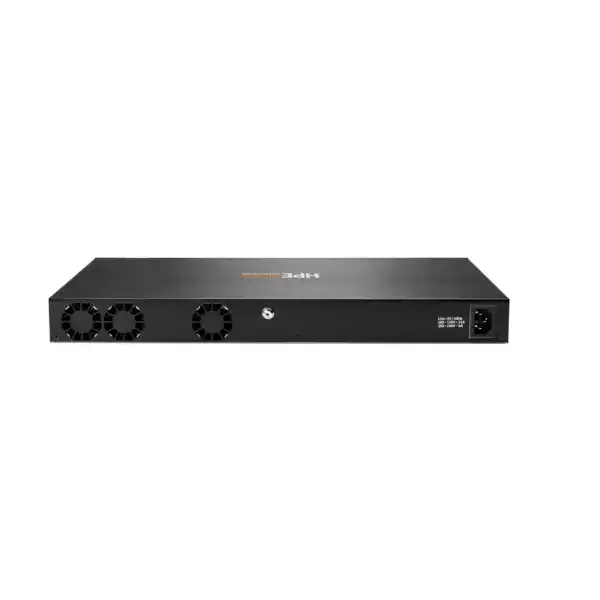
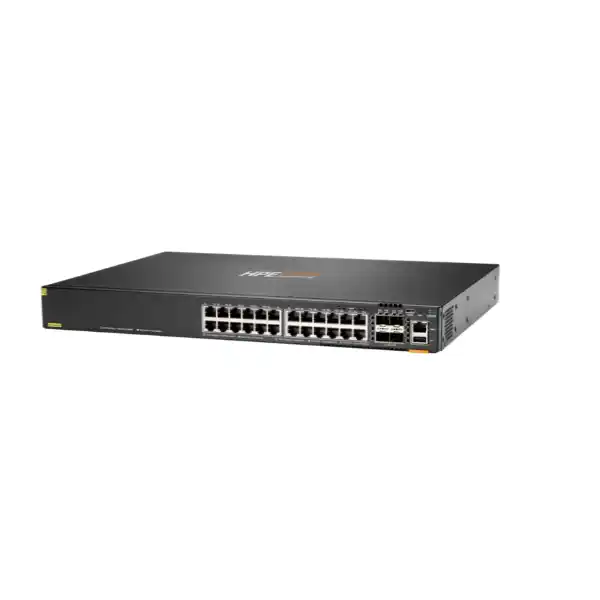
HPE Aruba Networking CX 6300F 24-Port 1GbE and 4-Port SFP56 Switch
A fixed-configuration enterprise switch for organisations that need 24 Gigabit copper access ports, four flexible high-speed uplinks, AOS-CX operations and stackable Layer 3 capabilities without access-port PoE. The JL668A is suited to carefully sized campus, branch, aggregation and selected data-centre roles where port type, uplink media and management design have been confirmed in advance.
Access: 24 × 10/100/1000 Base-T
Uplinks: 4 × SFP56, supporting 1/10/25/50G modes with compatible media
Power to endpoints: None on JL668A
Stacking: VSF, up to 10 members
Direct answer for buyers
The HPE Aruba Networking CX 6300F JL668A is a 24-port, non-PoE, fixed-configuration Layer 3 switch in the CX 6300 family. Its main role is to connect standard 10/100/1000 Base-T devices while providing four high-speed SFP56 ports for uplinks, inter-switch links or Virtual Stacking Framework connections. It should be considered by organisations that want enterprise AOS-CX operations and 24-port copper density but do not need the switch to power phones, cameras or wireless access points. The most important pre-order check is whether non-PoE 1GbE access ports and the planned uplink media match the deployment. FourTeck can help confirm the exact JL668A requirement, compatible optics or DACs, stack design, management licensing, rack and power requirements, and a quotation appropriate to a Dubai or UAE project.
What the CX 6300F JL668A does in an enterprise network
The JL668A occupies a useful middle ground between a simple unmanaged or Layer 2 access switch and a larger modular campus platform. It delivers 24 copper ports for conventional Ethernet endpoints and four high-speed uplink interfaces, while the CX 6300 software and stacking architecture provide the operational features expected in a managed enterprise network. That combination makes the switch relevant when the network team wants a compact 1U platform that can participate in routed designs, policy-based access, resilient uplink topologies and multi-switch stacks without buying access-port power capability that the project does not require.
The 24 copper ports operate at 10/100/1000 Base-T. In practical terms, they can connect desktops, printers, servers with 1GbE interfaces, management ports, building systems and other wired endpoints that either have their own power source or receive power through a separate method. Because JL668A is the non-PoE 24-port variant, it should not be selected when the design expects the switch itself to energise IP phones, cameras, badge readers or access points. This distinction sounds simple, but it is one of the most important procurement checks because the closely related JL666A provides Class 4 PoE/PoE+ and can be mistaken for the JL668A if a bill of materials is built only from the family name.
The four SFP56 ports give the model considerably more uplink flexibility than a switch limited to 1GbE or 10GbE uplinks. HPE documents these interfaces for supported 1G, 10G, 25G and 50G operation, subject to the correct transceiver, direct-attach cable, software level and design rules. A buyer can therefore use the access side for predictable 1GbE edge connectivity while choosing a faster uplink rate that matches the aggregation layer. This is particularly useful when a branch or access closet is expected to carry more aggregate traffic than a single 1GbE uplink could comfortably accommodate.
Who should consider the 24-port non-PoE model
Branches and offices with powered endpoints
A branch that has a moderate number of wired users, printers, controllers or other self-powered devices can use 24 Gigabit access ports without paying for a PoE budget it will not use. The four high-speed uplinks also leave room for resilient links or a faster connection to an upstream switch.
Infrastructure management networks
The model can be considered for management and infrastructure connectivity where many attached systems already have independent power. In those environments, the separate out-of-band management interface and enterprise AOS-CX tooling can be more relevant than access-port power delivery.
Compact routed access or aggregation
Where 24 copper access interfaces are sufficient, the Layer 3 feature set and high-speed uplinks make JL668A suitable for designs that need more than basic VLAN switching. Final routing and segmentation features should be mapped to the required AOS-CX release and licensing model.
This model is less compelling when the organisation expects significant growth beyond 24 copper endpoints, needs multi-gigabit access for modern wireless access points, requires PoE, or requires hot-swappable power and fan components. Those are signals to compare other CX 6300 variants before the order is placed. The point of the comparison is not that JL668A is insufficient in general; it is that the fixed 24-port non-PoE design is intentionally specific, so it should be selected only when that specificity matches the deployment.
Verified JL668A technical specifications
| Item | HPE Aruba Networking CX 6300F JL668A |
|---|---|
| Product type | Fixed-port Layer 3 managed Ethernet switch |
| Access ports | 24 × 10/100/1000 Base-T, non-PoE |
| High-speed ports | 4 × SFP56 supporting documented 1G/10G/25G/50G modes with compatible media |
| Management and service ports | 1 × USB-C console, 1 × USB Type-A host, 1 × OOBM port |
| Model switching capacity | 448 Gbps |
| Model throughput | 334 Mpps |
| Latency, 64-byte LIFO | 1Gbps: 2.28 μs; 10Gbps: 1.46 μs; 25Gbps: 1.90 μs; 50Gbps: 3.49 μs |
| Stacking | VSF, up to 10 members; 200 Gbps stacking bandwidth, 400 Gbps full duplex |
| Processor | Quad-core Arm Cortex-A72 at 1.8 GHz |
| Memory / storage | 8 GB DDR4; 32 GB eMMC; 8 MB packet buffer |
| Power supply | Internal fixed 200 W power supply |
| Power consumption | Approximately 49 W idle and 63 W at 100% traffic rate in HPE data-sheet testing |
| Input voltage | Fixed PSU: 100–120 V / 200–240 V AC; project power planning must still confirm local cord and PDU requirements |
| Dimensions | 44.2 cm W × 32.7 cm D × 4.39 cm H |
| Weight | 4.36 kg |
| Mounting | EIA-standard 19-inch rack or equipment cabinet; 2-post rack kit included in HPE documentation |
| Operating environment | 0°C to 45°C up to 5,000 ft; altitude derating applies above 5,000 ft; 5% to 95% RH at 40°C, non-condensing |
Specifications should be read together with the current HPE Aruba Networking QuickSpecs, installation guide and transceiver compatibility guidance. Optics, direct-attach cables, software versions, license entitlements and regional power accessories can change the final bill of materials even when the switch model itself remains JL668A.
Port architecture: why the 24 copper plus four SFP56 layout matters
The defining hardware choice on JL668A is not merely the count of 24 access ports; it is the relationship between those 1GbE copper ports and the four flexible high-speed interfaces. In a conventional access design, the 24 Base-T ports serve users or devices while the SFP56 ports form uplinks to distribution or core switches. Because the uplinks can operate at higher supported speeds, the access switch does not have to funnel all traffic through a single 1GbE connection. A designer can instead use one or more 10G, 25G or 50G links where the upstream platform and media support them.
The four high-speed ports also create options for resiliency. Two may be used for diverse uplinks to upstream switches while the remaining ports support stacking or other interconnections, depending on the chosen architecture. The correct arrangement depends on failure-domain design, oversubscription targets and the capabilities of the upstream devices. For example, a 24-port office edge with moderate traffic may be well served by dual 10GbE uplinks, while a server-heavy management network could justify a different uplink speed. The important point is to size from expected aggregate traffic and resilience requirements rather than simply selecting the highest rate available.
SFP56 is a physical interface class, not a guarantee that every transceiver of every speed is valid. HPE publishes support matrices and software requirements for optics and DACs. The exact cable length, connector, fibre type, optical standard and software release should therefore be confirmed before ordering. This is especially important when reusing existing optics from a previous platform, because mechanical fit alone does not establish support. FourTeck can include transceiver and DAC review as part of the bill-of-material discussion so the switch, links and upstream ports are specified as one system rather than as separate line items.
Switching performance and what the published numbers mean
HPE publishes a model switching capacity of 448 Gbps and model throughput of 334 Mpps for JL668A. Those figures indicate that the forwarding platform is designed for the port combination provided by this switch and are useful when comparing members of the same family. They should not be interpreted as an application throughput guarantee. Real traffic patterns, packet sizes, enabled services, upstream congestion, network topology and endpoint behaviour all influence the performance that a business experiences.
The published latency values are measured under defined test conditions with 64-byte packets. They help technical teams understand the switching platform, but they are not a substitute for end-to-end latency planning. An application path may cross firewalls, routers, WAN services, wireless networks or storage fabrics where delay is introduced elsewhere. For this reason, buyers should use the switch data to verify that the hardware is appropriate for the intended layer of the network, then evaluate the complete service path if a business application has strict latency requirements.
Capacity planning should also consider oversubscription. Twenty-four 1GbE access ports can theoretically present more traffic than a single lower-speed uplink should carry during simultaneous peaks. The available SFP56 ports allow the architecture to reduce that constraint by choosing suitable uplink speeds or link aggregation. However, there is no universal correct ratio. A user-access switch, a lab switch and a server-management switch can all have very different traffic profiles even when they use the same physical ports. A practical quotation discussion should therefore include the endpoint types, expected traffic direction, redundancy target and upstream switch model.
Virtual Stacking Framework planning
The CX 6300F family supports HPE Aruba Networking Virtual Stacking Framework, commonly shortened to VSF. JL668A can participate in a stack of up to 10 members. VSF allows multiple physical switches to be operated as a logical system, simplifying certain management and topology tasks while increasing port scale. HPE documents 200 Gbps of stacking bandwidth, or 400 Gbps when described at full duplex. Stacking links use supported high-speed ports and compatible media; HPE specifically notes that VSF stacking is not supported on the 1GbE access ports.
A ten-member maximum should not be treated as a recommendation to build every stack to ten units. The correct stack size depends on access density, fault domains, maintenance strategy, uplink design and physical cable routes. Smaller stacks can be easier to maintain and can limit the impact of a shared control-plane event, while larger stacks can reduce the number of separately managed devices. Network architects should decide where operational simplicity and failure containment need to balance.
When stacking across cabinets or rooms, transceiver type and distance become important. HPE documents long-distance stacking possibilities with suitable long-range transceivers, but the supported optics, link budget and software version must be confirmed. The fact that a distance is technically possible does not automatically make it the preferred campus design. Cabling pathway, fibre availability, redundancy and maintenance access often matter more than the maximum distance value. If JL668A switches will be stacked, the BOM should identify every stack link, required media, intended topology and spare-port requirement before hardware is ordered.
AOS-CX management and automation on the CX 6300F
JL668A runs AOS-CX, HPE Aruba Networking’s operating system for the CX switching portfolio. HPE describes AOS-CX as a database-driven, modular operating system designed to simplify operational tasks and expose network state for automation and troubleshooting. The platform supports traditional command-line management as well as programmatic methods, and the switch includes a dedicated out-of-band management interface that can be incorporated into a separate management network.
For operations teams, the value of AOS-CX is not just a different command syntax. The architecture supports telemetry, a time-series database and Network Analytics Engine functions that can help monitor changing network conditions and investigate events. REST APIs and Python-based automation options can also be used where the organisation has repeatable provisioning or compliance workflows. The business relevance is strongest when the IT team has a defined operating model: who owns configurations, how changes are approved, where backups are stored, how alerts enter the service desk and how software updates are controlled.
Automation should not be confused with automatic correctness. Templates, scripts and bulk changes can amplify both good and bad configuration decisions. Before using API-driven workflows or multi-switch changes, define configuration standards, rollback procedures and validation checks. A new JL668A deployment is a good opportunity to establish those controls rather than treating management as an afterthought. FourTeck can discuss the intended management approach during scoping so that local CLI operation, Central management, NetEdit or other tooling is considered before the network goes live.
Licensing, Central subscriptions and optional software
The base switch and the management ecosystem should be treated as separate procurement decisions. HPE documentation states that AOS-CX is included with CX switches and provides an active, perpetual set of native functions for enterprise networking. That does not mean every cloud-management, analytics or advanced security workflow is automatically included with a hardware purchase. Buyers should decide how the switch will be managed and which optional capabilities are needed before finalising the commercial quote.
HPE Aruba Networking Central is available as a management platform for wired, wireless and WAN infrastructure. A Central Foundation subscription enables switch-management functions such as onboarding, configuration, monitoring, troubleshooting and reporting. Central Advanced extends the available capabilities and, according to current HPE QuickSpecs, can include the CX Advanced Feature Pack so that a separate Advanced Feature Pack purchase is not required for the covered device and term. Licensing structures and product names can evolve, so the current subscription tier and term should always be confirmed at quotation time.
NetEdit is another operational tool associated with the CX portfolio. HPE documents it for coordinated configuration, validation, auditing and multi-switch changes, and also notes that a separate software license is required. An organisation that already has established network-management tooling may not need every optional platform. Conversely, a distributed IT estate could gain operational value from centralised onboarding and monitoring. The correct decision depends on management scale, desired automation, compliance workflow and support model rather than the switch port count alone.
Layer 3, segmentation and policy considerations
HPE positions the CX 6300F and 6300M platforms as stackable Layer 3 switches supporting enterprise routing and segmentation capabilities. Current family documentation references technologies such as OSPF, BGP, VRF, EVPN and VXLAN, along with quality-of-service and security functions. The buyer should not interpret the presence of a protocol name in family literature as permission to skip design review. A protocol may require a specific AOS-CX version, feature entitlement, topology or configuration pattern, and the rest of the network must support the same architecture.
Dynamic Segmentation is another family capability intended to help apply consistent role-based policy to wired and wireless clients. In suitable HPE Aruba Networking architectures, identity information can be used to apply policies without relying only on static port-by-port VLAN assignment. This can be useful for organisations with mixed users and IoT devices, but it is an architectural feature rather than a simple checkbox. Authentication services, policy definition, gateways or distributed enforcement choices and management licensing may all influence the final design.
For a straightforward office network, the buyer may use only a subset of the available capabilities. For a larger campus, the switch may participate in a routed access, overlay or policy-driven design. Both are valid. The important procurement step is to define the network role first, then map required features to the current supported software and licensing. That prevents a technically capable platform from being purchased with an incomplete design or incorrect assumptions about what is enabled on day one.
Compatibility: optics, DACs, upstream switches and existing cabling
Compatibility planning for JL668A is concentrated around the four high-speed interfaces and the systems to which they connect. Copper access ports are familiar, but the SFP56 side can involve several media choices. A link may use fibre transceivers, direct-attach copper, or another supported module type depending on speed and distance. Each choice has implications for connector type, fibre grade, cable length, optical budget, software support and the port mode on the upstream switch.
Reusing existing 10G optics can be cost-effective when the modules are explicitly supported, but assumptions should be avoided. A transceiver from another vendor or another switch generation may physically fit yet be unsupported or behave differently. Similarly, a fibre link originally designed for 10GbE may not necessarily meet the requirements of a higher-speed optical standard. The correct approach is to identify the existing module part number, fibre type, connector and link distance, then validate that information against the current HPE Aruba Networking transceiver guide and target software release.
Upstream switch compatibility also means more than matching nominal speed. Link aggregation, VLAN tagging, spanning-tree behaviour, routing protocols, MTU expectations and failure detection should be reviewed. If JL668A is replacing an older switch, document the current uplinks and logical configuration before migration. If it will join an existing CX 6300 VSF stack, confirm stack-member compatibility, software version alignment and the correct stacking links. The same discipline applies to a new deployment: make the network relationship explicit before buying the individual components.
The critical distinction: JL668A does not provide PoE
JL668A is the non-PoE 24-port model. That single fact should be written clearly into the bill of materials because another CX 6300F 24-port variant, JL666A, provides Class 4 PoE/PoE+. If the endpoints include IP phones, wireless access points, surveillance cameras, IoT sensors or access-control devices that are expected to receive power through Ethernet, JL668A will not power them directly.
A non-PoE switch can still be appropriate in a mixed network. The organisation may have separate PoE access switches for powered devices and use JL668A for servers, workstations, uplinks, management interfaces or self-powered appliances. This can reduce unnecessary power infrastructure in the rack and can be a clean fit where the attached equipment has independent power. However, adding external injectors later to compensate for an incorrect switch choice can increase complexity. It is better to count powered endpoints and required wattage during design.
If PoE is required, compare JL666A or another CX model with the required power class and port density. If multi-gigabit access and higher-power PoE are required for modern wireless designs, a Smart Rate model may be more suitable. The right comparison is based on endpoint interface speed and power demand together, not just on the number of switch ports.
Product-fit matrix for JL668A
Where JL668A fits inside the CX 6300 family
The CX 6300 family contains fixed and modular models with different port counts, PoE capabilities, Smart Rate options and serviceability characteristics. JL668A is specifically the fixed 24-port 1GbE non-PoE model. That makes it a useful baseline when the buyer needs the CX 6300F software and stacking architecture but does not need endpoint power or 48-port access density.
The closest functional comparison is often JL667A, the fixed 48-port 1GbE non-PoE model. The decision between them is primarily about copper port density, cabinet design and growth. If a site is already close to 24 active ports, buying a 24-port switch with almost no spare capacity can create an early expansion requirement. Conversely, a 48-port unit may be unnecessary in a small branch where the cable plant has fewer outlets and the rack has other constraints.
When PoE is required, JL666A is the 24-port Class 4 PoE/PoE+ fixed model and JL665A provides 48-port Class 4 PoE/PoE+ density. Modular CX 6300M models are relevant when the design requires features such as hot-swappable power supplies or fans, different port mixes or Smart Rate access. Newer CX 6300L models are positioned differently and include Layer 2-only designs, so they should not be treated as direct substitutes without checking the required routing and feature set.
Family selection should therefore begin with endpoint count, access speed, power requirement, serviceability and routing role. Once those are known, the model number follows logically. This approach is more reliable than choosing a family first and then searching for the cheapest member that appears to have enough ports.
When another switch should be evaluated
You need PoE
Evaluate a PoE-capable CX 6300F or Smart Rate model if the switch must power access points, phones, cameras or IoT endpoints. Count wattage as well as ports.
You need more than 24 copper ports
A 48-port model may reduce rack space, stack-member count and uplink consumption when endpoint density is higher.
You need multi-gigabit edge access
HPE Smart Rate models should be reviewed when endpoints require 2.5GbE, 5GbE or higher access speeds rather than standard 1GbE copper.
You need modular redundancy
CX 6300M designs deserve consideration when hot-swappable or redundant power and fan options are part of the availability strategy.
A different model can also be appropriate if the network requires a different airflow direction, specialised data-centre port mix, Layer 2-only architecture or a larger campus chassis. FourTeck can compare those requirements against the current CX portfolio rather than forcing JL668A into a role it was not selected to serve.
Rack, power and environmental planning
JL668A is a compact 1U switch measuring approximately 44.2 cm wide, 32.7 cm deep and 4.39 cm high, with a published weight of about 4.36 kg. HPE documents mounting in an EIA-standard 19-inch rack or equipment cabinet and includes a 2-post rack kit. Even with a compact switch, rack planning should confirm available RU space, front and rear clearance, cable-management path, PDU position and access for maintenance.
The switch uses a fixed internal 200 W power supply rather than removable modular PSUs. HPE lists a fixed-PSU input range of 100–120 V or 200–240 V AC and publishes power-consumption figures around 49 W idle and 63 W at 100% traffic rate under its test conditions. Actual site consumption can vary with configuration and attached media. The important operational implication is that the switch does not provide field-swappable PSU redundancy within the chassis. If power-path redundancy is required, the wider architecture and alternative models should be evaluated.
Environmental limits matter in UAE deployments, particularly in communications rooms that can become warm when building cooling is interrupted. HPE specifies an operating range of 0°C to 45°C up to 5,000 feet, with temperature derating at higher altitude, and operating relative humidity of 5% to 95% at 40°C non-condensing. These are equipment limits, not design targets. A network room should be engineered with stable cooling, clean airflow and monitoring rather than operating continuously near the maximum temperature.
Power cords and regional connector requirements should be confirmed with the exact order configuration. HPE listings can include country-specific suffixes and power options, and a global part number does not automatically determine the site’s final cord set. The quotation should therefore identify the installation location and power environment, especially when switches will be installed in data-centre PDUs or remote branches with standard wall power.
Deployment scenarios that make practical sense
1. Corporate office access without PoE dependence
An office may already power IP phones through another switch, use softphones, or have a separate wireless and security infrastructure. In that situation, JL668A can serve desktop PCs, printers, meeting-room systems and self-powered devices while the SFP56 links connect upstream. The decision should be based on the actual patch-panel count and expected three-to-five-year growth so that 24 ports do not become an immediate constraint.
2. Server and appliance management connectivity
Many servers, storage systems, hypervisors, security appliances and facility platforms expose 1GbE management interfaces that do not require PoE. A 24-port enterprise switch can consolidate those links, while the dedicated OOBM interface supports a separate management path for the switch itself. If this role is part of a true out-of-band design, failure isolation, authentication and upstream management connectivity should be planned independently from the production network.
3. Small aggregation point with mixed 1GbE edge links
In a branch or small facility, JL668A may aggregate downstream 1GbE devices or smaller switches while using one or more high-speed uplinks toward a distribution layer. This can be appropriate when the total port count is modest but resilient or faster upstream connectivity is still required. The designer should calculate traffic concentration and avoid using the switch as an aggregation device purely because it has four uplink ports.
4. Lab, staging or test networks
A technical team that needs enterprise AOS-CX features in a controlled lab can use the 24-port non-PoE model for test systems with their own power. High-speed SFP56 links can connect to a core or another lab switch. Where the lab is intended to reproduce production designs, match the software, licenses, optics and stack configuration closely enough that test results remain meaningful.
Implementation journey: from requirement to handover
- Define the switch role. Establish whether JL668A is access, aggregation, management-network infrastructure, or part of a VSF stack. Record endpoint types, port count, VLANs, routing role and resilience expectations.
- Validate the model choice. Confirm that 24 standard 1GbE copper ports are enough, PoE is not needed, fixed power and fans are acceptable, and the four SFP56 ports match the required uplink plan.
- Build the physical BOM. Select supported transceivers or DACs, fibre patch leads, rack accessories if anything beyond the included kit is required, regional power cords and any spare media appropriate to the support plan.
- Choose the management model. Decide between local management, Central, NetEdit or an existing orchestration approach. Confirm subscription terms and separate licenses where applicable.
- Prepare the logical configuration. Document management addressing, VLANs, trunks, routing, authentication, logging, time synchronisation, SNMP or telemetry, NTP, DNS, role policy, access control and stack settings as applicable.
- Stage before site change. Upgrade to an approved AOS-CX release, apply base configuration, verify optics and stack links, validate management reachability, and record serial numbers and configuration backups.
- Migrate with rollback. Map old ports to new ports, define the maintenance window, pre-label cables and keep a rollback plan. For routed or stacked migrations, test neighbouring devices and routing adjacencies after each critical step.
- Handover and operate. Store the final configuration, diagrams, software version, license records and support information. Confirm monitoring, alerting, backup and change-control ownership so the switch enters normal operations with clear accountability.
Buyer questions to answer before ordering
Is 24-port density enough after allowing for growth?
Count active ports, planned endpoints, spare capacity and any ports that will be consumed by local infrastructure. A switch that is already above roughly comfortable utilisation on day one can force an early expansion. If the cabinet is likely to exceed 24 copper connections, compare a 48-port model or a multi-switch plan before purchase.
Do any endpoints require PoE now or during the project life?
JL668A does not provide PoE. If phones, access points, cameras or other powered devices are in scope, identify their IEEE power class and wattage requirement. Do not assume external injectors are a desirable long-term substitute for a PoE-capable switch.
What speed should each uplink run?
Choose uplink speed from traffic and resilience needs, not only from the maximum port capability. A 10GbE link may be appropriate for a light branch, while 25GbE or 50GbE may be justified in a higher-throughput design. The upstream switch must support the same mode and the selected media.
Will the switch join a VSF stack?
If yes, identify all stack members, their part numbers and software levels. Define the stack topology and reserve supported high-speed ports for stack links. Include every required DAC or optical component in the BOM and consider how stack design affects maintenance and failure domains.
Is Central management required?
Central is optional from the perspective of owning the hardware, but a subscription is needed if the organisation wants Central’s cloud or on-prem management services. Select Foundation or Advanced based on the required operational capabilities and current HPE licensing terms. Record the subscription period for renewal planning.
What support and lifecycle expectations apply?
The procurement team should clarify required vendor support, software entitlement, replacement expectations and internal spares. Warranty and support terms can depend on product, region and service selection. Treat support as a defined line item rather than an assumption based on a generic family statement.
Operations, software and lifecycle discipline
A well-selected switch still needs a repeatable operational process. Establish an approved AOS-CX software train, review release notes before upgrades and maintain configuration backups outside the device. If the switch is part of a VSF stack, upgrade planning should account for the behaviour of the complete stack rather than treating each unit as unrelated hardware. The same applies to transceiver support: a software update can add or change support for particular modules, so optics should be considered during software change planning.
Monitoring should cover hardware health, interface state, errors, utilisation, environmental conditions, routing adjacencies and stack status as relevant. Network Analytics Engine and Central can provide additional operational visibility in suitable deployments, while existing enterprise monitoring tools may be integrated through standard interfaces. The objective is not to collect every metric; it is to define thresholds and alerts that correspond to service-impacting conditions.
Lifecycle management should maintain a record of serial number, location, configuration owner, software version, support entitlement, license subscription and related optics. When the organisation later expands or replaces the switch, that record provides a reliable starting point. It also reduces the risk that a Central or other term license expires without an assigned owner. Procurement, operations and support teams should agree who tracks these dates and how renewals are approved.
Procurement checklist for a Dubai or UAE quotation
Providing these inputs makes a quotation more accurate and reduces the chance that critical media, software or service items are omitted. For multi-site UAE projects, include the delivery and installation location for each switch because power, rack and service coordination may differ by site.
FourTeck assistance for selection, BOM and deployment
FourTeck can help turn the model name into a complete requirement rather than a single hardware line. The review can begin with the existing network, port count, PoE status, upstream switch, fibre or copper media, required uplink speed and management preference. From there, the quotation can identify whether JL668A is the appropriate model and which transceivers, DACs, licenses and accessories should accompany it.
For deployment projects, the scope can also include configuration planning, staging, migration coordination and handover requirements. The exact service content should be agreed in the quotation because a simple hardware supply and a production network migration are different engagements. Customers can review related enterprise networking products, discuss installation and configuration services, or contact FourTeck with the switch requirement for a model and BOM review.
UAE availability and ordering guidance
The JL668A appears in current HPE UAE product and QuickSpecs information, but FourTeck should confirm current UAE availability for the required quantity and project date before an order is committed. Availability can depend on the exact part number, region, quantity, vendor lead time and any country-specific order suffix. Delivery and project coordination can be discussed after the complete requirement is confirmed. No stock level or delivery date should be assumed from the model listing alone.
Related CX options worth comparing
CX 6300F JL666A
A 24-port 1GbE fixed model with Class 4 PoE/PoE+. Compare it when endpoint power is required but 24-port density remains appropriate.
CX 6300F JL667A
A 48-port 1GbE non-PoE fixed model. It is relevant when the same general access style is needed with higher copper-port density.
CX 6300F JL665A
A 48-port 1GbE Class 4 PoE/PoE+ fixed model for deployments needing both higher density and access-port power.
CX 6300M family
Modular family members should be considered when different access types, serviceable power/fan options or Smart Rate requirements change the design priorities.
The correct alternative depends on the specific reason JL668A does not fit. Port count, PoE, multi-gigabit access and hardware redundancy are different requirements and should not be collapsed into a single “bigger model” decision.
Frequently asked questions
Is JL668A a PoE switch?
No. JL668A is the 24-port non-PoE CX 6300F variant. If the attached devices need power over Ethernet, compare the JL666A or another PoE-capable model with the required power class and budget.
How many uplink ports are available?
The switch has four SFP56 interfaces. HPE documents supported operation at 1G, 10G, 25G and 50G with compatible media. The exact transceiver or DAC and software support should be confirmed for each link.
Can the JL668A be stacked?
Yes. The CX 6300F supports VSF stacking, with HPE documenting up to 10 members. Stacking uses supported high-speed links; the 1GbE access ports are not used for VSF stacking.
Does the switch require HPE Aruba Networking Central?
No. The switch runs AOS-CX and can be managed locally. Central is an optional management platform that requires the appropriate subscription when its onboarding, monitoring, reporting and other services are desired.
Are SFP56 transceivers included?
Do not assume so. Uplink optics and DACs should be selected as explicit BOM items based on speed, distance, fibre type, upstream-port compatibility and the current HPE support matrix.
Is the power supply redundant?
The JL668A uses an internal fixed power supply. If removable or redundant PSUs are a project requirement, evaluate CX 6300M or another platform whose hardware serviceability matches the availability design.
What information is needed for an accurate quote?
Provide quantity, site, port count, PoE status, uplink speeds, fibre or DAC details, stack plan, management subscription needs, rack and power conditions, installation scope and support expectations.
Can FourTeck help with configuration?
Yes, configuration or migration support can be scoped when required. The quotation should define the expected work, such as base configuration, VLANs, routing, VSF, management integration, testing and handover.
Decision recap for the JL668A
What FourTeck needs to prepare the right BOM
A short, accurate requirement is more useful than a long generic specification request. Share the inputs below and FourTeck can review whether JL668A and the associated media and software match the intended network role.
Confirm the JL668A model, uplinks and management plan before you buy
FourTeck can review whether the HPE Aruba Networking CX 6300F 24-port non-PoE switch is the correct fit, then help identify the supported optics or DACs, VSF requirements, management subscriptions and deployment services needed for the project. Share your quantity, site, existing upstream switch and expected port use so the quotation reflects the complete requirement rather than hardware alone.

Reviews
There are no reviews yet.