
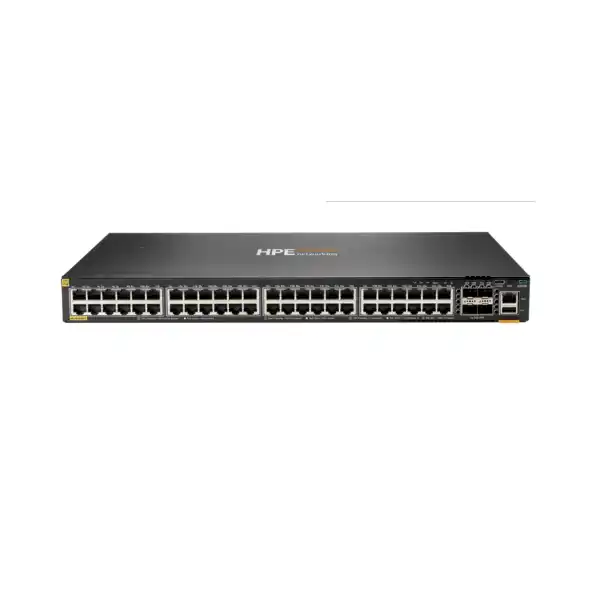
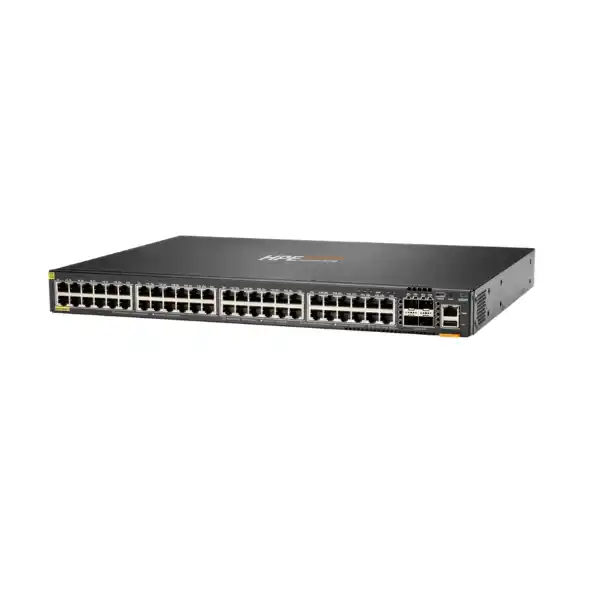
HPE Aruba Networking CX 6300F 48-Port PoE Switch in Dubai
A fixed-format enterprise access switch for organisations that need forty-eight Gigabit Ethernet PoE+ ports, high-speed SFP56 uplinks, advanced Layer 3 services and a scalable AOS-CX operating model without moving to a modular chassis.
Direct answer: what is the CX 6300F JL665A?
The HPE Aruba Networking CX 6300F JL665A is a 1U fixed Layer 3 switch with 48 Gigabit Ethernet PoE+ access ports and four high-speed SFP56 uplink ports. It is mainly used to connect and power enterprise endpoints such as wireless access points, IP phones, cameras and other Ethernet devices while providing advanced switching, routing and segmentation functions through AOS-CX. It suits medium to large office floors, campuses, branches and distributed enterprise networks that need dense PoE access. The most important item to confirm before ordering is the complete design: total PoE wattage, uplink speed and media, stacking requirements, management platform and any optional software subscriptions. FourTeck can help translate those requirements into the correct switch, optics, cabling, licenses, configuration scope and UAE quotation.
What the HPE Aruba Networking CX 6300F 48-Port PoE Switch does
The CX 6300F JL665A sits at a useful point between basic fixed access switching and more modular high-power access platforms. Its forty-eight copper downlink ports provide 10/100/1000BASE-T connectivity and IEEE 802.3af/802.3at PoE, allowing a single switch to serve a dense group of powered edge devices. The four SFP56 uplink positions provide the path toward faster aggregation or stack links without consuming user-facing copper ports. This combination matters when an organisation expects many wired users or powered endpoints on a floor but still wants enough uplink headroom to avoid creating a bottleneck between access and distribution layers.
The JL665A is part of the HPE Aruba Networking CX 6300 family and runs AOS-CX. That operating system is built for programmable operations, telemetry, routing, segmentation and automation. The switch is therefore not limited to simple Layer 2 access. It can participate in designs that use OSPF, BGP, VRF, EVPN and VXLAN where those capabilities fit the chosen architecture and software entitlement. For many buyers, the value is not a single feature but the ability to use the same switching family from straightforward user access through more sophisticated campus designs while retaining a consistent operating model.
PoE planning is central to the decision. Each access port can provide up to 30 W, but the chassis has a stated maximum PoE budget of 740 W. Forty-eight devices cannot therefore all draw 30 W simultaneously at full allowance, because that theoretical demand would be 1,440 W. A buyer should calculate realistic device consumption, startup behaviour and growth margin. A deployment with ordinary desk phones may fit comfortably, while a floor full of higher-power wireless access points, pan-tilt-zoom cameras or mixed IoT devices may require a different port distribution, additional switches or a higher-power model in the CX 6300 family.
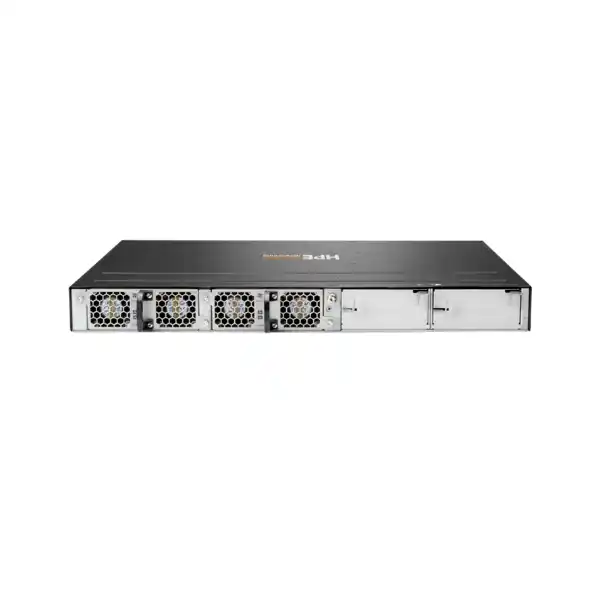
The fixed power supply and fixed fans also distinguish the 6300F from modular 6300M choices. The fixed design can simplify ordering and reduce component decisions, but it does not provide the same field-replaceable power-supply flexibility as modular models. Where power-supply redundancy, higher total PoE output or Smart Rate multi-gigabit access is a hard requirement, a CX 6300M or another model should be evaluated rather than assuming the JL665A is automatically the right fit.
Dense PoE access
Forty-eight Class 4 PoE ports make the switch relevant for office floors and edge closets with many powered endpoints. The practical limit is the 740 W chassis PoE budget, so endpoint wattage must be calculated rather than estimated from port count alone.
High-speed uplink path
Four SFP56 ports support 1, 10, 25 and 50GbE connectivity. HPE specifies the 50GbE capability for DAC use, making cable and transceiver selection an important part of the bill of materials.
Scalable switching
VSF can combine up to ten compatible CX 6300 members into a logical stack, supporting simplified operations and capacity growth. Stack topology, uplink usage and supported media should be planned before ordering optics or DACs.
AOS-CX operations
The switch uses AOS-CX and can be managed locally or through supported HPE management platforms. Cloud or advanced management features can require separate subscriptions, so the operational model should be decided with the hardware purchase.
Verified specifications for JL665A
| Specification | HPE Aruba Networking CX 6300F JL665A |
|---|---|
| Product type | Fixed-format, stackable Layer 3 managed Ethernet switch |
| Access ports | 48 × 10/100/1000BASE-T PoE+ ports |
| PoE standard | IEEE 802.3af and IEEE 802.3at; up to 30 W per access port |
| Maximum PoE budget | 740 W |
| Uplinks | 4 × SFP56 supporting 1/10/25/50GbE; 50GbE capability is specified for DAC connectivity |
| Management / service ports | 1 × USB-C console, 1 × out-of-band management, 1 × USB Type-A host |
| Power supply | Internal fixed 950 W power supply |
| Switching capacity | 496 Gbps model switching capacity |
| Throughput | 369 Mpps model throughput capacity |
| CPU | Quad-core ARM Cortex-A72 at 1.8 GHz |
| Memory / flash | 8 GB DDR4 / 32 GB eMMC |
| Packet buffer | 8 MB |
| VSF stack size | Up to 10 members |
| Stacking bandwidth | 200 Gbps, 400 Gbps full duplex |
| MAC table | 32,768 entries |
| VRFs | 256 |
| Dimensions | 44.2 × 32.7 × 4.39 cm (W × D × H) |
| Weight | 5.10 kg |
| Rack mounting | 19-inch EIA rack/cabinet; 2-post rack kit included |
| Operating temperature | 0°C to 45°C up to 5,000 ft; derating applies at higher altitude |
| Airflow | Front and side-to-back |
| Power input | 50–60 Hz; 100–120 V or 200–240 V AC |
Specification values above are based on the current HPE Aruba Networking CX 6300 Switch Series QuickSpecs for JL665A. Transceiver compatibility, software features, license terms and regional ordering codes should be reconfirmed at quotation time.
Who should consider the CX 6300F JL665A?
This model is most relevant when the access layer requires a high number of standard Gigabit Ethernet endpoints and a substantial, but not extreme, PoE budget. Typical examples include corporate office floors with mixed laptops, desk phones and wireless access points; education buildings with classroom connectivity and cameras; hospitality properties with APs, VoIP devices and room systems; and branch or campus networks that need consistent AOS-CX administration across multiple wiring closets.
It can also suit environments that want more capable routing and segmentation at the access layer. The CX 6300 family supports advanced Layer 3 functions including BGP, OSPF, VRF, EVPN and VXLAN. These capabilities can help when an organisation is moving away from purely Layer 2 access and wants a more distributed architecture, routed access, fabric overlays or policy-based segmentation. The presence of a feature in the platform does not mean every project needs it; the design should remain proportionate to operational skill, scale and business requirements.
A buyer should not select JL665A solely because it has forty-eight PoE ports. The correct question is whether the combination of 1GbE downlinks, 30 W maximum per port, 740 W total PoE budget, fixed PSU and SFP56 uplinks matches the endpoints and availability requirements. If many access points require multi-gigabit copper speeds or more than 30 W, a Smart Rate and higher-PoE model may be more appropriate. If the project needs PSU redundancy inside each access switch, the modular CX 6300M family deserves comparison.
For Dubai and UAE deployments, the switch is especially relevant where a standardised enterprise access design must be repeated across several floors or sites. In those cases, the important work is not only choosing the switch but defining a repeatable bill of materials: rack accessories, patching, optics or DACs, fibre type, UPS capacity, VLAN and routing design, authentication policy, monitoring platform and configuration template. FourTeck can help organise those inputs before quotation so hardware selection and deployment scope are aligned.
PoE design: why the 740 W budget matters
Power over Ethernet is often the deciding factor for a forty-eight-port access switch. The JL665A can provide PoE+ on all forty-eight copper interfaces, with individual ports supporting up to 30 W under IEEE 802.3at. However, the switch has a maximum PoE power budget of 740 W. This means the deployment must be designed using aggregate power, not simply the per-port headline. A full set of forty-eight endpoints drawing 15 W each would require 720 W and fits within the published maximum before allowing for design margin. Forty-eight endpoints drawing 20 W would require 960 W and would exceed it.
Real networks rarely have every endpoint at the same consumption. A floor might contain ten wireless access points, twenty IP phones, eight cameras, several door controllers and unused ports reserved for growth. The correct approach is to list the powered device model, maximum or negotiated PoE class, expected quantity and any devices with high startup demand. The resulting total should leave sensible headroom for replacements and future additions. This calculation also affects UPS sizing because the access switch may be responsible for keeping phones, APs and security devices running during brief power interruptions.
The fixed 950 W PSU supplies both system power and the PoE load. Because the PSU is internal and fixed on the 6300F, there is no option to add a second power module to increase the PoE budget or provide field-replaceable PSU redundancy. That makes the JL665A straightforward for deployments where 740 W is sufficient and external power resiliency is handled at the rack or UPS level. Where the design requires greater PoE output or dual hot-swappable power supplies, compare a CX 6300M model rather than trying to stretch the JL665A beyond its intended power envelope.
PoE policy is also an operational consideration. Network administrators can use power priority and monitoring practices to control what happens if demand approaches the available budget. Mission-critical devices such as access points, phones or security endpoints may need clearly defined priorities. Documentation should record which switch ports serve which devices, expected draw and any reserved capacity. This becomes particularly important after moves and changes because the original power calculation can become inaccurate over time.
Do not assume that 48 PoE+ ports means 48 devices can each consume 30 W simultaneously. For JL665A, calculate the total expected load against the 740 W maximum and include growth margin. If the result is close to the limit, distribute endpoints across additional switches or evaluate a higher-power model.
Uplinks, SFP56 connectivity and stacking design
The four front-panel SFP56 ports are a major reason to consider the CX 6300F rather than a lower-tier access switch. They can operate at 1, 10, 25 or 50GbE, allowing the same switch to connect to an existing Gigabit or 10GbE distribution layer today while leaving a path toward 25GbE or selected 50GbE links. HPE notes that the 50GbE capability on this platform is for DAC connectivity, so buyers should not assume that every 50GbE optical transceiver is valid. The exact cable or optic must be matched to the required speed, distance, fibre type and supported transceiver matrix.
Uplink sizing should begin with traffic patterns rather than port count. Forty-eight 1GbE access interfaces can theoretically present a large aggregate demand, but most office networks have substantial statistical multiplexing. A pair of 10GbE uplinks may be adequate for general user access, while dense wireless, video, storage or engineering workloads can justify 25GbE. Redundancy also matters: many designs use at least two uplinks, which can be connected to separate aggregation devices or used in a link aggregation group depending on the topology.
VSF uses front-plane links to combine compatible CX 6300 switches into a logical stack. The family supports up to ten members, and HPE lists stacking bandwidth of 200 Gbps, or 400 Gbps full duplex. A stack can simplify configuration, operations and link aggregation because multiple physical switches are managed as a single system. It also supports growth: an organisation can begin with the required number of access switches and add members as port demand increases, subject to topology and support requirements.
Stacking still requires design discipline. Decide whether the stack will use a chain or ring, which SFP56 ports will be dedicated to stacking, what link speeds will be used and whether uplink ports remain sufficient after stack links are assigned. HPE specifies that VSF stacking is not supported on the 1GbE access ports. Long-distance stack links may be possible with appropriate long-range 10GbE or 25GbE transceivers, but fibre type, distance, optics and supported combinations should be validated before procurement.
For high-availability architectures, the CX 6300 family also supports VSX clustering on suitable designs. VSX is different from VSF: it retains independent control planes across two switches while synchronising selected state. A network architect should choose between VSF and VSX based on topology, operational preference and failure-domain requirements rather than treating them as interchangeable names for stacking.
AOS-CX management, automation and visibility
AOS-CX is one of the most important differences between the CX 6300F and conventional entry-level switches. The operating system is designed around a programmable, database-driven architecture that supports automation, telemetry and consistent configuration workflows. For an IT team, this can make the switch easier to integrate into modern operations because configuration data, monitoring information and APIs are part of the platform rather than being add-ons to a legacy command-line model.
HPE Aruba Networking Network Analytics Engine can monitor selected operational states and events, using time-series data and agents to help administrators identify changes, anomalies and conditions that can affect service. In practical terms, a switch can provide richer context than a simple up/down alarm. This is useful when troubleshooting intermittent port errors, congestion, routing state or environmental conditions. The exact monitoring workflow depends on AOS-CX release, configuration and the management platform used.
HPE Aruba Networking Central can provide centralised onboarding, configuration, monitoring, troubleshooting and reporting for supported switches. A Central Foundation subscription enables comprehensive switch management, while a Central Advanced subscription adds higher-tier security and AIOps capabilities and includes the CX Advanced Feature Pack according to current HPE documentation. Buyers should therefore distinguish between owning the hardware and subscribing to a particular cloud-management capability. If Central is part of the target operating model, the subscription term and tier need to be included in the quotation.
HPE also documents HPE Mist Wired Assurance support for CX switches under specified software and subscription requirements. That can be relevant for organisations standardising around Mist operations, but it should not be assumed to be included with the switch. HPE states that Mist Wired Assurance requires a Mist subscription and a compatible AOS-CX release. A buyer should decide whether the switch will be managed through local AOS-CX tools, Aruba Central, Mist or a combination approved by the organisation’s architecture team.
Multi-Edit is another operational capability within the CX ecosystem. It supports coordinated configuration and validation across multiple switches, but HPE notes that a separate software license is required. This is a good example of why a switch quote should not be reduced to the hardware line item. The management experience can depend on subscriptions, software entitlements and the scale of the deployment.
FourTeck can help define the intended management method before the purchase is finalised. Useful inputs include the number of switches, whether the organisation already uses Aruba Central or HPE Mist, required subscription duration, need for advanced segmentation, change-control process, existing monitoring tools and desired level of configuration assistance. Clarifying those points early reduces the risk of buying hardware that later lacks the software entitlement expected by the operations team.
Layer 3 routing and segmentation considerations
The CX 6300 series is positioned as a stackable Layer 3 platform rather than a basic edge switch. HPE lists support for technologies including OSPF, BGP, VRF, EVPN and VXLAN. These functions can be useful in routed-access designs, campus fabrics and environments that want stronger separation between user, server, guest, voice, IoT and operational technology traffic. The ability to create many VRFs and large routing tables gives architects options for segmentation, but the design should be aligned with the organisation’s actual security and routing policies.
Dynamic Segmentation is an important concept within HPE Aruba Networking designs. It enables role-based policy to be applied across wired and wireless clients, reducing dependence on VLAN location alone. In suitable architectures, user or device identity can influence access policy, and traffic can be carried across an EVPN/VXLAN overlay. This can be valuable when users move between buildings or connect through different media but require consistent policy treatment.
However, advanced segmentation should not be purchased as a slogan. The customer should identify the enforcement model, identity source, authentication method, gateway or switch role, management platform and software tier needed to deliver the intended policy. Some advanced functions are subscription or feature-pack dependent. A design workshop before procurement can establish whether the project needs conventional VLANs and ACLs, downloadable roles, centralised tunnelling, distributed policy or an overlay fabric.
For straightforward branch networks, the switch may simply provide VLANs, static or dynamic routing, access-control lists and QoS. For larger campuses, it can become part of a more structured Layer 3 or fabric design. The important point is that the same hardware can support different operational models, but those models have different configuration complexity, dependencies and support requirements.
When requesting a quote, buyers should state whether the switch is intended as pure access, routed access, aggregation or another role. They should also provide the expected VLAN or VRF count, routing protocol requirements, authentication design, uplink topology and any fabric requirement. This information helps determine whether JL665A is sufficient and whether additional licenses, services or alternative models should be considered.
Product-fit matrix for the CX 6300F 48-Port PoE Switch
| Requirement | Suitable when | Confirm before ordering |
|---|---|---|
| 48-port user access | The closet needs a full forty-eight ports of standard 1GbE copper access. | Future growth, patching density and whether multi-gigabit access is required. |
| PoE endpoints | Most devices require IEEE 802.3af/at power and the total load remains within 740 W. | Device wattage, startup requirements, power priority and growth margin. |
| High-speed aggregation | The design can use 10GbE, 25GbE or supported 50GbE DAC uplinks. | Fibre type, distance, transceivers, DAC compatibility and port allocation. |
| Stack growth | Multiple compatible CX 6300 switches should operate as a VSF stack. | Member count, stack topology, stack-link speed and physical distance. |
| Cloud management | The organisation wants centralised monitoring and configuration through a supported HPE platform. | Subscription tier, term, tenant design and existing management environment. |
| Power redundancy | External rack/UPS resilience is acceptable and a fixed internal PSU is sufficient. | Whether field-replaceable or dual PSU capability is mandatory. |
| High-power / multi-gig edge | Only a limited number of devices need more than standard Gigabit/30 W service, or none do. | If many endpoints need 2.5/5/10GbE or 60–90 W, evaluate a different CX 6300 model. |
When JL665A may be a strong fit
Office-floor consolidation
A dense floor with many desk phones, PCs, printers and access points can benefit from forty-eight PoE+ ports in one rack unit. The model is especially relevant where standard 1GbE at the edge remains sufficient and higher-speed capacity is concentrated in the uplinks.
Campus standardisation
Organisations already using AOS-CX may prefer to keep a consistent switch family across buildings. VSF stacking, common management methods and similar operational workflows can reduce the number of platform variations that administrators must maintain.
PoE-heavy but not ultra-high-power edge
The 740 W PoE budget can support a substantial number of phones, cameras and standard-power APs. It fits best when the calculated device load stays comfortably below the limit and no large group of endpoints requires Class 6 or Class 8 power.
When another CX 6300 option should be evaluated
A different model may be the better choice when the project requirements move outside the JL665A’s fixed access profile. The first trigger is multi-gigabit copper. Modern high-end wireless access points can exceed 1GbE on the wired side and may benefit from 2.5GbE, 5GbE or 10GbE Smart Rate connectivity. If a large portion of the access points or specialised devices require those speeds, a CX 6300M Smart Rate model should be compared rather than using a 1GbE-only downlink design.
The second trigger is PoE power. JL665A provides Class 4 PoE+ with up to 30 W per port and a 740 W aggregate budget. Devices requiring 60 W or 90 W cannot be treated as standard 30 W endpoints. HPE’s modular CX 6300M range includes models that support higher PoE classes and substantially larger aggregate budgets when equipped with appropriate power supplies. This is relevant for high-performance access points, advanced cameras, displays and other high-power IoT equipment.
The third trigger is hardware redundancy. The 6300F uses a fixed internal PSU and fixed fans. If the customer requires field-replaceable fans, hot-swappable PSUs or dual power-supply redundancy at the switch level, the modular 6300M architecture provides a more suitable starting point. That decision should be made at design time because external UPS protection does not create the same failure behaviour as a second internal PSU.
A smaller twenty-four-port 6300F may also be a better purchase when the port requirement is limited and unlikely to grow. Buying forty-eight ports for a small branch can add unused capacity and cost without improving reliability. Conversely, if a floor needs more than forty-eight ports, a VSF stack or multiple access switches may be preferable to trying to force all endpoints into a single chassis.
FourTeck can help compare the JL665A with adjacent CX 6300F and CX 6300M models based on actual port demand, PoE budget, uplink speed, redundancy, Smart Rate requirements and management subscriptions. The goal is not to recommend the largest switch, but to choose the model whose constraints match the network plan.
Compatibility and integration checks before purchase
Switch compatibility is broader than whether an Ethernet cable fits the port. The first check is the endpoint layer. Confirm that devices connected to the forty-eight copper interfaces use 10/100/1000BASE-T and that their power requirements fit IEEE 802.3af or 802.3at. Devices that need multi-gigabit Smart Rate or IEEE 802.3bt higher-power classes should be identified separately because they may require another access-switch model.
The next check is uplink media. An SFP56 cage is physically flexible, but actual support depends on speed, transceiver or DAC type, AOS-CX release and HPE’s supported component matrix. A buyer should record the required link distance, fibre type, connector, peer device and speed. For example, a short in-rack stack connection may use a DAC, while a building-to-building uplink may need optical transceivers and appropriate fibre. HPE’s specific 50GbE note for DAC use on this model must be respected.
Stack compatibility also matters. HPE states that compatible CX 6300F and CX 6300M models can be mixed in a VSF stack, but the exact topology, speed and software version must be planned. CX 6300L has different stacking rules and should not be casually mixed into a design intended for 6300F/6300M VSF. If a stack includes different access-port or PoE models, documentation should clearly identify why each member is present and how power, uplinks and redundancy are distributed.
Management integration should be checked against the customer’s current environment. If Aruba Central is already used, the buyer should confirm the appropriate subscription and tenant onboarding process. If HPE Mist Wired Assurance is required, the relevant subscription and supported AOS-CX release must be included in the implementation plan. If local CLI, REST APIs, SNMP or third-party automation is preferred, the team should define authentication, logging, backup and change-control requirements.
Physical compatibility is equally important. The switch is a 1U device for a standard 19-inch rack and includes a 2-post rack kit. The rack should provide enough depth for the 32.7 cm chassis, cabling bend radius and rear power connection. Airflow is front and side-to-back, so cabinet design and neighbouring equipment should not obstruct intake or exhaust. The room temperature and ventilation should remain within the published operating envelope.
Finally, review power and electrical requirements. The fixed PSU accepts 100–120 V or 200–240 V AC at 50–60 Hz. In a UAE deployment, the exact PDU connection, plug type, UPS output, rack power allocation and regional ordering code should be confirmed with the quotation. This avoids the common problem of receiving correct network hardware with an unsuitable power accessory or incomplete rack plan.
Deployment and installation considerations in Dubai and the UAE
A successful deployment begins before the switch is mounted. Each cabinet should be surveyed for rack space, power, UPS capacity, grounding, patch-panel layout, cooling, cable management and uplink paths. A forty-eight-port PoE switch can concentrate a significant number of services into one rack unit, so physical organisation matters. Poor patching can make troubleshooting difficult and obstruct airflow even when the switch itself is correctly installed.
Port mapping should be prepared in advance. Network teams should identify which ports will serve access points, phones, cameras, printers, users, building systems and spare capacity. This mapping allows VLANs, authentication, QoS, PoE priorities and monitoring policies to be configured systematically. It also makes commissioning faster because engineers can validate each device against a planned port rather than discovering the topology after cables are connected.
Uplink design should include redundancy. Depending on the architecture, the switch may use two separate uplinks to a distribution pair, a link aggregation group, VSF topology or another resilient design. The correct choice depends on the upstream devices and whether the access switch is standalone or stacked. Optics and fibre patch leads should be ordered only after the required speed, connector and distance are confirmed.
Configuration should cover more than VLAN creation. A production deployment may require management addressing, out-of-band management, DNS, NTP, AAA, RADIUS/TACACS integration, SNMP or API access, syslog, spanning-tree policy, link aggregation, routing protocols, ACLs, DHCP protections, IPv6 controls, QoS, PoE settings, loop protection and software image management. The exact scope should be documented so the customer knows what is included in installation and what remains part of broader network design.
Testing should validate both connectivity and operational behaviour. Typical checks include access-port speed and duplex, PoE negotiation, VLAN membership, authentication, IP reachability, uplink redundancy, routing adjacencies, stack status, management-platform visibility, logs and backup configuration. Where the switch powers wireless access points or cameras, a sample of those devices should be tested under normal traffic conditions.
For larger UAE projects, staged rollout can reduce risk. One location or stack can be used as a reference configuration, after which validated templates are applied to additional switches. This approach is especially useful when many branches or floors share the same design. The reference build should document firmware release, subscriptions, transceivers, configuration version and test results.
FourTeck can assist with requirement review, bill-of-material development, installation planning and configuration scope. Service availability and onsite coverage depend on project location, quantity and agreed scope, so those details should be included in the quotation request rather than assumed from the hardware purchase.
Performance and capacity planning
HPE lists a model switching capacity of 496 Gbps and model throughput of 369 Mpps for JL665A. These figures indicate that the platform is designed to forward traffic at enterprise access-layer rates without treating every feature as a software-only function. Buyers should still interpret performance in the context of their architecture. End-user experience can be limited by access-link speed, uplink oversubscription, WAN bandwidth, server capacity, wireless design or policy configuration long before the switch reaches its headline forwarding limit.
A useful sizing exercise is to group traffic by endpoint type. Desk users and phones usually create bursty traffic with low average utilisation, while wireless access points may aggregate many clients behind a single port. Cameras generate more continuous flows, and storage or backup devices can sustain high throughput. If several high-bandwidth endpoints share the same access switch, uplink capacity may need to be increased even though the individual copper ports remain 1GbE.
Routing scale can also matter in larger networks. HPE publishes 61,000 IPv4 unicast routes, 61,000 IPv6 unicast routes, 32,768 MAC entries and 256 VRFs for this model. Most branch and campus access deployments will use a fraction of these values, but the numbers show that the switch is not limited to small flat networks. For complex routed-access or segmentation designs, architects should validate scale against the complete configuration rather than rely on one table value in isolation.
Packet buffering and queue configuration can influence behaviour under congestion. The JL665A has an 8 MB packet buffer, and the CX platform supports configurable queuing to align traffic handling with application priorities. QoS design is especially important if voice, video, business-critical applications and general data share the same uplinks. Incorrect QoS can create unexpected results even on a high-capacity switch, so classification and trust boundaries should be documented.
Capacity planning should include growth. A floor that uses forty ports today may exceed forty-eight after expansion, and a PoE load that uses 650 W today may approach the 740 W maximum after new cameras or APs are installed. Building 15–25 percent operational headroom into port, PoE and uplink planning can reduce forced redesigns, although the exact margin should reflect the customer’s growth forecast and budget.
Security and policy considerations
The access switch is a policy enforcement point, not just a connection point. AOS-CX supports access-control lists, role-based capabilities and a range of IPv4 and IPv6 protections. HPE documents IPv6 controls such as RA guard, DHCPv6 protection, dynamic IPv6 lockdown, neighbour-discovery snooping, destination guard and DHCP guard. These features can help reduce common local-network risks, but they must be configured to match the organisation’s addressing and authentication design.
Dynamic Segmentation can extend identity-based policy across wired and wireless infrastructure. In a suitable HPE architecture, users and devices can be assigned roles that influence communication regardless of physical port location. This is useful for organisations with large numbers of IoT devices because policy can be based on device identity and function rather than relying solely on many manually managed VLANs.
Authentication is another design decision. Network teams may integrate the switch with RADIUS or TACACS services for administrative access and endpoint admission. The exact protocol, certificate, role and fallback behaviour should be documented before rollout. A misconfigured authentication policy can disrupt user access, so staged testing is advisable before applying strict controls to all ports.
Security also includes the management plane. Use dedicated management addressing where appropriate, restrict administrative access, synchronise time, send logs to a protected collector and maintain configuration backups. Out-of-band management can provide a separate path for administration during production-network issues. Whether OOBM is connected on every switch depends on the customer’s operational model and available management network.
Licensing should be checked when advanced security or fabric functions are part of the requirement. HPE offers an optional CX Advanced Feature Pack, and Central Advanced subscriptions can include those advanced features. The hardware model alone should not be used as proof that every desired policy capability is licensed. FourTeck can help identify which features are needed and what software entitlement should accompany the switch.
Licensing and subscription questions to settle early
Does the switch require a subscription to operate?
The hardware runs AOS-CX; a cloud-management subscription is not the same thing as the switch’s basic ability to function. However, features delivered through Aruba Central, HPE Mist Wired Assurance, Multi-Edit or the CX Advanced Feature Pack can require separate subscriptions or licenses. Decide which operational capabilities are required before finalising the quote.
Which Aruba Central tier is relevant?
HPE documents Central Foundation for comprehensive switch management and Central Advanced for additional security and AIOps capabilities. Advanced also includes the CX Advanced Feature Pack under current HPE documentation. The correct tier depends on the intended management and policy workflow.
What about HPE Mist Wired Assurance?
Mist Wired Assurance is available for supported CX switches under defined subscription and AOS-CX version requirements. It should be specified as an operational choice, not assumed to be included in the JL665A hardware purchase.
Why does license term matter?
Subscription duration affects budget, renewals and lifecycle planning. A multi-site project should standardise license start dates where practical so the IT team does not inherit a fragmented set of renewal dates and inconsistent feature levels.
Buyer questions before ordering JL665A
Is 1GbE enough for every access device?
JL665A provides standard Gigabit Ethernet copper downlinks. That is suitable for many PCs, phones, cameras and access points, but it may be restrictive for high-end Wi-Fi access points or specialist devices that can use 2.5GbE, 5GbE or 10GbE. Identify those endpoints before choosing the model.
Will 740 W cover the PoE requirement?
Only a device-by-device calculation can answer this reliably. Add the planned maximum draw of all powered endpoints, consider startup behaviour and reserve capacity for growth. If the total is close to 740 W, a split across more switches or a higher-power model can provide safer operating margin.
Are optics or DACs included?
Do not assume uplink transceivers, fibre patch leads or DAC cables are included with the base switch. The required components depend on peer equipment, distance, speed and link type. These items should be listed explicitly in the bill of materials.
Can multiple 6300 switches be stacked?
Yes. The CX 6300 family supports VSF stacking up to ten members for compatible models. Stack link ports, speeds, media and software compatibility should be planned before purchase. The 1GbE access ports are not used for VSF stacking.
Does the fixed PSU create a limitation?
It can, depending on availability requirements. A fixed PSU simplifies the appliance but does not provide the hot-swappable dual-PSU model available in modular alternatives. If internal PSU redundancy is mandatory, evaluate a CX 6300M design.
Which software release should be installed?
Use a release supported for the desired feature set and management platform. The selected AOS-CX version should be validated against the customer’s standards, security requirements, subscription features and interoperability needs before production rollout.
What information is needed for an accurate quotation?
Provide quantity, site location, desired delivery timeframe, PoE endpoint list, uplink speed and distance, stack design, required optics or DACs, management subscription preference, support requirements and installation/configuration scope. This produces a more useful quote than requesting only the switch model.
Procurement checklist for a complete bill of materials
- Confirm exact base model JL665A and required quantity.
- List every powered endpoint and calculate aggregate PoE demand against 740 W per switch.
- Confirm whether all copper endpoints are satisfied by 1GbE and up to 30 W.
- Define uplink speed: 1GbE, 10GbE, 25GbE or supported 50GbE DAC.
- Specify transceivers, DACs, fibre type, connector and link distance.
- Define standalone, VSF or VSX topology and redundancy expectations.
- Confirm Aruba Central, HPE Mist, Multi-Edit or local management requirements.
- Add required subscription tiers and terms as separate quote items.
- Check rack depth, 1U space, airflow and cable-management clearance.
- Confirm PDU connection, UPS capacity and local power-cord requirement.
- Define AOS-CX target version and software policy.
- State installation, configuration, migration and testing scope.
- Confirm support entitlement and warranty details at quotation time.
- Confirm current UAE availability and vendor lead time before scheduling deployment.
Practical deployment scenarios
Corporate office floor with wired users and Wi-Fi
Consider an office floor with twenty-five wired users, twelve IP phones, six wireless access points, two meeting-room systems and several spare ports. The port count fits comfortably within forty-eight. The PoE calculation should include the phones, APs and room systems; if their combined maximum draw is well below 740 W, JL665A can provide both connectivity and power in one 1U device. Two 10GbE or 25GbE uplinks may be used to the distribution layer depending on expected traffic and upstream capability. The customer should then decide whether switches are standalone or stacked and whether management is local or through Aruba Central.
School or training building
A school may connect classroom APs, phones, cameras, printers and administrative devices from one wiring closet. The dense port count is useful, but surveillance cameras can create continuous traffic and PoE load. Designers should calculate camera power, video bandwidth and uplink utilisation rather than applying a generic office profile. VLAN or role-based segmentation may separate students, staff, cameras and building systems.
Hotel or serviced residence access layer
Hospitality environments can have many powered endpoints spread across guest rooms, corridors and shared spaces. A forty-eight-port PoE switch can consolidate APs, phones, cameras and management devices, but the physical cable plan and UPS requirement are significant because loss of one access switch can affect many services. Where the service-impact requirement is strict, compare fixed versus modular power architecture and consider stack or dual-uplink designs.
Multi-floor enterprise campus
In a larger campus, multiple JL665A units can be deployed per floor and grouped through VSF where appropriate. Standard configuration templates can define VLANs, authentication, QoS, management and monitoring. High-speed SFP56 uplinks help maintain consistent capacity toward the distribution layer. The main design question becomes whether standard 1GbE/30 W access remains sufficient across the planned lifecycle; if new APs require multi-gigabit speeds or higher PoE classes, a mixed CX 6300F/CX 6300M approach may be more economical than using one model everywhere.
Lifecycle, firmware and operational planning
Enterprise switching is a multi-year investment, so the purchase should include an operational plan. Start by deciding how firmware versions will be selected, tested and deployed. AOS-CX updates can introduce features, fixes and security improvements, but production networks should follow a controlled process: review release notes, validate dependencies, test on a reference device or non-critical site, back up configuration and confirm rollback procedures.
The CX 6300 family supports in-service software upgrade capabilities in specific conditions, including VSF environments and supported release paths. HPE documents mechanisms intended to maintain forwarding through certain upgrade scenarios. The exact behaviour depends on topology, release and feature use, so maintenance windows should still be designed from official documentation for the selected AOS-CX versions rather than assuming every upgrade is nondisruptive.
Subscription lifecycle matters as much as firmware. If the organisation uses Aruba Central, HPE Mist Wired Assurance or an advanced feature entitlement, renewal dates should be tracked centrally. A hardware refresh plan that ignores subscription expiry can create a mismatch between expected and available management functions. Multi-site deployments are easier to administer when license terms and renewal windows are standardised.
Spare strategy should be considered for fixed-format switches. Because the JL665A has a fixed PSU and fans, an internal power or fan failure is handled differently from a modular 6300M where individual components may be field-replaceable. Some organisations keep a spare switch for critical locations, while others rely on vendor support and network redundancy. The correct approach depends on service criticality, support contract and acceptable restoration time.
Before deployment, document the switch serial number, asset tag, rack position, management address, software release, configuration backup location, uplink optics and subscription association. These records reduce troubleshooting time and simplify later support, replacement or audit activities.
How FourTeck can support selection and deployment
FourTeck can help turn a switch request into a complete, deployment-aware bill of materials. For JL665A, that process usually begins with the number of locations, ports and powered endpoints. The next step is calculating PoE demand and identifying devices that need more than standard 1GbE or 30 W. Uplink distances and speeds are then used to select the appropriate transceivers, fibre components or DACs.
Management and licensing are reviewed separately from hardware. If the customer uses Aruba Central, FourTeck can include the required subscription tier and term in the quotation once the desired management features are defined. If the customer intends to use HPE Mist Wired Assurance or other licensed CX capabilities, those requirements should also be stated so software and hardware are aligned.
Configuration assistance can be scoped for the project rather than assumed. Typical requirements may include base AOS-CX configuration, VLANs, link aggregation, routing, stack formation, AAA, logging, SNMP, PoE policy, access controls, management-platform onboarding and testing. Larger projects may need design review, standard configuration templates and phased migration.
For organisations replacing an older access-switch environment, FourTeck can help identify migration dependencies. Important questions include whether VLAN IDs and IP subnets remain unchanged, whether endpoint authentication is being introduced, whether existing optics can be reused, whether old stacking designs map cleanly to VSF, and whether management tooling is changing at the same time. These details affect both hardware selection and implementation effort.
Use the FourTeck contact page to share the switch quantity and project requirements. You can also review enterprise networking products or discuss installation and configuration services when the scope extends beyond supply.
UAE availability and quotation guidance
Contact FourTeck to confirm current UAE availability for the HPE Aruba Networking CX 6300F JL665A. Availability can vary with exact ordering code, quantity, regional power option, vendor lead time and whether the quote includes subscriptions, optics or other accessories. A published model reference does not by itself confirm local stock or immediate delivery.
For the most accurate Dubai quotation, provide the number of switches, destination, expected project date, uplink design, required transceivers or DACs, Aruba Central or other management subscription requirements, installation scope and support expectation. If the project covers multiple UAE sites, include the site list and desired rollout sequence so delivery and configuration planning can be coordinated appropriately.
Warranty and support terms should be confirmed against the exact quoted SKU and selected service entitlement. Do not assume that a support level, replacement time or onsite response is automatically included with the base switch. FourTeck can include the applicable support options in the commercial proposal once the desired coverage is known.
Frequently asked questions
What is the exact part number for the 48-port PoE CX 6300F?
The standard HPE part number is JL665A for the CX 6300F 48-port 1GbE Class 4 PoE switch with four SFP56 uplinks. Regional variants or bundled ordering codes may add suffixes, so the final quote should identify the exact orderable SKU.
How much PoE power does JL665A provide?
The switch has a maximum PoE budget of 740 W. Its forty-eight access ports support IEEE 802.3af and 802.3at PoE, with up to 30 W per port. Aggregate endpoint demand must remain within the chassis budget.
Does the CX 6300F support 50GbE uplinks?
The four SFP56 ports support 1/10/25/50GbE operation. HPE specifies the 50GbE capability for DAC connectivity, so confirm the exact cable and peer-device compatibility before ordering.
Can JL665A be stacked?
Yes. Compatible CX 6300F and CX 6300M switches can participate in VSF stacks, with the family supporting up to ten members. Stack ports, speeds, topology and software release should be validated during design.
Is Aruba Central included?
Aruba Central management is subscription based. The hardware purchase should be separated from the management subscription, and the Foundation or Advanced tier should be selected according to the required operational and security features.
Is this switch suitable for high-power Wi-Fi access points?
It is suitable for access points that operate within 1GbE and IEEE 802.3at Class 4 PoE limits. APs needing multi-gigabit copper or more than 30 W should trigger a comparison with Smart Rate and higher-PoE CX 6300M models.
Does the fixed model have redundant power supplies?
No. JL665A has an internal fixed 950 W power supply. If the design requires hot-swappable or dual internal power supplies, evaluate a modular CX 6300M alternative.
What should I send FourTeck for a quote?
Send quantity, UAE delivery location, PoE device list, required uplink speeds and distances, stack requirement, optics or DAC needs, management subscription preference, support level and installation/configuration scope.
Decision recap for the CX 6300F JL665A
What FourTeck needs to prepare the right quotation
A useful quote should cover the complete access-layer requirement, not only the switch chassis. Share the following project inputs so the bill of materials can be matched to your network.
Confirm whether JL665A is the right access switch for your project
FourTeck can help confirm the HPE Aruba Networking CX 6300F 48-Port PoE Switch against your actual port count, PoE load, uplink design, stacking plan and management requirements. We can also help identify the optics, DACs, subscriptions and configuration scope that should appear in the same bill of materials. Current UAE availability, lead time and support options should be confirmed against the final quantity and exact ordering code.

Reviews
There are no reviews yet.