
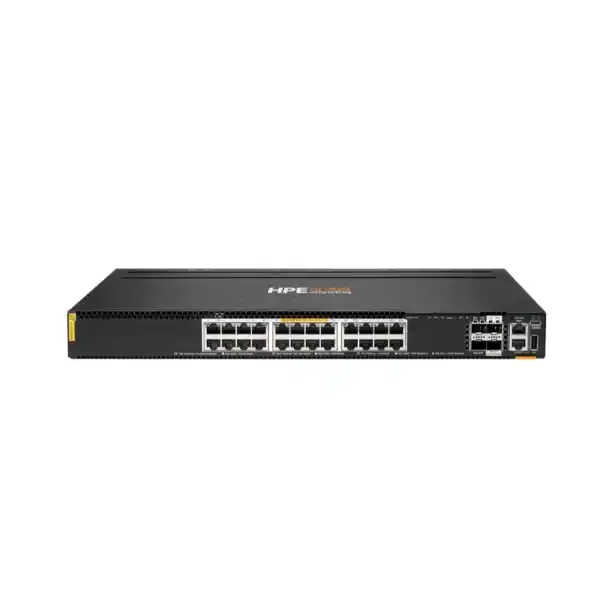
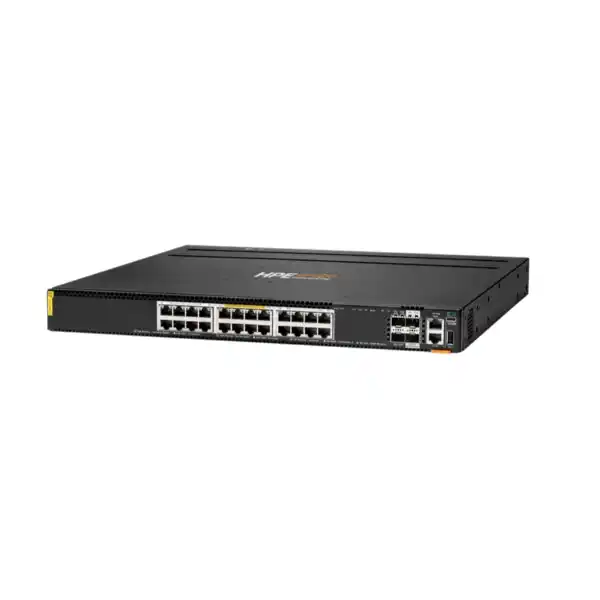
HPE Aruba Networking CX 6300L 24-Port Smart Rate Switch S3L75A in Dubai
A 24-port multi-gigabit access switch for organisations that need 1/2.5/5/10GbE copper connectivity, Class 6 PoE, high-speed 25G/50G uplinks, MACsec capability and scalable CX 6300L-only stacking.
Direct answer for business buyers
The S3L75A is the 24-port HPE Aruba Networking CX 6300L Smart Rate model, positioned as a stackable Layer 2 access switch with multi-gigabit copper interfaces and high-speed fibre uplinks.
It is mainly used where Wi-Fi access points, workstations, specialist endpoints or edge devices need more than 1GbE and may also need high-power PoE.
Enterprise offices, campuses, education, hospitality, healthcare and high-density branches that want 24 high-performance access ports rather than a larger 48-port chassis.
Confirm PoE demand, PSU choice, optics or DACs, cable capability at 2.5/5/10GbE, stack topology and whether Layer 2 positioning matches the planned routing design.
FourTeck can map endpoint counts, power demand, uplink speeds, stacking, management and installation requirements into a practical UAE quotation.
Where the CX 6300L S3L75A fits
The CX 6300L S3L75A is aimed at the enterprise access layer rather than being a generic unmanaged or entry-level switch. Its defining characteristic is the combination of twenty-four HPE Smart Rate copper ports, each designed for multi-gigabit operation, with dedicated high-speed fibre interfaces for uplink or stacking duties. That makes it relevant when edge bandwidth is increasing because of modern wireless access points, creative workstations, imaging devices, high-throughput endpoints or converged networks that have outgrown traditional 1GbE access.
The model also matters when buyers want to keep port count controlled. A 24-port design can make more sense than a 48-port switch in smaller wiring closets, premium meeting floors, branch offices or locations where many endpoints need higher speed or power but physical port density is moderate. The buying decision should therefore be based on the number and type of endpoints, not simply on the largest switch available.
A key distinction: CX 6300L is Layer 2 focused
HPE positions the CX 6300L family as Layer 2 access switches. The platform still supports capabilities useful in an enterprise access design, including IPv4 static routing, quality of service, access control lists and User-Based Tunneling for Dynamic Segmentation, but it should not automatically be treated as a direct substitute for a CX 6300F or CX 6300M where broader Layer 3 feature requirements drive the architecture.
This distinction is important during refresh projects. If the design expects the access switch to participate in advanced dynamic routing, campus core functions or a more complex routed-access architecture, the feature requirement should be validated against the intended AOS-CX release and, where necessary, a different CX 6300 variant should be compared.
Core technical profile
| Specification | S3L75A buyer-relevant detail |
|---|---|
| Access ports | 24 × HPE Smart Rate copper ports supporting 1GbE, 2.5GbE, 5GbE and 10GbE operation, with Class 6 PoE capability. |
| High-speed uplinks | 2 × SFP56 interfaces supporting up to 50GbE and 2 × SFP28 interfaces supporting up to 25GbE, subject to supported optics/DAC combinations. |
| PoE | IEEE 802.3af/at/bt support with Class 6 power delivery up to 60W per supported access port; total available PoE depends on installed PSU capacity. |
| Maximum PoE budget | Up to 2880W at system level when appropriately configured with supported power supplies; the actual design must be matched to expected endpoint draw and PSU selection. |
| Switching performance | Published model figures include up to 780Gbps switching capacity and approximately 580Mpps throughput. |
| Processing platform | Quad-core Arm Cortex-A72 at 1.8GHz with 8GB DDR4 memory, 32GB eMMC storage and 16MB packet buffer. |
| Stacking | VSF front-plane stacking up to 10 CX 6300L members. CX 6300L does not form a mixed stack with CX 6300F or CX 6300M. |
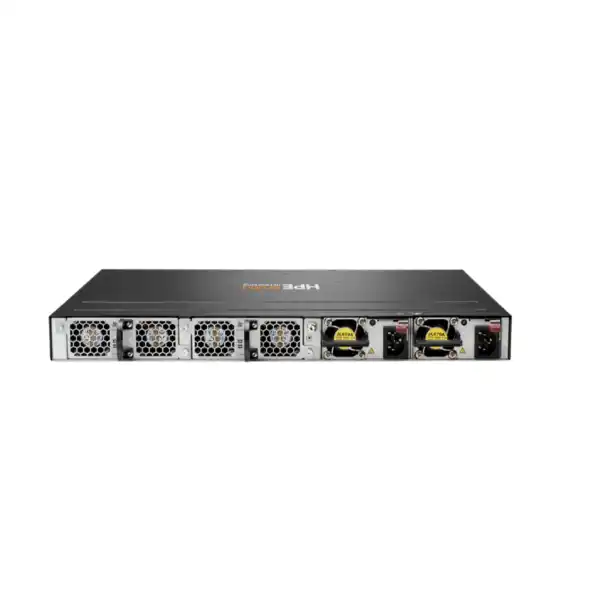
| Power architecture | Two field-replaceable, hot-swappable PSU slots; at least one supported PSU is required. Supported PSU families should be verified at quotation. |
| Cooling | Field-replaceable, hot-swappable fan design suitable for serviceable enterprise rack deployments. |
| Form factor | 1U rack-mountable enterprise switch for standard equipment cabinets; rack depth, airflow and cable management should be checked during installation planning. |
Why Smart Rate matters
Many enterprise networks still have Category cabling already installed in walls and ceilings, while endpoint requirements have moved beyond 1GbE. HPE Smart Rate is designed to provide multiple Ethernet speeds over copper so compatible devices can negotiate 2.5GbE, 5GbE or 10GbE where the cabling and endpoint support it. This is especially relevant for high-performance Wi-Fi access points, because wireless aggregate capacity can exceed what a single 1GbE wired uplink can comfortably carry.
The practical benefit is not that every endpoint should run at 10GbE. The benefit is flexibility: ordinary devices can operate at a lower negotiated rate while selected high-bandwidth devices use faster links. During a Dubai network refresh, cabling category, channel length, patching quality and endpoint NIC capability should be checked rather than assuming that every existing copper run will sustain 10GbE.
PoE sizing is a design exercise
Class 6 PoE support can deliver up to 60W on supported ports, making the switch suitable for more demanding powered endpoints than a conventional PoE+ access switch. However, the per-port capability and the total chassis budget are different numbers. A switch may support a high wattage on an individual port without being configured to provide the maximum wattage simultaneously on all ports.
For an accurate bill of materials, list the expected powered devices, their negotiated PoE class or worst-case draw, the number of devices per closet and the required power redundancy. That information determines whether a lower-capacity PSU arrangement is sufficient or whether a higher-power configuration is justified. Over-specifying PSUs raises cost, while under-sizing them can create avoidable deployment limitations.
High-speed uplinks prevent edge bottlenecks
Twenty-four multi-gigabit access ports can generate substantial aggregate traffic. The two SFP56 and two SFP28 interfaces give designers options for higher-speed uplinks, inter-switch connectivity or stacking. The correct choice depends on the upstream switch, transceiver support, fibre type, link distance and whether a DAC is appropriate inside the same rack or row.
A 50GbE-capable port does not automatically mean every 50G optic or cable is supported. HPE documentation places specific conditions on 50G use, including supported DAC scenarios. The quotation should therefore identify both ends of each uplink and the required distance so that the optical module or direct-attach cable can be selected from the supported matrix.
Stacking and resilience: what to plan before purchase
The CX 6300L family supports Virtual Switching Framework stacking with as many as ten members. A stack can simplify management and provide a more coherent access-layer design because multiple physical switches are operated as a coordinated system. For growing sites, this can be more practical than managing each access switch as an unrelated island. The S3L75A can therefore be deployed as a standalone switch initially or as part of a larger CX 6300L access stack when the topology requires it.
The most important compatibility rule is that CX 6300L members stack with CX 6300L members only. They are not intended to form a mixed VSF stack with CX 6300F or CX 6300M. This matters in refresh projects where an existing rack already contains another CX 6300 variant. The family name alone is not enough to establish stacking compatibility, so existing part numbers should be recorded before a new S3L75A is ordered.
Resilience also depends on power architecture, uplink design and physical topology. Two hot-swappable PSU slots make redundant power configurations possible, but redundancy requires the correct number and type of supported PSUs and suitable independent power feeds where true power-path resilience is required. Likewise, stacking improves operational simplicity but does not replace sound upstream redundancy, spanning-tree or multi-chassis design decisions where the network architecture needs them.
Management, automation and operational visibility
AOS-CX operational model
The CX platform uses AOS-CX, HPE Aruba Networking’s modern switch operating system. For buyers, the key advantage is a consistent operational approach across much of the CX portfolio. That can simplify training, configuration standards and troubleshooting when an organisation is standardising campus switching. Exact software release requirements should be checked for S3L75A, especially when introducing the model into an existing estate with a defined code baseline.
Centralised management
HPE Aruba Networking Central can be used for centralised visibility and management across supported wired and wireless infrastructure. Buyers planning cloud management should confirm the current subscription, entitlement and feature requirements rather than assuming that every management capability is included with hardware purchase alone. This is particularly important for multi-site organisations where licensing terms affect recurring cost.
Analytics and troubleshooting
The CX platform includes programmability and Network Analytics Engine capabilities intended to improve visibility and troubleshooting. The practical value is faster diagnosis of changing network conditions, but operational benefit depends on configuration, monitoring workflows and staff familiarity. A deployment plan should include alert ownership, logging destinations, configuration backup and a defined method for software maintenance.
Security and segmentation considerations
Access switches sit at the point where users, phones, cameras, access points and IoT devices enter the enterprise network, so security should be treated as part of the switching design rather than as a separate afterthought. The CX 6300L supports access control capabilities, quality-of-service controls and User-Based Tunneling used with HPE Aruba Networking Dynamic Segmentation designs. The S3L75A family positioning also includes MACsec support for link-layer encryption in supported configurations.
A secure deployment still requires policy decisions. VLAN structure, authentication method, device profiling, role assignment, access-control rules and uplink encryption should be planned against the organisation’s identity and security architecture. A feature existing in hardware does not mean it is automatically enabled or correctly integrated.
For regulated or security-sensitive environments, record which links actually require MACsec, whether peer devices support the required mode, and how keys or authentication will be managed. If the design relies on Dynamic Segmentation, the supporting HPE Aruba architecture and any relevant gateway or Central requirements should be validated before purchase.
When the S3L75A is a strong fit
- You need 24 copper access ports and expect a meaningful number of endpoints to use 2.5GbE, 5GbE or 10GbE.
- High-performance Wi-Fi access points need both multi-gigabit Ethernet and greater PoE headroom.
- You want a 1U enterprise switch with modular power and field-replaceable cooling rather than a simple fixed-power access device.
- Your uplink design benefits from dedicated 25G or 50G-capable interfaces.
- You plan to scale with additional CX 6300L switches and want VSF stacking across up to ten members.
- You prefer the AOS-CX operating model and HPE Aruba Networking management ecosystem for the access layer.
When another switch should be evaluated
The S3L75A should not be selected purely because it is a high-performance member of the CX 6300 family. If most endpoints are ordinary 1GbE devices with modest PoE requirements, a simpler access switch may deliver the required outcome at lower cost. If the site needs 48 access ports per rack, a CX 6300L 48-port variant may reduce switch count, although the 48-port models have different Smart Rate speed and PoE characteristics that must be compared carefully.
If the architecture depends on broader Layer 3 functions, advanced dynamic routing, different high-availability behaviour or mixed stacking with CX 6300F/CX 6300M, the CX 6300L family positioning may be too restrictive. In that case, a CX 6300F or CX 6300M model should be evaluated against the routing, resilience, uplink and power requirements rather than forcing the S3L75A into a role it was not chosen to perform.
Similarly, if 10GbE copper is required on only a handful of ports, another model with a mixture of 1GbE and multi-gigabit interfaces may be more economical. Good access-layer procurement starts with endpoint mapping and traffic expectations, not with a model number.
Practical deployment scenarios in Dubai and the UAE
High-density Wi-Fi floors
Modern access points can exceed 1GbE uplink demand and may require substantial PoE. A 24-port Smart Rate switch can suit floors where the number of APs is controlled but each AP needs a faster wired backhaul. Uplink capacity should be sized from expected aggregate wireless traffic, not simply from the number of access points.
Premium office and creative workloads
Engineering workstations, media systems, content teams or local high-speed storage workflows can benefit from 2.5/5/10GbE access. The switch can combine these devices with ordinary Gigabit endpoints while preserving higher-speed ports where needed. End-device NICs and horizontal cabling must be checked before promising 10GbE to the desk.
Hospitality and education
Hotels, training centres and campuses often combine wireless access points, cameras, building systems and user networks in the same closet. The S3L75A provides bandwidth and PoE flexibility, but segmentation, authentication and power calculations should be designed before installation so a mixed endpoint population remains manageable.
Branch consolidation
A branch with moderate port count but demanding endpoints can use the 24-port form factor without buying unnecessary 48-port density. Where several branches follow the same standard, a repeatable configuration, software baseline and monitoring policy can reduce support effort across the estate.
Installation and migration planning
Audit the existing closet
Record current switch models, rack space, patch-panel layout, UPS capacity, circuit availability, airflow, fibre termination, uplink distances and existing management dependencies.
Map ports and PoE
Classify every endpoint by required speed and power. Separate ordinary 1GbE clients from multi-gigabit APs or high-power devices so the switch and PSU configuration can be sized realistically.
Validate uplinks
Confirm upstream port type, required bandwidth, fibre or DAC choice, transceiver compatibility and redundancy. Avoid ordering optics from speed alone.
Set software and management
Define the target AOS-CX release, configuration standard, management platform, credentials, monitoring, logging and subscription requirements before cutover.
Plan cutover and rollback
Document VLANs, trunks, authentication, PoE-critical devices, stack sequence and rollback steps. For live environments, maintenance windows should reflect the operational impact of endpoint re-authentication and link renegotiation.
Power supply and redundancy choices
The CX 6300L uses modular power supplies rather than treating power as an afterthought. Supported PSU options span different capacities, and at least one PSU is required. The right combination depends on base switch consumption, total PoE load, input power availability and whether redundant operation is required.
For an accurate quote, provide a device-level PoE schedule. A design powering only a few access points may need far less capacity than a deployment with twenty-four high-power endpoints. If 1+1 resilience is required, that should be stated explicitly so the power design is calculated under a PSU-failure condition rather than only under normal operation.
Optics, DACs and cabling
The switch’s uplink slots provide flexibility, but optics are a separate compatibility decision. Fibre type, connector, distance, supported transceiver SKU, upstream platform and required speed all matter. For short in-rack connections, a supported DAC may be simpler; for building or campus links, optical transceivers may be required.
On the access side, existing copper should be tested against the intended Smart Rate speed. A link negotiating at 1GbE does not prove the same run will deliver 10GbE reliably. Cable category, termination quality, patch leads, channel length and electrical environment should be part of deployment validation.
Comparing nearby CX 6300 options
| Decision | CX 6300L S3L75A | Other CX 6300L models | CX 6300F / CX 6300M |
|---|---|---|---|
| Primary role | Layer 2 access with 24 high-speed Smart Rate ports. | Layer 2 access with higher 48-port density and different Smart Rate/PoE mixes. | Broader family choices for Layer 3, aggregation and specialised designs. |
| Copper speed | Up to 10GbE across 24 Smart Rate ports. | 48-port CX 6300L models are oriented to up to 5GbE Smart Rate access. | Varies by model, from 1GbE to multi-gigabit combinations. |
| Stack compatibility | CX 6300L only. | Can join a CX 6300L stack subject to model/software support. | Do not assume mixed stacking with CX 6300L. |
| Best reason to choose | You specifically need 24 ports of high-end Smart Rate access with Class 6 PoE and 25G/50G uplink options. | You need more access-port density and can accept the different port-speed profile. | You require features or architecture beyond the Layer 2-focused CX 6300L position. |
This comparison is intentionally role-based. Exact feature, software, uplink and licensing requirements should be mapped to the current HPE documentation for the candidate SKU before a final bill of materials is approved.
Procurement questions that improve quotation accuracy
If only two or three endpoints need multi-gigabit access, a different switch architecture may be more economical. If most of the 24 ports need 2.5/5/10GbE, the S3L75A becomes much more compelling.
Provide endpoint models where possible. APs, cameras, phones and specialist devices can draw very different power, and PSU sizing should be based on the expected simultaneous load plus resilience policy.
The upstream switch or router determines practical uplink choices. A 50G-capable port on the S3L75A is only useful when the peer, cable or optic and configuration support the intended link.
Record the exact part numbers of current stack members. CX 6300L must not be assumed to stack with CX 6300F or CX 6300M simply because the family number is similar.
If HPE Aruba Networking Central is part of the operating model, state the management scope and desired term so subscription and entitlement requirements can be checked as part of the commercial proposal.
Hardware supply and a complete deployment are different scopes. Rack installation, patching, configuration, migration, testing, documentation and post-cutover support should be listed separately when required.
Buying the HPE Aruba CX 6300L S3L75A in Dubai
For UAE procurement, the useful question is not only whether the S3L75A can be supplied, but whether the complete deployable configuration is specified correctly. Enterprise switches frequently depend on separately selected power supplies, power cords, transceivers, DACs, subscriptions and installation services. A quote that lists only the switch chassis may not represent the final working solution.
Dubai deployments can also vary significantly by site: a new office fit-out may have certified Cat6A and new fibre, while an older building may require cabling verification before 10GbE access is realistic. Data rooms may have different UPS, PDU and cooling constraints. Multi-site UAE projects may also require standardised configuration templates and staged deployment rather than a single delivery.
FourTeck can structure the quotation around the actual network requirement, including switch quantity, supported PSU choice, uplink media, PoE demand, stack architecture, management scope, installation and migration. That approach reduces the risk of receiving hardware that is technically correct in isolation but incomplete for the intended rack.
Frequently asked buyer questions
Is the CX 6300L S3L75A a 10GbE access switch?
Yes, its 24 HPE Smart Rate copper access ports support operation up to 10GbE when the connected device and cabling support that rate. It also supports lower negotiated speeds, so every port does not have to operate at 10GbE.
Does every port provide 60W PoE at the same time?
Class 6 capability allows up to 60W on a supported port, but simultaneous system-wide delivery depends on the installed PSU capacity and total PoE budget. The power design must therefore be calculated from actual endpoint demand.
Can it stack with a CX 6300M?
No. HPE specifies that CX 6300L switches stack with other CX 6300L switches and do not form a mixed stack with CX 6300F or CX 6300M. Existing stack member SKUs should be checked before expansion.
Are the power supplies included?
The CX 6300L platform uses modular power supplies and the exact bundle or regional configuration should be confirmed at quotation. At least one supported PSU is required, and the selected wattage directly affects available PoE and redundancy planning.
Do I need 50G uplinks?
Not necessarily. The presence of 50G-capable SFP56 interfaces gives design headroom, but 25G or another supported speed may be sufficient depending on aggregate access traffic and the upstream platform. Link requirements should be sized rather than maximised automatically.
Can existing Cat6 cabling be reused?
Potentially, but the supported rate depends on cable category, distance, installation quality and the endpoint. Do not assume every legacy channel will sustain 10GbE. Cabling validation is sensible where multi-gigabit performance is a procurement requirement.
Is HPE Aruba Networking Central mandatory?
The switch can be operated through supported local management methods, while Central is available for centralised management. Whether a Central subscription is appropriate depends on the organisation’s operating model, site count and desired cloud-managed capabilities.
Is S3L75A appropriate for a core switch?
Its HPE positioning is Layer 2 access. Although it has strong performance and high-speed interfaces, buyers with core or advanced routed-access requirements should compare CX 6300F, CX 6300M or another platform against the exact Layer 3 and resilience requirements.
What should be ordered with the switch?
Common dependencies include the correct PSU or redundant PSU arrangement, regional power cords, supported SFP28/SFP56 optics or DACs, patching, management subscriptions if required and implementation services. The exact list depends on the target rack and network design.
How should I decide between 24-port and 48-port CX 6300L?
Start with endpoint count and required Smart Rate speed. The S3L75A provides 24 ports with up to 10GbE Smart Rate access. The 48-port CX 6300L options provide more density but use a different access-speed profile, so the decision is not simply twice the number of ports.
Decision recap
Choose S3L75A when 24 multi-gigabit access ports and Layer 2 access positioning match the site.
Size uplinks from aggregate traffic rather than assuming the fastest port speed is always necessary.
Calculate endpoint PoE draw and resilience before choosing supported PSU capacity.
Validate optics, DACs, upstream interfaces, cabling and existing stack member SKUs.
Confirm AOS-CX baseline and any Central subscription or operational requirements.
Check rack, UPS/PDU, airflow, patching, fibre and migration scope before delivery.
What FourTeck needs for an accurate quotation
Build the right CX 6300L S3L75A configuration for your Dubai network
Share your port count, PoE devices, uplink design, existing switch environment and installation scope. FourTeck can help turn those requirements into a complete HPE Aruba Networking CX 6300L bill of materials instead of a chassis-only quote.

Reviews
There are no reviews yet.