
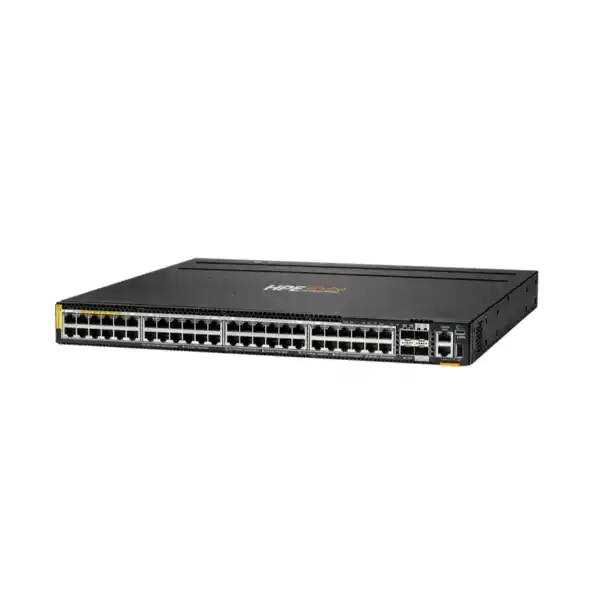
HPE Aruba Networking CX 6300L 48-Port Smart Rate Switch in Dubai
The S3L76A is a high-density Layer 2 multi-gigabit access switch for organisations that need 48 Smart Rate copper ports, advanced PoE delivery and fast 25G/50G uplinks without buying Layer 3 capability they do not intend to use at the access layer. It is particularly relevant for Wi-Fi access points, high-performance workstations, cameras, collaboration endpoints and other devices that can outgrow conventional 1GbE access.
Direct answer for buyers
The HPE Aruba Networking CX 6300L S3L76A is a 48-port Smart Rate, PoE-capable, stackable Layer 2 enterprise access switch in the CX 6300 family.
It is mainly used to connect high-density edge devices that benefit from 2.5GbE or 5GbE access, while providing fast uplinks toward aggregation or core switching.
Enterprises, campuses, hospitality sites, education networks and branch environments deploying modern Wi-Fi, IP endpoints or multi-gigabit user devices.
Confirm that a Layer 2 access design is appropriate, then size the PSU configuration, PoE load, uplink media, optics or DACs, stack topology and required management platform.
FourTeck can help translate device counts and power demand into the correct switch quantity, PSU mix, transceivers, cabling, stacking and implementation scope for a UAE deployment.
Exact model identity: why S3L76A matters
The phrase “CX 6300L 48-Port Smart Rate Switch” can refer to more than one closely related 48-port configuration, so buyers should not order only from the family name. This page is built around HPE product number S3L76A, whose current model description identifies 48 HPE Smart Rate copper ports operating at 100M, 1G, 2.5G and 5G, together with two SFP56 positions capable of 50G operation and two SFP28 positions intended for 25G-class uplinks. It is the Class 8 PoE-oriented 48-port CX 6300L variant and is explicitly positioned as a Layer 2 switch.
That distinction is important because another 48-port CX 6300L, S3L77A, uses a different uplink mix and Class 6/Class 8 port arrangement. The two models are not interchangeable merely because both have 48 Smart Rate access ports. When preparing a bill of materials, use the exact part number, confirm the uplink speed and media needed at the site, and verify how much endpoint power must be delivered simultaneously. This avoids a common procurement mistake in which the switch chassis appears correct but the uplink or PoE characteristics do not match the deployment plan.
Core S3L76A specifications
| Specification | Buyer-relevant detail |
|---|---|
| Product number | S3L76A |
| Access ports | 48 × HPE Smart Rate copper ports supporting 100M / 1G / 2.5G / 5G operation |
| PoE class | Class 8 capable access design; usable total PoE budget depends on the installed PSU combination and endpoint demand |
| High-speed uplinks | 2 × SFP56 50G positions plus 2 × SFP28 25G positions |
| Switching capacity | 780 Gbps |
| Throughput | 580 Mpps |
| Processor and memory | Quad-core Arm Cortex A72 at 1.8 GHz, 8 GB DDR4 and 32 GB eMMC; 16 MB shared packet buffer |
| Stacking | Up to 10 CX 6300L members; CX 6300L stacking is with other CX 6300L switches |
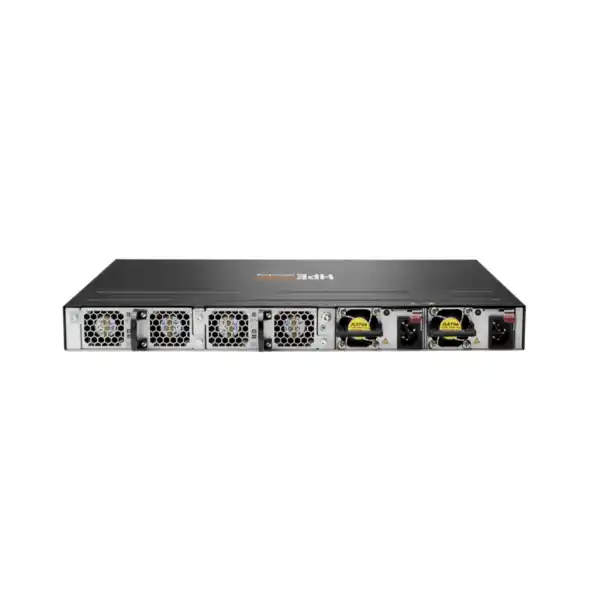
| Power architecture | Two field-replaceable, hot-swappable PSU slots; at least one supported PSU is required and is selected according to power needs |
| Console and management access | USB-C console, USB Type-A host and out-of-band management interface |
| Network role | Layer 2 access switching; do not assume the Layer 3 feature set of CX 6300F or CX 6300M models |
Why 48 Smart Rate ports change access-layer planning
Traditional access switching often assumes that every desk, phone, camera or access point will remain within a 1GbE envelope. That assumption is increasingly restrictive for high-density wireless and performance-sensitive edge devices. The S3L76A gives every one of its 48 copper access positions a Smart Rate path across 100M, 1G, 2.5G and 5G speeds, allowing the network team to provide multi-gigabit connectivity without dedicating separate specialist switches to faster endpoints.
The practical advantage is flexibility at the wiring-closet level. A floor may contain a mixture of ordinary 1GbE endpoints and devices that can negotiate 2.5GbE or 5GbE. The switch can serve both categories in the same access block, which helps when Wi-Fi access points are refreshed gradually or when workstation requirements differ by department. Multi-gigabit support is also useful where replacing horizontal copper cabling would be expensive, provided the installed cabling quality, distance and endpoint capabilities support the intended link rate.
Buyers should still treat Smart Rate as a design capability rather than an automatic performance guarantee. The endpoint NIC, cabling category and condition, patching, link negotiation and upstream capacity all influence the usable result. A 5GbE access link only creates business value when the device can use it and the uplink architecture has enough headroom. FourTeck can review the port-speed mix before quotation so that multi-gigabit density is matched to actual requirements rather than simply purchased as unused capacity.
PoE sizing is a purchasing decision
Class 8 capability is valuable for high-power access devices, but the correct PSU selection depends on the number of powered endpoints and their real power requirements. Do not size the project from the maximum per-port headline alone. Build an endpoint power table, allow for growth and decide whether a second power supply is required for capacity, resilience or both.
Power supplies are part of the BOM
The S3L76A has two hot-swappable PSU slots and requires at least one supported PSU. The appropriate power option depends on input power, target PoE reserve, redundancy policy and the electrical environment at the Dubai or UAE site.
Uplink design: two 50G plus two 25G positions
The S3L76A is especially useful where a 48-port multi-gigabit access layer would otherwise be constrained by modest uplinks. Its high-speed interfaces provide a path to 25G and 50G aggregation, giving designers room to consolidate traffic from dense wireless or user access. This does not mean every project needs all uplinks active at their highest supported rate. The correct configuration depends on oversubscription targets, stack design, aggregation switch capability, fibre type, link distance and whether direct-attach cabling can be used within the rack or row.
Optics and DACs should therefore be treated as explicit quotation items, not assumed to be included with the base switch. Check connector type, wavelength, fibre mode, distance and compatibility at both ends of each link. For stacking, also verify the required cabling and port allocation before hardware is shipped to site. A technically strong switch can still delay a deployment if the uplink media is left unspecified until installation day.
Performance for a dense multi-gigabit edge
For the S3L76A, HPE lists 780 Gbps of switching capacity and 580 million packets per second of throughput. Those figures are more relevant when interpreted alongside the port layout: 48 copper interfaces may run at different negotiated speeds while the switch also carries high-speed traffic toward upstream infrastructure. In other words, this is not merely a 48-port 1GbE access switch with a few faster ports added; its internal performance is designed for a substantially more demanding edge profile.
Actual application performance still depends on the complete network path. Congestion can occur upstream, on a firewall, WAN link, server interface or wireless medium even if the switch itself has ample switching capacity. For an office refresh, the best sizing question is not “Is 780 Gbps enough?” but “Where will traffic concentrate, what oversubscription is acceptable, and does the aggregation layer match the new access speeds?” Answering that before purchase produces a more balanced network than selecting access capacity in isolation.
Layer 2 positioning: the most important architectural check
The CX 6300 family includes models with broader Layer 3 feature sets, which can create confusion if buyers assume every switch carrying the “6300” name has the same routing role. The S3L76A is a CX 6300L model positioned for Layer 2 operation. That can be an excellent fit when routing, gateway functions and advanced Layer 3 policy are intentionally placed on an aggregation, core or security platform. It can also reduce over-purchasing when the access layer does not need those functions.
The limitation becomes important when the network design expects the access switch itself to participate in routing protocols or perform functions associated with the CX 6300F or CX 6300M feature set. In that case, the S3L76A should not be selected simply because its port density and PoE specification look attractive. The architectural role has to be confirmed first.
For greenfield deployments, document where default gateways will reside, how VLANs will traverse the access and aggregation layers, how redundancy is achieved and which device owns Layer 3 policy. For refresh projects, compare the current switch configuration to the intended CX 6300L configuration line by line. This is especially important if an older access switch has accumulated local routing features that were never captured in the design documentation.
Stacking and operational consistency
HPE documents support for stacks of up to 10 members for CX 6300L and notes that CX 6300L switches stack with other CX 6300L switches. That family boundary should be part of the migration plan. If an existing site already uses CX 6300F or CX 6300M switches, do not assume a new S3L76A can simply be inserted into the same stack. The logical and physical stack design must follow the supported model combination.
Stacking can simplify management and provide a more coherent access block, but it also creates choices about topology, cable type, port use and failure domains. Determine whether the project needs a single stack per communications room, multiple smaller stacks, or standalone units. Map how uplinks are distributed across members and how power redundancy is handled so that the loss of a PSU, cable or upstream path does not create an avoidable outage.
For multi-floor or campus projects, the stack plan should be documented before installation teams begin rack work. Label stack links and uplinks in the bill of materials, reserve the correct transceivers or DACs and define the intended member numbering. This is a small planning step that reduces commissioning errors and makes later support considerably easier.
Management, visibility and lifecycle operations
The CX 6300 platform uses AOS-CX and can be operated through established switch-management workflows including command-line and web-based access, while HPE Aruba Networking Central can be relevant where centralised management is part of the customer architecture. The most important procurement point is to decide the management model before deployment. A team that intends to use cloud-based central management may have subscription, account, onboarding and operational requirements that differ from a locally managed environment.
Operational design should also cover configuration backup, software lifecycle, administrative access, logging, monitoring, change control and troubleshooting responsibility. The S3L76A includes a dedicated out-of-band management interface and console connectivity, which is useful for recovery and isolated administration. Whether those interfaces are connected and monitored should be decided rather than left as an installation afterthought.
For larger UAE deployments, standardisation is often more valuable than individual device features. Agree on a baseline software release, naming scheme, management VLAN, authentication method, logging target, time source, configuration template and acceptance checklist. A repeatable baseline reduces variation across sites and helps support teams diagnose problems quickly when a change or endpoint issue occurs later.
Where the S3L76A fits well
Wi-Fi access layer
A strong fit where newer access points need more than 1GbE and may also require substantial PoE. The 2.5G/5G copper speeds provide room for wireless upgrades without moving every AP to fibre.
Digital workplace
Useful for design, engineering, media or data-heavy teams that use multi-gigabit desktop interfaces alongside ordinary 1GbE users on the same floor.
Hospitality and education
Dense endpoint environments can benefit from 48-port capacity, PoE flexibility and high-speed uplinks, particularly when access points, cameras and room devices share closet infrastructure.
Branch or campus refresh
A practical option where routing remains upstream but the access layer must move beyond 1GbE and support a broader range of powered endpoints.
When another CX 6300 option should be evaluated
The S3L76A should not be treated as the default answer for every CX 6300 requirement. If the access layer needs Layer 3 capabilities associated with CX 6300F or CX 6300M, compare those families instead. If the project needs 10GbE Smart Rate on copper access ports, a different CX 6300 model should be examined because the S3L76A access-speed profile tops out at 5GbE. If a 48-port design specifically needs the alternative Class 6/Class 8 arrangement and uplink mix of S3L77A, that model may be a better physical fit.
Conversely, if most endpoints are conventional 1GbE and PoE demand is modest, a lower-cost access configuration may deliver the same business outcome without paying for dense multi-gigabit capability. Selection should be driven by endpoint speeds, power requirements, uplink architecture, network role and growth expectations. FourTeck can compare nearby models using the actual device schedule rather than relying on family names alone.
Deployment planning for Dubai and UAE sites
A successful switch deployment begins before the hardware arrives. Confirm rack space, airflow direction, power availability, earthing, patch-panel layout and cable management. The CX 6300L is an enterprise rack switch, so cabinet depth, front and rear clearance, power distribution and service access should be checked against the site rather than assumed. In dense communications rooms, cable organisation matters because 48 copper links plus uplinks and stack connections can create a heavy patching load.
PoE projects require an additional electrical check. The network design may specify high-power endpoints, but the usable PoE budget is ultimately tied to PSU selection and input power. The electrical circuit and PDU must be able to support the chosen configuration. For dual-PSU designs, decide whether both supplies feed the same PDU or separate protected sources, and whether the objective is extra PoE capacity, power redundancy or both.
Environmental conditions also deserve attention. Communications rooms should maintain the operating environment required by the equipment and should not rely on open-office cooling assumptions. Dust control, airflow and unobstructed vents contribute directly to long-term reliability. Where the network serves critical hospitality, education, healthcare or operational workloads, power protection and monitoring should be incorporated into the wider site design.
Before cutover, validate VLAN assignments, trunks, link aggregation, management reachability, time and logging services, endpoint power behaviour and uplink redundancy. A staged migration is usually safer than moving an entire floor without port mapping. Capture the old switch port descriptions, map each endpoint to the new interface and define rollback steps for devices with special requirements.
Procurement checklist: what belongs in the quotation
A switch-only quote may look cheaper while leaving the project incomplete. For S3L76A deployments, the PSU and uplink choices are especially important because they influence PoE capacity, redundancy and inter-switch connectivity. A complete bill of materials should therefore be built from the network design, not from the chassis description alone.
Practical buyer questions
Does every access device need 5GbE?
No. The value of Smart Rate is that different endpoints can run at different supported speeds. A mixed floor can retain 1GbE devices while allowing capable access points or workstations to negotiate higher rates.
Is a power supply included automatically?
Treat the PSU as an explicit bill-of-materials item. The S3L76A provides two field-replaceable hot-swappable PSU slots and requires at least one supported PSU selected for the target power and resilience plan.
Can it join a CX 6300F stack?
No assumption should be made across the family. HPE states that CX 6300L models stack with other CX 6300L switches, so existing stack composition must be reviewed before purchase.
Does it replace a Layer 3 access switch?
Only when the network design does not require those Layer 3 functions at the access layer. The S3L76A is Layer 2 positioned, so gateway and routing responsibilities must be provided elsewhere where required.
Are optics included?
Do not assume so. Select compatible optics or DACs according to required speed, distance, fibre type and the interface at the upstream device. These should be listed separately in the quotation.
How many switches can be stacked?
HPE documentation lists support for up to 10 members in a CX 6300L stack. The stack topology, uplinks and cable plan should be designed before installation.
What determines the correct PoE budget?
Count every powered endpoint, record its expected and maximum demand, include growth and then select the PSU configuration that provides the required capacity and redundancy. Per-port capability alone is not enough.
Is S3L77A the same switch?
It is a related 48-port CX 6300L, but its Class 6/Class 8 arrangement and uplink mix differ. Use the exact HPE part number in procurement to avoid receiving a technically different configuration.
Migration from an existing access switch
Replacing a legacy switch with the S3L76A is not only a hardware exercise. Start by exporting the current configuration and identifying which settings are genuinely required in the new design. Record VLAN membership, trunks, link aggregation, voice and data segmentation, authentication dependencies, monitoring, management addressing and any unusual port settings. Then separate Layer 2 requirements from functions that may have been performed locally by the old switch but need to move upstream because of the CX 6300L role.
Next, build a physical port map. Mark endpoints that require PoE, note their power class where known and identify devices that can use 2.5GbE or 5GbE. This produces two useful outputs: a port-capacity plan and a realistic PSU requirement. It also prevents the new switch from being sized around an assumed uniform endpoint profile.
Finally, test the uplink and management path before moving large groups of users. Where possible, migrate in controlled batches and verify DHCP, DNS reachability, voice, wireless access-point adoption, camera recording paths and monitoring after each stage. A structured cutover turns the new multi-gigabit capability into an operational improvement rather than simply swapping one rack device for another.
Why this model is relevant to modern wireless rollouts
Wireless infrastructure is one of the clearest reasons to evaluate a multi-gigabit access switch. Modern access points can create a mismatch when a high-capacity wireless radio is connected through a traditional 1GbE Ethernet edge. The S3L76A gives network teams a dense set of 2.5GbE and 5GbE-capable copper interfaces, allowing a communications room to support a large number of faster AP uplinks while preserving standard Ethernet connectivity for other devices.
Power matters at the same time. Access points with additional radios, USB functions or more complex feature sets can have higher PoE demands than older generations. A Class 8-capable switch provides room for such endpoints, but the practical project still requires a PSU calculation. It is possible to have sufficient per-port capability but insufficient total power budget for the planned device count if the PSU combination is undersized.
For a Wi-Fi refresh, provide FourTeck with the access-point model, quantity per switch, expected negotiated Ethernet speed, maximum power requirement and redundancy preference. From that information, the switch, PSU, uplink and stack bill of materials can be reviewed together. This is more reliable than selecting the switch on port count alone.
For IT managers
Focus on access-layer role, management consistency, software standards, monitoring, migration and supportability. The S3L76A is strongest where dense multi-gigabit Layer 2 access is the real requirement.
For procurement teams
Use S3L76A as the controlling part number and request the PSU, optics, DACs, support and services as separate named items. This prevents near-identical CX 6300L variants from being substituted without technical review.
For network designers
Model uplink oversubscription, PoE demand, stack boundaries and failure scenarios. Confirm where Layer 3 functions reside and how 25G/50G uplinks integrate with the aggregation platform.
Decision recap
Choose S3L76A when 48-port Smart Rate Layer 2 access is the required role.
Match 2.5G/5G endpoint demand with 25G/50G upstream capacity and a realistic oversubscription target.
Calculate endpoint PoE demand first, then select the supported PSU combination.
Confirm transceivers, DACs, fibre, upstream interface speeds and CX 6300L stack composition.
Decide local versus central management, logging, software baseline and administrative access.
Validate rack, airflow, PDU, power source, patching, migration and acceptance testing.
What FourTeck needs for an accurate quotation
A precise quotation is faster when the technical scope is clear. Send the information you already know; missing items can then be resolved during the design review.
Plan the CX 6300L S3L76A around your real access-layer load
FourTeck can prepare a Dubai/UAE bill of materials that includes the exact S3L76A switch quantity, supported power supplies, PoE capacity, 25G/50G uplink components, stacking, installation and migration requirements. The objective is a complete deployment package rather than a chassis-only quote.

Reviews
There are no reviews yet.