
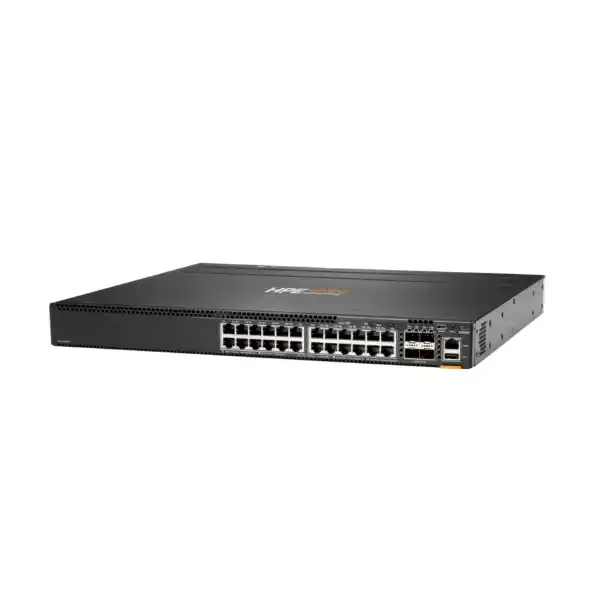
HPE Aruba Networking CX 6300M 24-Port 1GbE and 4-Port SFP56 Switch JL664A
A stackable enterprise Layer 3 switch for organisations that need dependable 1GbE copper access, high-speed 1/10/25/50GbE uplinks, modular power choices and the operational consistency of the HPE Aruba Networking CX platform. The JL664A is particularly relevant when PoE is not required at the edge and the design needs stronger uplink and stacking options than a basic fixed access switch.
Managed, stackable Layer 3 enterprise switch in the CX 6300M family.
Non-PoE. Connected endpoints must have separate power if they require it.
AOS-CX with local CLI/Web UI and optional HPE Aruba Networking Central management.
At least one compatible power supply is required and is ordered separately.
Direct answer: what is the CX 6300M JL664A?
The HPE Aruba Networking CX 6300M JL664A is a 1U, non-PoE enterprise switch with 24 copper 10/100/1000BASE-T access ports and four SFP56 uplink ports that support 1GbE, 10GbE, 25GbE and selected 50GbE connectivity. It is mainly used for enterprise access, distribution or aggregation designs where 1GbE endpoint connectivity must feed into faster uplinks or a resilient switch stack. It suits offices, campuses, server rooms and infrastructure zones that do not need PoE from these 24 access ports. Before proceeding, confirm the exact port, optics, power-supply, stacking and management requirements. FourTeck can help determine whether JL664A is the correct CX 6300M variant, identify compatible accessories and prepare a deployment-oriented quotation.
What the JL664A does in an enterprise network
The JL664A occupies a useful position between simple access switching and higher-capacity aggregation platforms. Its 24 copper access interfaces are designed for standard Ethernet devices that communicate at 10 Mbps, 100 Mbps or 1 Gbps, while the four high-speed SFP56 interfaces give network designers substantially more freedom on the uplink side. This combination can be useful in a floor-distribution cabinet, branch server room, back-office network, campus building or infrastructure zone where endpoints such as PCs, printers, controllers, appliances and non-PoE devices connect at 1GbE but the uplink to another switch must operate at 10GbE, 25GbE or an appropriate 50GbE configuration.
The switch runs HPE Aruba Networking AOS-CX, so it belongs to the same modern operating model used across the wider CX switching portfolio. For operations teams, that matters because the device can participate in an architecture that uses consistent configuration methods, routing features, telemetry and centralised management options instead of being treated as an isolated access box. The CX 6300 family supports advanced Layer 3 functions and multiple deployment roles, but the value of those features depends on the network design. A branch may use the JL664A primarily for access VLANs and resilient uplinks, while a campus design may use routing, segmentation or stack-based resilience more extensively.
The model is deliberately non-PoE. That is not a limitation when the connected devices have their own power or when the switch is used for infrastructure and non-powered endpoints. It can also avoid paying for PoE capability that is unnecessary in a specific cabinet. However, it is the wrong choice when the same access ports must power wireless access points, IP phones, surveillance cameras, badge readers or other powered devices. In those cases, a PoE-capable CX 6300M model such as JL662A or a Smart Rate PoE model such as JL660A should be evaluated instead of trying to solve the power requirement externally after purchase.
The four SFP56 interfaces are central to the model’s design value. They are not simply cosmetic uplinks. Depending on the chosen optics, direct-attach cables and supported configuration, they can be used for higher-speed inter-switch links and stack connectivity. This allows the access layer to avoid being constrained to a single low-speed uplink. The exact media, distance and speed must be planned before ordering because an SFP56 cage does not mean that every transceiver type or every speed-distance combination is automatically supported. The bill of materials should therefore include the actual transceivers, DACs, fibre patching or copper infrastructure required for the intended topology.
Who should consider this 24-port CX 6300M model?
JL664A is a strong candidate when a business needs 24 traditional copper Gigabit Ethernet access ports and wants the uplink, stacking and software architecture of the CX 6300M family without PoE. That can include office networks where desktop systems and printers are separately powered, industrial or operational environments that connect controllers through standard Ethernet, infrastructure racks that aggregate management interfaces, and branch or campus locations where the switch must forward access traffic to a higher-speed distribution layer.
It is also relevant when network teams want to standardise on AOS-CX across multiple switch roles. Standardisation can simplify configuration practices, troubleshooting workflows and change control, especially when the wider environment already uses HPE Aruba Networking switching. A consistent operating platform does not remove the need for design, but it can reduce the number of different management models that administrators have to maintain.
Procurement teams should shortlist the JL664A only after confirming that 24 access ports are enough for the rack over the planned service life. A switch that fits today but leaves no practical reserve can create an early expansion project. Conversely, buying a 48-port model for a permanently small environment can waste rack space and budget. The correct decision is based on active ports, expected growth, redundancy, spare-port policy and whether connected devices require PoE or multi-gigabit access speeds.
Typical fit signals
- Approximately 12–20 active 1GbE copper endpoints with room for controlled growth.
- No requirement to power endpoints directly from the access switch.
- Need for 10/25/50GbE-class uplinks or high-speed VSF stack links.
- Preference for AOS-CX operational consistency.
- Need for replaceable power and fan components rather than a fully fixed chassis design.
- Enterprise routing, segmentation or resiliency requirements beyond basic unmanaged switching.
Verified JL664A specifications that matter for selection
The following values are tied to the JL664A model rather than being maximum figures copied from another CX 6300M variant. Some capabilities in the wider family differ by port type, PoE class, newer hardware revision or software release, so buyers should keep the exact part number visible throughout quotation and configuration work.
| Specification | JL664A detail | Buyer relevance |
|---|---|---|
| Manufacturer | HPE Aruba Networking | Part of the CX 6300M switching family. |
| Part number | JL664A | Use this identifier to avoid confusion with 24-port PoE and SFP+ models. |
| Access ports | 24 × 10/100/1000BASE-T | Standard copper Gigabit Ethernet access; non-PoE. |
| High-speed ports | 4 × SFP56 supporting 1/10/25/50GbE options where supported | Used for uplinks, inter-switch connectivity and supported stacking designs; optics/DAC compatibility must be checked. |
| PoE | No | Choose another model if the switch must power APs, cameras, phones or other PDs. |
| Model switching capacity | 448 Gbps | Confirms the forwarding capacity of this specific 24-port copper model. |
| Model throughput | 334 Mpps | Useful when checking packet-forwarding requirements. |
| Processor | Quad-core Arm Cortex-A72 at 1.8 GHz | Supports the switch control and management plane. |
| Memory / storage | 8 GB DDR4, 32 GB eMMC | Platform resources for AOS-CX operation and system functions. |
| Packet buffer | 8 MB | Relevant to burst handling and congestion planning, but not a substitute for sound oversubscription design. |
| VSF stack size | Up to 10 members | Allows multiple compatible switches to be operated as a stack where the design supports it. |
| Stacking bandwidth | 200 Gbps; 400 Gbps full duplex | Important when sizing resilient inter-switch traffic paths. |
| Management ports | USB-C console, USB Type-A host, OOBM | Supports local console access, host use and out-of-band management design. |
| Power-supply bays | 2 field-replaceable, hot-swappable bays; minimum 1 PSU required | A compatible PSU is ordered separately; second PSU can be considered for redundancy. |
| Supported PSU | JL085A | Confirm power cord/localisation and redundancy requirements in the BOM. |
| Fan design | Field-replaceable fan-tray architecture | Confirm airflow direction and desired fan redundancy for the rack design. |
| Dimensions | 44.2 × 38.5 × 4.4 cm | Approximately 1U high; verify rack depth and cable clearance. |
| Weight | Approximately 5.43 kg | Relevant to rack loading and handling. |
| Operating temperature | 0°C to 45°C up to 5,000 ft; derating applies at higher altitude | Rack cooling and site conditions should be checked, especially in warm equipment rooms. |
Ports and uplinks: the most important JL664A design decision
The access side of the JL664A is straightforward: 24 RJ-45 ports provide 10/100/1000BASE-T Ethernet. This makes the switch appropriate for devices that need conventional wired connectivity at up to 1GbE. It does not provide multi-gigabit access on those RJ-45 ports and it does not supply PoE. If the requirement includes Wi-Fi 6/6E/7 access points that need more than 1GbE or require power from the switch, the access-port specification becomes the first reason to select a different CX 6300M model.
The four SFP56 interfaces create the main architectural advantage. A buyer can design higher-speed links toward an aggregation switch, core, server or compatible stack member, but the physical interface alone does not determine the final speed. The transceiver, DAC, fibre type, link distance, software support and peer-side interface must all match. For example, a 25GbE connection requires compatible 25GbE optics or cabling on both ends, while a 50GbE design must use a supported 50GbE method. HPE documentation notes specific restrictions around 50GbE use, so it is safer to treat 50GbE as a configuration that must be validated rather than assuming that any SFP56 optic can be inserted.
Uplink capacity should be sized from actual traffic, not simply from the largest speed available. Twenty-four 1GbE endpoints do not necessarily create 24Gbps of simultaneous northbound traffic. Office users may have much lower average utilisation, while a storage, backup or data-intensive environment may create sustained bursts that justify multiple uplinks. Network designers should review oversubscription, east-west traffic, resiliency and failure paths. If one uplink fails, the remaining path must still have enough capacity for critical traffic. Link aggregation can improve both bandwidth and resilience when the peer switch and topology support the required configuration.
The access cabling also deserves attention. Existing Category 5e or better cabling may be suitable for standard 1GbE copper links when correctly installed and tested, but cable condition, patch-panel quality and distance can still affect reliability. On the optical side, multimode versus single-mode fibre, connector type, distance and optic compatibility must be aligned. FourTeck can review these variables before the quotation is finalised so the order includes usable optics and patching rather than only the switch chassis.
VSF stacking and resilient growth
The CX 6300M platform supports Virtual Switching Framework stacking, with up to ten members in a compatible stack. For a growing organisation, this can simplify the operational model because multiple physical switches can be managed as a logical stack rather than as unrelated standalone devices. A stack can also make it easier to extend port density while retaining a common configuration and management approach. However, stacking should not be chosen only because the feature exists. The topology, inter-switch bandwidth, physical location and failure-domain requirements must be considered first.
JL664A supports high-speed stack connectivity through its SFP56 interfaces. HPE lists 200 Gbps stacking bandwidth, 400 Gbps when expressed as full-duplex aggregate capacity. The actual stack design depends on cable choice and supported topology. Long-distance stacking can be possible with appropriate long-range transceivers in supported scenarios, but using a geographically extended stack introduces operational and failure considerations that should be evaluated carefully. In many buildings, keeping stack members in the same or nearby rack environment is simpler to troubleshoot and maintain.
A resilient stack design should account for what happens when one member, one stack link or one power source fails. It should also consider the impact of software upgrades, maintenance windows and uplink placement. Distributing uplinks across appropriate members can avoid making one switch a single point of northbound connectivity. The exact design depends on the access architecture and peer devices, so the procurement discussion should include a simple logical topology rather than only the number of switches required.
Stacking is not the only resiliency method in the wider CX 6300 family. HPE also positions CX 6300 for designs that use VSX in selected scenarios, but the correct choice depends on platform support, topology and operational goals. Buyers should avoid assuming that every feature advertised at family level applies identically to every model and software release. The safest approach is to define the redundancy objective first—such as access continuity during a single-switch failure—and then confirm the supported architecture for the exact hardware and AOS-CX release.
AOS-CX management and operational model
The JL664A runs AOS-CX, HPE Aruba Networking’s operating system for the CX switching portfolio. For administrators, the operating system is as important as the port count because it determines how configuration is expressed, how changes are managed and which monitoring and automation capabilities are available. The switch can be managed locally through the command-line interface and web interface, and it includes an out-of-band management port that can be placed on a dedicated management network. Out-of-band access is valuable when production data paths are unavailable because it provides a separate route to the management plane.
HPE Aruba Networking Central is available as a centralised management option for the CX portfolio. Central can be useful for organisations that want a common operational view across distributed wired and wireless infrastructure. A Central subscription should be treated as a separate commercial and operational decision. The switch can be evaluated for local management without assuming that cloud management is automatically included. If Central is required, the subscription tier, term, device quantity and account design should be confirmed as part of the quotation.
Operational teams should also plan configuration standards before deployment. VLAN naming, interface descriptions, management IP addressing, authentication, logging, NTP, DNS, SNMP or telemetry, administrative roles and backup practices are simple details that become difficult to correct consistently after many switches are deployed. The best time to define these conventions is before the first switch enters production. For multi-site rollouts, a reusable baseline configuration can reduce avoidable variation while still allowing site-specific addressing and uplink settings.
Automation is valuable when it reduces repetitive work without hiding important state. AOS-CX exposes modern management and telemetry capabilities that can support structured operations, but organisations should match automation depth to their internal skills and change-control process. A fully automated approach is not automatically better for a small environment, and manual configuration is not automatically safer for a large one. The correct operating model should provide traceability, rollback planning and clear ownership.
FourTeck can scope the configuration requirement separately from the hardware purchase. Some buyers only need hardware and compatible accessories, while others need initial setup, VLAN and routing configuration, stack formation, uplink integration, Central onboarding or handover documentation. Defining that scope before quotation prevents ambiguity about what is included and which customer information must be supplied.
Layer 3 routing, segmentation and policy considerations
The CX 6300 series is positioned as a Layer 3 switching platform rather than a simple unmanaged access family. This allows the JL664A to participate in routed access, distribution and segmentation designs when the selected software release and configuration support the required functions. HPE lists routing technologies across the family including OSPF, BGP, VRF, EVPN and VXLAN. These features should not be enabled simply because they are available. The choice should follow the network architecture, scale and operational capability of the team.
For many office deployments, static routes, VLAN interfaces and a small number of dynamic-routing adjacencies may be enough. More advanced campus or data-centre-adjacent environments may use VRFs to keep routing domains separate or dynamic routing to provide resilient reachability. EVPN and VXLAN can be relevant in overlay designs, but they add architecture and troubleshooting complexity. A buyer selecting JL664A primarily for port density should not assume that an advanced overlay is required to gain value from the platform.
Segmentation should be planned around users, devices and risk, not only physical switch ports. Separate VLANs or routing domains may be required for corporate users, voice, building systems, guest access, management traffic and operational technology. The switch can enforce network boundaries as part of a wider design, but firewalling, authentication and endpoint security requirements may still sit elsewhere in the architecture. A switch ACL is useful for specific traffic-control tasks, yet it should not be described as a replacement for a dedicated security gateway where stateful inspection, threat prevention or internet-edge security is required.
Routing scale is another reason to use exact model documentation. HPE publishes model-specific table capacities for routes, hosts, multicast entries, MAC addresses and ACLs. These values are comfortably above the needs of many branch and campus access deployments, but large routing-heavy environments should validate them against actual design targets instead of treating the switch as an unlimited routing platform. If a network has unusually large route tables, many VRFs or intensive policy requirements, a higher-tier aggregation or core platform may be more appropriate.
During design review, FourTeck can help translate business requirements into practical switch questions: How many VLANs are needed? Will routing stay at the core or move to the access layer? Is dynamic routing required? Which uplinks must be redundant? Is central policy management part of the design? These questions are more useful than selecting features in isolation because they connect the hardware to the way the network will actually operate.
Power, fans, rack design and environmental planning
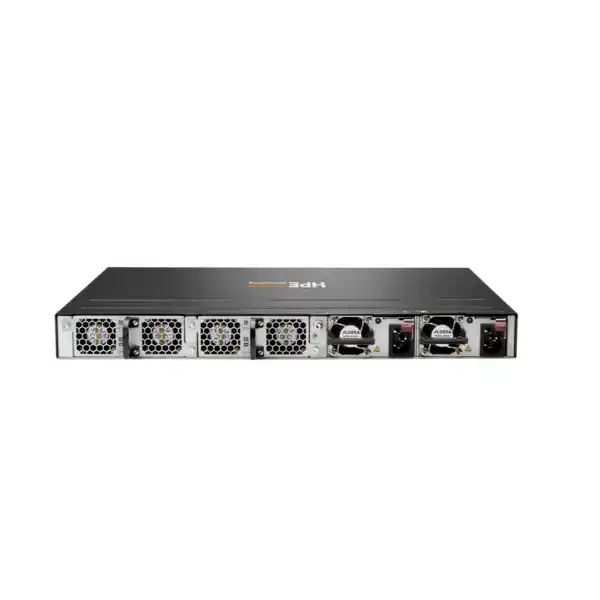
JL664A uses a modular power design. The chassis has two field-replaceable, hot-swappable power-supply slots and requires at least one compatible PSU. HPE identifies the JL085A power supply for this model, and the power supply is ordered separately. This detail is important for procurement because a switch chassis without the required PSU is not a complete deployable system. The bill of materials should also include the correct power cord or localisation option for the installation site.
A second power supply can be considered where power redundancy is required. Redundant PSUs are most useful when they are connected to genuinely independent power paths, such as separate PDUs or UPS-backed feeds. Installing two PSUs and connecting both to the same single point of failure does not provide the same level of resilience. The rack power design therefore needs to be discussed together with switch redundancy rather than treated as an accessory choice.
The modular fan architecture also matters in equipment rooms where maintenance and airflow planning are important. Buyers should confirm the fan-tray configuration and airflow direction against the rack layout. Mixed airflow directions can cause hot-air recirculation, particularly in dense racks. The switch is approximately 44.2 cm wide, 38.5 cm deep and 4.4 cm high, fitting the 1U class, but cable bend radius, power connectors and front/rear access add practical depth requirements beyond the chassis dimensions alone.
HPE specifies an operating temperature range of 0°C to 45°C up to 5,000 feet for the JL664A, with temperature derating at greater altitude. A controlled server room should normally stay well inside those limits. In Dubai and the UAE, however, equipment can sometimes be placed in small communications rooms with weak ventilation or high heat load. Ambient room temperature, rack exhaust and UPS heat should be considered during site assessment. A published maximum operating temperature should not be treated as a desirable normal target.
Environmental planning also includes dust, humidity, grounding, rack stability and maintenance access. The product is intended for professional network environments, not uncontrolled outdoor placement. If the deployment is in a warehouse, industrial zone or location with unusual heat, vibration or contamination, the environmental requirement should be reviewed before assuming a standard enterprise switch is suitable.
Product-fit matrix for JL664A
| Requirement | JL664A may fit when | Confirm before ordering |
|---|---|---|
| Access port density | 24 copper ports cover current demand with sensible spare capacity. | Growth forecast, patch-panel count and port-reserve policy. |
| Endpoint speed | Endpoints need up to 1GbE on copper. | Whether any endpoint needs 2.5/5/10GbE Smart Rate access. |
| PoE | Connected devices are independently powered. | Future AP, camera, phone or IoT power needs. |
| Uplinks | The design benefits from 1/10/25/50GbE-capable SFP56 interfaces. | Peer ports, optics, fibre type, DAC length and required bandwidth. |
| Stacking | Multiple compatible CX 6300 switches should operate as a VSF stack. | Member compatibility, stack topology and transceiver/cable choice. |
| Power resilience | Modular PSU architecture is preferred. | Number of PSUs, PDU paths, UPS design and local power cords. |
| Management | AOS-CX aligns with the organisation’s operational standard. | Local-only management versus HPE Aruba Networking Central subscription. |
| Routing | Layer 3 capabilities are required at access or aggregation. | Protocols, route scale, software feature support and architecture. |
Licensing, subscriptions and optional capabilities
A common purchasing mistake is to mix the switch hardware decision with the cloud-management decision. JL664A is an AOS-CX hardware platform and can be managed through local interfaces. HPE Aruba Networking Central is a separate management service that generally requires an appropriate subscription when selected. Buyers should therefore decide whether Central is part of the operational model, and if it is, the quotation should include the correct subscription quantity and term.
Advanced feature requirements should also be checked against the intended AOS-CX software release. HPE continues to develop the CX software platform, and the precise support of routing, security, telemetry and management functions can be release dependent. The safest procurement method is to identify the required feature—such as a specific routing protocol, EVPN/VXLAN function, authentication method or network-management integration—and verify support for the exact switch model and planned software release.
Optics, DACs, fibre patch leads, spare fan trays and power supplies are hardware options, not automatically included capabilities simply because the chassis has the corresponding slots. A complete quotation should state which of these items are included. The same applies to installation and configuration services. Hardware delivery does not automatically mean that rack installation, firmware alignment, stack formation, VLAN creation, routing integration, Central onboarding or testing are included unless those activities are part of the agreed scope.
For organisations with support-policy requirements, support coverage should be discussed separately from the base hardware warranty. HPE publishes warranty guidance for the platform, but the appropriate business-support service depends on desired response, replacement and software-support expectations. FourTeck can help capture those requirements in the quotation rather than assuming that the default hardware coverage matches the customer’s operational SLA.
Compatibility and integration checks
Switch compatibility is broader than whether an Ethernet cable physically fits. The first check is at Layer 1: access cabling, uplink optics, fibre type, connectors, distance and peer-port capability. A 25GbE or 50GbE uplink requires both ends of the connection to support the selected speed and media. A transceiver that operates in another product family should not be assumed compatible with JL664A without checking HPE’s current compatibility guidance.
The second check is topology compatibility. If JL664A will join a VSF stack, the proposed members, software levels, stack link speeds and cables should be validated as one design. HPE notes that CX 6300L switches have different stacking restrictions than the CX 6300M and CX 6300F families, so family names alone are not enough to determine stack compatibility. The stack should be planned using exact part numbers.
The third check is control-plane compatibility. Routing neighbours, authentication systems, management platforms, logging systems and monitoring tools need protocols and versions that align with the planned AOS-CX configuration. For example, an organisation using RADIUS or TACACS-based administrative control should confirm the desired authentication workflow. A site using an existing NMS should confirm how it will monitor switch health, interfaces and events. If HPE Aruba Networking Central is selected, account, subscription and onboarding prerequisites should be prepared before installation day.
The fourth check is power and physical compatibility. Rack depth, mounting standard, cable-management space, PDU socket availability, PSU input requirements and cooling direction should all match the site. This is especially important when a switch is replacing older equipment in a crowded rack where a nominally 1U replacement may still have different depth or connector positions.
Finally, configuration compatibility must be assessed during migrations. Syntax from a different switch vendor or an older ArubaOS-Switch platform should not simply be pasted into AOS-CX. VLANs, trunks, spanning-tree settings, link aggregation, routing, ACLs and management services should be translated deliberately. FourTeck can help define a migration checklist and validation plan so the new switch is integrated as part of a controlled change rather than a last-minute hardware swap.
Where JL664A fits among 24-port CX 6300M choices
The phrase “CX 6300M 24-port switch” can refer to several different HPE Aruba Networking products. JL664A is specifically the non-PoE copper 1GbE model. Buyers should compare the alternatives by access-media type, PoE requirement and endpoint speed rather than by the shared CX 6300M family name.
JL664A
24 × 1GbE copper, non-PoE
Choose when endpoints use standard copper Ethernet, do not need switch-supplied power, and four SFP56 uplinks provide the required northbound capacity.
JL662A
24 × 1GbE Class 4 PoE
Evaluate when the access switch must power compatible phones, cameras or access points through standard 1GbE copper ports.
JL660A
24 × Smart Rate Class 6 PoE
Evaluate when selected endpoints need multi-gigabit copper access and higher PoE capability than the JL664A can provide.
JL658A
24 × 1/10GbE SFP+ fibre
Evaluate when the access or aggregation requirement is primarily fibre rather than 24 copper RJ-45 ports.
There are also newer and specialised CX 6300M variants with different combinations of Smart Rate, PoE class, MACsec-capable uplinks and TAA requirements. Those should be considered when the project has compliance, encryption, high-power PoE or 10GbE access needs. FourTeck can compare current part numbers for the requested use case instead of treating all 24-port CX 6300M switches as interchangeable.
When JL664A may be the right fit
- The cabinet needs around 24 standard copper Gigabit Ethernet ports.
- Connected equipment is self-powered, so PoE would not add value.
- High-speed SFP56 uplinks are useful for aggregation or stacking.
- The organisation values AOS-CX consistency across its switching estate.
- Modular, replaceable power components are preferred for serviceability.
- Layer 3 routing or segmentation may be required at the switch.
When another model should be evaluated
- APs, cameras or phones need PoE from the switch.
- Endpoints require 2.5GbE, 5GbE or 10GbE over copper.
- More than 24 copper ports are needed in the same rack.
- The primary access requirement is fibre rather than RJ-45 copper.
- The design requires a specific newer uplink, MACsec or compliance feature not supported by JL664A.
- A lower-cost access platform can meet the full routing, resilience and management requirement.
Deployment planning for office, campus and infrastructure environments
In a conventional office access design, JL664A can serve a set of wired endpoints and send traffic through one or more higher-speed uplinks to the building distribution layer. The practical design questions are port count, VLAN assignment, uplink redundancy and how much spare capacity should remain. If voice phones or wireless access points need PoE, those devices may need to be connected to a different PoE switch, which can complicate patching. For that reason, an apparently inexpensive non-PoE choice should be assessed in the context of the whole cabinet.
In a campus environment, the CX 6300M family can support more advanced routing and stacking. JL664A may work as an access or aggregation node when its 1GbE copper access ports align with the endpoint profile. Stacking can add operational simplicity and port-density growth, but the uplink architecture should avoid unnecessary bottlenecks. A building with many users, IP surveillance streams or large file transfers may need multiple high-speed uplinks or a higher-capacity aggregation design.
In a server-room or infrastructure role, the 24 copper ports can connect management interfaces, appliances, controllers, console servers, low-bandwidth servers or other systems that use 1GbE. The SFP56 ports can provide faster connectivity to upstream switches. However, this model should not be confused with the JL658A fibre access model, which provides 24 SFP+ ports and is better aligned with environments that need many 1/10GbE optical interfaces.
For branch offices, the switch may provide more routing, stacking and uplink capability than a very small site requires. That is not automatically a disadvantage, but the network team should compare lifecycle needs against cost and complexity. If the branch has only a handful of endpoints, no advanced routing and no plan to grow, a lower-tier access model could be more appropriate. If the branch is strategically important and requires resilient uplinks, consistent AOS-CX operations and room for expansion, JL664A can become a stronger fit.
For any environment, the network diagram should identify downstream device categories, uplink peers, routing boundaries, management path, power source and redundancy. This simple step catches many mismatches before purchase. It can reveal, for example, that a supposedly non-PoE network actually contains access points that depend on PoE, or that the core switch only has 10GbE SFP+ ports and therefore does not benefit from a 25GbE design without an upgrade.
Installation and initial configuration considerations
A successful installation starts before the switch is placed in the rack. The project team should confirm rack units, rack depth, mounting hardware, PDU availability, airflow direction and cable routes. The JL664A is designed for standard rack mounting, but site-specific constraints can still cause problems. Short power leads, blocked ventilation, tight fibre bends and overloaded patch panels are common issues that are easier to resolve during planning than during a maintenance window.
The initial configuration should establish a secure management foundation. That normally includes the management address, default route or management VRF approach, administrative credentials, time synchronisation, DNS where required, secure management protocols and logging destinations. Unused services should not be enabled by default merely for convenience. If the organisation uses AAA services, the switch should be integrated using the approved authentication method while retaining a documented recovery process for situations where the external authentication system is unavailable.
VLANs and access interfaces should be configured from a documented port map. Port descriptions are worth the small effort because they reduce troubleshooting time later. Uplink interfaces should be validated for speed, optical power where relevant, link aggregation and VLAN/routing behaviour. If a stack is being built, stack member numbering, cabling and master/standby behaviour should be established before production endpoints are migrated.
Software version alignment is another important step. New hardware should not automatically be placed into production with whatever image happens to be installed from manufacturing. The network team should identify a supported release consistent with the organisation’s standard, compatibility requirements and change policy. Upgrades or downgrades should be planned before the switch carries production traffic.
Testing should cover more than a green link light. Validate management access, VLAN reachability, routing adjacencies, redundant uplink failover, stack health, monitoring visibility and representative endpoint traffic. For a replacement project, compare the new behaviour with the expected old-state services. FourTeck can include installation, configuration and testing tasks in the project scope when required, with the exact activities agreed before deployment.
Migration from an older access switch
Replacing an existing switch with JL664A should be treated as a service migration, not only a hardware replacement. The current switch configuration should be reviewed to identify active ports, VLANs, trunks, link aggregations, routing, spanning-tree settings, ACLs, monitoring, authentication and any unusual dependencies. Old configurations often contain years of legacy entries, so the migration is an opportunity to distinguish what is still required from what can be retired.
Port mapping is especially important when the old switch has a different port count or when patching is poorly documented. Before the change window, record which patch-panel outlets and devices are connected to each active interface. Identify critical systems that need priority testing after the migration. If any connected endpoint currently receives PoE, JL664A cannot replace that function directly; this would be a design mismatch that should be discovered before installation day.
Configuration translation should respect AOS-CX syntax and behaviour. Even when the existing device is another HPE Aruba Networking switch, commands and features can differ across operating-system generations. Recreate the intended network policy rather than copying syntax blindly. This is particularly important for trunks, spanning tree, LACP, routing and access-control rules, where small differences can create outages or loops.
A rollback plan should define what happens if the new switch cannot reach the expected peers or if a critical application fails after cutover. Retaining the previous switch configuration, documenting original cabling and keeping the old hardware available during the initial validation period can reduce recovery time. The rollback trigger should be decided before the maintenance window so the team does not debate it while services are unavailable.
Post-migration monitoring should continue after the first successful ping. Review interface errors, uplink utilisation, routing stability, log events and endpoint reachability. A migration can appear successful while hidden issues such as duplex negotiation, VLAN mismatch or oversubscription emerge only under normal business load. A short validation checklist provides much better assurance than relying on user complaints to reveal problems.
Security and operational control
Switch security begins with management access. Administrative interfaces should be reachable only from authorised management networks, credentials should follow the organisation’s identity policy, and secure protocols should be used for administration. Out-of-band management can provide a useful isolated path, but it should be protected like any other privileged network. Logging and time synchronisation are also fundamental because incident review is difficult when devices do not share accurate timestamps.
At the access layer, segmentation and authentication can reduce unnecessary trust between connected devices. The exact methods depend on the wider network design and identity systems. VLAN separation, ACLs and network-access-control integration can be used to enforce policy, while dynamic-segmentation capabilities in the HPE Aruba Networking ecosystem may offer additional options in supported architectures. Buyers should confirm the desired policy model instead of assuming that installing a modern switch automatically secures the endpoint network.
Configuration governance is equally important. Changes should be documented, backup copies should be maintained and firmware should follow a controlled lifecycle. A resilient switch can still become an operational risk if configuration is unmanaged. For organisations with multiple administrators, role separation and centralised audit processes can help reduce accidental changes. If HPE Aruba Networking Central is used, its management and visibility capabilities can become part of that operating model, subject to the selected subscription and architecture.
Physical security should not be ignored. Network racks should limit unauthorised access, especially when console and management ports are present. Fibre and copper patching should be labelled clearly to avoid accidental disconnection. Spare optics, power supplies and cables should be stored and tracked if the business relies on rapid local replacement. These practices are inexpensive compared with troubleshooting an undocumented production network.
How to size the JL664A for a real project
Start with the active endpoint count, not the total number of wall outlets. A floor may have 60 outlets but only 15 active devices, while another floor may have 20 outlets and nearly all of them in use. Record the number of devices that need wired Ethernet today, then add realistic growth and spare capacity. Many organisations prefer to avoid operating every switch at 100 percent port utilisation because moves, adds and failures become difficult to handle.
Next, classify endpoints by speed and power requirement. A standard desktop may need only 1GbE and its own power, which aligns well with JL664A. A modern wireless access point may need multi-gigabit connectivity and PoE, which does not. A surveillance camera may need only 1GbE but depend entirely on PoE. This endpoint inventory quickly determines whether JL664A is the right access-port model or whether a PoE/Smart Rate alternative should be chosen.
Then size the uplinks. Estimate the traffic that leaves the switch, identify critical applications and determine whether resilience requires two separate uplinks. Consider the peer switch’s available ports and speeds. A 25GbE uplink is not useful if the distribution switch cannot accept it, and a 10GbE uplink may be entirely adequate for a moderate office access layer. The best design balances expected traffic, failure conditions, future growth and available infrastructure.
Finally, decide whether the switch stands alone or participates in a stack. A single JL664A can be enough for a small rack, while two or more units can provide higher port density and stack-based operation. If resilience is important, model the failure of a switch, PSU, uplink and stack link. That exercise clarifies whether one chassis is sufficient, whether dual PSUs are justified and where uplinks should terminate.
FourTeck can use this sizing information to produce a more accurate quotation. A request that only says “one 24-port switch” leaves critical choices unresolved. A request that includes endpoint count, PoE needs, uplink speed, fibre distance, stack plan and desired management model is much more likely to result in a complete bill of materials on the first revision.
Procurement checklist before ordering JL664A
Specify JL664A so the order is not substituted with a PoE, fibre or Smart Rate 24-port variant.
Include production units, planned stack members and any approved spare requirement.
Check speed and PoE needs for every important device category.
At least one compatible PSU is required; decide whether a second PSU is needed for redundancy.
Match the PSU and installation site’s PDU/socket standard.
Choose 10, 25 or supported 50GbE according to peer capability and traffic design.
Confirm media, distance, connector type and current HPE compatibility.
If using VSF, document members, cabling, topology and desired resiliency.
Local AOS-CX management or HPE Aruba Networking Central with the appropriate subscription.
Check rack space, depth, airflow, temperature and maintenance access.
State whether VLANs, routing, stacking, Central onboarding and testing are required.
Match hardware and software support expectations to the organisation’s operational needs.
High-value buyer questions before the quotation is final
Does JL664A provide PoE?
No. JL664A is the non-PoE 24-port copper model. If powered endpoints are part of the same access layer, compare a PoE-capable CX 6300M model rather than adding external injectors by default.
Is the power supply included?
The chassis requires at least one compatible power supply and HPE documentation identifies the PSU as ordered separately. Include the PSU and appropriate power cord in the BOM.
Can all four SFP56 ports run at 50GbE?
Treat 50GbE as a supported-configuration question, not a blanket assumption. HPE documents model- and media-specific conditions. Confirm the exact DAC/optic, peer port and software support.
Does the switch require HPE Aruba Networking Central?
No for basic local operation. Central is an optional management approach that requires the appropriate subscription if selected. The desired management model should be included in the purchasing decision.
Can JL664A be stacked?
Yes, the CX 6300M platform supports VSF stacking with compatible members, up to ten members. Exact member compatibility, cabling and AOS-CX release should be verified for the intended design.
Is 24 ports enough?
Only if the current active-port count plus growth and spare capacity remain within 24. If the cabinet is likely to exceed that threshold, compare the 48-port CX 6300M option or a planned multi-switch stack.
FourTeck assistance for CX 6300M projects
FourTeck can help turn a product request into a deployment-ready requirement. For JL664A, that normally starts by confirming whether the buyer truly needs the non-PoE 24-port copper model or whether another CX 6300M variant better matches the endpoint profile. This distinction is important because several 24-port models share the same family name while differing materially in media type, PoE class and access speed.
For quotation preparation, FourTeck can review switch quantity, compatible power supplies, redundancy expectations, transceivers, DACs, fibre type, power cords, management subscriptions and implementation requirements. This helps reduce the risk of receiving the chassis without essential components. It also makes commercial comparison clearer because each quotation can be assessed against the same defined bill of materials.
For implementation, assistance can be scoped around rack installation, initial AOS-CX setup, VLAN configuration, uplink integration, routing, VSF stack formation, management-system onboarding, testing and handover. The precise work should be agreed in advance because different organisations have different internal responsibilities. Some IT teams want only hardware supply and will perform configuration themselves; others want a more complete deployment service.
For migrations, FourTeck can help review the existing topology and identify information needed to build the target configuration. A useful migration package includes the current port map, VLAN and routing design, uplink peers, maintenance window, rollback approach and acceptance tests. The goal is not to reproduce every legacy command but to preserve required services on the new AOS-CX platform.
You can review related enterprise networking products, discuss installation and configuration services, or contact FourTeck for model and BOM review. The appropriate scope depends on the exact site, quantity, topology and operational requirements.
UAE availability and project coordination
Contact FourTeck to confirm current UAE availability for the HPE Aruba Networking CX 6300M JL664A. Availability can depend on the exact part number, quantity, vendor lead time and any required accessories or services. The switch should not be considered deployable until the required PSU, power cord, uplink media and any additional components are confirmed.
For Dubai and wider UAE projects, delivery coordination, installation planning and configuration scope can be discussed after the requirement is defined. Lead time, support coverage and service scheduling should be confirmed for the specific quotation rather than assumed from general product availability.
Related options worth comparing
A good procurement decision compares JL664A with the closest alternatives based on the actual endpoint and uplink requirement. The following options are not presented as automatic replacements; they are models or choices that may be more suitable under specific conditions.
CX 6300M JL662A
Compare when 24 standard 1GbE copper access ports are still appropriate but the connected devices need Class 4 PoE.
CX 6300M JL660A
Compare when access points or other endpoints require multi-gigabit Smart Rate connectivity and higher PoE capability.
CX 6300M JL658A
Compare when the requirement calls for 24 SFP+ 1/10GbE fibre interfaces rather than 24 copper Gigabit Ethernet ports.
48-port CX 6300M models
Compare when one 24-port switch would leave insufficient port headroom and a denser single-chassis design is preferable.
Frequently asked questions about JL664A
What is the exact HPE part number for this 24-port non-PoE model?
The exact part number is JL664A. HPE names it the CX 6300M 24-port 1GbE and 4-port SFP56 Switch. Keeping JL664A on the quotation avoids confusion with other CX 6300M 24-port products.
Can JL664A power wireless access points or IP cameras?
No. Its 24 copper access ports are non-PoE. If powered devices must connect directly to the switch, use a PoE-capable model or redesign the power approach.
What uplink speeds are available?
The switch has four SFP56 interfaces supporting 1GbE, 10GbE, 25GbE and supported 50GbE configurations. The exact optic or DAC and peer-side interface must be compatible with the chosen speed.
How many switches can be placed in a VSF stack?
HPE specifies up to ten members for the CX 6300 stack. The exact member combination, cabling and AOS-CX release should be validated for the proposed topology.
Is a cloud subscription required to use JL664A?
A cloud subscription is not required simply to operate the switch locally. HPE Aruba Networking Central is an optional management platform and requires the appropriate subscription when selected.
Does JL664A include redundant power supplies?
The chassis has two hot-swappable PSU bays, but at least one compatible PSU is ordered separately. If redundant power is required, the second PSU and independent power path should be included in the design.
Can FourTeck help with optics and stacking cables?
Yes. FourTeck can review the required uplink speed, distance, peer switch and stack design to help identify a compatible optics/DAC bill of materials before quotation.
How can I check current Dubai or UAE availability?
Send FourTeck the exact part number JL664A, required quantity, accessory list and project location. Current availability and lead time can then be confirmed for that requirement.
Decision recap for the CX 6300M JL664A
24-port copper 1GbE access or infrastructure switching where endpoint PoE is not required.
Confirm port headroom and whether any endpoint needs more than 1GbE on copper.
At least one compatible PSU is required and uplink optics/DACs must be selected separately.
PoE, Smart Rate multi-gigabit access, fibre-heavy access or more than 24 copper ports are needed.
What FourTeck needs to prepare an accurate quotation
Active port count
PoE confirmation
Uplink speeds
Fibre distance / media
Stack requirement
PSU redundancy
Central subscription need
Installation scope
Dubai/UAE project location
Confirm the right CX 6300M model before you order
FourTeck can review whether JL664A matches your port, PoE, uplink, stacking and management requirements, then build a quotation that includes the required power and connectivity components. For Dubai and UAE deployments, configuration and installation scope can also be defined around the actual topology instead of assumed as part of hardware supply.

Reviews
There are no reviews yet.