
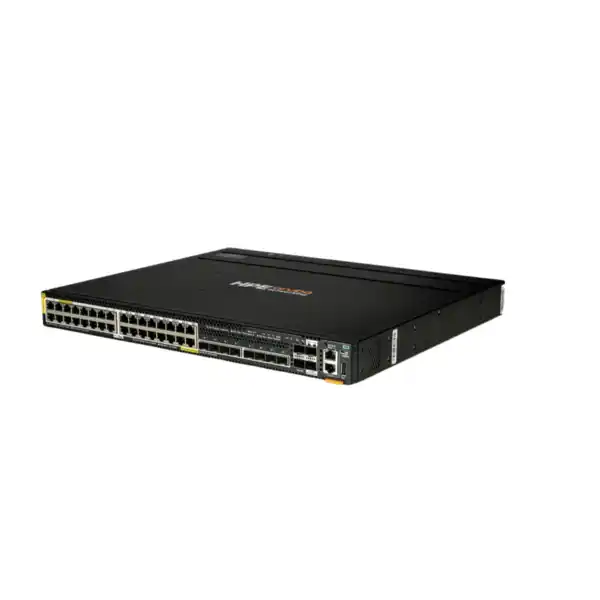
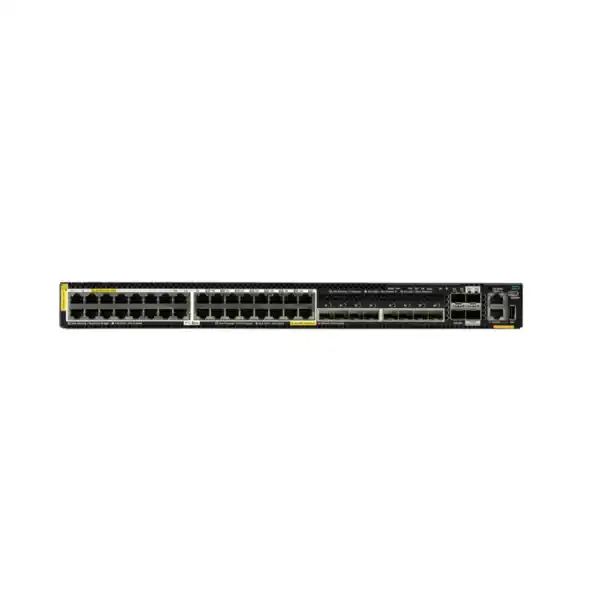
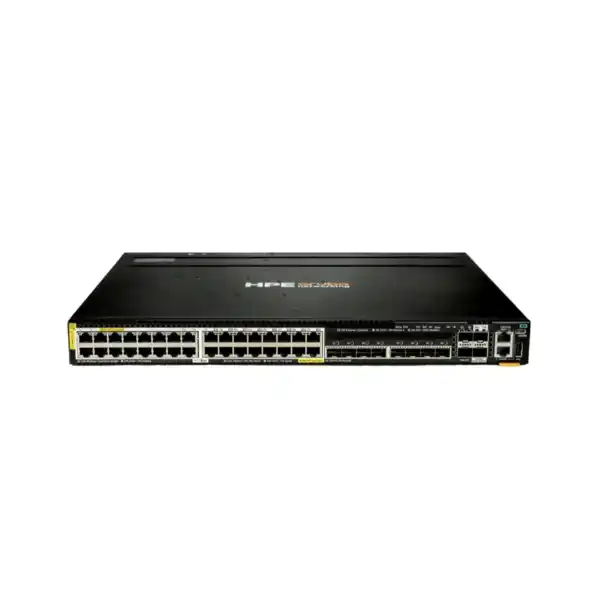
HPE Aruba Networking CX 6300M 32-Port Smart Rate Switch S4P42A
The HPE Aruba Networking CX 6300M S4P42A is designed for organisations that need more than conventional 1GbE access switching at the edge. It combines multi-gigabit Smart Rate connectivity, high-power Class 8 PoE capability, dedicated 10G fibre interfaces and 25G/50G high-speed uplinks in a 1U enterprise platform. This makes the switch particularly relevant for access layers supporting high-performance wireless, power-hungry edge devices, dense IoT environments and sites where uplink bandwidth must scale without replacing the entire switching platform.
HPE positions the CX 6300 family for access, aggregation and selected top-of-rack use cases. The S4P42A belongs to the modular CX 6300M line and runs the AOS-CX operating system, providing Layer 3 routing, programmability, network analytics and centralized management options. Its value is not simply the number of ports: the combination of Smart Rate access, Class 8 PoE, 10G SFP+, 25G SFP28 and 50G SFP56 connectivity is intended for networks where edge bandwidth, power delivery and uplink design must be considered together.
Exact Model Identification
| Manufacturer | HPE Aruba Networking |
|---|---|
| Series | CX 6300M |
| HPE product number | S4P42A |
| Product type | Stackable Layer 3 managed Ethernet switch |
| Access design | 32-port Smart Rate 5G Class 8 PoE configuration |
| Additional fibre interfaces | 8 x SFP+ 10G LRM, 2 x SFP28 25G MACsec and 2 x SFP56 50G |
| Form factor | 1U rack-mount |
| Operating system | AOS-CX |
Model identification matters because the CX 6300M family contains several combinations of 1GbE, Smart Rate, fibre and PoE ports. S4P42A should not be treated as interchangeable with a 48-port 1GbE model, a 24-port Smart Rate model or the TAA-designated S4P46A. A quotation should use the exact S4P42A product number when the requirement is for this non-TAA 32-port Smart Rate configuration.
Why Smart Rate Matters at the Access Layer
Traditional Gigabit Ethernet can become a bottleneck when newer wireless access points or specialized edge devices can use more than 1 Gbps of wired throughput. HPE Smart Rate is intended to provide multi-gigabit Ethernet over compatible copper cabling while retaining Ethernet autonegotiation. For a buyer, the practical benefit is that the access switch can support devices that need 2.5GbE or 5GbE without forcing an immediate move to fibre at every endpoint.
The suitability of multi-gigabit copper still depends on the installed cabling, link length, endpoint capabilities and the negotiated speed. A switch capable of Smart Rate does not guarantee that every existing cable run will sustain the highest available rate. During a refresh project, cabling quality should therefore be evaluated alongside switch selection, especially where older structured cabling is expected to carry sustained multi-gigabit traffic.
Class 8 PoE for High-Power Edge Devices
The S4P42A is a Class 8 PoE model. This is important for environments where connected devices require more power than conventional PoE or PoE+ can deliver. The CX 6300 family supports high-power IEEE 802.3bt use cases, and the S4P42A can be configured for a maximum PoE budget of up to 2880 W when the required power-supply arrangement is installed.
The maximum PoE figure should not be interpreted as an automatically available budget in every order. The switch has two field-replaceable, hot-swappable power-supply slots and requires at least one compatible power supply, ordered separately. Available PoE power depends on the PSU combination, input voltage and redundancy design. This makes the power plan part of the product selection rather than an afterthought.
For projects involving Wi-Fi access points, cameras, collaboration endpoints, building systems or other powered devices, a useful quotation input is the expected wattage per endpoint rather than only the number of PoE ports. A port-count-only design can under-size the switch if many endpoints need high power simultaneously.
High-Speed Fibre and Uplink Options
S4P42A includes eight SFP+ interfaces for 10G connectivity, plus two SFP28 interfaces supporting 25G with MACsec and two SFP56 interfaces supporting up to 50G. This mix gives the switch several deployment choices: 10G fibre can be used for server, distribution or legacy uplink requirements, while 25G and 50G interfaces can provide higher-capacity links or participate in a stacking design.
Optics and direct-attach cables are selected separately according to distance, fibre type, connector standard and the exact interface speed required. Buyers should avoid assuming that an SFP+, SFP28 or SFP56 cage accepts every optical module in every operating mode. The transceiver matrix and current AOS-CX software support should be checked for the planned optic or DAC before purchase.
The inclusion of MACsec on the 25G interface group is relevant where link-layer encryption is required between compatible infrastructure devices. MACsec is not a substitute for end-to-end application security, but it can add protection to Ethernet links where the network architecture calls for encrypted transport between switches or other supported endpoints.
Switching Performance and Architecture
HPE specifies 780 Gbps of switching capacity and approximately 580 Mpps of throughput for S4P42A. These figures give the platform enough headroom for a dense access role with high-speed uplinks, provided the traffic design and oversubscription assumptions are appropriate for the site.
The CX 6300 family uses HPE’s distributed switching architecture and Gen7 ASIC technology. In practice, performance should be considered together with the intended feature set: advanced routing, segmentation, policy enforcement, telemetry and stacking all affect how the switch will be deployed. A buyer replacing an older Layer 2 access switch should therefore plan the migration around configuration and operational requirements, not only forwarding capacity.
Layer 3 Routing and Campus Fabric Capabilities
The CX 6300 series supports enterprise Layer 3 functions including OSPF, BGP, VRF, EVPN and VXLAN features. This allows the platform to operate as more than a basic access switch and makes it suitable for networks that require routed access, segmentation, scalable campus fabrics or controlled extension of Layer 2 domains.
Not every environment needs every routing protocol. A straightforward branch or office deployment may use only VLANs, static routes and conventional redundancy, while a larger campus may use dynamic routing, VRFs and EVPN-VXLAN. The benefit of the platform is that the switching hardware can support a broader architecture without forcing all features into the initial configuration.
VSF Stacking and VSX High Availability
HPE Virtual Switching Framework can combine up to ten supported CX 6300 switches into a logical stack. This can simplify management and provide a practical scale-out path when one switch is not enough for the required access-port count. High-speed front-panel interfaces are used for stacking, so the stack topology, transceiver or DAC selection and reserved ports should be defined before finalizing the bill of materials.
The CX 6300 family also supports two-member VSX designs for active-active high availability. VSF and VSX serve different architectural purposes and are not used simultaneously on the same switch as part of one design. A campus access stack usually leads to a different physical and operational model than a two-switch VSX pair, so the preferred resilience method should be established during design rather than after hardware delivery.
AOS-CX Operations, Analytics and Automation
AOS-CX is a modern network operating system designed around programmability, telemetry and operational consistency. The CX 6300 platform includes the Network Analytics Engine, which can monitor selected system conditions and provide useful context for troubleshooting. A time-series database records operational state information that can help administrators investigate changes and recurring issues.
For larger environments, HPE Aruba Networking Central can provide centralized management across wired, wireless and WAN infrastructure. Switch Multi-Edit is another option for coordinated configuration changes and conformance checking. These management choices should be mapped to the organisation’s operational model: a locally managed switch, a centrally managed campus and a policy-driven multi-site network may use the same hardware differently.
Security and Segmentation Considerations
The CX 6300 family supports features intended to strengthen access-layer control, including role-based policy, device profiling, dynamic segmentation and encrypted link options. These capabilities become most useful when they are integrated into a broader identity, authentication and policy design rather than treated as isolated switch features.
Some advanced capabilities may depend on specific software features, subscriptions or supporting HPE Aruba Networking components. Application recognition and control, for example, is associated with the CX Advanced Feature Pack. The required software entitlement should therefore be checked against the final feature list. Purchasing the switch alone does not automatically mean every optional platform capability is licensed for use.
Power Supply Planning
S4P42A has two hot-swappable PSU slots and requires at least one power supply. Compatible supply choices include HPE X372 AC power supplies and a CX 6300M DC option. Different PSU capacities affect available PoE power and resilience. In a business-critical deployment, two supplies may be selected for redundancy, while a high-PoE design may require a higher-capacity combination to meet the endpoint load.
| Power planning item | Buyer decision |
|---|---|
| PSU quantity | Single supply for minimum operation or dual supplies for redundancy / higher PoE design |
| PSU capacity | Size against projected PoE load plus operational headroom |
| Input power | Confirm AC or DC requirement and available circuit capacity |
| PoE budget | Calculate from actual endpoint wattage, not only port count |
| Redundancy policy | Determine whether full endpoint power must remain available after one PSU failure |
The last point is frequently overlooked. A dual-PSU switch may continue operating after one supply fails while no longer having enough remaining PoE capacity for every powered device. If PoE continuity is critical, the failure-state budget should be calculated explicitly.
Physical Deployment
The switch is a 1U platform measuring approximately 4.4 x 44.2 x 38.5 cm and weighing up to about 6.02 kg depending on configuration. Rack depth, cable bend radius, airflow, service access and power-cable routing should be checked before installation. In high-density cabinets, the thermal design of the full rack matters more than the nominal height of a single switch.
Because the platform can supply substantial PoE power, electrical and cooling requirements can increase significantly when the switch is heavily loaded. A design for thirty-two low-power endpoints is materially different from a design serving many high-power Class 8 devices. Cabinet power distribution and UPS sizing should reflect the real operating scenario.
Where S4P42A Fits Well
- Enterprise access layers supporting multi-gigabit wireless access points.
- Campus environments that need high PoE power at the edge.
- Sites requiring a mixture of copper access and 10G/25G/50G fibre connectivity.
- Networks expected to use Layer 3 routing, segmentation or EVPN/VXLAN capabilities.
- Deployments that may scale through VSF stacking.
- Organisations standardising management through HPE Aruba Networking Central.
- Access or aggregation designs that need higher uplink capacity than conventional 10G-only switches.
When Another CX 6300 Model May Be Better
S4P42A is not automatically the best choice for every CX 6300 deployment. If most endpoints need only 1GbE and standard PoE, a simpler 24- or 48-port model may provide better value. If a project needs a larger number of copper access ports, a 48-port Smart Rate configuration may reduce the number of switches required. If 10GbE Smart Rate on copper is a hard requirement, the buyer should compare the newer SR10-capable models rather than assuming every Smart Rate port on S4P42A supports 10G in the same way.
TAA procurement is another distinction. The closely related S4P46A is the TAA-designated 32-port Smart Rate variant. Where contractual or regulatory procurement terms require TAA-compliant hardware, the exact approved SKU should be specified in the request for quotation rather than substituting S4P42A.
Compatibility and Quotation Checklist
An accurate quotation for the HPE Aruba Networking CX 6300M S4P42A should include more than the base switch. The following inputs affect the final bill of materials:
- Required quantity of S4P42A switches.
- Expected copper endpoint speeds: 1G, 2.5G, 5G or other supported modes.
- PoE device count and maximum wattage per endpoint.
- Required PoE headroom during normal operation and PSU failure.
- Single or redundant power-supply design.
- AC or DC power requirement and local input voltage.
- Number, speed and reach of 10G, 25G and 50G fibre links.
- Required HPE-supported optics, DACs or AOCs.
- VSF stacking topology or VSX high-availability requirement.
- HPE Aruba Networking Central management requirement.
- Any advanced software features or licensing dependencies.
- Existing switch configuration to be migrated.
- VLAN, routing, authentication and segmentation requirements.
- Support-service level and required coverage period.
- Any TAA or other procurement-compliance requirement.
Providing these details early reduces the risk of receiving a technically incomplete switch-only quote that omits PSUs, optics, licenses or stacking components required for the actual deployment.
Migration from Existing Access Switches
Replacing an older access switch with S4P42A is usually straightforward at the physical layer, but configuration migration deserves planning. Existing VLANs, trunks, link aggregation, spanning-tree behavior, routing, access-control lists, authentication and monitoring settings should be reviewed against AOS-CX syntax and feature behavior. A direct line-by-line configuration copy from a different operating system is not a reliable migration method.
For multi-gigabit upgrades, endpoint negotiation should also be tested. Some wireless access points or other devices may need firmware updates, specific Ethernet settings or suitable cabling before they negotiate their intended link rate. Testing a representative endpoint set before a large rollout can prevent deployment-day surprises.
Dubai and UAE Procurement Considerations
For projects in Dubai and the wider UAE, procurement should account for the exact S4P42A switch SKU, suitable regional power components, the required optics and the desired HPE support coverage. Delivery requirements can vary depending on whether the switch is ordered as a standalone chassis or as part of a complete network bill of materials. Availability of specific power supplies and transceivers can also affect project timing.
FourTeck can prepare a configuration-based quotation when the intended port speeds, PoE load, uplink distances, stacking requirement and management model are provided. This is especially useful for S4P42A because the base switch specification does not by itself determine the final PoE budget, redundancy level or optical connectivity.
Key Technical Specifications
| Specification | S4P42A |
|---|---|
| Series | HPE Aruba Networking CX 6300M |
| Switch type | Stackable Layer 3 managed switch |
| Access ports | 32-port Smart Rate 5G Class 8 PoE configuration |
| 10G fibre | 8 x SFP+ 10G LRM |
| 25G fibre | 2 x SFP28 25G with MACsec |
| 50G fibre | 2 x SFP56 50G |
| Switching capacity | 780 Gbps |
| Throughput | Up to approximately 580 Mpps |
| Maximum PoE budget | Up to 2880 W with appropriate PSU configuration |
| Power supplies | 2 hot-swappable slots; minimum 1 compatible PSU required and ordered separately |
| Stacking | VSF, up to 10 supported switches in a stack |
| High availability | VSX supported for two-member active-active designs |
| Management | CLI, SNMP, HPE Aruba Networking Central, Switch Multi-Edit and related AOS-CX tools |
| Form factor | 1U |
| Dimensions | Approximately 4.4 x 44.2 x 38.5 cm maximum, depending on configuration |
| Weight | Up to approximately 6.02 kg |
Buying Guidance
Choose the HPE Aruba Networking CX 6300M S4P42A when the project genuinely needs a combination of multi-gigabit copper access, high-power PoE, flexible fibre interfaces and advanced AOS-CX Layer 3 capabilities. It is particularly strong where a network refresh must support new wireless or powered-edge requirements while also increasing distribution or stacking bandwidth.
For a correct order, define the switch role first, then size power, optics and software around that role. If the requirement is primarily conventional 1GbE access, another CX 6300 model may be more economical. If high-density multi-gigabit PoE and 25G/50G uplinks are central to the design, S4P42A is a more appropriate platform to evaluate.

Reviews
There are no reviews yet.