
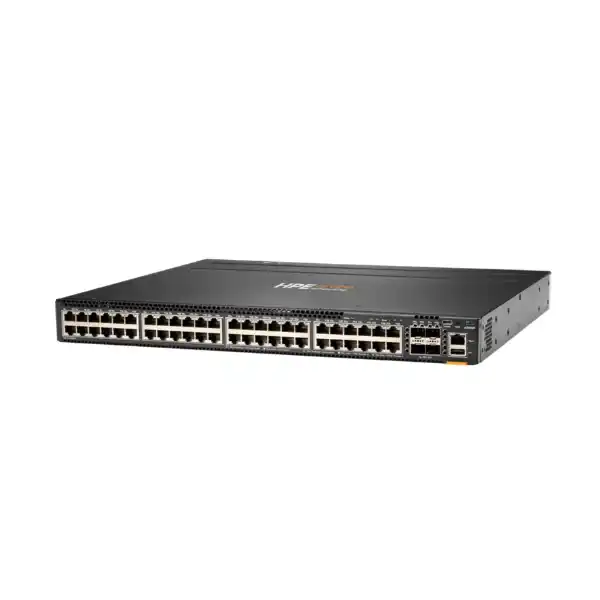
HPE Aruba Networking CX 6300M 48-Port Switch JL663A for Dubai Networks
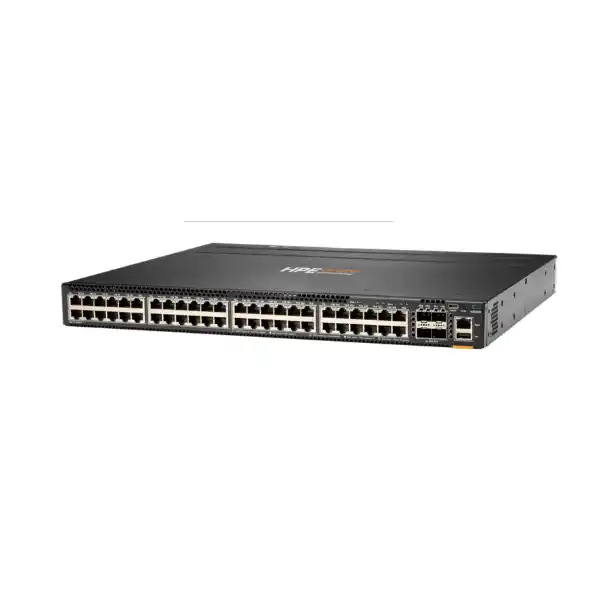
The HPE Aruba Networking CX 6300M 48-port 1GbE and 4-port SFP56 Switch, product number JL663A, is the non-PoE 48-port copper model in the CX 6300M family. It is designed for organizations that need a high-density Gigabit Ethernet access layer with substantially faster uplinks, modern AOS-CX software, stackable operation and replaceable infrastructure components, but do not need the switch itself to deliver power to endpoints.
This distinction matters during procurement. JL663A is not the 48-port Class 4 PoE model and it is not the Smart Rate multi-gigabit PoE model. Its 48 access interfaces are 10/100/1000BASE-T Ethernet ports. The four uplink ports can operate at 1GbE, 10GbE, 25GbE or 50GbE with supported optics or direct-attach connectivity. For many office, education, hospitality, government and enterprise campus deployments in Dubai, that combination provides a practical way to keep conventional 1GbE edge devices while creating higher-speed paths toward distribution, core, server or stacking infrastructure.
Exact Model Identification
| Manufacturer | HPE Aruba Networking |
|---|---|
| Series | CX 6300M |
| Product number | JL663A |
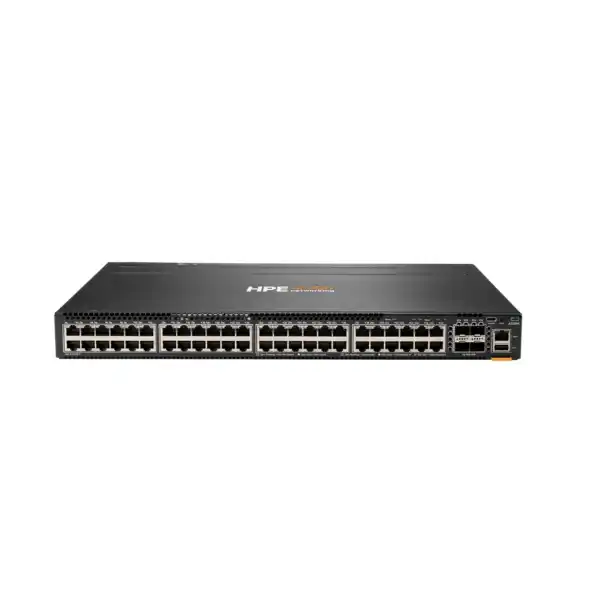
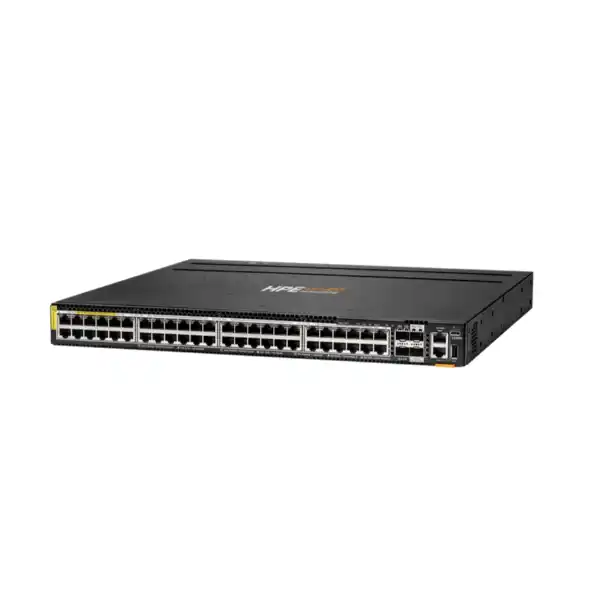
| Access ports | 48 x 10/100/1000BASE-T |
| High-speed ports | 4 x SFP56-class ports supporting 1/10/25/50GbE operation with compatible media |
| PoE | No — JL663A is the non-PoE 48-port model |
| Model switching capacity | 496 Gbps |
| Model throughput | 369 Mpps |
| Stacking | Virtual Switching Framework, up to 10 members |
| Management interfaces | USB-C console, USB Type-A host and dedicated out-of-band management port |
| Rack format | 1U-class chassis for standard 19-inch equipment racks |
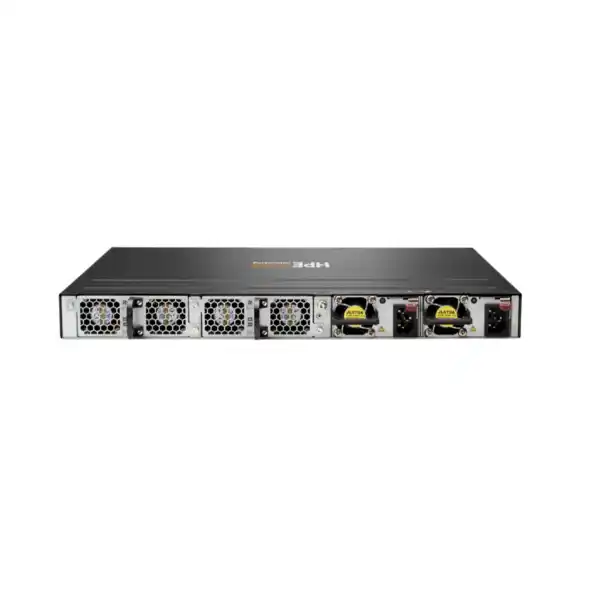
| Power architecture | Two field-replaceable, hot-swappable PSU slots; minimum one compatible PSU required |
Where the JL663A Fits
The JL663A makes the most sense when the access layer is dominated by devices that already receive power independently. Typical examples include desktop PCs, printers, servers, appliances, security platforms, industrial controllers and other wired endpoints that need standard 1GbE connectivity but do not require Power over Ethernet. Because the switch does not reserve chassis cost or power budget for PoE, it can also be attractive for aggregation or mixed infrastructure roles where copper Gigabit density is more important than endpoint power delivery.
A different CX 6300 model should be evaluated when access points, IP phones, surveillance cameras, door controllers, sensors or other powered devices are expected to draw PoE from the switch. Likewise, if many edge devices require 2.5GbE, 5GbE or 10GbE over copper, a Smart Rate variant is more appropriate. Choosing JL663A simply because it has 48 copper ports can result in an avoidable redesign if the endpoint power and multi-gigabit requirements were not identified at the start.
48 Gigabit Ethernet Access Ports
The 48 RJ-45 access ports operate at 10/100/1000 Mbps, making the switch suitable for established Gigabit Ethernet estates and for new deployments where 1GbE remains the correct endpoint speed. Buyers replacing an older access switch can normally preserve existing copper cabling where that cabling is standards-compliant and in good condition, but cabling quality, patch-panel condition and actual endpoint negotiation should still be checked during migration planning.
The lack of PoE is a defining characteristic rather than a minor specification. If the current access layer powers endpoints, the replacement design must either use a PoE-capable switch or provide an alternative power method. A site survey that records how many endpoints consume PoE, their power classes and expected future growth prevents selecting the wrong 6300M variant.
Four Flexible SFP56 Uplinks
JL663A provides four high-speed SFP56-class ports that can be used at supported 1GbE, 10GbE, 25GbE or 50GbE rates. This gives the switch considerable flexibility during phased network upgrades. A site can retain a 10GbE uplink today and move to 25GbE or 50GbE later where the upstream platform, transceiver type, fibre plant and AOS-CX support matrix allow it.
The port speed alone does not determine compatibility. The final design must match the switch port with the correct HPE Aruba Networking-supported transceiver, DAC or AOC, the required fibre type, connector, wavelength and link distance. The remote switch or server interface must support the same Ethernet speed and media standard. For 25GbE or 50GbE deployments, verify the exact optic and software support before ordering rather than assuming that any physically compatible SFP-family module will operate correctly.
Performance for Access and Aggregation Roles
HPE specifies a model switching capacity of 496 Gbps and a model throughput of 369 Mpps for JL663A. Those figures provide useful headroom for a dense 48-port Gigabit access layer with high-speed uplinks. The more important sizing question, however, is how much traffic is expected to converge on the uplinks. A 48-port access switch can be perfectly suitable even when the aggregate theoretical edge bandwidth exceeds a single uplink, provided the real application profile and oversubscription ratio are understood.
Sites with heavy east-west traffic, large imaging workloads, storage access, high-volume media workflows or unusually concentrated server traffic should calculate uplink demand instead of relying on port count alone. Multiple higher-speed uplinks, link aggregation or a different topology may be warranted. The 6300M family can serve both access and aggregation use cases, but those roles impose different requirements on optics, redundancy, routing and upstream capacity.
VSF Stacking and Operational Scale
The CX 6300 family supports Virtual Switching Framework stacking, and JL663A can participate in stacks of up to 10 members. VSF allows multiple physical switches to be operated as a coordinated logical system, which can simplify management and improve access-layer resiliency when the topology is designed correctly. HPE specifies 200 Gbps stacking bandwidth, or 400 Gbps full duplex, for the relevant CX 6300 architecture.
Stack design still requires care. The selected stack links consume supported high-speed interfaces and require appropriate transceivers or direct-attach media. Physical placement, stack topology, uplink distribution and failure domains should be planned before installation. A ten-member maximum is a platform capability, not a recommendation that every environment should build the largest possible stack. Smaller stacks can be easier to operate and may reduce the operational impact of maintenance or a stack-wide event.
AOS-CX Management and Automation
CX 6300 switches run the HPE Aruba Networking AOS-CX operating system. Management options include the command-line interface, web-based management and HPE Aruba Networking Central support. For organizations standardizing wired, wireless and WAN operations around Aruba Central, this can provide a common operational approach, but the required Central subscription or entitlement should be treated as a separate commercial item unless explicitly included in the quotation.
The CX platform is also designed for programmable operations and telemetry. Features available within the wider CX 6300 family include advanced Layer 3 and campus capabilities, but exact feature use depends on the software release, deployment architecture and licensing or subscription requirements in effect for the project. If the purchase is driven by OSPF, BGP, EVPN/VXLAN, segmentation, automation or a specific security function, those requirements should be listed explicitly so the proposed software level and design can be validated rather than inferred from the hardware model alone.
Power Supply and Fan Planning
One of the most important procurement details for JL663A is that the chassis has two field-replaceable, hot-swappable power-supply slots and requires at least one compatible power supply. HPE identifies the JL085A power supply for this model, and the required PSU is ordered separately in the standard configuration. A quotation therefore needs to state clearly whether one or two PSUs are being supplied.
A single PSU meets the minimum hardware requirement, while dual supplies can be selected when the site design requires power redundancy. Redundancy is meaningful only when the two supplies are connected to appropriately independent power paths. Connecting both to the same failed PDU or circuit does not provide the intended resilience.
The switch also uses field-replaceable fan components. HPE documentation indicates two fan-tray slots, with one fan tray installed and a second available separately. Airflow direction is important in controlled data rooms and should match the cabinet cooling design. Buyers operating mixed front-to-back and back-to-front equipment should confirm airflow orientation instead of treating fan selection as an afterthought.
Physical Installation Considerations
The JL663A chassis is approximately 44.2 cm wide, 38.5 cm deep and 4.4 cm high. It mounts in a standard 19-inch rack, and HPE documentation lists a two-post rack kit with the unit. Cabinet depth, cable-management space, fibre bend radius and access to replaceable PSUs and fans should be checked before installation, particularly in shallow wall cabinets originally installed for smaller access switches.
HPE specifies normal operation from 0°C to 45°C up to the stated altitude range, with derating at higher elevations and limited short-duration excursion capability. Dubai sites frequently use air-conditioned telecommunications rooms, but actual rack inlet temperature matters more than the building thermostat. Dust control, blocked airflow and overloaded cabinets can raise the local operating temperature substantially, so environmental conditions should be verified at the rack.
Management and Console Access
Dedicated management access includes a USB-C console port, USB Type-A host port and out-of-band management interface. The OOBM interface is useful where the operations design separates switch management traffic from the production data plane. During deployment, the management IP plan, administrative authentication method, time synchronization, logging destination, configuration backup process and monitoring platform should be defined before the switch enters production.
For a migration from an older ArubaOS-Switch, Cisco IOS-based, legacy ProCurve or another vendor platform, configuration should not be copied mechanically. VLANs, trunks, spanning-tree behavior, link aggregation, ACL logic, routing, DHCP relay, authentication and management controls need to be translated to the target AOS-CX design and tested.
Security and Segmentation Considerations
The CX 6300 family is designed for modern enterprise access networks where segmentation, identity and policy enforcement can matter as much as raw switching performance. A successful deployment starts by defining which users, devices and services should communicate, then mapping that requirement to VLANs, routing, ACLs, authentication and any Central-based segmentation architecture being used.
If MACsec, dynamic segmentation or advanced policy integration is mandatory, include that requirement in the bill-of-materials review. Hardware family names often cover multiple models and software capabilities evolve over time; the safest procurement method is to validate the exact JL663A hardware, AOS-CX version and any required licenses or subscriptions against the intended feature set.
When JL663A Is a Good Fit
- 48-port access closets where endpoints need standard 1GbE but do not require PoE.
- Sites that need faster 10/25/50GbE-capable uplinks while retaining 1GbE copper at the edge.
- Organizations standardizing on AOS-CX and HPE Aruba Networking operational tooling.
- Deployments that benefit from VSF stacking and replaceable power/fan components.
- Aggregation or infrastructure roles where copper Gigabit density is useful and endpoint power is provided elsewhere.
When Another CX 6300 Model Should Be Considered
- PoE endpoints: choose a PoE-capable CX 6300M variant if phones, access points, cameras or other powered devices need switch-supplied power.
- Multi-gigabit access: select a Smart Rate model where 2.5GbE, 5GbE or 10GbE copper access is required.
- Fibre-heavy access: evaluate a fibre access model if the edge is primarily SFP-based rather than RJ-45 copper.
- Different resiliency architecture: compare the wider CX portfolio if the design calls for a different redundancy, port-density or uplink architecture.
- Lower requirements: a smaller or simpler access platform may be more economical when advanced CX 6300 capabilities, modular field-replaceable components or high-speed uplinks are unnecessary.
What to Confirm Before Requesting a Dubai/UAE Quotation
An accurate quotation for the HPE Aruba Networking CX 6300M JL663A should be based on more than the switch part number. FourTeck can prepare the bill of materials more reliably when the required quantity, uplink speed, fibre type and link distance, number of PSUs, redundancy requirement, rack location, airflow preference, stack size and management approach are known.
- Number of JL663A switches required.
- Whether each switch requires one or two JL085A-compatible power supplies.
- Required power cords and UAE plug/PDU compatibility.
- Number and speed of uplinks: 1GbE, 10GbE, 25GbE or 50GbE.
- Optic, DAC or AOC requirements and link distances.
- Fibre type, connector and patching standard.
- Whether switches will operate standalone or in a VSF stack.
- Existing upstream switch model and supported port speeds.
- Need for HPE Aruba Networking Central and the applicable subscription term.
- Required routing, segmentation, security and authentication features.
- Rack depth, cooling arrangement and airflow direction.
- Migration, configuration, installation, testing or support services required.
Deployment Guidance for Business Buyers
For a new installation, start with the traffic and endpoint requirements rather than the model name. Count wired endpoints, separate devices that need PoE from those that do not, identify uplink destinations and estimate expected traffic growth. Then determine whether a standalone switch, a small VSF stack or a wider campus architecture is appropriate. This sequence makes it easier to select the correct optics, power supplies and management subscriptions at the same time as the chassis.
For replacement projects, record the existing VLANs, trunks, routing interfaces, spanning-tree roles, link aggregations, authentication policies and management dependencies before the old equipment is removed. A controlled migration should include configuration validation, uplink testing, failover testing where redundancy is implemented and a rollback plan. The result is a deployment that uses the CX 6300M platform as part of a coherent network design rather than as a simple port-for-port hardware swap.
HPE Aruba Networking CX 6300M JL663A Supply in Dubai
The JL663A is a strong candidate for Dubai and UAE organizations that need 48 ports of conventional Gigabit Ethernet, modern AOS-CX operations and flexible high-speed uplinks without paying for a PoE access layer they do not intend to use. Its value is highest when the buyer also plans the surrounding components correctly: power supply selection, optics, stack links, airflow, upstream compatibility and management licensing all affect the finished solution.
For quotation preparation, provide the switch quantity and the intended uplink, power and stacking design. FourTeck can then align the chassis with the required accessories and services instead of quoting an incomplete standalone switch that still needs critical deployment components.

Reviews
There are no reviews yet.