
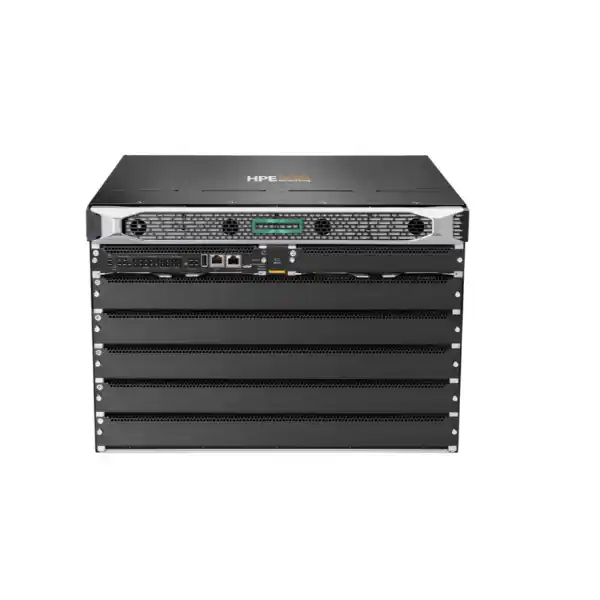
HPE Aruba Networking CX 6405 Modular Switch Dubai
A five-slot, 7RU AOS-CX platform for organizations that need a configurable mix of high-density access, campus aggregation, core routing, multi-gigabit connectivity, PoE and high-speed fibre in one resilient chassis. The important buying decision is not simply “CX 6405 or not”; it is the exact chassis generation, line-card set, power architecture, optics and software level required for your network.
Direct answer: what is the HPE Aruba Networking CX 6405?
Why the CX 6405 exists in the CX 6400 family
The CX 6405 is intended for environments where a fixed-port switch would force too many compromises, yet a larger ten-slot chassis would add unnecessary rack space, cost or complexity. Its five line-card slots allow the port composition to be shaped around the actual network: a campus may need large quantities of 1GbE PoE access ports today, HPE Smart Rate multi-gigabit ports for Wi-Fi access points, 25GbE server or aggregation links, and 40/100GbE uplinks for resilient core connectivity. Because these roles can coexist in one chassis, the design can be much more deliberate than simply stacking identical fixed-port switches.
HPE positions the CX 6400 family for access, aggregation and core deployments. The 6405 provides 14 Tbps of system switching capacity and 5.7 billion packets per second of throughput, while the larger 6410 doubles the chassis slot count and is rated at 28 Tbps and 11.4 Bpps. That comparison is useful during sizing: the 6405 can be a strong fit when five modular slots provide adequate present and forecasted density; the 6410 should be evaluated when slot growth, interface diversity or physical consolidation is likely to exceed the five-slot envelope.
CX 6405 technical profile that matters to buyers
| Chassis format | Five-slot modular chassis, approximately 7RU, suited to configurable access, aggregation and core roles. |
|---|---|
| System switching capacity | 14 Tbps for the CX 6405 platform. |
| System throughput | 5.7 Bpps. |
| Fabric architecture | Distributed Gen7 ASIC architecture with 2.8 Tbps non-blocking fabric per slot. |
| Interface spectrum | Line-card choices cover 1GbE, 10GbE, 25GbE, 40GbE and 100GbE, with selected SFP56 ports supporting 50G DAC use for interconnect and VSX subject to platform/software conditions. |
| PoE capability | Selected modules support IEEE 802.3af, 802.3at and 802.3bt, including configurations up to 60W per port. Actual PoE budget depends on installed modules, management modules, fan trays and power supplies. |
| Management interfaces | RJ-45 console, USB-C console, out-of-band management, USB Type-A host, plus support for Bluetooth dongle use with the CX Mobile App. |
| Power architecture | Up to four modular front-serviceable power supplies with rear-serviceable power-cord inlet adapters; HPE lists R0X35A and R0X36A PSU options for the platform. |
| Cooling and airflow | Two field-replaceable fan trays are specified for the 6405, with primary airflow from front to back. |
| Physical size | Approximately 44.26 cm wide × 44.85 cm deep × 30.66 cm high. HPE lists a configuration weight of about 29.3 kg for the base 6405 specification. |
Performance figures are platform capabilities, not a substitute for line-card and traffic-profile design. Real deployments must account for the chosen interfaces, forwarding tables, ACL scale, routing features, oversubscription expectations, PoE draw and redundancy strategy. This is especially important when the chassis is expected to combine campus access and aggregation functions rather than perform a single uniform role.
Line-card planning: where CX 6405 flexibility becomes valuable
The strongest reason to choose a CX 6405 instead of a fixed configuration is the ability to build a port mix around the network rather than around one switch SKU. HPE’s current CX 6400 v2 module portfolio includes dense 1GbE PoE modules, multi-gigabit Smart Rate modules, 10GBASE-T, SFP+, SFP28 and QSFP28 options. Current listings include 48-port 1GbE Class 4 PoE, 48-port 1GbE Class 4 PoE with four SFP56 ports, 48-port 1GbE Class 6 PoE with SFP56, Smart Rate 1/2.5/5GbE Class 6 PoE, 24-port 10GBASE-T with SFP56, 24-port SFP+ with SFP56, 48-port 1G/10G/25GbE SFP28 extended-table modules, and 12-port 40/100GbE QSFP28 extended-table modules. HPE also lists newer modules with 25G/100G density and a 24-port Smart Rate 1/2.5/5/10G Class 8 PoE design.
High-density 1GbE access
Useful when the chassis must terminate many conventional user, phone, camera or IoT connections. PoE class and total chassis power budget still need to match the powered-device estate.
Smart Rate for modern APs
Multi-gigabit copper is relevant where Wi-Fi access points or specialized endpoints exceed 1GbE. Cabling capability, port speed, PoE class and AP power requirement should be assessed as one design question.
10G copper and fibre
10GBASE-T can serve high-performance copper-connected devices, while SFP+ options support fibre-based server, distribution and aggregation designs where media type and distance matter.
25G, 40G and 100G aggregation
Higher-speed SFP28 and QSFP28 modules provide headroom for aggregation, server connectivity and core links. Optic type, fibre plant, breakouts and peer compatibility should be specified before pricing.
Do not order line cards from a feature description alone. Confirm the exact CX 6405 chassis SKU, module part number, supported AOS-CX release, optics and transceiver support matrix. The presence of both earlier and v2 hardware in the market makes this check materially important.
Power and PoE sizing for Dubai deployments
Power supply selection is one of the most consequential CX 6405 ordering decisions because the chassis does not become a finished deployment simply by choosing a switch bundle and line cards. HPE specifies support for up to four modular power supplies and lists 1800W-class R0X35A and 3000W-class R0X36A options. Their available output varies with input voltage, and the total usable PoE capacity depends on the number and type of management modules, line cards, fan trays and installed PSUs. A design with a large number of 60W or higher-power endpoints must therefore be calculated from endpoint demand and redundancy policy rather than from nominal PSU wattage alone.
In a UAE server room or campus equipment room, the electrical design should also account for separate power feeds where redundancy is required, rack PDU connector type, upstream breaker capacity, UPS capacity and cooling load. The switch supports front-to-back airflow, so cabinet orientation and hot-aisle/cold-aisle practice matter. HPE specifies an operating range of 0°C to 45°C up to 5,000 feet, with temperature derating at higher altitude. Dubai installations should be planned as conditioned IT environments rather than relying on the upper limit as a normal operating target.
For PoE-heavy access deployments, ask for a port-by-port power estimate. Access points, cameras, video endpoints, building systems and IoT equipment can have very different maximum draw. Reserve power for growth and decide whether the requirement is “survive one PSU failure without losing powered endpoints” or merely “run under normal conditions.” Those are different bills of materials. Always-On PoE and Quick PoE capabilities can improve service continuity, but they do not remove the need for adequate chassis power capacity.
High availability: VSX, redundant components and maintenance strategy
The CX 6400 family is designed for resilient enterprise networks, and HPE Aruba Networking Virtual Switching Extension (VSX) is central to that architecture. VSX synchronizes state across two independent control planes and supports active-active Layer 2 and Layer 3 designs. In practical terms, a pair of appropriately designed CX switches can provide multi-chassis link aggregation and preserve network availability through many control-plane events and planned maintenance activities without forcing the entire environment into one shared control plane.
Chassis resilience also depends on how the 6405 is physically populated. Redundant power supplies should be fed from genuinely independent power paths if the business requirement is to survive a feed or UPS failure. HPE also supports redundant management modules in the CX 6400 family. For organizations with strict maintenance windows, the design should review dual-management-plane requirements, software release support, VSX topology, uplink diversity and the operational procedure for upgrades. In-service software upgrade capabilities can help maintain forwarding during maintenance in supported configurations, but the exact feature behavior depends on the chassis design and AOS-CX release.
A common mistake is to treat “redundant switch” as a single checkbox. True service resilience spans chassis, management plane, power, upstream links, routing adjacency, downstream LAG design, fibre path diversity and operational procedure. FourTeck can translate an uptime objective into a concrete topology and bill of materials instead of simply doubling hardware without validating failure domains.
Routing, segmentation and campus fabric capabilities
The CX 6405 is more than a high-density Layer 2 chassis. AOS-CX supports enterprise Layer 3 functions including OSPF, BGP, VRF and policy features, while the CX 6400 family also supports technologies such as MPLS, EVPN and VXLAN. This allows the platform to participate in conventional routed campus designs as well as modern overlay-based architectures. Dynamic Segmentation can extend consistent role-based policy between wired and wireless environments, including EVPN/VXLAN fabric designs where appropriate.
For buyers, the key question is not whether a long protocol list exists; it is which functions are required in the intended topology and what scale they will consume. HPE lists 2,048 switched virtual interfaces and 256 VRFs for the 6405 specification, with routing, host-table and ACL scale varying by line card. Extended-table modules materially change selected scale limits, and HPE notes that increased host and route scale on certain v2 extended-table modules requires an all-extended-table line-card population for the higher values to apply. Mixing other module types can reduce the platform to the original scale figures.
That dependency matters in campus-core and large aggregation designs. If the business expects a large endpoint table, a substantial routed fabric, extensive ACL policy or future segmentation growth, the line-card architecture must be selected from scale requirements first. Port count alone is not sufficient.
Management, automation and operational visibility
AOS-CX and programmable operations
AOS-CX uses a modern architecture with REST APIs and automation capabilities. This suits teams that want repeatable provisioning, configuration validation and integration with operational workflows rather than purely manual CLI management.
Network Analytics Engine
NAE can monitor switch state, retain time-series operational information and use agents for event analysis and troubleshooting. It is particularly valuable when the operations team wants evidence and trend visibility rather than isolated point-in-time counters.
HPE Aruba Networking Central
Central can provide onboarding, configuration, monitoring, troubleshooting and reporting across wired and wireless infrastructure. Foundation and Advanced subscriptions have different capability sets, so the required term and feature level should be included in the commercial design.
HPE Mist Wired Assurance
HPE now lists Mist Wired Assurance support for CX switches with a qualifying Mist subscription and specified AOS-CX software level. Buyers considering this operational model should verify exact release and subscription prerequisites at quotation time.
Licensing: separate native switching needs from premium visibility
AOS-CX includes a substantial set of switching, routing and resiliency capabilities, and HPE specifically states that functions such as PBR, MSDP, BSR and IP SLA required for full Layer 3 access and aggregation can be available without additional software licenses. However, not every operational or security feature belongs to that native entitlement. HPE offers a term-based CX Advanced Feature Pack for additional visibility and advanced security use cases, including deeper application recognition, policy capabilities and Reflexive ACL functions.
Central licensing is a separate decision. A Central Foundation subscription covers core management functions such as configuration, onboarding, monitoring, troubleshooting and reporting. Central Advanced extends the platform with premium security and AIOps capabilities, including fabric and policy functions. HPE notes that when Central Advanced is used, a separate CX Advanced license is not required for the overlapping advanced feature entitlement. The quote should therefore avoid duplicated licensing and should align subscription duration with the organization’s support and lifecycle policy.
If the switch will be managed locally and does not require premium application visibility, the licensing bill can look very different from a centrally managed fabric deployment. Provide the intended management platform and security feature requirements early so the proposal reflects actual need rather than automatically attaching the largest software package.
Where the CX 6405 fits well — and where another option may fit better
Strong fit
- Campus distribution or core requiring a mix of copper and high-speed fibre interfaces.
- High-density access where PoE, Smart Rate and future module changes are valuable.
- Organizations standardizing on AOS-CX, Central, VSX and automation workflows.
- Deployments where five slots provide enough density without moving to the larger 6410 chassis.
- Networks that value replaceable modules, redundant power and management-plane resilience.
Evaluate alternatives
- A fixed-port CX model may be more economical if the port mix is predictable and modular expansion is not needed.
- The CX 6410 should be compared when five line-card slots may be exhausted by growth or when higher physical consolidation is required.
- A data-center-focused fixed platform may be preferable if the requirement is primarily very high-speed fibre with little access-edge PoE.
- If rack depth, power or cooling is tightly constrained, a modular 7RU chassis may not be the most efficient architecture.
- If only a small number of access ports are needed, chassis-level redundancy can add cost without delivering proportional value.
Deployment and migration considerations
Inventory the current network
Capture copper/fibre port counts, optics, VLANs, routing protocols, LAGs, PoE endpoints, uplink speeds, ACLs and management dependencies.
Define the target role
Decide whether the 6405 is primarily access, distribution, core or a combined role. That decision drives module mix, routing scale and resilience design.
Build the module and power model
Map each required port to a supported line card, calculate PoE demand, select PSU quantity and define whether failure of one PSU or feed must be tolerated.
Validate software and optics
Check AOS-CX release requirements, transceiver support, peer-device capabilities, breakout requirements and any Central, Mist or Advanced subscription needs.
Plan rack and cabling
Reserve 7RU plus cable-management space, verify depth, front-to-back airflow, PDU feeds, console/OOB access and fibre/copper patching paths.
Stage and migrate
Pre-build configurations, test VSX or routing adjacencies, verify monitoring, define rollback, and move services in controlled groups rather than treating the chassis swap as one event.
Frequently asked buyer questions
Does the CX 6405 include all required power supplies?
No. HPE documentation for the 6405 states that power supply units are ordered separately. The number and wattage should be chosen from the line-card load, PoE requirement and redundancy policy.
Can it provide high-power PoE?
Yes, selected line cards support IEEE 802.3bt and configurations up to 60W per port. Actual available PoE depends on the installed hardware and PSU capacity, so endpoint demand must be calculated.
Is the CX 6405 suitable for a core?
It can be. The platform supports advanced Layer 3 routing, VSX and high-speed 40/100GbE modules. Suitability depends on route scale, uplink density, redundancy objectives and growth forecasts.
What is the difference between CX 6405 and CX 6410?
The 6405 is the five-slot chassis and is rated at 14 Tbps / 5.7 Bpps. The 6410 is the larger ten-slot platform and is rated at 28 Tbps / 11.4 Bpps, offering more physical expansion.
Do I need HPE Aruba Networking Central?
Not for every deployment. Central is valuable for unified cloud or on-premises management, monitoring and automation, but local AOS-CX operation remains possible. Subscription needs should follow the chosen operating model.
Which exact CX 6405 SKU should I request?
If you are buying new hardware, ask the supplier to confirm the current CX 6405 v2 SKU and compatible modules. If matching an existing estate, provide the installed chassis part number so compatibility can be validated before quotation.
Decision recap for the CX 6405
What FourTeck needs for an accurate Dubai quotation
A modular chassis quote is most useful when it is based on the target network rather than an incomplete switch name. Send the information below and the proposed bill of materials can be checked for port density, power, optics, subscriptions and resilience before pricing.
Build the right CX 6405 configuration for your network
FourTeck can help translate your port counts, PoE devices, uplink speeds, redundancy target, optics, management model and migration scope into a compatible HPE Aruba Networking CX 6405 bill of materials for Dubai and UAE deployment.

Reviews
There are no reviews yet.