
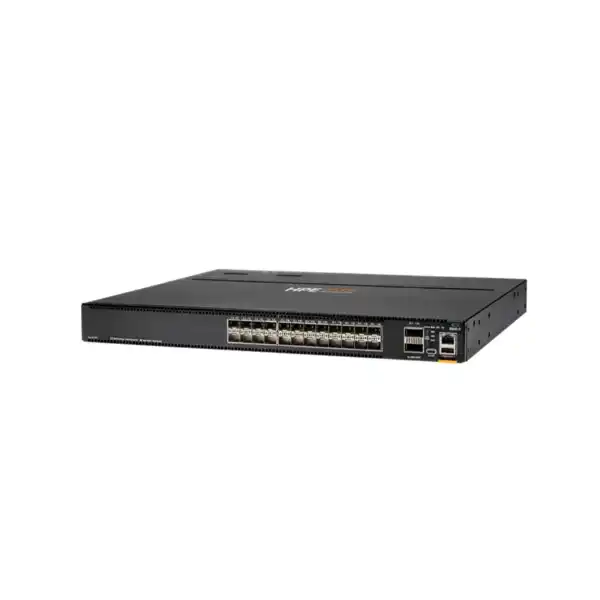
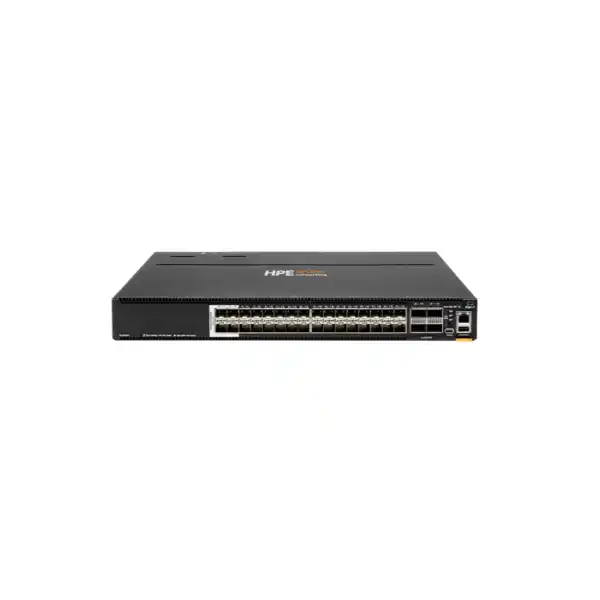
HPE Aruba Networking CX 8360 v2 Switch Series Dubai
A compact 1U switching family built for high-speed campus core, aggregation and modern data-center roles, with AOS-CX automation, VSX resiliency, rich Layer 2/3 routing and model choices spanning 10GbE, 25GbE and 100GbE-oriented connectivity.
Direct answer for buyers
The CX 8360 v2 is a family of fixed 1U HPE Aruba Networking switches designed for high-performance enterprise campus core/aggregation and dynamic data-center environments.
Typical roles include routed campus core, building or campus aggregation, server and storage aggregation, data-center leaf/spine designs and high-speed interconnects requiring 10/25/40/50/100GbE options.
Organizations that need dense high-speed ports, advanced routing, EVPN/VXLAN capability, redundant operation and programmable management should shortlist the family.
“CX 8360” is a family name. The exact port mix, airflow direction, transceivers, power arrangement, software features and management subscription must be matched to the intended topology.
FourTeck can translate your rack, port-speed, fibre/copper, resiliency, management, optics and migration requirements into a model-level bill of materials for a Dubai or UAE deployment.
Where the CX 8360 fits
The HPE Aruba Networking CX 8360 v2 sits in the part of the CX portfolio intended for networks where ordinary access-switch port density is no longer the main design question. Here the buyer is usually solving for uplink density, east-west traffic, high-speed server connectivity, resilient routing, deterministic failover and operational automation. That makes the family relevant to campus core and aggregation as well as compact data-center leaf, spine or border roles.
Its key advantage is not one universal port layout. HPE offers several hardware personalities under the 8360 name, allowing architects to choose dense SFP28 25GbE, SFP+ 10GbE, high-density 100GbE QSFP28, or copper 1/10GBASE-T depending on the environment. This matters because a 48-port copper aggregation switch and a 12-port 100GbE switch may carry the same family label but solve very different physical-layer problems.
For a Dubai deployment, the best selection process starts with traffic and cabling rather than the family name. Record how many 1/10/25/100GbE links are required on day one, how many will be added over the next refresh cycle, whether breakout connections are planned, whether MACsec is needed on selected links, and how each switch will be paired for redundancy. Those answers normally determine the right 8360 model faster than comparing headline throughput alone.
Buyer signals that point toward CX 8360
CX 8360 v2 model selection matrix
The following family view is intended to help buyers start a shortlist. Exact transceiver support, breakout behavior, software requirements and bundle contents should still be checked against the current HPE ordering guide for the exact SKU being quoted.
| Model | Primary access-facing ports | High-speed ports | Best starting point for |
|---|---|---|---|
| 8360-16Y2C v2 | 16 x 25G-class SFP/SFP+/SFP28 | 2 x 100G QSFP+/QSFP28 | Smaller high-speed aggregation or compact leaf designs |
| 8360-32Y4C v2 | 32 x 25G-class SFP/SFP+/SFP28 | 4 x 100G QSFP+/QSFP28 | Denser 25GbE aggregation with multiple 100GbE uplinks |
| 8360-48Y6C v2 | 48 x 25G-class SFP/SFP+/SFP28, with model-specific 50G operation considerations | 6 x 40/100G-class QSFP+/QSFP28 | High-density 25GbE fabrics and aggregation; selected MACsec-capable ports |
| 8360-24XF2C v2 | 24 x 10G SFP/SFP+ | 2 x 100G QSFP+/QSFP28 | 10GbE fibre aggregation where 25GbE density is not required |
| 8360-48XT4C v2 | 48 x 1/10GBASE-T copper | 4 x 100G QSFP+/QSFP28 | Copper-based 10GbE aggregation or server connectivity with 100GbE uplinks |
| 8360-12C v2 | 100GbE-focused configuration | 12 x 100G QSFP+/QSFP28 | Compact spine, high-speed core interconnect or dense 100GbE roles |
Performance is model dependent
HPE specifies up to 4.8 Tbps of bidirectional switching capacity across the family. That figure is useful for placing the series, but procurement should not treat it as the throughput of every 8360. Port layout and model determine the actual switching and forwarding profile.
For sizing, start from simultaneous traffic demand rather than nominal port speed. A core pair carrying Internet, WAN, east-west server, wireless, storage and inter-VLAN traffic can experience very different utilization from a leaf switch with many bursty server links. Headroom for failover is particularly important because one member of a redundant pair may temporarily carry additional traffic during maintenance or fault conditions.
AOS-CX operating model
The CX 8360 runs HPE Aruba Networking AOS-CX, a modern network operating system built around a modular architecture. For operations teams, that brings programmable interfaces, structured automation and a consistent configuration approach across supported CX platforms.
REST APIs and Python scripting are especially useful where switch configuration needs to integrate with change workflows, orchestration systems or infrastructure-as-code practices. The value is not simply that an API exists; it is that repetitive changes, validation and data collection can be built into controlled operational processes rather than performed manually on every switch.
Network Analytics Engine
HPE positions the CX Network Analytics Engine as an embedded visibility and troubleshooting capability. In practice, this is relevant to teams that want switch telemetry and event-driven monitoring closer to the infrastructure rather than relying only on periodic polling from an external platform.
The buyer decision is operational: decide which events, counters and conditions matter, who will own the resulting alerts, and how they fit into the monitoring stack already used by the business. Analytics adds value when it reduces diagnostic time; it should not become another unowned stream of notifications.
High availability with VSX: design the pair, not just the box
Virtual Switching Extension, or VSX, is one of the reasons the CX 8360 is frequently considered for core and aggregation roles. VSX allows two switches to operate as a resilient pair while retaining independent control planes. This architecture is useful when the business wants multi-chassis link aggregation, device-level fault tolerance and a maintenance model that avoids concentrating every control function into one logical chassis.
A successful VSX design still depends on engineering choices. The inter-switch link must be sized for the traffic that may cross it, keepalive connectivity must be planned, downstream and upstream link distribution should avoid asymmetric bottlenecks, and routing behavior during failures must be understood. The correct answer is not automatically “two identical switches with one cable between them.” The pair should be designed around traffic paths, failure domains and maintenance procedures.
For a Dubai campus core, for example, designers may connect building distribution blocks redundantly to both core switches and use routed uplinks toward firewalls, WAN routers or data-center services. In a data-center role, the same hardware family may participate in a fabric with EVPN/VXLAN. The physical switch may be identical, but the redundancy assumptions, routing scale, optics, cabling and software design can be materially different.
Routing and fabric capabilities that matter
BGP and OSPF
The family supports advanced Layer 3 designs using protocols such as BGP and OSPF. Which protocol is appropriate depends on campus standards, WAN integration, fabric architecture and the operational skills of the network team.
VRF segmentation
VRFs allow multiple routing domains to coexist on the same physical platform. This can separate corporate, guest, building systems, security, tenant or service networks without requiring a separate core switch for every routing domain.
EVPN and VXLAN
EVPN/VXLAN support makes the 8360 relevant to modern data-center overlays and selected campus-fabric designs. It is valuable when the architecture requires scalable L2/L3 overlays, but it also introduces control-plane, addressing and operational design decisions that should be resolved before purchase.
IPv6
IPv6 support allows the platform to participate in dual-stack or IPv6-forwarding environments. Buyers should validate the exact feature set required by their addressing, routing, security and monitoring policies rather than treating “IPv6 supported” as a complete design answer.
Optics, DACs and breakout cables are part of the design
Many CX 8360 models use SFP, SFP28 or QSFP28 interfaces. Those port names describe the physical interface family, not the complete connection. The chosen link may still require an HPE-supported optical transceiver, direct-attach copper cable, active optical cable, breakout assembly or adapter. Fibre type, wavelength, reach and connector standard must match at both ends.
Breakout can be attractive when a 100GbE port needs to fan out into multiple lower-speed links, but support is model and port dependent. HPE documentation notes optional 4 x 10/25G breakout on selected QSFP ports. The practical rule is to define the desired breakout topology before ordering optics. A bill of materials built from switch quantities alone can leave a project with the correct chassis but unusable uplinks.
For existing fibre plants in UAE campuses or data centers, also check whether the link is single-mode or multimode, the actual measured distance, patch-panel connector type and whether there are intermediate cross-connects. Reusing existing fibre is often possible, but only when the optics and link budget are compatible.
Airflow direction cannot be an afterthought
HPE offers CX 8360 v2 bundles with front-to-back or back-to-front airflow, depending on model. This is important in data centers that separate hot and cold aisles. A switch ordered with the wrong airflow direction can work against the rack’s thermal design even if every port specification is correct.
The airflow decision should match how the switch is mounted relative to servers, patch panels and the cold aisle. Top-of-rack and end-of-row environments sometimes orient networking equipment differently from servers, so the correct bundle cannot be inferred from “standard rack” alone. Confirm the rack elevation and airflow requirement before the purchase order.
HPE’s v2 bundle documentation also identifies redundant fan and power-supply configurations, with bundle contents varying by model. Redundancy is only meaningful if the power feeds are designed accordingly. Where two PSUs are installed, connecting both to the same single upstream PDU does not provide the same protection as diverse A/B power distribution.
Power, rack and physical deployment planning
Across the CX 8360 v2 family, electrical consumption varies by model and workload. Current HPE family data shows maximum consumption in a broad range rather than one universal figure, which is exactly why rack-level planning should use the selected SKU. Power budgeting must include both switch members in a resilient pair, any additional network equipment in the same rack, PDU loading, UPS capacity and the site’s cooling design.
The platform uses a compact 1U form factor, but depth and weight vary across the family. HPE provides two-post and four-post mounting options, and current bundle documentation states that v2 bundles include a two-post rack kit while a four-post kit may need to be ordered separately. This is a small procurement line item that can have a large installation impact: data-center racks commonly use four-post mounting, and discovering the mismatch during the change window delays deployment.
A pre-installation survey should therefore capture rack type, free rack units, rail or mounting requirement, PDU socket type, available A/B feeds, airflow direction, patch-panel position and cable-management path. The goal is to make the switch installation predictable before the equipment reaches site, especially when access windows in production facilities are limited.
Security and MACsec: verify the exact ports
Selected CX 8360 25GbE-oriented models include low-density MACsec-capable ports. HPE specifically describes MACsec on selected 10/25GbE interfaces and, on the high-density 48Y6C family member, selected 40/100GbE interfaces. This is useful where Ethernet links cross an untrusted or shared physical domain and link-layer encryption is part of the security requirement.
The phrase “supports MACsec” should not be translated into “every port on every 8360 encrypts traffic.” Port availability differs by model. A buyer who needs encrypted inter-building links, provider handoffs or data-center interconnects should identify the exact links requiring MACsec and map them to the supported interfaces before model selection.
Security design also extends beyond MACsec. Control-plane protection, routing policy, management access, AAA, logging, firmware governance, out-of-band management and configuration backup all influence the operational security of a core or aggregation switch. The hardware is the foundation; the secure operating model is created through configuration and lifecycle discipline.
Management and subscriptions
The switch can be operated through AOS-CX tooling and can also participate in HPE Aruba Networking Central management options where the required service and subscription are selected. HPE ordering material lists Foundation and Advanced subscription choices with different terms in its management portfolio.
Do not assume the desired cloud-management entitlement is automatically included with every switch bundle. At quotation stage, define whether the organization needs local management only, Central cloud management, Central On-Premises where applicable, advanced functionality, and the intended subscription term. License naming and commercial SKUs evolve, so the quote should use the current HPE program at the time of purchase.
Software release compatibility
The 8360 family has model-specific minimum AOS-CX software requirements. HPE’s release documentation, for example, lists minimum software versions for several v2 SKUs. That means replacement switches, new fabric members and expansion units should not be inserted into an existing environment without checking the target software train.
Before deployment, record the current AOS-CX release on existing peers, confirm the supported upgrade path, validate feature compatibility and schedule configuration backup and rollback steps. In a VSX pair, maintenance planning should be coordinated with the desired availability outcome rather than treating each switch as a standalone upgrade.
Practical CX 8360 use cases
Campus core pair
A pair of CX 8360 switches can aggregate routed building blocks, wireless infrastructure, firewalls and shared services. Model choice depends on the number and speed of distribution uplinks and on future growth. Fibre-heavy campuses may prefer SFP/SFP28 variants, while a small number of very fast aggregation links can point toward more QSFP28 capacity.
Data-center leaf
25GbE-oriented models are natural candidates where servers use 10/25GbE connections and leaf uplinks use 100GbE. The design should account for server NIC speed, oversubscription target, uplink count, EVPN/VXLAN architecture and whether each rack needs a redundant leaf pair.
Compact spine
The 8360-12C v2 is aimed at high-speed QSFP-based connectivity and can suit smaller spine or interconnect requirements where 100GbE density is more important than large numbers of lower-speed ports. A larger spine platform should be evaluated if fabric scale, port growth or redundancy requirements exceed the fixed-port design.
10GbE copper aggregation
The 48XT4C v2 provides a different physical profile from the fibre-first models. It can fit environments with existing 10GBASE-T server or appliance connections while retaining high-speed QSFP uplinks. Cable category, distance, power and thermal considerations should be reviewed for dense 10GbE copper deployments.
Migration from an existing core or aggregation layer
Replacing a core is not a simple device swap because the old switch usually concentrates dozens of hidden dependencies: VLAN gateways, static routes, dynamic routing neighbors, access-control policy, DHCP relay, multicast behavior, spanning-tree roles, link aggregation, monitoring, authentication, NTP, DNS, syslog, SNMP or telemetry, and sometimes services that were added years earlier without complete documentation. The migration plan should extract and classify those dependencies before configuration is recreated on AOS-CX.
A clean migration separates “must preserve” behavior from “should modernize” behavior. For example, routed distribution links and VRFs may be intentionally redesigned while user VLAN addressing remains unchanged. Similarly, VSX can change the way redundant uplinks are built, and EVPN/VXLAN can change the control plane entirely. Copying every legacy command concept one-for-one can preserve technical debt instead of improving the network.
The physical cutover should be mapped port by port. Identify the old interface, new interface, speed, optic or cable, remote endpoint, VLAN or routed function, LAG membership and test result. For fibre links, confirm optic compatibility before the change window. For routed peers, document expected neighbor states and convergence checks. For VSX, validate pair health and synchronization before downstream services are moved.
Rollback criteria should be explicit. Define which symptoms trigger rollback, how long the team will troubleshoot before reverting, and which configuration and cabling steps are required to restore the old core. A well-prepared migration turns a high-risk infrastructure event into a sequence of observable checks.
When the CX 8360 may not be the right choice
If the requirement is primarily 1GbE user access with PoE for phones, cameras and access points, a campus access-switch family is usually a more appropriate starting point. CX 8360 is aimed higher in the network hierarchy.
Large fabrics can outgrow the port density of a fixed 1U 8360 model. If the design requires significantly more 100GbE or emerging higher-speed capacity, compare larger or newer CX platforms rather than forcing the topology around port scarcity.
A 25GbE SFP28 model is a poor fit if the installed environment is dominated by copper 10GBASE-T, while the copper model may be inefficient where every endpoint is fibre or DAC. Media choice should precede model choice.
If a refresh is expected to move rapidly toward larger 100/400GbE fabrics, compare the 8360 with other HPE Aruba Networking CX options that better align with the target architecture and lifecycle horizon.
Dubai and UAE deployment considerations
Enterprise switch procurement in Dubai often involves more than choosing a part number. Commercial and implementation teams may need to coordinate delivery to a data center or office, site-access approvals, rack space, change windows, fibre patching, remote hands, equipment labeling and configuration staging. For projects spanning multiple UAE locations, keeping the bill of materials consistent across sites can simplify spares and operations.
Environmental conditions should be considered at the facility level. The CX 8360 is intended for controlled enterprise and data-center environments; outdoor ambient temperature is not the same as rack inlet temperature. Confirm the room’s cooling, rack airflow and equipment clearances, especially in high-density racks where servers, security appliances and switches contribute substantial heat.
For quotation accuracy, regional buyers should also specify required power cords, rack-mounting method, transceivers, cable lengths, support expectations and management subscriptions. A switch-only price is useful for comparison but may not represent a deployment-ready solution.
Procurement details that prevent surprises
1. Exact hardware SKU
Specify the exact 8360 model and whether a complete bundle or base unit is being ordered. Port count, airflow, fan count and included power components vary by SKU.
2. Airflow and mounting
Confirm front-to-back or back-to-front airflow and whether the rack requires two-post or four-post mounting. These are installation prerequisites, not cosmetic preferences.
3. Optics and cables
List every link speed, media type, reach and connector. Include DAC, AOC, breakout and adapter requirements instead of assuming they ship with the switch.
4. Management and licensing
State whether HPE Aruba Networking Central or advanced software capabilities are required and for what term. Use current subscription SKUs at quote time.
5. Software target
For additions to an existing CX estate, identify the current AOS-CX train, planned upgrade level and any features that depend on a minimum software release.
6. Services and migration
Separate hardware supply from staging, configuration, rack installation, cable migration, validation, documentation and post-change support so responsibilities are unambiguous.
Frequently asked buyer questions
Is the HPE Aruba Networking CX 8360 a campus switch or a data-center switch?
It can serve both domains. HPE positions the family for next-generation campus core and aggregation as well as virtual and dynamic data-center environments. The correct role depends on the model and topology. A 48-port 25GbE model may suit a server-facing leaf or dense aggregation layer, while a 12-port 100GbE model has a very different fabric profile.
Does every CX 8360 have the same speed and port count?
No. The family includes multiple fixed configurations, including 10GbE SFP+, 25GbE SFP28, 1/10GBASE-T copper and 100GbE QSFP28-oriented models. That is why a quote should always identify the exact model or SKU rather than using “CX 8360” alone.
Can CX 8360 be deployed as a redundant core pair?
Yes, VSX is a major high-availability capability in the CX platform and is commonly relevant to core and aggregation designs. The actual architecture still requires correct VSX inter-switch links, keepalive design, upstream/downstream redundancy and routing or LAG configuration.
Are transceivers included?
Do not assume so. The switch interface accepts supported optics or cables, but the required transceivers, DACs, AOCs, breakout cables or adapters should be quoted according to the link design. A complete bill of materials identifies the media for every populated interface.
Does the switch include redundant power supplies?
Many current v2 bundles are configured with two AC power supplies and redundant fans, but exact contents depend on the SKU. Verify the bundle and also verify that site power provides genuinely diverse feeds if power-supply redundancy is a business requirement.
Is HPE Aruba Networking Central mandatory?
The switch runs AOS-CX and supports local and programmatic management; Central is an additional management option where centralized cloud or on-premises management is desired. Confirm current subscription requirements and term during quotation because commercial packaging changes over time.
Which CX 8360 model is best for 25GbE servers?
Start with the 16Y2C, 32Y4C or 48Y6C style of 25GbE-oriented model, then choose based on server count, uplink requirement, desired oversubscription, MACsec needs and growth. The biggest model is not automatically the best if it creates unused ports or a mismatched airflow and power profile.
What information is needed for an accurate Dubai quotation?
Provide switch quantity, preferred model if known, required port speeds, copper or fibre preference, optic distances, breakout needs, airflow direction, rack type, redundancy design, management subscription requirement, software environment and whether configuration or migration services are needed. Those inputs turn a generic hardware request into an implementation-ready quote.
Decision recap: what should be settled before purchase?
What FourTeck needs from you for a precise CX 8360 quotation
Number of switches and Dubai/UAE deployment location.
Count of 1/10/25/40/50/100GbE connections.
Copper, multimode, single-mode, DAC/AOC and link distances.
Standalone, VSX pair, leaf pair or fabric role.
Two-post/four-post mounting and airflow direction.
Local management or HPE Aruba Networking Central requirement.
Existing switch platform, VLANs, routing and cutover expectations.
Desired support coverage and operational response expectations.
Build the right CX 8360 configuration before you order
Share your port map, expected traffic, rack details and management requirements. FourTeck can help identify the appropriate HPE Aruba Networking CX 8360 v2 model, compatible optics and cables, airflow and power bundle, subscription needs and migration services for a Dubai or UAE project.

Reviews
There are no reviews yet.