
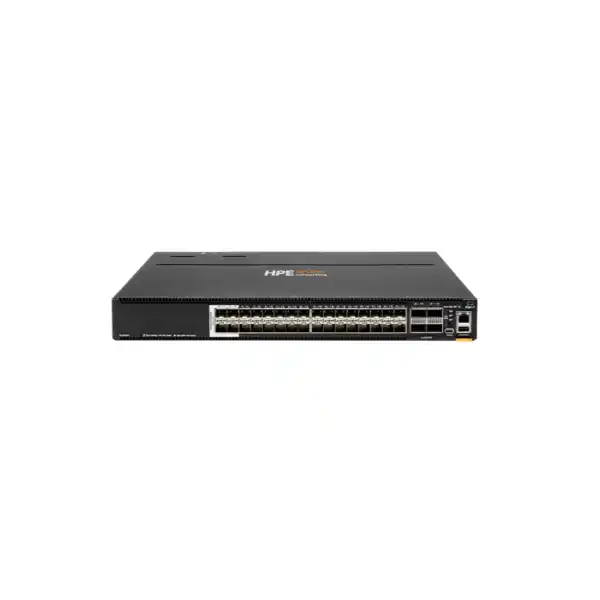
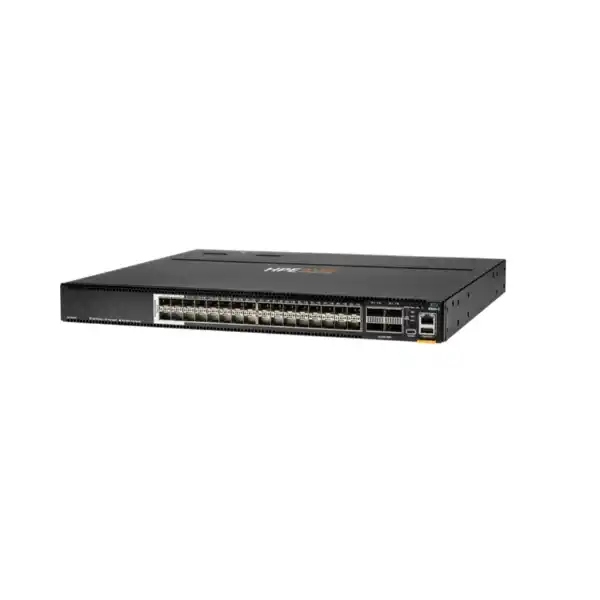
HPE Aruba Networking CX 8360 v2 Switch Series Dubai
A high-performance 1U AOS-CX switching family for organizations planning resilient campus cores, aggregation layers, data center leaf-spine fabrics and higher-speed migrations to 25GbE, 50GbE and 100GbE.
Buyer signals
Direct answer: what is the CX 8360 v2?
The HPE Aruba Networking CX 8360 v2 Switch Series is a family of fixed 1U enterprise switches based on AOS-CX. It is primarily used where organizations need dense, high-speed Ethernet for campus core or aggregation and for data center roles such as leaf, top-of-rack and end-of-row switching. It is aimed at enterprises, service environments and data centers that need resilient Layer 2/3 switching, automation, telemetry and a path from older 1/10GbE or 10/40GbE designs to faster 25/50/100GbE connectivity.
The most important purchasing decision is not simply whether “CX 8360 v2” is suitable. The exact model determines the port media, port count, high-speed uplink mix, whether selected ports support MACsec, fan count and airflow direction. Optics, breakout cables, transceivers, rack airflow, power feeds and software subscriptions also need to be matched to the deployment.
FourTeck can help a Dubai buyer turn the network requirement into an exact bill of materials: switch variant, airflow bundle, optics or DAC/AOC connectivity, required management or advanced licenses, support term, redundancy design and installation or migration scope.
Why this family is different
The CX 8360 v2 is not an access switch designed around large numbers of low-speed edge devices. Its strength is high-speed aggregation and fabric connectivity. HPE positions the family for next-generation campus core and aggregation as well as virtual and highly dynamic data center networks. That positioning matters because the product selection should begin with topology, uplink density and failure-domain design rather than with a simple port-count comparison.
AOS-CX operating model
AOS-CX uses a modern, modular architecture and exposes REST APIs and Python scripting for integration with operational workflows. The platform also includes Network Analytics Engine capabilities for telemetry and troubleshooting. For teams standardizing on automation, the value is not only faster interfaces; it is the ability to operate the switch as part of an API-driven network rather than as an isolated command-line device.
High availability by design
Virtual Switching Extension, or VSX, is a central resilience feature. A pair of switches remains independently controlled while synchronizing state across an inter-switch link. This architecture is useful when the design needs dual-homed downstream devices, resilient routing and maintenance flexibility without turning two physical switches into a single shared control plane.
Choose the exact CX 8360 v2 model before requesting a price
“CX 8360 v2” identifies a switch family, not one universal hardware configuration. HPE offers multiple port-density and media combinations, and several are sold in front-to-back and back-to-front airflow bundles. The model choice should follow the server, storage, firewall, uplink and cabling requirements in the rack.
| Variant | Typical port orientation | Buyer relevance |
|---|---|---|
| 8360-48Y6C v2 | 44 × 1/10/25GbE SFP-family ports, 4 × 10/25GbE ports with MACsec, 4 × 40/100GbE plus 2 × 40/100GbE with MACsec | Dense 25GbE server or aggregation connectivity with six high-speed QSFP-family ports and selected secured links. |
| 8360-32Y4C v2 | 32 × 25G-class SFP-family downlink positions with four 100G-class QSFP-family uplinks; selected ports support MACsec | A lower-density alternative when 48 × 25GbE access-facing ports are unnecessary. |
| 8360-16Y2C v2 | 16 × 1/10/25GbE or up to 8 × 50GbE plus 2 × 40/100GbE | Useful where a smaller high-speed footprint is sufficient and port density should not be overbought. |
| 8360-12C v2 | 12 × 40/50/100GbE QSFP-family connectivity | Suited to designs that need a compact concentration of high-speed fabric or aggregation links rather than many 25GbE ports. |
| 8360-48XT4C v2 | 48 × copper 100M/1/2.5/5/10GbE-class connectivity with four 40/100GbE QSFP28 uplinks | Relevant when the environment requires RJ-45 copper and Smart Rate connectivity rather than an SFP28-oriented server fabric. |
Port capability depends on the exact hardware variant and supported transceiver or breakout configuration. The final bill of materials should use the current HPE part number and supported options for the required release.
Performance, interfaces and migration planning
The CX 8360 v2 family scales to up to 4.8 Tbps of switching capacity and is designed around line-rate high-speed Ethernet. In practical buying terms, the headline capacity is only one part of the design. A switch can have enough aggregate fabric capacity while still being the wrong choice if its physical interfaces do not match the installed servers, storage arrays, firewalls or upstream core. A buyer moving from 10GbE to 25GbE, for example, should map every existing connection by media type and distance before deciding whether an SFP28-oriented Y model or the copper-focused 48XT4C is appropriate.
QSFP+/QSFP28 ports on applicable models support breakout options, allowing a high-speed port to be divided into multiple lower-speed links where supported. This can be valuable during phased migrations because it lets the design retain some 10GbE or 25GbE connectivity while moving toward 40/100GbE aggregation. Breakout is not a substitute for checking the exact port rules, cable type and AOS-CX support matrix. The intended breakout mode should be included in the quotation so the correct cables or optics are supplied.
The family also supports 50GbE on the 48Y6C, 32Y4C and 16Y2C models. This creates an intermediate migration path where 100GbE is unnecessary at every edge-facing link but 25GbE no longer provides enough headroom. A design team should consider expected east-west traffic, oversubscription ratio, storage bandwidth, virtualization host density and future server NIC speeds rather than selecting a port speed solely because the switch supports it.
For Dubai deployments, it is also worth checking whether the existing fiber plant and patching are ready for the chosen transceivers. Link distance, fiber type, connector type and optical budget can change the optics required even when the switch model remains the same. A quote that lists only the chassis is therefore incomplete for most production deployments.
Routing and data center fabric capabilities
The CX 8360 v2 provides an advanced Layer 2/3 feature set that includes technologies such as BGP, OSPF, VRF and IPv6. HPE also positions the platform for EVPN/VXLAN data center fabrics. These capabilities matter when the switch is expected to do more than simple aggregation—for example, acting as a leaf in a routed fabric, participating in underlay routing, or providing tenant and workload segmentation through overlays.
Protocol support should still be translated into an architecture. The number of VRFs, routes, VLANs, multicast groups and ACL entries required by the design can affect whether a given platform provides comfortable growth headroom. Current HPE QuickSpecs list a maximum of 4,094 VLANs and large IPv4/IPv6 routing and ACL scales for the family, but production sizing should use the exact software version, enabled features and model-specific scaling guidance rather than treating every published maximum as simultaneously achievable.
Organizations with simple campus aggregation may not need EVPN/VXLAN at all. In that case the purchasing decision can focus more heavily on resilient uplinks, routing convergence, port density and operations. Data center teams, by contrast, should evaluate the switch as part of a complete fabric design including route reflectors, underlay addressing, overlay control, automation and lifecycle procedures.
MACsec: useful, but not on every port
Selected CX 8360 v2 models provide IEEE 802.1AE MACsec capability on specific interfaces. On the 48Y6C v2, HPE documents four 10/25GbE MACsec-capable ports and two 40/100GbE MACsec-capable ports. The 32Y4C family also offers low-density MACsec on selected 25GbE-class ports. This is valuable where Layer 2 traffic must be protected across an untrusted or shared physical domain.
The key procurement point is that MACsec support is not universal across every interface. If the security design needs encryption on six inter-building links, for example, the port placement and speed of those links should be mapped before the hardware is ordered. A generic requirement such as “switch must support MACsec” is too broad to produce a reliable bill of materials.
MACsec also does not replace broader security architecture. Routing policy, ACLs, segmentation, identity controls, logging and physical protections remain separate considerations. Buyers should identify exactly which links require Layer 2 encryption and then confirm port and software compatibility for those links.
AOS-CX automation, telemetry and management
AOS-CX is one of the main reasons to evaluate the CX 8360 v2 as an operational platform rather than only as a set of fast ports. HPE describes AOS-CX as a modern, database-driven operating system with modular processes. REST APIs and Python scripting are available for integration with external systems, which can help network teams standardize configuration workflows, collect operational data and reduce repetitive manual changes.
The embedded Network Analytics Engine provides monitoring and troubleshooting functions using switch telemetry and a time-series data approach. For operations teams, the practical value is the ability to correlate state changes, health indicators and congestion conditions closer to the point where the traffic is handled. It can support faster diagnosis than an operating model that relies only on periodic external polling. The actual operational benefit depends on whether the team defines meaningful monitoring logic and integrates the resulting information into incident workflows.
HPE Aruba Networking Central can be used for centralized network operations, including onboarding, configuration, monitoring, troubleshooting and reporting. Central licensing should be treated as a separate commercial decision from the base hardware. The current HPE licensing model distinguishes included CX Foundation capabilities from advanced functionality and Central subscription tiers. HPE states that each CX switch includes an active embedded CX Foundation license, while advanced capabilities and Central services can require the relevant subscription or entitlement.
Before ordering, decide who will operate the switches and from where. A team that manages the platform locally through AOS-CX may have different subscription requirements from an organization standardizing multiple sites under Central. License term, support term and management architecture should therefore be quoted together so renewal dates and operational dependencies are visible from the start.
Resilience: VSX, redundant power and serviceable cooling
VSX pairs
VSX is designed around two switches that maintain independent control while synchronizing state. This allows downstream systems to use resilient multi-chassis connectivity and lets the architecture tolerate many control-plane or maintenance events without turning the pair into one monolithic failure domain.
Power redundancy
The family uses redundant, hot-swappable power supplies in the relevant bundles. To gain real resilience, each supply should be connected to an independent power path where the site design allows it. Two supplies connected to the same PDU do not protect against every upstream electrical failure.
Airflow direction
HPE sells variants with opposite airflow directions. This is a critical rack-design detail in hot-aisle/cold-aisle environments. A switch ordered with the wrong airflow can work against the cooling strategy even if every network specification is correct.
Replaceable fans
Depending on the model, bundles use three or five field-replaceable, hot-swappable fans. Fan count and airflow must match the exact hardware SKU. Keeping these details in the bill of materials prevents later confusion when spares are stocked.
Storage and lossless Ethernet considerations
The CX 8360 v2 includes data center bridging capabilities such as Priority Flow Control and Enhanced Transmission Selection, together with congestion-management functions. HPE also lists support for storage-related environments including iSCSI, lossless iSCSI, RoCE and NVMe over Fabrics scenarios. This makes the platform relevant to converged data center designs where Ethernet carries both general application traffic and latency- or loss-sensitive storage flows.
However, “supports lossless Ethernet” should not be interpreted as “any default configuration is suitable for every storage fabric.” Buffering, PFC priorities, queue allocation, ECN behavior, NIC configuration and the storage vendor’s validated design all matter. Poorly designed PFC can propagate congestion, while an incorrectly sized lossless pool can create behavior that is difficult to diagnose. Storage traffic should therefore be treated as a design input, not simply enabled as a feature after installation.
If the switch will carry RoCE or storage traffic, include the storage platform, host NIC type, expected bandwidth, required MTU, lossless class design and redundancy model in the pre-sales discussion. That information helps determine whether the CX 8360 v2 is an appropriate fit and what configuration work should be included in deployment services.
Optics, DACs and third-party transceivers
High-speed switches are frequently underquoted because the chassis is priced while the physical link components are left unspecified. For an SFP/SFP28/QSFP-based CX 8360 v2 deployment, each link may require an optical transceiver, direct-attach copper cable, active optical cable or breakout assembly. The correct choice depends on port speed, distance, fiber type, connector, rack layout and compatibility.
HPE documents an unsupported transceiver mode for certain 1G and 10G transceivers and cables, but it also states that the transceiver or cable is not covered by HPE warranty or support when used in that mode. This is an important distinction for production networks. A link may technically come up while creating a support risk the business did not intend to accept.
For new Dubai installations, a cleaner procurement method is to identify the required link inventory in a table: source device, destination device, speed, media, approximate distance and redundancy role. From that map, the optics and cable list can be selected consistently. This also exposes mixed-speed migrations where some links remain at 10GbE during the first phase while others move to 25GbE or 100GbE.
Do not assume that an existing 10GbE optic can be reused simply because an SFP28 cage is physically similar. Supported combinations, port restrictions and the exact AOS-CX release should be checked. The same discipline applies to QSFP breakout: the hardware, cable and logical port mode must all align.
Good fit scenarios
- Campus core or aggregation refresh where 25/100GbE capacity and resilient Layer 3 are required.
- Data center leaf or top-of-rack designs using 25GbE server connections and 100GbE fabric uplinks.
- Compact 1U environments that still need dual power, hot-swappable cooling and VSX-based redundancy.
- Networks adopting AOS-CX automation, REST APIs, Python-based workflows and richer telemetry.
- Migration projects that need a controlled path from older 10/40GbE connectivity toward 25/50/100GbE.
When to evaluate another option
- If the primary requirement is large-scale PoE access for phones, cameras and wireless APs, an access-switch family may be more appropriate.
- If the network needs substantially greater port density or modular expansion, a chassis or higher-capacity platform may fit better.
- If only a small number of 10GbE links are required, a lower-tier switch may deliver adequate capability with lower total cost.
- If every secured link requires MACsec, confirm whether the selected CX 8360 v2 has enough MACsec-capable ports; low-density MACsec may be insufficient.
- If the architecture depends on a particular storage or fabric validation, follow that vendor’s supported design rather than selecting by raw bandwidth alone.
Deployment journey for a Dubai enterprise
Document current switch roles, connected device speeds, routing protocols, VLAN/VRF counts, storage traffic, redundancy and management requirements.
Choose the 48Y6C, 32Y4C, 16Y2C, 12C, 48XT4C or other current variant according to port media, density and uplink design.
Add airflow direction, power cords, transceivers, DAC/AOC cables, breakout assemblies, licensing, support and spare requirements.
Validate software release, configuration templates, routing adjacencies, VSX behavior, monitoring and rollback procedure before production cutover.
Move links in controlled phases, verify optics and negotiated speeds, confirm forwarding and routing, then check redundancy under expected failure conditions.
Procurement details that change the quotation
A reliable quotation for the HPE Aruba Networking CX 8360 v2 should identify the exact HPE part number, not just the family name. For example, current HPE QuickSpecs distinguish 32Y4C bundles such as JL700C and JL701C according to airflow direction, while 48XT4C bundles such as JL706C and JL707C likewise differ by airflow. HPE has also published multiple ordering generations and bundle references, so the part number used in a live quote should come from the current regional catalog.
Power requirements deserve the same attention. A redundant two-supply switch only provides the expected resilience when the rack has the right power distribution and the supplied cords match the local PDU connection. If the project uses A and B power feeds, the installation plan should name both circuits. If the rack has only one feed, that constraint should be visible in the design rather than hidden behind the phrase “dual PSU.”
Support and software entitlements affect lifecycle cost. The hardware purchase may be only the first line of the commercial model; management subscriptions, advanced features, vendor support and professional services can carry separate terms. Aligning their duration makes renewal planning easier. It also prevents a situation in which the switch remains in service but a required centralized management or advanced entitlement has lapsed unexpectedly.
Availability and lead time can vary in the UAE by exact SKU, optics and subscription. FourTeck should therefore quote against the required configuration and quantity rather than presenting generic “in stock” language that may not apply to the requested airflow or port model.
Buyer FAQ
Is the CX 8360 v2 only for data centers?
No. HPE positions the family both for data center environments and for next-generation campus core and aggregation. The correct role depends on the chosen port model and the surrounding architecture.
Does every CX 8360 v2 port support MACsec?
No. MACsec is available on selected ports and selected models. The required secured links must be mapped to the specific MACsec-capable interfaces before ordering.
Can it form a resilient pair?
Yes. VSX is a major high-availability capability of the platform. Two switches remain independently controlled while synchronizing state and supporting resilient multi-chassis designs.
Are optics included automatically?
Not as a general assumption. The optics, DACs, AOCs or breakout cables should be selected according to the required speed, media and distance and listed explicitly in the bill of materials.
Does it require Aruba Central?
The switch runs AOS-CX and includes CX Foundation capabilities. Aruba Central is a management choice with its own licensing considerations. Whether it is required depends on the organization’s operating model and desired features.
What should be checked for a 25GbE migration?
Confirm server NIC support, optics or DAC compatibility, fiber type, breakout needs, uplink oversubscription, routing design, rack airflow and whether existing devices must continue operating at 10GbE during the transition.
Decision recap
Select the physical port mix first: dense 25GbE, compact 100GbE, smaller 25/50GbE or copper Smart Rate.
Size for current traffic, oversubscription and growth rather than relying only on the family’s maximum switching figure.
Separate included AOS-CX capabilities from optional advanced or Central subscriptions needed by the operating model.
Verify transceivers, cables, breakout modes, NICs, storage requirements and software release support.
Match front-to-back or back-to-front airflow, rack depth, power distribution and resilient feeds to the facility.
Design VSX, routing convergence, dual-homing and A/B power together; redundancy is architectural, not a checkbox.
What FourTeck needs for an accurate CX 8360 v2 quotation
A short technical brief prevents the quote from being reduced to a chassis-only price. The most useful inputs are:
Build the right HPE Aruba CX 8360 v2 configuration for Dubai
Share the intended topology, port speeds, airflow, optics, licensing and support requirements. FourTeck can translate them into a model-specific quotation that accounts for the complete deployment rather than only the base switch.

Reviews
There are no reviews yet.