
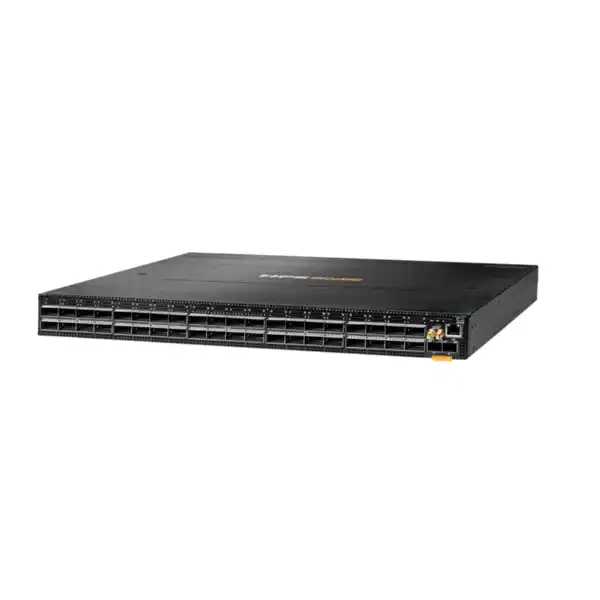
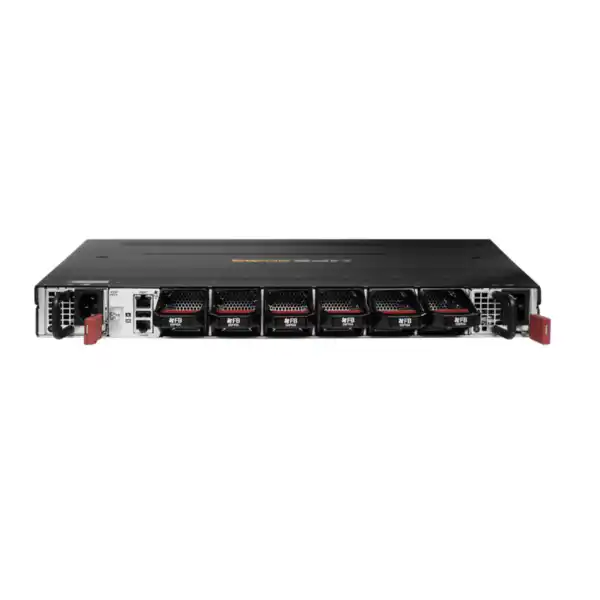
HPE Aruba Networking CX 9300 Switch Series in Dubai
The HPE Aruba Networking CX 9300 family is a high-capacity 1U switching platform for modern data center fabrics, high-speed server and storage connectivity, and 100GbE to 400GbE network transitions. The key buying decision is not simply “CX 9300 or not”; it is choosing the correct CX 9300 family member, airflow direction, optics, breakout plan, power design and fabric role for the actual rack and application.
Direct answer for buyers
A family of high-performance HPE Aruba Networking data center switches based on AOS-CX, with models aimed at dense 100GbE, 200GbE and 400GbE fabrics.
Leaf-spine fabrics, server and storage aggregation, intra-fabric links, high-speed cloud networks, EVPN-VXLAN deployments and Ethernet storage environments.
Enterprises, service environments and data center operators moving beyond 10/25GbE access or requiring substantial 100/400GbE density in a compact form factor.
The exact switch variant and port architecture. The CX 9300-32D and CX 9300S-32C8D are not interchangeable in port mix, capacity or deployment economics.
Model fit, airflow direction, compatible optics, breakout needs, power requirements, rack deployment, software compatibility, migration scope and quotation bill of materials.
Where the CX 9300 family fits
The HPE Aruba Networking CX 9300 Switch Series is positioned for networks where interface speed and fabric scale are central design requirements. HPE describes the family as a 1U fixed-configuration platform for high-density 100GbE and 400GbE connectivity across servers, storage and intra-fabric links. That makes it materially different from a conventional campus access switch. A CX 9300 purchase usually belongs to a data center architecture discussion: which devices are leaf switches, which are spines, what server NIC speeds are present today, which links will be broken out, what oversubscription is acceptable, and how the fabric will grow over the next refresh cycle.
For Dubai and UAE buyers, the practical value is density without moving immediately to a modular chassis. A 1U device can carry a large number of high-speed interfaces, but that density creates dependencies that need to be handled early. Optics can become a major part of the project cost. Power and cooling must be designed for loaded transceivers rather than an empty chassis. Airflow direction has to match the hot-aisle/cold-aisle design. Cabling and breakout choices determine how many physical endpoints can actually be connected. A technically correct order therefore needs more than the switch name and quantity.
CX 9300-32D versus CX 9300S-32C8D
CX 9300-32D
The CX 9300-32D is the higher-capacity member for very dense high-speed fabrics. HPE specifies 32 ports that can operate at 100GbE, 200GbE or 400GbE, with 25.6 Tbps switching capacity. A 400GbE port can be configured as one 400GbE connection, two 200GbE connections, or four 100GbE connections when the supported breakout components and software configuration are used.
This model is a strong candidate for 400GbE spine roles, high-density aggregation, and environments where many 100GbE server or fabric links need to converge in one rack unit. It should not automatically be selected when lower-speed server access dominates, because the physical interface mix may create unnecessary optics and breakout complexity.
CX 9300S-32C8D
The CX 9300S-32C8D takes a different approach: 32 access-side ports supporting 10/25/100/200GbE plus eight 400GbE ports. HPE lists 16 Tbps switching capacity. This mix can make the 9300S attractive where the edge of the data center still contains a range of NIC speeds but the fabric uplinks are moving to 400GbE.
The 9300S can reduce the need to force every endpoint into a 100GbE-or-higher design. It is therefore worth comparing when a migration includes 25GbE server connectivity, mixed generations of adapters or a need for a more gradual transition. The model decision should be driven by port-speed distribution and topology, not by headline capacity alone.
Key HPE Aruba Networking CX 9300 specifications
The following values are family-level planning references from current HPE product material. Exact ordering bundles, airflow, power supplies, transceiver support and operating limits must be validated against the selected part number and the AOS-CX release planned for deployment.
| Planning item | CX 9300-32D | CX 9300S-32C8D |
|---|---|---|
| Form factor | 1U fixed configuration | 1U fixed configuration |
| Primary data ports | 32 ports of 100/200/400GbE | 32 ports of 10/25/100/200GbE plus 8 ports of 400GbE |
| Switching capacity | 25.6 Tbps | 16 Tbps |
| Published throughput | Up to 5 Bpps | Up to 5 Bpps |
| High availability hardware | Redundant, field-replaceable, hot-swappable power supplies; replaceable fan options by bundle | Redundant, field-replaceable, hot-swappable power supplies; replaceable fan options by bundle |
| Management interfaces | SNMP, REST, serial console, micro-USB console and RJ-45 out-of-band management | SNMP, REST, RJ-45 and USB-C serial console, and RJ-45 out-of-band management |
| Operating system | AOS-CX | AOS-CX |
Port breakout changes the real port count
Port count on a 400GbE switch should never be interpreted as endpoint count without a breakout plan. On the CX 9300-32D, HPE supports flexible use of the 400GbE-capable ports, including 4 x 100GbE and 2 x 200GbE modes. HPE also documents 100GbE breakout to four 25GbE links in appropriate designs. This flexibility is powerful, but each breakout choice affects cable type, optic type, patching, rack labeling, supported link distance and the total number of logical interfaces.
A buyer connecting 25GbE server NICs has a different bill of materials from a buyer building 400GbE spine links between switches. The correct quotation should therefore identify every required speed and link distance rather than simply listing “32-port CX 9300.”
Optics are part of the architecture
QSFP-DD and QSFP28 environments can involve direct-attach copper, active optical cables, single-mode or multimode transceivers, and breakout assemblies depending on the topology. Compatibility has to be checked against the selected CX 9300 model and the supported transceiver matrix for the intended AOS-CX release. The switch chassis alone does not define a complete working link.
For procurement, provide source and destination device type, required speed, approximate cable length, fibre type where existing cabling will be reused, and whether the connection is switch-to-switch, switch-to-server or switch-to-storage. These inputs help prevent a common high-speed networking problem: purchasing physically similar optics that do not match the optical standard, reach, breakout mode or software support required by the design.
Leaf-spine and EVPN-VXLAN deployment
The CX 9300 family supports the advanced Layer 2 and Layer 3 features expected in modern data center fabrics, including BGP, OSPF, VRF-Lite and IPv6. HPE also identifies dynamic VXLAN with BGP-EVPN as a key capability for segmentation in data center and campus network designs. In a data center, this allows an underlay routed fabric to transport overlay network segments while control-plane information is exchanged through EVPN. The result can be a more scalable approach than extending large Layer 2 domains everywhere, but the technology requires disciplined addressing, routing policy, VTEP planning, MTU design and operational skills.
A CX 9300-32D can be attractive as a spine when large numbers of 100GbE or 400GbE links converge. The 9300S may suit a leaf role where servers use 25/100/200GbE while high-capacity 400GbE ports provide fabric uplinks. Those are design examples rather than universal rules. In some environments, another HPE Aruba Networking CX model may provide a better match for the required port speeds, budget or scale. The correct fabric is determined by endpoint density, oversubscription targets, east-west traffic, number of racks, redundancy model and expected growth.
For buyers replacing an older three-tier data center network, the commercial scope should include migration engineering as well as hardware. Existing VLANs, routing adjacencies, gateway locations, firewall insertion points, load balancer connections, storage networks and monitoring integrations may need to be mapped before the first new switch is installed. A fabric refresh that ignores these dependencies can create more risk than the new bandwidth resolves.
AOS-CX operations, automation and analytics
Database-driven operating system
The CX 9300 family runs AOS-CX. HPE positions AOS-CX as a modern, database-driven network operating system intended to simplify critical and complex tasks. For operations teams, software consistency across compatible CX platforms can reduce the friction of managing different command models and automation approaches.
REST and programmable workflows
REST interfaces provide a foundation for programmatic configuration and integration. HPE also describes Network Analytics Engine capabilities that can use Python agents and telemetry to help monitor and troubleshoot network, system, application and security-related conditions.
Fabric orchestration options
HPE Aruba Networking Fabric Composer is positioned to simplify automation, orchestration and visibility for network fabric underlays and virtualized overlays. Whether it belongs in a specific project depends on the intended operating model, existing tooling and current product compatibility.
Software tooling should be treated as a design dependency rather than assumed from the switch hardware alone. Before deployment, confirm the target AOS-CX release, interoperability with management platforms, approved transceivers, required features, upgrade process and support entitlement. This is particularly important in a live data center where a maintenance window must account for both configuration changes and software lifecycle planning.
Storage and lossless Ethernet considerations
HPE positions the CX 9300 family for Ethernet storage fabrics and describes support for the low-latency and lossless network characteristics required by storage traffic. This matters for software-defined storage, hyperconverged infrastructure and other designs in which many servers share SSD or flash-based resources across Ethernet. High interface speed alone, however, does not make a storage network lossless. Queueing, QoS, congestion behavior, buffer use, host configuration and the storage vendor’s validated design all influence the result.
If the CX 9300 will carry storage traffic, the project should identify the storage protocol, array vendor, server adapter model, required MTU, redundancy design and validated switching configuration. HPE documentation also points to compatibility validation for storage use cases. For a production storage fabric, use the current vendor interoperability guidance rather than generic assumptions about Ethernet. This is an area where a technically smaller switch with the right validated configuration can be a safer choice than a higher-capacity device selected only by throughput.
Resilience: hardware redundancy and VSX
HPE lists redundant, field-replaceable, hot-swappable power supplies for the CX 9300 family and provides bundle options with replaceable fans and defined airflow direction. This supports resilient rack design, but true service availability depends on more than having two power supplies. The two PSUs should normally be connected to independent power paths where the facility supports them, and the network topology should remove single points of failure above and below the switch.
HPE Aruba Networking Virtual Switching Extension, or VSX, is a high-availability technology available across supported CX platforms. It is designed to let two switches operate with an active-active style of resiliency while retaining independent control planes. In practical terms, a pair of switches can provide redundant downstream or upstream connectivity without turning every failure event into a full network outage. The exact VSX design must still account for inter-switch link capacity, keepalive connectivity, gateway placement and the behavior of connected devices.
For a critical Dubai data center deployment, ask whether the design requires a single CX 9300, a redundant pair, or a larger multi-rack fabric. A single high-capacity switch can still be a single failure domain. Redundancy should be mapped from the server NIC or storage controller through the switching fabric to upstream routing and security services, with failure scenarios documented before implementation.
Power planning
High-speed transceivers add a meaningful load to a dense switch. HPE publishes model-dependent power values and specific input-voltage requirements. For the CX 9300-32D, current product material states that 220–240 V input is required to support an 8-to-32-port production configuration. For the CX 9300S, HPE notes 200–240 V is required when transceiver power exceeds 5 W in any port. These are procurement-level requirements because the rack power design must match the switch and optic population.
Do not size rack PDUs from idle consumption. Capture the proposed transceiver count, expected port loading, PSU type and redundancy policy, then verify the maximum and typical draw for the selected ordering bundle.
Cooling and airflow
CX 9300 ordering choices include front-to-back and back-to-front airflow bundles. The airflow direction must align with the rack’s cold-aisle and hot-aisle arrangement. Mixing the wrong direction can cause the switch to ingest hot exhaust from neighboring equipment and undermine the thermal design even when the room temperature appears acceptable.
Operating-temperature limits also vary by model and bundle. HPE data lists up to 45°C for some CX 9300 configurations and 40°C for some CX 9300S variants at sea level. A Dubai data center should therefore validate inlet temperature at the actual rack, not rely only on facility set-point. Dense 400GbE optics can make local airflow particularly important.
Deployment workflow for a CX 9300 project
Map traffic and topology
Document rack count, server and storage endpoints, NIC speeds, east-west traffic patterns, north-south uplinks, routing boundaries and redundancy requirements. This reveals whether the switch is intended as leaf, spine, aggregation, storage or mixed-purpose infrastructure.
Choose the port architecture
Compare the 9300-32D and 9300S-32C8D by actual speed distribution. Count native 400GbE, 200GbE, 100GbE, 25GbE and any 10GbE requirements, then identify which links need breakout. Include spare capacity for growth instead of filling every logical port on day one.
Build the optics and cabling matrix
List each connection with speed, distance, media and remote interface. Confirm supported transceivers and breakout cables for the selected model and software release. This matrix becomes a practical installation and troubleshooting reference later.
Validate rack, power and airflow
Select the correct airflow bundle, verify PDU voltage and connector availability, confirm redundant feeds where required, reserve rack space and review expected thermal load. High-density fabrics should be engineered with the populated optical configuration in mind.
Prepare software and migration
Define the AOS-CX release, baseline configuration, routing and overlay design, management integration, upgrade approach and rollback plan. For brownfield replacement, stage the new fabric so dependencies can be migrated in controlled groups.
Test failure and performance scenarios
Validate link failover, routing convergence, VSX behavior where used, storage traffic policy, monitoring visibility and expected application flows. A high-capacity fabric is only production-ready when normal and failure-state behavior are both understood.
Migrating from 10/25GbE toward 100/400GbE
HPE explicitly positions the CX 9300 family as part of the transition from 10GbE and 25GbE server farms toward 100GbE and 400GbE EVPN-VXLAN spine configurations. That transition is rarely a single maintenance-window event. Many data centers have mixed generations of servers, hypervisors, storage arrays and firewalls. A sensible migration plan keeps those constraints visible instead of designing as if every device already supports the newest link speed.
Where 25GbE remains common, the CX 9300S-32C8D can be worth evaluating because its 32 access ports support 10/25/100/200GbE while eight separate ports provide 400GbE. Where the environment already standardizes on 100GbE or 200GbE and needs very high 400GbE density, the 9300-32D may provide a cleaner fit. Breakout can bridge some speed gaps, but every breakout adds physical and operational complexity, so it should be deliberately documented.
During migration, preserve a clear rollback path. Pre-stage VLANs, routing, BGP peerings, EVPN parameters and monitoring. Validate MTU end to end. Confirm firewall and load-balancer interface compatibility. For storage, follow the storage vendor’s validated network design. If the old and new fabrics coexist, define exactly where Layer 2 and Layer 3 boundaries sit during each phase. This work determines outage risk more than the raw switching capacity does.
When the CX 9300 may be the wrong choice
A balanced design does not begin by assuming the requested platform must be purchased. The CX 9300 family is built around very high data center port speeds. If the requirement is mainly 1GbE access, PoE for phones and wireless access points, or general campus edge switching, this is not the natural product class. A campus-oriented CX access platform would normally be more appropriate.
The CX 9300-32D may also be excessive where only a small number of 100GbE links are needed and there is no credible path to higher density. Conversely, if the planned fabric exceeds the practical scale or port count of fixed 1U devices, a different architecture or additional tiers may need to be evaluated. Fixed switches scale elegantly in leaf-spine designs, but they are not automatically the best answer for every rack count, oversubscription target or operational model.
The 9300S and 9300-32D should be compared with neighboring HPE Aruba Networking data center switches when lower-speed port density, different form factor, alternate power characteristics or different capacity is required. FourTeck can use the server/storage inventory and topology to determine whether the requested CX 9300 is correctly sized before the quotation is locked.
Procurement details that materially affect the quote
Exact switch variant
State whether the design needs CX 9300-32D or CX 9300S-32C8D. Family names alone are not enough to price the correct chassis and port mix.
Airflow direction
Confirm front-to-back or back-to-front based on rack orientation. This must align with the data center cooling plan.
AC or DC power
Available bundles differ. Confirm facility supply, redundancy and the voltage requirements associated with the intended transceiver population.
Optics and breakouts
Provide speed, fibre type and link length for each connection. Breakout assemblies should be included in the same design review as the switch.
Software and support
Define the required AOS-CX release, management tooling and support coverage. Compatibility should be validated before software is standardized.
Implementation scope
Clarify whether the request is hardware supply only or includes configuration, rack installation, migration, testing, documentation and support handover.
Buyer questions about HPE Aruba Networking CX 9300
Is the CX 9300 a 400GbE switch?
Yes, the family includes 400GbE capability, but the exact port arrangement depends on the model. The CX 9300-32D provides 32 ports that can operate at 100/200/400GbE. The CX 9300S-32C8D combines 32 ports supporting 10/25/100/200GbE with eight 400GbE ports.
Can a 400GbE port be broken out?
On the CX 9300-32D, HPE documents 400GbE ports that can be configured as 4 x 100GbE, 2 x 200GbE or 1 x 400GbE. The correct breakout cable or optics and current transceiver support should be verified for the intended software release.
Does the CX 9300 support EVPN-VXLAN?
HPE lists dynamic VXLAN with BGP-EVPN as a capability of the CX 9300 family for segmentation in data center and campus networks. A production design still needs an underlay routing plan, VTEP addressing, MTU validation and operational policy.
Can it be used for storage traffic?
The family is positioned for Ethernet storage fabrics and lossless QoS characteristics. Storage deployment should follow the storage vendor’s validated architecture, including adapter compatibility, QoS policy, MTU and redundancy requirements.
What is the switching capacity?
HPE specifies 25.6 Tbps for the CX 9300-32D and 16 Tbps for the CX 9300S-32C8D. Capacity is only one selection factor; port-speed mix and topology usually determine which platform is practical.
Does it have redundant power?
HPE documents two redundant, field-replaceable, hot-swappable power supplies. Bundle type, AC/DC choice, airflow and actual rack power architecture should be confirmed during ordering.
What should be checked before ordering optics?
Confirm the exact switch model, AOS-CX release, required link speed, remote interface type, fibre or copper media, link distance and whether the connection is native or breakout. These details are more reliable than choosing a transceiver by connector shape alone.
Is this suitable for a normal office access network?
Usually not. The CX 9300 is a high-speed data center platform. If the requirement is primarily 1GbE/2.5GbE access, PoE endpoints or general office edge switching, another HPE Aruba Networking CX access family should normally be evaluated.
Decision recap
What FourTeck needs for an accurate CX 9300 quotation
A short technical brief is enough to turn a family-level request into a useful bill of materials. Send as many of these items as are available:
Plan the right CX 9300 configuration for your Dubai data center
Share the required port speeds, rack count, airflow direction and link distances. FourTeck can help translate those requirements into the correct CX 9300 family member, compatible high-speed connectivity, power design and implementation scope without over-sizing the hardware or overlooking deployment dependencies.

Reviews
There are no reviews yet.