
HPE Aruba Networking CX 9300S Dubai
A 16 Tbps, 1U fixed switch for organizations that need dense 100GbE server or storage access, 400GbE fabric links, modern EVPN-VXLAN designs and AOS-CX operational consistency without moving to a larger modular chassis.
Direct answer for buyers
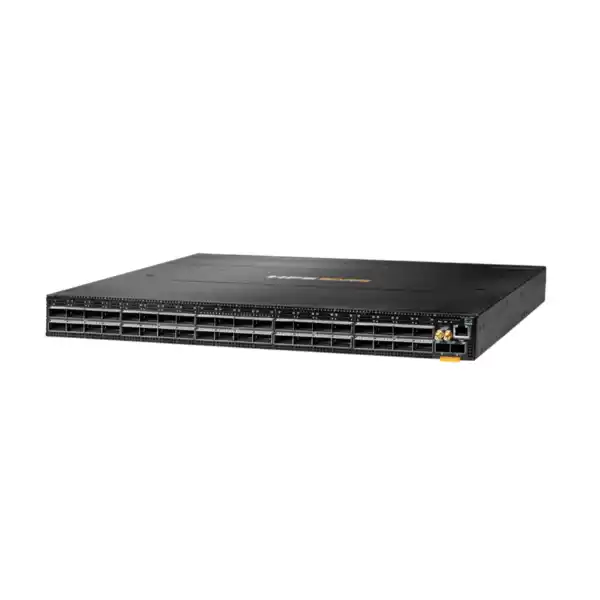
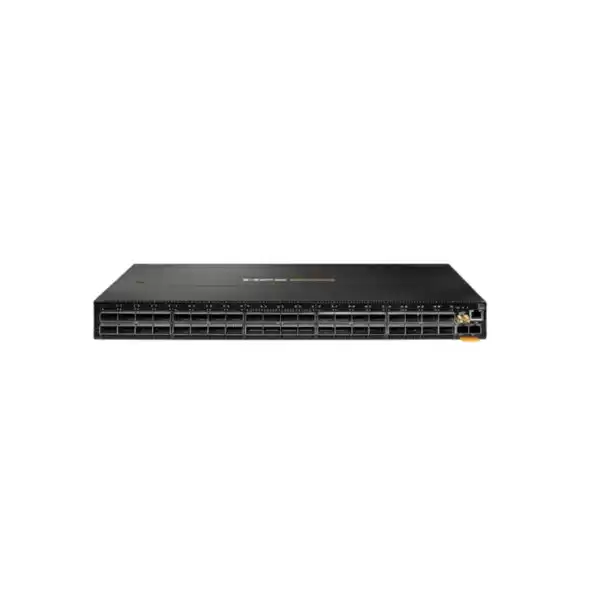
The HPE Aruba Networking CX 9300S-32C8D is a high-performance fixed data center switch in the CX 9300 family, combining 32 100GbE-class QSFP28 interfaces with eight 400GbE QSFP-DD interfaces in one rack unit.
Leaf-spine fabrics, top-of-rack server and storage connectivity, high-density 100G access, 400G inter-switch links, AI/ML network access, data center interconnect designs and selected campus core or aggregation deployments.
Enterprises, service environments and large private-cloud operators that have outgrown 25G-centric designs and need a compact path toward 100G or 200G server-facing connections with 400G uplinks.
Port-speed plan, optics and breakout method, rack airflow direction, AC or DC power selection, AOS-CX software feature support, required encryption functions and management subscription choices.
The appropriate CX 9300S bundle and part number, transceiver list, cable plan, redundancy requirements, management licensing, rack accessories, deployment scope and support options for a Dubai or wider UAE project.
Where the CX 9300S fits in an enterprise network
The CX 9300S is not simply a generic 400G switch. Its value comes from the way it combines many 100G access-facing interfaces with a smaller set of 400G fabric-facing interfaces. That port balance makes the platform particularly relevant where a data center is moving through several generations of server and storage bandwidth at the same time. A rack may still contain 10G or 25G workloads, newer systems may require 100G, and an AI or accelerated-compute cluster may introduce 200G requirements. Above those racks, the fabric may need 400G links to avoid creating an oversubscribed spine layer. The CX 9300S is designed around that transition pattern rather than around a single port speed.
HPE positions the CX 9300S-32C8D for top-of-rack leaf, end-of-row, core or aggregation, and spine use. That flexibility is useful, but role selection should be deliberate. A switch used as a leaf has different requirements from a switch used as a spine: server-facing breakout density, oversubscription ratio, routing scale, ECMP design, failure-domain planning and optic reach all change. In a campus collapsed-core design, the same chassis may be attractive because it offers high density and hardware support for link encryption in a compact 1U footprint, but the required AOS-CX feature set should still be validated against the software release planned for production.
For UAE buyers, environmental design is also part of product selection. Data-center rooms in Dubai are normally tightly controlled, yet rack-level airflow mistakes can still cause avoidable thermal problems. CX 9300S bundles are available with different airflow and power configurations. The direction of airflow must match the hot-aisle/cold-aisle layout and should be consistent with adjacent equipment. Power-feed type, PDU connector requirements and redundancy expectations should be settled before a part number is placed on a purchase order.
High-density 100G access
Thirty-two QSFP28 ports provide a practical foundation for 100GbE server, storage or leaf-spine connectivity. Supported breakout modes can also help accommodate lower-speed interfaces, but the exact transceiver, cable and software combination must be checked for the planned port speed.
400G fabric capacity
Eight QSFP-DD 400G ports give architects a separate high-bandwidth tier for spine, inter-rack or intra-fabric links. This helps build a denser fabric without consuming the 100G access-facing ports that may be needed for hosts or downstream switches.
AOS-CX operations
The platform runs HPE Aruba Networking CX Switch Operating System, with REST APIs, Python programmability, Network Analytics Engine functionality, resilient state handling and support for modern routing and EVPN-VXLAN designs.
Encryption-aware hardware
HPE documents up to 6.4 Tbps of MACsec capacity and 4.8 Tbps of IPsec/VXLANsec hardware capability for the CX 9300S-32C8D. Software support is release-dependent, so a buyer should validate the exact ports and encryption modes required instead of treating hardware capability as automatic feature availability.
Technical specification snapshot
Scaling figures can depend on table allocation, traffic model and software release. Treat published maximums as design inputs, not as a substitute for validating the production forwarding profile.
Port planning: the decision that drives the entire bill of materials
The physical port count is only the starting point. The useful question is how those interfaces will be consumed by real endpoints. A 100G QSFP28 port can serve a direct 100G attachment, but a project may also use supported breakout arrangements to connect multiple lower-speed endpoints. The 400G QSFP-DD ports can provide high-bandwidth fabric connectivity or be used with supported breakout options where the design calls for a different distribution of lanes. Every breakout choice changes the number and type of transceivers or direct-attach cables, the switch-port configuration and the patching plan.
Distance matters just as much as speed. Connections inside the same rack may be suited to DAC or AOC choices, while links across rows or between rooms may need optical modules selected for the required fibre type and reach. Existing structured cabling should be audited before optics are quoted. A multimode plant built for older 10G links may not automatically support the desired 100G or 400G topology at the same distance. Single-mode links may simplify longer runs but introduce a different optic and patching cost profile.
The practical procurement approach is to build a port map before requesting a final quotation. List every server, storage controller, downstream leaf or spine peer, current speed, target speed, medium, distance and redundancy requirement. This reveals how many native 100G and 400G ports are required, where breakouts are sensible and whether a neighbouring CX model with a different port balance may actually be a better fit.
EVPN-VXLAN and routing design
The CX 9300 family supports advanced Layer 2 and Layer 3 functions including BGP, OSPF, VRF-Lite and IPv6, and HPE positions dynamic VXLAN with BGP-EVPN for segmentation across data center and campus environments. For a modern leaf-spine fabric, that means the physical underlay and virtual overlay can be built on the same AOS-CX operational model. The benefit is not merely feature availability: consistent switch software, APIs and telemetry can reduce operational differences between leaf and spine tiers.
A buyer should still avoid specifying EVPN-VXLAN as a checkbox item. Route scale, VRF count, VLAN and VNI design, multicast requirements, border-leaf architecture, external routing and failure convergence all need to be aligned with the expected workload. Where the CX 9300S acts as a high-density leaf, the 100G ports may face servers, storage or downstream systems while the 400G ports carry northbound fabric traffic. Where it acts as a spine, the port distribution and desired number of leaf connections can change substantially.
If the new switch is replacing an older core or aggregation platform, migration design is especially important. Existing spanning-tree dependencies, MLAG-style constructs, first-hop redundancy, static routes, OSPF adjacencies, BGP policies and ACL behavior should be documented. The goal is not to reproduce a legacy architecture mechanically but to identify which services must remain compatible during the transition and which can be simplified as part of the move to AOS-CX.
AOS-CX management, automation and visibility
HPE Aruba Networking CX switches use a database-driven operating architecture intended to improve programmability, state visibility and resilience. For engineering teams, the practical value is the ability to work with REST APIs and Python-based automation rather than depending only on manual command-line configuration. HPE also provides Network Analytics Engine capabilities that can use time-series information for troubleshooting and analysis of network behavior.
Organizations standardizing on HPE Aruba Networking Central can integrate switch onboarding, configuration, monitoring, troubleshooting and reporting into a broader wired and wireless operational model. However, Central is not simply an included cloud portal for every advanced function. HPE documents subscription tiers, including Foundational and Advanced options, and the Advanced subscription expands capabilities such as premium security and AIOps functions. In some licensing models it can also include CX Advanced Feature Pack entitlement. The exact subscription term, feature requirement and device-management strategy should therefore be quoted explicitly.
Some enterprises prefer an on-premises-oriented operational workflow or use HPE Aruba Networking Fabric Composer for data center fabric orchestration. Others integrate AOS-CX through existing automation pipelines. The correct choice depends on who operates the network, whether change control is centralized, what telemetry needs to be retained, and how the fabric fits into the wider server, storage and security toolchain. A switch purchase should include that operating model discussion because management licensing and implementation effort can materially affect total project cost.
Encryption capability: verify software support
HPE lists substantial MACsec and IPsec/VXLANsec hardware capability for the CX 9300S-32C8D, but its documentation also calls out software-release limitations. If encryption is a purchasing requirement, confirm the exact AOS-CX release, supported ports, key-management method and deployment topology before finalizing the design.
PTP capability: hardware does not equal enabled feature
HPE identifies the platform as PTP-capable hardware while noting support status in current software documentation. Environments that require precision timing should validate the precise AOS-CX release and PTP profile before treating the switch as production-ready for that requirement.
Storage networking: design for lossless behavior
HPE positions the CX 9300 series for storage-optimized Ethernet use cases. Storage projects should define traffic classes, congestion behavior, QoS settings, MTU requirements and redundancy with the storage vendor instead of assuming that a high-speed Ethernet link alone creates a validated storage fabric.
High availability and physical resilience
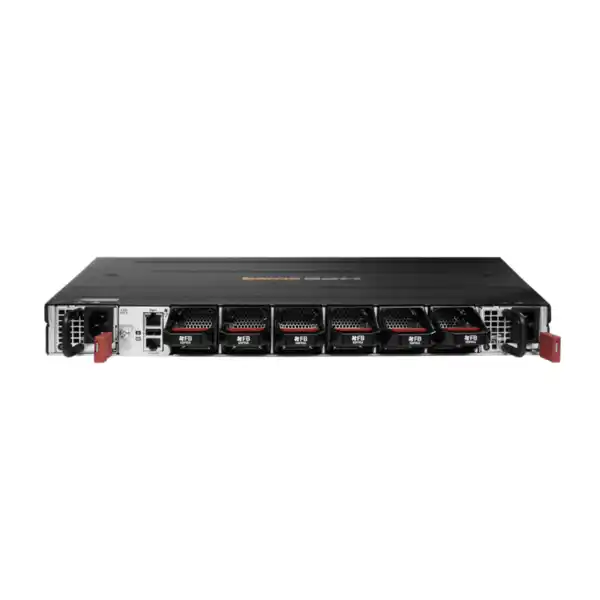
The listed CX 9300S bundles use redundant, field-replaceable and hot-swappable power supplies together with six redundant, field-replaceable and hot-swappable fans. That hardware design helps support maintenance without unnecessarily taking a switch out of service, but resilient infrastructure requires more than redundant components inside one chassis. Critical systems should be dual-homed where the server, storage platform and application architecture support it, and the two network paths should terminate on separate failure domains.
HPE Aruba Networking Virtual Switching Extension, or VSX, is relevant where two switches need to operate as a resilient pair while retaining independent control planes. The exact design depends on the role of the switches and the traffic pattern. For a data center leaf pair, server bonding or multi-chassis connectivity must be coordinated with the host configuration. For a core or aggregation pair, routed links may be preferred in some designs. The appropriate topology should be selected for convergence behavior and operational clarity rather than simply because a feature is available.
Power architecture should also be mapped end to end. Two power supplies provide little practical protection if both connect to the same PDU, UPS path or upstream electrical source. A production design normally allocates the two supplies to independent feeds where available. For DC-powered variants, site voltage, terminal connection and facility standards need to be verified. For AC bundles, confirm power-cord and PDU compatibility along with the conditions required to preserve redundancy.
Airflow, rack depth and installation in Dubai data centers
The chassis is approximately 61 cm deep and mounts in a standard 19-inch equipment rack. A two-post rack kit is listed with the switch, while HPE identifies an optional four-post rack kit for installations that require it. Check usable rack depth, rear clearance and cable bend radius before delivery.
Front-to-back and back-to-front bundle options exist. Select the direction that matches the row design. Mixing airflow directions within a rack can cause hot exhaust air to re-enter equipment intakes and may undermine otherwise adequate cooling capacity.
Operating-temperature limits vary by listed configuration. HPE documents specific ranges and altitude derating, so the exact selected bundle should be checked against the data hall set point and installation altitude rather than relying on a generic data-center temperature assumption.
A dense 100G/400G switch can accumulate substantial fibre and high-speed copper cabling. Plan front and rear cable managers, optic access, service loops and labeling so a failed optic or fan tray can be serviced without disturbing neighboring links.
CX 9300S versus CX 9300-32D: which port balance is better?
The CX 9300S-32C8D and CX 9300-32D belong to the same broader high-performance family but serve different density priorities. The CX 9300S provides 32 100G-class ports and eight 400G ports with 16 Tbps switching capacity. The CX 9300-32D is a higher-capacity design with 32 QSFP-DD ports capable of 100/200/400GbE operation and a published 25.6 Tbps switching capacity. In simple terms, the CX 9300S is attractive when many 100G access links need a defined set of 400G uplinks, while the CX 9300-32D deserves evaluation when the design needs a larger number of native 400G-class interfaces or substantially greater fabric flexibility.
That does not make the 32D automatically superior. A project that only needs eight 400G fabric links may gain no practical benefit from paying for a port architecture built around 32 400G-capable interfaces. Conversely, a fast-growing AI cluster or a spine layer expected to move rapidly toward 400G leaf connections may outgrow the CX 9300S port mix sooner than anticipated. The forecast matters more than a headline bandwidth number.
There are also cases where a smaller or different CX platform should be considered. If the network remains primarily 10G/25G with only limited 100G uplinks, a lower-density model may be more economical and easier to cable. If the requirement includes distributed services or a specialized policy architecture, another HPE Aruba Networking platform may align better. A useful shortlist starts from topology, port count, bandwidth growth, feature requirements and operational standards, then selects the switch.
Typical deployment scenarios
100G top-of-rack leaf
High-performance servers or storage arrays attach at 100G while 400G ports provide northbound links to the spine. The design should calculate oversubscription and expected east-west traffic rather than simply dividing access bandwidth by uplink bandwidth.
AI/ML access fabric
The platform can support 200GbE server-facing use cases documented by HPE, making it relevant to selected accelerated-compute environments. Confirm transceiver support, breakout mapping, lossless Ethernet requirements and whether the scale needs a 400G-heavier platform.
Storage Ethernet
Dense high-speed storage links can be combined with AOS-CX storage-optimization features. The storage vendor’s validated network settings, multipathing design, queue behavior and failure handling remain essential inputs.
Campus collapsed core
A compact high-performance pair can suit environments that need substantial fibre aggregation and Layer 3 capacity in limited rack space. Verify downstream optic mix, redundancy design and whether the data-center-oriented port speeds align with the campus distribution layer.
Licensing, support and lifecycle planning
AOS-CX includes a broad native feature set, but advanced capabilities and centralized management can introduce subscription choices. HPE documents an optional term-based CX Advanced Feature Pack and HPE Aruba Networking Central subscriptions. Central Foundational and Advanced tiers address different management and AIOps requirements, and HPE notes that an Advanced Central subscription can include the CX Advanced Feature Pack entitlement. Because licensing programs evolve, the quotation should state the subscription SKU, term, included functions and renewal model rather than relying on a generic line such as “management license.”
Support is equally important for a switch that may sit in the critical path of a data center. Buyers should decide required coverage hours, target response level, hardware-replacement expectations and whether software support or implementation assistance is part of the project. Spare strategy may also differ between a single enterprise data hall and a multi-site operator. In some cases, holding a complete cold spare or critical transceiver inventory can reduce recovery time more effectively than relying solely on remote troubleshooting.
Lifecycle planning should include the expected AOS-CX release train, approved maintenance windows, configuration backup method, automation repository and change-control process. The value of a programmable switching platform is highest when software operations are disciplined. A design that depends on a particular feature should record the tested software version and avoid uncontrolled upgrades that could change behavior across the fabric.
Procurement risks to remove before placing the order
The CX 9300S is sold through multiple bundle and switch SKUs, including airflow, AC/DC and TAA-related variants. A product-family name alone is therefore not enough for a purchase order. The selected SKU should explicitly match the data-center airflow plan and power system. Using the correct switch but the wrong airflow bundle can create an installation problem that is far more disruptive than a simple cable change.
Optics are another common source of budget variance. The chassis may be only one part of the project value. Thirty-two 100G links plus multiple 400G fabric links can require a significant quantity of transceivers, AOCs, DACs, fibre jumpers and breakout assemblies. Distance, fibre type and connector format should be verified before those components are priced. Where existing optics are expected to be reused, compatibility should be validated against HPE’s supported transceiver guidance and the intended AOS-CX release.
Finally, distinguish hardware capability from currently supported software function. HPE’s own CX 9300S documentation includes notes around PTP and certain encryption capabilities. If those functions are mandatory, they belong in the technical acceptance criteria. FourTeck can use the requirement list to help identify the appropriate bundle and supporting components, but final design approval should be based on the software release and feature matrix intended for deployment.
Practical implementation journey
Discovery
Capture current topology, host speeds, storage links, routing, VLAN/VRF structure, growth forecast, rack positions, power feeds and management standards.
Design
Define leaf/spine or core role, port map, breakout scheme, oversubscription, EVPN-VXLAN or traditional routing, redundancy, encryption and management architecture.
Bill of materials
Select exact CX 9300S SKU, power and fan direction, optics, cables, breakout assemblies, rack kit if required, licenses, support and any spare components.
Build and validate
Stage software, baseline configuration, management integration, routing and overlay behavior, redundancy, telemetry, host connectivity and failure scenarios before production cutover.
Migration
Move workloads in controlled stages, validate reachability and performance, monitor errors and congestion, then remove temporary compatibility paths once the fabric is stable.
Buyer questions
Is the CX 9300S a 400G switch?
Yes, but its architecture combines 32 QSFP28 100G ports with eight QSFP-DD 400G ports. It is especially useful where high-density 100G access and a smaller number of 400G fabric links are needed together.
Can it support 200G server links?
HPE positions the CX 9300S for 100G/200G access use cases including AI/ML deployments. The exact port, breakout, transceiver and software support should be verified for the required host adapter and cable type.
Does it require Aruba Central?
No. AOS-CX provides native switching, routing and operational functions. Aruba Central is an optional management path with subscription tiers that add centralized workflows and, depending on tier, additional capabilities.
Are power supplies and fans redundant?
HPE’s listed CX 9300S bundles include two redundant hot-swappable power supplies and six redundant hot-swappable fans. The two feeds should be connected to appropriately independent power paths if true infrastructure redundancy is required.
Should I choose CX 9300S or CX 9300-32D?
Choose based on port mix and growth. CX 9300S emphasizes 100G density plus eight 400G links; CX 9300-32D offers a much denser set of 400G-capable interfaces and higher switching capacity. A fabric forecast usually makes the decision clear.
What information is needed for a Dubai quotation?
Quantity, required airflow, AC or DC power, port-speed map, optic reach, cable type, breakout needs, management license term, support level, rack-kit requirement and any installation or migration services.
Decision recap
Best evaluated where 32-port 100G density and eight 400G fabric ports match the planned leaf, spine, core or aggregation role.
16 Tbps switching capacity is substantial, but oversubscription and future 400G growth still need topology-level calculation.
Validate optics, breakout cables, host adapters, storage requirements and existing fibre plant rather than purchasing transceivers by speed alone.
AOS-CX features, Central subscriptions and release-dependent encryption or timing support must align with the intended production design.
Confirm airflow direction, rack depth, four-post kit requirement, PDU connectivity and independent power feeds before delivery.
Compare CX 9300-32D when the roadmap needs materially more 400G-capable ports or greater fabric capacity.
What FourTeck needs for an accurate CX 9300S quotation
Providing these inputs lets the quotation reflect the real deployment rather than only the base chassis. It also helps surface whether the CX 9300S is the right port mix or whether another CX platform should be compared before purchase.
Plan the right HPE Aruba Networking CX 9300S configuration for your Dubai data center
Share the target topology, port speeds, optic distances, airflow, power and management requirements. FourTeck can help turn those inputs into a practical bill of materials and quotation for the UAE, including the switch bundle, compatible connectivity components, licensing, support and deployment scope.

Reviews
There are no reviews yet.