
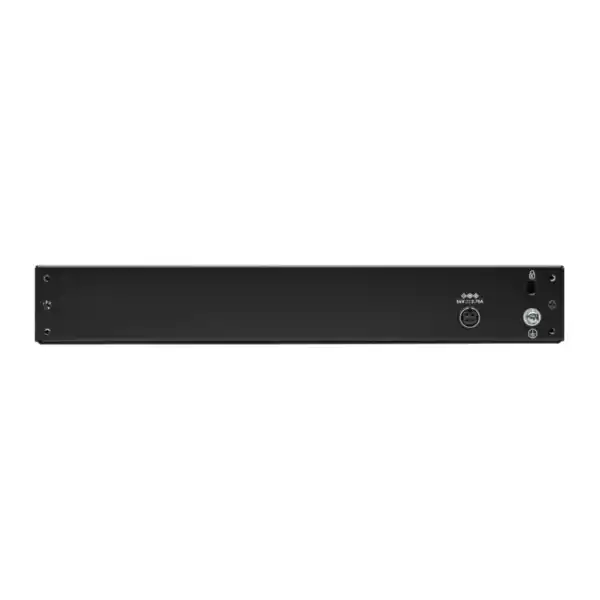
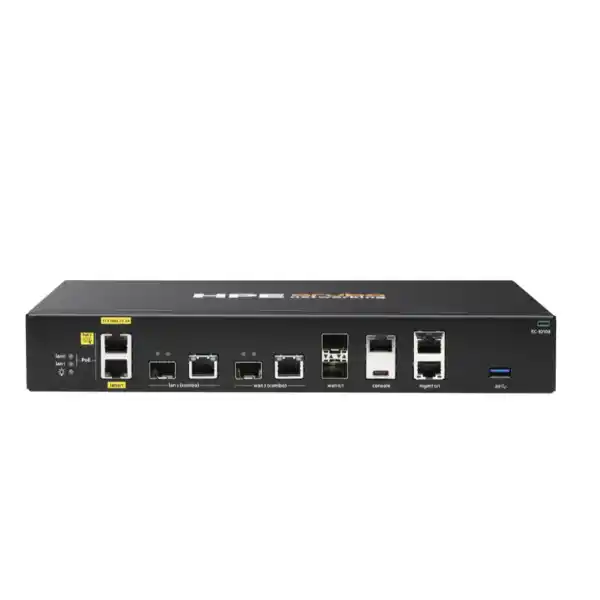
HPE Aruba Networking EdgeConnect 10108 SD-WAN Gateway
A compact EdgeConnect appliance for organizations that need multi-link WAN control, up to 2 Gbps of bidirectional WAN capacity, 1G/10G fibre options, policy-driven segmentation, and centralized SD-WAN operations at branch sites.
Direct answer: what is the EdgeConnect 10108?
Where EC-10108 fits in an EdgeConnect branch design
The HPE Aruba Networking EdgeConnect 10108 occupies an important position between entry branch appliances and the larger platforms intended for heavier branch, head-office, or data-centre roles. HPE’s current platform guidance identifies the EC-10108 as a medium-branch option with typical WAN bandwidth from 2 Mbps up to 2,000 Mbps. The dedicated data sheet also describes the hardware as a compact, cost-effective gateway suitable for small branch and remote-office environments. These descriptions are not contradictory when viewed through a sizing lens: the appliance is physically compact, but its 2 Gbps WAN ceiling and richer security performance allow it to serve sites that have outgrown smaller branch appliances.
For a Dubai organization, that distinction matters because branch size is not determined only by employee count. A relatively small office can consume significant WAN capacity if it hosts cloud collaboration, large file transfers, voice and video, remote desktop, guest internet, private-cloud access, backup traffic, and direct internet breakout. Conversely, a physically larger office can have modest WAN demand when most applications remain local. The EC-10108 should therefore be selected from traffic requirements, security inspection expectations, path diversity, interface requirements, and growth—not simply from the number of desks.
The appliance supports MPLS, internet and 4G/5G/LTE-based hybrid WAN transport. Cellular connectivity generally depends on an external carrier device or supported handoff rather than a built-in mobile radio. Its value is in combining available transports into an SD-WAN policy framework where traffic can be steered according to business intent, path conditions, application requirements, segmentation rules, and resilience objectives. This can reduce dependence on a single transport type while giving network operations one policy and visibility layer for multiple branches.
HPE Aruba Networking EdgeConnect 10108 specifications
The figures below are taken from current HPE documentation for the EC-10108. Actual design suitability still depends on feature use, software entitlement, traffic mix, topology and supported accessories.
| WAN bandwidth | 2 to 2,000 Mbps bidirectional |
|---|---|
| Simultaneous connections | 256,000 |
| Recommended WAN optimization | Up to 500 Mbps |
| IDS/IPS capacity | Up to 1,500 Mbps in Performant mode; up to 1,000 Mbps in Inline mode |
| Datapath connectivity | 2 x 10/100/1000 RJ45 with PoE support, 2 x combo ports (RJ45 or SFP), 2 x 1G/10G SFP+ ports |
| Network flexibility | Six ports can support WAN/LAN combinations; up to 128 IEEE 802.1Q VLANs |
| Routing | BGP and OSPF support |
| Memory and storage | 32 GB ECC memory; single 120 GB SSD |
| Encryption | AES-128 disk encryption; IPsec using AES-256 for network encryption |
| Management interfaces | 2 x 10/100/1000 RJ45 management ports; RJ45 console and USB-C console; 1 x USB 3.0 Type-A |
| Power | 100–240 VAC, 50–60 Hz, 165 W; single external power adapter |
| Dimensions | 43.7 mm high x 294.8 mm wide x 201.05 mm deep |
| Weight | 2.305 kg |
| Operating environment | 0°C to 40°C; 10% to 90% relative humidity, non-condensing |
| Manufacturer ordering reference | S0E23A for the standard EC-10108 SD-WAN Gateway; regional or special variants such as NAL should be checked against the required quote |
What those specifications mean in a real deployment
2 Gbps is a sizing ceiling, not a blanket promise
The WAN bandwidth rating is stated for bidirectional traffic. It should be treated as a platform sizing reference under documented conditions, not as a guarantee that every security, optimization and inspection feature can run at 2 Gbps simultaneously. If a branch expects heavy encrypted traffic, deep inspection, multiple tunnels, high session counts and sustained application bursts, size from the most demanding combined feature set rather than the circuit label alone.
IDS/IPS mode changes the conversation
HPE publishes up to 1,500 Mbps IDS/IPS capacity in Performant mode and up to 1,000 Mbps in Inline mode. A buyer considering security inspection on Gigabit-class internet circuits should decide whether the desired operational mode and security policy fit those figures. This is especially important when replacing a dedicated firewall or when expecting the SD-WAN gateway to participate in a consolidated branch-security architecture.
10G ports solve interface constraints, not throughput constraints
The two 1G/10G SFP+ cages provide valuable flexibility for fibre handoffs and high-speed LAN attachment. A 10G physical interface does not mean the appliance is a 10 Gbps SD-WAN platform. The distinction prevents a common procurement error: interface speed and supported aggregate WAN workload are separate design parameters. Fibre type, distance, transceiver support and provider presentation also need confirmation before optics are ordered.
PoE is useful but should be designed deliberately
The EC-10108 includes two PoE-capable Gigabit RJ45 ports, and HPE notes integrated PoE support for attached devices up to 60 W. That can simplify certain branch designs, but it should not be treated as a replacement for a full PoE access switch where many phones, access points, cameras or IoT devices are required. The powered-device requirement, cable path and overall branch switching design should determine how those ports are used.
SD-WAN, routing and path-control capabilities
EdgeConnect is designed around a software-defined WAN overlay rather than a simple static dual-WAN failover model. Business intent overlays can be used to define how traffic classes use available transports and how applications respond when path conditions change. In practice, an organization can combine MPLS with broadband internet, operate two diverse internet links, or incorporate cellular transport through an appropriate external service handoff. This allows the WAN architecture to favor performance, resilience or cost according to application need instead of treating every packet identically.
WAN link redundancy is supported through multiple link-bonding options, while LAN-side protection can use VRRP and BGP. The EC-10108 also supports BGP and OSPF routing. Those capabilities are particularly relevant when an SD-WAN deployment must integrate with an established branch routing design rather than replace it overnight. For example, a site may continue to exchange routes with an existing core or distribution layer while EdgeConnect takes control of WAN path selection. Migration planning should document route ownership, redistribution points, default-route behavior, failover timers, NAT responsibilities and any overlapping private address space before cutover.
HPE includes multiple IPSLA options for path monitoring. That matters because successful SD-WAN is not simply about having two links; it is about measuring whether each path is suitable for a particular application at a particular time. Voice, video, SaaS, remote desktop and bulk backup can have very different tolerance for latency, loss and jitter. The operational objective should be defined first, followed by policy. A well-sized appliance with vague path policies can still produce a poor user experience.
Centralized management with EdgeConnect SD-WAN Orchestrator
The EC-10108 runs EdgeConnect Operating System (ECOS), which provides a web interface and REST API for managing an individual appliance. Multi-site deployments are centrally configured, monitored and managed through HPE Aruba Networking EdgeConnect SD-WAN Orchestrator. HPE also documents REST API and streaming notification capabilities, making the platform relevant to operations teams that want to integrate SD-WAN events and configuration workflows with broader tooling.
The installation guide states that Orchestrator should be installed and registered with the HPE Aruba Networking Cloud Portal before an EdgeConnect gateway is set up. That dependency should be planned before hardware arrives at the branch. A purchase of the physical appliance alone is not the entire operational design; entitlement, software access, account registration, organization naming, deployment ownership and policy preparation must be ready for a controlled rollout.
Operational visibility and access
Management options include CLI access through console or SSH, secure HTTPS access, SNMPv3, secure syslog with configurable logging levels, and authentication through a local database, RADIUS or TACACS+. Real-time and historical graphing are supported, along with NetFlow and IPFIX. These features allow the EC-10108 to fit environments that already have centralized authentication, log retention, network-flow analysis and security-monitoring processes.
During design, decide which systems will be authoritative for administrator identity, logging, flow telemetry and incident investigation. Sending every possible event without a retention or alerting strategy can create noise. A better approach is to map EdgeConnect events to operational outcomes: circuit degradation, tunnel state, policy changes, authentication events, appliance health and security findings should each have an owner and a response path.
Security design: useful capability, but define the branch-security architecture
The EC-10108 supports IPsec network encryption using AES-256 and AES-128 disk encryption. It can operate in-line as a next-hop gateway at the site perimeter and HPE documents WAN hardening or zone-based stateful firewall operation. IDS/IPS is also supported, with published performance figures that differ by mode. These capabilities give the platform a meaningful security role, but procurement should still start with an architecture question: is EdgeConnect expected to be the branch security enforcement point, to work alongside a dedicated firewall, or to provide SD-WAN while selected security controls are delivered elsewhere?
That decision affects throughput sizing, cabling, route ownership, NAT, high availability, logging, operational responsibility and migration sequencing. In a design with a separate next-generation firewall, the team should decide whether the firewall sits inside or outside the EdgeConnect appliance and which device terminates provider addressing. In a consolidated design, the required security policies and feature entitlements must be mapped to the appliance’s supported capabilities and performance envelope. Avoid assuming that the presence of IDS/IPS removes the need to validate every security function required by internal policy or regulatory obligations.
Segmentation is also a core part of the EdgeConnect approach. HPE documents policy-based virtual network segmentation through SD-WAN Orchestrator, and the appliance supports up to 128 802.1Q VLANs. This can help separate corporate users, voice, guest, IoT, payment, operational technology or other traffic classes, but VLAN count alone is not the design. The real requirement is end-to-end segmentation: WAN overlays, routing domains, firewall policy, cloud access, authentication and branch switching all need to preserve the intended trust boundaries.
Connectivity and physical deployment planning
Copper, combo and fibre choices
The six datapath ports are not six identical interfaces. The appliance provides two PoE-capable Gigabit RJ45 ports, two combo interfaces that can use either RJ45 or SFP, and two 1G/10G SFP+ cages. A quote should identify which handoffs are copper, which are fibre, required fibre type and distance, and whether the ISP or upstream switch uses 1G or 10G presentation. Supported transceivers should be selected from current HPE compatibility guidance rather than assumed from connector shape.
Management access before production traffic
The EC-10108 has two dedicated management ports. HPE documents mgmt0 as DHCP by default, while mgmt1 uses a link-local default address for direct laptop attachment. This simplifies staging and break-glass access when planned correctly. Management addressing, DNS, NTP, outbound cloud access, administrator authentication and firewall rules should be prepared before zero-touch or orchestrated deployment begins.
Power and environmental conditions
The appliance uses a single external power adapter and is specified for 100–240 VAC at 50–60 Hz, with a 165 W requirement. Its operating range is 0°C to 40°C at 10% to 90% non-condensing relative humidity. In Dubai, that makes controlled indoor installation important. It should not be treated as a device for unconditioned outdoor cabinets or spaces where ambient temperature can exceed the supported range.
Compact hardware still needs proper mounting
At roughly 294.8 mm wide, 201.05 mm deep and 43.7 mm high, the EC-10108 is compact, but branch installation still needs orderly rack, shelf or approved mounting, airflow, cable strain relief, grounding and access to the external power adapter. HPE installation guidance requires professional installation and compliant grounding. The final bill of materials should confirm whether the required power adapter and accessory kit are included or need to be quoted separately for the chosen regional SKU.
Licensing, software and subscription checks before ordering
A complete EdgeConnect purchase should not be reduced to a hardware part number. The EC-10108 relies on the EdgeConnect software and orchestration ecosystem, and some capabilities can depend on the selected software entitlement or optional performance packs. HPE specifically presents WAN Optimization as an optional software performance pack for EdgeConnect. The data sheet recommends WAN optimization up to 500 Mbps on this appliance, so an organization that expects acceleration should confirm both the entitlement and the workload profile before treating that figure as part of the design.
The appropriate subscription term, support coverage, Orchestrator deployment model, and any security-related entitlement should be aligned with the organization’s contract strategy. A three-year project and a five-year branch lifecycle do not automatically imply the same license term. Procurement should also verify how renewals will be handled, who owns the HPE account, who receives lifecycle notices, and whether local support requirements call for additional services.
For a quotation in the UAE, give the supplier the exact functional requirements rather than asking for “the 10108 license.” State whether the project needs only core SD-WAN, WAN optimization, advanced security functions, centralized Orchestrator access, professional installation, migration, support, optics and accessories. This prevents the hardware from arriving correctly while the software or service components remain incomplete.
Deployment scenarios in Dubai and the UAE
Dual-internet branch replacing an MPLS-heavy design
A branch using two diverse broadband circuits can use EdgeConnect overlays to apply business intent and link-bonding policies while moving suitable applications away from expensive private WAN dependence. The design should confirm whether any legacy application still requires deterministic MPLS behavior, how direct internet breakout is secured, and what happens during provider impairment rather than complete failure.
Hybrid MPLS and internet migration
Organizations can retain MPLS for selected workloads while introducing internet transport for SaaS, cloud or lower-priority traffic. This phased approach can reduce migration risk because the existing private WAN remains available during transition. Routing adjacency, route preference, encryption policy, traffic classes and application identity should be agreed before moving production paths.
Cloud-first office with fibre handoff
A branch with high SaaS and cloud usage may benefit from 10G-capable SFP+ connectivity to an upstream switch or provider handoff even when the SD-WAN traffic target remains within the appliance’s 2 Gbps WAN range. That arrangement can eliminate a physical-interface bottleneck while preserving room for local aggregation, but it does not change the platform’s stated WAN capacity.
Resilient branch with cellular backup
For sites where broadband outages are unacceptable, a 4G/5G/LTE service can provide a third transport through an appropriate external device or carrier handoff. Cellular capacity, data allowance, NAT behavior and public addressing can differ significantly from fixed circuits, so the policy should reserve it for applications that matter during an outage rather than automatically sending every workload across the backup path.
When to compare a smaller or larger EdgeConnect model
The EC-10108 should not be selected simply because it is available. HPE’s current family guidance places the EC-10104 at the small-branch or home-office end, the EC-10106 as a small-branch platform, and the EC-10108 as a medium-branch platform. The EC-10108 also offers higher SD-WAN bandwidth and stronger advanced-security performance than the EC-10106. A smaller model can therefore be appropriate where circuit speeds, session counts, security inspection and growth remain comfortably lower and the required interface mix is simpler.
A larger platform should be evaluated if the branch is expected to exceed 2 Gbps of WAN capacity, requires materially higher security throughput, needs more resilient field-replaceable hardware, demands a different port density, or is being designed as a hub rather than a normal branch. This is especially relevant when a procurement team is tempted to use the presence of 10G SFP+ ports as evidence that a 10 Gbps WAN requirement is covered. It is not.
The best model comparison uses the same traffic profile across candidates: peak and average throughput, internet/MPLS/cellular links, encrypted traffic ratio, application mix, required IDS/IPS mode, WAN optimization expectations, expected simultaneous sessions, VLAN count, routing protocol use, optics, high availability, and three-to-five-year growth. This converts a model choice from a product preference into an engineering decision.
A practical EC-10108 implementation journey
Discover
Document all current WAN circuits, provider handoffs, routing, public IPs, NAT, security devices, critical applications, user populations, traffic peaks and outage pain points. Capture future circuit upgrades as well as today’s utilization.
Size
Compare throughput needs against the EC-10108 WAN and IDS/IPS figures. Include WAN optimization if required. Validate simultaneous connections, interface speeds, VLAN demand and expected three-to-five-year growth.
Design
Choose appliance placement, WAN/LAN port mapping, routing ownership, segmentation, Orchestrator model, authentication, logging, optics, management access and high-availability behavior. Define which security functions remain on other platforms.
Stage
Register the Orchestrator environment, prepare templates and business intent overlays, verify management reachability, label cables and optics, record serial details, and test configuration against a documented rollback plan.
Migrate
Move circuits and routing in a controlled sequence, verify application reachability and path policy, test provider failure scenarios, confirm voice and SaaS quality, and monitor route stability rather than declaring success from basic ping tests.
Operate
Set thresholds for link quality and appliance health, forward relevant logs and flow data, review business intent policies as applications change, and keep software, support and subscriptions aligned with the planned service lifecycle.
Common procurement mistakes to avoid
Buying only the appliance
A deployable SD-WAN solution may also need software entitlements, support, optics, accessory kits, power components, Orchestrator preparation and migration services. The physical gateway should be one line in a validated solution bill of materials.
Sizing from ISP speed alone
A 1 Gbps or 2 Gbps circuit label does not capture security inspection, optimization, encrypted traffic, simultaneous sessions, growth or failover. If two circuits can become active together, the expected aggregate traffic should be modeled.
Assuming any SFP will work
Optical form factor is not enough. Supported transceiver model, fibre type, wavelength, reach and upstream compatibility must all align. The HPE hardware reference should govern optic selection.
Ignoring single-device dependencies
The EC-10108 uses a single external power adapter and a single internal SSD. If the branch requires appliance-level redundancy rather than only WAN-link redundancy, the architecture may need a second appliance or a different platform approach.
Buyer questions about the HPE Aruba EdgeConnect 10108
Is EC-10108 suitable for a 2 Gbps internet link?
HPE lists WAN bandwidth from 2 to 2,000 Mbps bidirectional, so 2 Gbps is the top of its published WAN range. Suitability still depends on how much of that traffic is inspected, optimized or processed by other enabled functions. A design operating continuously at the platform ceiling should be reviewed carefully for growth and failover headroom.
Does it have 10 Gigabit interfaces?
Yes. It has two 1G/10G SFP+ interfaces. It also has two 1G combo interfaces and two PoE-capable Gigabit RJ45 interfaces. Interface speed does not change the stated 2 Gbps WAN capacity of the appliance.
Can it replace a firewall?
It includes zone-based stateful firewall capabilities, WAN hardening and IDS/IPS, but replacement suitability depends on the exact firewall functions, inspection requirements, policies and throughput that the organization expects. A feature-by-feature security design is preferable to assuming equivalence from category names.
Does it support WAN optimization?
HPE publishes recommended WAN optimization up to 500 Mbps for EC-10108. WAN Optimization is presented as an optional software performance pack, so entitlement and actual application suitability should be confirmed during quoting.
Which product code should be quoted?
HPE lists S0E23A for the standard EC-10108 SD-WAN Gateway and also publishes regional or special variants. The final UAE quote should verify the correct sales SKU, power components, accessory kit, entitlement and optics for the intended deployment.
Is the EC-10108 a data-centre appliance?
HPE’s current family positioning identifies it primarily as a medium-branch platform. For large hubs or data-centre roles with higher WAN capacity, greater port density or stronger hardware redundancy requirements, a larger EdgeConnect model should be evaluated.
Decision recap for EC-10108 buyers
What FourTeck needs for an accurate Dubai quotation
The more of these inputs you provide, the more accurately the hardware, software and implementation scope can be aligned.
Plan the right EdgeConnect 10108 configuration for your UAE branch
Share your circuit speeds, interface requirements, security expectations and migration scope. FourTeck can help validate whether EC-10108 is the right branch platform and prepare a quotation covering the required hardware, software, optics, accessories, support and deployment services.

Reviews
There are no reviews yet.