
HPE Aruba Networking EdgeConnect EC-M-H SD-WAN Gateway
A 1U enterprise SD-WAN hub platform for organizations that need multi-gigabit WAN capacity, flexible copper and 1/10GbE optical connectivity, centralized policy control and a practical path from legacy WAN designs to secure business-intent networking.
Best suited to a head office, regional hub or data-center role where branch traffic converges and WAN resilience, policy consistency and interface planning matter.
Direct answer for business buyers
The EC-M-H is an HPE Aruba Networking EdgeConnect physical SD-WAN hub gateway in a 1U rack form factor.
It aggregates and controls WAN traffic for head offices and data centers participating in an EdgeConnect SD-WAN fabric.
Enterprises with multi-site networks, several WAN transports, centralized applications or a need to modernize MPLS-heavy designs.
Confirm the exact orderable EC-M-H variant, required licensed bandwidth, optics and target high-availability architecture before purchase.
Gateway fit, interface requirements, licensing term, WAN handoffs, migration scope and UAE deployment services for an accurate bill of materials.
Where EC-M-H fits in an EdgeConnect design
The EC-M-H is not primarily a small-branch appliance. HPE positions it as a medium hub platform for a head office or data-center large-hub role, with typical bidirectional WAN bandwidth from 50 Mbps to 5 Gbps. That positioning matters because hub gateways encounter a different traffic profile from ordinary branches. A branch usually originates and receives traffic for one site; a hub may terminate overlays from many branches, carry data-center application flows, forward internet or cloud traffic, participate in routing, and absorb peaks created by centralized services. The right question is therefore not simply whether the appliance supports a particular circuit speed. Buyers should ask how much encrypted, feature-enabled traffic will converge at the hub and how much growth is expected during the planned subscription and hardware lifecycle.
For a UAE enterprise, the EC-M-H can make sense when Dubai or Abu Dhabi hosts a principal data center, a large headquarters, a regional shared-services hub or an internet breakout point that connects numerous remote locations. It also fits hybrid-WAN projects that combine internet, MPLS and cellular-backed connectivity. EdgeConnect overlays can use multiple link types, while business-intent policies govern how applications use those links. This helps an organization move from circuit-by-circuit WAN behavior toward application-aware policy without forcing every existing carrier service to disappear on day one.
The gateway should still be selected as part of an architecture, not as an isolated box. If aggregate hub bandwidth is expected to exceed 5 Gbps, if more modern 25GbE connectivity is required, or if the organization wants a different hardware generation, a larger or newer EdgeConnect hub platform should be compared. Conversely, a site that only needs branch-scale throughput may be better served by an appropriately sized branch gateway rather than paying for hub capacity that will remain unused.
Buyer signal: EC-M-H is strongest when…
- The site is a head office, data center or regional WAN aggregation point.
- Expected bidirectional WAN demand falls within the platform’s 50 Mbps–5 Gbps positioning.
- Copper 1GbE and 1/10GbE optical handoffs are both useful.
- WAN overlays need central orchestration and policy-based segmentation.
- Redundant power is important for hub resilience.
- The network team needs enterprise routing, monitoring and secure management integration.
Verified EC-M-H technical profile
HPE’s current EdgeConnect QuickSpecs identify the EC-M-H with the following platform-level characteristics. Exact orderable part, regional bundle and included components should be matched to the quote because HPE documentation also reflects lifecycle changes in EC-M-H ordering references.
| Typical deployment | Head office / data center large hub |
| Typical WAN bandwidth | 50 Mbps to 5 Gbps bidirectional |
| Simultaneous connections | 2,000,000 |
| Recommended WAN optimization | Up to 1 Gbps |
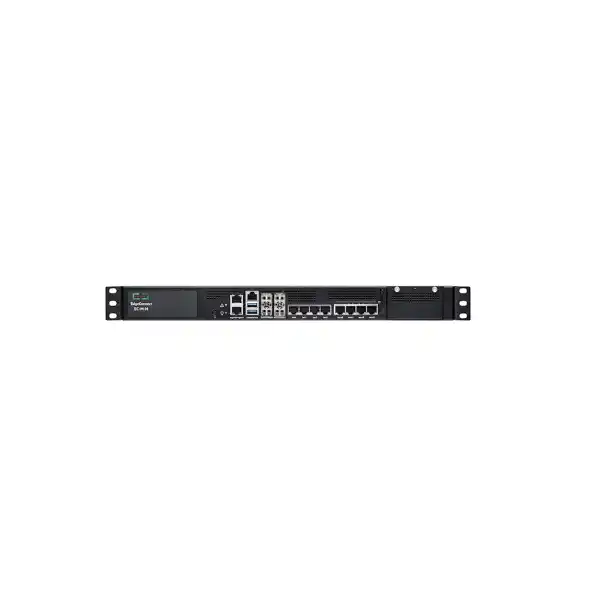
| Copper data interfaces | 8 × 10/100/1000 RJ45, commonly described as 4 LAN / 4 WAN |
| Optical data interfaces | 4 × 1/10 Gbps SFP+ cages supporting compatible pluggable optics |
| Management | 2 × 10/100/1000 management plus console |
| Routing | BGP and OSPF support |
| Network encryption | IPsec with AES-256 for the data plane; TLS 1.2 for management-plane encryption as documented |
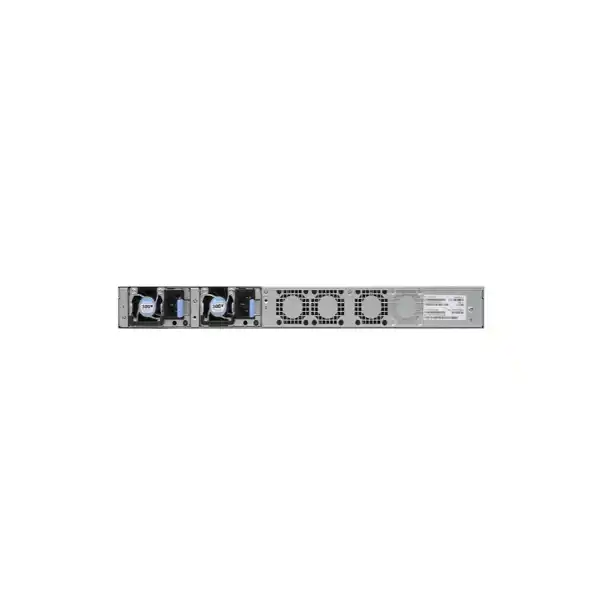
| Power | 1+1 redundant power; HPE lists 153 W / 522 BTU AC requirement |
| Form factor | 1U; height approximately 42.9 mm (1.69 in) |
| Operations | SNMP, SSH, HTTPS, secure syslog, RADIUS/TACACS+, graphing, NetFlow and IPFIX capabilities are documented for the platform. |
Connectivity: plan ports around the real WAN and LAN handoffs
The EC-M-H’s mixed interface set is one of its practical advantages. Eight 1GbE RJ45 data ports suit conventional copper carrier handoffs, firewall links, switch connections and management-adjacent designs, while four 1/10GbE SFP+ cages provide a path for higher-speed optical connections. HPE’s validated design material lists EC-SFP-SR and EC-SFP-LR optics as supported for EC-M-H, and also identifies EC-SFP-1000BT copper SFP support for this platform. Optics are not a detail to leave until installation day: fiber type, distance, connector standard, patching and the interface offered by the carrier or upstream switch must all align with the selected transceiver.
1GbE copper
Useful where WAN routers, carrier NTEs, switches or firewalls present standard RJ45 handoffs. Count physical links, HA cross-connections and any dedicated topology requirements before deciding the port budget.
1/10GbE fiber
Appropriate for high-speed LAN cores, data-center switching or optical WAN presentation. Select SR or LR according to the actual fiber plant and distance, not by assuming every SFP+ link uses the same optic.
Interface headroom
Allow spare interfaces where resilience or migration demands parallel connections. A technically sufficient port count on day one can become restrictive during carrier transition or dual-router cutover.
No 25GbE assumption
The classic EC-M-H is centered on 1/10GbE SFP+ connectivity. If the target design needs native 25GbE, compare newer or higher-class EdgeConnect hub platforms instead of forcing an unsuitable interface plan.
SD-WAN functions that matter at a hub
EdgeConnect is designed around an overlay approach in which physical transports become underlay paths and policy determines how application traffic uses them. For a hub, this is more than a convenience feature. The platform may sit at the center of branch-to-data-center flows, cloud-bound traffic, private WAN connectivity and internet access. Central orchestration helps network teams apply common intent rather than independently tuning static route and path preferences at every remote office.
Business-intent overlays
Policies can be aligned to application and business priorities, allowing different traffic classes to use available WAN paths according to defined objectives. This can reduce dependence on a single transport design and make hybrid WAN behavior easier to standardize.
Hybrid WAN support
HPE describes EdgeConnect hub platforms as supporting MPLS, internet and 4G/LTE/5G-based transport services. Actual cellular integration normally depends on an external compatible service or handoff rather than a blanket assumption of an embedded modem in this rack gateway.
Segmentation
Policy-based virtual network segmentation can help separate traffic classes and business zones across the WAN fabric. The design should map segmentation to the enterprise’s routing, firewall and security policy rather than treating it as an isolated SD-WAN feature.
Routing integration
BGP and OSPF support is especially relevant at a hub, where the gateway may need to exchange reachability with data-center cores, WAN routers or adjacent network services. Routing ownership and failover behavior should be documented before cutover.
Zero Touch Provisioning
HPE positions the platform for building an SD-WAN fabric with Zero Touch Provisioning. For a hub, pre-staging still deserves careful change control because the gateway often connects to critical routing, carrier and data-center domains.
Visibility and logging
Documented support includes secure syslog, real-time and historical statistics, NetFlow and IPFIX. These outputs should be integrated with the organization’s monitoring and logging standards so SD-WAN does not become an operational silo.
Licensing and Orchestrator: size the subscription with the network plan
Hardware capacity and licensed service level should be considered together. HPE’s validated solution guidance shows bandwidth-based EdgeConnect subscription choices for hub deployments, including examples at 500 Mbps, 1 Gbps, 2 Gbps and unlimited tiers depending on the relevant offer. That guidance also makes a useful planning point: if an organization expects to replace slower MPLS services with faster internet circuits during the subscription period, licensing should be selected with that future state in mind, or the contract term should leave room for a later change.
The management model is also part of the procurement decision. HPE documentation describes the EC-M-H control plane as automated and secured through the EdgeConnect SD-WAN Orchestrator. Buyers should confirm which Orchestrator entitlement, subscription tier and support services are included in the proposed SKU bundle, especially when comparing quotes from different dates. Hardware naming can remain familiar while commercial packaging changes, so a clean bill of materials should show appliance, subscription, term, optics, support and professional services as separate, understandable lines.
WAN optimization is another area where headline platform bandwidth should not be confused with optimization capacity. HPE lists recommended WAN optimization up to 1 Gbps for EC-M-H. A project that depends heavily on optimization for specific traffic flows should validate the optimization requirement independently from the overall 5 Gbps WAN positioning.
Quotation dependency checklist
- Required aggregate WAN bandwidth now and in the next renewal cycle.
- Subscription tier and term.
- Orchestrator entitlement and deployment model.
- Whether WAN optimization is required, and for how much traffic.
- Support level and hardware replacement expectations in the UAE.
- Professional services for migration, policy design and cutover.
High availability is more than redundant power
The EC-M-H includes 1+1 redundant power capability, which is valuable for a hub-class appliance, but true service resilience depends on the complete topology. Two power supplies connected to the same PDU or utility feed do not remove a site-level power dependency. Likewise, one gateway with redundant power does not protect against every appliance, maintenance or software failure. A critical data-center design may require two gateways, diverse switch connections, independent WAN paths and routing behavior that has been tested under failure.
Use separate power feeds where the facility design supports them; verify plug type, rack PDU capacity and heat load.
For high-criticality hubs, evaluate a dual-gateway design rather than assuming component redundancy equals service redundancy.
Plan switch-side links, VLANs, routing adjacencies and failure behavior so the LAN does not remain a single point of failure.
Carrier diversity, physical path diversity and handoff diversity matter when business continuity is a design objective.
EC-M-H procurement note: confirm the exact HPE orderable variant
A current buyer should not assume that every listing called “EC-M-H” represents the same commercial bundle. HPE QuickSpecs still identify an EC-M-H BTO model under part JZ872A, while newer HPE store material lists an EdgeConnect Medium-H orderable configuration under S3N75A and describes 4 × SFP+, 10 × RJ45, AC PSU and dual-SSD attributes in that newer listing. This is a lifecycle and ordering detail, not a reason to mix specifications across variants.
For that reason, the purchase order should identify the exact HPE manufacturer part number, regional availability, included power supplies, storage configuration, accessories and subscription bundle. FourTeck’s WooCommerce SKU for this page is a catalog identifier; it should not be interpreted as the manufacturer’s orderable part number. This distinction reduces the risk of receiving a technically similar but commercially different EC-M-H bundle.
Sizing the gateway for a Dubai or UAE hub
A reliable sizing exercise starts with traffic and topology, not employee count alone. A 1,000-user headquarters can generate less hub traffic than a smaller organization that backhauls every branch, cloud session and internet flow through one data center. Conversely, a large user population may not require a large hub if most SaaS traffic exits locally at branches. Map the actual forwarding model before matching the site to the EC-M-H’s 5 Gbps class.
1. Aggregate WAN demand
Add the traffic expected across all terminating WAN links, including peak periods. Consider encryption and enabled features, because HPE’s WAN range is stated with all features plus encryption in its capacity table.
2. Overlay fan-in
Count branch sites and understand which flows terminate or transit the hub. The documented 2,000,000 simultaneous connection figure gives useful scale context, but connection count should not replace traffic analysis.
3. Future circuit upgrades
If 1Gbps carrier services will become 2Gbps, 5Gbps or larger during the project life, include that growth in both hardware and subscription planning.
4. Internet breakout policy
Centralized internet breakout increases hub traffic. Local breakout at branches may reduce that load but changes the security and routing architecture.
5. Optimization scope
Separate the 1Gbps recommended WAN-optimization ceiling from general WAN forwarding expectations. Optimization-heavy designs deserve their own application assessment.
6. Resilience architecture
A pair of appliances can change port, rack, power, routing and licensing requirements. Size the full resilient design, not only the throughput of one unit.
When EC-M-H may not be the best fit
A balanced shortlist should include reasons to reject a product. EC-M-H is compelling when its hub role, bandwidth range and interface mix match the design. It is less convincing when the project needs significantly more throughput, native 25GbE connectivity, a branch-oriented form factor, or a hardware generation with a different lifecycle profile. It can also be over-sized for modest sites where a smaller EdgeConnect platform meets the actual requirement.
Compare a larger/newer hub if…
The design is moving beyond 5Gbps class WAN demand, expects 25GbE data-plane handoffs, or needs a current platform whose interfaces and lifecycle align better with a new data-center build.
Compare a smaller gateway if…
The site is a branch rather than a hub, traffic is well below this platform’s intended role, or the port and resilience requirements do not justify hub-class hardware.
Revisit architecture if…
All traffic is being backhauled by habit rather than policy. A modern SD-WAN design may change where internet, SaaS and security services should be reached, which can change the required hub size.
Deployment and migration journey
The most successful SD-WAN deployment is usually staged around routing, security and operational dependencies. Installing the gateway is only one step. The network team needs a defined underlay, overlay policies, change windows and rollback conditions. In a live data center, even a correct configuration can disrupt services if route redistribution, VLAN ownership or firewall adjacency is misunderstood.
Document circuits, carriers, IP addressing, routing protocols, VLANs, current WAN edge devices, security zones, critical applications and expected growth.
Decide hub topology, WAN link roles, overlay intent, segmentation, LAN routing, HA method, logging destinations, management access and subscription level.
Rack and cable the gateway, connect redundant power, install correct optics, establish management connectivity and pre-stage configuration under change control.
Test routing, application reachability, path steering, failover, monitoring, logging and management authentication before moving critical production traffic.
Move traffic in controlled phases where possible. Preserve a rollback path until operational monitoring confirms that expected flows and performance are stable.
Baseline capacity, maintain firmware and support processes, review path-quality trends, and revisit licensing before major circuit upgrades.
Security and operational integration
For encrypted WAN overlays, HPE documents IPsec with AES-256 on the data plane and TLS 1.2 for management-plane encryption on EC-M-H. These capabilities are only one layer of an enterprise security design. Administrative access still needs controlled authentication, management-network placement and logging. HPE lists local authentication as well as RADIUS and TACACS+ support, allowing the gateway to fit established identity and network-administration processes.
Secure syslog and flow telemetry are useful because the SD-WAN edge has visibility into path and application behavior that may not be obvious from traditional switching dashboards. NetFlow or IPFIX integration can support traffic analysis, while SNMP can feed infrastructure monitoring. Decide which system is authoritative for alerts so operational teams do not need to watch multiple unmanaged consoles.
The security architecture should also clarify whether the EC-M-H is expected to be the policy enforcement point for particular zones, whether a dedicated firewall remains in path, and where cloud-delivered security services are reached. Avoid assuming that an SD-WAN gateway automatically replaces every existing security function. The right answer depends on the organization’s security controls, compliance requirements and chosen EdgeConnect service features.
Operations questions to settle before go-live
- Who owns Orchestrator administration?
- Which RADIUS or TACACS+ policy applies?
- Where do secure syslog events go?
- Will NetFlow/IPFIX feed an existing analytics platform?
- What is the firmware and maintenance policy?
- How are carrier faults separated from overlay faults?
- What is the tested failover and rollback procedure?
Practical UAE use cases
Regional headquarters hub
A Dubai HQ can aggregate remote-office connectivity while applying common business-intent policies. The design may retain MPLS for selected critical traffic while adding internet paths for cost, capacity or cloud access.
Primary data-center SD-WAN hub
Organizations hosting ERP, file, voice or internal platforms centrally can use a hub gateway to terminate SD-WAN overlays near the applications, with BGP or OSPF integrating reachability into the data-center network.
MPLS modernization
Enterprises can introduce broadband alongside MPLS rather than performing a one-step carrier replacement. Application policy can guide the transition while traffic behavior is monitored.
Dual-carrier resiliency
Where two internet or private WAN providers are available, the SD-WAN overlay can use multiple links. Physical and carrier diversity should still be validated because two logical services can share hidden infrastructure.
Cloud-oriented WAN redesign
A company increasing SaaS usage can revisit the amount of traffic that must traverse a central hub. EC-M-H may remain the hub for private applications while policies evolve for cloud-bound flows.
Business continuity site
A secondary UAE data center or DR site may use a paired EdgeConnect hub design, but successful failover depends on synchronized routing, application recovery and carrier reachability—not only duplicate hardware.
Buyer questions answered
Is EC-M-H a 5 Gbps appliance?
HPE positions the EC-M-H for typical WAN bandwidth from 50 Mbps to 5 Gbps bidirectional with features and encryption. Actual suitability still depends on the enabled feature set, licensed bandwidth, traffic profile and architecture.
Does it support 10GbE?
Yes. The platform provides four 1/10GbE SFP+ data interfaces. Compatible optics must be selected according to the fiber or copper requirement and the supported-transceiver list for the exact hardware variant.
Can it be used at a branch?
Technically possible designs may exist, but HPE positions EC-M-H as a head-office/data-center large-hub gateway. A branch should be evaluated against branch-specific EdgeConnect models first to avoid unnecessary capacity and cost.
Are optics included?
Do not assume so. The bill of materials should state the required transceivers explicitly. SR, LR and supported copper SFP choices differ by distance and media, and the exact orderable bundle must be checked.
Does redundant power mean full HA?
No. Redundant power protects against some power-component failures. Appliance, switch, carrier, routing and site failures require additional design measures, often including a second gateway at critical hubs.
What should be supplied for a UAE quote?
Provide site role, circuit speeds, carrier handoffs, required ports and optics, expected growth, preferred license term, HA requirement, existing routing, migration scope and support expectations.
Decision recap
Best aligned to a head-office or data-center hub role rather than a routine small branch.
Use 50 Mbps–5 Gbps as the platform positioning range, then validate real aggregate encrypted traffic and growth.
Plan around 8 × 1GbE RJ45 and 4 × 1/10GbE SFP+ data connectivity, plus correct optics.
Match subscription bandwidth and term to both current circuits and planned carrier upgrades.
Redundant power is valuable, but critical hubs should assess dual-gateway, LAN and WAN redundancy as a complete system.
Confirm the exact current HPE orderable variant because documentation reflects both legacy and newer EC-M-H references.
What FourTeck needs for an accurate EC-M-H quotation
A useful quotation should be based on the intended network, not only a model name. The following inputs allow the hardware, licensing, optics and services to be matched more accurately.
Build the EC-M-H quote around your WAN, not a generic bundle
FourTeck can help Dubai and UAE organizations confirm the current HPE orderable EC-M-H variant, license tier, optics, rack/power requirements, high-availability design and migration services before purchase. Share the hub bandwidth, interfaces and site topology to turn a model request into a deployable bill of materials.

Reviews
There are no reviews yet.