
HUAWEI CLOUDENGINE • MODULAR DATA CENTER SWITCHING • REGIONAL PROCUREMENT GUIDE
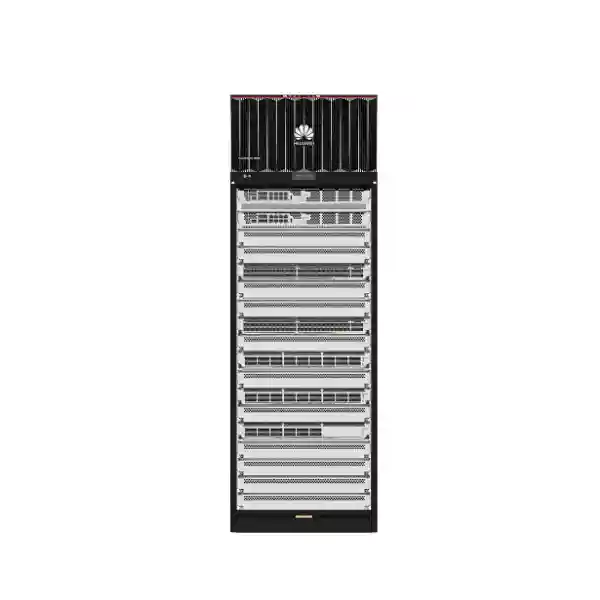
Huawei CloudEngine CE16800-X16
The Huawei CloudEngine CE16800-X16 is the 16-service-slot chassis in Huawei’s CloudEngine 16800-X modular data-center switching family. It is intended for organizations planning very high-capacity switching fabrics, cloud networks, large enterprise cores and scalable data-center architectures where line-card choice, optics, redundancy, software features, rack power and airflow must be designed as one complete bill of materials rather than treated as a simple standalone switch purchase.
Direct answer: what is the Huawei CloudEngine CE16800-X16?
The CE16800-X16 is a large modular data center switch chassis in Huawei’s CloudEngine 16800-X family. Huawei’s current international product information lists the CE16800-X16 with 16 service slots, nine switching-fabric module slots, a backplane-free Clos fabric architecture using cell switching and virtual output queues, and switching capacity listed as 714/1548 Tbps. Huawei also lists strict front-to-back airflow for the family and functions that can include VXLAN routing and bridging, BGP-EVPN, M-LAG, QinQ access to VXLAN, Layer 2 and Layer 3 services, telemetry and programmable management interfaces. Exact functions, scale, port speeds and capacity available to a real project depend on the chosen line cards, fabric modules, software release, licensing or feature support, and regional product configuration, so a quotation should always be based on an approved bill of materials.
Customers commonly search for phrases such as Huawei CE16800-X16 price, Huawei CloudEngine CE16800-X16 supplier, CE16800-X16 data center switch, CE16800-X16 400GE switch, Huawei core switch quotation, CE16800-X16 line cards, CE16800-X16 optics, Huawei data center switch reseller, and CE16800-X16 installation support. Those searches often hide a more important requirement: the buyer needs to know which chassis configuration will actually support the planned server, storage, firewall, spine-leaf, DCI or cloud-fabric design. FourTeck therefore recommends treating the model number as the start of the design discussion, not the final specification.
Verified platform highlights
High-capacity modular chassis
Huawei lists the CE16800-X16 with 16 service slots and nine switching-fabric module slots. This modular design lets architects select line cards and fabric resources according to the required network role instead of fixing all port types at purchase.
Backplane-free Clos architecture
The CE16800-X family is presented with a backplane-free Clos architecture using cell switching and VoQ. For buyers, the practical question is how the fabric, line cards and redundancy plan fit the target east-west and north-south traffic profile.
Data-center virtualization features
Huawei lists technologies including VXLAN routing and bridging, BGP-EVPN and M-LAG for CE16800-X configurations. Feature availability should be checked against the exact software and hardware combination proposed for the project.
Operations and automation
Telemetry and programmable interfaces can support network visibility and automation workflows. Buyers should define their monitoring platform, configuration method, change-control process and integration requirements before implementation.
What to specify before requesting a CE16800-X16 quotation
A chassis-only price is rarely enough for a meaningful enterprise comparison. A useful quotation should identify the required service line cards, switching-fabric modules, main processing or control components where applicable, power modules, fan modules, optical transceivers or cables, rack accessories, software requirements, support term and professional-service scope. It should also state which items are included, optional or customer-supplied. This is especially important when a buyer searches for “CE16800-X16 best price,” because two quotations can appear to describe the same model while actually containing very different hardware populations and support coverage.
Prepare the expected port counts and speeds, server and storage connectivity, uplink design, oversubscription target, leaf/spine topology, routing scale, VXLAN or EVPN requirement, redundancy objective, management network, telemetry destination, rack position, available power feeds, PDU connector types, cooling direction, fiber type, optic reach and migration window. If the CE16800-X16 is replacing another core switch, include the existing VLANs, VRFs, routing protocols, port channels, MLAG or clustering behavior, monitoring dependencies and change-control constraints. FourTeck can use those details to frame a more precise commercial and deployment discussion.
Where the CE16800-X16 fits
The Huawei CloudEngine CE16800-X16 is most relevant when the network design genuinely needs a large modular platform. Typical planning scenarios include a data-center spine, a high-capacity core, a cloud-fabric aggregation layer, a large campus or enterprise core with substantial east-west traffic, or an infrastructure modernization project that needs room for high-speed line-card evolution. The key benefit of a modular chassis is architectural flexibility: the buyer can plan around multiple service slots and a resilient switching fabric instead of building the entire requirement around a fixed-port device. That flexibility also increases design responsibility. Port density, line-card generation, optics, routing scale, software support and power requirements should be treated as interdependent decisions.
A CE16800-X16 is not automatically the correct answer simply because an organization wants a “fast switch.” Smaller environments may be better served by a lower-slot chassis or fixed-form-factor data-center switch. A large chassis becomes more compelling when the organization needs substantial interface density, growth headroom, modular service cards, resilient fabric components, and a structured operations model. FourTeck can help buyers compare the requested CE16800-X16 against the actual topology and avoid paying for unused capacity or, conversely, selecting too little fabric and forcing an early redesign.
Compatibility, optics and deployment planning
Line-card and optics compatibility should be confirmed from Huawei documentation for the exact hardware and software release. Do not assume that every transceiver with a matching physical connector is supported or that every advertised port speed is available on every card. Define optic type, wavelength, fiber mode, reach, connector, breakout requirement and link partner before ordering. In mixed-vendor environments, the network team should also verify negotiation behavior, FEC requirements, MTU, LACP, routing timers and any interoperability conditions that affect production traffic.
Physical planning is equally important. Huawei lists strict front-to-back airflow for the CE16800-X family, so rack orientation and hot-aisle/cold-aisle design must be consistent. Confirm rack units, rail or mounting requirements, chassis depth, service clearance, power-feed redundancy, PDU capacity and cooling before delivery. A large modular switch can become a facility issue as much as a network issue if power and airflow are treated as afterthoughts. Pre-staging should cover hardware inventory, software target, management addressing, configuration templates, cabling maps, labels, rollback procedures and acceptance tests.
Huawei CloudEngine CE16800-X16 Dubai
Organizations searching for Huawei CloudEngine CE16800-X16 Dubai are usually not looking for a basic office access switch. The model is relevant to high-capacity data-center, cloud, enterprise-core and service-provider-style infrastructure where a modular chassis must be matched to a detailed bill of materials. For a Dubai project, begin with the role of the switch: spine, core, aggregation, server-fabric, storage-connected fabric or major network refresh. Then define the required port speeds, line-card population, high-availability approach, optics, cabling and growth horizon. A buyer asking for a CE16800-X16 price in Dubai should request a configuration-level quote rather than a headline chassis price, because the line cards, switching-fabric modules, power, fans, optics and support scope can materially change the final project cost.
Dubai deployments also benefit from disciplined facility planning. Confirm the rack position, power-feed design, PDU connectors, available electrical capacity, front-to-back airflow, cooling reserve and cable pathways before the chassis arrives. If the switch will sit beside GPU servers, storage arrays, enterprise firewalls or high-density virtualization clusters, document expected east-west traffic and the desired oversubscription ratio. When the requirement includes VXLAN or BGP-EVPN, define the intended underlay and overlay architecture, route-reflector design, VTEP roles, gateway location and operational tooling. Features should be checked against the proposed software release and line-card combination rather than assumed from a family-level feature list.
For migration, Dubai IT teams should prepare the existing VLAN, VRF, routing, link-aggregation, management and monitoring configuration and decide how the cutover will be tested. A phased plan can reduce risk when the current core supports offices, server networks, IP telephony, security platforms, storage or public services. FourTeck’s infrastructure security and deployment services can be reviewed alongside the switching project because core changes often affect firewall paths, VLAN boundaries and upstream routing. Buyers can also review FourTeck UAE technology solutions for broader server, networking and data-center requirements. Availability, warranty, delivery date and installation scope should be confirmed in the final quotation; none should be assumed from the model name alone.
Huawei CloudEngine CE16800-X16 UAE
A Huawei CloudEngine CE16800-X16 UAE requirement often involves more than one site, a central data center, a disaster-recovery location, cloud connectivity or a large enterprise backbone. The first procurement question should be whether the CE16800-X16 is being specified by an existing network design or simply selected because of its capacity. If it is design-led, ask for the approved port matrix, card types, optic specifications, software features and redundancy model. If the requirement is still exploratory, start with traffic, interface and growth needs so the chassis can be compared with smaller CloudEngine platforms and fixed-form-factor alternatives. This avoids both under-sizing and paying for a 16-slot platform when the environment cannot use its scale.
For UAE projects spanning Dubai, Abu Dhabi, Sharjah or other emirates, document which links terminate locally and which connect through carrier services or data-center interconnects. The switch design should identify routing responsibilities, VRFs, segmentation, management access and how failures are handled between sites. If VXLAN and BGP-EVPN are part of the target architecture, confirm the exact overlay design and software support before purchase. If the CE16800-X16 will connect to firewalls, load balancers, storage or high-speed compute clusters, specify the required port speeds and physical media for each adjacent system. The optic list should be reviewed as carefully as the chassis list because reach, fiber mode and connector choice can affect both compatibility and cost.
Operational ownership should also be agreed before deployment. Decide who will manage software upgrades, configuration backups, telemetry, alerting, access control, change approvals and spare components. Large modular switches are long-lived infrastructure, so lifecycle planning matters. FourTeck’s enterprise firewall product guidance is useful when the core-switch project also changes perimeter or data-center security paths, while the deployment planning page outlines the type of interface, routing and cutover information that should be coordinated across security and switching teams. UAE customers should request the final Huawei CE16800-X16 quotation with a clearly itemized bill of materials, stated support term and agreed professional-service boundaries.
Huawei CloudEngine CE16800-X16 Uganda
Customers researching Huawei CloudEngine CE16800-X16 Uganda generally need an enterprise-grade data-center or core-switching platform rather than a conventional branch switch. A useful procurement process starts by establishing where the chassis will be installed, what systems it will connect and how much expansion is expected. List server uplinks, storage connections, firewall links, campus or WAN handoffs, internet-edge paths and any data-center interconnects. Then convert those requirements into a port-speed and line-card matrix. Because the CE16800-X16 is modular, the correct question is not simply whether the chassis supports a particular technology, but which specific card and software combination is needed for the planned interfaces and features.
For Uganda deployments, resilience planning should include local rack power, UPS runtime, generator transition behavior, cooling, remote-management access and the availability of appropriate spares. These are practical engineering considerations for any high-value core platform, especially when the network supports several business locations. Front-to-back airflow must align with the rack environment, and dual power paths should be designed according to the site’s actual electrical architecture. Fiber plans should document single-mode or multimode requirements, optic reach, connector type, patching route and spare transceivers. A quotation that omits optics or power accessories can look attractive but may not represent a deployable system.
Buyers should also define support responsibilities. Who will hold configuration backups? Who will approve software upgrades? Which team will monitor telemetry and hardware alarms? What is the escalation route if a line card or optic fails? These questions should be answered before cutover. FourTeck’s Uganda IT solutions site provides a regional route for networking and infrastructure enquiries, while the wider FourTeck network can coordinate requirements that involve servers, security and communication systems. For Huawei CE16800-X16 price or supplier enquiries in Uganda, provide the desired topology, quantities, card requirements, optic distances, power preference and installation location so the response can be based on an actual project scope rather than a generic chassis-only figure.
Huawei CloudEngine CE16800-X16 Kampala
A Huawei CloudEngine CE16800-X16 Kampala project is most likely to make sense where a centralized enterprise, carrier-neutral facility, institutional data center or large private infrastructure environment needs a modular high-capacity core. The design conversation should begin with application dependencies and traffic flows. Identify which systems must remain available during maintenance, which networks require separation, which uplinks are mission critical and which connections can be migrated in phases. From there, create an interface schedule that maps each server, storage, firewall, WAN or aggregation connection to a target line card and optic. This approach helps a Kampala buyer move from a product-name request to a configuration that can be reviewed technically.
If the switch is replacing an existing core, collect routing tables, VLAN and VRF definitions, port-channel configurations, gateway functions, monitoring settings and management ACLs. Decide whether existing addressing and routing will be preserved or redesigned. For EVPN/VXLAN projects, document underlay routing, VTEP placement, route-target policy, gateway design and integration with existing security zones. The CE16800-X family supports modern data-center virtualization capabilities, but implementation must be aligned with the exact software and card support in the proposed bill of materials. A proof-of-concept or staging exercise can be valuable when the migration introduces a new control plane or new high-speed optics.
Kampala procurement teams should request itemized commercial information that distinguishes chassis hardware, line cards, fabric components, power modules, fan modules, optics, software or subscriptions if applicable, warranty or support, logistics and implementation. That structure makes supplier comparisons more meaningful. It also reduces the risk of discovering after approval that critical transceivers or redundancy components were not included. Buyers can use FourTeck’s Uganda channel for regional coordination and the perimeter security planning resource when the core design also changes firewall uplinks or segmentation. The objective is a supportable Kampala data-center fabric with documented ownership, acceptance testing and room for growth, not merely delivery of a large chassis.
Huawei CloudEngine CE16800-X16 Arua
Huawei CloudEngine CE16800-X16 Arua searches are likely to come from organizations planning a substantial regional infrastructure node, a consolidated data center, a campus core or a network hub that must aggregate multiple services. Because a 16-slot modular chassis is a major platform, the strongest justification is usually a combination of density, resilience, modular growth and high-speed uplinks. An Arua project should therefore start with a capacity model: current connected systems, projected expansion, expected east-west traffic, WAN handoffs, security appliances, server virtualization, storage traffic and any long-distance fiber links. The result should be translated into a clear card and optics schedule before commercial approval.
Remote-support and sparing strategy deserves special attention. A core platform can be technically capable but operationally difficult if replacement parts, compatible optics or trained support are not planned. Identify which components are considered critical spares, how configuration backups are stored, how out-of-band access will work and what information a remote engineer can see during a fault. Document serial numbers and module positions at handover. Monitoring should cover hardware health, link state, routing adjacency, traffic utilization and environmental alarms. If telemetry is used, confirm where the data will be collected and how alert thresholds will be managed.
The physical environment should be validated before the chassis is shipped. Confirm rack size and depth, service clearance, floor loading where relevant, power circuits, UPS and generator behavior, PDU sockets, front-to-back airflow, cooling capacity and fiber entry points. Cabling should be labeled so future changes do not require tracing critical links during an outage. For quotation requests, avoid asking only for “Huawei CE16800-X16 price Arua.” Include required port types, optic distances, redundancy expectations, software functions and deployment responsibilities. This gives FourTeck a better basis to coordinate a configuration suitable for the site. Regional enquiries can be routed through FourTeck Uganda, while broader infrastructure needs can use FourTeck’s Africa resources when a project extends beyond one city or involves cross-border procurement.
Huawei CloudEngine CE16800-X16 Mbarara
For a Huawei CloudEngine CE16800-X16 Mbarara requirement, the central design question is how much modular capacity the local environment actually needs. Large education, healthcare, industrial, financial, government or private enterprise networks can accumulate many server, campus and branch connections over time, but the correct chassis size should still be proven with an interface and traffic plan. Document present uplinks, expected server growth, firewall connections, data-center services, virtualization clusters, storage networks and any aggregation switches. If the required density is significantly lower, a smaller chassis may provide a simpler lifecycle. If the plan needs many high-speed cards and expansion slots, the X16’s modular scale becomes easier to justify.
A Mbarara deployment should also separate the management design from production traffic. Define out-of-band access, administrator authentication, role separation, logging, configuration backup and software-change procedures. If the network team will automate configuration, verify the planned use of NETCONF, Ansible or other tools against the production release and internal change policy. For monitoring, identify the telemetry or SNMP collectors, NTP sources, syslog destinations and alert ownership. Operational details are often overlooked during procurement, yet they determine whether a sophisticated switch remains manageable after the installation team leaves.
Procurement documentation should ask vendors to identify every required component rather than bundling the project into a single ambiguous line. Request chassis, control components, fabric modules, service cards, power, fans, optics or DAC/AOC cables, rack accessories, software, support and implementation as separate or clearly described items. Confirm whether spares are included and whether the quote assumes customer-provided fiber or patching. This makes the CE16800-X16 supplier comparison more transparent. FourTeck can help structure the requirement and relate the switch to security, server and cabling dependencies. A Mbarara buyer should also define acceptance criteria such as hardware inventory, software version, interface tests, routing adjacency, redundancy failover, monitoring visibility and documented handover before the platform is placed into full production.
Huawei CloudEngine CE16800-X16 Gulu
A Huawei CloudEngine CE16800-X16 Gulu project should be planned around business continuity and operational simplicity as much as raw switching capacity. When a modular core serves multiple departments, campuses or regional connections, a failure or poorly planned change can affect a wide area. Begin by classifying links according to criticality. Identify redundant uplinks, single points of failure, routing dependencies, firewall paths, application networks and management access. Then determine which service cards and fabric resources are required to meet the desired resilience model. Huawei’s family-level specifications show a modular architecture, but the final design must prove how redundancy is achieved with the exact components being purchased.
Gulu network teams should also plan for physical and operational maintenance. Leave sufficient rack access to replace modules without disturbing neighboring equipment. Keep cable routing organized by function and destination. Confirm that cooling follows the required front-to-back direction and that power is distributed across suitable feeds. Maintain an inventory of optics and critical modules, including compatible spares where the project risk justifies them. Out-of-band management is particularly valuable for a high-value core because it can preserve administrative access when production routing is unavailable. Configuration backups should be stored separately from the device and updated after significant changes.
When requesting a Huawei CE16800-X16 quote in Gulu, include a simple network diagram, target port counts and speeds, optic distances, the planned routing or EVPN design, power preference, support expectation and installation site information. If a supplier responds with only a chassis code and one total price, ask what is excluded. The project may still require line cards, fabric modules, optics and professional services. FourTeck can help translate the network requirement into a procurement checklist so technical and commercial teams compare like with like. The final handover should include an agreed software baseline, labeled cabling, verified failover behavior, monitoring integration and an escalation route for support. That disciplined approach is more valuable than choosing a platform on switching-capacity figures alone.
Huawei CloudEngine CE16800-X16 Kenya
Huawei CloudEngine CE16800-X16 Kenya enquiries typically relate to enterprise data centers, cloud and hosting environments, financial or institutional networks, large campuses, service infrastructure or high-capacity private cores. The platform should be selected only after the team defines the intended fabric role and growth requirement. Build a port matrix covering servers, storage, leaf switches, firewalls, routers, WAN handoffs and management connections. Specify the desired interface speeds and optic reach. Then determine whether 16 service slots provide useful headroom or whether a smaller model would meet the same objective with lower power, space and lifecycle complexity.
For Kenya projects that include more than one facility, clarify the DCI or WAN architecture early. Define which Layer 2 domains, VRFs or routed services need to span locations and which should remain local. If EVPN/VXLAN is planned, document the underlay routing, overlay control plane, gateway functions and failure behavior. If the switch connects to security platforms, define where segmentation and policy enforcement happen so the core and firewall designs do not conflict. A modern data-center fabric should also have a monitoring strategy: telemetry, logs, routing-state visibility, interface utilization, environmental alarms and configuration backups should all have an owner.
Commercially, a Kenya CE16800-X16 quotation should be itemized and tied to a specific BOM revision. Optics, power modules and support terms can materially affect the total project value. Buyers should avoid comparing a fully populated solution with a chassis-only offer. FourTeck’s Kenya IT solutions site provides a regional contact path for networking, security and infrastructure requirements. Projects that also involve data-center perimeter controls can review the enterprise firewall planning content as a reminder to coordinate switch uplinks, routing, VLANs and security zones. Final pricing, stock, delivery, warranty and implementation scheduling should be confirmed for the exact quantity and configuration rather than assumed from online listings.
Huawei CloudEngine CE16800-X16 Kuwait
A Huawei CloudEngine CE16800-X16 Kuwait deployment belongs in a carefully engineered data-center or enterprise-core project. The chassis is designed for large modular fabrics, so buyers should begin with port density and topology instead of simply asking for the fastest available switch. List the number of high-speed server, storage, spine/leaf, firewall, router and DCI connections expected over the next planning cycle. Identify whether links need single-mode or multimode fiber, the required distances, and whether breakout connectivity is part of the design. From this, the network architect can determine the required service cards, fabric resources and optics.
Facility readiness is critical for Kuwait data centers because high-capacity switching must operate inside a controlled rack environment with adequate cooling and power. The relevant design requirement is the actual conditioned data-hall environment, not outdoor temperature. Confirm front-to-back airflow alignment, available rack space, power-feed redundancy, PDU ratings, cable pathways and service access. Large chassis projects should also define maintenance windows and how traffic will be rerouted during component replacement or software upgrades. If the network uses M-LAG, EVPN or other redundancy mechanisms, acceptance tests should verify failover behavior rather than relying only on configuration review.
Kuwait procurement teams should request explicit part descriptions for the chassis, line cards, fabric modules, power and cooling modules, optics, support and installation. Ask vendors to state assumptions such as customer-supplied fiber, existing racks or required software licenses. FourTeck’s Kuwait IT solutions site can be used for regional project enquiries, while FourTeck’s firewall resources can help when the same project includes data-center edge security. For buyers searching Huawei CE16800-X16 best price Kuwait, the most useful comparison is total deployable configuration and support scope, not the lowest isolated chassis number. Confirm current availability and commercial terms at quotation stage because enterprise hardware supply can vary by configuration and project timing.
Huawei CloudEngine CE16800-X16 Ghana
Huawei CloudEngine CE16800-X16 Ghana buyers should first decide whether the platform will serve a data-center spine, large enterprise core, shared services environment or aggregation point for multiple campuses or branches. That role determines the relevant interfaces and software features. Build a capacity worksheet with current and future port counts, link speeds, routing scale, server and storage growth, security-zone connections and external WAN or internet handoffs. The CE16800-X16 offers extensive modularity, but modularity creates choices that must be resolved before a meaningful price can be produced. A chassis without the correct cards and optics is not a complete solution.
For Ghana deployments, power continuity, cooling, fiber plant and remote operations should form part of the same planning document as the network configuration. Confirm rack and PDU details, front-to-back airflow, redundant electrical feeds, UPS behavior, spare optics and out-of-band management. Where the platform supports critical services, define what happens if a fabric, line card, power feed or upstream link fails. Operational teams should know the expected failover behavior and have a documented escalation path. If the project includes high-speed optical links between rooms or buildings, verify the fiber type and distance before selecting transceivers.
Commercial evaluation should distinguish hardware, support and services. Ask whether staging, configuration, installation, migration, testing and handover are included or optional. If the switch replaces an existing core, include the migration complexity in the scope rather than assuming it is part of hardware supply. FourTeck can coordinate Ghana enquiries through its regional network and the FourTeck Africa infrastructure portal, which covers networking and related IT categories. Ghana customers seeking a Huawei CE16800-X16 supplier should provide the exact project location, required quantity, BOM or port matrix, optic distances and support expectation. Final stock, warranty, logistics and delivery commitments should be confirmed in writing for the approved configuration.
Huawei CloudEngine CE16800-X16 Nigeria
Huawei CloudEngine CE16800-X16 Nigeria searches often indicate a large enterprise, financial, cloud, telecom, hosting, public-sector or multi-site infrastructure requirement, but the model should still be validated against the actual network. Start by defining the intended role and failure domain. If the CE16800-X16 will be the central core, identify every dependent distribution switch, firewall, router, server farm and service network. If it will operate as a spine, define leaf counts, uplink speeds and oversubscription. If it will support a cloud fabric, document the underlay, EVPN/VXLAN control plane, gateway placement and automation requirements. These details determine which cards and software functions matter.
Nigeria deployments can benefit from a robust resilience and operations plan. The switch should have documented power redundancy, cooling alignment, spare strategy, configuration backup, out-of-band access and monitoring. Site teams should know how to distinguish a link fault, optic fault, card issue, routing problem and upstream service failure. High-capacity platforms generate many operational signals, so telemetry and logging are useful only when they feed a monitoring process with clear ownership. Software upgrades should be planned against business maintenance windows and tested for feature compatibility, especially in networks that integrate multiple vendors.
When comparing CE16800-X16 price quotations in Nigeria, verify the same BOM is being compared. A lower figure may omit fabric modules, optics, power supplies, support or deployment services. Ask for line-item clarity and a stated validity period rather than relying on marketplace pricing that may describe a different regional SKU or incomplete chassis. FourTeck can help convert the intended topology into a procurement checklist and coordinate related security, server and cabling requirements through its wider regional network. The final decision should be based on technical fit, lifecycle support, total configuration, interoperability and implementation readiness. Availability, warranty and delivery must be confirmed for the approved project; they should not be inferred from generic online product listings.
Huawei CloudEngine CE16800-X16 Seychelles
A Huawei CloudEngine CE16800-X16 Seychelles requirement is most appropriate when the organization has a genuinely large data-center or core-network need and wants substantial modular growth. Because island procurement can make replacement logistics and specialist access important considerations, the project should devote as much attention to sparing and remote support as to the initial configuration. Begin with a port and topology plan covering local servers, storage, security appliances, campus aggregation, internet or carrier links and any inter-site connectivity. Confirm which connections need redundancy and which services can tolerate maintenance windows. This establishes whether a 16-slot platform is justified and what card mix is needed.
Optics and cabling should be finalized early. Record each link distance, fiber type, connector and target speed, and identify spare optics for critical connections. For cross-building or geographically separated links, coordinate the transceiver selection with the actual optical path rather than using a generic part assumption. The rack environment should be checked for power, cooling, front-to-back airflow, depth and service access. Where the chassis supports essential services, out-of-band management and remote console access can reduce recovery time by allowing support teams to diagnose problems even if production routing is disrupted.
Seychelles buyers should also ask how software support, replacement parts and escalation will be handled after deployment. Define which organization owns configuration changes, backups, monitoring and incident coordination. A clear handover pack should include the final BOM, module map, software version, management addressing, cable schedule, backup procedure and support contacts. FourTeck can coordinate multi-region infrastructure enquiries through its regional network, including the Africa portal for networking and data-center solution discussions. For Huawei CE16800-X16 price Seychelles requests, include quantity, destination, expected implementation period and full technical scope. The resulting quote should state logistics assumptions and should not promise stock or delivery until the exact hardware configuration and commercial route have been confirmed.
Related FourTeck resources for a complete data-center project
A core switch rarely operates in isolation. Data-center design usually touches perimeter security, internal segmentation, server uplinks, monitoring, rack power and migration planning. Review the Firewall Dubai solution hub for security-gateway context, the FourTeck firewall and infrastructure approach for deployment philosophy, and the enterprise firewall catalogue when the CE16800-X16 will connect directly to high-capacity security platforms. The implementation and support services page is useful for scoping configuration and migration responsibilities, while deployment planning guidance highlights the need to coordinate routing, VLANs, cabling and testing. For networks where the new core changes internet-edge or server-zone boundaries, see the perimeter firewall design resource and the enterprise firewall platform planning page for complementary security considerations.
Huawei CloudEngine CE16800-X16 FAQ
Is the CE16800-X16 a fixed-port switch?
No. It is a modular chassis. Huawei lists 16 service slots and nine switching-fabric module slots for the CE16800-X16. The usable interfaces depend on the selected service cards and associated components.
What switching capacity does Huawei list for the CE16800-X16?
Huawei’s international CloudEngine 16800 product page lists 714/1548 Tbps for the CE16800-X16. Capacity statements should be interpreted together with the proposed hardware generation, line cards and current Huawei documentation for the target region.
Does the CE16800-X16 support VXLAN and EVPN?
Huawei lists VXLAN routing and bridging and BGP-EVPN among CE16800-X family capabilities. Confirm exact support, feature scale and software prerequisites for the proposed configuration before purchase.
Why can two CE16800-X16 quotations have very different prices?
A modular chassis quote can differ because of line cards, fabric modules, control modules, power supplies, fan modules, optics, cables, software, support term, spares and installation services. Compare line items and BOM revisions rather than only the chassis name.
What details should I send to FourTeck?
Send the target location, quantity, intended switch role, port counts and speeds, line-card preferences if known, optic distances, topology, routing or EVPN requirements, redundancy objective, rack and power information, current equipment and required support or installation scope.
Can FourTeck quote a chassis only?
A chassis-only commercial request can be discussed, but buyers should make clear whether they already own compatible modules. For a new deployment, a complete BOM is normally more useful because it exposes missing cards, optics, power and support items before purchase approval.
Quotation checklist
For the fastest and most accurate commercial discussion, prepare the following information before requesting a Huawei CloudEngine CE16800-X16 quote.
- Project country, city and installation site type.
- Quantity of CE16800-X16 chassis required.
- Target role: spine, core, aggregation, cloud fabric or other.
- Required port speeds, port counts and expected three-to-five-year growth.
- Preferred or specified service cards, fabric modules and redundancy components.
- Optic type, fiber mode, distance and connector for each link class.
- VXLAN, BGP-EVPN, M-LAG, routing, telemetry and automation requirements.
- Rack, airflow, power feeds, PDU and cooling details.
- Existing core-switch model and migration constraints.
- Support term, spares, staging, installation, migration and handover expectations.
Decision recap: buy the configuration, not only the model name
The Huawei CloudEngine CE16800-X16 is a high-capacity modular data-center switch platform with 16 service slots and a fabric architecture designed for large-scale switching. Its value comes from how well the selected line cards, optics, redundancy, software and operational design match the real network. Before approval, confirm that the proposed BOM supports the intended interfaces and features, that the rack can supply the required power and cooling, and that migration and support responsibilities are written into the project scope.
FourTeck can help turn a Huawei CE16800-X16 product request into a structured quotation discussion covering hardware, compatibility, deployment and regional procurement. No stock, delivery date, warranty duration or specific commercial entitlement should be assumed until confirmed for the exact configuration and destination.

Reviews
There are no reviews yet.