
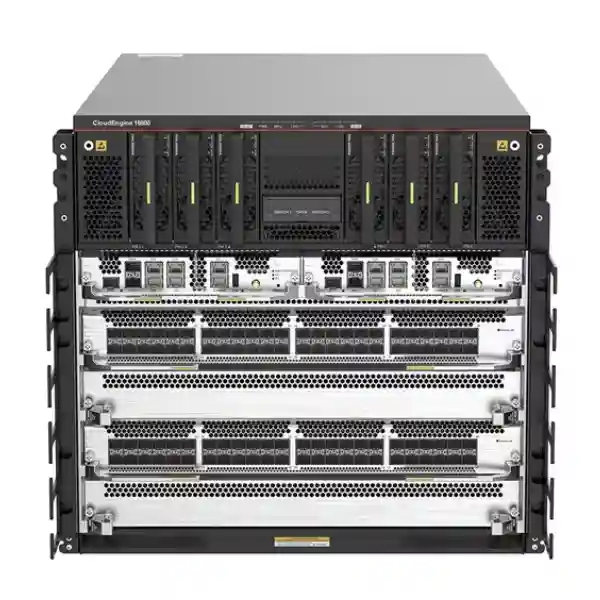
Huawei CloudEngine CE16800-X4
The Huawei CloudEngine CE16800-X4 is a high-capacity modular switch for modern data center core, aggregation and cloud-fabric designs. Huawei lists four service slots, nine switching-fabric-module slots, a backplane-free Clos architecture using cell switching and virtual output queues, strict front-to-back airflow, and support for advanced data center networking functions such as VXLAN routing and bridging, BGP-EVPN, M-LAG, MACsec, telemetry, IFIT, NETCONF and Ansible-based automation. It is intended for environments that need scalable bandwidth and a structured path toward high-density 100GE and 400GE network designs.
FourTeck can help buyers turn the model name into a complete bill of materials by reviewing the intended role, line-card mix, optics, cabling, routing protocols, resilience model, software release, rack and power conditions, security requirements, installation method and support expectations. Product availability, final configuration and commercial terms should always be confirmed in a formal quotation because modular chassis platforms depend heavily on the selected cards, software and accessories.
Direct answer for buyers
Choose the CE16800-X4 when you need a modular data center switching platform with four service slots, fabric redundancy options and room for high-speed interface growth, but do not order the chassis alone without checking the required MPUs, SFUs, service cards, optics, power modules and software support.
For a useful quotation, share your expected 25GE/40GE/100GE/400GE port requirements, existing spine-leaf topology, required routing scale, VXLAN/EVPN design, rack depth, power method, airflow direction, redundancy target and deployment country.
Huawei CloudEngine CE16800-X4 overview
The CloudEngine CE16800-X4 belongs to Huawei’s CloudEngine 16800-X modular data center switch family. In Huawei’s current international product information, the X4 is the four-service-slot member of the family, alongside larger X8 and X16 chassis. Huawei publishes switching-capacity figures of 179/387 Tbps for the CE16800-X4 on its international product page, while also noting that technical specifications can vary according to region, software, line cards and scenario. For procurement purposes, the capacity figure should therefore be treated as a vendor-published platform reference rather than a promise that every proposed bill of materials will behave identically.
The platform uses a Clos architecture with cell switching and virtual output queues. This design is important for data center buyers because the chassis is intended to move large volumes of east-west and north-south traffic while maintaining predictable behavior across modular service cards. Huawei also specifies strict front-to-back airflow, a practical consideration for hot-aisle/cold-aisle rack planning. A purchase discussion should include rack dimensions, airflow orientation, available electrical feeds, grounding, cable-management space and the maintenance clearances required around a populated modular chassis.
From a network-function perspective, the CE16800-X4 supports familiar enterprise and data center technologies including VLAN, STP, LACP, static routing and IPv4/IPv6 dynamic routing. Data center virtualization capabilities listed by Huawei include VXLAN routing and bridging, BGP-EVPN, M-LAG and QinQ access to VXLAN. Reliability and security capabilities listed for the CE16800-X platform include MACsec, BFD for BGP, IS-IS, OSPF, static routes and VXLAN, hardware-based BFD, DPFR and MoFRR. For operations teams, Huawei lists telemetry, NetStream, ERSPAN+, IFIT and Packet Event functions, alongside a standard NETCONF interface and Ansible-based automatic configuration support. The exact feature behavior should be validated against the software release and cards proposed for the project.
4 service slots
The X4 chassis provides four service slots, making card selection central to port density, interface speed and growth planning.
9 fabric slots
Nine switching-fabric-module slots provide the fabric framework for resilient, high-capacity chassis operation when designed with the correct module population.
400GE evolution
Huawei positions the CloudEngine 16800 family for high-bandwidth data centers that need to evolve toward 400GE connectivity without treating the network as a fixed-speed design.
Programmable operations
NETCONF, telemetry and Ansible support can help teams integrate configuration and observability into a broader automation workflow.
What to confirm before requesting a CE16800-X4 quote
Interface and card plan
Specify how many 25GE, 40GE, 100GE and 400GE connections are required now and during the expected service life. The service-card mix drives the practical port layout, optics list, cabling plan and overall cost.
Fabric and resilience
Define expected switch-fabric redundancy, management redundancy, uplink diversity and whether the architecture relies on M-LAG, EVPN multihoming or another high-availability method. A modular core should be quoted as a complete resilient system, not only as an empty chassis.
Routing and overlay scope
Document required IPv4/IPv6 protocols, route scale, BGP-EVPN control-plane design, VXLAN termination, underlay routing, inter-VRF needs and external connectivity. These details influence software, design validation and acceptance testing.
Rack, power and cooling
Confirm rack depth, supported mounting arrangement, PDU feeds, power type, redundancy policy, grounding and front-to-back airflow. Dense data center systems should be reviewed with facilities teams before delivery to avoid installation-day surprises.
Deployment scenarios and buyer fit
The CE16800-X4 can be considered for data center core and aggregation layers where fixed-format switches would not provide the required modular growth model. Typical evaluation scenarios include private cloud fabrics, enterprise data centers, high-performance storage networks, AI-oriented computing clusters, multi-tenant environments, large virtualization platforms and consolidation projects where many high-speed uplinks must be brought into a resilient core. The suitability of the X4 specifically depends on the number of required service slots and the planned interface mix. A design that quickly exceeds four card slots may be better evaluated against the larger X8 or X16 family members rather than forcing an over-constrained X4 configuration.
For leaf-spine environments, buyers should distinguish between the physical role of the CE16800-X4 and the logical services it will host. Some projects use a modular system as a high-capacity spine. Others use it as a border leaf, DCI aggregation point, services aggregation layer or combined core. Each role changes the port-speed ratio, route scale, overlay requirements, external peerings and resilience approach. Clarifying that role early helps avoid a bill of materials that is technically powerful but poorly matched to the topology.
Security should also be designed around the switching role. MACsec can be relevant for protecting supported Ethernet links, but it is not a replacement for a complete security architecture. Segmentation, firewall placement, management-plane security, AAA, out-of-band access, logging and change control should be planned together. Buyers who are integrating the switch with security gateways can review the broader FourTeck Firewall Dubai security portfolio when defining how the data center fabric connects to internet, WAN, partner and server-security zones.
Huawei CloudEngine CE16800-X4 Dubai
Organizations searching for Huawei CloudEngine CE16800-X4 Dubai are usually not looking for a simple desktop-switch purchase. They are planning a data center core refresh, a new cloud fabric, a high-speed aggregation layer, an AI or storage network, or a consolidation project where chassis configuration and deployment services matter as much as the model name. For a Dubai requirement, the first step is to define whether the CE16800-X4 will operate as the spine, border, aggregation or core layer and how many high-speed connections must be supported during the intended lifecycle. That information is more useful than asking for a chassis-only price because the practical system depends on service cards, switch-fabric modules, processing modules, optics, cables, power components and software support.
Dubai data center projects often involve strict rack, cooling, change-window and facilities coordination. The CE16800-X4 uses front-to-back airflow, so the proposed rack position should match the site’s hot-aisle/cold-aisle design. The buyer should also confirm power-feed type, redundancy expectations, available rack depth, cable-management paths and whether installation work must be coordinated with an existing production environment. If the switch is replacing a legacy core, migration planning should document current VLANs, routing adjacencies, VRFs, LAGs, gateway placement, server uplinks, storage paths, firewall connections and any Layer 2 dependencies that must survive the cutover.
For cloud-fabric deployments, Dubai buyers should provide the intended VXLAN and BGP-EVPN design, underlay routing choice, number of VTEPs, external BGP peers, security-zone boundaries and management architecture. This allows the quotation and services discussion to reflect the actual project rather than a generic hardware list. If MACsec, IFIT, telemetry, NetStream or Ansible automation are part of the requirement, include them in the technical scope so software and interoperability can be reviewed before purchase.
FourTeck can support the commercial and technical planning process for Dubai buyers through its UAE technology channel. For a broader view of the company’s networking and infrastructure scope, visit FourTeck UAE. Final availability, configuration, implementation scope and delivery coordination should be confirmed in the quotation rather than assumed from the model name alone.
Huawei CloudEngine CE16800-X4 UAE
For UAE enterprises, government-related entities, universities, financial organizations, cloud operators and large commercial data centers, a Huawei CloudEngine CE16800-X4 procurement exercise should be treated as a system-design activity rather than a single-SKU purchase. The X4’s four service slots can make it attractive where modularity is required but the project does not need the physical scale of the X8 or X16. The right fit depends on interface count, oversubscription targets, external connectivity, routing scale and how much room should remain for future service cards. Buyers should map required ports by speed and function: server or leaf-facing uplinks, spine links, storage connectivity, firewall and WAN handoffs, management links and inter-data-center connections.
A UAE bill of materials should clearly separate the base chassis from the modules and accessories needed to make the platform operational. Procurement teams can ask for the chassis configuration, management-processing components, fabric modules, line cards, power modules, fan assemblies where applicable, optics, direct-attach or active optical cables, rack accessories, software/support entitlement and implementation services as distinct items. This makes comparison easier and reduces the risk of receiving a low headline price that omits essential components.
Technical reviewers should validate how the CE16800-X4 will integrate with the existing network. Huawei lists VXLAN routing and bridging, BGP-EVPN and M-LAG among the platform capabilities, but the proposed topology still needs design decisions around route reflectors, underlay routing, tenant segmentation, anycast gateways, high availability, external routing and service insertion. If the environment includes multiple vendors, the acceptance plan should include standards-based interoperability tests, optic compatibility confirmation and agreed software versions on both sides of each link.
UAE buyers should also plan lifecycle operations: configuration backup, role-based administration, telemetry collection, logging, out-of-band management, software upgrade procedures and support escalation. A strong procurement document asks not only whether the switch can be supplied, but also who owns staging, installation, migration, testing, documentation and post-change support. FourTeck can review these inputs so the quotation reflects a deployable solution rather than an incomplete chassis order.
Huawei CloudEngine CE16800-X4 Uganda
Customers searching for Huawei CloudEngine CE16800-X4 Uganda are typically evaluating a high-end data center switching platform for a national enterprise, service provider, financial institution, university, cloud environment or major organization consolidating critical systems. For Uganda projects, the commercial conversation should begin with the complete network requirement: current core platform, number of connected racks or leaf switches, expected uplink speeds, internet and WAN handoffs, storage traffic, virtualization platform, routing design, growth forecast and resilience requirements. This helps determine whether the four-service-slot X4 offers enough physical expansion or whether a larger chassis deserves consideration before the bill of materials is finalized.
Procurement planning should also account for logistics and deployment readiness. A modular chassis order can involve multiple boxes, optics and accessories, so the purchasing team should request an itemized configuration and confirm import, freight, handling, receiving-site access and warranty or support procedures before approval. FourTeck should not assume immediate stock or a particular lead time; those details need to be checked against the exact configuration and supplier status at quotation stage. For regional technology enquiries and infrastructure planning, buyers can use FourTeck Uganda as a local-market information channel.
From a technical standpoint, the CE16800-X4’s front-to-back airflow and modular architecture mean the destination rack and power environment should be surveyed carefully. Data center teams should verify rack depth, available RU space, PDU capacity, dual-feed strategy, grounding, ambient conditions, cable routes and access for future card replacement. If the proposed switch becomes a central dependency for many services, the architecture should avoid single paths between the chassis and downstream leaf switches, firewalls, routers or storage systems.
Uganda deployments can also benefit from a clear operations plan. Huawei lists telemetry, NetStream, ERSPAN+, IFIT, Packet Event, NETCONF and Ansible support on the CE16800-X family. Network teams should decide which of these functions will actually be integrated into monitoring, automation and troubleshooting workflows. Procurement should include training or handover needs where internal engineers will support the platform after implementation. A quotation request that includes topology, port schedule, optics distances, routing requirements and the intended support model will produce a more useful response than a request for “CE16800-X4 price” alone.
Huawei CloudEngine CE16800-X4 Kampala
A Huawei CloudEngine CE16800-X4 Kampala project is likely to be associated with a centralized corporate data center, financial-services environment, large institutional network, hosting platform or service-provider core rather than a normal office LAN. Kampala buyers should therefore define the project boundary before requesting pricing. Is the CE16800-X4 replacing an existing modular core, forming a new spine layer, terminating VXLAN/EVPN overlays, connecting multiple server halls, or aggregating traffic from campus and WAN networks? Each answer produces a different card mix and migration plan.
If the project is a core replacement, create an inventory of existing physical and logical dependencies. That inventory should include fiber types and distances, transceiver speeds, port channels, VLAN trunks, VRFs, dynamic routing neighbors, first-hop gateway functions, firewall uplinks, internet routers, storage networks, backup systems and management platforms. Documenting these dependencies helps identify which connections can be migrated directly and which need new optics, breakout arrangements or topology changes. It also provides the basis for acceptance testing after the new chassis is installed.
Kampala environments may have different facility constraints from purpose-built hyperscale sites. The network team should check rack dimensions, cooling airflow, power redundancy, UPS capacity, generator strategy, grounding and physical access procedures. Huawei specifies front-to-back airflow for the CE16800-X family, so placement should match the site’s aisle design. Where power resilience is a critical requirement, the final configuration should be designed with the appropriate power modules and independent feeds rather than relying on assumptions about a standard chassis bundle.
Operationally, the platform’s telemetry and programmable management features are most valuable when there is a defined toolchain behind them. Kampala IT teams should decide where telemetry will be collected, how configuration changes will be approved, whether NETCONF or Ansible will be used for repeatable tasks, and how configuration backups and software images will be controlled. The result should be a supportable production platform, not only a powerful piece of hardware. FourTeck can use these inputs to prepare a more complete quotation and deployment discussion for Kampala-based projects.
Huawei CloudEngine CE16800-X4 Arua
Organizations looking for Huawei CloudEngine CE16800-X4 Arua should first validate whether a chassis-class data center core is appropriate to the workload and growth plan. The CE16800-X4 is a sophisticated modular platform, so the strongest business case is usually a location that aggregates substantial server, storage, WAN or service-provider traffic, or a project where the site forms part of a larger regional network. Buyers should avoid selecting it only because the model is high-end. The number of required high-speed links, the resilience objective and the expected network scale should justify the chassis architecture.
For an Arua deployment, logistics and on-site readiness deserve extra attention because a modular core should not arrive before the destination is prepared. The project team should confirm rack compatibility, suitable power distribution, UPS capacity, cooling, dust control, grounding and secure equipment access. It should also define how fiber and copper cabling will reach the chassis and whether new patch panels or structured cabling are required. If specialist installation or remote commissioning support is part of the requirement, that service should be included explicitly in the quotation rather than assumed.
Connectivity design is equally important. If Arua is a branch or regional site connected to Kampala or another core location, the CE16800-X4 may need to integrate with long-distance fiber, carrier Ethernet, MPLS, IP transit or routed WAN services. The data center design should specify which functions remain local and which are centralized elsewhere. For VXLAN or EVPN deployments, document VTEP placement, BGP peerings, route-reflector functions, tenant boundaries and failure behavior during WAN isolation. For conventional routed cores, document OSPF, IS-IS, BGP or static-routing requirements and any first-hop redundancy design.
Arua procurement teams should request a full itemized bill of materials, technical compatibility review, support terms and a clear definition of installation responsibilities. Availability, freight and delivery scheduling can vary depending on the selected cards and optics, so those details should be confirmed only after the final configuration is known. FourTeck can help translate the site requirements into a structured request covering chassis, modules, optical interfaces, cabling and services, reducing the risk that essential components are missed.
Huawei CloudEngine CE16800-X4 Mbarara
For Huawei CloudEngine CE16800-X4 Mbarara enquiries, the decision should start with capacity and criticality. A regional enterprise, university, healthcare group, financial organization, service provider or data-heavy institution may require a modular core when many systems converge on one location and the network must continue to scale. The four-service-slot X4 can provide modular flexibility, but planners should model how quickly the slot count may be consumed by the desired interface cards. If future growth would leave no practical expansion room, it is better to identify that during design than after installation.
Mbarara buyers should prepare a port schedule before asking for a commercial offer. The schedule can group interfaces by speed, distance and purpose: connections to leaf or access switches, servers, storage, firewalls, routers, backup systems, campus links and external providers. Fiber type and distance determine the optic class, while topology determines whether links operate individually, in LAGs or as part of a higher-level redundancy design. This information is essential because modular-switch pricing can change substantially with line cards and optics.
The physical site should be reviewed with the same discipline. Huawei specifies strict front-to-back airflow, so cabinet placement and cooling should support that direction. Confirm rack depth, cable-management clearance, power feeds, UPS resilience, grounding and environmental monitoring. If the equipment room is shared with other systems, verify that the chassis can be installed and serviced without blocking access to neighboring racks or airflow paths. A site-readiness checklist should be completed before the shipment is scheduled.
After commissioning, operations teams should have a documented process for backup, software upgrades, configuration control, monitoring and fault escalation. CE16800-X telemetry, NetStream, ERSPAN+, IFIT and Packet Event capabilities can support troubleshooting, but they need to be connected to suitable monitoring workflows. Mbarara projects should include handover documentation describing physical ports, logical interfaces, routing adjacencies, VLAN or VRF structure, overlay design and management access. This makes the network easier to support when staff or service partners change.
Huawei CloudEngine CE16800-X4 Gulu
A Huawei CloudEngine CE16800-X4 Gulu purchase should be matched to a clear data center or core-network requirement. Buyers evaluating the platform for a large institution, regional data center, carrier node or enterprise hub should quantify the traffic that will pass through the chassis and the number of independent failure domains it must support. The CE16800-X4’s four service slots make it more compact than larger models in the same family, but that advantage is meaningful only when the planned cards deliver the required port density with enough room for growth.
Gulu project teams can reduce procurement risk by asking for a configuration worksheet rather than a single part number. The worksheet should show the proposed chassis variant, processing modules, switch-fabric modules, service cards, power components, optics, cables and support or software services. Each line item should be linked to a technical purpose. For example, the optics list should identify speed and fiber reach; the service-card list should map to the required port schedule; and the fabric-module population should align with expected performance and redundancy.
For sites where remote support may be important, management architecture should be designed before go-live. Use a dedicated management network where practical, restrict administrative access, configure role-based accounts, protect credentials, define backup procedures and make sure there is a recovery method if production routing fails. The platform’s NETCONF and Ansible capabilities may help automate repeatable changes, but automation should be introduced with source control, testing and approvals rather than ad-hoc scripts on a critical core switch.
The migration plan should also address failure and rollback. If the CE16800-X4 replaces an existing core, record which services must be tested after each migration stage and which configuration can be restored if a dependency fails. Gulu buyers should confirm the support path for hardware issues, software questions and replacement components as part of the commercial discussion. FourTeck can use the final topology and site-readiness information to coordinate a quotation that reflects the real deployment scope instead of a generic chassis request.
Huawei CloudEngine CE16800-X4 Kenya
Huawei CloudEngine CE16800-X4 Kenya searches often come from organizations comparing high-capacity data center core switches for Nairobi or regional facilities, cloud platforms, financial networks, universities, service-provider infrastructure, enterprise private clouds and large virtualization environments. The most useful buying process begins with topology. Determine whether the CE16800-X4 will be used as a spine, border leaf, core, DCI aggregation device or services layer, then build a port schedule around that role. The four service slots create flexibility, but the line-card mix must be selected carefully so current requirements do not consume all expansion room on day one.
Kenya projects should also consider interoperability. Many data centers operate mixed-vendor environments where the Huawei core must connect to server switches, storage fabrics, security platforms and WAN routers from other suppliers. Standards-based features such as BGP, OSPF, IS-IS, LACP, VXLAN and BGP-EVPN can support mixed environments, but feature parity and operational behavior should be validated in the planned software releases. Create an acceptance-test matrix covering link negotiation, MTU, LAG behavior, routing convergence, EVPN route exchange, gateway reachability, MACsec where used, telemetry export and failover scenarios.
For procurement, request the complete chassis configuration, optics and support services instead of comparing only advertised reseller prices. High-end modular switching has many variables, and two quotes for the same CE16800-X4 model name can represent very different systems. Buyers can use FourTeck Kenya to discuss regional technology requirements and quotation planning. Lead time, delivery coordination, taxes, import arrangements and warranty handling should be confirmed for the exact order rather than generalized in advance.
Kenya network teams should also decide how they will operate the platform after deployment. Huawei lists telemetry, NetStream, ERSPAN+, IFIT, Packet Event, NETCONF and Ansible support on the CE16800-X family. These capabilities become useful when integrated into a defined monitoring and automation architecture. Include configuration backup, software maintenance, role-based administration, incident response and documentation in the deployment plan so the core remains supportable throughout its lifecycle.
Huawei CloudEngine CE16800-X4 Kuwait
For Huawei CloudEngine CE16800-X4 Kuwait requirements, buyers commonly need a high-capacity switch for a modern enterprise data center, hosting environment, financial network, oil-and-gas IT platform, government-scale infrastructure or cloud-fabric project. The CE16800-X4 should be evaluated according to the workload, not simply its headline switching capacity. Start by documenting the server and leaf-switch uplinks, storage traffic, internet edge, WAN connections, security appliances and any inter-data-center links. Then determine whether four service slots provide a comfortable path for both day-one needs and growth.
Kuwait projects should pay close attention to facilities integration because modular systems are sensitive to rack and cooling design. Huawei specifies strict front-to-back airflow for the CE16800-X platform. Confirm that cabinet orientation and the data center’s hot-aisle/cold-aisle arrangement match this direction. Review rack depth, weight capacity, cable pathways, redundant PDU feeds, grounding and available power before ordering. If the data center has formal method-of-procedure and change-control requirements, these should be incorporated into the implementation scope.
Network design should define how the CE16800-X4 participates in redundancy. Depending on the architecture, that may involve M-LAG, BGP-EVPN, dynamic routing, multiple uplinks, dual cores or a combination of mechanisms. The failure behavior should be tested deliberately: loss of a link, service card, fabric component, routing peer, external firewall connection or management path should not be left to assumption. If MACsec is required for supported links, include key-management and interoperability considerations in the design.
Commercially, ask for an itemized system configuration and confirm regional availability for the selected chassis, cards, optics and support package. FourTeck Kuwait can be used for regional enquiry and solution coordination. Final delivery timing, installation scope, warranty handling and software entitlement depend on the approved bill of materials and should be stated in the formal quotation. This approach gives procurement teams a clearer basis for comparing offers and helps technical teams avoid incomplete orders.
Huawei CloudEngine CE16800-X4 Ghana
Huawei CloudEngine CE16800-X4 Ghana enquiries are most relevant to organizations building or refreshing significant data center infrastructure rather than standard office networks. Financial institutions, telecom environments, universities, cloud operators, large enterprises and government-scale IT platforms may evaluate the X4 where they need a modular high-speed core with strong routing and data center virtualization capabilities. Before selecting the model, buyers should estimate the required port density by speed and confirm whether the four service-slot format can accommodate both the initial design and future expansion.
Ghana procurement teams should insist on a complete bill of materials. A modular switch is not defined only by the chassis. The working solution can require processing modules, fabric modules, service cards, power components, optics, cables, mounting accessories and support entitlements. Ask suppliers to show exactly what is included and what remains optional. This makes it easier to compare offers that might otherwise look similar at the model-name level while differing substantially in usable capacity and resilience.
Technical teams should prepare both logical and physical network information. Logical information includes VLANs, VRFs, routing protocols, BGP policies, EVPN/VXLAN design, LAGs, gateway roles, security segmentation and external peerings. Physical information includes rack location, fiber distances, connector types, power feeds, cooling and patching. The CE16800-X4’s front-to-back airflow should be matched to the facility design, and the rack should provide adequate access for service-card and cable maintenance.
For multi-country or West African organizations, the Ghana data center may also act as a regional hub. In that case, document WAN and DCI dependencies carefully so a core migration does not interrupt remote sites. FourTeck can coordinate broader African technology enquiries through FourTeck Africa. Product availability, freight, support and implementation arrangements should be confirmed after the exact configuration and destination are known. A structured requirement produces a more accurate quote and a safer deployment plan.
Huawei CloudEngine CE16800-X4 Nigeria
A Huawei CloudEngine CE16800-X4 Nigeria project may support a financial data center, telecom network, cloud environment, enterprise private cloud, energy-sector infrastructure, e-commerce platform or large institutional IT estate. In these environments, the switch should be selected using capacity planning rather than brand recognition alone. Buyers should estimate peak and future east-west traffic, north-south internet and WAN traffic, storage flows, virtualization requirements and the number of high-speed uplinks. The four service slots should provide a practical card layout with headroom; if they do not, the larger chassis models in the family should be evaluated before procurement.
Nigeria projects often involve several stakeholders: enterprise networking, server and storage teams, cybersecurity, facilities, procurement, finance and implementation partners. A useful request for quotation should therefore include one shared technical scope. It should identify the proposed switch role, card and port needs, optics distances, desired fabric and management redundancy, software version requirements, routing protocols, VXLAN/EVPN needs, monitoring integration, automation requirements and acceptance tests. This reduces back-and-forth and makes commercial comparisons more meaningful.
Because the CE16800-X4 can become a critical aggregation point, migration planning should include rollback and outage controls. Map current connections, record configurations, identify business-critical applications, stage the new chassis, test optics and links, validate routing in a controlled way and define measurable go/no-go checkpoints. High availability should be verified through failure testing rather than inferred from component redundancy. If the deployment includes MACsec, M-LAG or BGP-EVPN, test the relevant failover and interoperability scenarios before final handover.
Logistics should also be handled transparently. Availability can vary by line card, optic type and quantity, and delivery depends on the final destination and order configuration. Do not rely on generic online stock claims for a modular platform. FourTeck can review the requested bill of materials, regional delivery requirements and implementation scope, then confirm commercial details in a formal quote. Operations teams should also request final as-built documentation so the production network remains understandable after commissioning.
Huawei CloudEngine CE16800-X4 Seychelles
Huawei CloudEngine CE16800-X4 Seychelles buyers should focus on fit, logistics and resilience because a modular data center core is a significant infrastructure investment for an island environment. The platform can be considered for a national-scale enterprise, telecom facility, government data center, financial organization, hospitality group, cloud platform or other operation where multiple high-speed systems converge. Before selecting the X4, determine how many service-card slots are required today and how many should remain available for future expansion. The four-slot format can be efficient when the design is well matched, but it should not be chosen if growth would immediately exhaust the chassis.
Logistics planning is especially important. The project team should finalize the bill of materials before shipment, including all required modules, optics, spare considerations, cables and mounting accessories. Missing a specialized optic or module can delay commissioning after the chassis has already reached the site. Procurement should also confirm packaging, freight, import handling, support arrangements and replacement procedures in the commercial offer. Availability and lead time must be checked against the exact final configuration rather than assumed from a generic product listing.
Site readiness should cover rack depth, cooling, airflow, PDU feeds, UPS or generator resilience, grounding and cable pathways. Huawei specifies front-to-back airflow for the CE16800-X family, so the equipment room should support that direction. If the Seychelles deployment connects to off-island cloud services or regional data centers, WAN and DCI connectivity should be designed with clear failure scenarios. The core switch should not become a hidden single point of dependency between local applications and international connectivity.
Operations teams should also plan for maintainability. Define remote-management methods, administrative access control, configuration backup, telemetry collection, software updates and fault escalation. If local staff will manage routine changes, include training and handover documentation. If support will be delivered partly remotely, verify that out-of-band access and secure remote procedures are available. A well-scoped Seychelles quotation should therefore combine hardware, software, optics, logistics and services into one clear proposal rather than separating the chassis purchase from the realities of operating it.
Architecture planning: CE16800-X4 in a modern data center fabric
When the CE16800-X4 is placed into a leaf-spine architecture, design teams should start from traffic flows. East-west traffic between application tiers, virtual machines, containers, storage and analytics platforms can dominate a modern data center, while north-south traffic reaches internet edges, WAN routers, firewalls and external services. The spine or core must provide sufficient aggregate bandwidth and predictable failure behavior. The four service-slot chassis should therefore be sized using an interface schedule and oversubscription model rather than a simple total port count.
For VXLAN and BGP-EVPN, decide where VTEP and gateway functions reside, which devices act as route reflectors, how tenants or VRFs are segmented, how external routing enters the fabric and how multicast or BUM traffic will be handled. Huawei lists VXLAN routing and bridging and BGP-EVPN on the CE16800-X platform, but a successful fabric depends on consistent underlay addressing, MTU, BGP policy, route-target design, redundancy and operational visibility. Create a lab or staging plan when the environment contains multiple vendor platforms or business-critical workloads.
For traditional three-tier or collapsed-core networks, the same discipline applies. Document spanning-tree boundaries, LACP behavior, dynamic-routing adjacencies, gateway locations and Layer 2 extension requirements. Avoid carrying unnecessary legacy Layer 2 dependencies into a new high-capacity core merely because they existed previously. A migration is an opportunity to simplify the topology, improve routing boundaries and introduce clearer segmentation where business requirements permit.
Security and segmentation considerations
The CE16800-X4 is a data center switch, not a substitute for a next-generation firewall. Its network-security functions should be used as part of a layered architecture. MACsec can help protect supported Ethernet links, while routing, VRF and VXLAN structures can help create logical boundaries. Security gateways are still commonly required for stateful inspection, application control, threat prevention, internet edge protection, remote-access services or regulated segmentation. The network design should identify where those controls sit in relation to the data center fabric.
Management access should receive the same attention as production traffic. Restrict administrative protocols to trusted management networks, use centralized authentication where supported by policy, limit privileges, retain configuration backups and log changes. Use telemetry and flow visibility for operations, but ensure the monitoring architecture itself is protected. A secure core is not only one that forwards traffic quickly; it is one whose changes, access paths and failure states are visible and controlled.
Frequently asked questions about Huawei CloudEngine CE16800-X4
How many service slots does the CE16800-X4 have?
Huawei lists four service slots for the CE16800-X4. The card mix determines usable port density and speeds, so the required interfaces should be mapped before ordering.
How many fabric-module slots are available?
Huawei’s international CE16800-X specification lists nine switching-fabric-module slots. The final fabric population should be selected according to the proposed cards, performance and resilience requirements.
Does the CE16800-X4 support VXLAN and BGP-EVPN?
Yes. Huawei lists VXLAN routing and bridging and BGP-EVPN among the platform’s data center virtualization capabilities. Confirm release-specific support and interoperability for the intended design.
Is it suitable for 400GE networks?
Huawei positions the CloudEngine 16800 family for migration toward high-density 400GE. Exact port counts and card options depend on the selected service cards and current product documentation.
Does the switch support automation?
Huawei lists a standard NETCONF interface and Ansible-based automatic configuration support. Teams should still define testing, change control and source-of-truth processes before automating a production core.
Can I order only the chassis?
A chassis-only order is normally incomplete for production use. A deployable design may require management, fabric, service, power, optical and support components. Request an itemized bill of materials.
What information is needed for a price?
Provide the required port counts and speeds, card preference if known, optics and distances, redundancy target, power type, software/support needs, deployment country and service scope. This allows a meaningful quotation.
Is the published switching capacity the same for every configuration?
No assumption should be made. Huawei’s platform figures are vendor-published references, while practical capability can depend on software, cards and configuration. Validate the proposed bill of materials against current documentation.
Quotation checklist
Network role
Spine, core, border, aggregation, DCI or services layer; existing topology; migration objective; expected service life.
Port requirements
Quantity by 25GE/40GE/100GE/400GE, fiber distance, connector type, breakout requirements and growth headroom.
Protocol scope
IPv4/IPv6 routing, BGP-EVPN, VXLAN, M-LAG, VRFs, MACsec, BFD and external peerings that must be validated.
Facilities
Rack dimensions, power type, redundant feeds, grounding, airflow, cooling, cable management and site access requirements.
Operations
Telemetry collector, NMS integration, NETCONF/Ansible plans, software version, backup, admin access and documentation.
Commercial scope
Destination, quantity, support term, staging, installation, migration, testing, training, handover and warranty expectations.
Decision recap
The Huawei CloudEngine CE16800-X4 is a modular data center switch for organizations that need high-capacity switching, four service slots, a resilient Clos fabric architecture, high-speed Ethernet growth and modern data center functions such as VXLAN/BGP-EVPN, M-LAG, MACsec, telemetry and programmable management. Its strength is configurability, which also means it should not be purchased as an isolated chassis line item.
The safest purchasing approach is to define the topology, port schedule, optics, redundancy, facilities, software and support requirements first, then build the bill of materials. This produces a quote that can be evaluated technically and commercially and reduces the chance of missing service cards, optics, power components or implementation work.
Plan the CE16800-X4 as a complete data center system
Share the deployment country, current topology, target role, required high-speed ports, optics distances, routing and VXLAN/EVPN requirements, rack and power conditions, redundancy target and preferred support scope. FourTeck can use that information to prepare an itemized configuration and identify the questions that should be confirmed before purchase.
For buyers comparing the new switch with perimeter and data center security requirements, FourTeck can also align the connectivity plan with firewall placement, segmentation and external routing so network and security components are specified together instead of as disconnected purchases.

Reviews
There are no reviews yet.