
MODULAR DATA CENTER CORE • 8 SERVICE SLOTS • CLOUD FABRIC READY
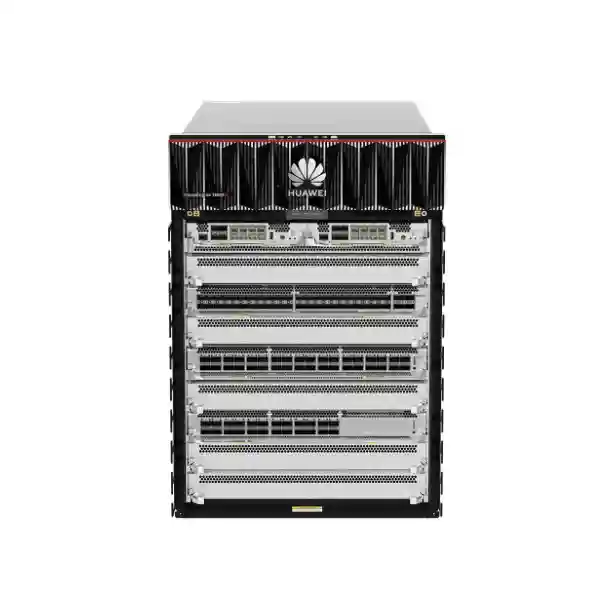
Huawei CloudEngine CE16800-X8
The Huawei CloudEngine CE16800-X8 is an eight-service-slot modular core switch in the CloudEngine 16800-X family, engineered for large data center and high-end campus networks that need scalable bandwidth, deterministic fabric behavior, high-speed Ethernet evolution, and operational visibility. Huawei documents a backplane-free Clos design with cell switching and virtual output queues, strict front-to-back airflow, VXLAN routing and bridging, BGP-EVPN, M-LAG, MACsec, hardware BFD, telemetry, NetStream, ERSPAN+, IFIT, Packet Event, NETCONF, and Ansible-based automation. Outside the Chinese mainland, Huawei currently publishes switching-capacity figures of 357/774 Tbit/s for the CE16800-X8, while actual usable capacity, interface density, and feature behavior depend on the selected switching fabric modules, service cards, software release, optics, and deployment design. FourTeck therefore treats the CE16800-X8 as a configurable system rather than a single fixed-spec appliance and helps buyers build the bill of materials around the network they actually intend to operate.
Eight service slots with nine switching-fabric module slots in Huawei’s published CE16800-X platform specifications.
Backplane-free Clos architecture using cell switching and VoQ for large-scale data center core deployment.
Flexible high-speed Ethernet card options, with Huawei documenting 10GE through 400GE choices and smooth evolution toward 800GE.
Telemetry, NetStream, ERSPAN+, IFIT, Packet Event, NETCONF, and Ansible-based automation support structured operations.
What the Huawei CloudEngine CE16800-X8 is designed to solve
The CE16800-X8 is aimed at networks where a fixed-port switch may become restrictive because traffic growth, interface-speed changes, redundancy requirements, or service-card density are expected to evolve over time. Instead of buying the chassis by name alone, buyers should begin with the traffic matrix: north-south internet and WAN traffic, east-west server and storage traffic, leaf-spine uplinks, high-performance computing flows, virtualization overlays, campus-core aggregation, and any inter-data-center connections. Those flows determine which service cards, optics, breakout modes, fabric modules, software functions, and redundancy design should be included in the bill of materials.
Huawei positions the 16800-X family for diversified computing power and converged data-center networking. The platform supports VXLAN routing and bridging with BGP-EVPN, which is relevant when the data center needs an overlay fabric with scalable endpoint mobility and segmented tenant or application networks. M-LAG can be considered where dual-homing is required without depending on a single chassis. MACsec can support link-layer encryption in designs where the chosen cards and software release support the required mode. Hardware-assisted BFD, DPFR, and MoFRR are documented reliability functions that can contribute to rapid fault detection and resilient forwarding designs. Their practical value depends on topology, protocol design, peer support, and software version, so these features should be validated against the intended network architecture rather than assumed from a feature list.
The platform’s operational toolset is equally important for large environments. Telemetry can export fine-grained state and performance data to external monitoring or analytics platforms; NetStream supports traffic visibility; ERSPAN+ can help with remote traffic analysis; IFIT is designed for in-situ flow measurement; and Packet Event can assist with fault analysis. For automation, Huawei documents a standard NETCONF northbound interface and Ansible-based configuration support. These capabilities can reduce repetitive work, but successful automation still requires naming standards, source-of-truth discipline, change control, version testing, and clearly defined rollback procedures.
Verified platform capabilities and configuration notes
Huawei’s current international product material lists the CE16800-X8 with eight service slots, nine switching-fabric module slots, strict front-to-back airflow, and a Clos fabric using cell switching and VoQ. The same published material lists 357/774 Tbit/s switching capacity for the X8 variant outside the Chinese mainland. Huawei’s newer CE16800-X documentation also describes flexible 10GE, 25GE, 40GE, 100GE, 200GE, and 400GE connectivity with evolution toward 800GE. Because the family is modular and board generations continue to develop, a quotation should identify the exact chassis assembly, main processing units where applicable, switching fabric modules, service cards, optical modules, cables, power modules, fan assemblies, software version, and support entitlement. A headline chassis capacity should never be used as a substitute for a port-level design.
Huawei also describes the CE16800-X family as using its YunShan operating system and lossless Ethernet technologies intended for demanding computing and storage traffic. The vendor’s iLossless technology is designed to learn traffic conditions and optimize queue and congestion behavior in supported scenarios. Buyers evaluating this for AI, HPC, distributed storage, or other latency-sensitive workloads should still define the actual host NICs, RoCE or storage architecture, buffer behavior, PFC/ECN policy, oversubscription ratio, cable plant, and end-to-end compatibility. Lossless behavior is a system property; it cannot be guaranteed simply by installing one switch in the path.
For physical planning, the CE16800-X8 should be treated as a substantial data-center chassis. Rack depth, rail compatibility, cable management, front-to-back cooling, power-feed design, floor or cabinet loading, maintenance clearance, and replacement access need to be checked before delivery. Power consumption depends heavily on card and optic population, so the project team should calculate actual and growth-state load rather than use a theoretical maximum as the normal operating requirement. Dual-feed or redundant power design, UPS capacity, generator integration, and PDU connector standards should be decided alongside the network architecture.
How to size a CE16800-X8 bill of materials
A useful quote starts with the number and speed of connections required on day one and at the expected growth point. Count server-leaf uplinks, aggregation links, WAN or DCI interfaces, firewall connections, storage-facing paths, management links, and any dedicated service networks. Then define whether each connection uses 25GE, 40GE, 100GE, 200GE, 400GE, or a planned transition to 800GE. For each port group, record optic type, fiber mode, reach, connector, breakout requirement, and the device at the far end. This prevents a common procurement problem where the chassis is correct but the ordered line cards or transceivers do not match the cabling and peer equipment.
Next, decide the logical architecture. A traditional Layer 2/Layer 3 core, a VXLAN EVPN fabric, a high-end campus core, and a storage-oriented lossless network can use the same chassis in very different ways. Route scale, MAC and ARP/ND scale, VRF count, ECMP width, multicast needs, BFD timers, security segmentation, telemetry volume, and controller or automation integration can all affect design choices. Feature support can vary by card and software release, so FourTeck recommends matching every critical requirement to the exact proposed hardware and software combination before the purchase order is finalized.
Finally, include operational lifecycle items. Define software support, spares strategy, optics spares, configuration backup, remote access method, logging, monitoring, out-of-band management, documentation, staging, acceptance testing, migration, rollback, and administrator handover. Organizations with strict change windows should plan pre-staging and compatibility testing before the chassis enters production. When the CE16800-X8 sits at the data-center core, small configuration errors can have wide impact, so implementation methodology is as important as raw switching capacity.
Network-security integration around a high-capacity core
A data-center core switch is not a firewall, but it frequently carries traffic to and from perimeter, segmentation, and data-center security gateways. Buyers planning the CE16800-X8 should therefore confirm firewall interface speeds, LAG design, routing adjacencies, VLAN or VRF handoff, asymmetric-routing risks, MACsec boundaries, and monitoring points. FourTeck’s Firewall Dubai solution portal provides security context, while the firewall deployment guidance explains planning considerations for interfaces, routing, VLANs, VPNs, and policy migration. Where the core connects to an internet or data-center security edge, the perimeter firewall planning page can help project teams separate switching capacity decisions from security inspection capacity.
For teams comparing physical security platforms around the switching core, review the Palo Alto Networks PA-Series overview, the PA-410 product planning example, and the Sophos XGS 88 planning example. These are not equivalent in scale to a CE16800-X8 core; they are included to illustrate the separate sizing questions that apply to security appliances. FourTeck’s business technology and security approach can also be reviewed when a project spans routing, switching, security, and deployment services.
Huawei CloudEngine CE16800-X8 Dubai
Organizations searching for a Huawei CloudEngine CE16800-X8 in Dubai are usually evaluating more than a chassis. The practical requirement is often a data-center core, large campus core, aggregation layer, cloud fabric, high-performance computing interconnect, or a modernization project in which existing 40GE or 100GE links must coexist with a roadmap toward 200GE, 400GE, or higher speeds. For that reason, a Dubai quotation should begin with the exact topology and port plan, not with a generic statement that the chassis has eight service slots. Each service slot can be populated differently, and the final solution depends on line-card generation, interface density, switching-fabric population, transceiver type, cabling, power, software release, and support terms.
For Dubai data-center projects, physical readiness deserves the same attention as logical design. Confirm cabinet depth and rail support, front-to-back airflow, hot-aisle/cold-aisle orientation, PDU feeds, UPS headroom, service clearance, and the route for high-count fiber bundles. If the switch will sit in a colocation facility, obtain the rack, power, cross-connect, access, and remote-hands constraints before the BOM is frozen. If it will be installed in an enterprise server room, verify that cooling and power are designed for a modular core chassis rather than a small fixed switch. FourTeck can help translate the network requirement into a structured equipment list and can coordinate the switching discussion with broader UAE infrastructure planning through FourTeck UAE.
The logical design should identify whether the CE16800-X8 will run a traditional routed core, BGP-EVPN VXLAN, M-LAG-based dual-homing, multicast services, high-density ECMP, or lossless Ethernet for specific computing or storage workloads. Where firewalls connect directly to the core, document routing ownership, failover behavior, LAG settings, MTU, VLAN/VRF boundaries, and monitoring points. For migration, record every existing core dependency before cutover: gateway SVIs, routing neighbors, VLANs, ACLs, QoS policies, multicast, management addresses, monitoring, time synchronization, and out-of-band access. A staged migration plan with validation and rollback criteria is more valuable than a headline capacity number.
Buyers should also ask for a quote that separates chassis hardware, mandatory system modules, service cards, optics, cables, licenses if applicable, support, spare components, staging, configuration, installation, testing, and documentation. Availability, lead time, warranty, and regional support eligibility should be confirmed in writing for the exact part numbers. This makes comparison easier and reduces the risk of receiving an incomplete chassis order. When requesting a Huawei CloudEngine CE16800-X8 Dubai quote, send the current topology, required port speeds, optic reaches, preferred redundancy, target software functions, rack details, power feeds, and expected deployment date so the proposal can be engineered around the actual environment.
Huawei CloudEngine CE16800-X8 UAE
A Huawei CloudEngine CE16800-X8 UAE project may support a single data center or a wider architecture connecting headquarters, disaster-recovery facilities, campuses, branches, internet edges, private cloud platforms, and carrier services. The X8 chassis is relevant when the network needs a modular core with growth room and multiple high-speed interface options, but the correct design depends on how traffic moves across the organization. A national or multi-emirate network may place different demands on the core than a single-site data center: more WAN or DCI links, stronger segmentation, multiple routing domains, diverse carrier handoffs, and stricter maintenance windows. The design team should therefore define whether the chassis is primarily a data-center fabric node, a campus core, a service aggregation device, or a combined role.
For an enterprise fabric, VXLAN with BGP-EVPN can provide scalable segmentation and endpoint reachability, while M-LAG can support dual-homed devices where that architecture is preferred. Traditional Layer 2 and Layer 3 protocols remain relevant for existing estates and phased migration. If the organization is moving from a conventional core to an overlay fabric, the project should document underlay routing, loopback addressing, BGP policy, VNI and VRF conventions, gateway placement, anycast behavior, MTU, multicast or ingress replication choices, and the interaction with firewalls and load balancers. The switch can support sophisticated features, but operational clarity matters more than using every available capability.
UAE procurement teams should request a component-level BOM. Modular systems can look inexpensive when only the chassis assembly is quoted, then become incomplete when switching fabric modules, controller or main processing components, service cards, optics, cables, power modules, and support are added later. The quotation should show whether each part is included, optional, spare, or customer-supplied. It should also identify the software release or minimum supported release for critical features. If MACsec, IFIT, Packet Event, high-rate telemetry, lossless Ethernet, or 400GE/800GE evolution is important, have the proposed card set validated against those specific requirements.
Environmental planning also matters. Confirm cabinet depth, airflow direction, cable-management strategy, redundant electrical feeds, UPS capacity, and maintenance access. For disaster-recovery designs, decide whether both sites use identical card populations or whether capacity is intentionally asymmetric. For projects that cross security, networking, and infrastructure boundaries, FourTeck can help coordinate the requirement through its UAE technology platform and the specialist Firewall Dubai resources. The final purchase decision should be based on verified part compatibility and a documented implementation plan, with current price, lead time, support terms, and service scope confirmed at quotation stage.
Huawei CloudEngine CE16800-X8 Uganda
For buyers researching the Huawei CloudEngine CE16800-X8 in Uganda, the first question should be whether the network truly needs a modular chassis of this class. It can make sense for a substantial data-center core, national enterprise backbone, service-provider environment, large campus, or consolidation project where many high-speed uplinks and future growth must be accommodated. It may be unnecessarily large for a small branch or regional office. A sizing discussion should therefore compare the current port requirement, three-to-five-year bandwidth plan, redundancy target, rack and power environment, and operational skills with the cost and complexity of the complete chassis solution.
For a Kampala-centered or nationwide organization with branches in other cities, the CE16800-X8 could serve as a central aggregation or data-center platform while remote sites use smaller access or aggregation switches. In that architecture, define how branch traffic arrives at the core, whether routes are exchanged dynamically, how internet and security gateways are connected, how VRFs separate business units or services, and what failover path exists if a WAN or core link fails. If VXLAN/BGP-EVPN is being considered, confirm that the operations team has a clear underlay/overlay addressing model and monitoring plan. If a conventional routed core is sufficient, avoid unnecessary overlay complexity simply because the platform supports it.
Procurement in Uganda should focus on completeness and supportability. A modular data-center switch is not just one SKU: the final BOM may include the chassis assembly, fabric modules, processing/control components, service cards, transceivers, breakout cables, power modules, fan modules, rail kits, software entitlements, support, and spares. Ask the supplier to identify every required component and to confirm whether the optics are Huawei-branded or third-party, whether they are supported with the proposed cards and software, and what warranty or support implications apply. FourTeck’s Uganda technology platform can be used to discuss regional procurement requirements and complementary infrastructure needs.
Site-readiness checks should include rack depth, equipment weight, front-to-back cooling, dust management, cable routing, redundant power feeds, UPS runtime, grounding, and out-of-band management. Where power stability is a design concern, calculate the expected populated-system load and ensure UPS and generator capacity are sized for the network rather than only the servers. Finally, prepare migration and acceptance criteria before installation: interface tests, routing-neighbor checks, failover tests, telemetry verification, management access, configuration backup, and documentation. A well-defined acceptance plan helps the organization verify that the delivered CE16800-X8 solution matches the engineered design instead of relying on a simple power-on test.
Huawei CloudEngine CE16800-X8 Kampala
A Huawei CloudEngine CE16800-X8 Kampala deployment is most relevant where the city site functions as a major data-center, head-office, campus, service aggregation, or national network hub. In that role, the switch may need to aggregate server fabrics, storage networks, security gateways, WAN links, and high-speed campus or branch connections. The planning process should separate these traffic classes and measure their real bandwidth requirements. East-west server traffic, for example, can grow differently from internet-bound traffic, while backup and replication windows can create short periods of high utilization that are easy to miss when sizing only from average link usage.
Because the CE16800-X8 has eight service slots, card selection determines how useful those slots become. A project that needs a large number of 100GE interfaces has a different optimum card mix from one preparing for 400GE spine links or 800GE evolution. The team should document port count by speed, required optic reach, fiber type, breakout, expected oversubscription, and spare-port policy. It should also check whether the far-end devices support the same FEC, autonegotiation, breakout, and optical standards. Interoperability testing is especially important when the core connects to equipment from multiple vendors.
Kampala-based organizations planning a VXLAN EVPN fabric should define where the VTEPs reside, how route reflectors are provided, how tenant VRFs are named, how external connectivity is advertised, and how firewall service insertion is handled. Where a simpler routed architecture is preferred, the platform can still be used for high-capacity IPv4/IPv6 switching and routing. The important point is to choose the least complex architecture that meets resilience, segmentation, scale, and growth requirements. Operational teams should also decide how telemetry, NetStream, IFIT, and Packet Event information will be collected, stored, and acted upon; visibility features provide little value if no monitoring workflow consumes the data.
For procurement, request a line-item quotation with current part numbers, support terms, power options, optics, spares, and implementation scope. Ask whether configuration staging is included and whether the delivery will arrive as loose components or as a preassembled, tested chassis. Confirm rack and power readiness before shipment. If the Kampala site is serving other Ugandan cities, include WAN failover and remote-support procedures in the design so a core event can be diagnosed even when normal in-band access is unavailable. FourTeck can help review these requirements through its Uganda channel while keeping the final recommendation tied to the customer’s actual topology and verified Huawei compatibility.
Huawei CloudEngine CE16800-X8 Arua
Customers searching for a Huawei CloudEngine CE16800-X8 in Arua should begin with a right-sizing check. The platform is a large modular data-center or high-end core switch, so it is most appropriate when an Arua site operates as a major regional aggregation point, data-center node, carrier or service hub, or a strategic facility with unusually high interface density and future growth requirements. For a conventional branch, campus distribution layer, or smaller server room, a lower-capacity platform may be operationally and commercially more suitable. FourTeck can help compare the requested model against the actual port, bandwidth, redundancy, and lifecycle requirements without assuming that the largest chassis is automatically the best choice.
If the Arua site is intended to aggregate multiple local or remote networks, create a traffic map before choosing line cards. List every upstream and downstream connection, the current speed, expected growth, optic reach, and whether the link is critical enough to require diversity. Consider how traffic behaves when one WAN path is unavailable: does all branch traffic shift to a second link, does internet traffic hairpin through another city, or does the site continue in a local-survivability mode? These answers can materially change the core port and routing requirements. A modular switch offers flexibility, but that flexibility should be used to build a resilient design rather than simply reserve empty slots.
Site engineering can be especially important for a large chassis at a regional location. Confirm the rack can accommodate the chassis depth and maintenance clearance, that cooling follows the required front-to-back airflow, and that electrical infrastructure supports redundant feeds with sufficient UPS and generator capacity. Fiber paths should be labeled and protected, and spare optics or critical modules should be planned according to the organization’s recovery-time objectives. If remote engineering support may be required, provide an independent out-of-band management path so the core remains reachable when production routing is disrupted.
The quote should be explicit about what is included: chassis, switching fabric modules, control components, service cards, optics, cables, power supplies, fan modules, rails, software, support, spares, staging, configuration, and testing. Avoid comparing a bare-chassis price with a fully populated solution. For logical functions such as VXLAN BGP-EVPN, MACsec, hardware BFD, telemetry, and automation, verify support against the exact board and software combination. If the Arua design is part of a wider Uganda network, document routing, segmentation, monitoring, and failover conventions across all sites so the CE16800-X8 integrates into a standardized operational model rather than becoming an isolated high-end device.
Huawei CloudEngine CE16800-X8 Mbarara
A Huawei CloudEngine CE16800-X8 Mbarara requirement should be evaluated in the context of the site’s role in the wider network. If Mbarara hosts a significant server environment, regional aggregation hub, large campus core, private-cloud node, or resilience site, the eight-slot modular architecture can provide room to combine different high-speed line cards and plan for future interface growth. If the site is primarily an access or branch location, however, the platform may exceed the requirement. A design review should compare the X8 with alternative form factors based on present port count, growth, redundancy, power, space, management capability, and expected service life.
For an aggregation role, the team should map server, storage, WAN, internet-security, and campus traffic separately. Where services are centralized elsewhere, WAN capacity and failure behavior can matter more than local east-west bandwidth. Where Mbarara hosts applications locally, the switch may need to carry substantial east-west traffic between compute, storage, and security services. That difference affects line-card selection, oversubscription, routing design, and telemetry. If the network will use VXLAN/BGP-EVPN, define VNI, VRF, route-target, and external-connectivity conventions in advance. If it will use traditional VLAN and routed interfaces, document gateway placement, spanning-tree boundaries where relevant, and the plan to minimize Layer 2 fault domains.
Physical planning should include airflow, cabinet depth, cable entry, fiber bend radius, PDU layout, redundant electrical feeds, and environmental monitoring. A modular chassis can create significant heat and cable density when heavily populated, so installation space should be evaluated with the final card mix in mind. Power sizing should be based on the proposed configuration and reasonable growth, not a generic number copied from another CE16800 family model. The organization should also determine which modules or optics need onsite spares and which can be replaced through supplier support within the required restoration time.
When requesting pricing, send a port schedule and topology rather than only the model name. Ask the quotation to identify every module and transceiver, current support entitlement, software version assumptions, staging scope, and whether implementation includes migration and acceptance testing. For a Mbarara site linked to a Kampala data center or other Ugandan locations, include routing convergence, alternate-path behavior, and out-of-band access in the acceptance plan. These steps help ensure that the CE16800-X8 is purchased as a complete engineered core solution rather than as an expensive chassis whose final configuration must be improvised after delivery.
Huawei CloudEngine CE16800-X8 Gulu
For a Huawei CloudEngine CE16800-X8 Gulu project, the strongest use case is a site that must operate as a serious regional core or data-center node rather than a routine branch. The chassis provides eight service slots and a modular fabric architecture, but those capabilities only create value when there is enough traffic, interface diversity, or growth to justify them. Before requesting a final quote, define how many 25GE, 100GE, 200GE, 400GE, or future higher-speed connections are actually required, which ones must be redundant, and which interfaces may use breakout. A clear port schedule can quickly reveal whether the X8 is appropriately sized or whether another platform would meet the need with less operational overhead.
If Gulu is part of a multi-site enterprise network, the design should pay particular attention to failure domains. Document what happens when a WAN circuit, power feed, service card, or upstream security device fails. The CE16800-X family supports technologies such as M-LAG and hardware BFD that can contribute to resilient designs, but redundancy is not created by a feature alone. It requires physically diverse links where possible, correct routing metrics, tested convergence, dual power, suitable peer devices, and procedures that operators understand. Acceptance testing should deliberately simulate realistic failures rather than only verify normal traffic flow.
Operational visibility is another important reason to consider a platform of this class. Telemetry, NetStream, ERSPAN+, IFIT, and Packet Event can give the network team more data about traffic and faults, but collection infrastructure and retention policy must be planned. Decide which monitoring system receives the data, what thresholds generate action, how events are correlated with application incidents, and how much management traffic is acceptable. Automation through NETCONF or Ansible should follow controlled templates and source-of-truth processes; automated mistakes can propagate faster than manual ones if change governance is weak.
For the physical site, verify rack depth, cooling direction, fiber management, UPS and generator integration, grounding, secure access, and remote console capability. A regional core should remain diagnosable even if production routing is unavailable, making out-of-band management and configuration backups important. The procurement package should list the exact hardware and software components, support coverage, spare strategy, and deployment services. When Gulu forms part of a wider Uganda architecture, reuse consistent naming, routing, segmentation, monitoring, and documentation standards across Kampala, Arua, Mbarara, and other sites. Consistency often delivers more operational value than deploying advanced features differently in every location.
Huawei CloudEngine CE16800-X8 Kenya
Organizations evaluating the Huawei CloudEngine CE16800-X8 in Kenya may be planning a data-center core, private-cloud fabric, service-provider aggregation layer, high-end campus, financial or enterprise backbone, or a refresh that must support much higher port speeds than the existing network. The X8’s modular design gives eight service slots and supports a broad range of high-speed Ethernet card options, but the purchasing decision should be made from an architecture and BOM perspective. Start by classifying each link as server-facing, leaf/spine, storage, DCI, WAN, internet edge, firewall, management, or campus aggregation, then capture the required port speed, optic reach, redundancy, and expected growth for each class.
A large Kenyan enterprise may need to connect more than one facility or city, so the CE16800-X8 design should be coordinated with DCI and WAN architecture. Where EVPN VXLAN is used, decide whether the core acts as a spine, border leaf, gateway, or another role, and document route-reflection, external BGP, anycast gateway, VRF, and VNI policy. Where a traditional routed core is used, pay close attention to ECMP, BFD, route summarization, multicast, and security handoffs. The objective is not to maximize feature usage; it is to build a design that can be supported during a failure at 2 a.m. by the actual operations team.
For Kenya procurement, request a complete solution quote with the chassis and all dependent modules clearly separated. Validate optic interoperability and fiber plant before ordering, especially for long-reach or high-speed links. Confirm power type, cable connectors, rack rails, software level, support entitlement, and spare strategy. For organizations with multiple facilities, it may be useful to standardize line-card families and optics so spares can be shared. FourTeck’s Kenya technology platform can support a regional requirement discussion alongside the final Huawei configuration validation.
Deployment planning should include staging, base configuration, software alignment, burn-in or functional testing where required, labeling, rack installation, patching, migration, monitoring integration, and acceptance. For a live core replacement, build a dependency map of every routed adjacency, VLAN, gateway, ACL, QoS policy, DHCP relay, multicast function, security connection, management system, and time source. Determine a rollback point for each migration phase. Because the CE16800-X8 may sit at the center of the environment, a controlled migration with clear ownership is often more important to business continuity than the choice between two line cards with similar headline capacity.
Huawei CloudEngine CE16800-X8 Kuwait
A Huawei CloudEngine CE16800-X8 Kuwait deployment is typically considered when the network needs a modular, high-capacity core with a long interface-speed roadmap and advanced data-center features. The eight-service-slot design is suited to environments where port density and card flexibility matter, but final capacity depends on the populated fabric and service cards. Procurement teams should therefore avoid treating the CE16800-X8 as a sealed appliance with one immutable specification. Instead, request a design that shows each card, optic, power module, support item, and software dependency, plus the reason each component is included.
In Kuwait data-center and campus environments, thermal and electrical engineering should be included early in the project. Huawei specifies strict front-to-back airflow for the CE16800-X family, so rack orientation and hot-aisle/cold-aisle layout must not conflict with the chassis. Calculate power and cooling from the proposed configuration, including growth, and confirm redundant feed design, UPS capacity, PDU connector types, and maintenance access. Dense 100GE or 400GE fiber can also create cable-management challenges, so plan patch-panel location, bend radius, labeling, and spare fibers before equipment arrival.
On the logical side, the platform supports BGP-EVPN and VXLAN for modern fabric designs, plus M-LAG and traditional Layer 2/Layer 3 protocols. MACsec and hardware BFD are relevant where secure links and fast failure detection are required, subject to card and software support. Monitoring can use telemetry, NetStream, ERSPAN+, IFIT, and Packet Event. The operations team should decide in advance which of these data sources will feed its NMS, analytics, SIEM, or troubleshooting workflows. A feature that is enabled but not observed or documented can add complexity without improving operational outcomes.
For commercial planning, FourTeck recommends asking for current regional part availability, warranty and support eligibility, lead time, staging options, and implementation scope in writing. The FourTeck Kuwait platform can be used for regional technology inquiries, while the final CE16800-X8 BOM should be validated against Huawei documentation. Include the current topology, port matrix, required routing or overlay features, rack specification, power feeds, optic distances, migration window, and post-deployment support expectations with the quote request. That information allows the supplier to price a usable system instead of a bare chassis that still requires significant engineering and components after purchase.
Huawei CloudEngine CE16800-X8 Ghana
For a Huawei CloudEngine CE16800-X8 Ghana requirement, the most important task is to establish the intended role of the chassis. Large enterprises, service providers, data-center operators, public-sector networks, universities, and organizations with substantial private-cloud environments can have very different traffic patterns even when they all need a high-capacity core. Some need dense server and storage connectivity; others need high-speed aggregation of campuses or regional sites. A correct design begins with the traffic matrix, not with a generic request for the biggest line card available.
The CE16800-X8 supports modern fabric technologies including VXLAN routing and bridging with BGP-EVPN, along with M-LAG, IPv4/IPv6 routing, MACsec, hardware BFD, and operational telemetry. Those capabilities can support a resilient data-center architecture, but the organization should define exactly which functions are necessary. If the network only needs a conventional routed core with redundant uplinks, a simpler configuration may be easier to operate. If the business needs multi-tenant segmentation, workload mobility, or large-scale fabric automation, EVPN VXLAN may provide stronger architectural benefits. In either case, document address planning, routing policy, failure behavior, and security boundaries before deployment.
Ghana procurement teams should compare proposals at the component level. One supplier may quote only the chassis while another includes fabric modules, power, line cards, optics, support, and implementation. Request an itemized BOM and mark every component as required, optional, or spare. Confirm the precise optic reach and fiber standard for each high-speed link; 100GE and 400GE deployments can fail to come up if the optics, FEC settings, connector type, fiber plant, or peer interface are mismatched. When support eligibility matters, verify whether third-party optics or components affect the vendor’s support position.
The physical site should be reviewed for rack depth, airflow, cable routing, electrical feeds, UPS and generator capacity, grounding, and environmental monitoring. Where the switch will be a national or central core, use an out-of-band management path and keep current configuration backups outside the chassis. The FourTeck Africa platform can be used to discuss multi-country and Ghana-related infrastructure requirements without assuming local stock or a specific delivery commitment. Ask for current availability, lead time, support terms, and logistics in the formal quotation. The strongest purchase package will combine validated hardware, clear architecture, staging, migration, acceptance testing, documentation, and an agreed support model.
Huawei CloudEngine CE16800-X8 Nigeria
A Huawei CloudEngine CE16800-X8 Nigeria project may be driven by data-center expansion, enterprise backbone consolidation, high-speed campus aggregation, private-cloud modernization, service-provider growth, or a move from 100GE toward 400GE and future 800GE connectivity. The eight-service-slot chassis provides room for a flexible line-card mix, but that flexibility increases the importance of good procurement discipline. Before pricing, create a port-by-port schedule that identifies interface speed, media, distance, peer device, redundancy, breakout, and expected growth. This allows the BOM to be engineered accurately and reduces the risk of ordering incompatible optics or the wrong service-card density.
For large multi-site environments, decide whether the CE16800-X8 is a single-site data-center core or part of a broader architecture. If multiple Nigerian facilities exchange large volumes of replication or application traffic, DCI capacity and failure design should be considered alongside the core. If traffic from remote branches is centralized, WAN and firewall paths may become bottlenecks even when the switch itself has ample capacity. Model normal and failure-state traffic separately so that redundant paths are sized for the load they will carry during an outage, not only for day-to-day utilization.
Feature planning should be tied to operational objectives. BGP-EVPN VXLAN can support scalable segmentation and modern fabrics; M-LAG can support dual-homing; MACsec can protect supported Ethernet links; hardware BFD can accelerate failure detection; and telemetry, NetStream, IFIT, ERSPAN+, and Packet Event can improve visibility. However, every enabled capability introduces configuration, monitoring, and troubleshooting requirements. Define who will operate the fabric, how changes are approved, where telemetry is collected, how logs are retained, how automation templates are tested, and how the team will recover from a failed change.
Nigeria buyers should request written confirmation of current part availability, regional support eligibility, warranty, lead time, and the exact inclusion of power modules, fans, fabric modules, processing components, service cards, optics, cables, rails, software, and support. The wider FourTeck Africa platform can support regional infrastructure discussions. For the site itself, validate rack dimensions, airflow, redundant power feeds, UPS/generator design, fiber management, and out-of-band access. A core replacement should be staged with a detailed dependency map and rollback plan. The objective is not simply to install a high-capacity Huawei switch; it is to deliver a core that can be operated predictably through growth, maintenance, and failures.
Huawei CloudEngine CE16800-X8 Seychelles
A Huawei CloudEngine CE16800-X8 Seychelles deployment should be justified by a substantial core-network requirement because the platform is designed for data-center and high-end core use rather than ordinary branch switching. It may be relevant for an organization consolidating multiple critical services, operating a significant data-center environment, aggregating many high-speed networks, or building a resilient national or multi-site infrastructure platform. For smaller environments, the same design exercise may show that a lower-capacity CloudEngine model offers a better operational fit. Right-sizing is particularly important when imported spare parts, rack space, power, and specialized support must be planned carefully.
The design should start with service criticality. Identify which applications or networks must continue operating during a link, module, or upstream failure; which services can tolerate a maintenance window; and which connections require physical path diversity. Use those requirements to decide the number of uplinks, card distribution, peer-switch design, power redundancy, and spare strategy. If the CE16800-X8 is deployed as part of a redundant pair, avoid placing all critical links from the same service on a single card or cable path where a localized failure could defeat chassis-level redundancy.
High-speed optics and fiber planning should be completed before shipment. Record the distance and fiber type for every 100GE, 200GE, or 400GE link, confirm connector and breakout requirements, and validate the peer equipment. Keep suitable spare transceivers for the interfaces whose loss would have the greatest operational impact. The platform’s front-to-back airflow also requires appropriate cabinet orientation, while power design should include dual feeds, UPS capacity, surge protection where required, and generator continuity based on the populated chassis load.
From an operations perspective, the CE16800-X8 supports telemetry, NetStream, ERSPAN+, IFIT, Packet Event, NETCONF, and Ansible-based automation. Decide which functions will actually be integrated into monitoring and change-control workflows. Remote troubleshooting is especially important for an island environment, so out-of-band access, external configuration backups, software images, diagrams, and a documented recovery process should be prepared. For procurement, ask for a fully itemized BOM, current availability, shipment terms, support eligibility, warranty, spares, and implementation scope. FourTeck can discuss regional requirements through its wider Africa platform, while the final technical configuration should be validated against Huawei’s current documentation and the site’s exact network design.
Compatibility, integration, and migration checklist
Compatibility should be validated at four levels: physical, optical, protocol, and operational. Physical checks cover rack depth, rails, airflow, power feeds, PDU connectors, cable pathways, and maintenance access. Optical checks cover form factor, wavelength, reach, fiber type, connector, FEC, breakout, and the exact peer interface. Protocol checks cover routing, LACP, VLAN and MTU behavior, EVPN/VXLAN parameters, multicast, BFD, MACsec, and any vendor-specific differences. Operational checks cover software version, feature licenses where applicable, monitoring, automation, AAA, NTP, logging, backup, and support entitlement.
For migrations, capture the existing configuration and transform it into a dependency map rather than copying it blindly. Identify unused VLANs, stale static routes, old ACL entries, undocumented LAGs, abandoned monitoring destinations, and temporary exceptions that should not automatically migrate. Build the new configuration in a staging environment where possible, then validate interfaces, routing adjacencies, policy handoffs, telemetry, management access, redundancy, and convergence. During cutover, use a checklist with measurable pass/fail criteria and a defined rollback threshold. After migration, compare route tables, MAC/ARP/ND learning, interface errors, packet loss, latency, and application reachability against the pre-change baseline.
Regional sourcing through the FourTeck network
FourTeck supports technology inquiries across multiple markets without implying that every product is stocked locally. UAE projects can begin through FourTeck UAE; Uganda projects through FourTeck Uganda; Kenya projects through FourTeck Kenya; Kuwait projects through FourTeck Kuwait; and wider African projects through FourTeck Africa. Current availability, lead time, shipping, warranty, support eligibility, and implementation scope should always be confirmed for the exact CE16800-X8 part list before purchase.
Frequently asked questions
How many service slots does the Huawei CloudEngine CE16800-X8 have?
Huawei’s current CE16800-X product specifications list eight service slots for the X8 model and nine switching-fabric module slots. The usable interface mix depends on the selected service cards and supported software.
What switching capacity does Huawei publish for the CE16800-X8?
Huawei’s international product page currently lists 357/774 Tbit/s for the CE16800-X8 outside the Chinese mainland. Capacity figures can be tied to fabric generation, card population, and roadmap status, so confirm the exact proposed hardware generation in the quotation.
Does the CE16800-X8 support 400GE and 800GE?
Huawei documents 10GE through 400GE options for the CE16800-X family and a path toward 800GE. Exact port density and availability depend on the specific line card and software release. A quote should name the required card and optic rather than rely on a family-level statement.
Can the CE16800-X8 be used for EVPN VXLAN?
Yes. Huawei lists VXLAN routing and bridging and BGP-EVPN for the CE16800-X family. The network design must still define underlay routing, VTEP roles, route reflection, VRFs, VNIs, gateway behavior, MTU, security handoffs, and monitoring.
Does it support automation?
Huawei lists a standard NETCONF interface and Ansible-based automated configuration. Effective automation also requires templates, source-of-truth data, credentials management, test procedures, change approval, and rollback.
Is the CE16800-X8 suitable for a small office?
Usually it would be excessive for a conventional small office because it is a modular high-capacity core platform. Suitability depends on the site’s actual port density, traffic, resilience, future growth, and data-center role. FourTeck can compare the requested model against the real requirement before quotation.
What information is needed for an accurate quote?
Provide the location, current topology, required number of interfaces by speed, optic distances, fiber type, redundancy expectations, routing or VXLAN requirements, rack dimensions, power feeds, software features, support term, migration scope, and target deployment date. This allows the seller to quote the complete chassis configuration instead of only the base enclosure.
Decision recap
Choose the CE16800-X8 when the network genuinely needs an eight-slot modular core, high-speed Ethernet growth, advanced fabric functions, and long-term card flexibility. Do not select it on chassis capacity alone. Validate the exact card generation, optics, rack, power, software, support, and migration design.
Quotation checklist
Send port counts and speeds, optic reaches, peer devices, topology, redundancy, VXLAN/BGP-EVPN or routing requirements, rack depth, power feeds, required spares, support term, staging needs, migration window, and acceptance criteria. Ask for every chassis component and service line item to be shown separately.
Related infrastructure and security planning
A CE16800-X8 deployment often touches the rest of the data-center architecture. Review firewall uplinks and policy boundaries, WAN and DCI capacity, leaf-switch compatibility, storage traffic, monitoring, automation, out-of-band management, optics, structured cabling, power, cooling, and rack design as one program. FourTeck can coordinate a requirement discussion across these areas and prepare the commercial proposal around the verified hardware configuration rather than treating the chassis as a standalone purchase.
Request a CE16800-X8 configuration review
Share your port matrix, topology, optic distances, rack and power details, software requirements, redundancy design, target location, and support expectations. FourTeck can use that information to prepare a more accurate bill of materials and commercial quotation, subject to current Huawei part availability and regional support terms.

Reviews
There are no reviews yet.