
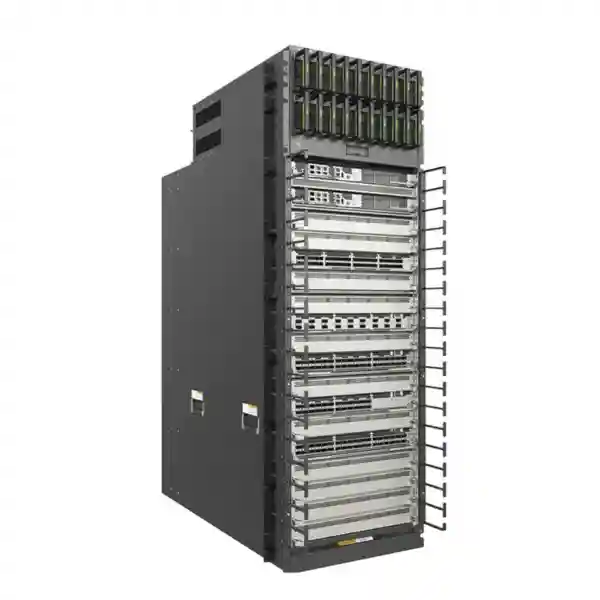
Huawei CloudEngine CE16816
Huawei CloudEngine CE16816 is the 16-service-slot chassis in the CloudEngine 16800 data center switch family. Huawei publishes a switching capacity of up to 178 Tbps for the CE16816, together with nine switching-fabric module slots, a backplane-free Clos architecture, cell switching, virtual output queuing, strict front-to-back airflow and a broad set of data center virtualization and Layer 2/Layer 3 capabilities. It is intended for environments where switching scale, modular expansion, fabric resilience and high-speed Ethernet evolution must be planned as part of a long-life network architecture rather than as a simple fixed-port purchase.
FourTeck helps buyers turn the model name into a complete requirement. A CE16816 project can depend on chassis power type, service cards, control and fabric modules, transceivers, cabling, rack depth, available electrical capacity, cooling design, software release, routing scale, VXLAN requirements, redundancy model and implementation scope. Because the exact supported capacity varies with software, line cards and deployment scenario, the quotation should identify the required bill of materials and design assumptions instead of relying on a headline chassis specification alone.
Figures are manufacturer-published platform values. Exact capability, port density, power draw and feature scale depend on the selected cards, software version and operating scenario.
Direct Answer: What Is the Huawei CloudEngine CE16816?
The Huawei CloudEngine CE16816 is a large modular chassis switch for data center and enterprise networking. It belongs to the CloudEngine 16800 family and is positioned where organizations need a high-capacity switching fabric, a large number of service slots, resilient modular components and a design that can support modern leaf-spine, core, aggregation and data center interconnection requirements. The chassis is not a complete one-part solution by itself: the final configuration depends on the selected main processing units, switching fabric units, service cards, power modules, fan modules, optical transceivers and software features required for the project.
Huawei’s published CE16800 specifications list the CE16816 with up to 178 Tbps switching capacity, 16 service slots and nine switching-fabric module slots. The family uses a Clos fabric architecture with cell switching and virtual output queuing. Published features include M-LAG, virtual systems, Cluster Switch System, VXLAN, VLAN, STP, LACP and IPv4/IPv6 routing functions. Huawei also positions the platform for evolution toward 400GE, but the actual interfaces available on a specific order depend on the line cards and optics selected. Buyers should therefore request a configuration-specific bill of materials rather than assume that every CE16816 includes a particular port type or speed.
The CE16816 is most relevant when a network design has outgrown fixed-configuration switching or when the organization wants a chassis-based architecture with room for interface, fabric and redundancy choices. Typical planning questions include how many 10GE, 25GE, 40GE, 100GE or 400GE connections are needed; whether the switch will operate as a core, spine or aggregation platform; how many racks or server rows it must connect; whether VXLAN EVPN or traditional Layer 2/Layer 3 design is required; what level of component redundancy is expected; and how much future capacity should be reserved. FourTeck can coordinate these questions before preparing a commercial quotation.
Huawei CloudEngine CE16816 Key Features and Buyer Benefits
Large Modular Capacity
Sixteen service slots give architects room to build port density around the actual data center requirement. The value is flexibility: capacity can be matched to uplink speeds, server connectivity and expansion plans instead of being locked to one fixed port layout.
Clos Fabric Architecture
Huawei describes the CE16800 fabric as a backplane-free Clos design using cell switching and VoQ. In procurement terms, the architecture is relevant to buyers evaluating scale, resilience and predictable forwarding behavior in a large modular chassis.
Data Center Virtualization
Published capabilities include M-LAG, virtual systems, CSS and VXLAN functions. The exact design should be validated against the software release, line-card support and the organization’s preferred overlay, redundancy and control-plane architecture.
Front-to-Back Airflow
Strict front-to-back airflow supports hot-aisle/cold-aisle planning. This matters because the CE16816 is a 32U chassis and must be treated as a substantial data center asset with appropriate rack, floor loading, cooling and service-clearance planning.
Power Architecture Choices
Huawei ordering information identifies AC/HVDC and DC CE16816 chassis variants. Power architecture should be chosen with the facility electrical design, redundancy objective, available feeds and final card population in mind.
High-Speed Evolution
The CloudEngine 16800 family is positioned for transition toward 400GE. Buyers should map expected server, storage, spine, DCI and WAN-facing bandwidth over the planned service life and confirm the specific cards and optics needed for each phase.
Verified Hardware Planning Points
| Item | Published CE16816 Information | Procurement Meaning |
|---|---|---|
| Switching capacity | Up to 178 Tbps | Use as an initial platform reference; validate card and scenario limits in the final design. |
| Service slots | 16 | Build the interface plan around present and future line-card requirements. |
| Fabric module slots | 9 | Redundancy and fabric population should be specified explicitly in the BOM. |
| Chassis dimensions | 483 × 1144 × 1436 mm; 32U | Confirm rack depth, aisle clearance, transport path and installation method. |
| Empty chassis weight | About 252.8 kg | Review rack load rating, floor loading and safe handling before delivery. |
| Power variants | AC/HVDC and DC chassis options | Match chassis choice to the facility power architecture and redundancy plan. |
| Operating temperature | 0°C to 40°C in the referenced datasheet | Maintain a controlled data center environment; do not treat outdoor ambient temperature as the equipment operating target. |
Important: Huawei notes that specifications can vary by line card and application scenario. Final purchase decisions should use the current Huawei documentation for the exact software release and hardware combination being quoted.
What to Confirm Before Requesting a CE16816 Quote
A complete CE16816 quotation should start with the network role and required interfaces, not only the chassis name. Share the number and speed of server, storage, spine, core, WAN and inter-data-center links; expected routing and VXLAN scale; redundancy objective; preferred power type; rack dimensions; optics reach; cable type; software or feature requirements; and whether installation, migration, configuration, testing, documentation or training are part of the project.
List every required link speed, media type, optics reach and expected growth.
Define control, fabric, power, uplink and chassis-level redundancy expectations.
Validate rack depth, floor loading, cooling, power feeds and installation access.
Confirm required protocols, telemetry, automation, VXLAN and management integration.
Related FourTeck Network and Security Resources
The CE16816 is a switching platform, but it normally sits inside a wider architecture that includes security gateways, WAN links, servers, storage, monitoring and operational support. Buyers can review FourTeck Firewall Dubai for the surrounding security layer, firewall deployment planning for migration and change-window considerations, and perimeter firewall design when the switch will connect high-capacity data center traffic to an internet or WAN security edge.
For reference architectures involving dedicated security appliances, the same website includes the Palo Alto Networks PA-Series, the PA-410 branch firewall, the PA-415, the Sophos XGS 88 and the PA-5450 modular security platform. These links are not presented as direct CE16816 substitutes; they are adjacent security references for architects building complete network paths.
For broader company and networking context, see About FourTeck Firewall Dubai. Customers evaluating switching beyond the firewall specialist site can also review FourTeck UAE, FourTeck Uganda, FourTeck Kenya, FourTeck Kuwait and FourTeck Africa for region-appropriate technology inquiries.
Huawei CloudEngine CE16816 Dubai
Organizations searching for Huawei CloudEngine CE16816 Dubai are usually evaluating a high-capacity data center or enterprise-core platform rather than a conventional office access switch. In Dubai, the buying discussion often starts with port density and performance, but a CE16816 project also needs practical facility planning. The chassis is 32U and the referenced Huawei datasheet lists an empty weight of roughly 252.8 kg, so rack strength, floor loading, installation path, lifting approach and service clearance should be considered before delivery. The published depth is more than one metre, which means the exact cabinet dimensions and rear-cable space must be checked rather than assuming any standard rack will be suitable.
For a Dubai data center, hot-aisle/cold-aisle discipline is particularly important. Huawei specifies strict front-to-back airflow and an operating range that should be maintained inside the controlled equipment environment. The outdoor climate does not change the chassis specification; instead, it increases the importance of properly engineered cooling, room monitoring, redundant power and clear maintenance procedures. Buyers should confirm whether the design uses the CE16816-AH AC/HVDC chassis or the CE16816-DC variant, how many power modules are required for the planned card population, and whether the facility can provide the required feeds with suitable redundancy.
Dubai enterprises may deploy a chassis switch in a private data center, headquarters core, service-provider environment, colocation suite or large campus aggregation design. Before requesting a Huawei CE16816 price in Dubai, prepare the exact interface requirement: quantities of 10GE, 25GE, 40GE, 100GE or 400GE connectivity where applicable; single-mode or multimode optics; required fiber reach; redundant uplinks; server and storage attachment; routing scale; VXLAN requirements; and whether a pair of chassis is needed for design resilience. A low headline chassis price can be misleading if the required line cards, optics, processing modules, fabric modules, power and support are not itemized.
FourTeck can help Dubai buyers organize this information into a bill-of-material discussion and implementation scope. Availability, lead time, warranty terms, software entitlement and project services should be confirmed in a current quotation. If the CE16816 will connect to an internet edge or security zone, the switching and firewall design should be reviewed together so uplink speeds, VLAN/VXLAN boundaries, routing, high availability and change windows are aligned. This approach is more useful than buying the chassis first and solving compatibility or facility issues during installation.
Huawei CloudEngine CE16816 UAE
A Huawei CloudEngine CE16816 UAE requirement can involve a single data center, a dual-site enterprise design or a standardized core platform serving operations across multiple emirates. The model is best evaluated as a modular infrastructure project. Huawei’s published specifications show a 16-service-slot chassis with up to 178 Tbps switching capacity and nine switching-fabric module slots, but those platform numbers do not define the final delivered configuration. UAE procurement teams should request a clear bill of materials that identifies chassis type, processing modules, fabric modules, service cards, power modules, fan modules, optics, cables, licenses or software entitlements, support coverage and any professional services.
For organizations with data centers in different UAE locations, the design discussion should separate local switching from data center interconnect. The CE16816 may serve as a core or fabric component, while long-distance connectivity, dark fiber, wavelength services or carrier Ethernet are separate dependencies. The optical budget, interface type and redundancy method need to be engineered for the actual route. If VXLAN is planned, confirm the overlay design, control plane, VTEP role, routing policy and interoperability with existing switches before ordering cards. If traditional VLAN and Layer 3 routing are preferred, document the expected VLAN, VRF, route and ECMP scale using the exact software release.
Facility readiness also matters across the UAE. A chassis of this size needs suitable rack depth, power distribution, cooling, cable management and service access. Buyers should ask the facilities team to validate electrical feeds and cooling against the final populated configuration rather than using the maximum chassis power figure as a shortcut for real consumption. Redundant components only improve availability when upstream power, cabling, optics, neighboring switches and operational procedures are also designed to avoid single points of failure.
When searching for a Huawei CE16816 supplier in UAE, compare more than the hardware price. Ask whether the quotation identifies exact part numbers, whether optics are genuine and compatible with the chosen cards, what support or warranty terms apply, what software version is proposed, and whether installation, configuration, migration and testing are included or optional. FourTeck can coordinate these technical and commercial questions and help buyers align the switching platform with the wider network, firewall, server and data center environment before purchase approval.
Huawei CloudEngine CE16816 Uganda
Customers searching for Huawei CloudEngine CE16816 Uganda are commonly looking for an enterprise or data center core capable of supporting substantial aggregation, virtualization and future bandwidth growth. For Uganda projects, the technical specification should be paired with a realistic deployment plan covering power quality, backup power, cooling, fiber paths, rack capacity and remote support. The CE16816 is a large 32U chassis, so it is not an access-layer device that should be selected only because high port counts are expected. Its value appears when a network genuinely needs modular scale, multiple high-speed line cards, fabric resilience and a long-term chassis architecture.
A Uganda enterprise with headquarters, regional branches and centralized applications should first decide where the high-capacity switching belongs. If most branch traffic arrives through WAN or carrier services, the CE16816 may sit at a primary data center or national core while smaller switches serve regional sites. The design should document routing boundaries, VLAN or VXLAN segmentation, firewall attachment, server and storage links, internet gateways and failover paths. Organizations should not assume that a large switching capacity automatically improves wide-area performance; WAN circuits, latency, carrier routing and remote-site equipment remain separate constraints.
Power engineering is especially important for a chassis platform. Huawei provides AC/HVDC and DC chassis options, and the final choice should fit the site’s UPS, generator, rectifier or data center power architecture. Confirm the number and rating of feeds, distribution units, grounding, surge protection, environmental monitoring and restart procedures after prolonged outages. For critical environments, verify how redundant power and fabric components interact with upstream power sources. Cooling should be based on the final configuration and room design, with strict front-to-back airflow maintained and intake temperatures kept within the vendor’s operating specification.
For procurement, request current availability and exact part numbers rather than a generic “CE16816 switch” quotation. Ask for service cards matched to the required interfaces, optics matched to fiber type and distance, support coverage, software entitlement and documented implementation tasks. FourTeck can help Uganda buyers structure the requirement and coordinate regional technology inquiries through its approved channels. Where delivery or onsite services are required, scope and timing should be confirmed in writing because logistics, customs, site access and engineer scheduling can vary by project and location.
Huawei CloudEngine CE16816 Kampala
A Huawei CloudEngine CE16816 Kampala deployment is most likely to make sense in a major headquarters, large private data center, telecom-related environment, financial or institutional network, or another site that aggregates many high-speed connections. Kampala buyers should begin with a traffic and topology study. Count current and forecast server, storage, uplink and inter-building connections; identify application east-west traffic; document internet and WAN paths; and decide whether the architecture will use conventional core/aggregation switching, leaf-spine design or a VXLAN-based fabric. This determines whether the 16-slot chassis is appropriately sized and which service cards are necessary.
Space and facility planning deserve early attention in Kampala because the chassis is physically substantial. Huawei’s published dimensions are approximately 483 mm wide, 1144 mm deep and 1436 mm high. The rack must therefore provide sufficient depth, load rating and access for cable routing and maintenance. The empty chassis alone is listed at more than 250 kg, before cards and power components are added. Confirm the delivery route from loading area to equipment room, doorway and lift limits, floor loading, rack anchoring and whether specialist handling is required. These details can prevent a technically correct order from becoming difficult to install.
Kampala network teams should also plan for operational continuity. Redundant fabric or power components do not replace tested procedures for software upgrades, configuration backup, change management and fault isolation. Decide how the CE16816 will be monitored, which telemetry or network-management tools will receive data, how administrators will access the management plane, and how out-of-band access will work during a production outage. If the switch becomes a central dependency for many business units, configuration standards and rollback procedures are essential.
When requesting Huawei CE16816 pricing in Kampala, include the exact destination, required interface speeds, optics distances, preferred power type, redundancy level, quantity and support expectations. Buyers should ask whether customs, freight, installation and commissioning are included or excluded rather than inferring these items from a product price. FourTeck can help translate the network plan into a quotation checklist and coordinate a configuration review so the proposed chassis, cards and optical components match the real Kampala deployment instead of a generic data-sheet example.
Huawei CloudEngine CE16816 Arua
For Huawei CloudEngine CE16816 Arua searches, the first question should be whether a chassis of this class belongs at the Arua site itself or at a centralized data center that serves Arua over the WAN. A 16-slot CE16816 can provide very large modular capacity, but many regional sites are better served by smaller aggregation switches connected to a national core. Organizations should compare the number of local high-speed interfaces, server workloads, storage systems, campus links and future expansion needs with the cost and facility requirements of a 32U chassis. This prevents over-sizing and keeps the design aligned with actual traffic patterns.
If Arua is a strategic regional hub with substantial compute or aggregation demand, site resilience becomes a central planning issue. Confirm stable power architecture, UPS runtime, generator integration where used, surge protection, grounding, cooling capacity and environmental monitoring. The CE16816 offers chassis options for different power environments, but the selected variant must match the site design. A resilient switch cannot protect applications from a facility-wide power interruption unless the upstream electrical system, cooling and connected network equipment are designed for continuity as well.
Fiber planning is equally important. Map every local and long-haul connection by distance, fiber type, connector, wavelength and required speed. The service card and transceiver must be selected as a compatible combination. Where links connect Arua to Kampala or other locations through a telecom provider, document the carrier handoff separately from the switch interface. Confirm whether the provider presents Ethernet, routed IP, wavelength or another service, and whether redundancy uses physically diverse paths. These decisions influence optics, routing and failover behavior more than the chassis model name alone.
Procurement teams in Arua should request a configuration-specific proposal that separates chassis hardware, line cards, fabric modules, control modules, power, optics, software entitlement, support and project services. Logistics should also be discussed explicitly: shipping destination, receiving capability, safe handling and availability of replacement parts may affect the operational plan. FourTeck can help buyers prepare the bill of materials and define what must be tested during commissioning, including link validation, redundancy, routing convergence, management access and documented handover.
Huawei CloudEngine CE16816 Mbarara
A Huawei CloudEngine CE16816 Mbarara project should be justified by local aggregation, data center or campus requirements. Large educational, healthcare, commercial or multi-site organizations may have a reason to centralize many fiber uplinks and server connections, but the final platform choice should be based on measured demand and architecture rather than the attraction of a large chassis. Begin with the number of buildings, racks, servers, storage systems and upstream WAN circuits that will terminate at the core. Then estimate growth and define which links truly need high-speed interfaces.
If the CE16816 will serve a campus core in Mbarara, pay attention to distance and fiber topology. Building-to-building links may require different transceivers from short data center connections, and each path should have a documented fiber type, connector, distance and redundancy requirement. The switch supports a broad data center feature set, but interoperability with existing access switches, routers, firewalls and monitoring systems should be validated. If VXLAN is not required, a simpler Layer 2/Layer 3 design may be easier to operate. If VXLAN is required, specify the control plane, VTEP placement, route distribution and troubleshooting tools before deployment.
Physical infrastructure must also be ready. The CE16816’s 32U height and deep chassis make rack selection important, while its weight requires appropriate handling and load planning. Cooling airflow should remain unobstructed from front to back. Power modules are hot-swappable according to the published platform information, but redundancy should be supported by independent facility feeds where the business continuity requirement calls for it. Administrators should also plan configuration backup, out-of-band access and documented maintenance windows so component replacement can occur without unnecessary service risk.
When comparing CE16816 suppliers for Mbarara, ask for exact part numbers, current manufacturer-supported options and transparent exclusions. A quote should not simply state “16-slot Huawei switch.” It should identify the cards that create the required ports, the optics that match each link, the processing and fabric population, power architecture, support term and implementation scope. FourTeck can help organize these requirements and coordinate quotation preparation while avoiding unverified promises about local stock, delivery time or onsite availability.
Huawei CloudEngine CE16816 Gulu
Businesses and institutions evaluating Huawei CloudEngine CE16816 Gulu should first identify the role the chassis would perform. If the site is a regional branch with a few WAN connections, a smaller platform may be more appropriate. If Gulu hosts a major aggregation point, private cloud, campus core, data center or service-provider node, the CE16816’s modular architecture can be evaluated against expected interface density, routing scale and resilience needs. This role-based approach avoids buying capacity that the site cannot use while still allowing future growth where it is genuinely required.
For a critical Gulu hub, design for recoverability as well as normal operation. Document what happens if a power feed fails, a fabric component is removed, an uplink goes down, a WAN path is lost or a software upgrade must be rolled back. The platform’s modular design supports resilient architectures, but business continuity depends on how the entire system is assembled. Connected routers, firewalls, access switches and carrier circuits need their own redundancy, and routing or M-LAG behavior should be tested rather than assumed. Monitoring should provide enough visibility to distinguish local switch faults from fiber, power or carrier problems.
Environmental and logistical planning are especially valuable for regional deployments. The CE16816 is a large, deep and heavy chassis. Confirm that the equipment room can accommodate the rack and airflow requirements, and that transport into the site can be completed safely. Keep installation spares and replacement strategy in mind when selecting optics, power modules and other field-replaceable items. If remote engineering support will be part of the operating model, provide secure out-of-band management so qualified personnel can diagnose the switch even when the production network is disrupted.
For a Huawei CE16816 quote in Gulu, provide the intended network role, interface schedule, fiber distances, required redundancy, chassis power preference, software features and expected commissioning tasks. Ask the supplier to separate hardware from support and services so procurement can see exactly what is included. FourTeck can help customers create a practical specification, review the relationship between the switch and the rest of the network, and prepare a quotation request without claiming stock, installation coverage or delivery dates that have not been confirmed for the project.
Huawei CloudEngine CE16816 Kenya
Huawei CloudEngine CE16816 Kenya buyers are typically assessing a high-capacity chassis for a data center, major enterprise campus, telecom environment or regional core. In Kenya, the product should be considered alongside the overall fabric strategy. A network that expects substantial east-west server traffic may use the chassis differently from an enterprise core carrying traffic between campuses, internet edges and application zones. Before choosing cards, architects should define the topology, expected oversubscription, port-speed mix, number of racks, storage traffic, virtualization platform and future expansion horizon.
For Nairobi-centered data center environments or other large Kenyan sites, rack and power engineering can be as important as protocol support. The CE16816 is a 32U platform with a published empty weight of approximately 252.8 kg and a depth exceeding one metre. Verify cabinet dimensions, floor loading, service clearance, power distribution and cooling before the shipment arrives. The platform’s strict front-to-back airflow should align with aisle design. If the project uses dual power feeds or generator-backed electrical systems, document how the chassis power modules map to independent sources and how maintenance can be performed safely.
Kenyan organizations with multiple cities or East African operations should also separate data center switching from WAN design. The CE16816 can aggregate high-speed links, but connectivity between Nairobi, Mombasa, Kisumu, regional offices or neighboring countries depends on carrier services and optical transport. Specify handoff speeds, routing protocols, failover expectations and security boundaries. If the platform participates in VXLAN or EVPN architecture, confirm the software feature set, control-plane design and interoperability with the rest of the fabric using the exact release proposed for deployment.
When searching for Huawei CE16816 price in Kenya, ask for a full solution breakdown. A useful quotation identifies chassis variant, processor and fabric modules, line cards, optics, power, support term, software entitlement and implementation options. It should also state what is not included, such as carrier circuits, new racks, power upgrades or structured fiber work unless specifically quoted. FourTeck can help Kenyan buyers prepare these details and coordinate technology inquiries through its regional channels, with availability and project services confirmed only after the exact requirement and destination are known.
Huawei CloudEngine CE16816 Kuwait
Organizations searching for Huawei CloudEngine CE16816 Kuwait are likely planning a data center, large enterprise core or high-capacity aggregation environment. The CE16816 offers substantial modular scale, but Kuwait buyers should start with facility and network design together. Huawei’s published operating temperature applies to the controlled equipment environment, so the external climate makes reliable cooling and environmental monitoring especially important. The chassis uses strict front-to-back airflow, and rack placement should preserve a clear cold-air intake and hot-air exhaust path without recirculation.
Electrical planning should be based on the populated chassis rather than a generic assumption. Huawei identifies AC/HVDC and DC CE16816 variants, so the data center engineering team should choose the chassis type that fits the site power architecture. Confirm distribution capacity, independent feeds, breaker sizing, UPS or DC plant integration, maintenance bypass arrangements and grounding. If redundancy is required, map individual power modules to facility sources so a single upstream failure does not defeat the intended design. The same principle applies to fabric modules, uplinks and neighboring switches.
Kuwait enterprises may require high-speed connections between compute clusters, storage networks, security systems, internet gateways and WAN routers. Build a port matrix before selecting service cards. Each line should identify speed, media, fiber type, reach, connector, redundancy and peer device. This is particularly important for 100GE or 400GE planning because optics and cable choices can materially affect budget and compatibility. If the architecture includes VXLAN, M-LAG or virtual systems, validate the intended topology and software support against the exact Huawei release being quoted.
Procurement should compare total delivered configuration rather than chassis price alone. Request part numbers, quantity, support terms, warranty handling, software entitlement and a clear scope for installation or commissioning. For replacements, include migration planning, test cases and rollback procedures. FourTeck can help Kuwait buyers structure the technical request and coordinate a quotation, but current availability, delivery timing and onsite support should be confirmed for the specific order. This protects the project from assumptions based on generic regional listings or older product information.
Huawei CloudEngine CE16816 Ghana
A Huawei CloudEngine CE16816 Ghana project is most relevant where an organization needs a large modular core or data center switch rather than ordinary branch connectivity. The first design step is to determine the traffic concentration point. A company with centralized workloads in Accra and branches elsewhere may need the chassis at the primary data center while using smaller switches at remote sites. A service provider or large institution may have a different topology with multiple aggregation nodes. The CE16816 should be placed where its sixteen service slots and high-capacity fabric solve a real scaling or resilience problem.
Ghana buyers should pay close attention to power continuity and equipment-room conditions. The platform is physically large and designed for controlled data center operation. Verify rack depth, weight capacity, airflow, room temperature monitoring, electrical feeds and backup power. If the site uses generator and UPS systems, document the expected transition behavior and runtime for the switching environment. A modular chassis may have hot-swappable components, but replacing a module safely still requires operational procedures, clear labeling and enough physical access around the rack.
For organizations connecting multiple Ghana locations, WAN service design must be documented separately. The CE16816 can handle high-capacity switching and routing roles, yet branch performance depends on circuit bandwidth, latency, routing policy and carrier resilience. Identify whether regional offices connect using MPLS, Internet VPN, carrier Ethernet, SD-WAN or another service, then decide where firewall policy, route control and segmentation belong. If the chassis is part of a VXLAN data center fabric, keep that design separate from the WAN overlay unless there is a deliberate reason to combine them.
When requesting Huawei CE16816 pricing in Ghana, provide a detailed port schedule and project scope. Ask for the chassis power variant, line cards, optics, control and fabric modules, support coverage, software version and any commissioning work. Freight, taxes, import processing, delivery to site and engineer travel should be stated explicitly if they are part of the proposal. FourTeck can help buyers prepare an accurate request and coordinate regional product discussions through its Africa channels while avoiding unsupported promises about inventory or deployment coverage.
Huawei CloudEngine CE16816 Nigeria
Huawei CloudEngine CE16816 Nigeria searches often reflect demand for a large enterprise, service-provider or data center switching platform capable of supporting substantial network growth. Nigeria deployments can involve dense headquarters networks, private cloud, financial services, telecom infrastructure, content platforms or multi-site enterprises. The CE16816’s 16 service slots and high switching capacity make it a platform to evaluate for such roles, but the correct decision depends on interface mix, routing scale, data center topology, resilience requirements and the facility’s ability to host a 32U chassis.
In major sites such as Lagos or Abuja, capacity planning should include both east-west and north-south traffic. Server-to-server and storage flows can drive fabric demand, while internet, cloud and branch traffic may concentrate on a smaller number of routed or firewall-facing links. A port matrix helps avoid purchasing the wrong combination of service cards. Include required speeds, interface counts, optical reach, fiber type, peer equipment and redundancy. If a 400GE roadmap is important, confirm which current Huawei cards and optics support the intended design rather than assuming every service slot can be populated identically.
Power resilience deserves explicit engineering. Where facilities use grid power together with UPS, generator or other backup arrangements, map the CE16816 power modules to independent sources and confirm the switching, cooling and management systems remain operational during transitions. The referenced Huawei datasheet gives maximum platform power information, but actual consumption depends on configuration. Use the final bill of materials for facility sizing. Cooling, rack strength and transport logistics are also important because the chassis is deep and heavy even before it is fully populated.
Nigeria procurement teams should request a transparent commercial structure: exact part numbers, support term, warranty process, software entitlement, optics, spares and implementation services. For a replacement project, document migration from the existing core, routing convergence, VLAN/VXLAN mapping, maintenance windows and rollback. FourTeck can help buyers organize these inputs and prepare a configuration-focused quotation request. Stock, customs processing, regional delivery timing and onsite engineering should be confirmed for the specific project and should never be assumed from a generic product listing.
Huawei CloudEngine CE16816 Seychelles
For Huawei CloudEngine CE16816 Seychelles requirements, the key question is whether the organization needs a very large modular chassis locally. Island environments can make logistics, spares planning and service access particularly important, so the platform should be selected only when its capacity and resilience fit the workload. A telecom operator, major government environment, large hospitality group, data center or national-scale enterprise may have a strong case; a smaller office network usually will not. Start by documenting server and storage workloads, campus or building uplinks, internet gateways and expected growth.
If the CE16816 is justified, plan the complete lifecycle before shipment. The chassis is 32U, more than one metre deep and heavy enough to require careful transport and installation. Confirm receiving facilities, rack dimensions, floor loading, safe handling, cable pathways and maintenance access. The equipment room should maintain the vendor’s operating environment with front-to-back airflow. Because replacement logistics can take longer for island deployments, buyers may also want to discuss an appropriate spare-parts strategy for optics or field-replaceable components based on business criticality.
Seychelles network design may also depend heavily on upstream telecom services. The CE16816 can provide high local switching capacity, but internet and inter-island or international connectivity remain bounded by carrier circuits. Separate local data center fabric requirements from external bandwidth and design the handoff carefully. If multiple carriers or links are available, decide how routing and firewall failover will work. If one major connection remains a single point of failure, adding redundancy inside the switch alone will not create end-to-end resilience.
For purchasing, provide the exact destination, chassis power requirement, service-card mix, optics distances, software features, support expectations and any installation or commissioning needs. Ask the supplier to state freight, import handling, warranty process and engineer travel separately if relevant. FourTeck can help Seychelles buyers prepare a clear bill-of-material request and coordinate regional discussions through its Africa technology channels. Availability and service scope should be confirmed in the final quotation, with no assumption of local stock, local office presence or fixed delivery timing unless explicitly documented.
Selection, Compatibility and Integration Guidance
A CE16816 configuration should be built from the network outward. Start with the peer devices and links: servers, storage arrays, leaf switches, routers, firewalls, optical transport and management systems. Confirm interface standards and speeds on both sides. For fiber connections, match transceiver type, wavelength, reach, connector and fiber plant. Do not assume an optic is compatible simply because it has the same nominal speed. Use the line-card and transceiver compatibility information for the exact Huawei hardware and software release.
For routing, document whether the switch will run static routing, OSPF, IS-IS, BGP or another protocol, how many VRFs are expected, and whether ECMP is required. For Layer 2, define VLAN scale, spanning-tree role and link aggregation. For modern data center fabrics, confirm VXLAN control-plane and gateway design. Published platform support is not a substitute for confirming the scale and feature combination needed by the final configuration. Feature interactions can matter, particularly when advanced telemetry, virtualization, large routing tables and high-speed interfaces are used together.
Security integration should also be architectural. A high-capacity switch can forward traffic far faster than a smaller firewall can inspect it, so north-south and inter-zone flows need realistic bandwidth planning. Avoid creating a 100GE or 400GE switching path that funnels through a security appliance sized for a much lower inspected rate unless the traffic engineering intentionally limits that path. Define which VLANs, VRFs or application zones require firewall inspection and which remain inside trusted data center segments, subject to the organization’s security policy.
Frequently Asked Questions
What is the Huawei CloudEngine CE16816 switching capacity?
Huawei’s current CE16800 product information publishes up to 178 Tbps switching capacity for the CE16816. Actual feature and forwarding scale can vary with line cards, software and deployment scenario, so the exact configuration should be validated before purchase.
How many service slots does the CE16816 have?
The CE16816 has 16 service slots. The platform also has nine switching-fabric module slots according to Huawei’s published specifications. The service cards are selected separately based on the required interface speeds and functions.
Does the CE16816 support 400GE?
Huawei positions the CloudEngine 16800 family for smooth evolution toward 400GE. Buyers should confirm the exact service cards, optics and software release required for the proposed 400GE interfaces instead of assuming 400GE is present in the base chassis.
Is the CE16816 suitable for a small office?
Usually the CE16816 is considered for data center, enterprise-core or similarly high-capacity roles. A small office with limited uplinks is normally better evaluated against smaller fixed or modular switches. The correct decision should follow actual port, bandwidth and resilience requirements.
Can I buy only the CE16816 chassis?
A chassis alone is not a complete production switching solution. The final order can require processing modules, switching fabric modules, service cards, power components, fans, optics, cabling, software and support. Request a complete bill of materials aligned to the intended design.
What information is needed for an accurate CE16816 quote?
Provide the destination, intended network role, interface counts and speeds, optics reach, fiber type, redundancy requirement, chassis power preference, routing and VXLAN needs, support term and whether installation, configuration, migration, testing or training is required.
Is the CE16816 compatible with other vendors?
Standards-based Ethernet and routing can support multivendor designs, but interoperability must be validated for the exact protocols, optics, link settings and advanced features in use. Proprietary or implementation-specific features should not be assumed to work across vendors without testing.
How should power and cooling be planned?
Use the final populated bill of materials to calculate electrical and thermal requirements. Confirm rack power feeds, redundancy, UPS or DC plant, cooling capacity and front-to-back airflow. Huawei’s maximum platform values are useful limits but do not replace configuration-specific facility calculations.
Why Contact FourTeck for Huawei CloudEngine CE16816?
The main purchasing risk with a chassis switch is not choosing the wrong brand; it is ordering an incomplete or mismatched configuration. FourTeck can help buyers structure the requirement around the network role, service cards, optics, rack and power readiness, redundancy, software features and implementation scope. This makes the quotation easier to compare and reduces the likelihood of discovering missing components after approval.
FourTeck can also help coordinate the surrounding infrastructure discussion. If a CE16816 core connects to firewalls, routers, servers, storage or WAN services, each dependency should be identified before the migration window. Final availability, pricing, support terms, delivery arrangements and engineering services remain subject to the current quotation and destination.
Quotation Checklist
Core, spine, aggregation, DCI edge or another defined function.
Quantities and speeds for every required physical link.
Fiber type, connector, reach and peer equipment for each link.
Chassis count, fabric population, power feeds and uplink diversity.
Routing protocols, VXLAN, M-LAG, telemetry and management needs.
Rack depth, floor loading, cooling, electrical feeds and access path.
Required warranty, vendor support and replacement expectations.
Installation, configuration, migration, testing, documentation and training.
Decision Recap
Choose the Huawei CloudEngine CE16816 when the design genuinely needs a large modular chassis with sixteen service slots, high switching capacity and data center-class fabric architecture. Do not select it only from a headline performance number. The right configuration depends on service cards, optics, power, software, rack readiness and the network role.
Before approving a purchase, verify the exact Huawei part numbers, current software and hardware compatibility, interface plan, support terms and deployment scope. A configuration-specific quote is the safest basis for commercial comparison and implementation planning.

Reviews
There are no reviews yet.