
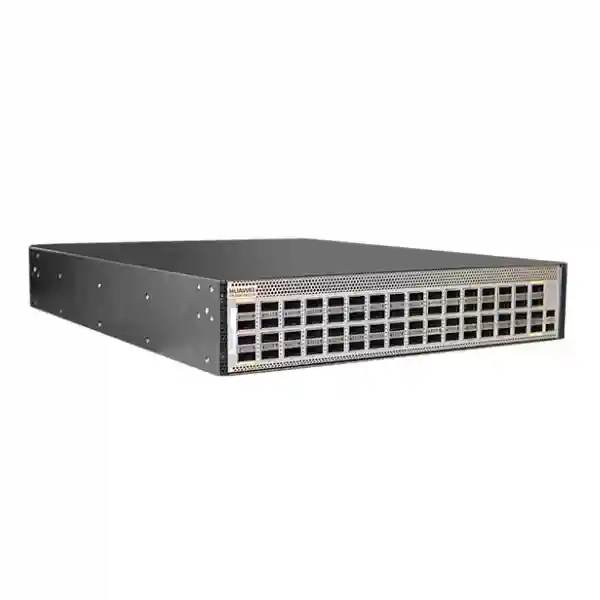
Huawei CloudEngine CE8850-64CQ-EI
A high-density 100GE switching platform for organizations planning data center fabrics, demanding campus cores, server aggregation, high-performance computing connectivity, and scalable east-west traffic architectures. FourTeck helps buyers translate the headline specifications into a practical bill of materials, optical-transceiver plan, airflow choice, power design, software scope, migration sequence, and deployment checklist.
12.8 Tbps
4,482 Mpps
42 MB Buffer
Direct answer for buyers
Choose the CE8850-64CQ-EI when you need dense 100GE at aggregation or core, but validate the complete design before ordering. The switch, optics or DAC/AOC media, breakout needs, airflow direction, power modules, software feature requirements, rack depth, redundancy design, and migration plan all affect the final solution.
What the Huawei CE8850-64CQ-EI is designed to do
The Huawei CloudEngine CE8850-64CQ-EI belongs to Huawei’s CloudEngine 8800 family, a data-center switching range designed for high-performance, high-density Ethernet environments. Huawei positions the CE8850-64CQ-EI for core or aggregation use in data center networks and for aggregation or core roles in campus networks. The model’s central value is density: a single fixed-form platform exposes up to 64 × 100GE QSFP28 interfaces while providing 12.8 Tbps switching capacity and 4,482 Mpps forwarding performance. That combination allows architects to consolidate a large number of high-speed uplinks or server-facing connections without immediately moving to a larger modular chassis.
The practical design question is not simply whether 64 ports are available. A buyer should map how many interfaces will operate at 100GE, 40GE, 25GE, or 10GE; how many will be consumed by inter-switch links, M-LAG peer connectivity, uplinks, server-facing connections, storage or HPC traffic; and what optical reach each link needs. Huawei documents support for 100GE QSFP28 optical modules and breakout of a 100GE port into four 25GE SFP28 interfaces. The platform also supports 40GE QSFP+ operation with breakout to 10GE SFP+ interfaces. This flexibility can help organizations move from mixed 10GE/25GE access toward denser 100GE fabrics without requiring every attached system to migrate at the same time.
For buyers comparing quotations, the model number alone is not enough. Different projects may require different power-module choices, fan and airflow arrangements, transceiver types, cables, feature packages, management integration, spares, rack accessories, and implementation services. FourTeck therefore recommends treating the CE8850-64CQ-EI as the center of a complete switching solution rather than as an isolated line item. A technically correct bill of materials reduces the risk of discovering after delivery that optics are incompatible with planned distances, airflow conflicts with the rack cooling strategy, or required network functions are outside the chosen software scope.
Verified technical highlights
Throughput and density
Huawei documentation lists 64 × 100GE ports, 12.8 Tbps switching capacity, 4,482 Mpps forwarding performance, L2/L3 line-speed forwarding and a 42 MB buffer for the CE8850-64CQ-EI.
Virtualized data-center fabrics
VXLAN routing and bridging plus BGP-EVPN support help the platform participate in modern overlay designs. M-LAG provides multi-device link aggregation for active-active connectivity strategies.
Operations and automation
Huawei lists telemetry, NetStream, sFlow, enhanced ERSPAN and open-programmability capabilities. The family also supports ZTP workflows and integration with Huawei management and analysis platforms where the project scope requires them.
Lossless and high-performance networking
The CloudEngine 8800 family includes data-center bridging and lossless-network functions such as PFC-related capabilities, helping architects plan Ethernet fabrics for latency-sensitive, storage, AI or HPC-oriented workloads when the wider solution is configured accordingly.
Architecture, optics and deployment planning
A 100GE switch purchase is usually constrained by topology more than by port count. Before specifying the Huawei CE8850-64CQ-EI, define whether it will be used as a leaf, spine, aggregation node, campus core, server-fabric concentrator, data-center interconnect edge, or a combination of roles. Then document the expected traffic paths. East-west workloads between servers can create a very different load profile from a campus core carrying user-to-application traffic. Likewise, an aggregation layer serving storage or compute clusters may need more attention to oversubscription, congestion behavior, queueing policy and link redundancy than a simple high-speed uplink layer.
Optics should be designed link by link. Identify the media type, fiber type, connector, distance, required speed, and whether each connection is direct, patched through a distribution frame, or broken out into multiple lower-speed lanes. A 100GE port that will connect to a 25GE server group may need the correct breakout cable or optical arrangement, while a long-distance 100GE inter-building link may require a different transceiver class. Procurement teams should avoid assuming that every QSFP28 optic is interchangeable. Device support, wavelength, reach, fiber plant, and peer-device compatibility must all be checked before the purchase order is finalized.
Airflow and rack planning are equally important. Huawei documents flexible front-to-back or back-to-front airflow depending on the fan and power modules used. The correct direction should match the hot-aisle/cold-aisle layout of the facility. Rack depth, cable bend radius, rear clearance, power-feed location, and service access should be confirmed during design rather than after equipment arrival. The product family supports redundant power and fan arrangements, but the actual order must include the modules required for the intended redundancy and airflow configuration.
For migration, capture the existing VLANs, routing protocols, static routes, ACLs, link aggregation, spanning-tree dependencies, multicast requirements, QoS policies, management addresses, monitoring targets, and upstream/downstream neighbors. Build a rollback plan and define acceptance tests. A high-capacity switch can still create downtime if a migration overlooks a single legacy dependency. FourTeck can help customers turn the technical requirement into a staged implementation checklist covering pre-configuration, labeling, cabling, validation, cutover, monitoring and documentation.
Who should consider the CE8850-64CQ-EI?
Data centers
Facilities building dense 100GE aggregation or spine layers, especially where many high-bandwidth uplinks must be consolidated in a compact footprint.
Enterprise campuses
Large campuses that need a high-capacity core or aggregation layer for distribution switches, data-center links, internet/security edges, and internal services.
HPC and AI infrastructure
Compute environments where high-throughput, low-latency Ethernet and lossless-fabric design are part of the broader solution requirement.
Service providers and cloud teams
Networks that require scalable overlays, automation, telemetry, multi-device resiliency and high-capacity interconnection between network zones.
Before asking for a price, define the configuration
Searches for “Huawei CE8850-64CQ-EI price” often lead to quotations that are difficult to compare because one offer may be a bare chassis while another may include power supplies, fan modules, optics, cables, licenses, support or installation. A lower line-item price does not necessarily represent a lower project cost. For an accurate comparison, ask every supplier to quote against the same technical scope.
Huawei CloudEngine CE8850-64CQ-EI Dubai
Organizations searching for the Huawei CloudEngine CE8850-64CQ-EI Dubai typically need more than a catalog description. Dubai data centers, enterprise headquarters, cloud platforms, financial environments, hospitality groups, logistics operators, universities and large multi-site businesses often have dense east-west traffic, fast uplinks, virtualized workloads, and strict change windows. The CE8850-64CQ-EI can be relevant where a design needs up to 64 × 100GE interfaces and 12.8 Tbps switching capacity in a high-density core or aggregation role. Before procurement, the network team should identify current 10GE/25GE/40GE/100GE requirements and forecast how many ports will be required after growth, redundancy and inter-switch connections are included.
Dubai projects also need careful facility planning. Many enterprise racks use hot-aisle/cold-aisle cooling, so the switch airflow direction must match the room design. Power feeds, rack depth, fiber trays, patch-panel placement and transceiver reach should be checked before delivery. If the CE8850-64CQ-EI is replacing an older core, a migration plan should document routing, VLANs, link aggregation, gateway functions, multicast dependencies and monitoring integrations. Where VXLAN or BGP-EVPN is part of the target architecture, the team should define the underlay and overlay design, route-reflector strategy if applicable, addressing plan, redundancy approach, and operational tooling before cutover.
For Dubai buyers, quotation quality matters because similar-looking offers can contain different components. Ask whether the proposal includes the required power modules, fan modules, optics, breakout cables, software functionality and implementation services. Do not assume stock, delivery time or support entitlement from a model number alone; request those items explicitly in writing for the specific project. FourTeck can assist with requirement capture, bill-of-material review, topology planning and configuration scope for enterprise switching projects in Dubai. Buyers who are also planning security at the data-center or internet edge can coordinate switching with the broader firewall and segmentation design so routing, VLAN boundaries, uplinks and redundancy work together instead of being treated as independent purchases. The goal is a deployable solution with defined interfaces and acceptance tests, not simply a box delivered to site.
Huawei CloudEngine CE8850-64CQ-EI UAE
A UAE procurement for the Huawei CloudEngine CE8850-64CQ-EI may span a head office, data center, disaster-recovery site, colocation facility, branch aggregation environment or private-cloud platform. The main design benefit is dense 100GE connectivity with support for lower-speed breakout, allowing an organization to build a core that serves current workloads while creating a migration path from 10GE and 25GE access toward 100GE uplinks. The platform’s 12.8 Tbps switching capacity, 4,482 Mpps forwarding performance, VXLAN/BGP-EVPN capability and M-LAG support make it relevant to networks that need more than simple Layer 2 switching.
For UAE-wide projects, standardization can be as important as raw performance. If multiple facilities will use the CE8850-64CQ-EI, define a repeatable template for interface naming, VLAN IDs, routing, management addressing, NTP, AAA, syslog, SNMP or telemetry, configuration backup, access control and software lifecycle procedures. A standard template reduces implementation variation and helps centralized teams troubleshoot remote sites. It also makes procurement more predictable because the required airflow, power modules, optics and spares can be specified consistently. Where different sites have different rack cooling directions, the bill of materials should explicitly identify the airflow variant for each destination.
UAE customers comparing the CE8850-64CQ-EI with alternative core switches should focus on architecture fit rather than brand alone. Determine whether 64 × 100GE density is genuinely needed, how many ports will be used for redundant uplinks, whether breakout will be used, what telemetry platform will consume device data, and whether the planned feature set depends on a particular software package. Include optical reach and fiber type in the quotation request instead of asking only for “100G modules.” FourTeck can help translate a UAE network requirement into a structured quotation with the switch, connectivity items, implementation tasks and acceptance criteria clearly separated. This approach helps procurement teams compare proposals on the same scope and gives engineers a cleaner path from purchase order to commissioning.
Huawei CloudEngine CE8850-64CQ-EI Uganda
Customers evaluating the Huawei CloudEngine CE8850-64CQ-EI Uganda are usually planning for a network where ordinary access switching is no longer enough. Large enterprises, service providers, universities, financial institutions, government environments, hosting platforms and organizations consolidating servers may need a high-capacity aggregation or core layer that can carry many lower-speed networks into a smaller number of 100GE links. The CE8850-64CQ-EI provides up to 64 × 100GE QSFP28 ports and supports breakout options that can help integrate 25GE and 10GE connections during a phased upgrade.
For Uganda projects, design around the real fiber and power environment. The network team should document whether links are within one rack, between racks, between rooms, or between buildings; confirm the available single-mode or multimode fiber; and specify optical distances before selecting transceivers. Power resilience should also be considered in the context of the site UPS, generator strategy and rack power distribution. The switch platform can support redundant power and fan arrangements when correctly configured, but those modules should be explicitly listed in the quotation. Spare optics and a clear replacement procedure may be useful for critical networks where procurement lead time could affect recovery.
A Uganda buyer should also decide who will operate the switch after installation. If the local or central team uses command-line configuration, telemetry, SNMP, automation or Huawei management tools, define those workflows during design. Establish configuration backup, admin access, logging, time synchronization and monitoring from day one. For multi-site environments, plan how the CE8850-64CQ-EI will connect to WAN, firewall and branch infrastructure rather than treating it as a standalone core. FourTeck’s Uganda IT solutions site provides regional context for networking, infrastructure and support requirements. When requesting a CE8850-64CQ-EI quotation, include port-speed counts, fiber distances, rack details, redundancy expectations and desired implementation scope so the proposal can be matched to the actual deployment.
Huawei CloudEngine CE8850-64CQ-EI Kampala
For organizations searching for the Huawei CloudEngine CE8850-64CQ-EI Kampala, the most common practical question is whether a 64-port 100GE platform is justified for the planned traffic. Kampala hosts many headquarters, data centers, education institutions, financial services environments, technology providers and multi-branch organizations where a central core can aggregate server, campus, security and WAN traffic. The CE8850-64CQ-EI can fit when the design needs dense 100GE, substantial east-west capacity, or a scalable foundation for 25GE/100GE server and distribution uplinks. If the current environment is mainly 1GE or 10GE, use a capacity plan to determine whether the switch will be used immediately at 100GE or primarily as a future-ready aggregation layer.
Kampala deployments should pay particular attention to migration sequencing. A core replacement can affect DHCP relay, routing, internet paths, firewall connections, IP telephony, wireless controllers, storage, virtualization clusters, surveillance systems and management platforms at the same time. Build a dependency map, identify maintenance windows, stage the configuration, label every uplink and prepare rollback instructions. If M-LAG is used for active-active connectivity, document the peer design and downstream behavior. If BGP-EVPN or VXLAN is introduced, test the control plane and operational monitoring in a lab or staging environment before carrying production traffic.
Procurement teams in Kampala should ask for a configuration-specific quotation rather than a generic “CE8850-64CQ-EI price.” State the required airflow direction, power-module arrangement, number and type of optics, breakout requirements, software functions and desired services. Also ask how warranty or support will be handled for the quoted supply and what information is required if an RMA becomes necessary. FourTeck can help structure the technical scope so procurement, facilities and networking teams work from the same document. A clear pre-installation checklist covering rack space, cooling, power, fiber, management IPs and acceptance tests can significantly reduce risk when commissioning a high-capacity core switch in a live Kampala environment.
Huawei CloudEngine CE8850-64CQ-EI Arua
A Huawei CloudEngine CE8850-64CQ-EI Arua requirement is more likely to appear in a regional aggregation, institutional, service-provider, edge data-center or multi-site backbone project than in a conventional small office. For an Arua deployment, start by confirming the traffic sources the switch will aggregate. If the network is collecting high-speed links from server clusters, regional sites, storage systems or campus distribution switches, the 64 × 100GE port density can provide substantial headroom. If only a few 10GE links are required, a lower-density platform may be more efficient, so capacity planning should come before product selection.
Longer supply and support chains make good spares planning especially valuable for regional deployments. Determine whether the project should hold spare transceivers, cables, fan modules or power modules, and document replacement procedures for field teams. The CE8850-64CQ-EI supports flexible airflow arrangements depending on the installed modules; choose the direction that matches the rack cooling pattern and keep replacement parts consistent with that airflow. Before delivery to Arua, verify rack depth, power connectors, UPS capacity and fiber termination so installation does not stop because of a facilities mismatch.
Remote operability should be part of the design. Establish secure out-of-band or management access where possible, central logging, configuration backup, time synchronization and network monitoring. Huawei lists telemetry, NetStream, sFlow and enhanced ERSPAN support, which can help a central operations team gain visibility when the switch is not in the same city. If local hands will perform physical tasks while a remote engineer performs configuration, prepare labeled port maps and step-by-step maintenance instructions. Procurement requests should include the expected service-port speeds, optical distances, redundancy model, software functions and desired commissioning scope. This creates a more accurate CE8850-64CQ-EI Arua quotation and helps ensure the delivered configuration can be installed and supported without relying on assumptions.
Huawei CloudEngine CE8850-64CQ-EI Mbarara
Organizations considering the Huawei CloudEngine CE8850-64CQ-EI Mbarara may be expanding a regional data center, university, hospital network, financial-services site, enterprise campus, ISP infrastructure or a backbone that aggregates multiple buildings and services. The model is best evaluated against a traffic matrix: count the number of existing 10GE and 25GE devices, planned 100GE uplinks, redundant paths and growth ports. Because a 100GE interface can be used with supported breakout arrangements for lower-speed connectivity, the CE8850-64CQ-EI can provide a transition path where server and distribution upgrades will happen in stages.
For Mbarara, pay attention to how the network will be supported after commissioning. A core switch becomes a dependency for many services, so configuration changes should be controlled and recoverable. Define administrator roles, backup frequency, software-image management, monitoring, log retention, NTP, AAA and emergency access. If the switch will route between VLANs or participate in dynamic routing, include a tested failover design. Where two switches will provide redundancy, decide whether the architecture uses M-LAG, routing-based equal-cost paths, stacking where supported and appropriate, or another design that the operations team can maintain confidently.
The physical installation should be treated as part of the solution. Confirm rack dimensions, front and rear service clearance, cable-management space, airflow direction, PDU capacity and the exact fiber patching route. For 100GE links, document each endpoint and optical budget rather than ordering generic modules. A quotation should state whether power and fan modules, optics, breakout cables, software and implementation are included. FourTeck can help customers prepare a structured scope for a CE8850-64CQ-EI Mbarara project, including a bill-of-material review and deployment checklist. This makes it easier for decision-makers to compare offers on equivalent terms and helps engineers avoid last-minute changes when the device reaches site.
Huawei CloudEngine CE8850-64CQ-EI Gulu
A Huawei CloudEngine CE8850-64CQ-EI Gulu deployment should be justified by aggregation density, bandwidth growth and operational requirements rather than by specification alone. Regional enterprises, institutions, service providers and large campuses may need to consolidate many uplinks into a resilient core, connect server or storage environments, or create a high-speed handoff to a backbone. The CE8850-64CQ-EI offers up to 64 × 100GE interfaces with 12.8 Tbps switching capacity, giving designers room to build a dense core while still using supported breakout for lower-speed connections where the installed base has not yet moved to 100GE.
For Gulu, resilience planning should include both network and site infrastructure. Dual network paths are useful only when upstream and downstream devices, fiber routes and power feeds do not share the same failure point. If two core switches are deployed, document how gateways, link aggregation and routing will behave during a device or link failure. Test failure cases during commissioning rather than waiting for a production incident. Similarly, verify that rack cooling and airflow are compatible with the selected fan and power orientation, and make sure the UPS and PDU design can support the equipment under the planned configuration.
Operational visibility can reduce the need for repeated on-site troubleshooting. Plan central monitoring, log collection, configuration backups and secure remote administration. Huawei’s telemetry, NetStream, sFlow and ERSPAN capabilities can contribute to a monitoring strategy when integrated with the tools selected by the organization. For procurement, provide a port schedule showing every intended connection, speed, distance and media type. Include spares and support requirements where the network is business-critical. FourTeck can help convert a CE8850-64CQ-EI Gulu requirement into a complete technical request for quotation so hardware, optics, software and services are specified together and the final design is easier to deploy, document and maintain.
Huawei CloudEngine CE8850-64CQ-EI Kenya
The Huawei CloudEngine CE8850-64CQ-EI Kenya is relevant to high-capacity data centers, financial networks, carriers, cloud and hosting platforms, universities, large enterprise campuses and organizations upgrading from 10GE/40GE aggregation toward 25GE/100GE fabrics. Kenya projects often combine server growth, virtualization, internet peering, branch aggregation and security services at the same core, so architects should separate these traffic domains and estimate peak east-west and north-south demand. With 64 × 100GE QSFP28 interfaces, 12.8 Tbps switching capacity and 4,482 Mpps forwarding performance, the CE8850-64CQ-EI is designed for workloads where high port density and line-rate forwarding matter.
For a Kenya deployment, decide whether the fabric will be traditional VLAN/routing, VXLAN with BGP-EVPN, or a phased combination. If introducing an overlay, plan the underlay routing, VTEP roles, route-target policy, redundancy and monitoring before installation. If the organization already uses virtualization or cloud orchestration, identify integration requirements and operational ownership. The switch supports automation and telemetry features, but those capabilities deliver value only when connected to a defined management workflow.
Procurement should include optical engineering. Nairobi data centers may have short intra-rack connections, cross-connects to meet-me rooms, links across halls or longer campus fiber runs, each requiring different media. Other Kenyan sites may need backhaul into a central facility. Record fiber type and link distance for every 100GE connection. FourTeck’s Kenya IT solutions site provides regional context for network-security and enterprise-infrastructure projects. When requesting a CE8850-64CQ-EI Kenya quote, include the intended power and fan configuration, airflow direction, optic quantities, breakout requirements, software features, implementation scope and support expectations. This avoids comparing a bare-device offer with a complete deployment proposal and gives the engineering team a clear commissioning baseline.
Huawei CloudEngine CE8850-64CQ-EI Kuwait
A Huawei CloudEngine CE8850-64CQ-EI Kuwait deployment is typically considered for enterprise data centers, telecom environments, financial services, government-scale networks, oil and gas infrastructure, large campuses or private-cloud platforms that need dense 100GE. The model’s 64 × 100GE QSFP28 interfaces can support high-capacity core and aggregation designs, while breakout flexibility can help connect 25GE or 10GE systems during a staged migration. The key is to verify that the network’s actual bandwidth, port count and redundancy goals justify this density and that the facility is ready for the power, rack and cooling requirements of the selected configuration.
Kuwait projects should give particular attention to environmental and airflow planning inside the equipment room. The CE8850 family supports front-to-back or back-to-front airflow depending on the installed fan and power modules, so the selected direction must align with the rack row’s cooling design. Confirm the rack depth, PDU placement, cable-management clearance and service access before delivery. For resilient installations, document how redundant power feeds are connected and how upstream/downstream links are distributed across separate failure domains.
The network design should also identify which services depend on the core: server VLANs, security zones, storage, internet edge, WAN, wireless controllers, voice, management and monitoring. If BGP-EVPN/VXLAN is planned, define the fabric control plane and operating model. If the design is conventional Layer 3, determine routing and gateway resilience. FourTeck’s Kuwait IT solutions site can support regional planning conversations for networking and security infrastructure. A useful CE8850-64CQ-EI Kuwait quotation should list the exact switch configuration, optics, cables, airflow, power modules, software scope, installation tasks and testing criteria. Stock status and lead time should be confirmed against the final bill of materials instead of assumed from a generic product listing.
Huawei CloudEngine CE8850-64CQ-EI Ghana
Buyers searching for the Huawei CloudEngine CE8850-64CQ-EI Ghana are generally working on a data-center, carrier, enterprise-core, university, financial, hosting or large campus network where 100GE density is a real requirement. In Accra or other Ghanaian business centers, the switch may aggregate server farms, distribution switches, security infrastructure and WAN or cloud connectivity. The 64 × 100GE interface count offers substantial consolidation, but architects should calculate usable ports after allocating links for redundancy, peer connectivity, upstream paths, management design and growth.
Fiber planning is essential. A Ghana project may include short rack-level links, data-center cross-connects, campus backbone connections or longer metro fiber. Each link should have a defined speed, connector, fiber type, distance and peer device so the correct optical or cable solution can be selected. Where breakout is used, document the lane mapping and labeling. Also check whether the existing patching and fiber plant can support the target speed. Upgrading a core to 100GE without validating the passive infrastructure can move the bottleneck from switching to cabling.
Operations teams should plan monitoring and support from the beginning. The CE8850-64CQ-EI supports telemetry-related functions, NetStream, sFlow and enhanced ERSPAN, enabling several options for traffic visibility when paired with appropriate tools. Establish configuration backup, secure administration, logging and software lifecycle procedures. FourTeck’s Ghana IT solutions site covers network switches and wider infrastructure planning, making it a useful regional reference for a coordinated deployment. A CE8850-64CQ-EI Ghana request for quotation should specify the switch, power and fan modules, airflow, optics, breakout assemblies, software features, commissioning needs and support expectations. This ensures the quoted solution can move from purchase to installation without hidden gaps in the bill of materials.
Huawei CloudEngine CE8850-64CQ-EI Nigeria
The Huawei CloudEngine CE8850-64CQ-EI Nigeria can fit large enterprise, telecom, financial, cloud, hosting, education and data-center networks where a dense 100GE aggregation or core layer is required. Nigeria’s large multi-site organizations may also use a high-capacity core to aggregate branch WAN, firewall, server and distribution networks. The switch provides 64 × 100GE QSFP28 ports, 12.8 Tbps switching capacity and 4,482 Mpps forwarding performance, but project success depends on the surrounding architecture: optics, fiber, routing, redundancy, security and operations must be designed at the same time.
For Lagos, Abuja, Port Harcourt and other deployment locations, procurement teams should distinguish between a bare switch quote and a complete configured system. Confirm the number and type of power modules and fans, airflow direction, all optical modules or cables, software functions, spares and implementation services. If the network is business-critical, document the support path and how replacement hardware would be handled. Do not rely on generic online stock claims; availability should be checked against the exact requested configuration when the quotation is prepared.
Network teams should decide whether to use traditional routing, M-LAG, stacking where appropriate, or an EVPN/VXLAN architecture. Each approach has different operational implications. A simpler design that the local team can support confidently may be preferable to a more complex fabric that is difficult to troubleshoot. Where advanced telemetry is used, define the collector, retention policy and alerts. FourTeck’s Nigeria IT services site provides regional context for infrastructure and network-security projects. A strong CE8850-64CQ-EI Nigeria RFQ should include a port schedule, fiber distances, peer equipment, redundancy goals, rack and power details, software needs and acceptance tests. This creates a common reference for procurement, engineering and deployment teams.
Huawei CloudEngine CE8850-64CQ-EI Seychelles
A Huawei CloudEngine CE8850-64CQ-EI Seychelles requirement is likely to arise in a carrier, government, financial, hospitality, data-center or large enterprise environment that needs to consolidate substantial traffic into a compact high-speed core. Because island deployments can involve longer procurement and logistics cycles, the design should be especially complete before equipment is ordered. Verify that the 64 × 100GE port density is appropriate for the planned topology, and determine how many interfaces will operate at 100GE versus supported breakout speeds. Include dedicated capacity for redundancy and future growth rather than sizing only for day-one connections.
Seychelles projects should consider operational independence. If specialist engineering resources are not always on site, build the network so routine monitoring, configuration backup and troubleshooting can be performed securely from a central location. Use clear interface descriptions, rack labels, fiber labels and documentation. Keep a tested recovery procedure for configuration loss or hardware replacement. Huawei’s telemetry, traffic-monitoring and remote-observation features can contribute to visibility, but they should be connected to an operational process with defined alerts and responsible teams.
Spares can also deserve more attention than in locations where replacement parts are locally accessible. Based on business criticality, consider whether the project should hold compatible optics, cables, power or fan components. Match airflow to the rack’s cooling strategy and verify UPS/PDU requirements before shipment. For optical links, confirm fiber type and reach rather than selecting modules only by speed. A CE8850-64CQ-EI Seychelles quotation should therefore cover the full deployment configuration, not just the switch. Ask for a clear list of included hardware, software scope, optics, implementation services, support terms and expected logistics. FourTeck can help prepare the technical scope so the proposed system is easier to ship, install, commission and support in an island environment where avoidable follow-up shipments can add cost and delay.
Frequently asked questions
How many 100GE ports does the CE8850-64CQ-EI provide?
Huawei’s current CloudEngine 8800 documentation lists 64 × 100GE service ports for the CE8850-64CQ-EI. Those interfaces use QSFP28 for 100GE operation. The final usable port count in a design depends on how many interfaces are reserved for uplinks, peer links, redundancy, breakout connections and future growth.
Can the 100GE ports be broken out to 25GE?
Yes. Huawei documentation states that each supported 100GE QSFP28 port can be split into four 25GE SFP28 interfaces. The physical implementation requires compatible breakout optics or cabling and compatible peer interfaces, so the exact media should be validated before ordering.
Does the CE8850-64CQ-EI support 40GE and 10GE?
Huawei documents support for 40GE QSFP+ operation, with each 40GE port able to break out to 10GE SFP+ interfaces when the correct supported media and configuration are used. This can be useful during staged migrations from older 10GE/40GE infrastructure.
Is the CE8850-64CQ-EI suitable for VXLAN?
Huawei lists VXLAN routing and bridging and BGP-EVPN among the data-center features of the CE8850-64CQ-EI. A production VXLAN design still requires a complete underlay/overlay plan, addressing, routing policy, redundancy, operational tooling and a review of software-feature requirements.
Does it support M-LAG?
Yes. Huawei lists M-LAG as a reliability/data-center capability. M-LAG can help provide active-active downstream connectivity across multiple devices, but peer-link design, failure behavior and operational procedures should be validated for the intended topology.
What should be included in a CE8850-64CQ-EI quotation?
Specify the switch configuration, power modules, fan modules, airflow direction, optics, DAC/AOC or breakout cables, software functions, spares, rack requirements, installation, configuration, migration, testing, documentation and support expectations. This makes supplier quotations comparable and reduces hidden gaps.
What is the maximum power consumption?
Huawei’s product page lists a maximum power consumption of 965 W for the CE8850-64CQ-EI. Actual consumption varies with configuration and operating conditions. Facilities planning should use the manufacturer specifications and the final hardware configuration rather than a generic estimate.
Can it be used as a campus core as well as in a data center?
Yes. Huawei describes the CE8850-64CQ-EI as suitable for core or aggregation roles in data-center networks and also for aggregation or core use in campus networks. Whether it is the right choice depends on port density, routing requirements, redundancy, operational complexity and budget.
Decision recap: when this model fits
Strong fit when
You need high-density 100GE for a data-center or campus core/aggregation role, expect significant east-west traffic, need VXLAN/BGP-EVPN or M-LAG capabilities, and can support the operational complexity of an enterprise-class switching platform.
Re-check the design when
Most connections are still 1GE/10GE, the expected port count is low, rack or cooling constraints are tight, or the operations team does not need advanced fabric features. A lower-density model may provide a simpler and more economical fit.
Quotation checklist
Related solution areas to review with the switch
Data-center security: Map firewall zones, internet edge, east-west segmentation and service networks before finalizing core routing. A switching upgrade can be a useful opportunity to simplify security boundaries and remove legacy VLAN dependencies.
Server and virtualization connectivity: Confirm NIC speed, bonding/LAG design, MTU requirements, storage traffic and hypervisor uplinks so the switch configuration matches the compute platform.
Optics and structured fiber: Validate every high-speed path from transceiver to patch panel to peer device. The passive fiber plant is part of the 100GE solution and should be tested accordingly.
Monitoring and operations: Decide how telemetry, flow data, logs, SNMP and configuration backups will be collected. Operational readiness should be tested as part of commissioning, not added after the first incident.
Plan the Huawei CE8850-64CQ-EI as a complete project
The CE8850-64CQ-EI is a high-capacity network platform, so the quality of the design around it matters as much as the headline port count. FourTeck can review the intended topology, port-speed mix, optical distances, redundancy, airflow, power, software functions and migration requirements before a quotation is finalized. This gives procurement a clearer bill of materials and gives engineering a more reliable path to deployment.
For the fastest quotation, provide your location, required quantity, current core-switch model, desired 100GE/40GE/25GE/10GE port counts, optical link distances, rack and airflow requirements, preferred redundancy design, and whether you need configuration or migration assistance. We will use those details to prepare a scope that can be checked technically before purchase.

Reviews
There are no reviews yet.