
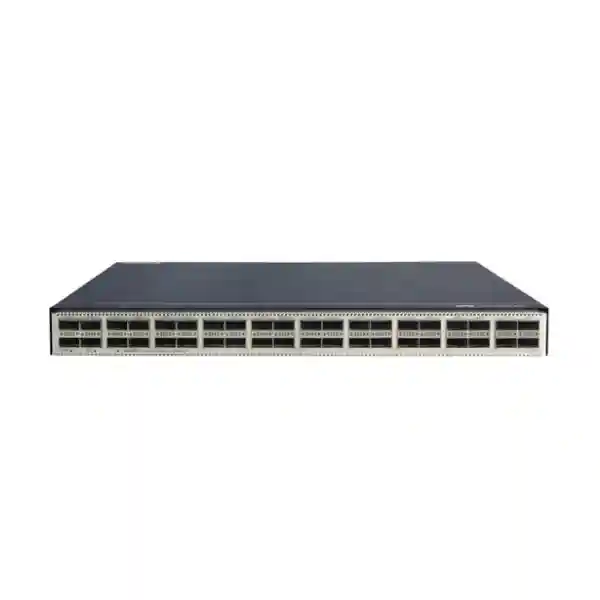
Huawei CloudEngine CE8851-32CQ8DQ-P Dubai
The Huawei CloudEngine CE8851-32CQ8DQ-P is a fixed 1U data center switch designed for high-density Ethernet fabrics where organizations need substantial 100GE capacity today and a planned route to 200GE and 400GE connectivity. Huawei publishes 32 x 40/100GE QSFP28 ports as the default interface set, a 19.2 Tbit/s switching capacity, 4,350 Mpps forwarding performance, and eight physical QSFP-DD positions that can be enabled for 400GE operation with the applicable CE88-RTU-8DQ hardware right-to-use. The 32 QSFP positions can also be upgraded for 200GE operation with the CE88-RTU-U32CQ hardware RTU. Those details matter during procurement because the chassis model name alone does not tell a buyer which port rights, fan direction, power modules, optics, cables, or software licenses are included in the proposed bill of materials.
FourTeck helps Dubai and UAE organizations turn the model request into a complete technical and commercial requirement. Share the intended topology, rack environment, port speeds, fibre type, link distances, redundancy design, preferred airflow, current Huawei software environment, and whether the switch is intended for leaf, spine, border, aggregation, storage, AI/HPC or general data center use. The objective is to quote the exact combination required for the project rather than assume that every published capability is active or bundled by default.
Direct answer: what should a buyer confirm before ordering the CE8851-32CQ8DQ-P?
Confirm six items before treating any quotation as complete: the exact mainframe bundle, fan direction, power modules, the required hardware RTUs, optics or direct-attach cables, and the software/support entitlement. Huawei’s ordering information distinguishes the base CE8851-32CQ8DQ-P chassis from factory bundles such as versions supplied with dual AC power and six fan boxes. The base model description can be listed without fan and power modules. This means a buyer should not assume that power supplies or fans are included merely because the switch model is specified. The airflow direction must also match the rack design so that hot and cold aisles are not compromised.
Huawei documents 32 x 40/100GE QSFP28 ports for the platform. Use this as the safest baseline when the quotation has not yet identified additional port RTUs.
The 32 QSFP positions can be upgraded to 200GE QSFP56 operation with the CE88-RTU-U32CQ hardware right-to-use. Confirm both entitlement and optical/cabling compatibility.
Use of the eight 400GE QSFP-DD positions requires the CE88-RTU-8DQ hardware right-to-use. Ask the supplier to show this separately in the bill of materials when 400GE links are required.
Huawei CloudEngine CE8851-32CQ8DQ-P specifications that matter in design reviews
The table below focuses on published platform values that are useful when architects, infrastructure teams and procurement departments review whether the model belongs in the proposed design. Final configuration should still be checked against the current Huawei documentation and the software release intended for deployment, because feature availability, licensing and supported transceivers can depend on release and ordering options.
| Item | Published value / buying note |
|---|---|
| Form factor | 1U fixed data center switch; 442 mm wide x 600 mm deep x 43.6 mm high. |
| Weight | Huawei publishes 9.1 kg excluding optical transceivers, power modules and fan assemblies, and 12.2 kg including AC power modules and fan assemblies but excluding optical transceivers. |
| Switching capacity | 19.2 Tbit/s. |
| Forwarding performance | 4,350 Mpps in Huawei’s CloudEngine 8851 switch datasheet. |
| High-speed ports | 32 x 40/100GE QSFP28; optional 32 x 200GE QSFP56 with CE88-RTU-U32CQ; optional 8 x 400GE QSFP-DD with CE88-RTU-8DQ. |
| Management | 1 x GE RJ45 out-of-band management interface, 1 x RJ45 console interface and 1 x USB port. |
| Memory / storage | 8 GB RAM, 64 MB NOR flash, 4 GB NAND flash and 64 MB system buffer. |
| Power modules | 1200 W AC power modules are documented. Confirm exact module type, quantity, airflow and input-power design in the quotation. |
| Maximum published power | Up to 973 W for a 32 x 100GE + 8 x 400GE optical scenario and up to 1152 W for a 32 x 200GE + 8 x 400GE optical scenario under Huawei’s stated test conditions. |
| Cooling | Air cooling with six fan trays; front-to-back or back-to-front airflow options are documented. |
| Operating environment | 0°C to 40°C at 0-1800 m, with altitude derating stated by Huawei; 5% to 95% relative humidity and operating altitude up to 5000 m are documented. |
Where the CE8851-32CQ8DQ-P fits in a modern data center
A model with dense 100GE access and a path to 200GE and 400GE is normally considered when the network needs more than a conventional campus-switch role. The CE8851-32CQ8DQ-P belongs in discussions about data center leaf-and-spine fabrics, high-performance server aggregation, east-west traffic, storage transport, border-leaf designs, scale-out virtualization environments and high-bandwidth interconnects. Huawei documentation for the CloudEngine 8851 family describes data center capabilities including VXLAN, BGP EVPN and M-LAG, together with telemetry and lossless-network technologies. The correct use of those functions depends on the software release, license package, architecture and operational standards adopted by the customer.
Use dense high-speed ports for server, appliance or downstream switch connections while reserving faster uplinks for the fabric. Oversubscription targets should be calculated from real traffic and growth assumptions.
The 400GE-capable QSFP-DD positions can support fabric evolution when the associated RTU and compatible optics are included. Link count, ECMP design and resilience should be planned before the BOM is finalized.
Huawei documents features such as PFC deadlock prevention, AI ECN, ECN Overlay and iQCN. Storage or AI/HPC designs should still be validated end-to-end with adapters, cabling, MTU, QoS and operational tooling.
Telemetry, enhanced traffic analysis and packet-event visibility can support operations teams that need faster fault isolation. Confirm support in the chosen software release and management architecture.
Procurement checklist for a clean bill of materials
A reliable quotation should identify every component that affects the switch’s usable configuration. For this model, procurement should start with topology and media requirements rather than simply requesting one chassis. The mainframe may be offered without fans and power supplies, while other bundle variants include those elements. Airflow is especially important in data centers because mixing port-side intake and exhaust assumptions with the rack’s hot-aisle/cold-aisle design can create a thermal problem even when the electrical specification is correct.
- Specify the exact chassis or factory bundle and ask the quotation to state whether fan trays and power modules are included.
- State the required airflow direction and confirm it against the rack and room cooling plan.
- List every desired 100GE, 200GE and 400GE link, including the remote device, fibre type, wavelength, distance and connector requirements.
- Include CE88-RTU-U32CQ when 200GE operation is required and CE88-RTU-8DQ when the eight 400GE QSFP-DD ports must be used.
- Confirm software licensing, support, software release, management integration and whether additional value-added packages are required.
- Plan dual-power feeds where resilience requires them, and verify PDU connectors, circuit capacity, rack power density and UPS design.
- Include rack mounting, fibre management, patching, labeling, spares and acceptance-testing requirements in the deployment scope.
- Confirm the exact warranty, support entitlement, vendor lead time, country of supply and delivery arrangement in writing before the purchase order is released.
FourTeck resources for network and data center projects
For related project planning, buyers can review the FourTeck Firewall Dubai portal when the switching design must be coordinated with perimeter or data center security, the FourTeck UAE IT services portfolio for switching, routing and infrastructure support, and the FourTeck Africa network-switching category for broader regional switching requirements. Buyers evaluating a wider technology project can also use the FourTeck UAE website. To send the exact Huawei model, quantity, destination and technical scope for review, use the Firewall Dubai contact page.
Huawei CloudEngine CE8851-32CQ8DQ-P Dubai
Dubai buyers searching for the Huawei CloudEngine CE8851-32CQ8DQ-P are usually looking beyond a standard office switch. Typical requirements include a new private data center, a colocation refresh, an enterprise server room that is moving to 100GE, a high-density virtualization cluster, a storage network, a leaf-spine fabric or an interconnection layer between compute, security and service appliances. In these projects the useful buying question is not simply whether the CE8851-32CQ8DQ-P is available. The question is whether the proposed bill of materials activates the speeds and functions expected by the design and whether the rack, cooling, optics and support choices are correct for the Dubai facility.
For a Dubai data center, start by mapping every planned link. A 100GE server or downstream switch connection may use a different optic or cable from a 100GE long-reach inter-rack link. A 400GE spine uplink brings another set of transceiver, fibre and breakout decisions. The eight physical QSFP-DD positions on this platform are not a reason to assume that 400GE use is included in the base chassis; Huawei’s documentation states that the CE88-RTU-8DQ hardware right-to-use is needed. Likewise, moving the 32 main QSFP ports from the default 100GE capability to 200GE requires the CE88-RTU-U32CQ. FourTeck can use the port map to help buyers request the correct rights, optics and accessories rather than discover an entitlement or media gap after delivery.
Power and cooling deserve equal attention. Huawei publishes a 1U chassis depth of 600 mm, dual-power scenarios in its power figures, and front-to-back or back-to-front airflow options. Dubai facilities often operate with disciplined hot-aisle/cold-aisle layouts, so the switch fan direction and power-module airflow must be matched to the rack orientation. The maximum published power values also show why rack power planning matters: Huawei cites up to 973 W for the stated 32 x 100GE plus 8 x 400GE optical scenario and up to 1152 W for the 32 x 200GE plus 8 x 400GE scenario under defined conditions. Those are not generic consumption promises; they are sizing references that should be interpreted with the actual optic mix, ambient temperature and power architecture.
When requesting a Huawei CloudEngine CE8851-32CQ8DQ-P Dubai quotation, provide the deployment area, rack type, power feeds, desired airflow, required software release, existing Huawei fabric or controller environment, number of 100GE/200GE/400GE links, optic reach, fibre type and target go-live window. If the switch is replacing another platform, add the current port map, VLANs, routing protocols, MLAG design, VXLAN/EVPN requirements and any automation or telemetry dependencies. This information lets the quotation distinguish the base hardware from rights, optics, support and professional services, and it gives technical teams a better basis for validating compatibility before the purchase order is approved.
Huawei CloudEngine CE8851-32CQ8DQ-P UAE
Organizations searching for the Huawei CloudEngine CE8851-32CQ8DQ-P UAE may be centralizing procurement for projects in Dubai, Abu Dhabi, Sharjah, Ajman or other Emirates, or they may be designing one standard platform for several facilities. A national procurement view changes the questions that should be asked. It becomes important to standardize the chassis bundle, fan direction, power-module configuration, software release, support entitlement, optical modules, labeling and spares so that the same switch model is not delivered in several materially different configurations. Standardization also makes operational documentation and replacement planning more manageable.
A UAE-wide project should separate three layers of the purchase. The first is the physical platform: CE8851-32CQ8DQ-P and the intended fan and power arrangement. The second is activation and software: 200GE or 400GE hardware RTUs when needed, plus the Huawei software and support package appropriate to the architecture. The third is connectivity: every QSFP28, QSFP56, QSFP-DD, breakout cable, DAC, AOC and fibre optic transceiver required to reach servers, storage systems, firewalls, routers or adjacent switches. Combining these layers into a single undefined line item may make an initial quote look simple but creates ambiguity during acceptance and deployment.
For customers running or planning VXLAN with BGP EVPN, M-LAG or telemetry, the design team should verify feature support against the actual Huawei software release rather than assuming that a family-level feature is active in every build. Huawei’s current support tools identify CE8851-32CQ8DQ-P within the CE8800 data center switch family, and vendor documentation describes a broad set of data center capabilities. Operational teams should also define management access, AAA, SNMP or telemetry approach, time synchronization, logging, configuration backup and change-control standards before cutover. That preparation is particularly valuable when multiple UAE sites are being commissioned by different integrators or project teams.
For procurement, share the final destination for each unit, quantity, preferred delivery sequence, rack and power standards, support expectations and whether installation, configuration, migration or acceptance testing is part of the scope. FourTeck can help turn those details into a structured Huawei CloudEngine CE8851-32CQ8DQ-P UAE inquiry. Current availability, lead time, warranty route, vendor support and project scheduling should always be confirmed on the quotation because they can vary with quantity, configuration, supplier status, licensing and the chosen regional supply channel.
Huawei CloudEngine CE8851-32CQ8DQ-P Uganda
Uganda buyers evaluating the Huawei CloudEngine CE8851-32CQ8DQ-P may be planning a high-capacity enterprise core, a service-provider or data-center fabric, centralized infrastructure for financial or public-sector workloads, a university computing environment, or a private-cloud platform that needs dense 100GE connectivity. Because this is a high-speed data center switch rather than an ordinary access switch, the procurement process should include infrastructure readiness. Rack depth, cabinet airflow, stable power, UPS capacity, generator strategy, fibre distribution, transceiver availability and access to qualified configuration support all influence whether the platform can be deployed efficiently.
One of the most useful steps for a Uganda project is to create a complete port schedule before requesting pricing. List the remote device on every connection, speed, optic form factor, fibre type, estimated distance and whether a breakout is required. This is particularly important when a design mixes 100GE server or appliance connectivity with 400GE fabric links. Huawei documents 32 x 40/100GE QSFP28 interfaces as the baseline and requires hardware RTUs for 200GE on those ports and for use of the eight 400GE QSFP-DD interfaces. A quotation that identifies only the chassis may therefore be technically incomplete for the intended topology.
Logistics and support should also be treated as design inputs. For projects outside the main distribution centers, the team should decide which components must be kept as spares: fans, power modules, optics, cables or even an additional switch, depending on service criticality. The airflow direction must match the rack layout, and dual power feeds should terminate on genuinely independent circuits if the resilience design depends on them. Where environmental control is limited, the published operating range, altitude derating and heat output should be compared with the actual room conditions rather than assumed suitable.
For a Huawei CloudEngine CE8851-32CQ8DQ-P Uganda quotation, provide the delivery city, expected quantity, deployment role, link map, optics, preferred fan direction, power standard, software and support requirements, and the target implementation window. If the project includes routing, EVPN/VXLAN, M-LAG, automation or telemetry, add the relevant architecture details so software and professional-service scope can be reviewed. FourTeck can coordinate a structured inquiry without claiming local stock or an automatic delivery time; commercial availability, shipment method, warranty handling and service scope should be confirmed for the specific order.
Huawei CloudEngine CE8851-32CQ8DQ-P Kampala
Kampala-based organizations often concentrate their core IT infrastructure in a head office, commercial data room, colocation environment or primary server facility that supports branch operations around Uganda. In that setting, the Huawei CloudEngine CE8851-32CQ8DQ-P can enter the conversation when 10GE or 25GE aggregation is no longer sufficient and the architecture is moving toward 100GE fabric links, dense virtualization, high-throughput storage or faster interconnection between network and security systems. The first design decision is the role of the switch: leaf, spine, border, aggregation or storage-oriented fabric node. That role determines which ports and rights actually need to be purchased.
For Kampala procurement teams, it is sensible to ask vendors to quote a complete and auditable BOM instead of one headline chassis price. The base CE8851-32CQ8DQ-P can be described without power modules and fans, while related bundle variants include two AC power modules and six fan boxes with a specified airflow direction. If the design requires 400GE links, the CE88-RTU-8DQ hardware RTU should be visible on the quotation. If 200GE is required across the 32 main QSFP positions, the CE88-RTU-U32CQ should be identified. Optics, fibre patching and spare modules should then be listed separately so procurement knows exactly what will arrive.
A Kampala data center project should also plan for change control and support after installation. Document management IP addressing, out-of-band access, administrator authentication, routing neighbors, VLAN and EVPN identifiers, MLAG peer relationships, software version, configuration backup, telemetry targets and escalation contacts. If the switch connects to firewalls, routers, storage arrays or servers supplied by different teams, agree interface speed, FEC, MTU and optic compatibility before the maintenance window. These details reduce the risk of a successful physical installation being followed by hours of interoperability troubleshooting.
When asking for Huawei CloudEngine CE8851-32CQ8DQ-P Kampala supply and deployment support, include the rack location, power and cooling environment, fibre routes, remote-device models, intended port speeds, software expectations, quantity and desired project scope. Where the switch supports critical banking, telecom, cloud, education or enterprise services, add the required resilience and spare strategy. Availability and delivery terms should be confirmed during quotation rather than assumed, especially for high-speed optics, specialized licences or project quantities that may depend on supplier and regional logistics.
Huawei CloudEngine CE8851-32CQ8DQ-P Arua
An Arua requirement for the Huawei CloudEngine CE8851-32CQ8DQ-P is likely to be part of a specialized infrastructure project rather than a routine LAN purchase. That makes remote-site readiness and lifecycle planning particularly important. If the switch will support a regional data room, service-provider node, large institutional network or high-capacity aggregation site, the organization should decide how it will handle spares, remote troubleshooting and component replacement before deployment. A 1U high-speed switch can save rack space, but it also concentrates substantial capacity in one device, so the impact of a failed power module, fan, optic or uplink should be understood.
Begin with the physical environment. The CE8851-32CQ8DQ-P is 600 mm deep and Huawei documents six fan trays with selectable airflow direction through the appropriate components. Confirm cabinet usable depth, front and rear cable clearance, airflow path, dust control, ambient temperature, UPS and generator capacity. If the design uses redundant power, make sure the two switch power inputs do not terminate on the same single point of failure. For long-distance fibre links from Arua to other facilities, select optics by actual reach and fibre plant rather than by port speed alone, and include attenuation and patch-panel losses in the optical budget where appropriate.
The next step is entitlement accuracy. Huawei documents 32 x 40/100GE QSFP28 interfaces as the default port capability, while 200GE operation on those ports requires CE88-RTU-U32CQ and use of eight 400GE QSFP-DD interfaces requires CE88-RTU-8DQ. If the project design shows 400GE uplinks or 200GE server links, those RTUs should be explicitly quoted. This avoids a common procurement mistake: matching the physical connector diagram to the desired topology without checking whether the required port right is enabled.
For a Huawei CloudEngine CE8851-32CQ8DQ-P Arua inquiry, provide the final destination, rack conditions, required quantity, each high-speed link, fibre distances, support strategy and whether the project includes configuration or remote commissioning. If on-site technical resources are limited, request detailed labeling, preconfiguration, configuration documentation, tested optics and a remote-support plan as part of the service discussion. FourTeck can help structure the requirement, but exact logistics, lead time, warranty processing and service availability should be confirmed for the project rather than treated as automatic local coverage.
Huawei CloudEngine CE8851-32CQ8DQ-P Mbarara
For Mbarara customers, a Huawei CloudEngine CE8851-32CQ8DQ-P project may support a regional enterprise hub, higher-education computing, healthcare infrastructure, financial services, communications platforms or a service-provider aggregation environment. The platform’s dense 100GE interface count makes sense only when the upstream and downstream architecture can make useful use of that bandwidth. Before purchase, the technical team should therefore identify the current traffic baseline, expected three-to-five-year growth, east-west traffic between servers, storage flows, uplink oversubscription and any requirement for 200GE or 400GE evolution.
In a project where budgets are tightly managed, it can be tempting to buy only the switch and defer accessories. That approach can be risky with high-speed data center equipment. The final cost and readiness depend on fan and power configuration, port RTUs, software rights, optics, fibre, patching and support. Huawei’s ordering data specifically differentiates the base CE8851-32CQ8DQ-P from bundle variants supplied with dual AC power and fan trays. A clear quotation should state which version is being offered and should not leave airflow direction or power-module quantity implicit.
Mbarara deployments may also benefit from a stronger spare and recovery plan. If replacement components cannot be sourced locally at short notice, the organization can decide whether to hold spare optics, fan trays, power modules or an additional switch. The correct choice depends on service criticality and network redundancy. A leaf-spine fabric with multiple equal-cost paths may tolerate a node outage differently from a single aggregation switch carrying all traffic. Operational documentation should show how traffic fails over, how routing or M-LAG reacts, and which links are business critical.
To request Huawei CloudEngine CE8851-32CQ8DQ-P Mbarara pricing, send a topology diagram or simple link table, quantity, required port speeds, fibre distances, power and airflow preference, software features and expected support scope. Include whether installation will be handled by an internal team or needs project assistance. FourTeck can help review the requirement and prepare a more complete BOM discussion. Availability, commercial terms, transport to Mbarara, warranty route and deployment services should be confirmed at quotation stage because they depend on the selected configuration, supplier availability and project scope.
Huawei CloudEngine CE8851-32CQ8DQ-P Gulu
A Gulu deployment of the Huawei CloudEngine CE8851-32CQ8DQ-P should be approached as an infrastructure system, not only as a hardware purchase. High-speed switch projects can fail to meet expectations when the network fabric, optics, rack cooling, power protection or operational skills are not planned alongside the chassis. If the switch will serve a regional institutional network, enterprise data room, public-sector environment or communications facility, start by documenting the services that cannot tolerate interruption and the traffic paths they use. This establishes the redundancy level needed from uplinks, power supplies and adjacent devices.
The CE8851-32CQ8DQ-P offers substantial port density in 1U, but its configurable high-speed capability means buyers should make port entitlements explicit. Use 32 x 40/100GE QSFP28 as the default published capability. Add CE88-RTU-U32CQ when the design needs 200GE operation on the main QSFP positions. Add CE88-RTU-8DQ when the eight 400GE QSFP-DD ports need to be used. Then define the transceiver or cable for every connection. Even when two devices both advertise 100GE or 400GE, interoperability can depend on optic type, wavelength, FEC, breakout mode, cable quality and software support.
Gulu projects that rely on remote administration should include a robust out-of-band management design. The switch provides a dedicated GE RJ45 management interface and a console port, which can be incorporated into a separate management network. Establish role-based administration, AAA, secure remote access, configuration backups, logs and monitoring from the beginning. If the deployment team intends to use Huawei telemetry, EVPN/VXLAN or M-LAG, verify the software release and license package and document the expected failover behavior before production traffic is migrated.
For Huawei CloudEngine CE8851-32CQ8DQ-P Gulu procurement, include destination, rack dimensions, environmental conditions, power feeds, quantity, port map, optics, software version, licensing and service requirements in the request. If travel or replacement logistics are important, include a spare strategy and remote-support expectation as well. FourTeck can use those details to support a structured quotation discussion, while current stock, shipping time, customs handling, warranty procedure and technical-service availability should be confirmed specifically for the order.
Huawei CloudEngine CE8851-32CQ8DQ-P Kenya
Kenya buyers considering the Huawei CloudEngine CE8851-32CQ8DQ-P may be building enterprise or colocation fabrics in Nairobi, expanding service-provider infrastructure, modernizing private cloud, scaling storage or creating high-speed interconnects for compute clusters. These projects frequently require both technical validation and careful procurement because 100GE, 200GE and 400GE networks introduce a wider set of optical, cabling and platform-entitlement choices than a conventional campus network. A high-density switch can reduce the number of devices in the rack, but only if the port map and oversubscription model match the actual workload.
For a Kenya project, calculate the fabric from endpoints backward. Identify the number of server, storage, firewall, router and switch links; their current speed; and the expected growth. If the intended uplinks are 400GE, confirm CE88-RTU-8DQ in the BOM. If server or fabric interfaces need 200GE, confirm CE88-RTU-U32CQ. If the requirement is entirely 100GE, the default 32-port capability may be sufficient, but optics and software still need to be selected. This approach keeps the quotation aligned to the topology instead of using every possible platform capability whether or not it is required.
Data center operations in Kenya should also review power density, cooling and redundancy. Huawei publishes up to 973 W maximum power for its stated 32 x 100GE plus 8 x 400GE optical test scenario and up to 1152 W for the equivalent 200GE scenario. Those figures show why high-speed transceivers and ambient conditions need to be part of the electrical calculation. The switch supports front-to-back or back-to-front airflow depending on the installed fan and power components, so airflow direction should be standardized within the row.
When requesting Huawei CloudEngine CE8851-32CQ8DQ-P Kenya supply, send the destination, quantity, topology, port-speed plan, optic reaches, preferred airflow, support term, required software features and implementation scope. If the switch must integrate with an existing Huawei CloudEngine fabric, include current software versions and management architecture. FourTeck can help structure the BOM and compatibility discussion, while final availability, price, warranty handling, delivery lead time and professional-service schedule should be confirmed for the specific Kenyan order.
Huawei CloudEngine CE8851-32CQ8DQ-P Kuwait
Kuwait organizations looking for the Huawei CloudEngine CE8851-32CQ8DQ-P are often evaluating data center upgrades where port density, deterministic cooling, power redundancy and high-speed fibre are more important than the basic feature checklist. The 1U format can suit dense racks, but it also requires disciplined thermal design. Huawei documents the switch with front-to-back or back-to-front airflow options, six fan trays and 1200 W-class AC power modules. Buyers should make airflow orientation and power-module configuration part of the purchase specification, particularly where racks follow strict hot-aisle/cold-aisle practices.
The published 0°C to 40°C long-term operating range at lower altitudes should not be interpreted as a reason to ignore room cooling. High-speed optics generate additional heat, and the vendor’s maximum power figures are based on defined traffic, optic and temperature conditions. Kuwait facilities should check the rack’s available power budget, PDU socket type, circuit loading, UPS runtime and generator transfer plan against the actual configuration. For resilient designs, dual switch power modules should connect to independent power paths whenever the facility architecture supports that approach.
From a network standpoint, confirm whether the switch will remain a 100GE platform or needs 200GE and 400GE functions. Huawei lists 32 x 40/100GE QSFP28 ports as standard, with CE88-RTU-U32CQ required for 32 x 200GE operation and CE88-RTU-8DQ required to use the eight 400GE QSFP-DD interfaces. The quotation should also identify compatible optics, direct-attach or active optical cables, software licensing and support. If VXLAN/BGP EVPN, M-LAG, telemetry or lossless Ethernet features are part of the design, validate them against the selected software release.
For a Huawei CloudEngine CE8851-32CQ8DQ-P Kuwait quotation, provide rack and cooling details, port map, fibre type and distances, required quantities, power design, preferred airflow, software requirements, support expectations and any installation or migration scope. If the switch is part of a broader security or data center refresh, include adjacent firewall and routing interfaces so the entire interconnect can be checked. FourTeck can help organize the requirement, but availability, delivery, warranty, licence entitlement and implementation dates should be confirmed in the commercial proposal.
Huawei CloudEngine CE8851-32CQ8DQ-P Ghana
Ghana buyers may evaluate the Huawei CloudEngine CE8851-32CQ8DQ-P for financial-services infrastructure, telecommunications, cloud and hosting platforms, universities, public-sector data centers, mining or industrial enterprise systems that need faster east-west traffic and a scalable fabric. Whether the switch is deployed in Accra or another location, the same rule applies: high-speed switching should be ordered as a complete system. The chassis, fan direction, power, port rights, optics, software and support all affect whether the delivered solution can be used as designed.
A Ghana procurement team should first distinguish capacity from enabled interfaces. The switch has a published switching capacity of 19.2 Tbit/s and 4,350 Mpps forwarding performance, but the desired interface speed still depends on the port rights. Huawei documents 32 x 40/100GE QSFP28 ports by default. The CE88-RTU-U32CQ is required to upgrade those positions to 200GE, and the CE88-RTU-8DQ is required to use the eight 400GE QSFP-DD interfaces. This distinction is particularly important when comparing supplier quotations because one offer may include the necessary RTUs and another may quote only the base chassis.
The physical facility should be checked at the same time. Confirm 600 mm switch depth plus cabling clearance, airflow direction, rack cooling, dual power feeds, PDU capacity and the effect of high-power optics. Where power quality is a concern, ensure the switch is protected by the data center’s UPS and generator strategy rather than relying only on the device’s own power modules. Where rapid local replacement cannot be guaranteed, decide which spare components should be held based on the network’s tolerance for downtime.
For Huawei CloudEngine CE8851-32CQ8DQ-P Ghana supply, share the project city, quantity, topology, link distances, required speeds, software features, target support level and implementation scope. Include information about remote devices so optic and interoperability questions can be reviewed before shipment. FourTeck can assist with requirement clarification and quotation coordination, while stock status, shipping, customs, warranty handling and service availability should be confirmed for the actual project instead of assumed from the product name alone.
Huawei CloudEngine CE8851-32CQ8DQ-P Nigeria
Nigeria has a wide range of high-capacity networking use cases, from financial institutions and carriers to large enterprises, cloud platforms, content infrastructure, universities and government data centers. A Huawei CloudEngine CE8851-32CQ8DQ-P Nigeria requirement should therefore begin with the intended architecture rather than a generic specification request. A leaf switch serving 100GE servers has different optic, oversubscription and failure-domain requirements from a spine switch carrying 400GE fabric links or a border device connecting firewalls and routers.
The bill of materials should make the platform’s upgrade rights explicit. The 32 QSFP positions support 40/100GE by default according to Huawei. Moving those ports to 200GE requires CE88-RTU-U32CQ. Using the eight 400GE QSFP-DD positions requires CE88-RTU-8DQ. A supplier comparison should therefore check more than the chassis price: compare fan and power inclusion, RTUs, software license, support, optics, fibre or cables, mounting accessories and any professional-service line items. If two quotations differ significantly, a line-by-line BOM review often reveals that they are not offering the same usable configuration.
For deployments in Lagos, Abuja, Port Harcourt or other Nigerian locations, facility and logistics planning also matter. Validate rack depth, airflow orientation, available cooling, PDU and UPS design, generator support and optical-fibre routes. If critical services depend on the switch, plan redundancy at both device and network levels. Holding spare high-speed optics can be particularly useful because a fabric may remain healthy while one failed or mismatched transceiver blocks an essential link. Operations teams should also document software version, configuration backup, management access, monitoring and escalation procedures.
To request Huawei CloudEngine CE8851-32CQ8DQ-P Nigeria pricing, send the location, required quantity, role of each switch, 100GE/200GE/400GE link plan, optic distances, power and airflow preference, software requirements and expected support. If the design uses EVPN/VXLAN, M-LAG, telemetry or lossless features, include those requirements so the software and service scope can be reviewed. FourTeck can help structure the procurement request, while exact availability, delivery time, warranty route and local implementation arrangements should be confirmed in the final quotation.
Huawei CloudEngine CE8851-32CQ8DQ-P Seychelles
A Seychelles deployment of the Huawei CloudEngine CE8851-32CQ8DQ-P may support a central enterprise data room, telecommunications platform, government system, hospitality technology environment, financial infrastructure or a private-cloud project where high bandwidth and limited rack space make a dense 1U switch attractive. Island logistics make planning particularly important. The team should avoid treating fans, power supplies, optics and port rights as items that can always be sourced quickly after installation. A complete and tested bill of materials can reduce the risk of deployment delays.
Create the optic and spare plan before shipment. Huawei documents 32 x 40/100GE QSFP28 ports by default, optional 200GE operation with CE88-RTU-U32CQ and optional use of eight 400GE QSFP-DD ports with CE88-RTU-8DQ. Decide which ports will be active on day one and which are reserved for growth. For each active link, identify the transceiver or cable type, fibre plant, connector, distance and remote device. Where business continuity is important, include spare optics and consider which other field-replaceable components should be held locally.
Environmental design should take account of the switch’s heat and airflow. The switch uses six fan trays, and Huawei provides component options for opposite airflow directions. The selected direction should follow the cabinet’s cold-air intake and hot-air exhaust pattern. Review UPS and generator capacity, dual power-feed independence and rack PDU loading, especially if the configuration uses many high-power optical modules. Monitoring should include temperature, fan and power status as well as interface errors and traffic conditions so problems can be detected before they become service outages.
For a Huawei CloudEngine CE8851-32CQ8DQ-P Seychelles quotation, provide the island or site, quantity, deployment role, full port schedule, optic reach, airflow preference, power arrangement, software and support needs, and the required installation or remote-commissioning scope. FourTeck can help consolidate the hardware and service requirement, while freight method, insurance, customs, delivery lead time, warranty handling and on-site support should be agreed for the specific project. This is safer than assuming that a standard mainland supply model automatically applies to an island deployment.
Software, fabric and integration considerations
The hardware specification is only one part of a data center fabric. Huawei’s CloudEngine documentation describes VXLAN routing and bridging, BGP EVPN, M-LAG, telemetry, enhanced traffic-analysis capabilities, ZTP and a range of lossless-network functions for the CE8851 family. Buyers should not convert those family-level capabilities into a blanket assumption that every function is active without checking the planned software release and license. The current Huawei support environment identifies CE8851-32CQ8DQ-P within the CE8800 family and makes version-specific documentation available, so design validation should be performed against the release intended for production.
If the switch is part of a VXLAN/EVPN fabric, define the control-plane architecture, route-reflector strategy where applicable, VTEP roles, underlay routing, MTU, anycast gateway design, VLAN-to-VNI mapping and failure behavior. If M-LAG is used, document peer links, keepalive paths, dual-homed endpoints and operational procedures. If the design targets lossless Ethernet for storage, AI or HPC traffic, define PFC, ECN, queueing and congestion-management policies end-to-end; a lossless-capable switch alone cannot guarantee a healthy lossless fabric if NIC, storage, cabling or upstream settings are inconsistent.
For monitoring and operations, plan secure management access, AAA, NTP, logging, SNMP or telemetry, configuration backup and a software-upgrade process. Huawei publishes a dedicated out-of-band GE management interface, console interface and USB port for the platform. Incorporating the management port into a separate management network can preserve access when the production fabric has a fault. Define who can change the configuration, where backups are kept and how rollback is handled. These operational details often have more influence on long-term stability than any single headline performance number.
Optics, cabling and breakout planning
High-speed Ethernet procurement becomes much easier when optics are treated as part of the switch design rather than as accessories chosen later. Start with a link matrix containing the CE8851 port, remote device and port, speed, fibre type, connector, distance, optic type, breakout arrangement and expected redundancy. This matrix allows the engineering team to check compatibility and gives procurement a precise quantity list. It also makes it possible to identify where DAC or AOC connections may be more practical than optical transceivers for short in-rack or adjacent-rack links.
When 400GE is used, verify not only the CE88-RTU-8DQ but also the specific QSFP-DD optic or cable, fibre plant and remote-port capabilities. When 200GE is required on the main ports, verify CE88-RTU-U32CQ and the appropriate QSFP56 media. For 100GE, consider whether the link is SR4, LR4, CWDM-based, single-lambda or another supported type according to the current Huawei compatibility information. A generic statement such as ‘100G optic’ is not enough for a purchase order because reach, wavelength and fibre requirements differ substantially.
Breakouts should be documented carefully because a physical high-speed port can represent multiple logical interfaces only where the hardware, software and supported cable or optic combination permit it. If breakouts are planned for servers or lower-speed uplinks, confirm the exact mode in Huawei documentation and test the remote device configuration. Label both ends of every link and record serial numbers for high-value optics where operational policy requires it. A disciplined optic inventory simplifies troubleshooting and makes spares easier to manage.
Power, thermal and rack readiness
The CE8851-32CQ8DQ-P fits a 1U rack space, but rack readiness includes more than height. Its 600 mm chassis depth requires sufficient cabinet depth for rear modules, airflow and cable bend radius. The published platform can be configured for front-to-back or back-to-front airflow depending on the fan and power components, so match the switch orientation to the facility’s cold-air intake and hot-air exhaust design. Mixing airflow directions in the same rack row can recirculate hot air and reduce the thermal margin of both switches and neighboring servers.
Electrical sizing should use the real proposed configuration. Huawei publishes typical and maximum values under stated test conditions, including maximum values up to 973 W for a 32 x 100GE plus 8 x 400GE optical configuration and 1152 W for a 32 x 200GE plus 8 x 400GE optical configuration. The actual deployment can differ because optic power, traffic, temperature and configuration vary. Use vendor figures as planning references, then calculate circuit loading and UPS capacity with appropriate facility margins and applicable electrical standards.
Redundant power is useful only when the supporting electrical design is also redundant. Where business continuity requires independent A and B feeds, connect the switch power supplies to separate PDUs and upstream power paths. Document which outlet powers each module and include that mapping in rack records. During commissioning, verify fan direction, power status, temperature alarms and cable clearance before placing the switch into service. These checks are simple but prevent avoidable reliability problems.
Frequently asked questions
Does the CE8851-32CQ8DQ-P include 400GE by default?
Huawei documents eight 400GE QSFP-DD interfaces for the platform but states that use of those ports requires the CE88-RTU-8DQ hardware right-to-use. Confirm that entitlement and the required optics in the quotation.
Can the 32 main ports operate at 200GE?
Yes, Huawei documents 32 x 200GE QSFP56 capability, but the CE88-RTU-U32CQ hardware RTU is required to upgrade the default 100GE port rights. Media and remote-device compatibility must also be checked.
Are fans and power supplies always included?
No. Huawei’s ordering information lists a base CE8851-32CQ8DQ-P mainframe without fan and power modules, as well as bundle variants that include two AC power modules and six fan boxes. Ask the supplier to state the exact bundle.
What airflow options are available?
Huawei documents front-to-back and back-to-front airflow configurations through the relevant fan and power components. Select the direction to match the data center row and rack cooling design.
Is the CE8851 suitable for VXLAN EVPN fabrics?
Huawei documents VXLAN routing and bridging, BGP EVPN and other data center features for the CE8851 family. Confirm exact feature support, license and configuration requirements for the software release you intend to deploy.
What should I send for a quotation?
Send quantity, destination, switch role, required 100GE/200GE/400GE links, optic distances, fibre type, rack and airflow preference, power design, software and support needs, and whether installation or migration services are required.
Can FourTeck confirm stock and lead time?
Current stock, supplier status and lead time can vary by configuration, quantity, optics, RTUs and destination. Request written confirmation for the exact BOM rather than relying on a general product listing.
What is the safest way to compare two supplier quotes?
Compare the BOM line by line: chassis variant, power, fans, airflow, RTUs, software licence, support term, optics, cables, warranty route, delivery and services. A lower headline price may represent a different usable configuration.
Decision recap
The Huawei CloudEngine CE8851-32CQ8DQ-P is best evaluated as a configurable high-density data center platform. Its headline hardware capacity is strong, but purchase success depends on the details that sit around the chassis. Use the default 32 x 40/100GE capability as the baseline, add the correct hardware RTUs when 200GE or 400GE is required, match fan and power airflow to the rack, build an optic list from the actual topology, confirm software licensing and support, and document how the switch will be managed and monitored. For international projects, add logistics, spares and warranty handling to the technical review.
You need dense 100GE in 1U with a planned route to 200GE or 400GE and your network architecture can use the capacity.
Fan direction, power, RTUs, optics, licences, support and software compatibility are explicitly identified.
Validate rack depth, cooling, electrical feeds, fibre routes, management access, configuration standards and rollback.
Quotation checklist
Send the following information in one request to reduce back-and-forth and make supplier comparisons more useful:
Number of units, city/country, delivery location type and target project date.
Leaf, spine, border, aggregation, storage, AI/HPC or another design role.
Count of 100GE, 200GE and 400GE links, breakouts and expected future growth.
Link distance, fibre type, connectors, remote device models and preferred optic types.
Cabinet depth, hot/cold aisle orientation and required port-side intake or exhaust.
A/B feeds, PDU type, voltage, UPS/generator strategy and required power-module count.
Target Huawei release, EVPN/VXLAN, M-LAG, telemetry, lossless functions and support term.
Installation, configuration, migration, testing, documentation, training or remote support.
Request a CE8851-32CQ8DQ-P configuration review
Share the exact Huawei CloudEngine CE8851-32CQ8DQ-P requirement and FourTeck can help organize the questions that should be answered before purchase: chassis bundle, airflow, power, port RTUs, optics, software, support and deployment scope. A detailed request gives sales and engineering teams enough information to prepare a quotation that can be compared and validated instead of relying on a model-only price.
For the fastest technical review, attach a basic topology or port schedule and state which links must run at 100GE, 200GE or 400GE. If a current switch is being replaced, include its model, software release and connected devices. Commercial availability, delivery, warranty and implementation dates can then be confirmed against the final bill of materials.

Reviews
There are no reviews yet.