
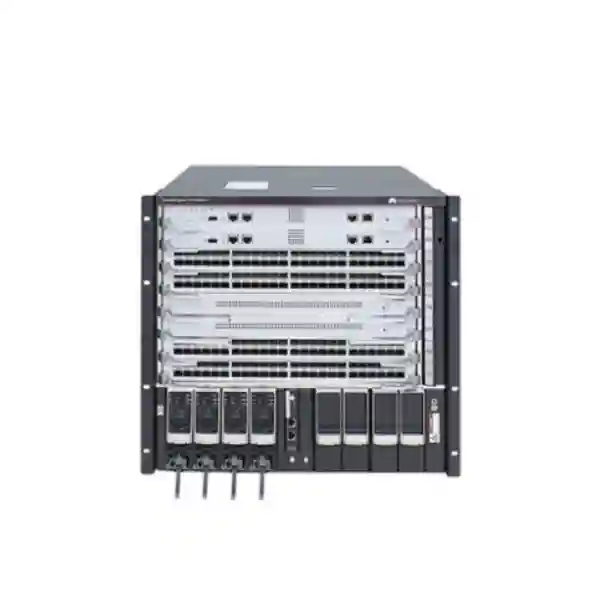
Huawei CloudEngine S12700E-8
The Huawei CloudEngine S12700E-8 is positioned by Huawei as a flagship core switch for high-end campus networks. The eight-service-slot chassis is built for organizations that need a scalable core capable of supporting high-density Ethernet, converged wired and wireless policy, virtualization and modern campus fabrics. Buyers typically research this model when a fixed-form switch no longer offers enough slot flexibility, when multiple buildings or access layers must aggregate into a resilient core, or when network teams want a platform that can evolve through interface-card, switching-fabric and software choices rather than a complete redesign.
Direct answer: who should evaluate the S12700E-8?
The Huawei CloudEngine S12700E-8 should be evaluated by enterprises, universities, government environments, healthcare groups, hospitality operators, large commercial campuses and multi-building organizations that require a chassis-based core with room for multiple service cards and high-speed uplinks. It is particularly relevant where the design must aggregate many access switches, support high-speed server or distribution links, carry large volumes of east-west and north-south campus traffic, or coordinate wired and wireless policies from the core.
A quotation should not be based on the chassis name alone. The usable system depends on the selected MPUs, SFUs, service cards, transceivers, power modules, software features, redundancy design and software compatibility. FourTeck therefore recommends treating the S12700E-8 as a configurable platform rather than a single box. A useful request for quotation should state current and expected user counts, access-switch quantities, required port speeds, fiber types and distances, uplink topology, redundancy expectations, routing and segmentation needs, wireless integration plans, rack and power constraints, and the software or controller environment that the switch must join.
Verified Huawei CloudEngine S12700E-8 specifications
| Specification | Huawei published value | Why it matters in planning |
|---|---|---|
| Forwarding performance | 28,800 Mpps | Helps size the core for large packet-processing loads rather than relying on port count alone. |
| Switching capacity | 38.4 Tbit/s current / 57.6 Tbit/s hardware-ready | Supports growth planning, but actual configuration and software choices must be validated. |
| MPU slots | 2 | Allows designs that consider control-plane redundancy when supported by the chosen modules and configuration. |
| SFU slots | 4 | Switch-fabric selection is part of a complete bill of materials and performance plan. |
| Service-card slots | 8 | Provides flexibility to mix interface types according to access, aggregation and uplink requirements. |
| Fan slots | 4 | Rack airflow, room cooling and serviceability should be included in site readiness. |
| Wireless integration | S12700E series supports management of up to 10,240 APs | Useful where wired and wireless management or policy convergence forms part of the architecture. |
Huawei states that the value before and after the slash in switching-capacity figures represents current capability and the capability that the hardware is ready to support. Final performance, feature availability and supported cards depend on the actual hardware and software release, so project-specific validation remains essential.
Core and aggregation role
Use the S12700E-8 where multiple access or distribution layers must converge into a high-capacity campus core. The chassis format is useful when you need different port densities and speeds across the same platform and want expansion choices beyond a fixed-port switch.
Wired and wireless convergence
Huawei positions the series for unified wired and wireless management scenarios. Buyers should still confirm controller architecture, AP models, software versions, licensing and scale requirements before assuming a specific wireless design.
Fabric and virtualization options
The platform supports capabilities including VXLAN, BGP-EVPN and Super Virtual Fabric according to Huawei’s published specification set. These features can help modernize segmentation and campus fabrics when aligned with the wider architecture.
Operational visibility
Huawei lists iPCA for real-time statistics on packet loss and packet-loss ratios at network and device levels. Operational teams should map monitoring requirements to their NMS, telemetry, alerting and troubleshooting workflow.
Configuration and quotation checklist
A common purchasing mistake is to request only “Huawei S12700E-8 price” without defining the intended build. A chassis quote can look attractive while omitting essential control, switching-fabric, power, interface, optical or software components. For a usable comparison between quotations, ask every supplier to identify exactly what is included and excluded.
- Chassis part number and exact model designation.
- Number and model of MPUs and SFUs.
- Required GE, 10GE, 25GE, 40GE or 100GE service cards and expected port population.
- Optics, DACs, AOCs or other transceiver requirements, including fiber type and distance.
- AC, DC or other power-module requirements and the intended redundancy mode.
- Software version, feature set, licensing or subscription items required for the proposed design.
- Routing, VLAN, VXLAN, BGP-EVPN, WLAN, policy or management requirements that must be supported.
- Rack space, cable management, cooling, power feed, earthing and physical installation constraints.
- Existing Huawei or third-party devices with which interoperability must be validated.
- Documentation, implementation, migration, configuration, testing, training or post-deployment support scope.
Huawei CloudEngine S12700E-8 Dubai
Organizations searching for Huawei CloudEngine S12700E-8 Dubai are usually evaluating a campus-core upgrade, a new headquarters network, a data-heavy enterprise site or a multi-building environment that has outgrown fixed-port aggregation. Dubai projects often combine dense office populations with guest connectivity, IP telephony, video conferencing, wireless access, surveillance, building systems, cloud access and high-speed links between floors or buildings. The practical question is therefore not simply whether the S12700E-8 is powerful enough; it is how the eight service-card slots should be populated and how the core should be integrated into the rest of the network without creating avoidable complexity.
For a Dubai deployment, start by documenting the existing access layer and the traffic flows that currently converge at the core. Identify whether uplinks are 10GE, 25GE, 40GE or 100GE, whether fiber is multimode or single-mode, whether any long-distance campus links require particular optics, and whether the design must support redundant paths between network rooms. If the project includes wireless consolidation, record the AP estate, management approach and desired policy model. Huawei publishes wired and wireless convergence capabilities for the S12700E series, but the correct architecture still depends on AP models, controller choices, software versions and licensing.
Dubai buyers should also treat power and cooling as part of the switch design. A chassis platform occupies meaningful rack space and can host different combinations of processing, fabric and line cards. Facility teams should confirm cabinet depth, cable-management space, available power feeds, UPS capacity, cooling and maintenance access before installation. If this is a replacement for an older core, create a migration map showing existing VLANs, routing adjacencies, first-hop redundancy, spanning-tree behavior, gateway placement, DHCP-relay requirements, management addresses and monitoring dependencies. That map reduces the risk of discovering hidden dependencies during a change window.
When requesting Huawei CloudEngine S12700E-8 price in Dubai, ask for a fully itemized bill of materials rather than a chassis-only number. Include the expected number of service cards, optics, power modules, control and fabric modules, software items and implementation scope. FourTeck can use that information to structure a project quotation and confirm what must be validated before deployment. The objective is a core design that matches actual port density, resiliency and growth requirements, not a generic bundle that later requires unplanned additions.
Huawei CloudEngine S12700E-8 UAE
The search for Huawei CloudEngine S12700E-8 UAE commonly comes from enterprises planning a nationwide or multi-emirate infrastructure standard, not only a single-site switch purchase. A UAE project may connect headquarters, branches, warehouses, education campuses, clinics, hospitality properties or service facilities with different access-layer sizes. In that environment, the S12700E-8 can be considered as a central campus-core platform where high switching capacity, slot flexibility and growth headroom are more important than the simplicity of a fixed-form switch.
The first procurement step should be a capacity model. Count current access-switch uplinks, then add planned expansion, redundant links and expected speed upgrades. If the network is still mainly 10GE at the aggregation layer but is expected to move toward 25GE, 40GE or 100GE for high-traffic segments, the service-card strategy should preserve a practical migration path. Huawei’s S12700E portfolio supports multiple interface families, but exact card support must be checked against the target software release and the selected chassis build. Buyers should avoid assuming that any interface card shown in a generic S12700E list automatically matches every project configuration.
UAE network teams should also define which functions belong at the core. Some organizations want the switch to provide campus routing, gateway services, policy enforcement and fabric functions, while others keep more functions in firewalls, controllers or dedicated platforms. Huawei lists VXLAN Layer 2 and Layer 3 gateway support, BGP-EVPN and NETCONF-based configuration within the S12700E specification set. Those capabilities can be relevant to a modern campus fabric, but they should be mapped to operational skills, change processes, automation tools and interoperability requirements before being included in the design.
For UAE procurement, an actionable RFQ should state site locations, expected user growth, existing vendor mix, planned port speeds, fiber distances, redundancy expectations, routing protocols, wireless integration needs and support scope. Ask the quotation to separate hardware, optics, software, implementation and optional support so stakeholders can compare equivalent proposals. FourTeck can help convert that design information into a structured S12700E-8 request without making assumptions about stock, delivery or warranty terms that have not been confirmed for the specific order.
Huawei CloudEngine S12700E-8 Uganda
Customers searching Huawei CloudEngine S12700E-8 Uganda are often looking for a robust core platform for universities, larger enterprises, government environments, financial institutions, service providers or organizations with several buildings and growing application traffic. The correct buying conversation should focus on network scale, available infrastructure and lifecycle planning. Uganda deployments may include a mixture of older copper access, fiber backbones, wireless expansion, IP voice, CCTV and centralized business systems. A chassis-based core becomes useful when the network needs a flexible combination of uplink speeds and a clearer path for future interface growth.
Begin by mapping every link that will terminate at or pass through the core. Record access-switch models, uplink speeds, fiber type, connector type, distance and whether links are single or redundant. If remote buildings or campuses connect over provider circuits or long fiber runs, identify where routing, security and failover are handled. The S12700E-8 provides eight service-card slots and Huawei publishes support for GE through 100GE line-card options across the series, but the exact modules should be selected only after the port map is complete. This avoids spending on unused density while still preserving expansion capacity.
Power resilience and environmental readiness deserve equal attention. The project team should confirm rack space, reliable power feeds, UPS or generator strategy, cooling, dust management, physical security and spare-component procedures. A high-capacity core can be technically suitable yet operationally weak if the supporting room is not prepared for its power, airflow and cabling needs. For organizations outside the main urban centers, it can also be useful to plan remote-management access, configuration backups, documented rollback procedures and a sensible spare strategy so routine maintenance does not depend on emergency procurement.
FourTeck’s Uganda IT solutions portal provides a regional route for networking enquiries. When requesting S12700E-8 pricing, include the required service-card mix, optics, control and fabric modules, power approach, software needs and any implementation or migration support. That allows a quotation to be aligned with the actual Ugandan deployment instead of presenting only a bare chassis price that may not represent the final system cost.
Huawei CloudEngine S12700E-8 Kampala
Huawei CloudEngine S12700E-8 Kampala searches are typically tied to high-density enterprise and institutional networks where user growth, wireless adoption and centralized services place pressure on the existing core. Kampala organizations may operate from multi-floor offices, education campuses, medical facilities, financial environments, hotels, large retail locations or mixed-use compounds. In these settings, a core switch is expected to do more than offer fast ports: it must fit the physical network, provide predictable redundancy, integrate with existing routing and monitoring, and leave room for future access-layer expansion.
A useful Kampala design exercise begins with traffic characterization. Identify which applications generate the most bandwidth, where servers and internet gateways are located, how much traffic crosses between departments or buildings, and which services are latency-sensitive. Voice, video and wireless roaming may need different quality-of-service treatment from backups, bulk transfers or CCTV streams. Huawei lists QoS, WLAN services, iPCA and wired/wireless convergence capabilities for the S12700E series. Those functions can support a service-aware campus, but policies should be defined from measured business requirements instead of enabled as generic defaults.
Kampala buyers should also examine migration risk. Replacing a campus core often changes the point at which VLAN gateways, routing adjacencies and high-availability functions operate. Before installation, export current configurations, document addressing, routing metrics, VLAN trunks, link aggregation, DHCP relay, multicast requirements, authentication dependencies and monitoring systems. Plan a rollback path and test critical services after each migration stage. If the organization uses third-party access switches, firewalls or network-management tools, confirm interoperability and supported protocols in the intended software release.
For procurement, request an itemized S12700E-8 bill of materials that makes the difference between chassis, modules, transceivers, software and services visible. A lower chassis price is not automatically a lower project cost if essential cards or optics are excluded. Kampala projects can be routed through the same FourTeck Uganda networking channel, with the requirement sheet identifying building count, port speeds, uplink distances, redundancy goals and expected support scope.
Huawei CloudEngine S12700E-8 Arua
For customers researching Huawei CloudEngine S12700E-8 Arua, the key issue is usually whether an enterprise-class chassis core makes operational and financial sense for the scale of the local site. A larger institution, regional office, education environment, healthcare campus or organization consolidating several buildings may benefit from the S12700E-8 when there are many fiber uplinks, substantial wireless growth or a requirement to standardize the core with a broader national network. Smaller environments may not need this class of platform, so sizing should begin with actual port, bandwidth and resiliency requirements rather than brand preference.
Arua projects should place strong emphasis on site readiness and maintainability. Document the network room, rack dimensions, cooling, power protection, grounding, cable pathways and remote-management connectivity. Where specialist access may take longer than in a major metropolitan hub, good documentation and predictable spare planning become especially valuable. Keep a record of module part numbers, optics, software versions and configuration backups. Define which components are critical to service restoration and which can be sourced as needed. This approach is more useful than purchasing unnecessary spares without a recovery plan.
Network designers should also examine the relationship between the core and WAN connectivity. If Arua links to Kampala or other sites over carrier services, internet VPNs or private circuits, clarify whether the S12700E-8 will simply aggregate the campus or participate directly in routed WAN paths. Security boundaries should remain explicit: campus switching, firewalling, internet edge, remote access and identity functions may sit on different systems. The S12700E-8 can support sophisticated routing and fabric functions, but feature placement should follow the organization’s security and operational model.
When requesting a quotation for Arua, include the number of buildings, anticipated access switches, uplink speeds, fiber type and distances, required redundancy, expected wireless scale, rack and power details, and whether installation or remote configuration assistance is needed. FourTeck can use the regional Uganda channel to prepare the request while keeping unverified claims about stock, delivery timing or local inventory out of the proposal until those commercial details are confirmed.
Huawei CloudEngine S12700E-8 Mbarara
Huawei CloudEngine S12700E-8 Mbarara searches can arise from institutions and businesses expanding beyond a simple collapsed-core design. Hospitals, universities, commercial groups, regional operations and larger campuses may need a core that can aggregate many access switches while supporting faster backbone links and a growing wireless estate. The S12700E-8’s eight service-card slots make it a configurable platform, but the value of that flexibility appears only when the service cards are chosen from a documented port and traffic plan.
For Mbarara, separate current need from three-to-five-year growth. Count every uplink that must be active on day one, then identify which buildings or departments are likely to expand. Determine whether 10GE remains sufficient for most access aggregation or whether higher-speed uplinks are justified for server zones, high-density wireless areas, video workloads or storage traffic. Avoid simply buying the highest-speed card available: optics, fiber plant, connected devices and budget must all support that choice. Huawei’s published S12700E portfolio spans multiple Ethernet speeds, allowing a mixed design when the exact cards and software support are validated.
Resilience should be expressed as specific failure scenarios. Ask what happens if one uplink fails, one power feed is lost, a control component requires maintenance, a distribution switch is restarted, or the WAN path goes down. Redundancy that exists only on a diagram may not protect services if both paths share the same fiber duct, power source or upstream dependency. A stronger design checks physical diversity as well as logical protocols. Operational procedures should define how failover is tested and how alarms are monitored.
For an Mbarara S12700E-8 RFQ, include service-card quantities, optical interfaces, redundancy objectives, required protocols, wireless integration scope and the existing switch estate. If migration services are required, provide current topology and a maintenance-window preference so the implementation scope can be estimated separately from hardware. This keeps the quotation transparent and helps decision-makers compare a complete deployment rather than a chassis-only headline price.
Huawei CloudEngine S12700E-8 Gulu
Customers considering Huawei CloudEngine S12700E-8 Gulu should first decide whether the device is intended as a campus core, a regional aggregation point or part of a standardized enterprise architecture used across several Ugandan locations. The distinction affects port density, routing design, resiliency and support requirements. A Gulu campus with several buildings and heavy wireless usage may have different priorities from a regional office that mainly aggregates branch traffic and local access switches.
If the platform is used as a campus core, map access and distribution uplinks building by building. Record the number of fibers, their type, available strands, distances and supported transceivers. This can reveal whether a planned 40GE or 100GE upgrade is constrained by the existing fiber plant. Where cabling upgrades are required, include them in the project plan before choosing interface cards. The chassis supports a flexible service-card model, but the physical network must be able to use the selected interfaces effectively.
Gulu deployments can also benefit from disciplined remote operations. Define an out-of-band or fallback management method where practical, centralize configuration backups, document software images and maintain a change log. If the core supports critical voice, wireless, security-camera or application traffic, create a simple priority list showing which services must be restored first after an outage. Huawei’s platform capabilities such as iPCA and policy-aware campus functions can contribute to visibility, but monitoring tools and response processes still need to be configured around the organization’s real operational model.
When asking for S12700E-8 pricing in Gulu, specify whether the requirement includes only supply or also design review, configuration, migration, testing and handover documentation. State the desired port-speed mix and any planned future cards. A well-scoped quotation should list all modules and optics and should identify assumptions that still require technical confirmation. This gives the procurement team a clearer basis for approval and reduces the risk of discovering omitted components after the purchase decision.
Huawei CloudEngine S12700E-8 Kenya
Huawei CloudEngine S12700E-8 Kenya searches generally reflect demand for a scalable enterprise campus core rather than a basic access switch. Kenya organizations with large offices, education estates, logistics facilities, healthcare campuses, financial operations or distributed commercial sites may need a platform that can aggregate many access switches and support high-speed links to server, security or WAN environments. The S12700E-8 is relevant when eight service-card slots offer a practical balance between the smaller and larger S12700E chassis options.
For Kenya, procurement should begin with topology rather than price. List access-layer switch counts, uplink speeds, fiber runs and expected expansion in Nairobi, Mombasa or other operational locations as applicable to the project. Determine whether the core is expected to host only campus routing or also participate in fabric technologies such as VXLAN and BGP-EVPN. Huawei publishes support for these capabilities in the S12700E series, but the design should specify exactly where gateways, route reflectors, controllers and policy systems sit. That architecture is more important than checking a feature box in isolation.
Kenyan enterprises should also align switching with security and internet-edge design. A core switch can provide segmentation and routing, but firewalls, identity systems and access controls define how users and services are protected. Document VLAN or VRF boundaries, guest networks, server segments, management networks and third-party connections. If the S12700E-8 replaces an existing core, plan the migration in logical stages so routing, DHCP, authentication, voice and wireless dependencies can be tested before the old platform is removed.
FourTeck’s Kenya IT solutions site can be used for regional networking enquiries. A complete S12700E-8 quote request should include the required service-card mix, optics, power and redundancy approach, management or automation requirements, software expectations and any installation or migration services. Buyers should request confirmation of commercial terms for the exact configuration instead of assuming that a generic online chassis price includes all components needed for production deployment.
Huawei CloudEngine S12700E-8 Kuwait
The Huawei CloudEngine S12700E-8 Kuwait search intent is strongly commercial: buyers typically want to know whether the model suits a headquarters, campus, government facility, education environment, hospitality group, healthcare network or large enterprise site and what should be included in a complete quotation. Kuwait projects can combine dense indoor users, business-critical wireless, IP voice, video, surveillance, building systems and high-capacity internet or data-center connections. A chassis core should therefore be specified against the complete traffic and resiliency model.
Environmental planning is important. Data and network rooms should provide appropriate cooling, clean power, rack space and service clearance for a high-capacity chassis. Confirm whether the cabinet can accommodate chassis depth plus front and rear cabling, how power circuits are distributed, and whether the organization’s redundancy objective requires separate feeds or UPS paths. These checks should be completed before delivery, because reworking power and cabinets after installation can delay commissioning and compromise cable management.
At the network level, define the transition path from existing access switches. If the current environment uses 1GE access with 10GE uplinks, the new core may need to support today’s links while leaving slots or ports available for faster aggregation. If the campus is already moving to multi-gigabit wireless access and higher-capacity distribution, plan the interface-card mix accordingly. Huawei’s S12700E line supports a broad range of Ethernet interface speeds, but each card and software combination should be validated for the chosen deployment.
FourTeck’s Kuwait business IT and networking portal provides a local-market route for enquiry and quotation planning. Include chassis, MPUs, SFUs, line cards, optics, power, software, rack constraints and migration scope in the request. Where existing firewalls, WLAN systems or management platforms must remain, list their models and versions so interoperability questions can be addressed before implementation. This produces a more reliable project estimate than a price request containing only the S12700E-8 model name.
Huawei CloudEngine S12700E-8 Ghana
Customers searching Huawei CloudEngine S12700E-8 Ghana are often planning network modernization for an enterprise campus, university, public-sector organization, financial environment, hotel group, healthcare facility or multi-building commercial site. In these cases, the core must combine capacity with operational simplicity. The S12700E-8 offers eight service-card slots, which can support a staged interface strategy where the organization deploys what it needs now and preserves room for future uplink or density changes, subject to validated module and software support.
A Ghana design should explicitly cover power continuity and environmental conditions. Core switching is a central dependency: if the core stops, many downstream systems may lose connectivity simultaneously. The project team should therefore review UPS sizing, generator strategy where used, power-feed diversity, cooling, rack airflow and surge or earthing practices. These facilities topics belong in the network project because the reliability of the switch cannot compensate for weak supporting infrastructure.
For application planning, identify high-bandwidth and latency-sensitive workloads. Video conferencing, voice, wireless traffic, surveillance feeds, backups, large file movement and server access can compete for the same uplinks. A core architecture should use measured utilization where possible and avoid designing solely around average traffic. Peak periods, failover scenarios and future growth matter. Huawei lists high switching capacity, iPCA, QoS and advanced campus functions for the S12700E series; these capabilities can be integrated into a design after traffic classes and operational objectives are clearly defined.
Regional buyers can use the FourTeck Ghana technology portal to frame an S12700E-8 requirement. A useful RFQ should include building count, access-switch uplinks, fiber distances, required interface speeds, redundancy, wireless scale, routing and segmentation requirements, optics, power modules and desired support services. Ask suppliers to identify every included item and every assumption so technical and procurement teams can compare complete solutions rather than unrelated chassis prices.
Huawei CloudEngine S12700E-8 Nigeria
Huawei CloudEngine S12700E-8 Nigeria searches frequently come from organizations that need a higher-capacity core for major offices, campuses, industrial environments, financial institutions, education networks, healthcare groups or large distributed enterprises. Nigeria deployments can involve substantial user counts, many access switches, mixed fiber infrastructure, branch connectivity and a strong requirement for service continuity. A modular chassis can provide useful growth options, but the final design should be based on documented topology and power conditions at the intended site.
Power resilience deserves detailed planning. A core switch may support multiple power modules and redundancy modes, but the broader system must provide stable and appropriately protected supply. Network teams should coordinate with facility teams on UPS capacity, generator transitions, circuit loading, rack power distribution and grounding. If two redundant switch power feeds ultimately depend on the same upstream circuit, the design may not provide the resilience stakeholders expect. Include power-path documentation in the acceptance checklist.
At the logical layer, determine whether the S12700E-8 will act as a conventional Layer 3 campus core or participate in a more automated fabric. Huawei’s published specifications include VXLAN L2/L3 gateway capability, BGP-EVPN and NETCONF configuration support. These can be useful for segmentation and automation, but organizations should consider team skills, controller strategy, monitoring and change governance. A simpler architecture that is well operated can be more reliable than an advanced feature set introduced without adequate operational preparation.
FourTeck’s Nigeria IT services portal can be used to initiate a regional procurement discussion. Provide the desired chassis build, service-card quantities, optics, software, power configuration and migration scope. For multi-site projects, state whether all locations should use the same standard configuration or whether different port densities are needed. This allows commercial terms to be requested against a precise technical scope rather than relying on unverified assumptions about availability or bundled components.
Huawei CloudEngine S12700E-8 Seychelles
Huawei CloudEngine S12700E-8 Seychelles enquiries are most relevant to larger hospitality groups, public-sector environments, education institutions, service organizations or enterprise campuses that need a resilient central switching platform and expect meaningful growth. Because the Seychelles market is geographically dispersed, procurement and lifecycle planning should consider not only chassis capacity but also the availability of the exact modules, optics and spares required to keep a core network maintainable over time.
Start with a site-by-site inventory. Where separate buildings or properties connect over fiber, microwave, carrier Ethernet or other services, document the bandwidth and termination points. Decide which links terminate directly on the core and which remain behind routers, firewalls or provider equipment. The S12700E-8 can aggregate high-speed campus links, but WAN and internet-edge functions may still belong on dedicated platforms. A clear functional boundary simplifies troubleshooting and helps ensure that security policy is applied in the intended place.
For island deployments, logistics can influence the support model. Create a list of components that would cause a major outage if unavailable, then decide whether the business case supports local spares, shared spares across sites or supplier-based replacement arrangements. Keep accurate records of transceiver types, fiber connectors, service-card models and software versions. Remote support is far more effective when an on-site technician can identify the correct module, retrieve a configuration backup and follow a documented replacement or rollback procedure.
A Seychelles S12700E-8 request for quotation should state expected users, AP count, access-switch quantities, building links, required port speeds, optics, power constraints, redundancy objectives and support expectations. If the solution is for a hotel or resort environment, also identify guest Wi-Fi, back-office systems, surveillance, voice, IPTV or property applications that place load on the network. FourTeck can then structure a multi-region enquiry around the actual system requirements without making unsupported claims about local stock, delivery times or on-island resources.
Compatibility, migration and design questions to settle before ordering
Interface compatibility
Confirm the exact line-card model, software release, transceiver type and connected-device capabilities. Do not assume that every interface combination associated with the wider S12700E family is valid for the proposed build.
Software and feature scope
List routing protocols, VXLAN, EVPN, WLAN, automation, telemetry, authentication and management requirements. Ask for confirmation of licensing or subscription items associated with the intended functions.
Physical readiness
Verify rack units, depth, cable pathways, airflow, cooling and power feeds. Include access for installation and future module replacement, especially where racks are already densely populated.
Migration sequencing
Document existing gateways, routing, VLANs, trunks, link aggregation, DHCP relay, ACLs, QoS, authentication and monitoring. Move services in controlled stages and define rollback criteria before the maintenance window.
Frequently asked questions
Is the Huawei CloudEngine S12700E-8 a core switch?
Yes. Huawei positions the CloudEngine S12700E series as flagship core switches for high-end campus networks. The S12700E-8 is the model with eight service-card slots.
What is the switching capacity of S12700E-8?
Huawei publishes 38.4 Tbit/s current switching capacity and 57.6 Tbit/s hardware-ready switching capacity for the S12700E-8, with 28,800 Mpps forwarding performance.
How many service-card slots does it have?
The S12700E-8 has eight service-card slots, two MPU slots, four SFU slots and four fan slots according to Huawei’s published specifications.
Can it support 100GE?
Huawei lists 100GE line-card options within the S12700E family. The exact card, port density, software support and optics should be confirmed for the intended S12700E-8 build before ordering.
Does it support VXLAN and BGP-EVPN?
Huawei’s published S12700E specifications include VXLAN L2/L3 gateway functions, centralized and distributed gateways and BGP-EVPN. Project teams should verify the needed software release and design requirements.
Can it manage wireless APs?
Huawei states that the S12700E series can manage up to 10,240 WLAN APs. Real deployments should confirm AP models, licensing, controller architecture and software compatibility.
Why do online S12700E-8 prices vary so much?
Many listings represent different bundles. Some may show chassis-only pricing while others include control modules, fabrics, power supplies, cards or services. Compare itemized bills of materials rather than headline prices.
What should I send FourTeck for a quote?
Send location, user and AP counts, current switches, uplink speeds, fiber distances, required interfaces, redundancy target, routing or fabric features, rack and power constraints and expected support scope.
Decision recap
The Huawei CloudEngine S12700E-8 is a strong candidate when an organization needs a modular eight-service-slot campus core with high forwarding capacity, flexible high-speed interfaces and the option to support advanced campus technologies. It should not be selected only because it has a large published switching figure. The better decision is based on required uplinks, traffic patterns, failure scenarios, software functions, operational skills, power and rack readiness, and a complete bill of materials.
Quotation checklist
To receive a more accurate Huawei CloudEngine S12700E-8 proposal, prepare the following information before contacting sales. Even partial answers help the technical team identify which details still require discovery.
- Country, city and site type.
- Number of buildings, network rooms and access switches.
- Current and target uplink speeds.
- Fiber type, connector type and approximate distances.
- Required GE, 10GE, 25GE, 40GE and 100GE port quantities.
- Desired redundancy for control, fabric, power and network paths.
- Expected routing, VLAN, VXLAN, EVPN, WLAN and management functions.
- Existing firewall, router, access-switch, AP and network-management platforms.
- Rack, cooling, power and UPS details.
- Whether design, configuration, migration, testing, documentation or training is required.
Related procurement paths across FourTeck
Regional buyers can use FourTeck’s verified country portals to discuss networking projects in Uganda, Kenya, Kuwait, Ghana and Nigeria. These links are intended as region-specific starting points for requirement discovery; exact product availability, commercial terms and implementation scope should be confirmed for each project.
Consult FourTeck before finalizing the bill of materials
A well-designed S12700E-8 solution connects business scale to a precise technical build. Share the network diagram, current uplinks, growth targets and required features so the quotation can identify the correct chassis components, service cards, optics, power arrangement and optional services. FourTeck can then help structure the procurement discussion while clearly separating verified Huawei specifications from configuration choices that still need project-specific confirmation.

Reviews
There are no reviews yet.