
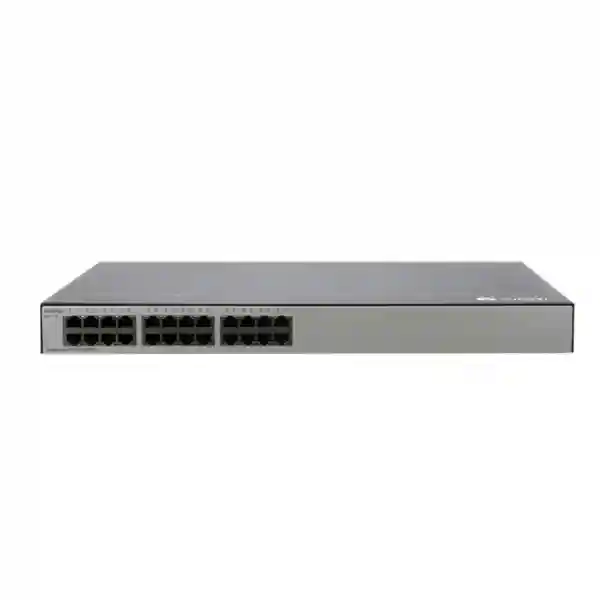
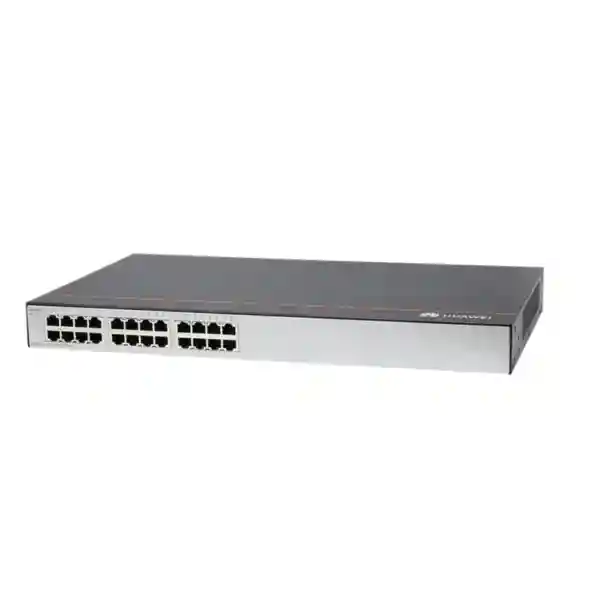
Huawei CloudEngine S1730S-L24P-A
A 24-port Gigabit PoE+ unmanaged access switch for organizations that want simple Ethernet aggregation and centralized endpoint power without introducing a managed switching control plane. The model combines 24 copper Gigabit ports, a 370 W PoE budget, 48 Gbit/s switching capacity and 36 Mpps forwarding in a compact 1U-class chassis suitable for structured racks, communications cabinets and edge closets.
All user-facing ports are 10/100/1000BASE-T and support endpoint power delivery.
Enough aggregate PoE capacity for mixed cameras, access points, phones and control endpoints when correctly budgeted.
The published switching capacity matches the aggregate full-duplex bandwidth envelope of twenty-four Gigabit access ports.
Designed for plug-and-play Layer 2 connectivity where advanced VLAN, routing and telemetry controls are not required on the switch itself.
What the Huawei CloudEngine S1730S-L24P-A is designed to do
The Huawei CloudEngine S1730S-L24P-A belongs to the S1730 unmanaged access family. Its role is deliberately straightforward: accept Ethernet connections from edge devices, switch traffic at Layer 2, and deliver PoE or PoE+ power over the same copper cabling to compatible powered devices. In practical terms, that makes it an access-layer building block rather than a policy-enforcement or routing platform. It is suited to networks where the design intent is simple aggregation, centralized endpoint power, minimal day-to-day switch administration and a clear separation between the access device and upstream services such as routing, firewalling, DHCP, network access control or WAN security.
For a UAE office, retail site, warehouse, clinic, school, hospitality back-office area, construction site cabinet or surveillance deployment, that operational simplicity can be useful. Installers can terminate up to twenty-four copper Ethernet runs on the front panel and power compatible devices without deploying separate local power adapters at each endpoint. This is particularly valuable for ceiling-mounted wireless access points, wall-mounted IP phones and cameras placed in corridors, car parks, loading areas or other locations where adding an electrical socket beside each network device would increase installation cost and maintenance complexity.
The switch is not a substitute for a managed campus access switch when the project requires port-level VLAN assignment, 802.1X authentication, dynamic network segmentation, SNMP monitoring, spanning-tree tuning, link aggregation configuration or detailed traffic visibility. Those capabilities belong in a different product class. The S1730S-L24P-A is more appropriate when the required behavior is stable forwarding with Ethernet auto-negotiation and PoE delivery, while policy and security are handled elsewhere in the architecture. Buyers evaluating the product should therefore start with the network design, not simply the port count. If a site is expected to evolve into a segmented or centrally monitored campus, the commercial case for a managed model should be considered before procurement.
FourTeck can position this switch as part of a complete edge design that also includes structured cabling, wireless, security gateways, servers and endpoint systems. For broader UAE infrastructure requirements, the FourTeck UAE portfolio can be used to align switching with the rest of the site design rather than treating the switch as an isolated purchase.
Port architecture and front-panel behavior
The front of the S1730S-L24P-A provides twenty-four 10/100/1000BASE-T Ethernet interfaces. Each port can negotiate the appropriate Ethernet rate with a connected endpoint and can supply PoE+ power. There are no separate optical uplink cages listed for this exact L24P-A model, so every network-facing service port is copper RJ45. That point matters during design: an installation that requires direct fiber uplinks from the access switch should either use an upstream media-conversion strategy or select a model with native SFP or SFP+ interfaces.
Because the product is unmanaged, the physical port map is intentionally uncomplicated. The practical design focus becomes endpoint density, copper cable quality, power requirements and upstream topology. The switch learns and forwards Ethernet traffic in hardware without requiring the administrator to create a configuration file before normal operation. From an installation perspective this reduces commissioning steps, but it also means the switch does not provide the granular control expected from a managed access device.
A dedicated PD compatibility check selector on the front panel provides PoE and E-PoE operating choices. In standard PoE mode, power is provided to endpoints detected as compliant with IEEE 802.3af or 802.3at behavior. In E-PoE mode, the compatibility check is broadened so the switch can detect and power certain non-standard devices or standard devices that may be identified as non-standard because of environmental conditions. This feature should be used with engineering judgment: compatibility mode can be useful in mixed estates, but standard-compliant PoE endpoint behavior remains preferable for predictable support and troubleshooting.
What 48 Gbit/s switching capacity means
Huawei publishes a 48 Gbit/s switching capacity and a 36 Mpps packet-forwarding rate for this model. For a 24-port Gigabit switch, the 48 Gbit/s switching figure corresponds to the aggregate bidirectional bandwidth envelope of twenty-four 1 Gbit/s interfaces operating full duplex. This does not mean any single port can exceed one Gigabit per second; it means the internal forwarding fabric is sized to move traffic across the set of access ports without an artificially low fabric ceiling under normal non-blocking design assumptions.
The 36 Mpps forwarding figure is equally useful because packet rates can become the limiting factor before raw bandwidth when traffic consists of small frames. In voice, surveillance, office productivity and typical Wi-Fi edge deployments, workloads are usually a blend of packet sizes and burst patterns rather than continuous minimum-sized frames. The published forwarding rate therefore gives architects a way to check that the switch is intended for line-rate class access behavior rather than low-end hub-like oversubscription.
These performance figures should still be interpreted within the topology. If twenty-three endpoints simultaneously send toward a single one-Gigabit uplink endpoint connected to the twenty-fourth port, congestion can occur because the egress port itself is limited to one Gigabit. The switching fabric cannot remove a bottleneck created by oversubscribing one destination link. Good designs distribute traffic sensibly and ensure the upstream device or topology is sized for aggregate demand.
PoE+ engineering: the most important sizing task
The major differentiator of the S1730S-L24P-A is its 370 W PoE power budget. A PoE switch should never be selected solely by counting Ethernet ports because powered devices draw very different amounts of energy. A basic IP phone may need only a few watts, a fixed surveillance camera may sit in the mid-single-digit to low-teens range, a PTZ camera can require substantially more, and modern wireless access points can move into higher PoE classes depending on radio configuration and USB or peripheral loads. The engineering job is to add the maximum expected consumption of all powered devices, include sensible headroom and confirm that both aggregate budget and per-port requirements fit the switch.
IEEE 802.3af PoE commonly supports up to 15.4 W delivered by the power sourcing equipment per port, while 802.3at PoE+ extends that ceiling to 30 W at the sourcing side. The endpoint receives somewhat less after cable loss. The S1730S-L24P-A supports PoE+ on all twenty-four access ports, but the shared 370 W budget means it cannot supply 30 W simultaneously to every port; twenty-four ports multiplied by 30 W would be 720 W. In other words, “24 PoE+ ports” describes interface capability, while “370 W PoE budget” describes the total power pool available across the chassis. This distinction is fundamental when preparing a bill of materials.
For professional projects, use each endpoint manufacturer’s maximum PoE draw rather than average consumption. Average values can understate startup demand, heater activation, infrared illumination, radio transmit peaks or peripheral loads. Add engineering headroom instead of designing exactly to 370 W. A common practice is to preserve a margin so later device replacement or firmware changes do not immediately push the switch to its power ceiling. The precise headroom percentage depends on the environment and service-level requirement, but leaving reserve is preferable to operating continuously at the theoretical maximum.
Also account for UPS sizing. When the switch powers twenty or more edge devices, its electrical load is not merely the switch electronics. Published maximum consumption is 418 W at 100 percent PoE load, including a 370 W PoE allocation. A UPS selected for a non-PoE access switch may therefore be inadequate. The battery runtime calculation should use realistic full-site load, desired autonomy, UPS power factor and battery aging assumptions rather than the switch’s no-PoE consumption figure.
Electrical, mechanical and environmental specifications
| Specification | Huawei CloudEngine S1730S-L24P-A | Deployment meaning |
|---|---|---|
| Ports | 24 x 10/100/1000BASE-T PoE+ | Twenty-four copper endpoints with data and compatible DC power over Ethernet. |
| Switching capacity | 48 Gbit/s | Sized for the aggregate bidirectional envelope of 24 Gigabit access ports. |
| Packet forwarding | 36 Mpps | Hardware forwarding performance appropriate to Gigabit access switching. |
| PoE budget | 370 W | Shared budget across all powered ports; endpoint count depends on actual wattage. |
| Maximum consumption | 34 W without PoE; 418 W at full PoE load | Important for UPS, circuit and cooling calculations. |
| Rated AC input | 100-240 V AC, 50/60 Hz | Compatible with normal UAE mains infrastructure when installed correctly. |
| Input operating range | 90-264 V AC, 47-63 Hz | Published tolerance range; still use conditioned power and proper protection. |
| Dimensions | 43.6 x 442 x 220 mm basic; 225.7 mm maximum depth | Rack-width form factor with shallow depth suitable for many telecom cabinets. |
| Operating temperature | -5°C to +45°C at 0-1800 m, with altitude derating above 1800 m | Use a ventilated, climate-controlled cabinet in UAE heat. |
| Humidity | 5% to 95% RH, non-condensing | Prevent condensation, water ingress and poorly ventilated outdoor enclosure use. |
| Cooling | Air-cooled, two fans | Maintain airflow clearance and avoid sealed cabinets without heat removal. |
| Noise | Below 49.6 dB(A) at 27°C published condition | Suitable for comms rooms; consider acoustics if installed near occupied workspaces. |
The chassis measures 43.6 mm high, 442 mm wide and 220 mm deep before protruding parts; maximum depth is approximately 225.7 mm. The width is appropriate for conventional 19-inch rack installation with the proper mounting hardware, while the relatively shallow depth can help in wall-mounted telecommunications cabinets where deep enterprise switches may be difficult to accommodate. Always verify rail, bracket and cabinet clearance against the actual mounting kit supplied with the unit.
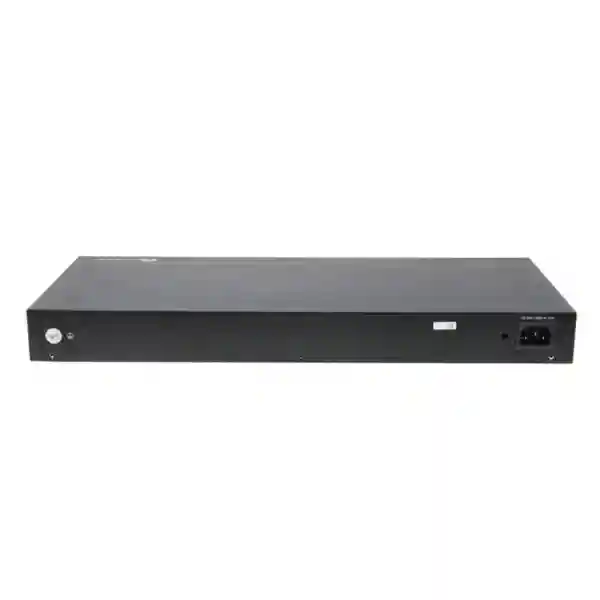
Huawei specifies service-port surge protection of ±7 kV common mode and power-supply surge protection of ±6 kV in both differential and common modes. These values improve equipment resilience but should not be interpreted as a replacement for building grounding, bonding, surge protective devices or professional electrical design. The rear panel includes a grounding point, and the published guidance specifies a minimum 18 AWG ground conductor cross-section. In real installations, follow local electrical rules and project specifications, especially where long copper runs, rooftop devices, outdoor cameras or electrically noisy environments are involved.
UAE thermal design
The published maximum operating temperature is +45°C at lower altitudes, but a cabinet exposed to a roof, warehouse ceiling, plant room or outdoor wall can exceed ambient room temperature significantly. Do not assume the switch is suitable for an unconditioned enclosure simply because the city air temperature is below 45°C. Measure or estimate the enclosure’s internal worst-case temperature, include heat from the switch and other powered equipment, and provide ventilation or active cooling where necessary. Dust loading on fan paths should also be considered in industrial, construction and desert-adjacent environments.
UPS and power continuity
When the switch powers cameras, phones or access points, a UPS protects several business functions at once. Size the UPS for the switch chassis plus PoE load, upstream router or firewall, NVR where relevant and any local controller. A 418 W maximum switch load can materially change runtime compared with a non-PoE switch. For mission-critical CCTV or voice, define required autonomy in minutes, then calculate at realistic end-of-life battery capacity instead of relying only on the UPS headline VA rating.
Cabling quality
Gigabit Ethernet and PoE performance depend on the horizontal cabling channel. Certified Category 5e or better copper with correct termination, conductor gauge and patching is the baseline for predictable operation. Long runs, undersized conductors, copper-clad aluminum, poor punch-downs and high bundle temperatures can increase voltage drop and error rates. PoE creates additional heat in cable bundles, so cable selection and pathway design matter especially when many high-power endpoints are concentrated in one tray or riser.
Deployment scenarios in UAE networks
The strongest use cases for the S1730S-L24P-A are edge environments where devices need reliable Gigabit connectivity and shared PoE power but do not require the switch itself to enforce advanced network policy. The following scenarios show how the hardware characteristics translate into design choices.
IP surveillance and CCTV
A 24-port PoE+ switch can centralize power and data for a sizable camera zone. Fixed dome, bullet and turret cameras typically draw less power than high-performance PTZ models, heaters or devices with strong IR illumination, so the 370 W budget should be allocated by exact camera specification rather than camera count alone. In a surveillance network, the main traffic consideration is sustained video bitrate toward an NVR or VMS server. If all cameras forward through one 1 Gbit/s uplink port, calculate aggregate encoded bitrate, recording quality, event bursts and future expansion. Twenty-four cameras at 8 Mbit/s each produce roughly 192 Mbit/s before overhead, which is comfortable on Gigabit Ethernet; higher-resolution streams, multiple streams per camera or dense AI workloads can raise that figure substantially.
For installations needing CCTV network segmentation or per-port security, put the S1730S-L24P-A behind an appropriately designed upstream managed switch or choose a managed access model instead. An unmanaged switch cannot substitute for VLAN-aware access control when strict separation is part of the security requirement.
Wireless access points
The switch can power PoE and PoE+ wireless access points when their Ethernet and power requirements fit within Gigabit and 802.3at limits. Before standardizing on this model, check whether the selected AP uses a 1 Gbit/s or multi-gigabit wired interface. Newer high-throughput Wi-Fi access points may benefit from 2.5G, 5G or 10G access links and may also require higher power classes than PoE+. The S1730S-L24P-A is therefore best matched to APs whose wired interface and maximum power requirement remain within Gigabit PoE+ capability.
For a multi-AP office, calculate aggregate backhaul demand and roaming architecture. The unmanaged switch transports frames; wireless controller logic, VLAN tagging, SSID policy and authentication must be delivered by the AP platform and upstream network design. FourTeck’s UAE IT Services practice can integrate the access switch with structured cabling, WLAN planning and upstream security controls.
IP telephony and office endpoints
IP phones are a classic PoE application because a central UPS can keep both Ethernet connectivity and endpoint power available during short utility interruptions. A typical deployment may connect desktops through the phone’s integrated PC port, but whether that topology is appropriate depends on phone capabilities, required VLAN separation and the upstream network design. If voice VLAN automation, LLDP-MED policy or per-port quality-of-service controls are mandatory, a managed access switch is usually a better fit.
Where phones operate on a simple flat edge segment and the upstream network handles the necessary services, the S1730S-L24P-A can provide cost-effective power and connectivity. The PoE budget is usually generous for twenty-four standard desk phones, leaving capacity for selected cameras or access points if required.
Retail, hospitality and branch sites
Smaller branches often need one device to connect POS terminals, printers, cameras, phones and a handful of APs. An unmanaged PoE switch reduces local configuration work and can simplify replacement because the hardware does not depend on a complex site-specific configuration. That simplicity can be valuable when central IT supports many geographically distributed locations.
The trade-off is reduced remote visibility and control. If branch operations require centralized switch monitoring, automated configuration backup, remote port shutdown, traffic statistics or user segmentation, then simplicity becomes a limitation rather than an advantage. The right decision is determined by operational model as much as purchase price.
Network topology planning with an unmanaged switch
A typical topology places the S1730S-L24P-A at the outer access edge. One or more of its ports connect upstream toward a router, firewall or managed aggregation switch, while the remaining ports serve end devices. Since this exact model does not provide dedicated high-speed optical uplinks, the upstream connection consumes one of the same Gigabit copper interfaces used for endpoints. The design should therefore consider both physical port count and the bandwidth of the upstream path.
For a small CCTV zone, one port might connect to an NVR or managed distribution switch and the other ports to cameras. For a branch office, an uplink might connect to a firewall LAN interface while phones, PCs and APs occupy the remaining ports. For a larger campus, the product can serve a localized cluster, but the lack of switch-side VLAN configuration may prevent it from meeting segmentation standards. An upstream managed switch can still carry VLANs, but the unmanaged access device itself does not offer the same port-level policy control as a managed layer.
Avoid creating accidental loops. Managed switches can use spanning-tree protocols to detect and block redundant Layer 2 paths, but unmanaged designs may not provide the controls needed for deliberate redundant topologies. A simple single-uplink tree is therefore easier to operate. If high availability requires multiple physical paths, choose a switch architecture specifically designed for loop prevention and link aggregation rather than improvising redundant patching.
Security should also be enforced upstream. A properly configured next-generation firewall can control traffic between networks, apply application policies, filter threats and terminate VPNs. The switch simply provides local Layer 2 access. For projects combining switching with perimeter security, FourTeck’s Firewall Dubai resources can be used to align edge connectivity with firewall sizing and policy design.
When the S1730S-L24P-A is a good fit
- The site needs up to twenty-four copper Gigabit endpoints and many of them require PoE or PoE+ power.
- A 370 W shared PoE budget covers the documented maximum draw of the planned powered devices with suitable reserve.
- The switch does not need to create VLANs, enforce 802.1X, export detailed telemetry or support a centrally managed campus fabric.
- A one-Gigabit copper uplink or simple local topology is appropriate for expected aggregate traffic.
- The communications cabinet provides correct grounding, AC power, airflow and temperature control.
- The organization values plug-and-play operation and low configuration overhead more than advanced switch-side features.
When to choose a different class of switch
- You need multi-gigabit access for Wi-Fi 6E/7 access points or other endpoints above 1 Gbit/s.
- You need SFP/SFP+ fiber uplinks directly on the switch, or aggregate uplinks faster than one Gigabit.
- Your security design requires per-port VLANs, 802.1X, DHCP snooping, dynamic ARP inspection or advanced access controls.
- Operations require SNMP monitoring, centralized configuration, automated firmware governance or remote switch diagnostics.
- The powered-device estate requires PoE++ or exceeds the available shared PoE budget.
- The topology depends on link aggregation, managed redundancy, stacking or sophisticated spanning-tree engineering.
Sizing methodology: how FourTeck engineers should validate a project
A disciplined sizing exercise starts with an endpoint schedule. List every device expected to connect to the switch, including device type, quantity, Ethernet speed, maximum PoE draw, physical location, cable length and required network segment. Avoid placeholder estimates such as “about twenty cameras.” A real bill of materials should identify camera models, AP models and phone models because power behavior and bandwidth can vary materially even within the same product family.
Next, calculate PoE demand. Multiply quantity by the maximum documented power draw for each endpoint category and add the categories together. Then reserve spare budget. If the calculated result is already near 370 W, do not rely on typical consumption to justify the design. Either reduce load, split the endpoints across more than one switch or move to a platform with a larger power budget. Remember that future replacement devices can draw more power than the equipment initially installed.
Third, calculate traffic. Cameras produce sustained downstream or upstream streams depending on architecture, access points aggregate many wireless clients, and NAS or server devices can generate bursts close to line rate. Estimate the traffic converging on the upstream port. A switch can have adequate internal capacity while still experiencing congestion on a single 1 Gbit/s link. If expected sustained load approaches the uplink capacity, select an architecture with faster uplinks rather than assuming burst tolerance will solve a structural bottleneck.
Fourth, review services and security. Ask whether the switch must separate voice, CCTV, staff Wi-Fi, guest Wi-Fi and building-management devices. Ask whether the customer needs remote monitoring, port shutdown, NAC, VLAN assignment or troubleshooting data. If any of those features are mandatory at the access layer, an unmanaged switch may not meet the requirement even if its port and power counts look ideal.
Fifth, validate physical deployment. Confirm rack width, cabinet depth, patch-panel layout, horizontal cable manager space, AC socket type, UPS capacity, earthing point, thermal environment and fan clearance. In UAE sites, special attention should be given to cabinets in warehouses, plant spaces and partially conditioned areas. A shallow chassis is helpful, but thermal design remains a system-level responsibility.
Finally, document expansion. Reserve enough ports, PoE power and upstream capacity for the realistic life of the site. Buying exactly twenty-four ports for twenty-four day-one devices leaves no expansion path and makes maintenance swaps awkward. A modest amount of planned spare capacity often reduces lifecycle cost even if it raises initial hardware cost slightly.
Cabling, grounding and surge considerations
Copper Ethernet is convenient because the same four-pair cable can carry Gigabit data and PoE, but the quality of the permanent link directly influences reliability. Use certified solid-copper structured cable appropriate for the installation environment, terminate to recognized standards and test the completed channel. Avoid copper-clad-aluminum conductors in professional PoE installations because higher resistance can increase voltage drop and heat. Patch cords should also be appropriately rated; the weakest component in the channel can become the cause of intermittent endpoint resets or negotiation issues.
For long cable bundles carrying significant PoE current, thermal rise should be included in pathway design. Cable standards and local engineering practice may require bundle-size, ambient-temperature and conductor-gauge considerations. This is especially important in UAE ceiling spaces or service risers where baseline temperatures can already be high. Keeping bundles organized, using suitable cable categories and maintaining ventilation in containment routes improves both electrical and data performance.
The switch’s published surge-protection figures add a layer of resilience, but external surge energy can exceed equipment-level protection. Outdoor cameras, gate controllers and rooftop devices may be exposed to induced surges through long copper runs. Where the risk assessment requires it, use appropriately specified surge protection, bonding and grounding at system boundaries. Copper between separate buildings can also create grounding and lightning exposure issues; fiber is often the preferred inter-building medium because it removes the conductive data path.
A key limitation of this exact model is the absence of native fiber ports. If the design requires an optical link to another building or distant communications room, use an external media converter only when that approach meets the project’s reliability and management requirements. In larger or more critical networks, selecting a switch with integrated SFP or SFP+ uplinks is generally cleaner and reduces the number of powered intermediate devices.
Operational model: simplicity versus visibility
Unmanaged switches are often described as easier to operate, and that is true in one sense: there is no switch configuration to build, back up or restore. A replacement device can generally be patched into the same physical topology without recreating VLAN databases, management IP addresses or access policies. This can shorten basic replacement time for simple sites and reduce the skill level needed for first-line support.
However, the absence of configuration also means the absence of many diagnostic controls. A managed switch can show per-port error counters, PoE status, learned MAC addresses, link flaps, interface utilization and other telemetry that helps remote teams isolate faults. With an unmanaged switch, troubleshooting relies more heavily on physical observation, endpoint logs, upstream device information and structured testing. For a customer operating hundreds of branches, that reduction in visibility may increase support cost even if the switch itself is inexpensive.
The decision should therefore be based on total operational requirements. A single retail outlet with straightforward devices and local technical support may benefit from unmanaged simplicity. A hospital, large school, corporate HQ or regulated environment may need auditable segmentation and centralized monitoring, in which case a managed access platform will usually be more appropriate.
Procurement teams should include network operations in the selection process. The lowest upfront hardware price is not always the lowest lifecycle cost if the device cannot provide the telemetry or controls needed by the support model.
Power consumption, cooling and UPS design
Published consumption data helps separate the switch’s own electronics from the endpoint power it distributes. Without PoE load, maximum consumption is listed at 34 W, while a full PoE load can raise total consumption to 418 W. A typical consumption figure of approximately 31 W is published for a 30 percent traffic load without describing a large PoE burden. These numbers illustrate why a PoE switch must be treated as an electrical distribution point, not just a networking appliance.
For UPS sizing, determine the expected PoE load under the failure scenario. If the business wants all cameras and phones to stay live during an outage, the UPS must support them through the switch. If only critical devices need backup, it may be better to split endpoints across critical and non-critical switches or circuits so battery capacity is not consumed by low-priority loads. That kind of architecture can improve runtime without purchasing a very large UPS.
Power converted inside the switch and delivered through PoE eventually becomes heat in the cabinet, cables and endpoints. The S1730S-L24P-A uses two fans and air-cooled heat dissipation. Do not block the airflow path with tightly packed equipment, loose patch leads or cabinet side panels positioned against fan openings. In shallow wall boxes, cable bend radius and front-door clearance can also affect airflow. A neat patching plan improves serviceability as well as thermal performance.
For hot UAE environments, cabinet cooling should be planned from measured or calculated heat loads. An office IDF inside a conditioned building has very different requirements from a warehouse cabinet, parking control room or rooftop enclosure. The product’s temperature rating is a component limit, not a guarantee that any enclosure will remain within that limit.
Procurement notes for UAE buyers
When sourcing an established model such as the S1730S-L24P-A, verify the exact product code, hardware condition, included accessories, power cord, mounting brackets and warranty status on the quotation. Similar-looking S1730 family members can have different port counts, PoE capability, form factors or uplink options. The purchase order should therefore use the full model designation rather than a generic description such as “Huawei 24-port PoE switch.”
Also confirm product lifecycle and local availability. Established access models can remain in distributor inventory after newer generations are introduced, but stock source, manufacturing date, firmware context and warranty entitlement may vary. For projects with a multi-year standardization requirement, the buyer should confirm that the chosen model aligns with the expected support horizon and replacement strategy. If a project is starting from a clean sheet, comparing the S1730S-L24P-A with current-generation alternatives can avoid locking a new deployment to an older access design without a deliberate reason.
The quotation should identify whether the unit is new, unused and channel-supplied, and should state delivery terms, warranty, VAT and any services separately. For larger rollouts, include spare-unit strategy. Keeping one pre-tested spare can be more valuable operationally than relying on urgent replacement procurement after a failure, especially at sites where twenty or more powered endpoints depend on a single switch.
For organizations operating across more than one region, FourTeck can also align hardware standards with broader deployment needs through its Africa infrastructure practice, while keeping the UAE bill of materials specific to local site, power and support requirements.
Frequently asked technical questions
Does every port support PoE+?
Yes. The model provides twenty-four 10/100/1000BASE-T interfaces with PoE+ capability. The important constraint is the 370 W shared power budget, so the total number of endpoints that can draw their maximum power simultaneously depends on their individual wattage.
Can it power 24 devices at 30 W each?
No. Twenty-four times 30 W equals 720 W, which exceeds the 370 W PoE budget. Each port is PoE+ capable, but the chassis does not have enough aggregate PoE power for maximum 30 W output on all twenty-four ports simultaneously.
Does it have SFP uplinks?
This exact S1730S-L24P-A configuration is specified with twenty-four copper 10/100/1000BASE-T ports and no dedicated SFP uplink ports. If native fiber uplinks are required, select a different model designed with optical cages.
Is it managed?
No. It is an unmanaged access switch. It is appropriate for plug-and-play forwarding, but projects requiring switch configuration, VLAN control, telemetry, managed redundancy or advanced security should use a managed switch platform.
Is it suitable for IP cameras?
Yes, provided the cameras use compatible Ethernet and PoE standards and the total power and traffic remain within the design envelope. Calculate maximum camera wattage and aggregate recording bitrate before finalizing quantity per switch.
Can it run Wi-Fi access points?
Yes for APs that use Gigabit Ethernet and fit within PoE+ power. Multi-gigabit APs or devices requiring PoE++ are not an ideal match because the switch access ports are limited to 1 Gbit/s and 802.3at-class power.
What does E-PoE mode do?
The PD compatibility selector can broaden power detection for certain non-standard powered devices or devices that may not be detected as standard because of external conditions. Standard PoE mode is preferable when endpoints are fully 802.3af/at compliant.
How much rack depth is required?
The basic chassis depth is 220 mm and maximum published depth is about 225.7 mm, but real cabinet planning must also include patch-cord bend radius, front-door clearance, rear power cable space and airflow.
Can it be used in a hot warehouse?
Only if the actual switch ambient temperature remains within the published operating range and airflow is maintained. UAE warehouse or outdoor-adjacent cabinets can exceed room ambient, so temperature should be measured or engineered rather than assumed.
What UPS capacity should be used?
There is no single correct UPS size. Use the expected switch plus PoE load, add upstream equipment, decide the required runtime, and then select a UPS with suitable watt capacity and battery autonomy. The switch can draw up to 418 W under full PoE load.
Does surge protection remove the need for grounding?
No. Equipment-level surge protection improves resilience, but the site still needs proper grounding, bonding and surge-protection design. Outdoor copper links and separate-building connections deserve particular attention.
Is it appropriate for a new large campus?
That depends on the campus standards. Large environments commonly require managed VLANs, authentication, monitoring, fiber uplinks and redundancy. If those are mandatory, a managed campus access switch is typically more suitable even when the S1730S-L24P-A has enough physical ports.
Decision recap for technical buyers
The Huawei CloudEngine S1730S-L24P-A is best understood as a high-density unmanaged PoE access device rather than a feature-rich campus switch. Its strengths are easy deployment, twenty-four Gigabit copper ports, PoE+ on every port, a substantial 370 W shared power budget, 48 Gbit/s switching capacity and a shallow rack-friendly chassis. Those characteristics make it practical for straightforward CCTV, voice, wireless and mixed edge deployments where the access layer does not need sophisticated configuration.
The most important limitations are equally clear. There are no native optical uplinks on this exact model, no multi-gigabit access ports, and no managed control plane for VLAN configuration, access authentication, telemetry or link-aggregation policy. In many small and medium sites, those limitations are acceptable because the upstream router or firewall provides the necessary policy. In larger or more controlled environments, they may be decisive reasons to use a managed switch instead.
A correct purchase decision therefore comes from matching four dimensions: port count, PoE power, bandwidth topology and operational control. If all four align, the S1730S-L24P-A is a straightforward way to deliver data and power from one rack device. If even one dimension is outside the product envelope, select a different switch rather than forcing the topology around the hardware.
Quotation input checklist
- Required switch quantity and site location
- Endpoint list and total port requirement
- Maximum PoE draw per endpoint model
- Current and future PoE budget requirement
- Expected uplink traffic and upstream device
- Rack or cabinet dimensions
- UPS runtime requirement
- Warranty and support expectation
- Target delivery date within the UAE
Engineering validation checklist
- 370 W budget covers endpoint maximums with reserve
- All devices are Gigabit-or-lower Ethernet
- PoE requirement is 802.3af/at rather than PoE++
- Copper uplink is acceptable
- No switch-side VLAN or NAC controls are mandatory
- Cabinet temperature remains within operating range
- Grounding and surge design is documented
- UPS is sized for switch plus powered devices
- Spare ports and lifecycle requirements are defined
Plan the S1730S-L24P-A as part of the complete edge system
For best results, quote the switch together with the surrounding infrastructure: certified cabling, patch panels, rack hardware, UPS capacity, upstream routing or firewalling, and the powered endpoint schedule. This produces a design that can be validated electrically and operationally before installation rather than discovering limits during commissioning.
FourTeck can assist with UAE switch supply, network design coordination, site infrastructure and integration planning. For broader enterprise networking requirements beyond this individual product, visit FourTeck Global or use the local FourTeck UAE resources linked earlier on this page.
When requesting a quotation, include the number and model of cameras, APs, phones or other powered devices. With that information, the PoE budget and uplink suitability can be checked before the order is placed.

Reviews
There are no reviews yet.