
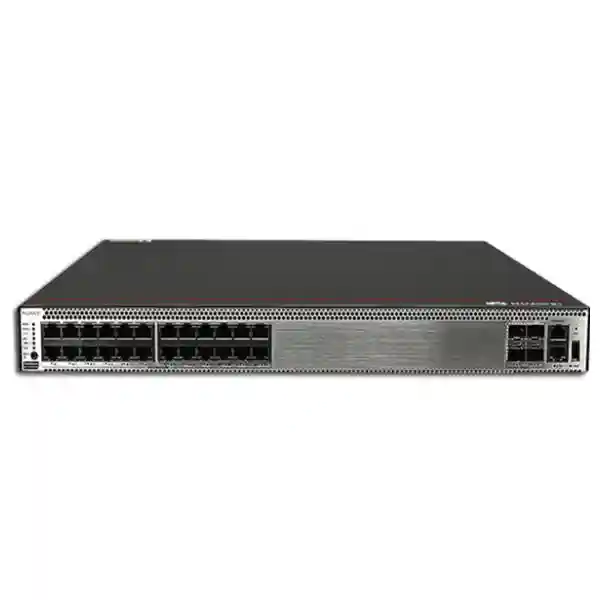
Huawei CloudEngine S5731-S24T4X-A
A high-performance 24-port Gigabit Ethernet access switch with four fixed 10GE SFP+ uplinks, AC power, Huawei VRP software, enterprise Layer 2 and Layer 3 capabilities, iStack, advanced access security, and operational tooling for modern UAE campus and branch networks.
4 × 10GE SFP+ uplinks
96 Mpps forwarding
128/672 Gbit/s switching
1U rack form factor
AC powered, non-PoE
Direct answer: what is the S5731-S24T4X-A designed to do?
The Huawei CloudEngine S5731-S24T4X-A is a fixed-configuration enterprise switch designed primarily for Gigabit Ethernet user access and small-to-medium aggregation roles. Its front-panel access density is straightforward: twenty-four copper 10/100/1000Base-T interfaces connect endpoints, servers, printers, IP gateways, wireless controllers, building systems, or downstream switches, while four 10GE SFP+ interfaces provide higher-bandwidth fiber or direct-attach uplinks toward distribution or core infrastructure. This combination is especially useful in wiring closets where most attached devices need standard Gigabit Ethernet but the uplink must carry the aggregate traffic of many access ports without forcing a 1GE bottleneck.
For UAE enterprise deployments, the model fits offices, education campuses, government departments, retail sites, hospitality back-office networks, healthcare administration networks, warehouses, branch locations, and multi-floor commercial buildings where Power over Ethernet is not required from this specific switch. The “-A” variant is the AC-powered fixed-power version of the S5731-S24T4X family. It should not be confused with S5731-S24P4X PoE models or the base S5731-S24T4X variant that supports removable power modules. Correct model identification matters during quotation because chassis power architecture, PoE availability, accessories, and redundancy options differ across the family.
Architecturally, the switch combines a purpose-built forwarding ASIC with Huawei’s Versatile Routing Platform software. That gives network engineers familiar enterprise functions such as VLAN segmentation, link aggregation, spanning-tree controls, access authentication, ACLs, quality of service, multicast handling, IPv4 and IPv6 routing, monitoring, remote management, and virtualization features such as iStack. For projects where a procurement team needs a compact, non-PoE, 24-port access layer with four native 10GE uplinks and mature software, the S5731-S24T4X-A offers a balanced design without paying for PoE circuitry that may never be used.
Auto-negotiating 10/100/1000Base-T ports for standard copper endpoint and access connections.
Four fixed high-speed uplink ports for fiber optics or supported direct-attach connectivity.
Packet forwarding capacity sized for enterprise access and aggregation traffic patterns.
128 Gbit/s device switching capability and 672 Gbit/s system switching capability as specified by Huawei.
Hardware architecture and port map
The defining value of this model is the relationship between access density and uplink bandwidth. Twenty-four Gigabit copper interfaces create a theoretical edge-facing capacity of 24 Gbit/s in each direction if every port is operating at line rate. The four 10GE SFP+ ports provide up to 40 Gbit/s of raw uplink interface capacity before protocol overheads and topology choices are considered. In a conventional access design, two or more 10GE links can be combined using link aggregation to increase available uplink bandwidth and provide physical path redundancy. The remaining 10GE ports can be used for additional aggregation, stacking-related designs where supported by the software plan, server attachment, inter-switch trunks, or alternate-path connectivity. Actual design should always be based on traffic patterns rather than a simple port-speed sum, because user access networks are statistically multiplexed and rarely drive every edge interface at sustained full rate simultaneously.
Huawei rates the S5731-S24T4X-A at 96 million packets per second of forwarding performance. The published switching-capacity notation is 128 Gbit/s / 672 Gbit/s. Huawei documentation explains that the value before the slash refers to device switching capability and the value after the slash to system switching capability. This distinction is important when comparing datasheets: procurement teams should avoid comparing the 672 Gbit/s system figure directly with a competitor’s device-specific fabric number unless both vendors define the metric in the same way. For practical access-layer sizing, the port count, uplink count, forwarding performance, feature scale, topology requirements, and expected application mix are more meaningful than one isolated headline number.
The S5731-S24T4X-A is a 1U platform measuring approximately 43.6 mm high, 442 mm wide, and 220 mm deep according to Huawei’s current series datasheet. That shallow depth is useful in branch racks and telecommunications cabinets where full data-center server depth is unavailable. Huawei lists chassis weight including packaging at about 4.40 kg for this variant. The fixed AC architecture simplifies procurement because the -A unit includes AC power rather than requiring the removable power module selection associated with the base S5731-S24T4X model. On the other hand, a project that specifically requires field-replaceable redundant power modules should evaluate the non-A base variant or another model designed for that redundancy level.
Cooling is air-cooled with intelligent fan-speed adjustment and built-in dual fans. Airflow is specified from the front toward the rear panel. That direction should be considered when the switch is mounted in enclosed racks, wall cabinets, or dense communications rooms. Blank panels, cable managers, patch cords, and adjacent equipment should not obstruct intake or exhaust. UAE deployments frequently operate in air-conditioned equipment rooms, but local thermal planning remains essential because ambient room temperature, dust loading, rack airflow, UPS heat, and closed cabinet design can all affect the effective inlet temperature seen by the switch.
Core specifications for UAE procurement
| Parameter | Huawei CloudEngine S5731-S24T4X-A |
|---|---|
| Fixed access ports | 24 × 10/100/1000Base-T Ethernet |
| Fixed uplink ports | 4 × 10GE SFP+ |
| PoE | Not supported on this T-series model |
| Forwarding performance | 96 Mpps |
| Switching capacity | 128 Gbit/s device / 672 Gbit/s system |
| Power architecture | AC power supply, fixed -A variant |
| Rated AC input | 100–240 V AC, 50/60 Hz |
| Maximum power consumption | 80 W |
| Typical published power at 30% traffic | 63 W |
| Published power at 100% traffic | 67 W |
| Minimum power consumption | 48 W |
| Dimensions | 43.6 × 442 × 220 mm (H × W × D) |
| Rack height | 1U |
| Cooling | Air-cooled, intelligent fan adjustment, built-in dual fans |
| Airflow | Front intake to rear exhaust |
| Long-term operating temperature | -5°C to 45°C at 0–1800 m; derating above 1800 m according to Huawei guidance |
| Storage temperature | -40°C to +70°C |
| Software platform | Huawei Versatile Routing Platform (VRP) |
Layer 2 switching, VLAN design and segmentation
At the access layer, VLAN architecture determines how users, devices, voice systems, guest services, building systems, management traffic, and infrastructure services are separated. The CloudEngine S5731-S family supports up to 4094 VLANs and includes enterprise mechanisms such as guest VLAN, voice VLAN, GVRP, MUX VLAN, VLAN mapping, and assignment based on attributes including MAC address, protocol, IP subnet, policy, and port. This allows a network architect to move beyond one-VLAN-per-port static designs and build segmentation that follows business function, endpoint type, security posture, or operational ownership.
For a UAE commercial office, a common design might isolate corporate workstations, finance systems, guest Internet access, printers, CCTV recording infrastructure, building-management controllers, network-management interfaces, and shared services. Even when the S5731-S24T4X-A is not directly powering cameras or phones, it can still carry those VLANs from non-PoE downstream equipment, external PoE injectors, access points connected through separate powered infrastructure, or other switches. Trunk links over the 10GE SFP+ interfaces can transport multiple tagged VLANs toward a distribution switch, firewall cluster, or routing core. Careful VLAN pruning helps reduce unnecessary broadcast exposure and clarifies fault domains.
Loop prevention remains essential in any Layer 2 environment. Huawei VRP provides spanning-tree functions suited to enterprise designs, while link aggregation can combine physical interfaces into a logical connection for both bandwidth and resilience. Where two uplinks are aggregated toward an upstream logical system, traffic can continue across surviving member links after a physical-link failure, subject to the chosen topology and protocol configuration. Network engineers should align the aggregation model on both ends and confirm transceiver compatibility, optical budget, fiber type, link distance, and allowed VLANs before commissioning.
The switch’s MAC address handling supports a scale suited to enterprise access, with the S5731-S family documentation listing 64,000 MAC entries along with learning, aging, static entries, dynamic entries, blackhole entries, and filtering based on source MAC addresses. That scale offers comfortable room for normal branch and campus access domains, but large Layer 2 extensions should still be designed conservatively. Extremely broad broadcast domains increase operational risk regardless of hardware table size. A better design keeps Layer 2 boundaries intentional, routes between business segments where appropriate, and uses access controls at those boundaries.
Layer 3 routing for access and aggregation
The CloudEngine S5731-S line is not limited to simple Layer 2 access. Huawei positions the series with enhanced Layer 3 capabilities, including enterprise routing protocols used in campus and aggregation networks. Depending on software version and licensed feature set, the platform supports functions such as static routing, RIP, OSPF, IS-IS, BGP, VRRP, and corresponding IPv6 capabilities. This makes the switch useful when a project wants routed access, local inter-VLAN gateways, resilient first-hop routing, or dynamic exchange of routes with an upstream distribution pair.
In a routed-access design, each wiring closet can become a Layer 3 boundary rather than stretching VLANs across multiple floors. The S5731-S24T4X-A can terminate local VLAN interfaces and advertise reachable networks upward through OSPF or another supported routing protocol. This reduces spanning-tree dependency, narrows failure domains, and creates clearer convergence behavior. Whether that architecture is appropriate depends on the operational maturity of the customer, firewall placement, identity policies, IP address plan, and how services such as wireless roaming, voice, multicast, and network access control are implemented.
VRRP can be used in designs that require a resilient virtual default gateway across two Layer 3 devices. BGP and IS-IS support provide additional flexibility for larger enterprise or service-provider-style environments, while static routes may be entirely sufficient for a small branch. Feature availability should be checked against the exact VRP release and commercial licensing package before a bill of materials is finalized. A tender that merely states “supports BGP” is often incomplete; the real design questions include route scale, policy controls, convergence expectations, IPv6 requirements, security filters, monitoring, and whether a given function is included in the base software entitlement.
For organizations standardizing Huawei networking, VRP also provides a consistent operational model across many campus products. That can reduce the training burden compared with mixing unrelated CLI conventions at every layer. For organizations operating a multi-vendor environment, the more important consideration is protocol interoperability. Standards-based Ethernet, VLAN tagging, link aggregation, IPv4/IPv6 routing, SNMP, SSH, and common routing protocols enable the S5731-S24T4X-A to participate in heterogeneous designs when configuration parameters are aligned correctly.
Why four 10GE uplinks matter
Four native SFP+ interfaces give the design room for dual-homed uplinks, link aggregation, separate service paths, or direct high-speed attachment. They also provide a practical migration path from 1GE uplinks without replacing the access switch.
Why non-PoE can be desirable
If endpoints are desktops, printers, servers, appliances, or independently powered devices, a non-PoE switch avoids unnecessary PoE power budgeting and simplifies the electrical profile. Choose a PoE model only when powered endpoints require it.
Security controls at the enterprise edge
Access switches sit at a security-sensitive point because they are the first managed network devices encountered by many endpoints. The S5731-S series provides mechanisms that help validate users and devices, control what traffic may pass, and reduce the impact of common Layer 2 and control-plane attacks. Huawei lists support for MAC address authentication, IEEE 802.1X authentication, and Portal authentication, together with dynamic policy delivery for VLAN, QoS, and access-control-list settings. In a network access control design, these capabilities can help place different device categories into the correct segment after authentication rather than relying only on permanently assigned switch ports.
DHCP snooping is particularly relevant in office networks because a rogue DHCP server can redirect users to incorrect gateways or DNS services. The switch can maintain a DHCP snooping binding table and distinguish trusted from untrusted interfaces so that DHCP server responses are accepted only from authorized paths. The same binding information can support additional protections against address spoofing when combined with appropriate functions. Strict ARP learning and related anti-spoofing mechanisms help reduce exposure to ARP manipulation inside a broadcast domain.
Huawei also documents defense mechanisms against denial-of-service and user-targeted attacks, including controls related to SYN floods, LAND attacks, Smurf attacks, ICMP floods, bogus DHCP servers, IP/MAC spoofing, DHCP request floods, and manipulation of DHCP client identifiers. These features are not a substitute for an enterprise firewall or endpoint protection platform. Their purpose is to harden the switching layer and enforce local policy close to the endpoint. Security architecture should still include perimeter and internal segmentation firewalls, identity services, endpoint controls, centralized logging, vulnerability management, and a documented incident-response process.
ACL and QoS processing are implemented using hardware-assisted forwarding. This is important because enterprise policy enforcement must not depend on software-only packet handling for ordinary traffic. Engineers should nevertheless validate the scale of ACL entries, rule complexity, counters, IPv6 parity, and interaction with other enabled features. A procurement specification that requires hundreds or thousands of policy entries should be tested against the exact release and configuration rather than inferred from the existence of the ACL feature itself.
Quality of Service for voice, video and business applications
The S5731-S24T4X-A supports enterprise quality-of-service mechanisms that allow traffic to be classified, marked, queued, scheduled, rate-limited, and prioritized according to business requirements. This matters in access environments where real-time voice, video meetings, ERP transactions, cloud applications, backups, software distribution, and bulk file transfers may share the same uplinks. Without a deliberate QoS policy, a burst of low-priority traffic can increase latency and jitter for time-sensitive flows even when average utilization appears acceptable.
A good campus QoS design begins with trust boundaries. If endpoint markings cannot be trusted, the access switch should classify traffic based on known ports, VLANs, ACL matches, application architecture, or authentication-derived policy. Trusted infrastructure may be allowed to preserve DSCP markings, while user-generated markings are rewritten to policy values. Queue scheduling can then provide differentiated service under congestion. The objective is not to make every application “high priority”; that would eliminate the value of prioritization. Instead, network architects should define a small number of service classes that reflect measurable business needs.
The four 10GE uplinks give useful headroom for access-layer aggregation, but QoS is still relevant because congestion can occur at multiple points, including WAN edges, firewalls, Internet circuits, server links, or oversubscribed upstream aggregation. End-to-end policy should therefore be consistent across the switch, wireless infrastructure, routers, security appliances, and service-provider handoff. Monitoring queue drops and interface utilization after deployment provides evidence for future tuning instead of relying on assumptions made during design.
For voice environments, voice VLAN and authentication controls can be combined with QoS classification so that phones or voice gateways receive suitable network treatment while remaining separated from general user traffic. Because the S5731-S24T4X-A does not provide PoE, phones attached directly to it require local power, external injectors, or another powered-access arrangement. In new unified-communications projects, that distinction should be decided before switch procurement, not discovered during installation.
iStack, availability and scalable operations
Huawei’s iStack technology virtualizes multiple compatible physical switches into a single logical system. Huawei documentation for the S5731-S series states that up to nine physical switches can participate in an iStack, subject to the supported stacking method, software release, and model compatibility. From an operations perspective, a stack simplifies management because administrators work with one logical switch rather than configuring every member as an unrelated device. From a topology perspective, links can be distributed across members, allowing an upstream or downstream link aggregation group to survive a member or port failure when the design is implemented correctly.
Stacking does not eliminate the need for capacity planning. A stack must be evaluated for inter-member bandwidth, failure behavior, upgrade procedures, master-election behavior, software compatibility, cabling layout, maintenance windows, and physical fault domains. If all members, uplinks, and power feeds terminate in one cabinet or one electrical circuit, stacking improves device-level manageability but does not remove the cabinet-level or power-distribution single point of failure. Enterprise designs should deliberately separate dependencies according to the required availability target.
The -A model’s AC power architecture is simple but differs from the S5731-S24T4X base model that can use removable power modules. A project requiring redundant internal power modules should therefore not assume the -A suffix provides the same 1+1 power arrangement. External power resiliency can still be improved through a correctly sized UPS, protected distribution, redundant upstream power where available, and environmental monitoring. The appropriate architecture depends on whether the switch supports ordinary office users, critical healthcare systems, trading-floor endpoints, industrial controls, or other services with different downtime tolerance.
Huawei publishes an MTBF figure of 47.34 years and an MTTR figure of two hours for the S5731-S24T4X-A in its current series datasheet. These statistical values help compare platform reliability, but they should not be interpreted as a guarantee that an individual switch will operate for decades without failure. Practical service availability depends on spare strategy, support entitlement, replacement logistics, configuration backup, monitoring, cabling redundancy, power, cooling, and the architecture around the switch.
Operations, monitoring and zero-touch capabilities
The S5731-S series is designed for managed enterprise environments rather than unmanaged plug-and-play switching. Huawei lists management through CLI, SSH, web-based management, and SNMP versions 1, 2c, and 3, along with RMON, multiple log hosts, port traffic statistics, and network quality analysis functions. In security-conscious networks, SSH and SNMPv3 should normally be preferred over weaker legacy management methods. Administrative access should be placed on a dedicated management VLAN or out-of-band network where possible, restricted with ACLs, integrated with centralized authentication, and monitored through logging.
Zero-touch deployment and batch configuration can reduce the effort required to install many access switches across a campus or multiple branch locations. The platform also supports USB-based deployment, remote upgrades, and replacement workflows intended to reduce manual configuration during device swaps. The exact automation method should fit the customer’s management stack. A large enterprise may integrate switches into centralized Huawei management and orchestration, while a smaller organization may use controlled configuration templates, backups, and standard operating procedures.
Super Virtual Fabric, or SVF, is another Huawei mechanism aimed at simplifying access-layer operations. The S5731-S can function as a client in an SVF system where core, aggregation, access, and wireless components are presented through a more centralized management model. Plug-and-play access, centralized templates, and automatic service delivery can reduce repetitive configuration. Whether SVF is selected should depend on the broader Huawei campus architecture and software lifecycle rather than the presence of the feature alone.
For customers operating mixed-vendor monitoring platforms, standard telemetry inputs remain important. SNMP polling, syslog collection, interface counters, error statistics, CPU and memory monitoring, optical transceiver diagnostics where supported, spanning-tree events, authentication logs, routing-neighbor status, and environmental alerts should all be incorporated into the operational baseline. A switch is easier to support when alert thresholds, ownership, escalation, configuration backup, and firmware policy are defined before the first outage.
Multicast, video distribution and enterprise media traffic
Enterprise campuses increasingly carry multicast traffic for IPTV, digital signage, live video, market data, surveillance distribution, discovery protocols, and specialized operational systems. Huawei documents Layer 2 and Layer 3 multicast support across the S5731-S family, including IGMP snooping and protocols such as PIM-SM, PIM-DM, PIM-SSM, and MLD for IPv6 environments. These capabilities allow the network to deliver multicast streams only where receivers have expressed interest rather than flooding the traffic to every access port.
In hospitality or education deployments, correct multicast design can make the difference between a stable IPTV or lecture-distribution service and an access network flooded by unnecessary high-bitrate streams. IGMP snooping should be paired with a correctly placed querier and consistent VLAN design. Routed multicast requires a clear rendezvous-point or source-specific architecture depending on the chosen protocol. Network teams should validate how multicast interacts with redundant paths, stacked switches, firewalls, wireless controllers, and any security policies between source and receiver networks.
For CCTV projects, the S5731-S24T4X-A can transport camera traffic but does not power cameras. It is therefore most appropriate when cameras are powered separately, connected through PoE access switches elsewhere, or when the switch serves as an aggregation layer for NVRs and downstream PoE equipment. Video bit rate should be calculated from camera count, codec, resolution, frame rate, motion profile, and retention design rather than using only port count. Four 10GE uplinks provide useful headroom for aggregated media traffic, but storage and recorder interfaces must be sized as part of the same end-to-end design.
The same principle applies to unified communications and video conferencing. Network capacity should be evaluated across every constrained point, including the local access switch, uplinks, distribution layer, firewall path, WAN link, Internet connection, and remote service. QoS protects real-time traffic during contention, while multicast controls prevent unwanted replication. Together, these features make the S5731-S24T4X-A a strong fit for managed campus networks carrying mixed business applications rather than simple best-effort data only.
IPv6 readiness and dual-stack campus design
Huawei positions the S5731-S series with mature IPv6 features, allowing organizations to design dual-stack access and routing rather than treating IPv6 as a future replacement project. In practice, IPv6 adoption requires more than enabling addresses. Network teams need an addressing plan, RA and DHCPv6 policy, DNS strategy, ACL parity, monitoring support, logging, routing, multicast listener handling, and security controls that match what already exists for IPv4. An unmanaged IPv6 path can undermine segmentation even when the IPv4 side is carefully controlled.
The switch’s support for IPv6 routing protocols and first-hop functions allows it to participate in a campus architecture where both protocol families are active. This is relevant to government, education, telecom, and multinational organizations that may have formal IPv6 requirements. It also helps enterprises avoid purchasing an access platform that becomes a constraint when cloud services, branch standards, or compliance frameworks begin requiring IPv6 connectivity.
A migration plan should define which networks are dual stack, which remain IPv4-only, and whether any IPv6-only services are anticipated. Security teams must review ACLs and monitoring because IPv6 extension headers, neighbor discovery, router advertisements, and multicast behavior differ from familiar IPv4 patterns. Operational tooling should collect both IPv4 and IPv6 flow or counter data where available, and troubleshooting documentation should cover both families.
For procurement, the important conclusion is that the S5731-S24T4X-A is not limited to legacy IPv4 access. It provides a platform for gradual transition while retaining traditional enterprise Ethernet and routing functions. The exact feature matrix should still be verified against the chosen VRP release, especially for advanced IPv6 routing, security, and scale requirements.
Power, thermals and UAE equipment-room planning
The S5731-S24T4X-A is specified for 100 to 240 V AC at 50/60 Hz, making it suitable for normal UAE enterprise power environments when installed through correctly rated distribution equipment. Huawei publishes a maximum device power consumption of 80 W, with figures of approximately 63 W at 30 percent traffic load, 67 W at 100 percent traffic load, and 48 W minimum power consumption under its defined test conditions. Actual site consumption depends on configuration, transceivers, traffic, ambient conditions, and software behavior. Because this is a non-PoE model, there is no large endpoint power budget to add to the chassis consumption.
For UPS sizing, engineers should avoid multiplying only the nominal switch wattage by the number of devices. The power plan should include upstream routers, firewalls, wireless controllers, servers or appliances in the same rack, optical equipment, PDU losses, UPS efficiency, battery aging, desired runtime, and future growth. If network availability is important during generator transfer or short utility interruptions, the switch should remain on protected power for the entire required runtime. Maintenance bypass and UPS failure modes should be understood before the network is declared resilient.
Huawei specifies long-term operation from -5°C to 45°C at altitudes from 0 to 1800 meters, with temperature derating above 1800 meters. UAE sites are usually near sea level, so altitude derating is rarely the main constraint; the more common issue is high external ambient temperature combined with insufficiently cooled indoor cabinets. The equipment room should therefore maintain stable conditioned air, control dust, and allow the switch’s front-to-rear airflow path to remain unobstructed. Storage temperature is specified from -40°C to +70°C, but storage tolerance should never be mistaken for normal operating limits.
Huawei lists maximum heat dissipation of 273 BTU/hour for the S5731-S24T4X-A. This value is useful when estimating room cooling for multiple switches in a dense rack. In a small closet with ten similar network devices, the combined heat load can become meaningful even though each individual switch appears modest. Cooling capacity, rack ventilation, UPS heat, and adjacent telecom equipment should be considered together. For critical deployments, temperature sensors and environmental alerts should be included in the monitoring design.
Optics, uplink design and fiber planning
The four 10GE SFP+ ports are one of the main reasons to select the S5731-S24T4X-A over an entry-level Gigabit switch with only 1GE uplinks. They allow a wiring closet to connect to a building distribution layer at 10 Gigabit Ethernet and provide enough interfaces for redundancy, aggregation, or separate service paths. Transceiver selection must match the installed fiber plant. Multimode links typically use short-reach optics over OM3 or OM4 cabling, while single-mode links use long-reach optics over OS2 fiber. The precise optic should be chosen for distance, wavelength, connector type, fiber attenuation, patch-panel path, and vendor compatibility.
A common enterprise design uses two 10GE uplinks as an aggregated pair toward a resilient upstream system. If the distribution layer is two physical switches operating as one logical aggregation domain, links can be split across the two upstream chassis. This reduces dependence on one cable, optic, or upstream port. Where the upstream switches are independent and do not support a multi-chassis aggregation mechanism compatible with the access layer, a routed design or spanning-tree-based redundancy may be more appropriate.
Optical budget should be documented rather than assumed. Engineers should record fiber type, length, number of splices and patch panels, transmit power range, receiver sensitivity, and estimated loss margin. Dirty connectors are a common cause of unstable fiber links, so inspection and cleaning are part of good deployment practice. DOM or DDM readings from supported optical modules can help diagnose marginal links, but they do not replace physical testing when the cabling path is suspect.
For short in-rack or adjacent-rack 10GE connections, supported direct-attach copper or active optical cable options may reduce transceiver count and simplify installation. Compatibility must be confirmed for the exact switch software and interface type. When requesting a quotation, customers should specify whether 10GE uplinks require SR, LR, DAC, or another medium, because the base switch does not automatically imply that the correct optics and patch leads are included.
Licensing, software versions and feature verification
Enterprise switch procurement should separate hardware capability from software entitlement. The S5731-S24T4X-A hardware provides the physical interfaces and forwarding resources, while advanced features depend on the VRP software release, feature package, license state, and regional commercial policy. Huawei has evolved the S5731-S family across multiple software generations, so a requirement written against one release should not automatically be assumed for every shipment or refurbished unit.
Before ordering, the design team should identify required functions such as dynamic routing, MPLS, advanced multicast, sophisticated QoS, automation, stacking, network access control, and centralized management integration. Each function should then be checked against the target VRP version and license package. This avoids two opposite errors: buying an unnecessary premium license for a simple Layer 2 deployment, or discovering after installation that a required routing or automation function is not enabled under the purchased entitlement.
Firmware lifecycle is equally important. Organizations should maintain an approved release policy rather than upgrading switches ad hoc. A stable campus release should be selected based on vendor support, security advisories, compatibility with network-management systems, transceiver support, known issues, and interoperability with upstream devices. Changes should be tested on representative hardware before broad rollout. Configuration backups and rollback procedures must be retained so that an upgrade problem does not become a site-wide outage.
FourTeck can assist UAE customers with hardware selection, implementation planning, uplink optics, and broader infrastructure requirements through the FourTeck UAE portfolio. For projects that include structured infrastructure work, managed support, or deployment services around the switch, the FourTeck IT Services UAE team can be included in the solution scope.
Sizing methodology: how many S5731-S24T4X-A switches do you need?
The fastest but least reliable way to size an access-switch project is to divide the number of endpoints by twenty-four. A professional design begins by separating endpoint categories and understanding which ones actually belong on this non-PoE platform. Desktop computers, printers, fixed servers, industrial controllers, AV equipment, locally powered IP devices, and uplinks to specialized systems may fit directly. Wireless access points, IP phones, surveillance cameras, access-control readers, and IoT devices often need PoE and may therefore require a different switch model or an external power method. This classification can materially change the bill of materials.
Port reserve should then be added. Filling every port on day one leaves no room for moves, temporary troubleshooting, new hires, spare equipment, or future services. Many enterprise designs reserve between ten and twenty percent of access capacity depending on growth expectations, but the correct figure is project specific. A 24-port switch might therefore be planned for roughly 18 to 21 ordinary endpoint ports after allowing for expansion, special links, or local design constraints. If a floor requires 42 non-PoE ports, two 24-port switches may be preferable to forcing a last-minute third switch after commissioning.
Uplink sizing requires traffic analysis. Twenty-four users browsing cloud applications generate very different traffic from twenty-four high-resolution video sources or engineering workstations moving multi-gigabyte datasets. A single 10GE uplink may be sufficient for many office closets, but resilient designs often use at least two physical uplinks. The four SFP+ interfaces provide flexibility for dual links plus spare capacity or alternate paths. Link aggregation should be sized around failure-state bandwidth as well as normal-state bandwidth; if two 10GE links are required to carry peak traffic, losing one link could create congestion exactly when the network is already handling a failure event.
Rack-unit count, power, UPS capacity, fiber pairs, patch panels, transceivers, and distribution-switch port availability must be sized along with access-switch count. A bill of materials is complete only when every required optic, cable, rack accessory, license, support item, and implementation task is accounted for. For multi-building projects, the design should also distinguish horizontal copper limits from backbone fiber distances and include the correct physical media for each segment.
Deployment patterns in UAE enterprise networks
Office floor access
Use the 24 copper ports for employee workstations, printers, meeting-room appliances, and other independently powered devices. Carry corporate, guest, management, and shared-services VLANs over redundant 10GE fiber uplinks to the distribution layer.
Branch aggregation
Deploy the switch as a compact aggregation node for smaller downstream networks. Use Layer 3 routing or trunks according to the branch architecture, and connect to a local firewall or SD-WAN edge through resilient links.
Server and appliance access
Connect 1GE management interfaces, security appliances, storage controllers, print servers, or building systems that do not require PoE. Reserve 10GE SFP+ ports for higher-speed upstream or server connectivity where supported.
Non-PoE secure zone
Use VLANs, ACLs, authentication, DHCP snooping, and routing boundaries to create controlled access for specialized devices. The platform’s security functions help enforce policy close to endpoints while firewalls provide broader segmentation.
For security-heavy designs, switching is only one layer of the architecture. Customers planning new segmentation, Internet edge refreshes, or firewall migrations can review the Firewall Dubai solutions portfolio so access-switching requirements are aligned with security policy, VLAN boundaries, routing, and uplink capacity. Global or multi-country customers can also coordinate broader infrastructure requirements through FourTeck Global.
Interoperability in mixed-vendor networks
The S5731-S24T4X-A can operate in environments that contain third-party firewalls, routers, wireless controllers, servers, and distribution switches, provided the design uses interoperable standards and the participating devices are configured consistently. Basic Ethernet, IEEE 802.1Q VLAN tagging, standard link aggregation, IPv4 and IPv6 routing, SNMP, SSH, and common routing protocols are not proprietary to Huawei. However, vendor-specific enhancements and negotiation protocols should be reviewed before assuming seamless interoperability.
Huawei lists VBST compatibility with PVST, PVST+, and RPVST-style environments, and includes protocol mechanisms such as LNP and VCMP that provide functions comparable to familiar vendor-specific trunk or VLAN management approaches. In mixed networks, architects should normally prefer explicit configuration and widely supported standards rather than depend on automated proprietary negotiation. A trunk should have a documented native or untagged VLAN policy, an explicit allowed VLAN list, matched MTU where required, and consistent spanning-tree expectations at both ends.
Routing interoperability should be validated through neighbor relationships, route filtering, timers, authentication, metric design, and failure testing. An OSPF adjacency forming successfully is only the first step; engineers must also confirm which routes are exchanged, which defaults are originated, how summarization behaves, and what happens when one uplink fails. BGP designs require equivalent care with policies, communities, maximum-prefix protection, and route selection.
Optical interoperability can be a separate issue from protocol interoperability. Even when two switches support 10GBASE-SR or 10GBASE-LR, each vendor may enforce or report transceiver compatibility differently. The safest procurement method is to specify approved Huawei-compatible optics for the S5731-S24T4X-A and approved optics for the device on the other end, then connect them over a standards-compliant fiber plant. If third-party optics are proposed, they should be validated against the exact software release and support policy before deployment.
Migration from legacy access switches
Replacing an older 24-port switch with the S5731-S24T4X-A is physically straightforward, but configuration migration should be treated as a network change rather than a simple hardware swap. The project team should first inventory existing VLANs, port descriptions, trunk settings, spanning-tree roles, link aggregation groups, access-control lists, QoS settings, DHCP snooping trust boundaries, static MAC entries, routing interfaces, management addresses, authentication settings, syslog targets, NTP sources, SNMP configuration, and monitoring dependencies. Any obsolete configuration can then be removed instead of carried forward indefinitely.
Port-by-port mapping should be prepared before the maintenance window. Each legacy switch port needs a destination port, VLAN assignment, speed/duplex expectation, authentication policy, and cable label. Uplinks should be migrated in a controlled order so that management access is maintained. When moving from 1GE uplinks to 10GE SFP+, optical cabling and upstream interfaces must be ready before the access switch is replaced. A migration that assumes “the fiber is already there” without checking connector type, fiber grade, distance, and patch-panel continuity is a common source of delay.
A rollback plan is mandatory for business-critical sites. The previous switch configuration should be backed up, existing cabling photographed or documented, and the old device kept available until post-change validation is complete. Validation should include endpoint connectivity, gateway reachability, DHCP, DNS, Internet access, internal applications, voice or media where relevant, authentication, routing neighbors, uplink aggregation, spanning-tree state, monitoring, and logging. Error counters should be checked after traffic stabilizes because a link can appear “up” while suffering physical-layer errors.
After migration, operational documentation should be updated with the new model, serial number, rack position, management IP, software version, optic types, cable IDs, support contract, and configuration backup location. The value of a managed enterprise switch is fully realized only when the operations team can identify and support it quickly during an incident.
Model selection: S5731-S24T4X-A versus nearby options
The S5731-S24T4X-A is most appropriate when the project needs twenty-four copper Gigabit access ports, four 10GE uplinks, AC input, and no PoE. If endpoint count is closer to forty or more per closet, an S5731-S48T4X-A may reduce chassis count by providing forty-eight Gigabit copper ports with four 10GE SFP+ uplinks and higher published forwarding performance. Conversely, if phones, access points, or cameras must be powered directly from the switch, a P-series PoE model is the appropriate family direction rather than the T-series device described on this page.
The base S5731-S24T4X should be considered when removable power modules and 1+1 power backup are required. The -A model is differentiated by its AC power implementation. A -D variant exists for DC-powered requirements. These suffixes are not cosmetic; they affect power architecture, ordering, site design, and resilience. Procurement requests should always include the complete model string to avoid receiving a chassis with the wrong power arrangement.
Projects that require Multi-Gigabit copper for Wi-Fi 6/6E access points, 25GE or 40GE uplinks, larger buffers, more advanced campus features, or higher PoE classes should assess newer or higher-tier Huawei CloudEngine families. The S5731-S24T4X-A remains compelling where ordinary 1GE access is the correct endpoint speed and 10GE uplinks are sufficient. Selecting a switch because it is newer or has a higher headline capacity does not automatically improve a network; matching port media, feature requirements, scale, lifecycle, support, and budget is more important.
A useful procurement worksheet compares exact access-port count, PoE requirement, uplink speed and count, internal power redundancy, stacking, routing feature requirements, license entitlement, rack depth, environmental conditions, expected growth, warranty or support, and optic requirements. That comparison prevents a model selection based only on price or brand familiarity and makes technical review much easier for procurement teams.
Procurement considerations for Dubai and the wider UAE
A UAE quotation for the Huawei CloudEngine S5731-S24T4X-A should identify more than the switch chassis. It should state the exact model suffix, AC power arrangement, software or license package, quantity, support level, lead time, and whether SFP+ transceivers are included. Because optical requirements vary from site to site, many switch quotes exclude optics unless the customer specifies the link type. The buyer should therefore provide the number of 10GE links, approximate distance, fiber type, and connector requirements so that the correct modules and patch leads can be quoted together.
Rack installation accessories, horizontal and vertical cable management, copper patch cords, labeling, fiber jumpers, PDUs, UPS capacity, grounding, and environmental monitoring may also be part of the implementation scope. In greenfield projects, structured cabling certification results should be available before commissioning. In existing sites, questionable legacy copper should be tested because a switch replacement cannot correct damaged cabling or poor termination.
Support expectations should be matched to business criticality. A small branch may accept next-business-day hardware replacement, while a large campus or operationally critical site may require local spare units, rapid vendor support, or a redundant topology that keeps users online during a device failure. The commercial package should reflect the recovery objective. A low-cost switch without a support plan can become expensive if the only response to failure is emergency procurement.
FourTeck can structure the bill of materials around the actual site architecture rather than quoting a bare switch in isolation. Supplying the endpoint count, rack location, current uplink type, existing core switch model, required fiber distances, PoE needs, VLAN count, routing approach, and desired resilience level allows the quotation to include the correct supporting components and reduce change orders during installation.
Frequently asked technical questions
Does the S5731-S24T4X-A provide PoE?
No. This T-series model is a non-PoE switch. If the project must power IP phones, cameras, wireless access points, or other powered devices directly through Ethernet, select an appropriate S5731-S PoE model or another PoE-capable CloudEngine platform.
How many 10 Gigabit uplinks are included?
Four fixed 10GE SFP+ interfaces are provided. They can be used for fiber or other supported SFP+ connectivity according to the selected modules and network design.
Can it perform Layer 3 routing?
Yes. The S5731-S family supports enhanced Layer 3 functions, including enterprise routing protocols and IPv6 capabilities. Exact protocol availability, scale, and entitlement should be checked for the intended VRP software and license package.
Can multiple switches be stacked?
Huawei documents iStack for the S5731-S series, with up to nine physical switches virtualized as one logical device in supported configurations. Compatibility, cabling method, software version, and topology should be verified for the exact deployment.
Is the -A model the same as the base S5731-S24T4X?
No. The -A suffix identifies the AC-powered variant. The base S5731-S24T4X has a different power-module arrangement and can support 1+1 power backup. Always order using the complete model code.
Are SFP+ optics included automatically?
Not necessarily. Optics are normally selected according to fiber type, distance, connector, and topology. A complete quotation should state the exact transceivers and patch leads required for each uplink.
Engineering checklist before installation
Physical layer
Confirm rack space, cabinet depth, airflow direction, patch-panel condition, copper certification, fiber type, SFP+ optic selection, connector cleanliness, cable labels, and spare patch leads. Verify that the rack can accommodate front access and rear power without crushing cables or blocking airflow.
Power and environment
Confirm protected AC power, UPS runtime, PDU outlets, grounding, room temperature, cabinet ventilation, dust control, and monitoring. Calculate the combined rack heat load rather than evaluating the switch alone.
Network configuration
Document VLANs, trunks, allowed VLAN lists, management addressing, routing, link aggregation, spanning tree, QoS, authentication, ACLs, DHCP snooping, logging, NTP, SNMP, AAA, and configuration backup procedures.
Change management
Define the maintenance window, stakeholder contacts, pre-change health checks, rollback trigger, rollback cabling plan, validation tests, post-change monitoring period, and responsibility for updating diagrams and inventory.
Decision recap: when this model is the right fit
Choose the Huawei CloudEngine S5731-S24T4X-A when the access layer needs twenty-four standard Gigabit copper ports, four fixed 10GE SFP+ uplinks, enterprise switching and routing functions, mature security controls, and AC power in a compact 1U chassis. It is especially suitable where attached devices are independently powered and PoE is unnecessary. This combination keeps the platform focused on data switching while still providing the uplink capacity and software depth expected in a managed enterprise network.
The model is less suitable when a project needs PoE, Multi-Gigabit copper access, more than twenty-four edge ports per chassis, internal 1+1 removable power supplies, or uplinks faster than 10GE. In those cases, another S5731-S variant or a newer/higher CloudEngine family should be assessed. The correct choice depends on endpoint type, port density, uplink design, power resilience, software features, operational standards, and lifecycle requirements rather than any single specification.
For UAE procurement, the recommended approach is to quote the complete solution: exact switch model, software entitlement, support, 10GE transceivers, fiber or DAC media, rack accessories, patching, UPS implications, implementation services, and configuration requirements. That creates a deployable bill of materials and reduces the risk of discovering missing optics, wrong power assumptions, or unsupported features during the installation window.
Quotation input checklist for Huawei S5731-S24T4X-A
To receive an accurate technical and commercial quotation, provide the information below with the enquiry. These details help determine whether the S5731-S24T4X-A is the correct variant and whether optics, licenses, support, or installation services should be included.
Structured consultation for your UAE network
A productive switch consultation should answer three questions: what must connect today, what growth is expected over the equipment lifecycle, and what level of failure can the business tolerate? With those answers, the design can confirm access-port density, PoE requirements, 10GE uplink count, fiber optics, Layer 3 boundaries, stacking, security policy, and support strategy.
FourTeck can evaluate the S5731-S24T4X-A as part of a broader campus or branch architecture rather than treating it as an isolated line item. Share an existing topology, endpoint count, rack photographs, or a simple list of required services, and the bill of materials can be aligned to the actual technical requirement.
Include PoE needs, fiber distance, redundancy target, and desired support level so the exact model and accessories can be validated before quotation.
Technical procurement note
Specifications, software feature availability, licensing, accessory compatibility, and regional ordering options can change over a product lifecycle. Final project approval should therefore be based on the exact Huawei part number, current VRP release, applicable license, selected SFP+ modules, and the required support package at the time of order.
The S5731-S24T4X-A is specifically the AC-powered, non-PoE, 24-port GE model with four 10GE SFP+ uplinks. Do not substitute an S5731-S24P4X, S5731-S24T4X, or S5731-S24T4X-D without reviewing the resulting changes in PoE capability, power architecture, and bill of materials.

Reviews
There are no reviews yet.