
Huawei CloudEngine S5731-S32ST4X
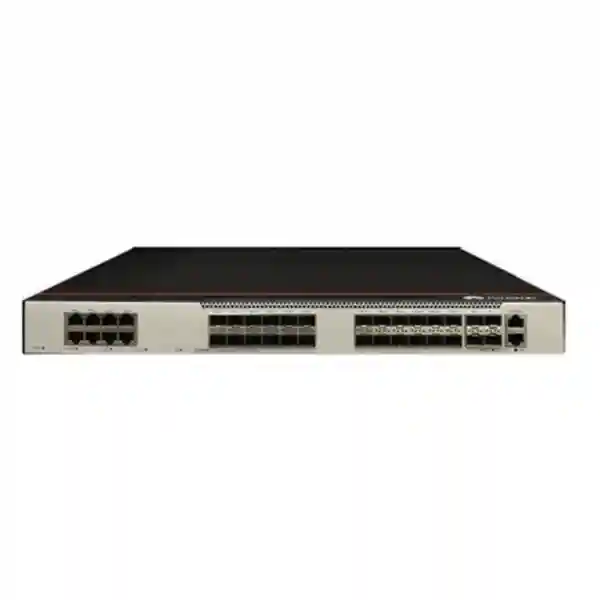
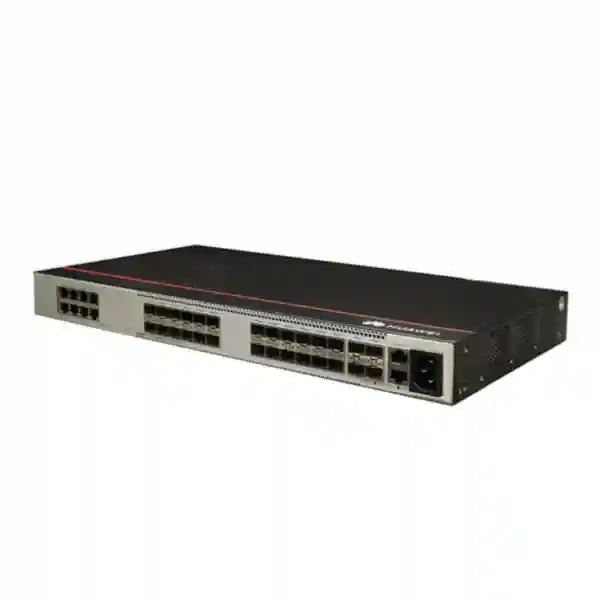
A fiber-forward campus access and aggregation switch that combines twenty-four SFP access interfaces, eight Gigabit copper access ports and four 10 Gigabit SFP+ uplinks in a compact 1U platform built on Huawei VRP.
Choose the S5731-S32ST4X when your access layer is predominantly optical, you still need a small pool of native copper ports, and four 10GE uplinks provide the correct aggregation envelope. It is particularly useful for UAE campuses, distributed buildings, hospitality networks, CCTV backbones and enterprise floors where fiber endpoints outnumber copper endpoints.
Packet forwarding performance specified by Huawei for the S5731-S32ST4X family.
Device/system switching figures should be read exactly as stated in the Huawei model documentation.
A rack-efficient 43.6 × 442 × 420 mm chassis for the modular-power S5731-S32ST4X base model.
Unified switching, routing, management, policy and automation functions on Huawei Versatile Routing Platform.
Why the S5731-S32ST4X is different from a conventional copper access switch
Most standard enterprise access switches devote almost every front-panel service interface to copper Ethernet. The Huawei CloudEngine S5731-S32ST4X reverses that balance. Twenty-four of its thirty-two access-facing interfaces are SFP slots, while only eight are fixed 10/100/1000BASE-T copper ports. That physical design immediately tells an architect what kind of job the platform is intended to solve: networks where the distance, electrical isolation, media type or building topology favors fiber at the access layer. In a large UAE estate, this may include security buildings, warehouse zones, gatehouses, parking systems, utility compounds, remote IDF rooms, rooftop communications enclosures or office blocks connected across a campus. Rather than installing a copper-heavy switch and consuming extra media converters, a fiber-dominant switch lets the access layer terminate optical links directly and keeps the optical path under the control of the switching platform.
The eight native copper ports remain valuable because a real installation is rarely one hundred percent optical. They can support local management devices, nearby servers, appliances, conventional edge equipment or short-run copper endpoints without forcing every connection through an SFP copper transceiver. This mixed-media design can therefore reduce accessory count and simplify rack engineering. The right question is not whether thirty-two access ports are enough in isolation; it is whether the ratio of twenty-four optical to eight copper interfaces matches the endpoint map at the intended site. FourTeck typically recommends creating a port schedule before procurement that labels every endpoint by medium, speed, connector, distance, redundancy requirement and expected growth. That exercise prevents a model that looks correct by total port count from becoming a poor fit once the real optical-to-copper ratio is considered.
The four fixed 10GE SFP+ uplinks give the platform a clean path into a distribution, aggregation or core layer. They can be used for multiple physical uplinks, link aggregation, resilient topology design or other roles supported by the selected network architecture and software feature set. Because the access side can contain many simultaneous optical streams, the uplink plan should be sized from application behavior rather than from raw port count alone. A campus dominated by user desktops may produce very different uplink utilization from one carrying surveillance video, storage traffic, Wi-Fi backhaul, broadcast services or data-intensive industrial applications. The S5731-S32ST4X gives the designer four high-speed optical interfaces; the designer still has to decide how those interfaces will be allocated to maximize availability and avoid avoidable oversubscription.
24 optical access interfaces
The SFP bank is the defining characteristic of the model. It is appropriate when access runs are fiber-based or when optical isolation and extended reach are more important than low-cost copper density. Transceiver selection still needs to match fiber type, wavelength, connector system, optical budget and peer interface.
8 native GE copper interfaces
The RJ45 interfaces retain local flexibility for devices that are physically near the switch. This is useful in mixed racks because small numbers of copper endpoints do not require dedicated converter hardware or a second access switch purely for Ethernet handoff.
4 fixed 10GE SFP+ uplinks
Four high-speed optical uplinks provide options for resilient aggregation and high-bandwidth northbound connectivity. Port-channel design, routing, stacking and failure-domain choices should be planned before optics are ordered.
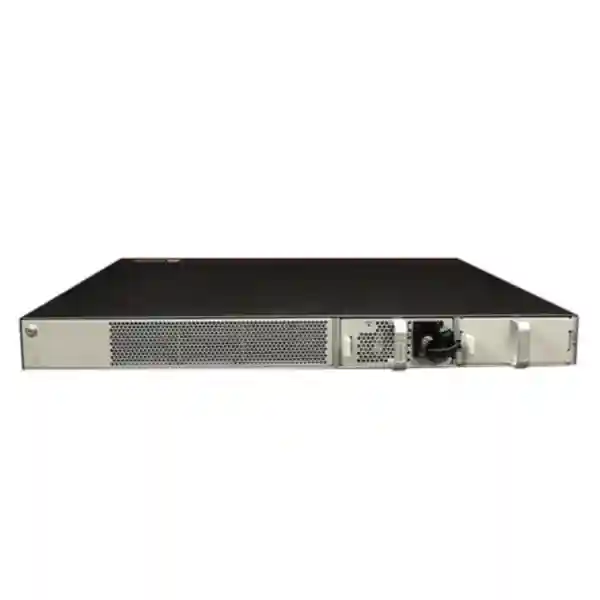
1+1 power strategy
The modular-power base model supports a redundancy approach that is materially different from the built-in AC and DC variants. For critical installations, quote preparation should identify the exact chassis suffix and required power modules, not only the abbreviated product family name.
Understanding the 1/2.5GE SFP access capability
Huawei documents the S5731-S32ST4X as providing twenty-four 1/2.5GE SFP ports, but there is an important operational detail that must be preserved in a production design. The interfaces are GE by default, and the vendor notes that in V200R023C00 and later releases the port mode 2.5ge command can be used to set the applicable access interface rate to 2.5GE. This matters because a procurement team may otherwise read the port label and assume that every deployed software image, transceiver combination and operational state automatically provides 2.5GE service. Software release, feature support and optics compatibility should be verified as a single change-control item before the faster mode is introduced.
From an architecture standpoint, 2.5GE on optical access can be useful where a gigabit service is becoming restrictive but migration to 10GE on every edge link would be excessive. It provides an intermediate performance step for selected endpoints, distribution handoffs or specialized devices. At the same time, the uplink design has to reflect the possibility that aggregate demand rises as individual access ports move above 1 Gbit/s. A switch that looked lightly oversubscribed when twenty-four access interfaces were treated as GE can present a very different traffic profile if several are configured for 2.5GE and carry sustained loads.
FourTeck’s recommended engineering sequence is to identify which links genuinely require 2.5GE, confirm software release compatibility, confirm transceiver and peer compatibility, assess aggregate uplink demand, test the intended optics in a staging environment and record the port-mode configuration in the operational baseline. That method avoids treating multigigabit capability as a marketing checkbox. It becomes a controlled design decision that is supported by the software image, physical media, monitoring thresholds and capacity plan.
Huawei VRP and enterprise switching architecture
The S5731-S family is built on Huawei’s Versatile Routing Platform, usually referred to as VRP. For enterprise network teams, the significance of VRP is not simply command syntax. It provides a common operational foundation for Layer 2 switching, Layer 3 routing, IPv6, multicast, QoS, security, management, stacking and automation functions. A consistent operating framework becomes increasingly valuable as a campus grows from a few access switches into multiple buildings, aggregation layers and routed distribution blocks. Engineers can standardize configuration templates, operational procedures, monitoring policies and change controls around a coherent platform rather than treating each switch as an isolated appliance.
A well-designed VRP deployment begins with role definition. On one site the S5731-S32ST4X may operate primarily as a Layer 2 optical access switch, with routing concentrated upstream. On another site it may participate in Layer 3 routing at the access or aggregation boundary. The same physical interface set can therefore support different architectural patterns, but the configuration should follow the intended failure domains. Extending VLANs everywhere may look simple during initial installation, yet it can enlarge broadcast domains and make failure analysis more complex. Routing closer to the edge can improve containment and convergence, but it also introduces route policy, addressing and operational requirements. The right design is driven by scale, application dependency, convergence targets and team capabilities.
Huawei lists enhanced Layer 3 functions for the S5731-S family, including OSPF, IS-IS, BGP and VRRP. Those protocols make the platform relevant beyond basic access switching. OSPF can support structured interior routing in enterprise campuses, IS-IS can be appropriate in designs that standardize on that IGP, BGP can support policy-oriented routing and EVPN-related use cases, while VRRP can provide first-hop redundancy where the switch participates in gateway functions. The presence of a protocol should not be confused with an automatic recommendation to enable it. Each protocol should have a clear architectural purpose, a defined adjacency scope, authentication or security policy where applicable, route filtering and documented convergence expectations.
Layer 2 foundation
Huawei specifies up to 64,000 MAC entries and 4094 VLANs for the S5731-S series. The feature set includes MAC learning and aging, static and dynamic entries, blackhole MAC entries, source-MAC packet filtering, guest VLAN, voice VLAN, GVRP, MUX VLAN and multiple VLAN assignment methods.
For a UAE enterprise, these capabilities support conventional segmentation patterns across offices, voice, wireless, cameras, building systems and other device classes, provided the VLAN plan is engineered around operational boundaries rather than simply consuming IDs.
Layer 3 routing
OSPF, IS-IS, BGP and VRRP allow the switch to participate in routed access or aggregation designs. BFD support for static routes, OSPF, IS-IS, BGP, PIM and VRRP can improve failure detection within architectures that use those functions.
The practical value is faster and more deterministic fault handling when the rest of the design, timers and upstream devices are engineered consistently. Aggressive timers should never be introduced without validation under realistic load and failure conditions.
VLAN segmentation, MAC scale and access-layer control
The stated 64K MAC table gives the S5731-S series considerable address-learning headroom for a standard enterprise access platform. However, architects should still model the expected Layer 2 population rather than assume the maximum can never be approached. Large virtualization domains, downstream unmanaged switching, dense wireless environments and broad Layer 2 extensions can cause an access device to learn far more addresses than its immediate front-panel endpoint count suggests. Monitoring MAC-table utilization and controlling where Layer 2 domains are extended are sound operational practices even when the theoretical capacity is generous.
The 4094-VLAN capability supports extensive logical segmentation, but the best designs usually use far fewer VLANs per access switch than the maximum. VLANs should correspond to policy or failure boundaries such as corporate users, voice, guest access, cameras, building management, payment systems, lab environments, network management and other security zones. Consistent naming and ID allocation across multiple UAE sites makes troubleshooting easier and reduces the risk of accidental overlap during inter-site expansion. Where devices need policy-based placement, Huawei supports VLAN assignment based on MAC address, protocol, IP subnet, policy and port, allowing segmentation to be aligned with endpoint identity and service intent rather than purely with the physical socket.
Voice VLAN and guest VLAN functions can help separate traffic classes that have different security and QoS requirements. MUX VLAN can support controlled Layer 2 isolation patterns, while VLAN mapping can help when service boundaries require identifier translation. These features should be applied with clear documentation because complex VLAN manipulation can become difficult to troubleshoot if it is introduced without a service map. For each access port, engineers should be able to answer what traffic is expected, how it is classified, which VLAN or policy it receives, what upstream gateway serves it, and how an unauthorized or misconfigured endpoint is handled.
Routing, BFD and resiliency for aggregation roles
When the S5731-S32ST4X is used above a pure access role, routing design becomes a central part of sizing. OSPF is often selected for enterprise interior routing because it provides structured areas, route calculation and standard interoperability. IS-IS offers another mature link-state option. BGP introduces a policy-oriented model and is also foundational to EVPN designs. The switch additionally supports VRRP for first-hop gateway redundancy. What matters in production is not simply that all of these protocols exist, but that the selected protocol aligns with the topology and operational skill set.
Bidirectional Forwarding Detection can accelerate recognition of failed forwarding paths beyond what some routing protocol timers detect on their own. Huawei lists BFD support with static routes, OSPF, IS-IS, BGP, PIM and VRRP. This can be valuable in a dual-uplink campus where the business expects rapid path transition after a fiber cut or upstream failure. Yet BFD sessions add control-plane work and should be tuned responsibly. A staging test should verify convergence behavior, route withdrawal, application impact and any interaction with link aggregation, spanning-tree or upstream firewalls.
In a routed access design, the four 10GE uplinks can be divided across independent upstream devices to reduce the effect of a single distribution failure. In a Layer 2 design, link aggregation and loop-prevention choices become more prominent. In a stacked design, the stack topology changes how physical uplinks are distributed across member devices. Each pattern can be resilient, but only if the physical topology, logical topology and failure-testing plan are considered together. A quote that contains the switch and optics without a topology drawing is incomplete for a critical network.
MPLS and VPN capabilities for advanced enterprise and metro-edge designs
Huawei’s documented feature matrix for the S5731-S series includes MPLS basic functions such as LDP, double MPLS labels and priority mapping between Ethernet or IP QoS markings and MPLS EXP behavior. It also lists MPLS-TE tunnel establishment, MPLS-TE protection, VPN multi-instance CE functions, GRE tunneling, VLL, PWE3, VPLS and MPLS L3VPN. These capabilities move the platform well beyond the profile of a simple Layer 2 office switch and can be relevant in service-provider-style enterprise networks, large campuses, managed infrastructure environments or metro-edge designs.
The presence of MPLS features should be evaluated alongside software licensing, version support, route scale, operational tooling and the specific service architecture. An enterprise that only needs VLAN access and routed uplinks should not introduce MPLS merely because the switch supports it. Conversely, an organization that operates multiple isolated services across a shared transport network may benefit from technologies such as L3VPN or VPLS when they are part of a standardized design. The most important procurement step is to distinguish the hardware capability from the complete solution requirement. Licenses, software release, configuration, upstream compatibility and technical support all have to be included in the bill of materials and implementation plan.
For UAE projects connecting multiple facilities over carrier or private fiber, MPLS and GRE options may help integrate the switch into broader transport architectures. The design should define where labels or tunnels begin and end, how customer or service separation is maintained, what route distinguishers or VPN instances are required, how MTU overhead is accommodated and where encryption is applied if confidentiality is needed. Those details are implementation-specific and should be engineered before activation rather than improvised during commissioning.
Multicast-ready access
Huawei lists PIM-SM, PIM-DM, PIM-SSM, MLD and IGMP snooping capabilities for the series. These are relevant to video distribution, conferencing, IPTV-style services and other one-to-many traffic patterns where uncontrolled flooding would waste bandwidth.
For surveillance-heavy sites, multicast planning should include source locations, receiver density, querier placement, Layer 3 boundaries and failover. The objective is to deliver required streams without turning every VLAN into a broadcast-style replication domain.
IPv6 maturity
Huawei positions the S5731-S with mature IPv6 capabilities and documents IPv6 standards including neighbor discovery, stateless address autoconfiguration, ICMPv6 and OSPFv3 support. IPv6 ACL support is also included in the feature matrix.
A dual-stack rollout should treat IPv6 security as a first-class requirement. Filtering, routing policy, management access and monitoring need IPv6 equivalents; disabling attention to IPv6 while endpoints auto-configure can create an unmonitored path.
QoS: protecting voice, video and business applications
The S5731-S feature set includes traffic classification using ACLs, traffic filtering, committed access rate policing, packet-priority modification, VLAN modification, egress traffic shaping, queue shaping, Weighted Random Early Detection, tail drop, Priority Queuing, Weighted Deficit Round Robin and combined PQ plus WDRR behavior. Huawei specifies eight priority queues. These functions allow the switch to treat traffic classes differently when links become congested, which is essential in converged enterprise networks where voice, video, transactional applications, backups and bulk transfers share uplinks.
QoS design should start with a classification policy. The network has to know which packets deserve low-latency treatment, which applications can tolerate delay, which traffic should be rate-limited and where markings are trusted. A common mistake is to enable prioritization on one access switch without confirming that the same DSCP or 802.1p markings are respected across the rest of the path. End-to-end behavior matters. A packet that receives priority at the edge but loses its marking or enters an uncontrolled bottleneck upstream may not achieve the expected application performance.
For a UAE branch or campus that carries IP voice and video conferencing, FourTeck can map application classes to queue and policing behavior, then validate with synthetic or real traffic before production handover. For video surveillance, the priority policy may be different because steady high-bandwidth streams can overwhelm smaller transactional flows if they are not controlled. Backups and replication often belong in lower-priority or shaped classes. The objective is not to make every business application high priority; it is to create a disciplined hierarchy that preserves critical traffic when contention occurs.
ACLs, authentication and access security
The S5731-S supports packet filtering at Layers 2 through 4 and includes basic and advanced IPv4 ACLs, basic and advanced IPv6 ACLs, Layer 2 ACLs, user-group ACLs and user-defined ACL capabilities. Huawei’s documentation also describes MAC address authentication, 802.1X authentication and Portal authentication, with dynamic delivery of policies such as VLAN, QoS and ACL parameters. That combination supports identity-aware access designs in which connecting a device or user can result in a specific network role rather than a static port-only assignment.
For enterprise deployments, 802.1X can help prevent an unused wall socket or access port from becoming an untrusted entry point. MAC authentication can support device classes that cannot run an 802.1X supplicant, although it should be treated as a weaker identity signal than certificate-based authentication. Portal authentication can serve guest or controlled-access scenarios. The correct method depends on endpoint capability, identity infrastructure and desired user experience. Dynamic policy is most effective when the identity source, RADIUS design, fallback behavior and failure mode are tested in advance.
Huawei also documents mechanisms intended to defend against denial-of-service and user-targeted attacks, as well as strict ARP learning to reduce ARP spoofing risk. Security controls at the access switch complement rather than replace the firewall. The switch can restrict who connects, what VLAN or ACL an endpoint receives and which Layer 2 or local behaviors are accepted, while a dedicated firewall performs stateful inspection, application policy, threat prevention, VPN and perimeter enforcement. For deployments that require firewall design alongside the switching layer, the FourTeck Firewall Dubai practice can align segmentation and uplink policy with the campus architecture.
A secure baseline should also restrict management-plane access. Administrative protocols should be limited to defined management subnets, strong authentication should be used, unnecessary services should be disabled, SNMPv3 should be preferred over older unsecured management methods where operationally feasible, and configuration backups should be stored outside the device. Because the S5731-S supports HTTPS, SNMP versions, NETCONF/YANG and other management mechanisms, the team should explicitly decide which are enabled and from where they may be reached.
VXLAN, BGP EVPN and policy-driven virtualization
Huawei positions VXLAN as a mechanism for constructing a unified virtual fabric in which multiple services or tenant networks share one physical infrastructure while remaining logically isolated. The S5731-S family provides hardware-assisted VXLAN encapsulation and supports centralized and distributed gateway models, BGP EVPN and NETCONF/YANG-based configuration. Huawei’s detailed feature matrix notes that VXLAN Layer 2 and Layer 3 gateway functions can require additional licensing, which is a critical commercial and technical detail for any project that intends to use the switch as more than a conventional campus access device.
VXLAN is attractive where a campus wants scalable network virtualization, flexible endpoint placement or a fabric architecture that separates the physical underlay from logical overlay networks. BGP EVPN provides a control-plane method for distributing endpoint and reachability information rather than relying only on data-plane learning. In large deployments, this can improve scale and operational structure. It also raises the design bar: underlay routing, VTEP placement, route-target policy, gateway model, MTU, redundancy and controller or automation integration must all be planned coherently.
For an organization considering a fabric migration, FourTeck recommends separating the decision into three layers. First, confirm the business reason for an overlay, such as segmentation scale or operational automation. Second, validate that the exact hardware model, VRP release and license set support the intended VXLAN role. Third, build a staged migration plan that allows legacy VLAN services and new fabric services to coexist during transition. This prevents an advanced feature from becoming a dependency before the operational team is ready to support it.
iStack and simplified operations
Huawei’s iStack technology allows multiple compatible switches to operate as a single logical system. In practical terms, stacking can simplify management, expand usable port density and create a framework for distributing uplinks across physical members. Member switches can provide redundancy for one another and can use inter-device link aggregation to increase path resilience. For campus projects, this can be useful where a pair or group of access switches should be operated as one logical unit rather than as a collection of independent devices.
Stacking should still be treated as an architectural choice with failure-domain implications. A stack can simplify control and uplink design, but it also couples member devices operationally. Software upgrades, stack-link integrity, master election and member replacement procedures should be documented. The stack cabling should be routed to reduce the risk of a single physical incident affecting multiple links, and the bandwidth of the stack path should be assessed against expected east-west traffic between members. When uplinks are distributed across members, a test plan should verify behavior after a member failure, stack-link failure and upstream-link failure.
For sites with only one S5731-S32ST4X, standalone deployment may be entirely appropriate. For sites with two switches serving the same rack or building, the decision between stacking and independent routed operation depends on the desired operational model. Independent Layer 3 access can create smaller failure domains and avoid stack dependencies, while stacking can make Layer 2 services and multichassis-style link usage simpler. FourTeck can evaluate both designs as part of an implementation scope through FourTeck IT Services UAE.
Telemetry and CampusInsight integration
Huawei describes telemetry support for collecting device data in real time and sending it to CampusInsight for analysis and fault localization. Streaming operational data can reduce dependence on slow periodic polling and can help engineering teams identify performance changes earlier, provided the analytics platform and retention plan are correctly implemented.
NETCONF and YANG
NETCONF/YANG support gives automation teams a model-driven method for configuration and state management. It can be used to reduce manual change variance, but production automation should include credential control, validation, rollback logic and source-of-truth discipline.
Traditional network management
The platform also supports familiar operations tools such as ping, traceroute, NQA, NTP, SNMP, HTTP/HTTPS, RMON and NetStream. A mature operations model usually combines real-time visibility, event logging, flow analysis and configuration backup rather than relying on a single management protocol.
Management-plane separation
The dedicated Ethernet management interface, console port and USB support give engineers multiple maintenance paths. Out-of-band access is especially important for critical UAE sites because it preserves a troubleshooting route when the production forwarding plane is disrupted.
Hardware design, power planning and thermal engineering
The modular-power S5731-S32ST4X measures 43.6 mm high, 442 mm wide and 420 mm deep and occupies 1U of rack space. Huawei lists a packaged chassis weight of 7.35 kg for this base model, a 1.4 GHz four-core CPU, 2 GB of RAM and 1 GB of flash. The hardware table shows support for pluggable 150 W and 600 W AC options and 180 W and 1000 W DC options within the documented power-supply framework. The model supports 1+1 power backup, allowing redundant power design when the correct modules and feeds are selected.
Power redundancy is only meaningful when the electrical path is also redundant. Installing two power modules into a switch but feeding both from the same PDU, UPS circuit or distribution breaker does not protect against upstream electrical failure. For a critical rack, FourTeck recommends mapping each power input to separate protected feeds where the site infrastructure permits. The quote should specify the exact module type, number of modules, power cords and country-compatible plug requirements. When DC power is required, the supply architecture and earthing approach should be reviewed with the site’s electrical or facilities team.
Huawei specifies maximum power consumption of 120 W for the base S5731-S32ST4X. The same hardware table lists lower consumption figures under particular traffic-loading conditions and a minimum figure of 44.5 W. These values are useful for rack power and heat planning, but facility design should generally use conservative figures rather than assuming a lightly loaded state. Huawei also lists maximum heat dissipation of 406.82 BTU/hour for this base model. In densely packed network rooms, the combined heat from switches, firewalls, servers, UPS systems and optics should be considered as one thermal load.
The base S5731-S32ST4X uses air-cooled heat dissipation with intelligent fan-speed adjustment and built-in triple fans. Huawei specifies airflow entering from the front and left and exhausting from the rear. Rack placement therefore needs clear intake and exhaust paths. UAE equipment rooms can face high ambient temperatures, dust exposure and overloaded cooling systems; thermal design should not depend on the switch’s maximum operating limit as a normal target. Huawei states a long-term operating range of -5°C to 45°C up to 1800 m, with temperature derating above that altitude. Maintaining a controlled room well below the upper limit improves operating margin.
Storage specifications extend from -40°C to +70°C and relative humidity is specified at 5% to 95% non-condensing. Equipment waiting for installation should still be stored in a clean, conditioned environment. Condensation risk is especially important when hardware is moved between very cold indoor storage and hot, humid external areas. Allowing the equipment to acclimatize before power-on, following vendor handling guidance and keeping fiber interfaces protected from dust are basic but important installation practices.
Do not confuse S5731-S32ST4X, S5731-S32ST4X-A and S5731-S32ST4X-D
The three names are similar but their power and physical construction differ. The base S5731-S32ST4X is the deeper 420 mm chassis with pluggable power options and 1+1 power backup. The S5731-S32ST4X-A is a built-in AC model and the S5731-S32ST4X-D is a built-in DC model; Huawei’s hardware table lists the A/D chassis depth at 220 mm. All three share the same broad front-panel interface pattern of twenty-four optical access ports, eight copper GE ports and four 10GE SFP+ uplinks, but procurement should not treat them as interchangeable part numbers.
A correct quotation should state the exact suffix, required power architecture and rack-depth constraints. If the design needs redundant field-replaceable power modules, the base S5731-S32ST4X is the relevant model family member. If a site values shallower depth and built-in power more than modular redundancy, one of the suffix variants may be evaluated separately. This page focuses on the base S5731-S32ST4X and intentionally keeps its power characteristics distinct from the A and D models.
Optics, fiber type and link-budget planning
A fiber-centric switch is only as reliable as the optical design attached to it. The S5731-S32ST4X provides SFP and SFP+ cages; the actual link characteristics are determined by the installed transceivers and the fiber plant. Before ordering optics, an engineer should identify the required speed, multimode or single-mode fiber, connector type, wavelength, distance, attenuation, patch-panel count and peer interface. A transceiver that physically fits in an SFP slot is not automatically the correct part for every link.
Multimode fiber is common in shorter building and data-room runs, while single-mode fiber is generally preferred for longer inter-building links and new campus backbones where future distance or bandwidth flexibility matters. The exact optic should be selected based on the installed plant and required reach. Link budget should include fiber attenuation, connector loss, splice loss and engineering margin. For long or older fiber paths, an optical power measurement can prevent commissioning delays caused by undocumented loss.
Uplink optics need particular attention because a failure or incompatibility affects many downstream users. Where two distribution switches are used, uplinks should be separated physically when possible so that a single damaged tray, patch panel or cable route does not isolate the access switch. Labeling should identify local port, remote device, remote port, fiber pair, wavelength where relevant and service role. Documentation should be updated after any port move so the logical network diagram continues to match the rack.
FourTeck can supply the S5731-S32ST4X as part of a broader network scope through FourTeck UAE, including compatible optics, patching, rack accessories and implementation services. For multi-country projects, the FourTeck global site provides an additional route for coordinated enterprise requirements.
Sizing the four 10GE uplinks
Four 10GE SFP+ uplink ports offer substantial northbound bandwidth for a standard access switch, but the correct use depends on traffic concentration and resilience. One design might allocate two 10GE links to one distribution pair using link aggregation and two to another role. Another might use one or two uplinks per upstream device with routed point-to-point links. A small site may use only two and reserve the remaining interfaces for growth. There is no universal allocation because the best layout depends on whether the network is Layer 2 or Layer 3, whether switches are stacked and whether upstream devices support compatible aggregation or routing behavior.
Capacity planning should estimate peak traffic rather than simply multiply all access-port line rates. User access networks are often oversubscribed because endpoints rarely transmit at full rate simultaneously. Surveillance, backup, storage and data-processing networks can behave differently and may create sustained flows. If several 2.5GE optical access interfaces are expected to operate at high utilization, the uplink ratio deserves closer attention. NetStream or other traffic monitoring can provide empirical data from an existing environment to guide the migration.
Resilience also consumes ports. A design that uses four uplinks solely to maximize aggregate throughput can still have a weak failure model if all four fibers follow the same physical route or terminate on one upstream chassis. Conversely, a design that uses only two 10GE links but routes them to independent distribution switches over separate fiber paths may deliver better availability for the business. Bandwidth and redundancy should therefore be evaluated together rather than treated as competing afterthoughts.
During acceptance testing, engineers should verify each uplink independently, then test failure scenarios while monitoring route, stack or link-aggregation convergence. The test should include optical loss where measurable, interface errors, negotiated speed, MTU, VLAN or routing state, packet loss during transition and restoration behavior. This creates evidence that the redundant design works in practice rather than only on the diagram.
Common UAE deployment scenarios
Multi-building corporate campus
Fiber from satellite buildings can terminate directly on the SFP access bank, while 10GE uplinks connect toward resilient distribution. The eight copper interfaces can serve local rack devices or nearby management endpoints.
Hospitality and large-property networks
Hotels, resorts and mixed-use properties frequently contain remote telecom rooms, parking areas and service buildings. Fiber access reduces distance limitations and electrical concerns between separated structures.
Surveillance aggregation
Where remote camera zones feed local access devices or fiber endpoints, the optical density can be useful. Multicast, QoS and 10GE uplinks should be designed around aggregate video bitrate and recording architecture.
Industrial and logistics estates
Warehouses and yards can span distances that are inconvenient for copper. Fiber also avoids some electromagnetic and grounding issues associated with metallic inter-building cabling.
Campus aggregation
The Layer 3, MPLS, multicast and 10GE feature set enables the platform to serve selected aggregation roles when port scale and performance match the design. Routing scale and software licensing should be confirmed against the exact intended feature set.
Fiber-rich office floors
Organizations that intentionally deliver fiber deeper into the access layer can use the twenty-four optical interfaces while retaining eight conventional GE ports for local copper exceptions.
Deployment methodology for a new S5731-S32ST4X
A reliable deployment begins before the hardware arrives. The first phase is discovery: collect the existing switch configuration, VLAN list, IP addressing, spanning-tree or routing topology, authentication method, uplink utilization, optical inventory, rack dimensions, power availability and environmental conditions. Existing interface counters are especially useful because they reveal error-prone links, unexpectedly busy ports and legacy devices that may need special handling. Discovery should also identify any services that rely on undocumented static settings.
The second phase is low-level design. Every S5731-S32ST4X interface should be assigned a planned function, medium and expected speed. Uplinks should be mapped to upstream devices, VLAN trunks or routed networks should be defined, and management addressing should be reserved. If the switch will use OSPF, IS-IS or BGP, routing neighbors and policies should be documented. If access authentication is required, RADIUS servers, fallback behavior and device exceptions should be agreed. If VXLAN is planned, the overlay and underlay must be designed as separate but coordinated systems.
The third phase is staging. The switch should be powered in a controlled environment, upgraded to the approved software release, given a secure baseline and tested with representative optics. Management access, logging, NTP, SNMP or telemetry, authentication, QoS and routing should be validated before site cutover. A backup of the approved configuration should be stored centrally. For a redundant deployment, staging should include failure tests rather than merely verifying normal forwarding.
The fourth phase is physical installation. Rack depth should accommodate the 420 mm base chassis plus cable bend radius and rear clearance. Power modules should be connected to the intended protected feeds. Fiber should be cleaned and inspected where appropriate before insertion, and every patch lead should be labeled at both ends. Airflow paths must remain unobstructed. Cable management should avoid placing sharp bends or mechanical stress on fiber connectors.
The fifth phase is migration. Ports should be moved in a controlled sequence so that failures can be isolated. After each service group is migrated, engineers should verify link state, VLAN or route presence, gateway reachability, application connectivity and monitoring visibility. For voice or video systems, a functional test is more meaningful than a simple ping. For uplink changes, routing or aggregation convergence should be observed in real time.
The final phase is handover. The as-built diagram, port schedule, IP plan, software version, license record, serial inventory, configuration backup, credentials process and test results should be updated. Operations staff should know how to reach the switch out of band, how to identify a failed power module, how to replace a transceiver, how to check stack state if stacking is used and how to escalate software or hardware faults. A network is not complete when packets pass; it is complete when the support team can maintain it confidently.
Migration from a legacy switch
Replacing a legacy access switch with the S5731-S32ST4X is not simply a port-for-port exercise when the media profile changes. A legacy platform may use copper access and separate media converters, while the new model can terminate fiber directly. The migration plan should therefore decide which converter paths will be retired, which fibers can be patched directly and whether any optics need to be changed to align with supported interfaces. A detailed cross-connect schedule reduces the chance that technicians discover connector or wavelength mismatches during the maintenance window.
Configuration translation also deserves care. VLAN IDs may transfer easily, but spanning-tree modes, trunk defaults, link aggregation, QoS syntax, authentication behavior and routing protocol defaults can differ between vendors or software families. The objective is to preserve service intent rather than to reproduce each legacy command. If the old switch contains years of accumulated configuration, migration is an opportunity to remove obsolete VLANs, unused ACL entries and abandoned management services.
A rollback plan should identify how long the old switch remains available, which patch leads are preserved, how configuration backups are accessed and what event triggers a rollback. For critical campuses, a short parallel validation period may be justified. The network team should compare pre- and post-migration interface statistics, routing state and application behavior so that hidden performance issues are detected before the old equipment is decommissioned.
Operational monitoring and day-two management
Once the S5731-S32ST4X is in production, monitoring should focus on signals that reveal deterioration before users report a problem. Interface utilization, errors, discards, optical levels where available, CPU utilization, memory, temperature, power state, fan state, routing adjacency, stack state and configuration changes should be collected. Thresholds should reflect the normal behavior of the site rather than generic defaults. An uplink that routinely reaches ninety percent utilization needs a different capacity plan from one that briefly spikes during backups.
NTP is fundamental because logs and alarms are difficult to correlate when device clocks differ. Central syslog retention enables post-incident analysis. SNMPv3 can provide secure polling, while telemetry can offer more immediate state streaming. NetStream can help identify which conversations are driving uplink utilization. Network Quality Analysis functions can support active measurement in designs that use them. The right combination depends on the organization’s monitoring stack, but no critical switch should operate as an isolated device with only local logs.
Configuration management is equally important. A known-good baseline should be backed up after every approved change. Automated comparison can alert the team to drift. Credentials and management keys should follow organizational rotation and access-control policies. If NETCONF/YANG is used for automation, changes should be generated from controlled templates and reviewed through the same governance process as manual CLI changes.
Capacity review should be scheduled, not left to crisis response. Quarterly or semiannual review of uplink peaks, MAC learning, route scale, power alarms and error rates can identify when the switch is approaching a design limit or when the business has changed its usage pattern. A switch selected correctly at deployment can still become undersized after new camera systems, wireless upgrades, servers or building expansions are added. Monitoring turns the network from a static installation into a managed service.
Software, licensing and feature validation
Advanced capabilities should always be checked against the intended VRP version and license package. The 2.5GE optical port mode is one example where Huawei explicitly references V200R023C00 and later. VXLAN Layer 2 and Layer 3 gateway functions are another example because Huawei’s detailed feature list notes an additional-license requirement. Procurement should therefore capture not only the hardware SKU but also the software image, required feature licenses and any support entitlement necessary to maintain the planned configuration.
A controlled software standard reduces operational complexity. Running many different VRP releases across access switches can create differences in command behavior, supported optics, security fixes and feature availability. Before an upgrade, release notes should be reviewed, configuration compatibility assessed and a rollback method prepared. In stacked environments, upgrade behavior and member compatibility require additional attention. A test switch or staging environment is valuable when the campus carries critical applications.
Licensing records should be stored with the asset inventory so that future engineers can determine what functionality is legitimately enabled. If a planned design depends on VXLAN, MPLS or automation features, those dependencies should be written into the low-level design and acceptance checklist. This prevents a common project failure where the physical switch arrives on time but the software entitlement needed for the intended architecture is discovered only during commissioning.
Sizing questions FourTeck uses before quotation
A technically accurate quote for the Huawei CloudEngine S5731-S32ST4X starts with workload and topology information. The model is a strong fit for many fiber-heavy sites, but the final bill of materials depends on details that are not visible in a product name. The following questions help translate the chassis specification into a deployable solution.
Frequently asked technical questions
Does the S5731-S32ST4X provide PoE?
This model is not a PoE access switch. Its defining access mix is optical SFP plus non-PoE Gigabit copper. If powered endpoints such as phones or access points need power directly from the switch, a PoE-capable model should be evaluated instead.
Are all 24 SFP ports 2.5GE automatically?
No. Huawei notes that the ports are GE by default. On V200R023C00 and later, the applicable port can be set to 2.5GE with the documented port-mode command. Software and optics compatibility should be verified before deployment.
Can the switch route between VLANs?
The S5731-S family provides enhanced Layer 3 features and supports routing protocols including OSPF, IS-IS and BGP plus VRRP. The design should confirm software, licensing and scale requirements for the exact routing role.
Can it be used for VXLAN?
Huawei documents hardware-assisted VXLAN, BGP EVPN and centralized or distributed gateway options for the family. The detailed feature list states that VXLAN Layer 2 and Layer 3 gateway functions require additional licensing, so licensing must be part of the design.
Does it support redundant power?
The base S5731-S32ST4X supports 1+1 power backup using the applicable pluggable power supplies. The -A and -D suffix models use built-in power and have a different physical design.
How many 10GE uplinks are available?
Four fixed 10GE SFP+ interfaces are provided. They can be allocated according to the required uplink, aggregation, routing or resilience architecture.
What management interfaces are present?
Huawei lists a dedicated ETH management port, an RJ45 console port and USB 2.0, in addition to network management methods such as SNMP, HTTPS, NETCONF/YANG and telemetry-related functions.
What rack depth should be allowed?
The base S5731-S32ST4X chassis depth is 420 mm. The rack must also provide room for rear clearance, airflow, power cabling and front fiber bend radius. The A/D built-in-power variants are shallower but are different models.
Procurement guidance for UAE projects
For a production network, the switch chassis is only one line in the bill of materials. A complete quotation may include one or two power modules depending on the redundancy target, SFP access optics, SFP+ uplink optics, fiber patch leads, rack accessories, console or management connectivity, software or feature licenses, support services, configuration and onsite installation. The scope should also state whether existing fiber is being reused or whether new structured cabling is included.
Model naming should be checked carefully. The requested item is Huawei CloudEngine S5731-S32ST4X, not merely “S5731” or “S32ST4X-A”. When a project depends on 1+1 modular power, the suffix matters. When rack depth is limited, the physical difference between the base model and the A/D variants matters. When 2.5GE is required, the software version matters. When VXLAN gateways are required, the license matters. Accurate procurement aligns all four layers: chassis, power, software and optics.
FourTeck can prepare UAE quotations that map these dependencies into a single deployable scope. Customers should provide endpoint counts, fiber types, approximate distances, uplink topology, power preference and any advanced feature requirements. That information is enough to move from a generic hardware request to a practical design and bill of materials.
Engineering comparison within the S5731-S family
The S5731-S32ST4X should be selected because of its interface composition, not simply because it belongs to the S5731-S family. Copper-heavy variants in the same family provide large numbers of 10/100/1000BASE-T ports and may be better for conventional office access. PoE variants are suited to endpoints that require switch-delivered power. The S5731-S48S4X offers a larger optical access count. The S5731-S32ST4X occupies a specific middle position: twenty-four optical access ports, eight copper ports and four 10GE uplinks.
That profile can be more economical and operationally cleaner than buying a forty-eight-port optical switch for a site that needs only around two dozen fiber connections. It can also be more appropriate than a twenty-four-port copper model plus external media conversion. The eight copper interfaces provide a useful exception pool without dominating the chassis. Capacity growth should still be considered: if the site is expected to add many additional fiber endpoints within the next two years, a higher-density optical model may reduce future rack and uplink complexity.
The family comparison should also include power design. The base S5731-S32ST4X’s modular power and 1+1 backup capability can be a decisive requirement for critical sites, while built-in-power variants can reduce depth and simplify lower-criticality deployments. A correct model choice therefore balances access-medium density, uplink need, power resiliency, rack constraints and software features.
Designing for availability instead of only throughput
High port speed does not automatically create a highly available network. Availability comes from eliminating single points of failure, separating failure domains and validating convergence. With the S5731-S32ST4X, redundancy can start at the power layer through 1+1 modular power and continue through independent uplinks, dual upstream switches, routing or aggregation protocols and redundant management paths. Each layer should be mapped to the business service that depends on it.
For example, a switch may have dual power modules but still fail if both feeds connect to one UPS. It may have four uplinks but still become isolated if all fibers share one patch tray. It may connect to two distribution switches but still suffer a loop or slow convergence if Layer 2 control is not engineered properly. It may use dynamic routing but still drop traffic for too long if timers and BFD are not tuned to the application’s tolerance. Availability is therefore an end-to-end property rather than a hardware checkbox.
Maintenance also affects availability. A stacked design may allow some hardware replacement without reconfiguring every service, but software maintenance can affect multiple stack members. Independent routed access switches may create smaller maintenance domains but require more routing configuration. The correct pattern depends on service criticality, maintenance windows, staff skill and topology scale. FourTeck’s network design process considers operational maintenance alongside initial failover behavior.
Acceptance tests should record measurable outcomes: which power feed was removed, which link was disconnected, how long traffic interruption lasted, which adjacency changed, whether application sessions survived and whether monitoring generated the expected alarm. This converts redundancy claims into evidence and gives the support team a known reference for future incidents.
Security and firewall integration in a segmented campus
The access switch is the first enforcement point for many endpoints, but enterprise segmentation often continues through a firewall or security gateway. The S5731-S32ST4X can classify users or devices, assign VLANs, apply ACLs and restrict Layer 2 behaviors. A firewall can then enforce stateful policy between security zones, inspect applications, terminate VPNs and apply threat-prevention controls. When both layers are designed together, the switch handles local access discipline while the firewall governs higher-level trust boundaries.
A practical design may separate corporate users, servers, cameras, guest devices, building-management systems and network administration into different VLANs or routed segments. Not every communication path needs to traverse a firewall, but high-risk or policy-sensitive boundaries often benefit from centralized inspection. The routing design determines where the security boundary sits. If inter-VLAN routing occurs on the access switch, some flows may bypass the firewall unless policy-based forwarding or an alternate architecture is used. If the firewall is the gateway for selected VLANs, traffic naturally reaches the security policy point.
This is why switch procurement should not be isolated from firewall architecture. Interface counts, VLAN IDs, routing protocol choices, gateway location and uplink capacity all influence the security design. For UAE organizations building a new campus or refreshing both switching and security, a combined design avoids later rework caused by mismatched segmentation assumptions.
Recommended pre-installation checks
Verify that the requested unit is S5731-S32ST4X and whether modular redundant power is required. Do not substitute the -A or -D variant without checking depth and power architecture.
Record fiber type, connector, distance and remote transceiver for all twenty-four optical access paths and each 10GE uplink.
Choose the approved VRP release and confirm any feature dependency, especially 2.5GE port mode, VXLAN, stacking and routing functions.
Allow for 420 mm chassis depth, power connectors, fiber bend radius and unobstructed front/left intake and rear exhaust.
Reserve management addressing, define NTP, logging, SNMP or telemetry and secure administrative access before the production cutover.
Validate redundant power, uplink loss, routing or aggregation convergence and monitoring alarms before the switch is accepted.
When the S5731-S32ST4X is the right fit
The model is especially well aligned with environments where optical access is the norm rather than an exception. If a building or campus requires roughly two dozen fiber terminations, a limited number of local copper connections and resilient 10GE uplinks, the front-panel mix is efficient. The ability to use selected optical access ports at 2.5GE on the appropriate software release adds a useful performance tier without changing to a full 10GE access platform. Layer 3 routing, multicast, QoS, iStack, security controls and automation functions allow the switch to fit into a mature enterprise architecture instead of operating as an unmanaged aggregation point.
A different model should be considered when the site primarily needs copper access, when PoE is required, when more than twenty-four optical access ports are needed, when uplink capacity must exceed the available four 10GE interfaces, or when the rack cannot accommodate the base chassis depth. The engineering goal is not to maximize the number of features purchased; it is to select the model whose physical interface map, performance, software capability and redundancy characteristics align with the network that actually exists.
Decision recap for UAE network teams
Twenty-four SFP access ports, eight native GE copper ports and four 10GE SFP+ uplinks make the platform purpose-built for mixed but fiber-dominant edge or aggregation networks.
The base model’s 1+1 modular power design can support resilient rack architecture when paired with separate feeds and redundant uplinks.
VRP, Layer 3 routing, multicast, QoS, ACLs, authentication, MPLS functions, VXLAN options and network automation provide a broad enterprise feature envelope.
Confirm chassis suffix, power modules, transceivers, VRP release, licensing, rack depth, fiber distances and upstream topology as one bill of materials.
Quotation input checklist
To receive an accurate UAE quotation and implementation scope for the Huawei CloudEngine S5731-S32ST4X, send the following information. Even approximate values are useful during the first design pass.
Build the S5731-S32ST4X into a complete, supportable network design
FourTeck can help translate the switch specification into an implementation-ready scope covering optics, fiber compatibility, redundant power, uplink architecture, VLAN and routing design, security integration, software licensing, staging, onsite migration and acceptance testing.
For the fastest technical response, include the port counts, fiber type, approximate distances, upstream switch model and required redundancy level. The resulting quotation can then be aligned to the actual UAE site rather than based on chassis quantity alone.

Reviews
There are no reviews yet.