
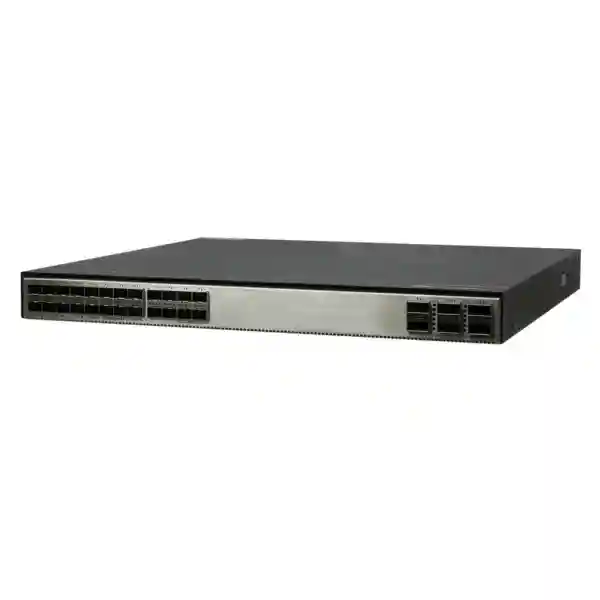
Huawei CloudEngine S5732-H24S6Q in UAE
A fiber-dense 1U switch for enterprise campus aggregation, optical access, compact core and data-center edge designs, combining 20 GE SFP access interfaces, four 10GE SFP+ interfaces and six 40GE QSFP+ interfaces with Huawei VRP software, virtualization, wired and wireless convergence, telemetry and resilient network functions.
Direct answer: where the S5732-H24S6Q fits in a UAE network
The Huawei CloudEngine S5732-H24S6Q is best understood as a high-capacity fixed-form-factor optical Ethernet switch for environments where the access or aggregation layer is predominantly fiber. It is not a conventional copper access switch and it is not designed primarily to deliver PoE to desk phones or wireless access points. Its strength is optical port density and high-speed uplink capacity in a compact 1U chassis. The front-panel mix of twenty GE SFP ports, four 10GE SFP+ ports and six 40GE QSFP+ ports makes it particularly relevant to campuses that already use fiber-to-building, fiber-to-floor, fiber-to-room or fiber-to-device architectures, as well as distribution layers that must aggregate multiple optical access switches while retaining multiple 40GE paths toward a core.
For UAE organizations, the model can be considered for education campuses, government facilities, hospitals, hospitality properties, transportation sites, industrial campuses, large office estates and multi-building developments where fiber is preferred for distance, electromagnetic isolation, pathway density or long-term cabling strategy. It can also serve as a compact core for smaller sites when its forwarding scale, routing requirements, software feature set and redundancy model match the design. The six 40GE interfaces provide substantial options for upstream connectivity, stacking or high-bandwidth interconnection, while the mixed GE and 10GE optical interfaces allow designers to connect legacy gigabit fiber endpoints and newer 10-gigabit-capable systems without forcing a one-speed-only architecture.
FourTeck positions this switch as a design component rather than a stand-alone SKU. A successful deployment depends on more than the chassis: optical transceiver type, fiber grade, connector system, distance, wavelength plan, redundancy, power module selection, software release, feature licensing and interoperability with the rest of the campus all matter. Our UAE team can help align these pieces with the required bill of materials, and organizations that need broader switching, security and infrastructure assistance can review FourTeck UAE and FourTeck IT Services UAE for related implementation support.
Hardware architecture and fixed-port map
SFP access interfaces
Designed for optical Gigabit Ethernet connectivity to remote switches, servers, industrial systems, distribution frames or fiber-fed building zones, subject to supported optics and software compatibility.
SFP+ high-speed interfaces
Useful for 10-gigabit server links, downstream high-capacity access nodes, aggregation interconnects and migration from GE to 10GE in selected portions of the optical campus.
QSFP+ uplink interfaces
Provide high-bandwidth paths for core connectivity, resilient uplinks, inter-switch aggregation and other supported 40GE designs, with final use dependent on the approved transceiver and topology.
The port mix is important because it allows a designer to avoid consuming high-speed interfaces merely to maintain connectivity with older fiber zones. Twenty native GE optical ports can preserve investment in existing gigabit fiber circuits, while four 10GE SFP+ ports serve faster downstream or server-facing roles and six QSFP+ interfaces provide 40GE capacity toward the upstream network. This distribution is especially useful in brownfield campuses where not every building is upgraded at the same time. A network team can maintain Gigabit Ethernet where application demand is modest, move selected buildings or services to 10GE, and still create high-bandwidth 40GE trunks toward the central core.
The chassis measures approximately 442 mm wide, 420 mm deep and 43.6 mm high, corresponding to a 1U rack footprint. Huawei documentation lists packaged chassis weight around 8.9 kg for this model. Rack planning should nevertheless account for installed power modules, optical modules, cable management, front and rear clearance, rail or shelf requirements and the total rack thermal load rather than using product weight alone. In dense UAE data rooms, the practical challenge is often not the 1U height but maintaining clean fiber bend radius and avoiding obstruction of neighboring equipment. A well-designed rack should provide vertical and horizontal fiber management, clear labeling and enough service loop to replace optics without disturbing adjacent links.
Because SFP, SFP+ and QSFP+ ports are physical cages rather than universal promises of any optic, transceiver compatibility must be validated before ordering. Single-mode, multimode, wavelength, reach and connector details should be selected from Huawei-supported optical-module lists for the intended software release and hardware revision. The optical budget should consider transmitter power, receiver sensitivity, cable attenuation, patch panels, fusion splices, connector loss and engineering margin. For longer campus runs, particularly those crossing outdoor pathways or multiple intermediate distribution points, this calculation is more reliable than assuming that a nominal distance printed on an optic automatically guarantees a stable link.
Performance: switching capacity, forwarding and real design limits
Huawei publishes model performance figures for the S5732-H24S6Q, but buyers should interpret these figures in the context of software version and the exact manufacturer document used for procurement. Current Huawei English product material lists forwarding performance of 450 Mpps and switching capacity figures shown as 600 Gbit/s / 2.4 Tbit/s. Other Huawei regional or older collateral can display different values for the same family because of software generation, measurement convention or product-document revision. For a production BOM, the correct approach is to validate the requested throughput figure against the exact hardware part number, software release and active feature set rather than mixing specifications from different brochure generations.
Forwarding performance measured in millions of packets per second describes how many packets the switching system can process under a defined test profile. Switching capacity describes the fabric bandwidth available for moving traffic among interfaces. Neither number should be treated as a universal application-throughput guarantee. Real traffic includes different frame sizes, multicast, broadcast, control-plane packets, routing lookups, access-control rules, QoS operations, telemetry export and protocol overhead. Application performance also depends on congestion behavior, oversubscription at each aggregation point, server capacity, WAN limits and packet-loss sensitivity. When sizing the S5732-H24S6Q, the key question is not simply whether the headline capacity exceeds the sum of port rates; it is whether the planned traffic matrix, failure-state load and service policy can be handled with adequate margin.
Consider a campus distribution block with eight remote buildings. Some buildings may connect at 1GE because their user count and application profile are modest, while others may use 10GE. During normal operation, traffic may be split across two upstream 40GE paths. If one upstream path fails, the surviving path must accommodate the redistributed flows without creating unacceptable congestion. The design therefore needs to evaluate the failure state, not only the normal state. The same principle applies when the switch participates in a stack or when multiple 40GE interfaces are bundled. Link aggregation can increase available capacity and improve resilience, but hashing behavior means individual flows do not necessarily span every member equally.
The S5732-H24S6Q is consequently suited to designs where the optical port mix and high-speed uplinks align with a measured traffic model. A FourTeck design review can document endpoint counts, peak traffic, east-west versus north-south flows, application criticality, multicast requirements, resilience objectives and growth expectations before finalizing the number of switches and uplink topology. This method is more dependable than choosing a model only because it has a large switching-capacity figure.
Power, cooling and UAE rack-room planning
Power architecture
Huawei documentation for this model lists pluggable 600 W AC and 1000 W DC power-supply options and supports a 1+1 power-redundancy design when appropriately configured. Published rated AC input is 100–240 V AC at 50/60 Hz, while the broader AC operating range is documented as 90–290 V AC at 45–65 Hz. The DC option is listed with a rated range of -48 to -60 V DC and a broader operating range of approximately -36 to -72 V DC. Confirm the exact power module part number, connector requirements and site electrical standard before installation.
A redundant-power design only delivers meaningful resilience when the feeds are genuinely independent. In a critical UAE facility, that may mean separate PDUs fed from separate UPS outputs or independent power paths where the electrical architecture permits. Installing two power supplies into the same overloaded PDU does not create the same fault isolation as diverse feeds. The quotation stage should therefore capture whether one or two power modules are required and whether matching power cords, PDU outlets and electrical loading are available.
Thermal and environmental design
Manufacturer material lists maximum power consumption around 229 W for the S5732-H24S6Q and specifies air-cooled operation with intelligent fan-speed adjustment and pluggable fan modules. Published operating temperature for the referenced all-optical series is -5°C to +45°C at 0–1800 m, with a temperature derating at higher altitude. Storage is listed at -40°C to +70°C and relative humidity at 5% to 95% non-condensing. These limits are equipment specifications, not a recommendation to operate a data room at the upper boundary.
In the UAE, cooling strategy deserves particular attention for telecommunications rooms near roofs, service corridors, warehouses or partially conditioned areas. Outdoor ambient temperature can be far above comfortable IT-room conditions, and a temporary HVAC failure can push an enclosed rack beyond equipment limits quickly. Monitoring should include room temperature, rack inlet temperature, power status and fan alarms. Dust control and clean airflow are equally important because fiber-rich switches can accumulate contamination around cooling paths and optical connectors.
Layer 2 design, segmentation and resilient Ethernet
The CloudEngine S5732-H family is built on Huawei’s Versatile Routing Platform and provides the familiar enterprise switching functions expected in a campus distribution platform. Depending on software and license package, deployments can use VLAN-based segmentation, link aggregation, spanning-tree technologies and Huawei or standards-based protection mechanisms to build resilient Ethernet domains. The practical design objective is to limit failure scope and broadcast propagation while keeping failover predictable. Large flat VLANs stretched across many buildings may appear simple at first, but they can create wide fault domains and make troubleshooting difficult. A structured VLAN and routing boundary strategy is normally preferable.
Huawei documentation for the series describes support for traditional STP, RSTP and MSTP as well as Ethernet protection technologies such as ERPS. These options serve different topologies. MSTP can map groups of VLANs to spanning-tree instances and is widely understood in mixed enterprise environments. ERPS is designed for ring protection and can be attractive where buildings are physically connected in a fiber ring. The appropriate choice depends on topology, interoperability and recovery objectives. A design should avoid running multiple overlapping protection mechanisms without a clear control-plane model because unintended interactions can complicate convergence.
Link aggregation can combine multiple physical interfaces into a logical connection for additional bandwidth and link-level resilience. When used between distribution and core switches, the port-channel design should be symmetrical and validated for the chosen protocol, transceiver type and peer platform. Engineers should remember that aggregation load balancing is typically flow-based. A single large flow may use only one member even when several links form the bundle, while many independent flows can distribute more evenly. Capacity planning should therefore consider the application flow pattern, not only the sum of member link speeds.
For campuses with multiple tenants, departments or security zones, VLANs can separate Layer 2 domains, but VLAN separation alone should not be considered a complete security architecture. Inter-VLAN routing, ACLs, authentication, network access control and firewall policy determine how segments are allowed to communicate. Where sensitive business systems are involved, the switching design should integrate with the organization’s firewall and security architecture. FourTeck’s Firewall Dubai practice can be used alongside switching projects when segmentation must continue through security enforcement points.
The model’s optical nature is also useful for resilient building-to-building links because fiber avoids the distance and electromagnetic constraints of copper. However, resilient switching requires physical-path diversity as well as protocol diversity. Two fiber links routed through the same underground duct, same riser or same patch panel can fail together. For high-availability campuses, the survey should identify physically diverse pathways, separate termination points and documented fiber cores so that logical redundancy is supported by physical redundancy.
Layer 3 routing and campus-core use
The S5732-H family can participate in routed campus designs rather than operating only as a Layer 2 bridge. Huawei documentation describes IPv4 and IPv6 functions and dynamic routing support within the family. This matters when the device is positioned at building distribution or as a compact core, because routing boundaries can improve fault containment, reduce spanning-tree dependence and allow more deterministic use of redundant paths. The exact protocol set and scale must be checked against the selected software version and commercial software package before the model is approved for a design.
A common modern campus pattern is to route links between distribution and core while keeping user VLANs local to a building or access block. This reduces the need to stretch Layer 2 domains across the campus and allows routing protocols to choose alternate paths during failures. Another pattern is to keep selected VLANs extended when an application or migration requirement demands it while routing most other networks. The S5732-H24S6Q can fit either model, but the choice should be deliberate and documented. Engineers should define first-hop gateway location, redundancy method, route summarization, default-route strategy, failure convergence and interaction with firewalls or WAN routers.
IPv6 planning should be treated as part of the base architecture even when the production network remains primarily IPv4. Huawei describes mature dual-stack capability in the series. A dual-stack campus needs IPv6 addressing, router advertisement policy, DHCPv6 decisions, IPv6 ACLs, management-plane controls and monitoring that sees both protocol families. It is a common mistake to deploy IPv6-enabled infrastructure without equivalent security visibility. The switch should therefore be configured so that IPv6 behavior is intentional rather than an uncontrolled side effect of default protocol support.
If the S5732-H24S6Q is considered for a compact core, validate route-table scale, multicast scale, ACL resources, VPN requirements, convergence behavior and all required high-availability functions. Compact fixed switches can be highly capable, but they do not automatically replace modular core platforms in every environment. A hospital campus, financial institution or very large government network may require control-plane redundancy, card-level redundancy, larger tables or service separation beyond the scope of a fixed 1U design. The correct architecture depends on the business impact of failure and the expected lifecycle growth.
VXLAN, virtualization and multi-service campus design
Huawei positions VXLAN as an important function in the CloudEngine S5732-H family. VXLAN creates logical Layer 2 network segments over a routed IP underlay, giving architects more flexibility than traditional VLAN extension alone. Huawei documentation describes centralized and distributed gateway models and BGP EVPN-based establishment of VXLAN tunnels, subject to the correct software and licensing. For an enterprise campus, this can support virtual-network separation on a shared physical infrastructure, allowing different business groups, tenants or service classes to use one physical network while remaining logically isolated.
VXLAN is valuable when it solves an architectural problem, but it also adds control-plane and operational complexity. A deployment should start with a clear underlay design. The IP fabric needs stable routing, consistent MTU, redundant paths, deterministic addressing and strong monitoring. The overlay then maps users or services into virtual networks. If BGP EVPN is used, route-target and route-distinguisher design, gateway placement and failure behavior must be defined. Troubleshooting skills also change: engineers need to inspect both the underlay reachability and overlay tunnel state rather than assuming that a VLAN problem is confined to a single switch.
For multi-building UAE campuses, the overlay approach can be attractive when business units need consistent segmentation across different physical locations. A university may isolate administration, laboratories, student systems, cameras and building management. A hospitality group may separate guest services, corporate operations, surveillance, property management and back-of-house systems. A government estate may maintain multiple security zones on common fiber infrastructure. VXLAN can help deliver this separation while reducing the need to build duplicate physical networks, but policy enforcement and compliance requirements must still be considered. Logical isolation is part of a security design, not a substitute for firewalls, identity controls or endpoint protection.
Licensing is especially important in this area. Huawei’s N1 software model can differentiate basic switching from advanced automation, virtualization and analytics functions. The quotation must therefore identify whether the project requires only conventional Layer 2/Layer 3 switching or also VXLAN, free mobility, CampusInsight integration or advanced controller-driven features. Buying the chassis without the required software entitlement can delay commissioning, while purchasing advanced licenses for a simple standalone deployment can add unnecessary cost. FourTeck can map requested use cases to the software and license package during presales validation.
Wired and wireless convergence
One of the distinctive capabilities Huawei promotes for the S5732-H family is integrated wireless access-controller functionality. Huawei states that the platform can manage up to 1024 wireless APs when appropriately licensed and configured. This allows a campus architecture to combine switching and wireless control functions rather than deploying a separate hardware controller in every design. The value is not merely hardware consolidation: converged policy can help align user identity, access rights and operational visibility across wired and wireless networks.
The maximum AP figure should not be interpreted as a recommendation to attach 1024 APs to one switch without further analysis. Wireless sizing depends on AP models, controller architecture, tunnel or local forwarding mode, redundancy, client density, roaming domains, feature use, software release and failure-state requirements. Huawei documentation has also indicated that a smaller number of APs may be supported by default and additional AP management can require licenses. Any project planning to use native AC functionality should therefore specify the number of APs today, projected growth, HA strategy and exact license quantity.
In a Wi-Fi deployment, the S5732-H24S6Q is not typically the PoE edge switch powering the access points because its access interfaces are optical. Instead, it can sit higher in the topology, aggregating PoE access switches over fiber while also participating in the wireless control architecture. This separation is often sensible in large properties: copper PoE switching remains close to APs and users, while optical distribution carries aggregated traffic across building distances. The result can be cleaner power planning and longer inter-building reach than trying to extend copper access beyond its intended limits.
Converged wired and wireless policy is most valuable when identity services, authentication methods and operational processes are also aligned. The series supports enterprise access-control methods such as 802.1X, MAC authentication and portal-based authentication in the documented feature set. A production design should define RADIUS dependencies, certificate strategy, guest access, fallback behavior, device profiling and what happens when authentication infrastructure is unavailable. The network should be designed so that convergence simplifies operations rather than creating a single uncontrolled dependency.
Telemetry, iPCA, TWAMP and intelligent operations
Modern campus operations require more than interface-up and interface-down alarms. Huawei documents real-time telemetry capabilities in the S5732-H family and integration with its campus analytics platform. Telemetry streams operational measurements more continuously than traditional periodic polling and can give operations teams better visibility into utilization, delay, packet loss and device state. When combined with a suitable analytics platform, this data can shorten the time between a user complaint and identification of the affected path.
Huawei also describes iPCA functions for measuring service quality along a traffic path and TWAMP for active IP performance measurement. These technologies address different operational questions. Telemetry can expose device and interface behavior; active measurement can test path performance; packet-conservation or flow-quality mechanisms can help locate loss more precisely. A well-designed monitoring strategy uses the switch as a source of high-quality evidence while central systems correlate that evidence with topology, application and user context.
This matters in fiber campuses because the physical link may remain electrically and optically up even while users experience congestion, packet loss or quality degradation. A 40GE uplink can be operational yet overloaded for short periods. A faulty optic can generate intermittent errors. A routing change can move traffic onto a longer or congested path. Voice or video can suffer before traditional SNMP thresholds trigger. Enhanced visibility helps operations teams identify the difference between endpoint, access, distribution, core and WAN problems instead of troubleshooting each layer by trial and error.
For UAE organizations with strict service-level requirements, monitoring should be designed before go-live. Define which interfaces are critical, what telemetry will be exported, where logs will be stored, who receives alarms and how long performance history must be retained. Management traffic should use protected paths and authenticated protocols. Time synchronization is also essential because event correlation becomes difficult when switches, firewalls, servers and monitoring systems disagree on time. NTP design should therefore be part of the deployment checklist.
Analytics functionality may require additional Huawei controller or software components, and feature availability can vary by software package. FourTeck can help separate functions delivered directly by the switch from functions that depend on iMaster NCE-Campus, CampusInsight or other management systems so that the project scope includes the required platforms rather than assuming every analytics function is embedded locally in the chassis.
Security controls and campus threat visibility
The S5732-H family includes a broad set of access-layer and infrastructure-protection capabilities. Huawei documentation describes protections against common denial-of-service patterns, DHCP-related attacks, IP/MAC spoofing and ARP abuse, alongside authentication methods and policy enforcement. These controls can reduce the attack surface at the switching layer, particularly when combined with DHCP snooping, trusted-port design, source validation and dynamic access policy. They should be configured according to the actual topology because an incorrectly trusted interface or incomplete binding model can weaken the intended protection.
Huawei also promotes built-in security-probe functions and integration with its security analytics ecosystem. The documented approach includes NetStream-style traffic visibility, encrypted-communication analytics and threat detection workflows integrated with Huawei security platforms. The architecture can help identify suspicious behavior without relying only on payload inspection. However, advanced threat analytics normally depends on external analytics or controller components, suitable licenses and careful privacy and data-governance review. The switch provides visibility and enforcement capabilities within a broader security system rather than replacing a dedicated firewall, SIEM, EDR or SOC process.
Access control should be planned in layers. At the physical and data-link layer, shut unused ports, lock down management access and control which VLANs are allowed on trunks. At the identity layer, use 802.1X or another authentication method where appropriate. At the IP layer, apply ACLs and anti-spoofing controls. At segmentation boundaries, enforce policy through routing controls and security appliances. For management, use authenticated administrative access, role separation, centralized logging, configuration backups and change control. No individual feature compensates for weak operational governance.
For organizations subject to internal security standards or regulatory requirements, the procurement document should identify management encryption requirements, password and AAA policy, logging retention, SNMP version, cryptographic constraints, segmentation rules and vulnerability-management process. Software maintenance is part of security: the switch should run a supported release approved for the deployed features, and upgrades should be tested before production rollout. Huawei describes intelligent upgrade workflows in the family, but enterprises should still maintain formal maintenance windows, rollback procedures and backups.
iStack and high-availability design
Huawei documents iStack support for the S5732-H series. Stacking allows multiple compatible switches to operate as a logical system, simplifying management and enabling cross-device link aggregation in supported designs. This can improve link and device resilience because downstream or upstream systems can distribute connections across different physical stack members while seeing a logical switching system. It can also expand port capacity without introducing a separate management plane for every unit.
A stack is not automatically equivalent to two independent networks. Stack members share control relationships and can be affected by common software defects, configuration errors or stack-link problems. Architects should decide whether the business requirement is simplified device redundancy or true fault-domain separation. For many enterprise campuses, a well-designed stack provides an effective balance of availability and operational simplicity. For extremely critical environments, two independent systems using routed or multi-chassis mechanisms may be preferred to avoid a common control domain.
Stack-link bandwidth and physical topology must be sized for failure conditions. If one link or one member fails, traffic may be redirected over remaining stack paths. The same is true for upstream aggregated links. A diagram should show which physical ports are used for stacking, which are used for uplinks and how traffic flows when each single component fails. Reserving 40GE interfaces for stacking can reduce the number available for core uplinks, so the design must account for this trade-off before ordering.
High availability also includes redundant power, fans, optical paths and upstream peers. The S5732-H24S6Q supports 1+1 power redundancy when configured with the required modules. Pluggable fan design supports serviceability, but maintenance procedures should define whether a failed fan can be replaced without violating thermal limits. Fiber uplinks should use physically diverse routes where possible. Finally, configuration backup and spare strategy matter: knowing that a switch can be replaced quickly is only useful if the replacement unit, compatible optics, software image, license entitlements and configuration are available.
Optics engineering: selecting SFP, SFP+ and QSFP+ modules correctly
The largest practical risk in an optical-switch procurement is often not the switch chassis but the transceiver and fiber combination. The S5732-H24S6Q contains SFP, SFP+ and QSFP+ cages, but each connection still needs a supported module with the correct Ethernet speed, fiber type, wavelength and reach. For a UAE campus with mixed legacy and new cabling, the project may include short multimode links inside a building, longer single-mode runs between buildings and high-capacity 40GE links to a core. These should be engineered separately rather than standardized blindly on one optic type.
Start by documenting the physical path for every fiber link: endpoint A, endpoint B, cable type, strand count, connector type, estimated distance, patch panels, intermediate splices and whether the fiber is dedicated or part of a shared outside-plant system. Then select an optic supported by the switch and peer device. Both ends must use compatible Ethernet standards and optical characteristics. A transceiver that physically fits the cage may still be unsupported, and two modules at the same nominal speed may use different wavelengths or encoding.
Optical power budget should include total attenuation plus margin. Single-mode fiber loss per kilometer is only one component. Patch-panel connectors, dirty end faces, mechanical splices and fusion splices all contribute. Excessive receiver power can also be a concern on very short links with long-reach optics. For this reason, a proper design uses manufacturer transmit and receive specifications and calculated path loss. During commissioning, optical diagnostic readings and light-level testing should be compared with expected values so that marginal circuits are corrected before they become intermittent production faults.
Connector cleanliness is critical. A microscopic contaminant on an LC or MPO/MTP interface can create significant loss or reflection. Technicians should inspect and clean fiber end faces before connection, use dust caps correctly and avoid leaving disconnected transceivers exposed. For 40GE QSFP+ links, the selected optical standard may use duplex LC or parallel-fiber connectivity depending on the optic. Cabling and patch panels must match that standard. Migration planning is especially important when an existing fiber plant was built only for duplex Gigabit Ethernet.
FourTeck quotations can include compatible optics as part of the BOM rather than treating them as an afterthought. When requesting pricing, provide the number of GE, 10GE and 40GE links plus approximate distances and fiber type. If the installed fiber documentation is uncertain, a site survey or test can reduce the risk of ordering unsuitable modules.
Deployment topologies for UAE enterprises
1. Multi-building campus aggregation
Place one or two S5732-H24S6Q units in a central distribution room. Remote building switches connect over GE or 10GE fiber, while 40GE interfaces provide resilient paths to a campus core. This design works well when the central node must aggregate many optical links without occupying several rack units.
2. All-optical access layer
Use the switch in an environment where endpoints or remote access nodes are fiber-connected. GE SFP ports preserve broad compatibility, selected 10GE ports serve higher-throughput systems, and 40GE uplinks prevent the aggregation layer from becoming the first bottleneck.
3. Compact site core
For a smaller campus, branch headquarters or industrial site, the S5732-H24S6Q can be assessed as a compact core when its routing scale, software features and resilience match requirements. Multiple 40GE interfaces can connect server, distribution and WAN/security blocks.
4. Data-center access or service aggregation
The mixed optical interface set can aggregate appliances, servers or service networks that use GE and 10GE while maintaining higher-speed 40GE upstream connectivity. Validate latency, table scale, redundancy and required data-center protocols before selecting it for this role.
These topologies are starting points rather than templates to copy without analysis. Each project should identify the failure domains, cable routes, endpoint counts, routing boundaries, multicast requirements, security policy and management architecture. UAE projects also need practical coordination with structured-cabling contractors, MEP teams, rack suppliers and facility managers. A technically correct switch configuration can still fail to meet project goals if fiber handoff points, power feeds, cabinet depth or cooling are not ready when the equipment arrives.
Sizing methodology: how many S5732-H24S6Q switches are needed?
Start with port demand by speed, not total endpoint count. List how many GE optical connections are required today, how many are expected to migrate to 10GE, how many 40GE interfaces are reserved for core uplinks, stack connections or special systems, and how many spare interfaces should remain for growth and emergency moves. Because the chassis has different port classes, a design with twenty-four total links may still require more than one switch if too many links need 10GE or 40GE connectivity.
Next calculate bandwidth. Estimate normal peak traffic and failure-state traffic for each uplink. A building with a 10GE downlink does not necessarily generate 10 Gbit/s continuously, but the aggregate of many buildings can create bursts. Backup traffic, software deployment, camera streams, virtual-desktop sessions and cloud synchronization can shift normal patterns dramatically. Use monitoring from the existing network where available. If replacing an older switch, historical interface graphs provide a better baseline than generic user-per-port assumptions.
Then check resiliency. If a two-switch design is required, decide whether endpoints are dual-homed, whether access switches use aggregated links across a stack, whether routing provides path redundancy and how many ports are lost when a member fails. Reserve enough high-speed ports for the chosen HA model. If two 40GE ports are used for stack links and two more for redundant core uplinks, only the remaining QSFP+ capacity is available for other purposes. The design should show this explicitly.
Software sizing follows hardware sizing. Count wireless AP licenses if native AC is used. Identify whether VXLAN, free mobility, advanced analytics or controller integration is required. Confirm whether the project needs basic software, an N1 Foundation package or an advanced package. Feature names and commercial bundles can change across software generations, so current quotation documents should be used to map the required entitlement. Renewal or subscription terms should also be understood where applicable.
Finally, include spares. A resilient campus may keep one cold spare chassis or at least spare power and fan modules, depending on support contract and recovery-time objective. Optics are small and relatively easy to stock, so critical sites often retain spare transceivers for the most important link types. The business case for a spare is not based only on equipment cost; it is based on the cost of downtime and the lead time to obtain a replacement.
For a structured quotation, FourTeck can turn these inputs into a BOM that identifies switches, power supplies, optics, licenses and implementation services. Projects involving multiple countries can also coordinate wider sourcing through FourTeck Africa where regional rollout planning is relevant.
Software, licensing and version-control considerations
The S5732-H24S6Q is a platform whose final feature set depends on software release and licensing. Huawei’s VRP provides the operating system foundation, while commercial packages can control advanced campus functions. For procurement, record the target software release alongside the hardware SKU. This prevents a common problem in which a feature is confirmed from a newer brochure but the delivered device is commissioned on a release where the command, scale or license behavior differs.
A controlled deployment should maintain a tested software baseline. Before rolling a version into production, validate boot behavior, interface compatibility, routing protocols, stack operation, controller integration, telemetry export, authentication and any required VXLAN functions in a lab or pilot environment where practical. Backup configuration and license information before upgrades, and document the rollback process. If the switch is part of a stack, follow Huawei’s supported upgrade procedure for that stack topology rather than treating each member as an unrelated standalone unit.
Licensing should be tied to use cases. If the switch is simply aggregating optical access links with standard VLAN and routing functions, the required package may be different from a campus fabric using VXLAN, free mobility and controller-driven automation. If native AC functionality will manage hundreds of APs, AP license quantities must be captured. If advanced monitoring relies on CampusInsight, the analytics platform and associated entitlements belong in the project scope. This use-case-first method reduces both under-licensing and unnecessary spending.
Support lifecycle is equally important. Organizations should confirm software support, security-patch policy and hardware service coverage for the planned operational period. Enterprise switching is often deployed for many years, so the chosen model must fit not only today’s feature requirement but also the organization’s maintenance strategy. FourTeck can align the quote with requested support duration, delivery expectations and replacement strategy.
Migration from legacy campus switches
A migration to the S5732-H24S6Q should begin with discovery. Export existing configurations, interface descriptions, VLAN lists, trunk definitions, routing tables, spanning-tree roots, link aggregations, ACLs, QoS settings, multicast configuration, management addresses, NTP, AAA and monitoring configuration. Correlate the logical configuration with the physical fiber schedule. Legacy environments often contain undocumented circuits or ports whose description no longer matches their real destination. Resolving those discrepancies before the change window is far less risky than discovering them during cutover.
Next identify behavioral differences. Command syntax, default settings and feature implementation can vary across vendors and software generations. Do not translate configuration line by line without understanding intent. For example, a trunk’s native VLAN behavior, spanning-tree edge settings, LACP timing or DHCP snooping trust model may differ. The new configuration should reproduce the intended network policy, not the old syntax. Where the project moves from another vendor to Huawei, interoperability tests with adjacent devices are advisable.
Plan the cutover around dependencies. Core or distribution switch replacement can affect many buildings at once. Stage optics, label fibers, preconfigure the switch, verify licenses and power it on before the maintenance window. If possible, migrate noncritical links first and confirm monitoring, routing and authentication before moving high-impact services. Maintain a rollback plan with a clear decision point. A good rollback plan states exactly what conditions trigger reversal and how cabling and configuration return to the original state.
Post-migration validation should include more than ping tests. Verify interface errors, optical receive levels, spanning-tree state, routing adjacencies, route count, default gateway reachability, DNS, DHCP, authentication, voice/video quality, wireless controller operation where relevant, monitoring telemetry and redundancy. Trigger selected failover tests during the approved window: disconnect an uplink, remove one power feed if safe, or fail one stack path according to the design. Resilience that has never been tested remains an assumption.
Finally, update documentation immediately after the change. Record the final port map, optic types, serial numbers if required by asset policy, software version, license state, management IP, rack position, fiber IDs and support details. Accurate documentation reduces recovery time when a problem occurs months or years later.
Use cases by industry
Education and research
Universities can aggregate fiber from academic buildings, laboratories, libraries, residence facilities and wireless access blocks. High-speed 40GE uplinks help centralize traffic while VLAN or VXLAN segmentation separates student, staff, research, IoT and security systems. Telemetry is useful where large numbers of users produce rapidly changing demand.
Hospitality and mixed-use property
Large hotels and mixed-use developments often contain multiple telecom rooms linked by fiber. The switch can aggregate guest services, administration, surveillance and building systems while upstream firewalls and routing enforce separation. Redundant optical pathways are particularly valuable where service continuity affects guest experience.
Government and enterprise campuses
Multi-building estates can use the switch at aggregation points where numerous optical access switches converge. Policy, authentication and telemetry functions support centralized operations, while Layer 3 routing and virtualization can reduce the size of individual fault domains.
Industrial and logistics environments
Fiber is attractive where distance, electrical noise or physical plant conditions make copper less suitable. The S5732-H24S6Q can aggregate optical links from production zones, warehouses or remote network cabinets, provided environmental conditions at the switch location remain within specified limits.
Healthcare
Hospitals can use optical aggregation to connect clinical buildings, diagnostic areas and data services while segmenting medical, administrative and facilities networks. Change control, high availability and monitoring are especially important because network disruption can affect operationally critical systems.
Transport and large public venues
Airports, terminals, stadiums and large venues may need long fiber runs, many distribution zones and significant video or wireless traffic. Multiple 40GE interfaces give the architecture room for high-capacity uplinks, while operational telemetry helps identify congestion during peak events.
Specification summary for procurement
| Product model | Huawei CloudEngine S5732-H24S6Q |
| Fixed interfaces | 20 × GE SFP, 4 × 10GE SFP+, 6 × 40GE QSFP+ |
| Form factor | 1U fixed-form-factor enterprise switch |
| Dimensions | Approximately 442 × 420 × 43.6 mm (W × D × H) |
| Published maximum power consumption | Approximately 229 W in referenced Huawei all-optical series documentation |
| Power options | Pluggable AC and DC modules; 1+1 redundancy supported with appropriate configuration |
| Operating environment | Published -5°C to +45°C at 0–1800 m; altitude derating applies above this range |
| Wireless convergence | Integrated AC capability with support up to 1024 APs when correctly licensed/configured |
| Virtualization | VXLAN and BGP EVPN capabilities within supported software/license scope |
| Operations | Telemetry, intelligent O&M integration, iPCA/TWAMP capabilities and controller-based management features subject to release and package |
Procurement note: manufacturer specifications can vary by software generation, regional publication and BOM revision. Final quotation should be validated against the exact Huawei part number, target VRP release, licenses, power modules and optics required for the project.
What to include in an RFQ for the S5732-H24S6Q
A complete RFQ avoids repeated clarification and allows the supplier to quote the correct switch, power, optics and licenses. State the quantity of chassis required and whether the design uses standalone units or a stack. Specify whether redundant power is mandatory and whether the site uses AC or DC feeds. If AC is used, identify the expected plug and PDU standard. If DC is used, provide the telecom power-system details and installation responsibility.
List every optical connection by speed and approximate distance. For example: twelve GE single-mode links below 5 km, four 10GE single-mode links below 2 km and two 40GE multimode links inside the same data room. If fiber type is unknown, state that clearly rather than guessing. Include connector type if known. For existing campus fiber, provide OTDR or loss-test results when available. This information allows the optic selection to be based on the real optical plant rather than a generic bundle.
Describe the required software features in business language: Layer 3 routing, OSPF, BGP, IPv6, VXLAN, EVPN, iStack, wireless AC, number of APs, telemetry, CampusInsight integration, authentication, multicast or MPLS. The presales engineer can then map requirements to the appropriate Huawei software package. Avoid requesting only a license name copied from an old project because commercial packaging may have changed.
Include support expectations such as one-year, three-year or longer service coverage, on-site replacement requirements, software support and target response time. If the switch is part of a critical environment, state the maximum acceptable outage so the design can include the correct spare or support strategy. Also provide the required delivery location within the UAE and any site access or documentation conditions for installation.
For implementation, identify whether FourTeck is expected to supply hardware only or also perform configuration, staging, rack installation, migration, testing, documentation and handover. A clearly scoped service package creates a more accurate project plan and reduces assumptions between the customer, cabling contractor and network integrator.
Frequently asked technical questions
Is the S5732-H24S6Q a PoE switch?
Its primary fixed interfaces are optical SFP, SFP+ and QSFP+ ports, so it should not be selected as a conventional RJ45 PoE access switch. In typical campuses it aggregates downstream PoE access switches over fiber.
Can it act as a core switch?
It can be evaluated for compact-core use in smaller or medium sites, but the decision depends on route scale, redundancy model, required protocols, failure impact and lifecycle growth. Large critical networks may require a larger modular platform.
Does it support 40GE uplinks?
Yes. The model is documented with six 40GE QSFP+ interfaces. The chosen transceiver, fiber type and peer device must support the same Ethernet standard.
Can it manage wireless APs?
Huawei promotes native AC capability in the series, with up to 1024 APs supported when the architecture, software and license package are appropriate. Confirm AP license quantity and HA design before deployment.
Does it support VXLAN?
Huawei documentation describes VXLAN and BGP EVPN functions for the family. Availability depends on software release and license package, so the feature should be explicitly included in the RFQ.
Can two units be stacked?
The series supports iStack. Exact stack cabling, supported member count, interface use and version requirements should be validated against the current Huawei configuration guide for the deployed release.
Which optics should I order?
That depends on speed, fiber type, distance, wavelength and peer compatibility. Provide the fiber schedule and distances so supported Huawei optics can be selected correctly.
Is redundant power available?
Yes, Huawei documents 1+1 power redundancy with appropriate pluggable power modules. For real redundancy, connect the modules to independent protected power feeds where possible.
UAE procurement and project-delivery considerations
Enterprise switch procurement in the UAE often involves coordination among the end user, consultant, main contractor, system integrator, structured-cabling company and facilities team. The network BOM should therefore be frozen against a technical submittal that clearly identifies switch model, power configuration, optics, licenses and support. This prevents substitutions that look similar commercially but do not meet the approved design. Where a project specification references an older software release or discontinued optic, the integrator should raise a technical clarification before ordering.
Delivery planning should account for staging time. Receiving the hardware is not the same as being ready for cutover. The switches may need asset tagging, firmware alignment, license activation, base configuration, burn-in, stack testing and integration with AAA or monitoring systems. Optics should be matched to fiber paths and labeled. Configuration should be reviewed by a second engineer for critical changes. These activities are easier in a staging environment than inside a restricted production data room during a short maintenance window.
For greenfield buildings, involve the network team before rack and cabling layouts are finalized. The switch is 420 mm deep, but the installed depth also includes front fiber management, rear power leads and service clearance. Cabinet depth and PDU placement should not obstruct fans or power modules. Fiber trays should maintain bend radius. Patch-panel positions should allow clean routing to SFP and QSFP cages without crossing fan exhaust or blocking access to neighboring equipment.
For multi-country rollouts, standardize architecture while allowing local variation in fiber plant, power and regulatory requirements. FourTeck’s regional operations can help maintain a consistent model and configuration approach across sites, while the UAE project can be anchored through the FourTeck global network when cross-border coordination is required.
Operational lifecycle and maintenance
The operational lifecycle begins on day one of commissioning. Save a clean baseline configuration, software image reference, license record and physical port schedule. Export inventory information into the organization’s asset system. Configure centralized AAA rather than relying only on local administrator accounts, and retain an emergency-access procedure under controlled governance. Send system logs to a central platform, use secure SNMP or telemetry methods, and monitor power, fan, temperature, interface error and optical alarm conditions.
Track interface utilization over time. Optical aggregation switches often remain in service for many years, during which bandwidth demand increases. A 1GE building uplink that is comfortable today may become a bottleneck after new wireless APs, cameras or cloud applications are added. Because the S5732-H24S6Q includes 10GE and 40GE connectivity, it offers migration options, but only if spare interfaces and suitable fiber are available. Capacity reviews should be part of periodic network health checks.
Maintain transceiver hygiene and spares. When an optic is replaced, inspect and clean the fiber before assuming the transceiver was the only problem. Compare digital optical monitoring values with historical readings when available. A gradual decrease in receive power can indicate contamination, macro-bending or fiber degradation. For critical links, record light levels during commissioning to create a baseline for future troubleshooting.
Software maintenance should follow vendor advisories and the organization’s change process. Review security bulletins, feature caveats and recommended releases. Do not upgrade only because a newer image exists; upgrade when there is a justified security, stability or feature reason, and test the path. Conversely, do not leave the network indefinitely on an unsupported release. Lifecycle management balances stability with security and supportability.
Finally, test redundancy periodically. Power-feed diversity, stack failover and alternate uplinks can silently lose redundancy without causing a visible outage. A failed secondary link may go unnoticed until the primary also fails. Monitoring should raise redundancy degradation alarms, and maintenance windows should periodically verify that the documented recovery path still works.
Why exact BOM validation matters
Enterprise networking product families often contain visually similar models with materially different ports, power budgets, software capabilities and lifecycle status. The S5732-H name appears across multiple Huawei product generations and form factors, so the suffix is essential. This page concerns the CloudEngine S5732-H24S6Q with twenty GE SFP ports, four 10GE SFP+ ports and six 40GE QSFP+ ports. Do not substitute a similarly named copper, Multi-GE or V2 model without checking the approved design.
The BOM should identify the base device part number, each power module, each fan requirement where separately ordered, every transceiver, software package, AP or feature license and support service. If a 40GE optic requires a particular fiber type or patch lead, include that accessory. If redundant power needs two cords or specific PDU connectors, capture them. If a stack uses dedicated cables or optical links, add those. A complete BOM avoids the expensive situation in which the chassis arrives but cannot be commissioned.
FourTeck’s role is to turn the network requirement into an orderable and deployable set of components. Customers can request supply-only pricing or a wider scope including design review, staging, migration and documentation. The more accurate the input topology and fiber information, the more precise the resulting quotation.
Decision recap: when this model is a strong technical match
Choose the architecture around optical density
The S5732-H24S6Q is most compelling when many network connections are already fiber and the design needs a compact way to combine GE, selected 10GE and multiple 40GE interfaces. It avoids using copper-heavy access hardware in a location whose primary role is optical aggregation.
Validate software before purchase
If the project depends on VXLAN, EVPN, native AC, free mobility, telemetry analytics or advanced security integration, put those functions in the RFQ. The hardware model alone does not prove that every advanced function is licensed and active in the delivered software package.
Engineer the optics
Transceivers and fiber plant determine whether the physical network will work reliably. Confirm speed, reach, wavelength, connector and optical budget for every circuit. Keep critical spare optics and document baseline light levels.
Design for the failure state
Capacity and redundancy should be verified with one link, one power feed or one switch member unavailable. A topology that performs well only while every component is healthy is not a resilient topology.
Quotation input checklist
Structured consultation for Huawei CloudEngine S5732-H24S6Q UAE projects
Send FourTeck your port counts, fiber distances, topology, power preference, feature requirements and target support term. We can review the model against the intended role, validate optics and licensing, identify redundancy requirements and prepare a project-ready BOM. For migration work, the scope can include configuration preparation, staging, cutover planning, validation and handover documentation.
A technically complete request is the fastest path to accurate pricing. Instead of asking only for “one S5732-H24S6Q,” include the surrounding design so that the quote reflects the interfaces and software needed to make the switch operational on day one.
Optics selection
Licensing alignment
Staging and migration
Documentation and support

Reviews
There are no reviews yet.