
Huawei CloudEngine S5735-S24U4XE-V2
A high-power Gigabit access switch for organizations that need 90 W PoE++ at the edge, 10 Gigabit optical uplinks, dedicated stacking, resilient power design, and mature Layer 2/Layer 3 services in a compact 1U platform.
Designed for structured enterprise networks where access switching is expected to power cameras, wireless access points, phones, building systems, IoT gateways and other powered devices while preserving deterministic uplink capacity and operational visibility.
Core hardware profile
Direct answer: what the S5735-S24U4XE-V2 is built to do
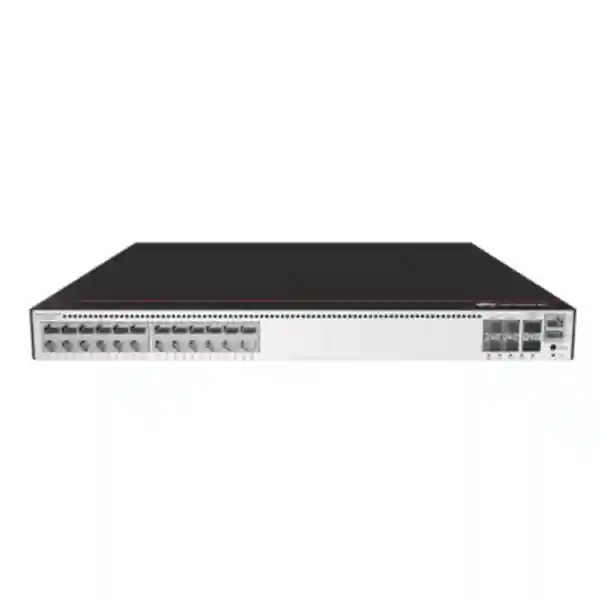
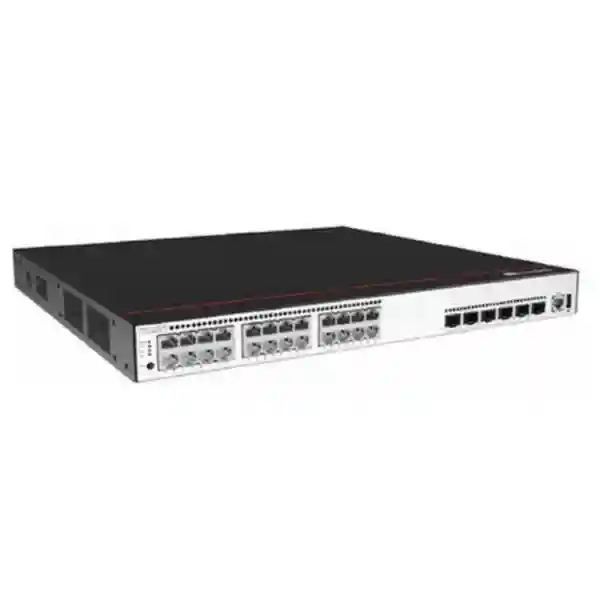
The Huawei CloudEngine S5735-S24U4XE-V2 is an enterprise-class campus access switch in the CloudEngine S5735-S-V2 family. The model combines twenty-four 10/100/1000BASE-T access interfaces with 90 W PoE++ capability, four 10GE SFP+ uplink interfaces and two dedicated 12GE stack ports. Huawei lists forwarding performance at 132 Mpps and switching capacity at 176 Gbps/520 Gbps in its international product materials, while the switch is engineered around a modular power architecture that supports three power modules with N+1 backup. This makes the device especially relevant when access-layer power density and service continuity matter as much as basic Ethernet port count.
In practical UAE deployments, that combination means a single 1U access switch can connect conventional wired endpoints and at the same time supply power to devices with significantly different demand profiles. Standard IP phones and compact sensors may consume relatively little power, while PTZ cameras, high-performance wireless access points, video endpoints, access-control controllers, digital signage and specialized edge devices can require much higher power. Rather than treating PoE as a simple yes-or-no feature, the S5735-S24U4XE-V2 gives network designers room to engineer a power budget that follows the actual endpoint mix.
The switch is also not limited to simple Layer 2 forwarding. The S5735-S-V2 software family supports VLAN services, advanced access control, IPv4 and IPv6 routing, OSPF, IS-IS, BGP, VRRP, QoS, multicast, authentication, DHCP security and telemetry. For organizations standardizing access switches across branch, office, education, hospitality, healthcare or commercial buildings, those capabilities help keep one operational model across many wiring closets instead of creating separate designs for data, voice, wireless and surveillance.
Verified hardware and performance specifications
| Specification | Huawei CloudEngine S5735-S24U4XE-V2 |
|---|---|
| Access interfaces | 24 × 10/100/1000BASE-T Ethernet ports |
| PoE capability | PoE++ with support up to 90 W on qualifying powered-device connections, subject to power budget and configuration |
| Uplink interfaces | 4 × 10GE SFP+ ports |
| Stack interfaces | 2 × dedicated 12GE stack ports |
| Forwarding performance | 132 Mpps in Huawei international series documentation |
| Switching capacity | 176 Gbps / 520 Gbps as specified in Huawei international product documentation |
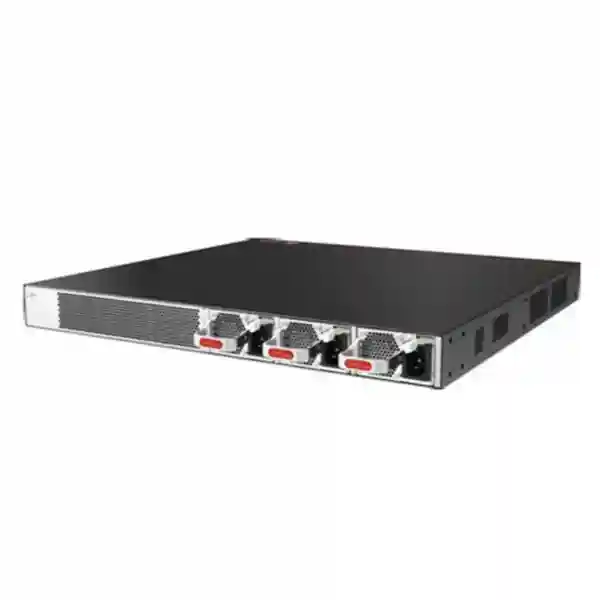
| Power architecture | Three power-module positions with N+1 power backup design |
| Chassis | 1U; published chassis dimensions approximately 442 × 420 × 43.6 mm |
| Routing families | Static, RIP/RIPng, OSPF/OSPFv3, IS-IS/IS-ISv6, BGP/BGP4+, ECMP, VRRP/VRRP6 |
| Operations | Telemetry support with Huawei campus management and assurance workflows |
Final power budget, supported transceivers, software feature availability and version-specific limits should be validated against the exact ordered part number, selected power modules and current Huawei release documentation before deployment.
Why 90 W PoE++ changes access-layer design
A PoE switch should be selected by total available power and endpoint distribution, not just by the number of PoE-capable ports. The S5735-S24U4XE-V2 is specifically differentiated from ordinary PoE+ access switches because its downlink ports can support higher-power PoE++ applications up to 90 W. That gives designers more freedom to support endpoints that exceed the 30 W envelope associated with conventional PoE+ while still keeping data and power on the same structured cabling plant.
Huawei publishes a detailed power-module matrix for this model. As one important reference point, a 1000 W AC module used on 220 V input is listed with 846 W of available PoE power. In that example, the published budget can support all twenty-four ports at 802.3af levels, all twenty-four at 802.3at levels, fourteen ports at 60 W, or nine ports at 90 W when the endpoints are fully loaded at those classes. The exact supported count changes with input voltage, power-module type, redundancy configuration and the real consumption of connected powered devices, so a project bill of materials should always be based on measured or manufacturer-rated endpoint draw rather than maximum port count alone.
This matters in UAE surveillance and wireless projects because endpoints often vary significantly. A fixed dome camera may draw a small fraction of the power needed by a high-zoom PTZ with heater, illuminator or auxiliary accessories. Likewise, an enterprise access point under normal client load may consume far less than its peak specification. The engineering objective is therefore to reserve headroom for simultaneous peaks, startup conditions, future endpoint upgrades and a failed power module if N+1 operation is part of the availability requirement.
PoE sizing method
- List every powered endpoint and its maximum or engineered design draw.
- Separate standard PoE, PoE+ and PoE++ devices rather than using one average value.
- Add startup and environmental headroom where the endpoint vendor recommends it.
- Reserve capacity for growth, spare ports and replacement devices with higher power requirements.
- Model the budget again under the intended N+1 power-failure state.
- Confirm cabling category, patch-panel quality, connector condition and thermal loading for high-power delivery.
Fast and perpetual PoE for service continuity
The S5735-S-V2 family is positioned with Fast PoE and Perpetual PoE capabilities. In operational terms, these features are intended to reduce the dependence of connected powered devices on the full switch software boot cycle. For services such as IP surveillance, access control and wireless connectivity, this can be more meaningful than a simple maximum-watt figure. A powered device that remains energized or receives power earlier during a switch restart can recover service faster than one that must wait for the complete control plane to initialize before power is restored.
Perpetual PoE is especially relevant to planned maintenance. Network teams sometimes need to reboot a switch after an upgrade or operational change while trying to avoid unnecessary restarts of cameras, phones, sensors or access points. Keeping power behavior stable can reduce endpoint reinitialization, lower disruption to edge systems and avoid the long reconvergence sequence that may occur when hundreds of clients reconnect through wireless APs at the same time. The feature should still be validated against the selected software release, power configuration and specific powered-device behavior, because overall service continuity also depends on uplink redundancy, authentication infrastructure and upstream network state.
For a UAE building network, this gives designers another availability layer beyond redundant power. N+1 power modules reduce the risk that one PSU failure removes switch power; Fast/Perpetual PoE can help reduce the endpoint impact of certain switch restart events; link aggregation, VRRP, stacking and redundant upstream architecture can then address network-path continuity. A complete resilient design uses all of these mechanisms together rather than relying on any single feature.
10GE uplinks: capacity planning beyond the access-port count
Four 10GE SFP+ uplinks give the S5735-S24U4XE-V2 significantly more aggregation flexibility than an access switch limited to Gigabit uplinks. The correct design, however, is not automatically to populate every uplink. Uplink selection should follow traffic patterns, redundancy objectives, fiber plant, upstream interface availability and whether the switch will operate as an individual device or as part of a stack.
In a typical enterprise wiring closet, two 10GE links may be grouped through link aggregation toward a distribution pair, leaving additional 10GE interfaces for secondary paths, special service networks or future expansion. In a surveillance-heavy environment, uplink calculations should consider the sustained aggregate bitrate of all cameras plus recording overhead, viewing traffic and management traffic. In a wireless deployment, the designer should consider not only AP backhaul but also internet breakout, east-west application traffic, roaming behavior and peak concurrency. Although each access port is Gigabit Ethernet, many simultaneous flows can still drive substantial aggregate demand toward the core.
Optics must be selected as part of the system rather than as an afterthought. Fiber type, link distance, patching, connector type, attenuation budget, upstream transceiver compatibility and required diagnostic support all affect the bill of materials. Short-range multimode links inside a building and longer single-mode links across a campus may require different transceiver families. Where copper direct-attach options are used in compatible short-reach scenarios, rack layout and cable handling become important. FourTeck can align the switch, optics and structured-cabling approach with the wider UAE network design through FourTeck UAE.
The most useful design question is therefore not “does it have 10GE?” but “what failure and load model should those four 10GE interfaces satisfy?” A well-planned access switch should continue to provide acceptable service during a single uplink failure, an upstream maintenance event or a future increase in endpoint traffic. That requirement determines how many optics are needed, how links are grouped, where they terminate and whether diverse fiber paths are justified.
Dedicated 12GE stacking and operational scale
The two dedicated 12GE stack ports are an important architectural detail because they preserve the four 10GE SFP+ interfaces for uplink or service use. On access switches without dedicated stacking interfaces, building a stack can consume ports that would otherwise be available to the distribution layer. Huawei’s dedicated stack design separates those functions and helps simplify repeatable wiring-closet templates.
Stacking is useful when an access block needs more than twenty-four copper ports but the operations team prefers to manage the devices as a coordinated system. It can simplify configuration consistency, reduce the number of independent management targets and create additional options for distributing uplinks across different physical members. The exact topology, supported member count, stack bandwidth behavior, software prerequisites and upgrade process should be confirmed against the deployed software release because stack design is as much an operational decision as a cabling decision.
For availability, the physical arrangement matters. Power feeds should be distributed appropriately, stack links should avoid single-cable dependency where the supported topology permits a resilient ring, and uplinks should be spread across members so one chassis event does not remove all upstream connectivity. PoE endpoints that are critical to security or building operations should also be distributed across members rather than concentrated on one unit. This turns stacking from a convenience feature into part of the resilience model.
From a change-management perspective, standardized stack templates can also reduce deployment errors across multiple UAE branches. VLANs, access policies, routing adjacencies, management settings and monitoring can follow a predictable pattern, while each site can vary only where local addressing, uplink media or endpoint density requires it. That consistency is valuable for organizations operating retail outlets, clinics, schools, offices, warehouses or hospitality properties under one central network team.
Layer 2 segmentation for data, voice, cameras and building systems
Huawei lists support for up to 4094 VLANs in the S5735-S-V2 feature set, along with voice VLAN, MUX VLAN and VLAN assignment based on parameters such as MAC address, protocol, IP subnet, policy and port. In enterprise access networks, this provides the segmentation tools needed to keep user devices, IP phones, wireless management, guest services, surveillance, access-control systems and facilities technology in separate logical domains even when they share the same physical switch.
Segmentation should be designed around security and operational ownership, not simply around endpoint type. A camera VLAN may need controlled access only to recording servers, NTP, DNS and management systems. A voice VLAN may need QoS treatment and access to call-control services while being blocked from general server networks. Building-management devices may require tightly restricted paths because many embedded systems are maintained by third parties or use long software lifecycles. Guest wireless traffic may need isolation and direct internet breakout without access to corporate resources.
The S5735-S24U4XE-V2 can enforce this structure at the access edge, but inter-VLAN security should be coordinated with firewalls and upstream policy controls. For organizations integrating campus switching with perimeter or internal segmentation firewalls, Firewall Dubai can be used as a related FourTeck resource for security-focused design and sourcing.
Layer 3 routing at the access or aggregation boundary
The S5735-S-V2 platform supports a broad Layer 3 feature set including static routing, RIPv1/v2, RIPng, OSPF, OSPFv3, ECMP, IS-IS, IS-ISv6, BGP, BGP4+, VRRP and VRRP6. This does not mean every network should push dynamic routing to the access layer, but it gives architects freedom to choose routed-access, traditional Layer 2 access, or mixed designs according to scale and operational maturity.
A conventional campus may keep VLAN gateways on distribution switches or firewalls, with the S5735-S24U4XE-V2 providing Layer 2 access and redundant trunks upstream. A routed-access design may instead terminate subnets closer to the edge and use OSPF or another supported protocol toward the distribution layer. Routed access can reduce spanning-tree scope and create clearer failure domains, but it also changes how mobility, first-hop redundancy, security inspection and troubleshooting work. The right choice depends on organization size, staff skills, application dependencies and the amount of Layer 2 adjacency actually required.
VRRP and VRRP6 can provide first-hop redundancy where multiple Layer 3 devices share gateway responsibilities. ECMP can distribute traffic across equal-cost paths when the topology and routing design support it. BFD can improve failure detection for supported protocol relationships. These mechanisms are valuable only when timers and failure domains are engineered consistently across the network; overly aggressive timers can create instability, while overly slow detection can extend outages.
For branch and campus projects, routing design should also account for WAN architecture. If branches use SD-WAN, MPLS, internet VPN or dual-carrier connectivity, the access switch’s Layer 3 role must be coordinated with the edge router or firewall. The switch can provide local routing and segmentation, but WAN path selection and security policy usually belong to the dedicated edge platform. The result should be a clear demarcation of responsibility between access, core, firewall and WAN systems.
Access security: identity, binding and edge protection
An enterprise access switch is a policy enforcement point because almost every endpoint enters the network through it. Huawei’s S5735-S-V2 security feature set includes IEEE 802.1X authentication, portal authentication, AAA, RADIUS, HWTACACS, NAC integration, port security, sticky MAC, blackhole MAC entries, limits on learned MAC addresses, IP/MAC/interface/VLAN binding, DHCP snooping, CPU defense, blacklists and whitelists. Together, these functions support a layered approach where identity, location and device behavior can influence access.
802.1X is the preferred foundation where endpoints and authentication infrastructure support it. It allows network access to be granted based on authenticated user or device identity rather than assuming that physical connection equals trust. Policy can then place users into appropriate VLANs or apply differentiated access controls. For equipment that cannot perform 802.1X, MAC-based mechanisms and controlled exceptions can be used, but those exceptions should be monitored because a MAC address is easier to imitate than a cryptographic credential.
DHCP snooping is particularly important on shared access networks. By distinguishing trusted and untrusted DHCP directions and building binding information, it helps reduce the risk posed by unauthorized DHCP servers and certain address-spoofing behaviors. IP/MAC/interface/VLAN bindings can further tie expected endpoint identity to physical attachment. Port isolation can restrict peer-to-peer communication among devices that need common upstream services but should not talk directly to each other.
Management-plane security is equally important. SSH v2 and HTTPS should be preferred over insecure legacy administration methods, while AAA should centralize administrator authentication where possible. HWTACACS or RADIUS can support centralized identity and command-accountability policies depending on the management environment. Management interfaces should live in dedicated subnets, and administrative access should be filtered to approved jump hosts or network-management systems.
These switch controls complement rather than replace dedicated firewalls, endpoint protection and identity platforms. A secure campus design places enforcement as close as practical to the source while still maintaining centralized policy and logging. For deployment assistance covering switch hardening, VLAN design, AAA integration and operations, organizations can reference FourTeck IT Services UAE.
QoS for voice, video, wireless and business applications
The S5735-S-V2 feature set includes eight queues on each interface, rate limiting, interface traffic policing, two-rate three-color CAR, packet redirection, traffic shaping, DSCP and 802.1p remarking, and DRR, SP and combined DRR+SP scheduling. These capabilities are important when a single access switch carries real-time voice, surveillance video, interactive business applications, internet traffic and background transfers at the same time.
QoS should begin with classification and trust boundaries. An IP phone or managed wireless access point may mark traffic correctly, while an unmanaged endpoint should not necessarily be allowed to assign itself the highest priority. The switch can classify traffic by Layer 2 to Layer 4 fields and then re-mark, police or queue it according to policy. Strict-priority treatment is appropriate for carefully bounded real-time traffic, but allocating too much traffic to a strict-priority queue can starve other classes. Weighted or deficit scheduling should therefore be used to maintain fairness among remaining services.
Surveillance traffic is often misunderstood in QoS design. A large camera estate may generate predictable high-bandwidth streams, but that does not automatically mean every video packet should receive top priority. Voice and network-control traffic usually need lower latency and jitter. Camera traffic may instead require assured bandwidth without monopolizing the uplink. Wireless backhaul can carry multiple application classes and should preserve useful markings from authenticated users while controlling guest or bulk traffic.
The best QoS design is end-to-end. Markings established at the access edge must be recognized consistently by distribution switches, firewalls, WAN routers and service-provider networks where applicable. If one hop ignores or rewrites priorities unexpectedly, the intended policy may fail under congestion. Before deployment, FourTeck engineers can map application classes, expected peak loads and WAN behavior into a consistent campus policy rather than configuring queues independently on each device.
Multicast for video distribution and conferencing
Huawei lists support across the S5735-S-V2 family for multicast technologies including IGMP snooping and Layer 3 multicast protocols such as PIM-SM, PIM-DM and PIM-SSM. This is relevant for campuses carrying IPTV, digital signage feeds, conferencing distribution or other one-to-many video services. Without appropriate multicast control, a stream intended for a small set of receivers can be flooded more broadly through the Layer 2 domain, consuming bandwidth on ports that do not need the content.
IGMP snooping allows the switch to observe receiver membership and constrain multicast forwarding to interested interfaces. Where the switch participates in routed multicast, PIM variants can help build distribution trees across Layer 3 boundaries. The selected mode should reflect the application and upstream network. Source-specific multicast can simplify some controlled environments, while sparse-mode designs are common where receivers are distributed and multicast sources are relatively limited.
Multicast planning should include querier placement, VLAN boundaries, source discovery, receiver behavior and interaction with wireless systems. Some applications use multicast only for discovery while carrying media in unicast; others rely heavily on multicast transport. Capturing the real application pattern during design prevents overengineering and helps avoid issues that appear only when endpoints scale up.
IPv6 readiness without forcing an immediate migration
The platform supports mature IPv6 functions including IPv6 routing protocols, neighbor discovery, path MTU behavior and IPv6 operational tools. For organizations that currently run predominantly IPv4 networks, that capability provides a migration path without requiring the access layer to be replaced later solely because IPv6 becomes mandatory for a new service, cloud integration, security standard or organizational policy.
Dual-stack design should be treated as a security project, not just an addressing project. If IPv6 is enabled but not monitored, endpoints may communicate over a path that receives less policy attention than IPv4. ACLs, routing controls, logging, DNS, identity systems and firewalls should be aligned across both protocol families. The Huawei feature set includes IPv6 ACL capabilities and IPv6 routing options, allowing policy architecture to evolve with the addressing plan.
Organizations with long equipment lifecycles benefit from selecting access switches that can support both protocol families even when the initial deployment is IPv4-only. The decision reduces the risk of future redesign at the physical access layer and helps keep migration work focused on addressing, policy and application compatibility rather than switch replacement.
Telemetry and intelligent campus operations
Huawei positions telemetry as a key operational capability of the CloudEngine S5735-S-V2 family. Instead of relying only on periodic polling, telemetry can provide a more continuous stream of device and network information for supported management and assurance systems. When integrated with Huawei campus operations platforms such as iMaster NCE-CampusInsight in an appropriate architecture, this data can help identify faults and performance anomalies more quickly than manual CLI investigation alone.
For a network operations team, the value is not the telemetry protocol by itself but the workflow built around it. Interface errors, congestion, endpoint behavior, topology changes and resource conditions need to become actionable events. Alerts should be correlated with user impact, service importance and maintenance history rather than generating a flood of low-priority notifications. A well-designed management system also preserves time-series data so intermittent issues can be investigated after the event.
In multi-site UAE environments, consistent monitoring is particularly useful because a central IT team may not have engineering staff in every branch. Standardized access switches can expose similar counters and event types across sites, making remote troubleshooting easier. This is also where accurate documentation matters: switch names, stack-member identification, uplink descriptions, patch-panel references and endpoint labeling should match the monitoring platform so an alert leads quickly to the correct physical location.
Telemetry does not remove the need for SNMP, syslog, configuration backup, AAA logging or change management. Instead, it becomes one layer in a broader observability model. Organizations should decide which platform is the source of truth for inventory, which system collects events, where configurations are backed up, how changes are approved and how long logs are retained. That operational design can be more valuable over the switch lifecycle than any single command-line feature.
Power-module architecture and N+1 resilience
The S5735-S24U4XE-V2 uses a three-power-module architecture with N+1 backup capability. This is particularly important for a high-power PoE switch because the power system serves two loads at once: the switch electronics and the powered endpoints. A design that appears adequate under normal conditions can become underpowered after one module fails if the remaining capacity is not sufficient for both the chassis and the connected PoE load.
N+1 engineering therefore starts with the failure state. The project should determine how much PoE power must remain available after the loss of one module, whether all endpoints are equally critical, and whether noncritical devices may be shed to preserve higher-priority loads. Cameras covering emergency exits, access-control devices, wireless APs serving operational areas and ordinary desk phones may not all have the same business impact. Power prioritization can be aligned with that hierarchy where supported.
The upstream electrical design also matters. Installing multiple switch power modules but connecting every feed to the same unprotected circuit creates less resilience than it appears. Critical installations should evaluate independent PDUs, UPS capacity, circuit diversity, generator-backed power and rack-level electrical loading. In dense PoE deployments, heat generated by both the switch and cabling environment should be considered in the rack and room cooling plan.
When requesting a quotation, specify whether the required supply is AC or DC, the desired N+1 behavior, the total PoE budget, the expected mains environment and any UPS constraints. The switch is commonly supplied as a chassis that requires the correct power-module selection; ordering only the base unit without matching power components can delay deployment. A complete FourTeck bill of materials should therefore treat switch chassis, power modules, power cords, optics, stacking accessories and support coverage as one engineered system.
Physical deployment in UAE racks and wiring closets
With an approximately 442 mm wide, 420 mm deep and 43.6 mm high chassis, the S5735-S24U4XE-V2 occupies 1U but is deeper than compact desktop-class access switches. Rack selection must therefore allow comfortable clearance for the chassis, power modules, rear airflow, cable bend radius and service access. A shallow wall cabinet may be unsuitable even if its nominal width is 19 inches.
The cabling plan should separate power and data neatly, maintain correct fiber bend radius and keep stack cables protected from accidental disturbance. Copper patch cords carrying high PoE loads should be high quality and correctly terminated. Where many high-power endpoints run through large bundles, designers should consider the thermal behavior of the structured cabling system and follow the cabling manufacturer’s installation guidance for bundle size, conductor gauge and environmental temperature.
Environmental conditions in UAE sites can vary dramatically. A modern data room in Dubai may maintain stable temperature and filtration, while a warehouse, guard room, retail back office or remote facility may experience higher ambient temperature, dust or inconsistent cooling. The switch should be installed within Huawei’s environmental specifications, and the room should provide clean airflow, grounding and appropriate power protection. Locating an enterprise PoE switch above a heat-producing UPS or in a sealed unventilated cabinet can reduce reliability regardless of the switch’s feature set.
Patch-panel documentation should also be part of commissioning. Each switch port should map to a room outlet or endpoint, and critical PoE devices should have clear names. When a camera or AP fails months later, accurate port descriptions and patching records can save more troubleshooting time than any single monitoring feature.
Deployment scenarios for the S5735-S24U4XE-V2
Wi-Fi access layer
Use the Gigabit PoE++ ports for enterprise APs whose peak power requirement exceeds ordinary PoE+, while aggregating traffic over 10GE SFP+ links. For APs that support multi-gigabit Ethernet, remember that this model’s copper access ports are Gigabit, so the AP may be power-compatible but throughput-limited to 1 Gbit/s at the wired edge. That distinction should be checked before standardizing on the switch for high-throughput Wi-Fi generations.
IP surveillance
Power standard cameras, high-draw PTZ devices and related edge equipment while segmenting video traffic into dedicated VLANs. Use 10GE uplinks when aggregate camera bitrate or recording architecture requires more than a single Gigabit path, and size PoE for worst-case camera power rather than average draw.
Hospitality and education
Consolidate phones, APs, cameras, classroom devices, signage and building systems onto a common access platform with separate VLANs and policies. Stacking can simplify larger floor or building deployments while dedicated 10GE uplinks maintain connectivity to distribution switches.
Office and branch networks
Use mature Layer 2/Layer 3, authentication and QoS features for corporate users, voice and secure edge access. Organizations with multiple branches can standardize a repeatable configuration template and vary only addressing, uplink media and endpoint count per site.
Healthcare environments
Separate clinical, administrative, guest, surveillance and facilities traffic while powering selected edge systems. Where device availability is critical, design N+1 power, redundant uplinks and UPS capacity together rather than relying on the switch alone.
Retail and distributed sites
Connect POS support infrastructure, APs, cameras, phones and IoT systems using standardized security and management policies. Central telemetry, AAA and configuration discipline can reduce the operational cost of maintaining many small sites.
Sizing the switch correctly: port count is only the first step
A twenty-four-port switch may appear straightforward to size, but access-layer design should account for spare capacity, PoE power, uplink bandwidth, rack space, fiber availability and failure domains. A common mistake is to install exactly enough ports for today’s endpoints. This leaves no space for temporary devices, new cameras, additional APs, moves and changes, or troubleshooting. For a new installation, reserve ports according to the expected growth rate and the practical difficulty of adding another switch later.
The second dimension is PoE. Twenty-four PoE++ capable interfaces do not imply that all twenty-four can simultaneously draw 90 W. The total budget depends on the selected power modules and input conditions. Build a spreadsheet of endpoint power values, add contingency and test the N+1 failure case. If the result is close to the available budget, either increase power capacity, distribute endpoints across additional switches or classify which loads may be deprioritized.
The third dimension is uplink utilization. Twenty-four 1GE access ports can theoretically offer 24 Gbit/s of edge connectivity before considering full-duplex direction, while the switch provides four 10GE uplink interfaces. Actual users rarely saturate every port simultaneously, so oversubscription is normal. The appropriate ratio depends on workload. Office browsing and SaaS traffic may tolerate substantial oversubscription, while high-bitrate video ingest, workstation imaging or large local transfers may require more uplink headroom.
The fourth dimension is topology. If a floor needs forty or sixty ports, a stack of multiple switches may be more practical than independent devices, but only if the stack design, power feeds and uplinks are resilient. Critical endpoints can be spread across members. Conversely, a small isolated area may be better served by one standalone unit with redundant uplinks and spare ports.
Finally, lifecycle matters. The switch should be evaluated against the organization’s expected replacement horizon. If future Wi-Fi access points will require 2.5GE or higher wired access, this Gigabit model may not be the ideal long-term choice for those particular ports even though it can supply high PoE power. A mixed architecture can use the S5735-S24U4XE-V2 for cameras, phones and standard Gigabit endpoints while using multi-gigabit models where AP throughput requires it.
Interoperability and migration from mixed-vendor access networks
Huawei documents VBST interoperability with PVST/PVST+/RPVST-style environments and LNP functionality comparable to dynamic trunk negotiation concepts. These capabilities can help when the S5735-S24U4XE-V2 is introduced into an existing campus that is not entirely Huawei. Even so, migration should be planned carefully because spanning-tree behavior, VLAN trunking, link aggregation and proprietary defaults can differ between vendors.
Before connecting a new access switch, document the current root-bridge placement, allowed VLANs, native or untagged VLAN behavior, LACP mode, link speed, MTU, DHCP relay and first-hop gateway location. Explicit configuration is preferable to relying on dynamic negotiation in a production network. During migration, verify MAC learning, spanning-tree state, routing adjacencies and uplink redundancy before moving endpoint blocks.
Authentication systems also need interoperability checks. RADIUS and 802.1X are standards-based, but attribute names, policy logic and downloadable authorization behavior can vary among NAC platforms. A pilot should test corporate devices, phones, printers, cameras and exceptions before a large migration. Logging should be enabled so failed authentication can be distinguished from cabling, DHCP or VLAN problems.
For optics, do not assume every third-party transceiver will behave identically. Use supported Huawei optics or validated alternatives according to the project’s support policy, and match both ends of the fiber link by wavelength, fiber type and distance. Where the upstream switch is another vendor, verify interoperability in advance rather than discovering link issues during a maintenance window.
Management, change control and configuration standards
A technically capable switch still requires disciplined operations. Before production use, define a standard baseline covering hostname format, management VLAN, management IP addressing, AAA, administrator roles, NTP, DNS, syslog, secure management protocols, SNMP or telemetry, configuration backup, spanning-tree settings, interface descriptions, unused-port policy and software version. The baseline should be version controlled so changes can be reviewed and rolled back.
Interface descriptions should include enough information to identify the connected asset or patch-panel position without needing a site visit. Uplink descriptions should show the remote device and port. Stack members should have stable naming and documented physical order. PoE-critical interfaces can include endpoint type and business importance. These small documentation practices reduce mean time to repair when incidents occur.
Software upgrades deserve their own procedure. Review release notes, supported upgrade paths, feature changes, known issues and stack behavior. Back up configurations and, where possible, test the target release on representative hardware before wide deployment. Plan for endpoint power behavior during reboot and confirm whether Fast/Perpetual PoE is configured as expected. Monitor routing, authentication, telemetry and PoE after the upgrade rather than checking only that the switch is reachable.
Organizations that need a wider multi-vendor network and infrastructure partner can also use FourTeck Global as a reference point for broader enterprise technology engagement beyond a single UAE access-switch purchase.
UAE procurement checklist: what should be in the bill of materials
The base switch model is only one line in a complete deployment. Because the S5735-S24U4XE-V2 uses modular power and supports optical uplinks and dedicated stacking, the quotation should reflect the intended architecture. The most common procurement problem is not choosing the wrong switch family; it is omitting a required module, optic, cable or support item and discovering the gap after the equipment arrives on site.
Lead time should be confirmed against the exact part number rather than the family name. Similar Huawei models can differ in PoE class, port type, power arrangement or uplink composition. A quotation should therefore show the complete manufacturer code and description for every item. If the project has a fixed installation date, reserve time for staging, software standardization, optic verification and burn-in rather than scheduling delivery and cutover on the same day.
For multi-site rollouts, consider staging the switches before distribution. A central process can load the approved software release, apply baseline configuration, label the chassis and stack members, record serial numbers, test power modules and verify optics. Sites then receive equipment that is much closer to deployment-ready, reducing the chance of inconsistent configuration across locations.
When this model is the right fit—and when to consider another access switch
Strong fit
Choose the S5735-S24U4XE-V2 when the project needs twenty-four Gigabit copper access ports, high-power PoE++ capability, four 10GE uplinks, dedicated stacking and enterprise Layer 2/Layer 3 features. It is especially attractive for cameras, phones, standard Gigabit APs, signage and building systems where high power can matter even if the data connection remains 1GE.
It also fits environments that value modular power redundancy and want one switch family capable of supporting authentication, routing, QoS, multicast and telemetry rather than deploying unmanaged or lightly managed PoE hardware.
Consider alternatives
Consider a multi-gigabit access model when Wi-Fi APs or workstations need more than 1GE over copper. Consider a 48-port model when rack density and port count justify consolidation. Consider a non-PoE version if the switch will connect only self-powered equipment and PoE budget would provide no value.
For environments needing substantially faster uplinks, larger routing tables, specialized data-center functions or advanced fabric roles, a higher-tier campus or data-center platform may be more appropriate. The correct comparison should be based on traffic, features, lifecycle and operations—not on model numbering alone.
Frequently asked technical questions
Does every copper port support 90 W simultaneously?
No. The interfaces are capable of PoE++ use, but the number of ports that can deliver a given power level at the same time depends on the installed power modules, input voltage and total PoE budget. Huawei’s published 1000 W AC, 220 V example provides 846 W for PoE, which is enough for nine ports at a full 90 W allocation or fourteen at 60 W, while all twenty-four can be supported at lower 802.3af/at levels under that published budget.
Are the four SFP+ ports only for uplinks?
They are typically used as 10GE uplinks toward distribution or core switches, but their role depends on configuration and the supported software design. Dedicated stack ports mean stacking does not need to consume these SFP+ interfaces, which preserves uplink flexibility.
Can it be used as a Layer 3 switch?
Yes. The S5735-S-V2 family supports static routing and dynamic protocols including OSPF, IS-IS and BGP, as well as VRRP and IPv6 variants. The design should still determine whether routing belongs at access, distribution or firewall layers.
Is it suitable for Wi-Fi 6/6E/7 access points?
It can power many high-demand APs, but the copper downlink is Gigabit Ethernet. If an AP requires 2.5GE, 5GE or 10GE wired throughput to realize its full capacity, choose a multi-gigabit access-switch model for those ports. Power compatibility and data-rate compatibility must be evaluated separately.
Does it support secure user authentication?
The platform supports 802.1X, portal authentication, AAA, RADIUS, HWTACACS and NAC-related workflows, together with port security and DHCP snooping. Exact policy integration should be tested with the organization’s identity platform.
What should be ordered with the base unit?
Normally the complete BOM should address power modules, power cords, 10GE optics, fiber patching, stack accessories where stacking is required, rack installation requirements and support coverage. The exact items depend on the topology and PoE budget.
Decision recap for UAE network teams
The Huawei CloudEngine S5735-S24U4XE-V2 is best understood as a power-dense enterprise access switch rather than simply a 24-port Gigabit device. Its differentiators are the ability to support 90 W PoE++ endpoints, four 10GE SFP+ uplinks, two dedicated 12GE stacking interfaces, modular N+1 power design and a software stack that includes substantial Layer 2, Layer 3, security, QoS, multicast and telemetry capabilities. Those features make it suitable for wiring closets where endpoint power and service continuity are important and where the access layer is expected to participate in enterprise policy rather than only forward frames.
For many UAE projects, the strongest use case is a mixed edge: cameras, phones, APs, building systems and user devices connected to one standardized access platform. The model can simplify those environments because high-power devices do not require separate midspan injectors, while the 10GE uplinks create sufficient aggregation options for typical twenty-four-port access blocks. Dedicated stack ports preserve those uplinks when multiple units are combined.
The main design caveat is equally important: the downlink data rate is 1GE. A high-power AP may be fully supported electrically while still being limited by a Gigabit wired interface. For Wi-Fi designs where 2.5GE or higher is part of the performance target, use a multi-gigabit access switch for those ports. Similarly, PoE++ capability does not mean unlimited power. Total budget and N+1 failure-state capacity must be calculated using the selected power modules.
If those constraints align with the endpoint mix, the S5735-S24U4XE-V2 offers a strong balance of power density, uplink capacity, reliability and enterprise network services in a 1U form factor. The procurement decision should then focus on the exact PSU combination, optics, stack design, software/support requirements and rollout method rather than debating the switch family in isolation.
Quotation input checklist
To produce an accurate UAE quotation and avoid missing accessories, provide the following information with the request. It is not necessary to know every answer in advance; even partial data helps distinguish a simple chassis request from a complete deployment BOM.
For a wider UAE enterprise infrastructure quotation, the FourTeck UAE team can align switch hardware with optics, cabling, firewall, wireless, server and implementation requirements as one coordinated bill of materials.
Structured consultation panel
For a production deployment, FourTeck can structure the consultation around three engineering questions: how much powered-device capacity is required today and after growth; how the switch should remain connected and powered during a component failure; and how VLAN, routing, security and management should integrate with the rest of the network. Answering those questions produces a more reliable design than selecting accessories after the chassis is purchased.
A typical engagement can cover switch and PSU sizing, 10GE optic selection, stack topology, VLAN/IP planning, access security, uplink LACP, routing protocol choice, PoE prioritization, configuration baseline, telemetry/syslog integration and staged rollout. Where the project includes firewalling, wireless, structured cabling or servers, those dependencies should be reviewed at the same time so interface assumptions are verified before procurement.
The objective is a deployable BOM and configuration approach matched to the site rather than a generic list of parts. This is particularly important for high-PoE projects, where power-module choices and endpoint distribution directly affect resilience.

Reviews
There are no reviews yet.